

ASTM D5262-21
(Test Method)Standard Test Method for Determining the Unconfined Tension Creep and Creep Rupture Behavior of Planar Geosynthetics Used for Reinforcement Purposes
General Information
- Abstract
SIGNIFICANCE AND USE
5.1 This test method is developed for use in the determination of anticipated total elongation over time or time to rupture that may occur in geosynthetics under sustained loading conditions.
5.1.1 The test data can be used in conjunction with interpretive methods to determine creep strain potential at design loads.
5.1.2 The test data can be used in conjunction with interpretive methods to determine creep rupture potential at various loads.
5.2 This test method is not intended for routine acceptance testing of geosynthetics. This test method should be used to characterize geosynthetics intended for use in reinforcement applications in which creep or creep rupture is of concern. The plane strain or rupture condition imposed during testing must be considered when using the test results for design.
5.3 The basic distinctions between this test method and other test methods for measuring tension creep and creep rupture behavior are: (1) the width of the specimens (Section 8), and (2) the measurement of total elongation over time or time to rupture from the moment of specimen loading. The greater widths of the specimens specified in this test method minimize the contraction edge effect (necking) that occurs in many geosynthetic materials and provides a closer relationship to actual material behavior in plane strain tension conditions.
5.4 The creep or stress rupture of a given geosynthetic is likely to be reduced in soil because of confining stresses and load transfer to the soil. The unconfined environment represents a controlled test in which the results are conservative with regard to the behavior of the material in service. Confined or in-soil testing may model the field behavior of the geosynthetic more accurately.
SCOPE
1.1 This test method is intended for use in determining the unconfined tension creep and creep rupture behavior of geosynthetics at constant temperature when subjected to a sustained tensile loading. This test method is applicable to all geosynthetics.
1.2 The test method measures total elongation of the geosynthetic test specimen, from the time of loading, while being maintained at a constant temperature. It includes procedures for measuring the tension creep and creep rupture behavior at constant temperature of conditioned unconfined geosynthetics as well as directions for calculating tension forces to plot creep and creep rupture curves.
1.3 The values stated in SI units are to be regarded as the standard. The values given in parentheses are for information only.
1.4 This standard does not purport to address all of the safety concerns, if any, associated with its use. It is the responsibility of the user of this standard to establish appropriate safety, health, and environmental practices and determine the applicability of regulatory limitations prior to use.
1.5 This international standard was developed in accordance with internationally recognized principles on standardization established in the Decision on Principles for the Development of International Standards, Guides and Recommendations issued by the World Trade Organization Technical Barriers to Trade (TBT) Committee.
- Status
- Published
- Publication Date
- 14-Feb-2021
- Technical Committee
- D35 - Geosynthetics
- Drafting Committee
- D35.02 - Endurance Properties
Buy Documents
ASTM D5262-21 - Standard Test Method for Determining the Unconfined Tension Creep and Creep Rupture Behavior of Planar Geosynthetics Used for Reinforcement Purposes
REDLINE ASTM D5262-21 - Standard Test Method for Determining the Unconfined Tension Creep and Creep Rupture Behavior of Planar Geosynthetics Used for Reinforcement Purposes
Overview
ASTM D5262-21 is a widely recognized standard developed by ASTM International for assessing the long-term unconfined tension creep and creep rupture behavior of planar geosynthetics utilized in reinforcement applications. This test method provides essential data on how geosynthetics perform under sustained tensile loading over time, supporting the effective design and durability assessment of soil reinforcement solutions. It is relevant for all geosynthetic products, including geotextiles, geogrids, and geomembranes, and is conducted at constant temperature to ensure consistent results.
Key Topics
Purpose & Significance
- Determines anticipated total elongation or time to rupture for geosynthetics under prolonged loading.
- Provides key data for evaluating creep strain and rupture potential, guiding design loads and service life calculations.
Test Methodology
- Measures the total elongation of geosynthetic test specimens from initial loading, maintaining controlled temperature and humidity.
- Utilizes wide-width test specimens to minimize edge effects (necking), providing results closer to field performance in plane strain conditions.
Scope & Applicability
- Applicable to all geosynthetics intended for reinforcement purposes where creep or creep rupture is a design concern.
- Not intended for routine acceptance testing but for material characterization in critical engineering applications.
Practical Distinctions
- The use of wider specimens and direct measurement from the moment of loading differentiate this method from other tension creep tests, improving the reliability of measured material behavior.
Applications
The results of ASTM D5262-21 testing are critical in multiple engineering and construction sectors where the long-term performance of geosynthetics is crucial:
- Soil Reinforcement:
- Used in design of embankments, retaining walls, and reinforced slopes where geosynthetics provide essential structural support.
- Roadway and Railway Construction:
- Assesses geosynthetics incorporated in base stabilization and subgrade improvement to predict performance over decades.
- Landfill and Environmental Containment:
- Supports the design of geomembrane and geotextile liners, important for preventing failure due to long-term creep or rupture.
- Bridge Abutments and Foundations:
- Evaluates reinforcement materials contributing to the overall durability and service life of critical infrastructure.
By quantifying properties such as tension creep and creep rupture behavior, designers can select materials that are best suited for the expected loading and environmental conditions, ensuring safety, reliability, and compliance with engineering specifications.
Related Standards
For a comprehensive geosynthetic testing program, ASTM D5262-21 is commonly used alongside several related standards:
- ASTM D4595 - Test Method for Tensile Properties of Geotextiles by the Wide-Width Strip Method.
- ASTM D6637/D6637M - Test Method for Determining Tensile Properties of Geogrids.
- ASTM D4354 - Practice for Sampling of Geosynthetics and Rolled Erosion Control Products.
- ASTM D4491 - Test Methods for Water Permeability of Geotextiles.
- ISO/TR 20432 - Guidelines for the Determination of the Long-Term Strength of Geosynthetics for Soil Reinforcement.
Together, these standards help ensure that geosynthetics used in construction and reinforcement are thoroughly evaluated for performance, durability, and suitability in various engineering applications.
Keywords: ASTM D5262-21, geosynthetics testing, tension creep, creep rupture, reinforcement, geotextiles, geogrids, geomembranes, soil stabilization, long-term durability, infrastructure design, civil engineering standards.
Relations
- Effective Date
- 01-Feb-2024
- Effective Date
- 15-Nov-2023
- Effective Date
- 01-May-2020
- Effective Date
- 01-Feb-2020
- Effective Date
- 15-Apr-2018
- Effective Date
- 01-Aug-2017
- Effective Date
- 01-Mar-2017
- Effective Date
- 01-Mar-2017
- Effective Date
- 01-Jan-2016
- Effective Date
- 15-Sep-2015
- Effective Date
- 01-Sep-2015
- Effective Date
- 01-Sep-2015
- Effective Date
- 15-Jul-2015
- Effective Date
- 01-Jul-2015
- Effective Date
- 01-Apr-2015
Buy Documents
ASTM D5262-21 - Standard Test Method for Determining the Unconfined Tension Creep and Creep Rupture Behavior of Planar Geosynthetics Used for Reinforcement Purposes
REDLINE ASTM D5262-21 - Standard Test Method for Determining the Unconfined Tension Creep and Creep Rupture Behavior of Planar Geosynthetics Used for Reinforcement Purposes
Get Certified
Connect with accredited certification bodies for this standard

Control Union Certifications
Global certification for agriculture and sustainability.

Hohenstein Institut
Textile testing and certification.

Bureau Veritas Bangladesh
Bureau Veritas certification services in Bangladesh.
Sponsored listings
Frequently Asked Questions
ASTM D5262-21 is a standard published by ASTM International. Its full title is "Standard Test Method for Determining the Unconfined Tension Creep and Creep Rupture Behavior of Planar Geosynthetics Used for Reinforcement Purposes". This standard covers: SIGNIFICANCE AND USE 5.1 This test method is developed for use in the determination of anticipated total elongation over time or time to rupture that may occur in geosynthetics under sustained loading conditions. 5.1.1 The test data can be used in conjunction with interpretive methods to determine creep strain potential at design loads. 5.1.2 The test data can be used in conjunction with interpretive methods to determine creep rupture potential at various loads. 5.2 This test method is not intended for routine acceptance testing of geosynthetics. This test method should be used to characterize geosynthetics intended for use in reinforcement applications in which creep or creep rupture is of concern. The plane strain or rupture condition imposed during testing must be considered when using the test results for design. 5.3 The basic distinctions between this test method and other test methods for measuring tension creep and creep rupture behavior are: (1) the width of the specimens (Section 8), and (2) the measurement of total elongation over time or time to rupture from the moment of specimen loading. The greater widths of the specimens specified in this test method minimize the contraction edge effect (necking) that occurs in many geosynthetic materials and provides a closer relationship to actual material behavior in plane strain tension conditions. 5.4 The creep or stress rupture of a given geosynthetic is likely to be reduced in soil because of confining stresses and load transfer to the soil. The unconfined environment represents a controlled test in which the results are conservative with regard to the behavior of the material in service. Confined or in-soil testing may model the field behavior of the geosynthetic more accurately. SCOPE 1.1 This test method is intended for use in determining the unconfined tension creep and creep rupture behavior of geosynthetics at constant temperature when subjected to a sustained tensile loading. This test method is applicable to all geosynthetics. 1.2 The test method measures total elongation of the geosynthetic test specimen, from the time of loading, while being maintained at a constant temperature. It includes procedures for measuring the tension creep and creep rupture behavior at constant temperature of conditioned unconfined geosynthetics as well as directions for calculating tension forces to plot creep and creep rupture curves. 1.3 The values stated in SI units are to be regarded as the standard. The values given in parentheses are for information only. 1.4 This standard does not purport to address all of the safety concerns, if any, associated with its use. It is the responsibility of the user of this standard to establish appropriate safety, health, and environmental practices and determine the applicability of regulatory limitations prior to use. 1.5 This international standard was developed in accordance with internationally recognized principles on standardization established in the Decision on Principles for the Development of International Standards, Guides and Recommendations issued by the World Trade Organization Technical Barriers to Trade (TBT) Committee.
SIGNIFICANCE AND USE 5.1 This test method is developed for use in the determination of anticipated total elongation over time or time to rupture that may occur in geosynthetics under sustained loading conditions. 5.1.1 The test data can be used in conjunction with interpretive methods to determine creep strain potential at design loads. 5.1.2 The test data can be used in conjunction with interpretive methods to determine creep rupture potential at various loads. 5.2 This test method is not intended for routine acceptance testing of geosynthetics. This test method should be used to characterize geosynthetics intended for use in reinforcement applications in which creep or creep rupture is of concern. The plane strain or rupture condition imposed during testing must be considered when using the test results for design. 5.3 The basic distinctions between this test method and other test methods for measuring tension creep and creep rupture behavior are: (1) the width of the specimens (Section 8), and (2) the measurement of total elongation over time or time to rupture from the moment of specimen loading. The greater widths of the specimens specified in this test method minimize the contraction edge effect (necking) that occurs in many geosynthetic materials and provides a closer relationship to actual material behavior in plane strain tension conditions. 5.4 The creep or stress rupture of a given geosynthetic is likely to be reduced in soil because of confining stresses and load transfer to the soil. The unconfined environment represents a controlled test in which the results are conservative with regard to the behavior of the material in service. Confined or in-soil testing may model the field behavior of the geosynthetic more accurately. SCOPE 1.1 This test method is intended for use in determining the unconfined tension creep and creep rupture behavior of geosynthetics at constant temperature when subjected to a sustained tensile loading. This test method is applicable to all geosynthetics. 1.2 The test method measures total elongation of the geosynthetic test specimen, from the time of loading, while being maintained at a constant temperature. It includes procedures for measuring the tension creep and creep rupture behavior at constant temperature of conditioned unconfined geosynthetics as well as directions for calculating tension forces to plot creep and creep rupture curves. 1.3 The values stated in SI units are to be regarded as the standard. The values given in parentheses are for information only. 1.4 This standard does not purport to address all of the safety concerns, if any, associated with its use. It is the responsibility of the user of this standard to establish appropriate safety, health, and environmental practices and determine the applicability of regulatory limitations prior to use. 1.5 This international standard was developed in accordance with internationally recognized principles on standardization established in the Decision on Principles for the Development of International Standards, Guides and Recommendations issued by the World Trade Organization Technical Barriers to Trade (TBT) Committee.
ASTM D5262-21 is classified under the following ICS (International Classification for Standards) categories: 59.080.70 - Geotextiles. The ICS classification helps identify the subject area and facilitates finding related standards.
ASTM D5262-21 has the following relationships with other standards: It is inter standard links to ASTM D4439-24, ASTM D6637/D6637M-15(2023), ASTM D4354-12(2020), ASTM D1776/D1776M-20, ASTM D4439-18, ASTM D4439-17, ASTM D2990-17, ASTM D123-17, ASTM D1776/D1776M-16, ASTM D123-15b, ASTM D4439-15a, ASTM D123-15a, ASTM D6637/D6637M-15, ASTM D4439-15, ASTM D123-15. Understanding these relationships helps ensure you are using the most current and applicable version of the standard.
ASTM D5262-21 is available in PDF format for immediate download after purchase. The document can be added to your cart and obtained through the secure checkout process. Digital delivery ensures instant access to the complete standard document.
Standards Content (Sample)
This international standard was developed in accordance with internationally recognized principles on standardization established in the Decision on Principles for the
Development of International Standards, Guides and Recommendations issued by the World Trade Organization Technical Barriers to Trade (TBT) Committee.
Designation:D5262 −21
Standard Test Method for
Determining the Unconfined Tension Creep and Creep
Rupture Behavior of Planar Geosynthetics Used for
Reinforcement Purposes
This standard is issued under the fixed designation D5262; the number immediately following the designation indicates the year of
original adoption or, in the case of revision, the year of last revision.Anumber in parentheses indicates the year of last reapproval.A
superscript epsilon (´) indicates an editorial change since the last revision or reapproval.
1. Scope D1776/D1776MPractice for Conditioning and Testing Tex-
tiles
1.1 This test method is intended for use in determining the
D2990Test Methods forTensile, Compressive, and Flexural
unconfined tension creep and creep rupture behavior of geo-
Creep and Creep-Rupture of Plastics
synthetics at constant temperature when subjected to a sus-
D4354Practice for Sampling of Geosynthetics and Rolled
tained tensile loading. This test method is applicable to all
Erosion Control Products (RECPs) for Testing
geosynthetics.
D4439Terminology for Geosynthetics
1.2 The test method measures total elongation of the geo-
D4595Test Method for Tensile Properties of Geotextiles by
synthetic test specimen, from the time of loading, while being
the Wide-Width Strip Method
maintained at a constant temperature. It includes procedures
D6637/D6637MTest Method for DeterminingTensile Prop-
for measuring the tension creep and creep rupture behavior at
erties of Geogrids by the Single or Multi-Rib Tensile
constant temperature of conditioned unconfined geosynthetics
Method
aswellasdirectionsforcalculatingtensionforcestoplotcreep
E6Terminology Relating to Methods of MechanicalTesting
and creep rupture curves. 3
2.2 ISO Standard:
1.3 The values stated in SI units are to be regarded as the ISO/TR 20432Guidelines for the Determination of the
standard. The values given in parentheses are for information Long-Term Strength of Geosynthetics for Soil Reinforce-
only. ment
1.4 This standard does not purport to address all of the
3. Terminology
safety concerns, if any, associated with its use. It is the
3.1 For definitions of many terms used in this test method,
responsibility of the user of this standard to establish appro-
refer to Terminologies D123, D4439, and E6.
priate safety, health, and environmental practices and deter-
mine the applicability of regulatory limitations prior to use.
4. Summary of Test Method
1.5 This international standard was developed in accor-
dance with internationally recognized principles on standard- 4.1 The tension creep and creep rupture behavior of uncon-
ization established in the Decision on Principles for the finedgeosyntheticsismeasuredbyapplyingasustainedloadin
Development of International Standards, Guides and Recom- one step and measuring the total elongation of the test
mendations issued by the World Trade Organization Technical specimen as a function of time while maintaining a specified
Barriers to Trade (TBT) Committee. temperature and humidity.
2. Referenced Documents
5. Significance and Use
2.1 ASTM Standards:
5.1 This test method is developed for use in the determina-
D123Terminology Relating to Textiles
tionofanticipatedtotalelongationovertimeortimetorupture
that may occur in geosynthetics under sustained loading
conditions.
This test method is under the jurisdiction of ASTM Committee D35 on
Geosynthetics and is the direct responsibility of Subcommittee D35.02 on Endur-
5.1.1 The test data can be used in conjunction with inter-
ance Properties.
pretive methods to determine creep strain potential at design
Current edition approved Feb. 15, 2021. Published February 2021. Originally
loads.
approved in 1992. Last previous edition approved in 2016 as D5262–07 (2016).
DOI: 10.1520/D5262-21.
For referenced ASTM standards, visit the ASTM website, www.astm.org, or
contact ASTM Customer Service at service@astm.org. For Annual Book of ASTM Available from International Organization for Standardization (ISO), ISO
Standardsvolumeinformation,refertothestandards’sDocumentSummarypageon Central Secretariat, Chemin de Blandonnet 8, CP 401, 1214 Vernier, Geneva,
the ASTM website. Switzerland, https://www.iso.org.
Copyright © ASTM International, 100 Barr Harbor Drive, PO Box C700, West Conshohocken, PA 19428-2959. United States
D5262−21
5.1.2 The test data can be used in conjunction with inter- weights, weights and fulcrums, hydraulics, or pneumatics.The
pretivemethodstodeterminecreeprupturepotentialatvarious loadingmechanismmustpermitreproduciblyrapidandsmooth
loads. loading, as specified in 11.5. No dynamic forces on placement
of the loads shall be allowed. Provision must also be made to
5.2 This test method is not intended for routine acceptance
ensure that shock loading caused by specimen failure is not
testing of geosynthetics. This test method should be used to
transferred to other specimens undergoing testing. If a non-
characterize geosynthetics intended for use in reinforcement
weight or gravity system is used to apply the load, a backup
applications in which creep or creep rupture is of concern.The
system shall be available to ensure continuity of load applica-
plane strain or rupture condition imposed during testing must
tion.Thetypeofbackupsystemavailableshallbedescribedin
be considered when using the test results for design.
the report.
5.3 The basic distinctions between this test method and
6.3 Extension Measurement—LVDTs or dial gauge exten-
other test methods for measuring tension creep and creep
someters are preferred for the measurement of elongation in
rupture behavior are: (1) the width of the specimens (Section
geosynthetics when testing specimens with short gauge lenths.
8), and (2) the measurement of total elongation over time or
Whenever possible, other means of measuring elongation
time to rupture from the moment of specimen loading. The
should be calibrated against extensometers. In any case, the
greater widths of the specimens specified in this test method
device chosen shall be capable of measuring deformations to
minimize the contraction edge effect (necking) that occurs in
an accuracy of at least 0.1% of the gauge length of the
manygeosyntheticmaterialsandprovidesacloserrelationship
specimen. The means of measuring elongation should be
to actual material behavior in plane strain tension conditions.
indicated clearly in the report.
5.4 The creep or stress rupture of a given geosynthetic is
6.4 Vibration Control—Creep and creep rupture tests are
likely to be reduced in soil because of confining stresses and
sensitive to shock and vibration.The location of the apparatus,
load transfer to the soil. The unconfined environment repre-
test equipment, and mounting shall be designed so that the
sentsacontrolledtestinwhichtheresultsareconservativewith
specimen is isolated from vibration. Multi-station test equip-
regard to the behavior of the material in service. Confined or
ment must be of sufficient rigidity so that no significant
in-soiltestingmaymodelthefieldbehaviorofthegeosynthetic
deflection due to shock or vibration occurs during testing.
more accurately.
6.5 Time Measurement—The accuracy of the time measur-
6. Apparatus
ing device shall be 61% of the elapsed time of each creep or
creep rupture measurement load increment.
6.1 Clamps:
6.1.1 Clamps should be at least as wide as the specimen,
6.6 Temperature Control and Measurement:
with appropriate clamping power that will prevent slipping or
6.6.1 The temperature in the test space, especially close to
damage of the test specimen within or at the faces of the
the gauge length of the specimen, shall be maintained within
clamps. The clamps and clamping technique shall be designed
62.0°C (63.6°F) of the targeted value by a suitable auto-
to minimize eccentric loading of the specimen. A swivel or
matic device and shall be stated in the report. It is generally
universal joint shall be used on one of the clamps at the end of
recognized that thermal contraction and expansion associated
the specimen. It is recommended that clamps permit the final
with small temperature changes during the test may produce
centering of the specimen prior to application of the load.
changes in the apparent creep rate, especially near the transi-
6.1.2 Geotextiles and Geomembranes—Each clampshallbe
tion temperature.
sufficiently wide to grip the entire width of the specimen,
6.6.2 Temperature measurements shall be recorded at fre-
200mm (8.0 in.), and a minimum of 50 mm (2.0 in.) length in
quent intervals, or recorded continuously, in order to ensure an
the direction of the applied force.
accurate determination of the average test temperature and
6.1.3 Geogrids—These should be clamped to ensure com-
compliance with 6.6.1.
pletetensionloadtransferthroughtestdirectionmembers.The
6.7 Environmental Control and Measurement:
type of clamp and load transfer mechanism should be detailed
6.7.1 Whenthetestenvironmentisair,therelativehumidity
in the test report. Roller grips or low melting point alloy with
shall be maintained between 50 and 70% unless the creep or
adequate strength may be used to assist proper clamping. See
creep rupture behavior of the geosynthetic has been shown to
Test Method D6637/D6637M.
be unaffected by humidity. The relative humidity shall be
6.1.4 Other Related Products—Where special clamps are
recorded at frequent intervals to ensure that an accurate
usedtogriptheseproducts,theyshouldconformtothegeneral
determination of the average test humidity can be made.
requirements for clamps used to grip geotextiles,
6.7.2 The test environment shall be maintained constant
geomembranes, and geogrids, and the clamping methods used
throughoutthetest.Safetyprecautionsshouldbetakentoavoid
should always be detailed in the report.
personal contact during the test. The area should be isolated
6.2 Loading System—The loading system must be designed
adequately and fenced such that only the test operator has
so that the load applied and maintained on the specimen is
access to the test station.
within 61% of the desired load. Loads may be applied by
7. Sampling
7.1 Laboratory Sample—For the laboratory sample, take a
Examples of clamping, loading, and extensometer systems that have been used
successfully are found in the appendixes. full-width swatch at least 1 m (40 in.) long in the machine
D5262−21
direction from each roll in the lot sample. The sample may be 8.1.2 Geogrids—Prepare specimen width to include at least
taken from the end portion of a roll, provided there is no threelongitudinalelementsabreastparalleltothedirectionthat
evidence that it is different from other portions of the roll. See the creep or creep rupture behavior is being measured with
Practice D4354. each element long enough to include at least three apertures.
8.1.2.1 Uniaxial Geogrids—Cut specimens as illustrated in
7.2 Test Specimens:
Fig. 1(a).
7.2.1 Geotextiles and Geomembranes—For tests in the ma-
8.1.2.2 Biaxial Geogrids—Cut ribs around the periphery of
chine and cross-machine directions, respectively, take from
aspecimennocloserthan10mm( ⁄8in.)toajunction.SeeFig.
each sample the number of specimens as directed in 9.1. Take
1(b).
the specimens from a diagonal on the sample, with no
specimenscloserthanonetenththewidthoftherollor150mm 8.2 The length of the specimen depends on the type of
(6 in.), whichever is smaller. For geomembranes, exercise care
clamps being used. The specimen must be long enough to
in selecting, cutting, and preparing the specimens to avoid extend through the full length of both clamps, as determined
nicks, tears, scratches, folds, or other imperfections that are
for the direction of the test.
likely to cause premature failure.
8.3 When specimen integrity is not affected, the specimen
NOTE 1—Nonreinforced geomembranes are extremely sensitive in this may be cut initially to the finished width.
regard.
8.4 This test method may not be suitable for some woven
7.2.2 Geogrids and Other Related Products—For tests in
geotextilesorgeogridsthatexhibitbreakingstrengthsinexcess
the machine and cross-machine directions, respectively, take
of 100 kN/m (570 lbf/in.), due to clamping and equipment
from each sample the number of specimens as directed in 9.1.
limitations.
Takethespecimensatrandomfromthelaboratorysample.For
measurement of machine direction properties, take specimens
9. Number of Tests
fromdifferentpositionsacrossthewidthofthesample.Forthe
9.1 Unless otherwise agreed upon, creep and creep rupture
measurementofcross-machinedirectionproperties,takespeci-
tests shall be conducted at load levels as specified by the
mens from different positions along the length of the sample.
designer or customer. Four load levels are recommended for
Take no specimens nearer to the edge than one tenth the width
characterization of the material. Loads shall be selected at
of the roll or 150 mm (6 in.), whichever is smaller.
intervalsofthemaximumloadperunitwidthasdeterminedby
the applicableASTM test methods that are appropriate for the
8. Test Specimen
product being tested.
8.1 Geosynthetics—Prepare each finished specimen to the
9.1.1 For creep tests, appropriate loads may be between 20
width appropriate for the particular geosynthetic with the
and 80% of the ultimate tensile strength of the sample being
length dimension parallel to the direction that the creep or
tested, depending on the material being tested.
creep rupture behavior is being measured.
9.1.2 For creep rupture tests, the loads may be between 30
8.1.1 Geotextiles—Cut specimen at least 210 mm (8.4 in.)
and 90% of the ultimate tensile strength of the sample being
wide by at least 200 mm (8.0 in.) long. Then strip yarns from
tested, depending on the material being tested.
eachsidetoleave200mm(8.0in.)widthofintactfabricunder
test. NOTE 2—It is generally recognized that characterization involves
FIG. 1(a) Uniaxial Geogrid; (b) Biaxial Geogrid
D5262−21
identification of the load levels at which three different stages of creep
ity of 50 to 75% (if required; see 6.7.1). Contractual parties
occur:primary(decreasingstrainwithtime),secondary(linearincreasein
may specify an additional temperature(s) based on expected
strain with time), and tertiary (exponential increase in strain with time).
service conditions for the installation.
9.2 To evaluate design creep strains, it is recommended that
11.3 Mount the specimen centrally in the clamps. The
a minimum of two creep tests be performed for each test
specimenlengthmustbeparalleltothedirectionofapplication
temperature (that is, one at the design load and one at a load
of force. Note the direction being tested: either machine or
that exceeds the design load, as specified by the designer).
cross-machine.
9.3 To determine creep rupture, it is recommended that a
11.4 Attach the extension measuring devices directly to the
minimum of twelve creep rupture tests be performed, with at
specimen,ifappropriate.Iftheseareopticaldevices,setupthe
least four at each test temperature to sufficiently characterize
measurement mechanism accordingly. Make the initial or
the creep rupture curve. As a guide, at least four of the tests
reference measurement.
should have rupture times between 10h and 1000h, four
11.4.1 Itisrecommendedthattheinitialgaugelengthbeset
shouldhaverupturetimesbetween1000hand10000h,andat
at a minimum of 75 mm (3 in.) for geotextiles and geomem-
least one test should have a rupture time of approximately
branes.
10000h or more.
NOTE3—Foreachtemperature,thefourtestsshouldbeatdifferentload 11.4.2 Thegaugelengthforgeogridsshouldbethedistance,
levels. Ideally, two test loads at a temperature should be the same at the
inthemachinedirection,acrossxconsecutiveaperturesinclud-
next lowest temperature and two should be the same at the next highest
ing x nodes, where x ≥ 2.
temperature for ease of time-temperature shifting.
11.5 Apre-loadofnotmorethan1%oftheultimatetensile
10. Conditioning and Testing Atmosphere
strength of the specimen may be applied, including the weight
10.1 Bring the specimens to moisture equilibrium in the of a bottom clamp (if fitted at this point) and any extension
atmosphere for testing geosynthetics. Equilibrium is consid-
measurement equipment fitted.Apply the pre-load rapidly and
ered to have been reached when the increase in mass of the smoothly on the specimen. Record the pre-load and resulting
specimen,insuccessiveweighingsmadeatintervalsofnotless
extension. It is generally accepted that the application of a
than 2 h, does not exceed 0.1% of the specimen mass. In pre-load force is required when testing certain geosynthetics
general practice, the industry approaches equilibrium from the
for which part of the extension on loading occurs from a
as-received state. realignment of fiber structure and is relatively variable, while
the subsequent time-dependent elongation, which is due to
NOTE 4—It is customary that geosynthetic materials are frequently not
creep of the fibers, is more consistent. The application of a
weighedtodeterminewhenmoistureequilibriumhasbeenreached.While
suchaprocedurecannotbeacceptedincasesofdispute,inroutinetesting, pretension force has therefore been selected as a simple means
it may be sufficient to expose the material to the standard atmosphere for
of establishing zero strain.
testing for a reasonable time period before the specimens are tested. A
11.6 Apply the full load rapidly and smoothly to the
time period of 24 h has been found acceptable in most cases. However,
certain fibers may exhibit slow moisture equilibrium rates from the
specimen, preferably at a strain rate of 10 63%⁄min. Record
as-received wet state. When this is known, a preconditioning cycle, as
the total time for loading (excluding pretension). For test data
prescribed in Practice D1776/D1776M, may be agreed upon between
interpretation, disregard extension measurements within five
contractual parties.
times of the loading time.
10.2 Tocharacterizetheinfluenceoftemperatureandfacili-
11.7 Measure the extension of the specimen in accordance
tatetheapplicationoftheblockshiftingofdataasdescribedin
with at least the following approximate time schedule: 1, 2, 6,
Appendix X5 in addition to the standard temperature of
10, and 30 min; and 1, 2, 5, 10, 30, 100, 200, 500, and 1000 h.
20 62.0°C (68 63.6°F), two or more additional tempera-
For creep tests longer than 1000 h, measure and record
tures should be used to cover the useful temperature range of
extension at least every 500 h until testing is complete.
the geosynthetic considered and higher temperatures. These
shouldbechoseninsuitableincrementsreflectingthevariation
NOTE 5—In design, it is generally accepted that creep or creep rupture
ofcreepandcreepruptureofthegeosyntheticwithtemperature
data should not be extrapolated beyond one order of magnitude. In many
cases, a test period of 1000 h therefore may not reflect the long-term
and phase transitions of the material.The test temperature will
behavior of the material accurately. For such cases, tests should be
generally be determined by site conditions and should be
conducted for a minimum of 10000 h. If, afterTTS if used, extrapolation
agreed upon by contractual parties. Suggested additional tem-
by more than one order of magnitude (one log decade of time) is
peratures are 10 6 2.0 °C (50 6 3.6 °F), 30 6 2.0 °C
necessary, then apply a correction to the calculated rupture strength in
(86 6 3.6 °F), 40 6 2.0 °C (104 6 3.6 °F), 50 6 2.0 °C
accordance with Clause 10.1 of ISO/TR 20432.
(122 63.6°F), and 60 62.0°C (140 63.6°F). NOTE6—Forpreliminaryevaluationofnewlydevelopedproductswhen
testing is underway but has not yet reached 10000 h, creep or creep
11. Procedure
rupture behavior may be inferred from completed test results on essen-
tially identical products from the same family of products (that is,
11.1 Determine the ultimate tensile strength (T )ofthe
ult
manufactured by the same organization using the same process
sample(s) provided for creep testing in accordance with the
technology, polymer type, polymer structure, polymer molecular weight,
wide-width method, Test Method D4595 or D6637/D6637M, polymer additives, constituent materials, product configuration, etc.).
Application of this inference is appropriate only when a minimum of
Method B, as appropriate.
1000h of testing is completed on the new product and a definable
11.2 Test adequately conditioned specimens. Conduct the
correlation exists with the available 10000 h test results for the family of
tests at the temperature(s) selected in 10.2 and relative humid- products which bound the ultimate strength and constant load level for
D5262−21
creep or creep rupture testing of the new product.
12.2 Creep Rupture Curves—The standard is a graph of
creep rupture load (% of T ) versus time on a logarithmic
11.8 Readings should be recorded more frequently if dis- ult
scale, as shown in Fig. 3.
continuities in the creep strain versus log of time plot are
suspected or encountered. To avoid such discontinuities, the
NOTE8—Datacouldalsobepresentedaslog10ofcreepruptureloading
use of automatic monitoring and measuring equipment is
(%) versus log10 of time, if appropriate, to give a better straight line for
recommended. the plot trend line. For example, this has been found to be appropriate for
PP and HDPE geogrids.
11.9 Terminate a test when the specimen ruptures or at the
12.2.1 Time—Elapsed times to rupture are converted to
endoftheagreed-uponperiodorwhenthes
...
This document is not an ASTM standard and is intended only to provide the user of an ASTM standard an indication of what changes have been made to the previous version. Because
it may not be technically possible to adequately depict all changes accurately, ASTM recommends that users consult prior editions as appropriate. In all cases only the current version
of the standard as published by ASTM is to be considered the official document.
Designation: D5262 − 07 (Reapproved 2016) D5262 − 21
Standard Test Method for
EvaluatingDetermining the Unconfined Tension Creep and
Creep Rupture Behavior of GeosyntheticsPlanar
Geosynthetics Used for Reinforcement Purposes
This standard is issued under the fixed designation D5262; the number immediately following the designation indicates the year of
original adoption or, in the case of revision, the year of last revision. A number in parentheses indicates the year of last reapproval. A
superscript epsilon (´) indicates an editorial change since the last revision or reapproval.
1. Scope
1.1 This test method is intended for use in determining the unconfined tension creep and creep rupture behavior of geosynthetics
at constant temperature when subjected to a sustained tensile loading. This test method is applicable to all geosynthetics.
1.2 The test method measures total elongation of the geosynthetic test specimen, from the time of loading, while being maintained
at a constant temperature. It includes procedures for measuring the tension creep and creep rupture behavior at constant
temperature of conditioned unconfined geosynthetics as well as directions for calculating tension forces to plot creep and creep
rupture curves.
1.3 The values stated in SI units are to be regarded as the standard. The values given in parentheses are for information only.
1.4 This standard does not purport to address all of the safety concerns, if any, associated with its use. It is the responsibility
of the user of this standard to establish appropriate safety safety, health, and healthenvironmental practices and determine the
applicability of regulatory limitations prior to use.
1.5 This international standard was developed in accordance with internationally recognized principles on standardization
established in the Decision on Principles for the Development of International Standards, Guides and Recommendations issued
by the World Trade Organization Technical Barriers to Trade (TBT) Committee.
2. Referenced Documents
2.1 ASTM Standards:
D123 Terminology Relating to Textiles
D1776D1776/D1776M Practice for Conditioning and Testing Textiles
D2990 Test Methods for Tensile, Compressive, and Flexural Creep and Creep-Rupture of Plastics
D4354 Practice for Sampling of Geosynthetics and Rolled Erosion Control Products (RECPs) for Testing
D4439 Terminology for Geosynthetics
D4491 Test Methods for Water Permeability of Geotextiles by Permittivity
D4595 Test Method for Tensile Properties of Geotextiles by the Wide-Width Strip Method
D6637D6637/D6637M Test Method for Determining Tensile Properties of Geogrids by the Single or Multi-Rib Tensile Method
E6 Terminology Relating to Methods of Mechanical Testing
This test method is under the jurisdiction of ASTM Committee D35 on Geosynthetics and is the direct responsibility of Subcommittee D35.02 on Endurance Properties.
Current edition approved June 1, 2016Feb. 15, 2021. Published June 2016February 2021. Originally approved in 1992. Last previous edition approved in 20122016 as
D5262 – 07 (2016).(2012). DOI: 10.1520/D5262-07R16.10.1520/D5262-21.
For referenced ASTM standards, visit the ASTM website, www.astm.org, or contact ASTM Customer Service at service@astm.org. For Annual Book of ASTM Standards
volume information, refer to the standards’s Document Summary page on the ASTM website.
Copyright © ASTM International, 100 Barr Harbor Drive, PO Box C700, West Conshohocken, PA 19428-2959. United States
D5262 − 21
2.2 ISO Standard:
ISO/TR 20432 Guidelines for the Determination of the Long-Term Strength of Geosynthetics for Soil Reinforcement
3. Terminology
3.1 Definitions—For definitions of many terms used in this test method, refer to Terminologies D123, D4439 and E6.
3.1 For definitions of many terms used in this test method, refer to Terminologies D123, D4439, and E6.
3.2 Definitions of Terms Specific to This Standard:
3.2.1 atmosphere for testing geosynthetics, n—air maintained at a relative humidity between 50 and 70 % and the test (Section
10.2).
3.2.2 creep, n—the time-dependent increase in accumulative strain in a material resulting from an applied constant force.
3.2.3 design load, n—the load at which the geosynthetic is required to operate in order to perform its intended function.
3.2.4 failure, n—an arbitrary point at which a material ceases to be functionally capable of its intended use.
3.2.5 geogrid, n—a geosynthetic formed by a regular network of integrally connected elements with apertures greater than 6.35
mm ( ⁄4 in.) to allow interlocking with surrounding soil, rock, earth, and other surrounding materials to function primarily as
reinforcement.
3.2.6 geomembrane, n—an essentially impermeable geosynthetic composed of one or more synthetic sheets.
3.2.6.1 Discussion—
In geotechnical engineering, essentially impermeable means that no measurable liquid flows through a geosynthetic when tested
in accordance with Test Methods D4491.
3.2.7 geosynthetic, n—a planar product manufactured from polymeric material used with soil, rock, earth, or other geotechnical
engineering-related material as an integral part of a man-made project, structure, or system.
3.2.8 geotextile, n—a permeable geosynthetic comprised solely of textiles.
3.2.8.1 Discussion—
Current manufacturing techniques produce nonwoven fabrics, knitted (non-tubular) fabrics, and woven fabrics.
3.2.9 index test, n—a test procedure that may contain a known bias, but that may be used to establish an order for a set of
specimens with respect to the property being measured.
3.2.10 rate of creep, n—the slope of the creep-time curve at a given time.
−1
3.2.11 tensile creep rupture strength, [FL ] , n—for geosynthetics, the force per unit width that will produce failure by rupture
in a creep test in a given time, at a specified constant environment.
3.2.12 tensile creep strain, n—the total strain at any given time.
3.2.13 wide strip tensile test, n—for geosynthetics, a tensile test in which the entire width of a 200-mm (8.0 in.)-wide specimen
is gripped in the clamps with a gage length of 100 mm (4.0 in.).
4. Summary of Test Method
4.1 The tension creep and creep rupture behavior of unconfined geosynthetics is measured by applying a sustained load in one step
and measuring the total elongation of the test specimen as a function of time while maintaining a specified temperature and
humidity.
Available from International Organization for Standardization (ISO), ISO Central Secretariat, Chemin de Blandonnet 8, CP 401, 1214 Vernier, Geneva, Switzerland,
https://www.iso.org.
D5262 − 21
5. Significance and Use
5.1 This test method is developed for use in the determination of anticipated total elongation over time or time to rupture that may
occur in geosynthetics under sustained loading conditions.
5.1.1 The test data can be used in conjunction with interpretive methods to evaluatedetermine creep strain potential at design loads.
5.1.2 The test data can be used in conjunction with interpretive methods to evaluatedetermine creep rupture potential at various
loads.
5.2 This test method is not intended for routine acceptance testing of geosynthetics. This test method should be used to
characterize geosynthetics intended for use in reinforcement applications in which creep or creep rupture is of concern. The plane
strain or rupture condition imposed during testing must be considered when using the test results for design.
5.3 The basic distinctions between this test method and other test methods for measuring tension creep and creep rupture behavior
are are: ((1)1) the width of the specimens (Section 8)), and ((2)2) the measurement of total elongation over time or time to rupture
from the moment of specimen loading. The greater widths of the specimens specified in this test method minimize the contraction
edge effect (necking) that occurs in many geosynthetic materials and provides a closer relationship to actual material behavior in
plane strain tension conditions.
5.4 The creep or stress rupture of a given geosynthetic is likely to be reduced in soil because of confining stresses and load transfer
to the soil. The unconfined environment represents a controlled test,test in which the results are conservative with regard to the
behavior of the material in service. Confined or in-soil testing may model the field behavior of the geosynthetic more accurately.
6. Apparatus
6.1 Clamps:Clamps:
6.1.1 Clamps should be at least as wide as the specimen, with appropriate clamping power that will prevent slipping or damage
of the test specimen within or at the faces of the clamps. The clamps and clamping technique shall be designed to minimize
eccentric loading of the specimen. A swivel or universal joint shall be used on one of the clamps at the end of the specimen. It
is recommended that clamps permit the final centering of the specimen prior to application of the load.
6.1.2 Geotextiles and Geomembranes —Geomembranes—Each clamp shall be sufficiently wide to grip the entire width of the
specimen, 200 mm 200 mm (8.0 in.), and a minimum of 50-mm (2.0-in.) 50 mm (2.0 in.) length in the direction of the applied
force.
6.1.3 Geogrids—These should be clamped to assureensure complete tension load transfer through test direction members. The
type of clamp and load transfer mechanism should be detailed in the test report. Roller grips or low melting point alloy with
adequate strength may be used to assist proper clamping. See Test Method D6637D6637/D6637M.
6.1.4 Other Related Products—Where special clamps are used to grip these products, they should conform to the general
requirements for clamps used to grip geotextiles, geomembranes, and geogrids, and the clamping methods used should always be
detailed in the report.
6.2 Loading System—The loading system must be designed so that the load applied and maintained on the specimen is within
61 % of the desired load. Loads may be applied by weights, weights and fulcrums, hydraulics, or pneumatics. The loading
mechanism must permit reproducibly rapid and smooth loading, as specified in 11.411.5. No dynamic forces on placement of the
loads shall be allowed. Provision must also be made to ensure that shock loading,loading caused by specimen failure,failure is not
transferred to other specimens undergoing testing. If a non-weight or gravity system is used to apply the load, a backup system
shall be available to ensure continuity of load application. The type of backup system available shall be described in the report.
6.3 Extension Measurement—Extensometers LVDTs or dial gauge extensometers are preferred for the measurement of elongation
in geosynthetics. geosynthetics when testing specimens with short gauge lenths. Whenever possible, other means of measuring
Examples of clamping, loading, and extensometer systems that have been used successfully are found in the appendixes.
D5262 − 21
elongation should be calibrated against extensometers. In any case, the device chosen shall be capable of measuring deformations
to an accuracy of at least 0.003 6 mm (0.0001 6 in.). 0.1 % of the gauge length of the specimen. The means of measuring
elongation should be indicated clearly in the report.
6.4 Vibration Control—Creep and creep rupture tests are sensitive to shock and vibration. The location of the apparatus, test
equipment, and mounting shall be designed so that the specimen is isolated from vibration. Multi-station test equipment must be
of sufficient rigidity so that no significant deflection due to shock or vibration occurs during testing.
6.5 Time Measurement—The accuracy of the time measuring device shall be 61 % of the elapsed time of each creep or creep
rupture measurement load increment.
6.6 Temperature Control and Measurement:
6.6.1 The temperature in the test space, especially close to the gagegauge length of the specimen, shall be maintained within
62.0°C (63.6°F)62.0 °C (63.6 °F) of the targeted value by a suitable automatic device and shall be stated in the report. It is
generally recognized that thermal contraction and expansion,expansion associated with small temperature changes during the
test,test may produce changes in the apparent creep rate, especially near the transition temperature.
6.6.2 Temperature measurements shall be recorded at frequent intervals, or recorded continuously, in order to ensure an accurate
determination of the average test temperature and compliance with 6.6.1.
6.7 Environmental Control and Measurement:
6.7.1 When the test environment is air, the relative humidity shall be maintained between 50 and 70 % unless the creep or creep
rupture behavior of the geosynthetic has been shown to be unaffected by humidity. The relative humidity shall be recorded at
frequent intervals to ensure that an accurate determination of the average test humidity can be made.
6.7.2 The test environment shall be maintained constant throughout the test. Safety precautions should be taken to avoid personal
contact during the test. The area should be isolated adequately and fenced such that only the test operator has access to the test
station.
7. Sampling
7.1 Laboratory Sample—For the laboratory sample, take a full-width swatch at least 1-m (40-in.) 1 m (40 in.) long in the machine
direction from each roll in the lot sample. The sample may be taken from the end portion of a roll, provided there is no evidence
that it is different from other portions of the roll. See Practice D4354.
7.2 Test Specimens:Test Specimens:
7.2.1 Geotextiles and Geomembranes—For tests in the machine and cross-machine directions, respectively, take from each sample
the number of specimens as directed in 9.1. Take the specimens from a diagonal on the sample, with no specimens closer than
⁄10one tenth the width of the roll or 150 mm (6 in.), whichever is smaller. For geomembranes, exercise care in selecting, cutting,
and preparing the specimens to avoid nicks, tears, scratches, folds, or other imperfections that are likely to cause premature failure.
NOTE 1—Nonreinforced geomembranes are extremely sensitive in this regard.
7.2.2 Geogrids and Other Related Products—For tests in the machine and cross-machine directions, respectively, take from each
sample the number of specimens as directed in 9.1. Take the specimens at random from the laboratory sample. For measurement
of machine direction properties, take specimens from different positions across the width of the sample. For the measurement of
cross-machine direction properties, take specimens from different positions along the length of the sample. Take no specimens
nearer to the edge than ⁄/10one tenth the width of the roll or 150 mm (6 in.), whichever is smaller.
8. Test Specimen
8.1 Geosynthetics—Prepare each finished specimen to specimen to the width appropriate for the particular geosynthetic with the
length dimension parallel to the direction that the creep or creep rupture behavior is being measured.
D5262 − 21
8.1.1 Geotextiles—Prepare specimen width to 200 mm (8.0 in)Cut specimen at least 210 mm (8.4 in.) wide by at least 200 mm
(8.0 in) long.in.) long. Then strip yarns from each side to leave 200 mm (8.0 in.) width of intact fabric under test.
8.1.2 Geogrids—Prepare specimen width to include at least three longitudinal elements abreast parallel to the direction that the
creep or creep rupture behavior is being measured with each element long enough to include at least three apertures, as illustrated
in apertures.Fig. X2.1.
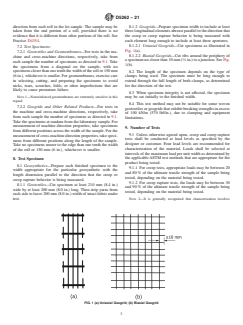
8.1.2.1 Uniaxial Geogrids—Cut specimens as illustrated in Fig. 1(a).
8.1.2.2 Biaxial Geogrids—Cut ribs around the periphery of a specimen no closer than 10 mm ( ⁄8 in.) to a junction. See Fig. 1(b).
8.2 The length of the specimen depends on the type of clamps being used. The specimen must be long enough to extend through
the full length of both clamps, as determined for the direction of the test.
8.3 When specimen integrity is not affected, the specimen may be cut initially to the finished width.
8.4 This test method may not be suitable for some woven geotextiles or geogrids that exhibit breaking strengths in excess of 100
kN/m (570 lbf/in.), due to clamping and equipment limitations.
9. Number of Tests
9.1 Unless otherwise agreed upon, creep and creep rupture tests shall be conducted at load levels as specified by the designer.
designer or customer. Four load levels are recommended for characterization of the material. Loads shall be selected at intervals
of approximately 10 % of the maximum load per unit width as determined by the applicable ASTM test methods.methods that are
appropriate for the product being tested.
9.1.1 For creep test, thetests, appropriate loads should be 20, 30, 40, 50 and 60 %may be between 20 and 80 % of the ultimate
tensile strength of the sample being tested, unless otherwise agreed upon by the parties involved.depending on the material being
tested.
9.1.2 For creep rupture tests, the loads should be 50, 60, 70, 80, may be between 30 and 90 % of the ultimate tensile strength of
the sample being tested, unless otherwise agreed upon by the parties involved.depending on the material being tested.
NOTE 2—It is generally recognized that characterization involves identification of the load levels at which there is no creep (no increase in strain with
the log of time), low to moderate creep three different stages of creep occur: primary (decreasing strain with time), secondary (linear increase in strain
with the log of time), and high creep tertiary (exponential increase in strain with the log of time).
FIG. 1 (a) Uniaxial Geogrid; (b) Biaxial Geogrid
D5262 − 21
9.2 To evaluate design creep strains, it is recommended that a minimum of two creep tests be performed for each test temperature
(that is, one at the design load and one at a load that exceeds the design load, as specified by the designer).
9.3 To evaluatedetermine creep rupture, it is recommended that a minimum of fourtwelve creep rupture tests be performed for
performed, with at least four at each test temperature to sufficiently characterize the creep rupture curve. As a guide, at least four
of the tests should have rupture times between 10 h and 1000 h, four should have rupture times between 1000 h and 10 000 h, and
at least one test should have a rupture time of approximately 10 000 h or more.
NOTE 3—For each temperature, the four tests should be at different load levels. Ideally, two test loads at a temperature should be the same at the next
lowest temperature and two should be the same at the next highest temperature for ease of time-temperature shifting.
10. Conditioning and Testing Atmosphere
10.1 Bring the specimens to moisture equilibrium in the atmosphere for testing geosynthetics. Equilibrium is considered to have
been reached when the increase in mass of the specimen, in successive weighings made at intervals of not less than 2 h, does not
exceed 0.1 % of the specimen mass. In general practice, the industry approaches equilibrium from the as-received side.state.
NOTE 4—It is customary that geosynthetic materials are frequently not weighed to determine when moisture equilibrium has been reached. While such
a procedure cannot be accepted in cases of dispute, in routine testing, it may be sufficient to expose the material to the standard atmosphere for testing
for a reasonable time period before the specimens are tested. A time period of 24 h has been found acceptable in most cases. However, certain fibers may
exhibit slow moisture equilibrium rates from the as-received wet side.state. When this is known, a preconditioning cycle, as prescribed in Practice
D1776D1776/D1776M, may be agreed upon between contractual parties.
10.2 To characterize the influence of temperature, temperature and facilitate the application of the block shifting of data as
described in Appendix X5 in addition to the standard temperature of 20 6 2.0°C (68 6 3.6°F),20 6 2.0 °C (68 6 3.6 °F), two or
more additional temperatures should be used to cover the useful temperature range of the geosynthetic considered. considered and
higher temperatures. These should be chosen in suitable increments reflecting the variation of creep and creep rupture of the
geosynthetic with temperature and phase transitions of the material. The test temperature will generally be determined by site
conditions and should be agreed upon by contractual parties. Suggested additional temperatures are 10 6 2.0°C (50 6 3.6°F),
30 6 2.0°C (86 6 3.6°F), 40 6 2.0°C (104 6 3.6°F), 50 6 2.0°C (122 6 3.6°F), and 60 6 2.0°C (140 6 3.6°F).10 6 2.0 °C
(50 6 3.6 °F), 30 6 2.0 °C (86 6 3.6 °F), 40 6 2.0 °C (104 6 3.6 °F), 50 6 2.0 °C (122 6 3.6 °F), and 60 6 2.0 °C
(140 6 3.6 °F).
11. Procedure
11.1 Determine the ultimate tensile strength (T ) of the sample(s) provided for creep testing in accordance with the wide-width
ult
method, Test Method D4595 or D6637/D6637M, Method B, as appropriate.
11.2 Test adequately conditioned specimens. Conduct the tests at the temperature(s) selected in 10.2 and relative humidity of 50
to 75 % (see (if required; see 6.7.1). Contractual parties may specify an additional temperature(s) based on expected service
conditions for the installation.
11.3 Mount the specimen centrally in the clamps. The specimen length in the machine direction and cross machine direction tests,
respectively, must be parallel to the direction of application of force. Note the direction being tested: either machine or
cross-machine.
11.4 Attach the extension measuring devices directly to the specimen. specimen, if appropriate. If these are optical devices, set
up the measurement mechanism accordingly. Make the initial or reference measurement.
11.4.1 It is recommended that the initial gagegauge length be set at a minimum of 75 mm (3 in.) for geotextiles and
geomembranes.
11.4.2 The gauge length for geogrids should be the distance, in the machine direction, across twox consecutive apertures including
thex three nodesnodes, where x ≥ 2.
11.5 Where required, place a pretension force, which includes any load due to the mass of the clamps, rapidly and smoothly on
D5262 − 21
the specimen. In any case, the total time between placement of a pretension load and full load shall not exceed 10 min. Record
the pretension force A pre-load of not more than 1 % of the ultimate tensile strength of the specimen may be applied, including
the weight of a bottom clamp (if fitted at this point) and any extension measurement equipment fitted. Apply the pre-load rapidly
and smoothly on the specimen. Record the pre-load and resulting extension. It is generally accepted that the application of a
pretensionpre-load force is required when testing certain geosynthetics,geosynthetics for which part of the extension on loading
occurs from a realignment of fiber structure and is relatively variable, while the subsequent time-dependent elongation, which is
due to creep of the fibers, is more consistent. The application of a pretension force has therefore been selected as a simple means
of establishing zero strain.
11.5 The pretension force, which includes the weight of the loading mechanism and weight of grip, should have a maximum total
applied force on the specimen of 45 N (10 lbf) for materials exhibiting a breaking force of 17 500 N/m (100 lbf/in.) and under,
as determined in accordance with Test Method D4595. For materials exhibiting a breaking force in excess of 17 500 N/m (100
lbf/in.), a pretension force equal to 1.25 % of the expected breaking force should be applied: however, in no case should the total
pretension force exceed 300 N (67.5 lbf).
11.6 Apply the full load rapidly and smoothly to the specimen, preferably at a strain rate of 10 6 3 % ⁄min. Record the total time
for loading (excluding pretension). In any event, disregard For test data interpretation, disregard extension measurements within
five times of the loading time.
11.7 Measure the extension of the specimen in accordance with at least the following approximate time schedule: 1, 2, 6, 10, and
30 min; and 1, 2, 5, 10, 30, 100, 200, 500, and 1000 h. For creep tests longer than 1000 h, measure and record extension at least
every 500 h until testing is complete.
NOTE 5—In design, it is generally accepted that creep or creep rupture data should not be extrapolated beyond one order of magnitude. In many cases,
a test period of 1000 h therefore,therefore may not reflect the long-term behavior of the material accurately. For such cases, tests should be conducted
for a minimum of 10 000 h. If, after TTS if used, extrapolation by more than one order of magnitude (one log decade of time) is necessary, then apply
a correction to the calculated rupture strength in accordance with Clause 10.1 of ISO/TR 20432.
NOTE 6—For preliminary evaluation of newly developed products when testing is underway but has not yet reached 10 000 h, creep or creep rupture
behavior may be inferred from completed test results on essentially identical products from the same family of products;products (that is, manufactured
by the same organization using the same process technology, polymer type, polymer structure, polymer molecular weight, polymer additives, constituent
materials, product configuration, etc.). Application of this inference is appropriate only when a minimum of 1000 h 1000 h of testing is completed on
t
...