

ASTM D8441/D8441M-22
(Specification)Standard Specification for International Symbol for Identifying Consumer Products Containing Intoxicating Cannabinoids
General Information
- Abstract
SCOPE
1.1 This specification establishes an international symbol applicable to all products containing intoxicating cannabinoids at a quantity or concentration sufficient to have a warning deemed necessary by the authority having jurisdiction (AHJ).
1.2 This specification shall apply to all finished products that are intended for consumer use, which includes topical use, ingestion, inhalation, and any/all other methods of adsorption on or in the body of a human or animal.
1.3 This specification provides uniformity in identifying potential health and safety hazards associated with exposure to a substance that may cause intoxicating (that is, mind or consciousness altering, or both) effects.
1.4 This specification seeks to ensure visual clarity and consistency, which results in improvement of recognition and comprehension for the end user.
1.5 Units—The values stated in either SI units or inch-pound units are to be regarded separately as standard. The values stated in each system are not necessarily exact equivalents; therefore, to ensure conformance with the standard, each system shall be used independently of the other, and values from the two systems shall not be combined.
1.6 This standard does not purport to address all of the safety concerns, if any, associated with its use. It is the responsibility of the user of this standard to establish appropriate safety, health, and environmental practices and determine the applicability of regulatory limitations prior to use.
1.7 This international standard was developed in accordance with internationally recognized principles on standardization established in the Decision on Principles for the Development of International Standards, Guides and Recommendations issued by the World Trade Organization Technical Barriers to Trade (TBT) Committee.
- Status
- Published
- Publication Date
- 31-Jan-2022
- Technical Committee
- D37 - Cannabis
- Drafting Committee
- D37.04 - Processing and Handling

Overview
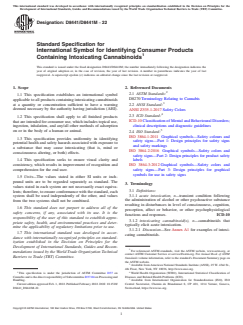
ASTM D8441/D8441M-22 defines the international symbol for identifying consumer products containing intoxicating cannabinoids. Issued by ASTM International, this standard provides specifications for a symbol used on packaging to alert consumers to the presence of cannabinoids that may produce intoxicating or mind-altering effects. The standard aims to promote consistent labeling and enhance end user recognition and comprehension regarding potential health and safety hazards associated with such products.
The symbol is applicable to all finished consumer products intended for topical use, ingestion, inhalation, or any other method of adsorption in humans or animals, where cannabinoid content reaches levels requiring a warning as determined by the local authority having jurisdiction (AHJ).
Key Topics
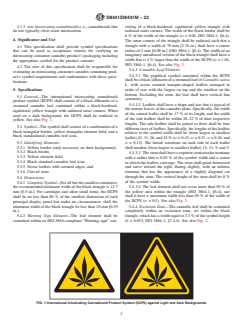
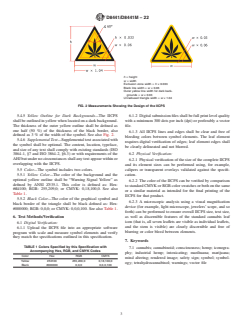
- International Symbol Specifications: The standard details dimensions, color requirements, and design elements for the Intoxicating Cannabinoid Product Symbol (IICPS). The symbol consists of a black silhouette of a cannabis leaf within a black-bordered yellow triangle, with specific guidelines for symmetry, size, and placement.
- Clarity and Consistency: Guidelines ensure the symbol is visually clear and easy to recognize across different products and packaging types, improving consumer awareness.
- Health and Safety Communication: The symbol communicates the presence of intoxicating cannabinoids and associated effects, supporting harm reduction and responsible product use.
- Applicability: The standard covers all products intended for consumer use, emphasizing topical, ingestible, and inhalable forms, as well as products for animals.
- Verification and Testing: Methods for digital and physical verification of the symbol’s dimensions, color accuracy, and graphical clarity are included, ensuring compliance and uniformity. Minimum size and digital formats (such as vector files or 300 dpi images) are specified.
- Color Designation: The color yellow must be “Warning Signal Yellow” (HEX: #ffd100, RGB: 255,209,0), while black design elements follow similar precise definitions.
Applications
ASTM D8441/D8441M-22 is valuable to a wide range of stakeholders in the cannabinoid product supply chain:
- Product Manufacturers and Packagers: Ensures products containing intoxicating cannabinoids are labeled clearly, addressing market and regulatory requirements regarding consumer safety.
- Regulatory Authorities (AHJs): Provides a uniform reference for enforcement and inspection of cannabis and hemp-derived products, supporting public health mandates.
- Retailers and Distributors: Enhances liability management by ensuring products carry the required international cannabinoid warning symbol.
- Testing Laboratories and Certifying Bodies: Facilitates compliance testing to verify correct usage of the symbol on consumer products.
- Consumers: Improves hazard recognition for individuals using cannabinoid-infused products, contributing to informed decision-making.
Related Standards
ASTM D8441/D8441M-22 references and aligns with several recognized international standards to ensure global compatibility and best practices:
- ASTM D8270 – Terminology Relating to Cannabis
- ANSI Z535.1 – Safety Colors
- ISO 3864 Series – Graphical symbols for safety colors and safety signs, including label design principles and graphical elements
- ICD-10 – Classification of Mental and Behavioural Disorders (World Health Organization)
Summary
By incorporating the international symbol prescribed in ASTM D8441/D8441M-22, organizations demonstrate a commitment to safety, compliance, and consumer protection in the fast-evolving cannabinoid product market. This standard aids global harmonization of hazard communication, supports regulatory authorities, and ensures that end users can recognize products containing intoxicating cannabinoids at a glance.
Keywords: consumer products, cannabinoid labeling, safety symbol, cannabis packaging, health and safety, standard specification, ASTM D8441, product compliance, intoxicating cannabinoid, hazard communication, cannabis product identification, international symbol, THC warning, regulatory compliance.
Get Certified
Connect with accredited certification bodies for this standard

BSI Group
BSI (British Standards Institution) is the business standards company that helps organizations make excellence a habit.

TÜV Rheinland
TÜV Rheinland is a leading international provider of technical services.

TÜV SÜD
TÜV SÜD is a trusted partner of choice for safety, security and sustainability solutions.
Sponsored listings
Frequently Asked Questions
ASTM D8441/D8441M-22 is a technical specification published by ASTM International. Its full title is "Standard Specification for International Symbol for Identifying Consumer Products Containing Intoxicating Cannabinoids". This standard covers: SCOPE 1.1 This specification establishes an international symbol applicable to all products containing intoxicating cannabinoids at a quantity or concentration sufficient to have a warning deemed necessary by the authority having jurisdiction (AHJ). 1.2 This specification shall apply to all finished products that are intended for consumer use, which includes topical use, ingestion, inhalation, and any/all other methods of adsorption on or in the body of a human or animal. 1.3 This specification provides uniformity in identifying potential health and safety hazards associated with exposure to a substance that may cause intoxicating (that is, mind or consciousness altering, or both) effects. 1.4 This specification seeks to ensure visual clarity and consistency, which results in improvement of recognition and comprehension for the end user. 1.5 Units—The values stated in either SI units or inch-pound units are to be regarded separately as standard. The values stated in each system are not necessarily exact equivalents; therefore, to ensure conformance with the standard, each system shall be used independently of the other, and values from the two systems shall not be combined. 1.6 This standard does not purport to address all of the safety concerns, if any, associated with its use. It is the responsibility of the user of this standard to establish appropriate safety, health, and environmental practices and determine the applicability of regulatory limitations prior to use. 1.7 This international standard was developed in accordance with internationally recognized principles on standardization established in the Decision on Principles for the Development of International Standards, Guides and Recommendations issued by the World Trade Organization Technical Barriers to Trade (TBT) Committee.
SCOPE 1.1 This specification establishes an international symbol applicable to all products containing intoxicating cannabinoids at a quantity or concentration sufficient to have a warning deemed necessary by the authority having jurisdiction (AHJ). 1.2 This specification shall apply to all finished products that are intended for consumer use, which includes topical use, ingestion, inhalation, and any/all other methods of adsorption on or in the body of a human or animal. 1.3 This specification provides uniformity in identifying potential health and safety hazards associated with exposure to a substance that may cause intoxicating (that is, mind or consciousness altering, or both) effects. 1.4 This specification seeks to ensure visual clarity and consistency, which results in improvement of recognition and comprehension for the end user. 1.5 Units—The values stated in either SI units or inch-pound units are to be regarded separately as standard. The values stated in each system are not necessarily exact equivalents; therefore, to ensure conformance with the standard, each system shall be used independently of the other, and values from the two systems shall not be combined. 1.6 This standard does not purport to address all of the safety concerns, if any, associated with its use. It is the responsibility of the user of this standard to establish appropriate safety, health, and environmental practices and determine the applicability of regulatory limitations prior to use. 1.7 This international standard was developed in accordance with internationally recognized principles on standardization established in the Decision on Principles for the Development of International Standards, Guides and Recommendations issued by the World Trade Organization Technical Barriers to Trade (TBT) Committee.
ASTM D8441/D8441M-22 is classified under the following ICS (International Classification for Standards) categories: 11.120.99 - Other standards related to pharmaceutics. The ICS classification helps identify the subject area and facilitates finding related standards.
ASTM D8441/D8441M-22 is available in PDF format for immediate download after purchase. The document can be added to your cart and obtained through the secure checkout process. Digital delivery ensures instant access to the complete standard document.
Standards Content (Sample)
This international standard was developed in accordance with internationally recognized principles on standardization established in the Decision on Principles for the
Development of International Standards, Guides and Recommendations issued by the World Trade Organization Technical Barriers to Trade (TBT) Committee.
Designation: D8441/D8441M −22
Standard Specification for
International Symbol for Identifying Consumer Products
Containing Intoxicating Cannabinoids
This standard is issued under the fixed designation D8441/D8441M; the number immediately following the designation indicates the
year of original adoption or, in the case of revision, the year of last revision. A number in parentheses indicates the year of last
reapproval. A superscript epsilon (´) indicates an editorial change since the last revision or reapproval.
1. Scope 2. Referenced Documents
2.1 ASTM Standards:
1.1 This specification establishes an international symbol
D8270Terminology Relating to Cannabis
applicable to all products containing intoxicating cannabinoids
at a quantity or concentration sufficient to have a warning
2.2 ANSI Standard:
deemed necessary by the authority having jurisdiction (AHJ).
ANSI Z535.1-2017Safety Colors
2.3 ICD Standard:
1.2 This specification shall apply to all finished products
ICD-10Classification of Mental and Behavioural Disorders;
thatareintendedforconsumeruse,whichincludestopicaluse,
clinical descriptions and diagnostic guidelines
ingestion, inhalation, and any/all other methods of adsorption
on or in the body of a human or animal.
2.4 ISO Standard:
ISO 3864-1:2011 Graphical symbols—Safety colours and
1.3 This specification provides uniformity in identifying
safety signs—Part 1: Design principles for safety signs
potential health and safety hazards associated with exposure to
and safety markings
a substance that may cause intoxicating (that is, mind or
ISO 3864-2:2016 Graphical symbols—Safety colors and
consciousness altering, or both) effects.
safety signs—Part 2: Design principles for product safety
1.4 This specification seeks to ensure visual clarity and
labels
consistency, which results in improvement of recognition and ISO 3864-3:2012Graphical symbols—Safety colors and
comprehension for the end user. safety signs—Part 3: Design principles for graphical
symbols for use in safety signs
1.5 Units—The values stated in either SI units or inch-
pound units are to be regarded separately as standard. The
3. Terminology
values stated in each system are not necessarily exact equiva-
3.1 Definitions:
lents; therefore, to ensure conformance with the standard, each
3.1.1 acute intoxication, n—transient condition following
system shall be used independently of the other, and values
the administration of alcohol or other psychoactive substance
from the two systems shall not be combined.
resulting in disturbances in level of consciousness, cognition,
1.6 This standard does not purport to address all of the
perception, affect or behavior, or other psychophysiological
safety concerns, if any, associated with its use. It is the
functions and responses. ICD-10
responsibility of the user of this standard to establish appro-
3.1.2 intoxicating cannabinoid(s), n—cannabinoids that
priate safety, health, and environmental practices and deter-
typically elicit acute intoxication.
mine the applicability of regulatory limitations prior to use.
3.1.2.1 Discussion—See Annex A1 for examples of intoxi-
1.7 This international standard was developed in accor-
cating cannabinoids.
dance with internationally recognized principles on standard-
ization established in the Decision on Principles for the
Development of International Standards, Guides and Recom-
For referenced ASTM standards, visit the ASTM website, www.astm.org, or
mendations issued by the World Trade Organization Technical
contact ASTM Customer Service at service@astm.org. For Annual Book of ASTM
Barriers to Trade (TBT) Committee.
Standards volume information, refer to the standard’s Document Summary page on
the ASTM website.
Available fromAmerican National Standards Institute (ANSI), 25 W. 43rd St.,
4th Floor, New York, NY 10036, http://www.ansi.org.
1 4
This specification is under the jurisdiction of ASTM Committee D37 on World Health Organization (WHO), International Statistical Classification of
CannabisandisthedirectresponsibilityofSubcommitteeD37.04onProcessingand Diseases and Related Health Problems (ICD).
Handling. Available from International Organization for Standardization (ISO), ISO
Current edition approved Feb. 1, 2022. Published February 2022. DOI: 10.1520/ Central Secretariat, Chemin de Blandonnet 8, CP 401, 1214 Vernier, Geneva,
D8441_D8441M-22. Switzerland, https://www.iso.org.
Copyright © ASTM International, 100 Barr Harbor Drive, PO Box C700, West Conshohocken, PA 19428-2959. United States
D8441/D8441M − 22
3.1.3 non-intoxicating cannabinoid(s), n—cannabinoidsthat sisting of a black-bordered, equilateral yellow triangle with
do not typically elicit acute intoxication. radiused outer corners. The width of the black border shall be
6 % of the width of the triangle (w × 0.06, ISO 3864-1, §6.4).
4. Significance and Use
The outer corners of the triangle shall be radiused such that a
triangle with a width of 70 mm [2.76 in.] shall have a corner
4.1 This specification shall provide symbol specifications
radius of 2 mm [0.08 in.] (ISO 3864-1, §6.4). The width of an
that can be used as acceptance criteria for verifying an
imaginaryunradiusedversionoftheblacktriangleshallhavea
intoxicating consumer cannabis product’s packaging including
width that is 4 % larger than the width of the IICPS (w × 1.04,
the appropriate symbol for the product contents.
ISO 3864-1, §6.4). See also Fig. 2.
4.2 The user of this specification shall be responsible for
5.4.3 Cannabis Leaf Element:
evaluatinganintoxicatingconsumercannabiscontainingprod-
5.4.3.1 The graphical symbol contained within the IICPS
uct’s symbol requirements and conformance with these speci-
shallbeablacksilhouetteofastemmedleafof Cannabis sativa
fications.
L. with seven serrated marquis-shaped leaflets arranged in
order of size with the largest on top and the smallest on the
5. Specifications
bottom. Excluding the stem, the leaf shall have vertical line
5.1 General—The international intoxicating cannabinoid
symmetry.
product symbol (IICPS) shall consist of a black silhouette of a
5.4.3.2 Leaflets shall have a shape and size that is typical of
stemmed cannabis leaf contained within a black-bordered,
the mature leaves of the cannabis plant. Specifically, the width
equilateral yellow triangle with radiused outer corners. When
of the central leaflet shall be 17 % of its length, and the width
used on a dark background, the IICPS shall be outlined in
of the side leaflets shall be within 20–22 % of their respective
yellow. See also Fig. 1.
lengths. The side leaflets shall be paired so there shall be four
5.2 Symbol—Thesymbolshallconsistofacombinationofa
differentsizesofleaflets.Specifically,thelengthsoftheleaflets
black triangular border, yellow triangular element field, and a
relative to the symbol width shall be (from largest to smallest
black standardized cannabis leaf icon.
leaflet)43,31,26,and15%(w×0.43, w×0.31, w×0.26,and
5.3 Identifying Elements: w × 0.15). The lateral serrations on each side of each leaflet
5.3.1 Yellow border (only necessary on dark background), shall number (from largest to smallest leaflet) 13, 11, 9, and 5.
5.3.2 Black border,
5.4.3.3 Thestemshallhaveasuperiorsemicircularterminus
5.3.3 Yellow element field,
with a radius that is 0.05 % of the symbol width and a center
5.3.4 Black standard cannabis leaf icon,
in which the leaflets converge.The stem shall point downward
5.3.5 Seven leaflets with serrated edges, and
and curve toward the right, flaring slightly, with an inferior
5.3.6 Curved stem.
terminus that has the appearance of a slightly diagonal cut
through the stem. The vert
...