

ASTM D8375-23
(Test Method)Standard Test Method for Determination of Cannabinoid Concentration in Dried Cannabis and Hemp Raw Materials using Liquid Chromatography Tandem Mass Spectrometry (LC-MS/MS)
General Information
- Abstract
SIGNIFICANCE AND USE
5.1 The analysis and reporting of cannabinoid content in cannabis and hemp is required to address human health and safety concerns, satisfy testing and labeling requirements, and meet the regulatory guidelines of various jurisdictions. This test method is useful in providing quantitative results for up to seventeen cannabinoids in dried cannabis and hemp raw material samples.
SCOPE
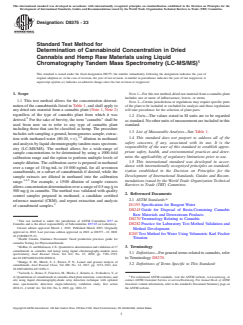
1.1 This test method allows for the concentration determination of the cannabinoids listed in Table 1, and shall apply to any dried raw material from a cannabis plant (Note 1, Note 2) regardless of the type of cannabis plant from which it was derived.2 For the sake of brevity, the term “cannabis” shall be used from now on to refer to any type of cannabis plant including those that can be classified as hemp. The procedure includes sub-sampling a ground, homogeneous sample, extraction with methanol:water (80:20, v:v),3,4 dilution in methanol and analysis by liquid chromatography tandem mass spectrometry (LC-MS/MS). The method allows for a wide-range of sample concentrations to be determined by using a 1000-fold calibration range and the option to perform multiple levels of sample dilution. The calibration curve is prepared in methanol over a range of 10 ng/mL to 10 000 ng/mL for all seventeen cannabinoids, or a subset of cannabinoids if desired, while the sample extracts are diluted in methanol into the calibration range.3,4,5 For example, a 1/500 dilution of sample extracts allows concentration determination over a range of 0.5 mg/g to 500 mg/g in cannabis. The method was validated with quality control samples prepared in methanol, a candidate certified reference material (CRM), and repeat extraction and analysis of cannabinoid samples.3
Note 1: For this test method, dried raw material from a cannabis plant includes one or more of inflorescence, leaves, or stems.
Note 2: Certain jurisdictions or regulations may require specific parts of the plant to be included or excluded for analysis and those regulations will take precedence for the selection of plant parts.
1.2 Units—The values stated in SI units are to be regarded as standard. No other units of measurement are included in this standard.
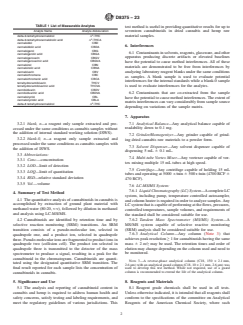
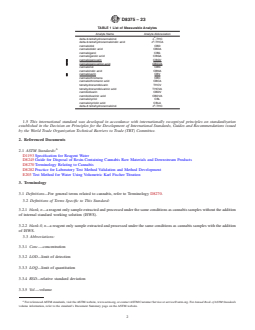
1.3 List of Measurable Analytes—See Table 1.
1.4 This standard does not purport to address all of the safety concerns, if any, associated with its use. It is the responsibility of the user of this standard to establish appropriate safety, health, and environmental practices and determine the applicability of regulatory limitations prior to use.
1.5 This international standard was developed in accordance with internationally recognized principles on standardization established in the Decision on Principles for the Development of International Standards, Guides and Recommendations issued by the World Trade Organization Technical Barriers to Trade (TBT) Committee.
- Status
- Published
- Publication Date
- 28-Feb-2023
- Technical Committee
- D37 - Cannabis
- Drafting Committee
- D37.03 - Laboratory
Buy Documents
ASTM D8375-23 - Standard Test Method for Determination of Cannabinoid Concentration in Dried Cannabis and Hemp Raw Materials using Liquid Chromatography Tandem Mass Spectrometry (LC-MS/MS)
REDLINE ASTM D8375-23 - Standard Test Method for Determination of Cannabinoid Concentration in Dried Cannabis and Hemp Raw Materials using Liquid Chromatography Tandem Mass Spectrometry (LC-MS/MS)
Overview
ASTM D8375-23 is the definitive standard test method for the determination of cannabinoid concentration in dried cannabis and hemp raw materials using Liquid Chromatography Tandem Mass Spectrometry (LC-MS/MS). Developed by ASTM International, this standard addresses the quantitative analysis of up to seventeen key cannabinoids, ensuring compliance with regulatory, safety, and labeling requirements across jurisdictions. Laboratories, regulatory agencies, and producers rely on ASTM D8375-23 to assess cannabinoid profiles with precision and accuracy in both cannabis and hemp plant materials.
Key Topics
Purpose and Scope:
ASTM D8375-23 provides a validated test method for measuring concentrations of cannabinoids in any dried raw material derived from cannabis plants, including those classified as hemp. The method is universally applicable, regardless of plant part (inflorescence, leaves, stems) and local regulatory specifics.Analytical Procedure:
- Sample Preparation: Dried cannabis or hemp material is homogenized and extracted using a methanol:water solution (80:20, v:v).
- LC-MS/MS Analysis: Extracts are diluted into a calibration range and analyzed using LC-MS/MS, employing a 1000-fold calibration range for broad quantitation, from 0.5 mg/g to 500 mg/g in plant material.
- Calibration: Calibration curves are prepared in methanol, covering a range of 10 ng/mL to 10,000 ng/mL for each cannabinoid.
- Validation: Method validation includes the use of quality control samples, candidate certified reference materials (CRMs), and routine recovery checks.
Measurable Analytes:
The method quantifies a wide panel of cannabinoids, such as:- Δ9-tetrahydrocannabinol (Δ9-THC)
- Δ9-tetrahydrocannabinolic acid (Δ9-THCA)
- Cannabidiol (CBD)
- Cannabidiolic acid (CBDA)
- Cannabigerol (CBG)
- Cannabinol (CBN)
- Cannabichromene (CBC)
- Tetrahydrocannabivarin (THCV)
- Cannabivarin (CBV)
- Delta-8 THC (Δ8-THC)
- And more, for a total of up to 17 primary analytes.
Interference and Quality:
The procedure is designed to minimize analytical interferences with strict control over reagents, blanks, and calibration. The use of CRMs and isotopically-labeled internal standards ensures ongoing accuracy and precision.
Applications
Regulatory Compliance:
Many jurisdictions regulate the permissible content of cannabinoids in dried cannabis and hemp products. ASTM D8375-23 provides laboratories the methodology required for compliance with legal limits, satisfying regulatory and labeling mandates.Product Labeling and Consumer Safety:
Accurate cannabinoid profiling ensures producers can provide reliable label information, supporting consumer safety and confidence in product composition.Quality Assurance in Production:
Producers implement this method to monitor product consistency, verify ingredient claims, and support quality control programs throughout the supply chain.Research and Development:
Scientists and product developers utilize the standard for developing cannabinoid-rich strains and formulations, as well as for studying plant chemotype variations.
Related Standards
- ASTM D1193: Specification for Reagent Water, ensuring high-quality water for analytical procedures.
- ASTM D8245: Guide for the Disposal of Resin-Containing Cannabis Materials.
- ASTM D8270: Terminology Relating to Cannabis, providing definitions of relevant terms.
- ASTM D8282: Practice for Laboratory Test Method Validation and Method Development.
- ASTM E203: Test Method for Water Using Volumetric Karl Fischer Titration.
Conclusion
ASTM D8375-23 delivers a robust, validated approach for the determination of cannabinoid concentration in dried cannabis and hemp materials using LC-MS/MS technology. By establishing consistent laboratory practices, ensuring data integrity, and supporting regulatory compliance, this standard is integral to the safety, quality, and transparency of cannabis and hemp products worldwide.
Relations
- Effective Date
- 01-Jan-2024
- Refers
ASTM D8282-19 - Standard Practice for Laboratory Test Method Validation and Method Development - Effective Date
- 01-Sep-2019
- Effective Date
- 15-Jan-2019
- Effective Date
- 01-Mar-2006
- Effective Date
- 10-Feb-1999
- Effective Date
- 10-Feb-1999
Buy Documents
ASTM D8375-23 - Standard Test Method for Determination of Cannabinoid Concentration in Dried Cannabis and Hemp Raw Materials using Liquid Chromatography Tandem Mass Spectrometry (LC-MS/MS)
REDLINE ASTM D8375-23 - Standard Test Method for Determination of Cannabinoid Concentration in Dried Cannabis and Hemp Raw Materials using Liquid Chromatography Tandem Mass Spectrometry (LC-MS/MS)
Get Certified
Connect with accredited certification bodies for this standard

BSI Group
BSI (British Standards Institution) is the business standards company that helps organizations make excellence a habit.

TÜV Rheinland
TÜV Rheinland is a leading international provider of technical services.

TÜV SÜD
TÜV SÜD is a trusted partner of choice for safety, security and sustainability solutions.
Sponsored listings
Frequently Asked Questions
ASTM D8375-23 is a standard published by ASTM International. Its full title is "Standard Test Method for Determination of Cannabinoid Concentration in Dried Cannabis and Hemp Raw Materials using Liquid Chromatography Tandem Mass Spectrometry (LC-MS/MS)". This standard covers: SIGNIFICANCE AND USE 5.1 The analysis and reporting of cannabinoid content in cannabis and hemp is required to address human health and safety concerns, satisfy testing and labeling requirements, and meet the regulatory guidelines of various jurisdictions. This test method is useful in providing quantitative results for up to seventeen cannabinoids in dried cannabis and hemp raw material samples. SCOPE 1.1 This test method allows for the concentration determination of the cannabinoids listed in Table 1, and shall apply to any dried raw material from a cannabis plant (Note 1, Note 2) regardless of the type of cannabis plant from which it was derived.2 For the sake of brevity, the term “cannabis” shall be used from now on to refer to any type of cannabis plant including those that can be classified as hemp. The procedure includes sub-sampling a ground, homogeneous sample, extraction with methanol:water (80:20, v:v),3,4 dilution in methanol and analysis by liquid chromatography tandem mass spectrometry (LC-MS/MS). The method allows for a wide-range of sample concentrations to be determined by using a 1000-fold calibration range and the option to perform multiple levels of sample dilution. The calibration curve is prepared in methanol over a range of 10 ng/mL to 10 000 ng/mL for all seventeen cannabinoids, or a subset of cannabinoids if desired, while the sample extracts are diluted in methanol into the calibration range.3,4,5 For example, a 1/500 dilution of sample extracts allows concentration determination over a range of 0.5 mg/g to 500 mg/g in cannabis. The method was validated with quality control samples prepared in methanol, a candidate certified reference material (CRM), and repeat extraction and analysis of cannabinoid samples.3 Note 1: For this test method, dried raw material from a cannabis plant includes one or more of inflorescence, leaves, or stems. Note 2: Certain jurisdictions or regulations may require specific parts of the plant to be included or excluded for analysis and those regulations will take precedence for the selection of plant parts. 1.2 Units—The values stated in SI units are to be regarded as standard. No other units of measurement are included in this standard. 1.3 List of Measurable Analytes—See Table 1. 1.4 This standard does not purport to address all of the safety concerns, if any, associated with its use. It is the responsibility of the user of this standard to establish appropriate safety, health, and environmental practices and determine the applicability of regulatory limitations prior to use. 1.5 This international standard was developed in accordance with internationally recognized principles on standardization established in the Decision on Principles for the Development of International Standards, Guides and Recommendations issued by the World Trade Organization Technical Barriers to Trade (TBT) Committee.
SIGNIFICANCE AND USE 5.1 The analysis and reporting of cannabinoid content in cannabis and hemp is required to address human health and safety concerns, satisfy testing and labeling requirements, and meet the regulatory guidelines of various jurisdictions. This test method is useful in providing quantitative results for up to seventeen cannabinoids in dried cannabis and hemp raw material samples. SCOPE 1.1 This test method allows for the concentration determination of the cannabinoids listed in Table 1, and shall apply to any dried raw material from a cannabis plant (Note 1, Note 2) regardless of the type of cannabis plant from which it was derived.2 For the sake of brevity, the term “cannabis” shall be used from now on to refer to any type of cannabis plant including those that can be classified as hemp. The procedure includes sub-sampling a ground, homogeneous sample, extraction with methanol:water (80:20, v:v),3,4 dilution in methanol and analysis by liquid chromatography tandem mass spectrometry (LC-MS/MS). The method allows for a wide-range of sample concentrations to be determined by using a 1000-fold calibration range and the option to perform multiple levels of sample dilution. The calibration curve is prepared in methanol over a range of 10 ng/mL to 10 000 ng/mL for all seventeen cannabinoids, or a subset of cannabinoids if desired, while the sample extracts are diluted in methanol into the calibration range.3,4,5 For example, a 1/500 dilution of sample extracts allows concentration determination over a range of 0.5 mg/g to 500 mg/g in cannabis. The method was validated with quality control samples prepared in methanol, a candidate certified reference material (CRM), and repeat extraction and analysis of cannabinoid samples.3 Note 1: For this test method, dried raw material from a cannabis plant includes one or more of inflorescence, leaves, or stems. Note 2: Certain jurisdictions or regulations may require specific parts of the plant to be included or excluded for analysis and those regulations will take precedence for the selection of plant parts. 1.2 Units—The values stated in SI units are to be regarded as standard. No other units of measurement are included in this standard. 1.3 List of Measurable Analytes—See Table 1. 1.4 This standard does not purport to address all of the safety concerns, if any, associated with its use. It is the responsibility of the user of this standard to establish appropriate safety, health, and environmental practices and determine the applicability of regulatory limitations prior to use. 1.5 This international standard was developed in accordance with internationally recognized principles on standardization established in the Decision on Principles for the Development of International Standards, Guides and Recommendations issued by the World Trade Organization Technical Barriers to Trade (TBT) Committee.
ASTM D8375-23 is classified under the following ICS (International Classification for Standards) categories: 11.120.99 - Other standards related to pharmaceutics. The ICS classification helps identify the subject area and facilitates finding related standards.
ASTM D8375-23 has the following relationships with other standards: It is inter standard links to ASTM E203-24, ASTM D8282-19, ASTM D8245-19, ASTM D1193-06, ASTM D1193-99e1, ASTM D1193-99. Understanding these relationships helps ensure you are using the most current and applicable version of the standard.
ASTM D8375-23 is available in PDF format for immediate download after purchase. The document can be added to your cart and obtained through the secure checkout process. Digital delivery ensures instant access to the complete standard document.
Standards Content (Sample)
This international standard was developed in accordance with internationally recognized principles on standardization established in the Decision on Principles for the
Development of International Standards, Guides and Recommendations issued by the World Trade Organization Technical Barriers to Trade (TBT) Committee.
Designation: D8375 − 23
Standard Test Method for
Determination of Cannabinoid Concentration in Dried
Cannabis and Hemp Raw Materials using Liquid
Chromatography Tandem Mass Spectrometry (LC-MS/MS)
This standard is issued under the fixed designation D8375; the number immediately following the designation indicates the year of
original adoption or, in the case of revision, the year of last revision. A number in parentheses indicates the year of last reapproval. A
superscript epsilon (´) indicates an editorial change since the last revision or reapproval.
NOTE 1—For this test method, dried raw material from a cannabis plant
1. Scope
includes one or more of inflorescence, leaves, or stems.
1.1 This test method allows for the concentration determi-
NOTE 2—Certain jurisdictions or regulations may require specific parts
nation of the cannabinoids listed in Table 1, and shall apply to of the plant to be included or excluded for analysis and those regulations
will take precedence for the selection of plant parts.
any dried raw material from a cannabis plant (Note 1, Note 2)
regardless of the type of cannabis plant from which it was
1.2 Units—The values stated in SI units are to be regarded
derived. For the sake of brevity, the term “cannabis” shall be
as standard. No other units of measurement are included in this
used from now on to refer to any type of cannabis plant
standard.
including those that can be classified as hemp. The procedure
1.3 List of Measurable Analytes—See Table 1.
includes sub-sampling a ground, homogeneous sample, extrac-
3,4
1.4 This standard does not purport to address all of the
tion with methanol:water (80:20, v:v), dilution in methanol
safety concerns, if any, associated with its use. It is the
and analysis by liquid chromatography tandem mass spectrom-
responsibility of the user of this standard to establish appro-
etry (LC-MS/MS). The method allows for a wide-range of
priate safety, health, and environmental practices and deter-
sample concentrations to be determined by using a 1000-fold
mine the applicability of regulatory limitations prior to use.
calibration range and the option to perform multiple levels of
1.5 This international standard was developed in accor-
sample dilution. The calibration curve is prepared in methanol
dance with internationally recognized principles on standard-
over a range of 10 ng ⁄mL to 10 000 ng/mL for all seventeen
ization established in the Decision on Principles for the
cannabinoids, or a subset of cannabinoids if desired, while the
Development of International Standards, Guides and Recom-
sample extracts are diluted in methanol into the calibration
3,4,5
mendations issued by the World Trade Organization Technical
range. For example, a 1/500 dilution of sample extracts
Barriers to Trade (TBT) Committee.
allows concentration determination over a range of 0.5 mg ⁄g to
500 mg ⁄g in cannabis. The method was validated with quality
2. Referenced Documents
control samples prepared in methanol, a candidate certified
2.1 ASTM Standards:
reference material (CRM), and repeat extraction and analysis
D1193 Specification for Reagent Water
of cannabinoid samples.
D8245 Guide for Disposal of Resin-Containing Cannabis
Raw Materials and Downstream Products
1 D8270 Terminology Relating to Cannabis
This test method is under the jurisdiction of ASTM Committee D37 on
D8282 Practice for Laboratory Test Method Validation and
Cannabis and is the direct responsibility of Subcommittee D37.03 on Laboratory.
Current edition approved March 1, 2023. Published March 2023. Originally
Method Development
approved in 2022. Last previous edition approved in 2022 as D8375 – 22. DOI:
E203 Test Method for Water Using Volumetric Karl Fischer
10.1520/D8375-23.
2 Titration
Health Canada, Guidance Document: Good production practices guide for
cannabis Testing for Phytocannabinoids.
McRae, G. and Melanson, J. E., Quantitative determination and validation of 17
3. Terminology
cannabinoids in cannabis and hemp using liquid chromatography-tandem mass
3.1 Definitions—For general terms related to cannabis, refer
spectrometry, Anal Bioanal Chem, Vol 412, No. 27, 2020, pp. 7381–7393,
doi:10.1007/s00216-020-02862-8.
to Terminology D8270.
Mudge, E. M., Murch, S. J., Brown, P. N., Leaner and greener analysis of
3.2 Definitions of Terms Specific to This Standard:
cannabinoids, Anal Bioanal Chem, Vol 409, No. 12, 2017, pp. 3153–3163, doi:
10.1007/s00216-017-0256-3.
Vaclavik, L., Benes, F., Fenclova, M., Hricko, J., Krmela, A., Svobodova, V., et
al. Quantitation of cannabinoids in cannabis dried plant materials, concentrates, and For referenced ASTM standards, visit the ASTM website, www.astm.org, or
oils using liquid chromatography-diode array detection technique with optional contact ASTM Customer Service at service@astm.org. For Annual Book of ASTM
mass spectrometric detection: single-laboratory validation study, first action Standards volume information, refer to the standard’s Document Summary page on
2018.11, J AOAC Int. Vol 102, No. 6, 2019, pp. 1822–33 the ASTM website.
Copyright © ASTM International, 100 Barr Harbor Drive, PO Box C700, West Conshohocken, PA 19428-2959. United States
D8375 − 23
TABLE 1 List of Measurable Analytes
test method is useful in providing quantitative results for up to
Analyte Name Analyte Abbreviation seventeen cannabinoids in dried cannabis and hemp raw
delta-9-tetrahydrocannabinol Δ -THC material samples.
delta-9-tetrahydrocannabinolic acid Δ -THCA
cannabidiol CBD
6. Interferences
cannabidiolic acid CBDA
cannabigerol CBG
6.1 Contaminants in solvents, reagents, glassware, and other
cannabigerolic acid CBGA
apparatus producing discrete artifacts or elevated baselines
cannabigerovarin CBGV
cannabigerovarinic acid CBGVA
have the potential to cause method interferences. All of these
cannabinol CBN
materials are demonstrated to be free from interferences by
cannabinolic acid CBNA
cannabivarin CBV analyzing laboratory reagent blanks under the same conditions
cannabichromene CBC
as samples. A blank sample is used to evaluate potential
cannabichromenic acid CBCA
interferences for the internal standards while a blank-0 sample
tetrahydrocannibivarin THCV
tetrahydrocannibivarinic acid THCVA is used to evaluate interferences for the analytes.
cannibidivarin CBDV
6.2 Contaminants that are co-extracted from the sample
cannibidivarinic acid CBDVA
cannabicyclol CBL
have the potential to cause method interferences. The extent of
cannabicyclolic acid CBLA
matrix interferences can vary considerably from sample source
delta-8 tetrahydrocannabinol Δ -THC
depending on variations of the sample matrix.
7. Apparatus
7.1 Analytical Balance—Any analytical balance capable of
3.2.1 blank, n—a reagent only sample extracted and pro-
cessed under the same conditions as cannabis samples without readability down to 0.1 mg.
the addition of internal standard working solution (ISWS).
7.2 Grinder/Homogenizer—Any grinder capable of grind-
3.2.2 blank-0, n—a reagent only sample extracted and
ing dried cannabis raw materials to a powder form.
processed under the same conditions as cannabis samples with
7.3 Solvent Dispenser—Any solvent dispenser capable of
the addition of ISWS.
dispensing 5 mL 6 0.1 mL.
3.3 Abbreviations:
7.4 Multi-tube Vortex Mixer—Any vortexer capable of vor-
3.3.1 Conc.—concentration
tex mixing multiple 15 mL tubes at high speed.
3.3.2 LOD—limit of detection
7.5 Centrifuge—Any centrifuge capable of holding 15 mL
3.3.3 LOQ—limit of quantitation
tubes and operating at 5000 r ⁄min 6 500 r ⁄min (4700 RCF 6
3.3.4 RSD—relative standard deviation
470 RCF).
3.3.5 Vol.—volume
7.6 LC-MS/MS System:
7.6.1 Liquid Chromatography (LC) System—A complete LC
4. Summary of Test Method
system, including pump, temperature controlled autosampler,
4.1 The quantitative analysis of cannabinoids in cannabis is
and column heater is required in order to analyze samples. Any
accomplished by extraction of ground plant material with
LC system that is capable of performing at the flows, pressures,
methanol:water (80:20, v:v), followed by dilution in methanol
controlled temperatures, sample volumes, and requirements of
and analysis using LC-MS/MS.
the standard shall be considered suitable for use.
7.6.2 Tandem Mass Spectrometer (MS/MS) System—A
4.2 Cannabinoids are identified by retention time and by
MS/MS system capable of selective reactive monitoring
selective reaction monitoring (SRM) transitions. An SRM
(SRM) analysis shall be considered suitable for use.
transition consists of a pseudo-molecular ion, selected in
7.6.3 Analytical Column—Any column (Note 3) that
quadrupole one, and a product ion, selected in quadrupole
achieves peak resolution ≥ 1 for cannabinoids having the same
three. Pseudo-molecular ions are fragmented to product ions in
mass 6 2 m/z may be used. The retention times and order of
quadrupole two (collision cell). The product ion selected in
elution may change depending on the column used and need to
quadrupole three is transmitted to the detector of the mass
be monitored.
spectrometer to produce a signal, resulting in a peak for the
cannabinoid in the chromatogram. Cannabinoids are quanti-
NOTE 3—A reverse-phase analytical column (C18, 150 × 2.1 mm,
tated using the designated quantitative SRM transition. The
2.6 μm) with an analytical guard column (C18, 10 × 2.1 mm, 2.6 μm) was
final result reported for each sample lists the concentration of used to develop this test method. While not required, use of a guard
column is recommended to extend the life of the analytical column.
cannabinoids in cannabis.
8. Reagents and Materials
5. Significance and Use
5.1 The analysis and reporting of cannabinoid content in 8.1 Reagent grade chemicals shall be used in all tests.
cannabis and hemp is required to address human health and Unless otherwise indicated, it is intended that all reagents shall
safety concerns, satisfy testing and labeling requirements, and conform to the specifications of the committee on Analytical
meet the regulatory guidelines of various jurisdictions. This Reagents of the American Chemical Society, where such
D8375 − 23
TABLE 2 MCS Solution Preparation
specifications are available. Other grades may be used, pro-
vided it is pure enough to be used without lessening the Reference
Cannabinoid Conc. in
Reference Standard Standard
accuracy of the determination.
Conc. mixture
Solution/Solvent Solution Vol.
(μg/mL) (μg/mL)
(μL)
8.2 Purity of Water—Unless otherwise indicated, references
Δ -THCA 1000 400 40.0
to water shall be understood to mean reagent water as defined
CBDA 1000 400 40.0
by Type I of Specification D1193.
CBGA 1000 400 40.0
CBGVA 1000 400 40.0
8.3 Acetonitrile, LC-MS grade, or equivalent.
CBNA 1000 400 40.0
THCVA 1000 400 40.0
8.4 Cannabinoid reference standard solutions, CRM or
CBCA 1000 400 40.0
equivalent.
CBDVA 1000 400 40.0
8.4.1 Cannabinoid reference standard solutions are commer-
CBLA 500 800 40.0
Δ -THC 1000 400 40.0
cially available individually or as mixed standards, typically at
CBD 1000 400 40.0
concentrations of 1.0 mg/mL or 0.5 mg/mL in methanol or
CBG 1000 400 40.0
acetonitrile.
CBGV 1000 400 40.0
CBN 1000 400 40.0
8.5 Cannabinoid internal standard solutions-isotopically la-
CBV 1000 400 40.0
beled: THC-d3, THCA-d3, CBD-d3, CBG-d3, CBGA-d3, THCV 1000 400 40.0
CBC 1000 400 40.0
CBN-d3, and CBCA-d3. CRM or equivalent.
CBDV 1000 400 40.0
8.5.1 Isotopically-labeled cannabinoid internal standard so-
CBL 1000 400 40.0
lutions are commercially available, typically at concentrations Δ -THC 1000 400 40.0
MeOH - 1600 -
of 0.1 mg/mL in methanol or acetonitrile.
Total Volume - 10 000 -
8.6 Cannabis CRM, if available.
8.7 Formic acid, LC-MS grade, or equivalent.
8.8 Hemp CRM, if available.
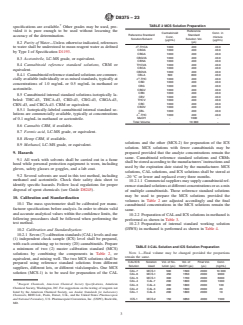
solutions and the other (MCS-2) for preparation of the ICS
8.9 Methanol, LC-MS grade, or equivalent.
solution. MCS solutions with fewer cannabinoids may be
9. Hazards prepared provided that the analyte concentrations remain the
same. Cannabinoid reference standard solutions and CRMs
9.1 All work with solvents shall be carried out in a fume
shall be stored according to the manufacturers’ instructions and
hood while personal protection equipment is worn, including
used by the expiration date stated by the manufacturer. MCS
gloves, safety glasses or goggles, and a lab coat.
solutions, CAL solutions, and ICS solutions shall be stored at
9.2 Several solvents are used in this test method, including
–20 °C or lower and replaced every three months.
methanol and acetonitrile. Check their safety data sheet to
10.2.1.1 Commercial suppliers may supply cannabinoid ref-
identify specific hazards. Follow local regulations for proper
erence standard solutions at different concentrations or as a mix
disposal of spent chemicals (see Guide D8245).
of multiple cannabinoids. Those reference standard solutions
may be used to prepare the MCS solutions provided the
10. Calibration and Standardization
volumes in Table 2 are adjusted accordingly and the final
10.1 The mass spectrometer shall be calibrated per manu-
cannabinoid concentrations in the MCS solutions remain the
facturer specifications before analysis. In order to obtain valid
same.
and accurate analytical values within the confidence limits, the
10.2.2 Preparation of CAL and ICS solutions in methanol is
following procedures shall be followed when performing the
performed as shown in Table 3.
test method.
10.2.3 Preparation of internal standard working solution
(ISWS) in methanol is performed as shown in Table 4.
10.2 Calibration and Standardization:
10.2.1 Seven (7) calibration standards (CAL) levels and one
(1) independent check sample (ICS) level shall be prepared,
with each containing up to twenty (20) cannabinoids. Prepare
TABLE 3 CAL Solution and ICS Solution Preparation
a minimum of two (2) master calibration standard (MCS)
NOTE 1—Final volume may be changed provided the proportions
solutions by combining the components in Table 2, or
remain the same.
equivalent, and mixing well. The two MCS solutions shall be
CAL/ICS Solution Vol. of So- Vol. of Final Vol. Conc.
prepared using reference standard solutions from different
Solution Used lution (μL) MeOH (μL) (μL) (ng/mL)
suppliers, different lots, or different vials/ampules. One MCS
CAL-7 MCS-1 500 1500 2000 10 000
solution (MCS-1) is to be used for preparation of the CAL
CAL-6 MCS-1 450 1550 2000 9000
CAL-5 MCS-1 300 1700 2000 6000
CAL-4 CAL-7 200 1800 2000 1000
Reagent Chemicals, American Chemical Society Specifications, American
CAL-3 CAL-4 200 1800 2000 100
Chemical Society, Washington, DC. For suggestions on the testing of reagents not
CAL-2 CAL-3 400 1600 2000 20
listed by the American Chemical Society, see Analar Standards for Laboratory
CAL-1 CAL-3 200 1800 2000 10
Chemicals, BDH Ltd., Poole, Dorset, U.K., and the United States Pharmacopeia
and National Formulary, U.S. Pharmacopeial Convention, Inc. (USPC), Rockville, ICS-1 MCS-2 150 3850 4000 1500
MD.
D8375 − 23
TABLE 4 ISWS Preparation
10.2.6.3 Cannabis reference standard solutions may be used
to spike the RRS samples. It is recommended to spike as many
NOTE 1—Final volume may be changed provided the concentrations
cannabinoids as possible during preparation of the RRS,
remain the same. Internal standards may be omitted if the corresponding
cannabinoid analyte is not included in the MCS.
however this will be limited due to reference standard solution
Cannabinoid
concentrations, volumes and cannabinoid concentrations in the
Stock Conc (μg/ Conc. in mixture
Stock Solution/ Stock Vol. (μL)
un-spiked cannabis samples.
mL) (ng/mL)
Solvent
10.2.7 Inject each CAL to obtain the chromatograms, moni-
THC-d3 100 250 500
THCA-d3 100 250 500 toring the SRM transitions of each analyte and its internal
CBD-d3 100 250 500
standard. Calibration software is used to conduct quantitation
CBG-d3 100 250 500
of the target analytes with SRM transitions of each analyte
CBGA-d3 100 250 500
CBN-d3 100 250 500 used for quantitation and confirmation.
CBCA-d3 100 250 500
10.2.8 The calibration software manual should be consulted
MeOH - 48 250 -
Total volume - 50 000 - to use the software properly. The quantitative method uses peak
area ratios of the analyte/internal standard vs the analyte
concentration in units of ng/mL. Regressions (that is, linear or
quadratic depending on the instrument used) may be generated
10.2.4 Routine Recovery—Routine recovery shall be dem-
using the data system software. Forcing the regression line
onstrated in each sample analysis batch by processing a
through the origin is not recommended. Each CAL used to
cannabis or hemp matrix CRM (10.2.5) or by preparing and
generate the regression shall have a calculated concentration
processing a routine recovery spike (RRS) (10.2.6).
≤15 % bias (≤20 % bias for CAL-1) from the nominal concen-
10.2.4.1 Analysis of a cannabis or hemp matrix CRM is the
tration and shall be rejected if this specification is not met.
preferable option to provide evidence of method recovery.
Certain jurisdictions or regulations may require more stringent
10.2.5 Routine recovery using a cannabis or hemp matrix
specifications and those regulations will take precedence.
CRM: Cannabis or hemp matrix CRMs may be purchased from
commercial suppliers and shall include a valid certificate of 10.2.9 Linear calibration may be used if the coefficient of
2 2
analysis. determination, r , is ≥ 0.99. A weighting of 1/x or 1/x is
10.2.5.1 A minimum of one (1) matrix CRM sample shall be recommended to give more emphasis to the lower concentra-
taken through the complete analytical test method procedure. tions. A minimum of five (5) points is considered acceptable
The calculated concentrations of each analyte included in the for each analyte. Rejected CALs shall not be adjacent to one
CRM certificate of analysis shall have percent bias ≤20 % or ≤ another. If the low or high CAL point are rejected, the reporting
the expanded uncertainty reported in the certificate of analysis, range shall be modified to reflect this change (Note 4).
whichever is greater.
10.2.10 Quadratic calibration may be used if the coefficient
2 2
10.2.6 Routine recovery using a RRS:
of determination, r , is ≥ 0.99. A weighting of 1/x or 1/x is
10.2.6.1 RRS samples shall be prepared in homogeneous,
recommended to give more emphasis to the lower concentra-
ground cannabis samples that have known cannabinoid con-
tions. A minimum of five (5) points is considered acceptable
centrations. It is recommended to spike a minimum of five (5)
for each analyte. Rejected CALs shall not be adjacent to one
cannabinoids into the sample, while a minimum of two (2)
another. If the low or high CAL point are rejected, the reporting
cannabinoids shall be used to calculate routine recovery.
range shall be modified to reflect this change (Note 4).
Cannabinoids used to calculate routine recovery shall have a
NOTE 4—Certain jurisdictions or regulations may prohibit the rejection
post-spike matrix concentration level ≥ two (2) times the level
of the high or low calibration points and those regulations will take
present in the un-spiked cannabis sample and provide a
precedence.
concentration ≥ three (3) times the CAL-1 concentration after
10.2.11 The retention time window of the SRM transitions
sample extraction and dilution.
shall be within 65 % of the retention time of the analyte in a
10.2.6.2 A minimum of one (1) RRS and one (1) un-spiked
mid-point CAL. If this is not the case, re-examine the CAL to
matrix sample shall be taken through the complete analytical
determine if there was a shift in retention time during the
test method procedure. The recovery shall be calculated using
analysis. If a retention time shift occurred, the sample shall be
blank subtraction as shown in Eq 1 and shall be between 80 %
re-injected. If the retention time is still incorrect in the sample,
and 120 %.
refer to the peak as an unknown.
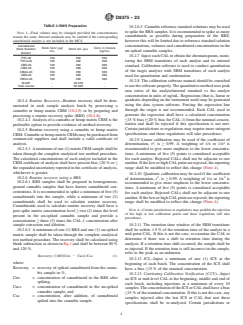
Recovery5~100!~Crrs 2 Cucs! ⁄Csa (1)
10.2.12 ICS—Inject a minimum of one (1) ICS at the
where:
beginning of each batch. The concentration of the ICS shall
Recovery = recovery of spiked cannabinoid from the canna-
have a bias ≤15 % of the nominal concentration.
bis sample in %,
10.2.13 Continuing Calibration Verification (CCV)—Inject
Crrs = concentration of cannabinoid in the RRS after
an ICS or mid-level CAL at the beginning, middle and end of
spiking,
each batch, including injections at a minimum of every 10
Cucs = concentration of cannabinoid in the un-spiked
samples. The concentration of the ICS or CAL shall have a bias
cannabis sample, and
≤15 % of the nominal concentration. If this is not the case, any
Csa = concentration, after addition, of cannabinoid
samples injected after the last ICS or CAL that met these
spiked into the cannabis sample.
specifications shall be re-analyzed. Certain jurisdictions or
D8375 − 23
TABLE 5 HPLC Conditions
regulations may require more stringent acceptance specifica-
tions and those regulations will take precedence.
NOTE 1—Parameters may be optimized for specific instruments and
analytical column used.
10.3 Method Blanks:
Parameter Setting
10.3.1 A blank sample shall be injected at least once in the
Column reverse phase
run. Any peak in the blank sample at the retention time and
Guard Column reverse phase
Mobile Phase A water:formic acid (100:0.1, v:v)
SRM transitions of the internal standards shall have a peak area
Mobile Phase B acetonitrile:formic acid (100:0.1, v:v)
≤5 % of the average of the internal standard peak areas of the
Flow Rate (mL/min) 0.5
CAL samples. Run Time (min) 18
Column temperature (°C) 40
10.3.2 A blank-0 sample shall be injected at the beginning,
Switch Valve times (min) 0-1.5 min to waste, 1.5-14.0 min to MS,
middle and end of the run, including a blank sample injected a 14.0-18.0 min to waste
Injection Volume (μL) 1.0
minimum of every 10 samples. Any peak in the blank-0 sample
Needle Wash acetonitrile:methanol:water:formic acid
at the retention time and SRM transition of the analytes shall
(40:40:20:1, v:v:v:v)
Autosampler Temperature (°C) 5 °C
have a concentration ≤20 % of CAL-1 concentration.
10.4 If a laboratory has not performed the test before or if
there has been a major change in the measurement system, for
TABLE 6 HPLC Gradient
example: a new analyst or new equipment, perform a precision
NOTE 1—Gradient may be optimized for specific columns used.
and bias study to demonstrate the laboratory capability.
Time (min) Flow (mL/min) %B
10.4.1 If a cannabis or hemp matrix CRM is available,
0.0 0.5 60
8.0 0.5 68
analyze at least four (4) replicates of the CRM. The sample
13.5 0.5 68
shall be taken through the complete analytical test method.
13.6 0.5 95
Calculate the mean (average) concentration and % RSD and
14.5 0.5 95
14.6 0.5 60
compare to the concentration in the CRM certificate of
18.0 0.5 60
analysis. The calculated concentrations of the analytes shall
have percent bias ≤15 % or ≤ the expanded uncertainty
reported in the certificate of analysis, whichever is greater, and
TABLE 7 Mass Spectrometer Parameters
an RSD ≤15 %.
NOTE 1—Parameters may be optimized for specific instruments used.
10.4.2 If a cannabis or hemp CRM is not available, the ICS,
Parameter Setting
RRS or an in-house cannabis or hemp reference sample may be
Scan Type SRM
used to demonstrate precision and bias.
Ion Source Heated Electrospray
Polarity Positive
10.4.3 This study shall be repeated until the single operator
Ion Spray Voltage (V) 4000
precision and bias are within the specifications.
Sheath Gas (arbitrary units) 50
Aux Gas (arbitrary units) 20
Sweep Gas (arbitrary units) 2
11. Conditioning and Instrument Parameters
Ion Transfer Tube Temperature (°C) 325
Vaporizer Temperature (°C) 150
11.1 Analyze using a tandem mass spectrometer (MS/MS)
Collision Gas (Pa) 0.2
coupled to a high-performance liquid chromatography (HPLC) Dwell Time (msec) 40
system
11.2 Introduce sample using an autosampler and achieve
analyte separation on an appropriate reverse-phase column
12. Procedure
(Note 5). Equilibrate the instrument by injecting a minimum of
12.1 Record all sample information in conformance within
one blank sample and one CAL-1 sample to verify analyte
the requirements of the existing lab management practices as
retention times and that signal to noise ratios (S/N) of all
defined within your quality management system (QMS).
analytes are ≥10. See Tables 5-8 for additional instrument
parameters. Parameters in Table 7 are an example only and 12.2 Homogenize the dried cannabis at low temperature
may be different in name, number and setting for various
using a grinder.
instruments. Parameters should be optimized for specific LC-
12.3 Weigh 100 mg 6 5 mg of sample into 15 mL tubes,
MS/MS systems. Collision energy settings in Table 8 may
recording the mass to an accuracy of 0.1 mg.
require optimization for specific mass spectrometers.
12.4 Add 5 mL 6 0.1 mL of methanol:water (80:20, v:v).
NOTE 5—A C18, 2.6 μm, 2.1 mm × 150 mm HPLC column fitted with
12.4.1 For RRS samples, reduce the volume of methanol-
a C18, 2.6 μm, 2.1 mm × 10 mm guard column was used with the gradient
:water (80:20, v:v) by the volume of reference standard
described in Table 6 to develop this test method.
solutions spiked into the sample.
11.3 Table 8 illustrates the SRM transitions used for can-
12.5 Vortex at high speed for 90 s 6 10 s.
nabinoids. Bold entries indicate transitions used for
quantitation, while non-bold entries indicate transitions used
12.6 Centrifuge at 5000 r ⁄min 6 500 r ⁄min (4700 RCF 6
for qualification. 470 RCF) for 5 min 6 0.5 min.
D8375 − 23
TABLE 8 SRM Transitions for Cannabinoids
12.14 Pipet 50 μL 6 1 μL of ISWS to glass screw cap vials
with glass inserts (50 μL 6 1 μL of methanol to the blank).
NOTE 1—Retention times will vary with column and mobile phase used.
12.15 Pipet 100 μL 6 2 μL of each sample to the vials.
NOTE 2—Collision energy may be optimized for specific instruments
used.
12.16 Cap the vials and vortex for 10 s 6 5 s.
Retention Collision
Precursor Product
12.17 Analyze by LC-MS/MS.
Compound Time Energy
(m/z) (m/z)
(min) (V) NOTE 6—For example, a 1/500 dilution of extract provides quantitation
in cannabis over a range of 0.5 mg ⁄g to 500 mg/g and is achieved by
CBDVA 2.2 313 191 26
pipetting 0.04 mL of supernatant and 19.96 mL of methanol to a glass vial
313 233 20
CBDV 2.6 287 165 23 and vortexing for 10 s 6 5 s.
287 123 30
CBGVA 2.6 315 191 23
13. Calculation or Interpretation of Results
333 191 26
CBV 3.5 283 223 20
13.1 Sample peak identities are verified by comparison of
283 265 16
the retention time of analyte peaks in the appropriate SRM
CBDA 3.7 341 219 26
359 219 25
transitions of the ICS or a mid-level CAL with those of the
CBGA 4.0 343 219 23
samples. The peak area ratio (quantitation SRM transition/
361 219 26
qualification SRM transition) of the samples shall be within
CBG 4.4 317 193 16
317 123 32
630 % of the peak area ratio (quantitation SRM transition/
THCV 4.4 287 165 23
qualification SRM transition) of the ICS or mid-level CAL.
287 123 30
CBD 4.6 315 193 21
13.2 The concentration of cannabinoids in the diluted
315 135 20
samples (ng/mL) are calculated from the weighted calibration
THCVA 5.6 313 191 26
313 233 20 curve of the peak area ratios (analyte/internal standard). If the
CBN 6.5 311 223 22
cannabinoid concentration in the diluted sample is determined
311 241 18
to be below the calibration range, it is reported as below the
CBNA 7.8 337 235 25
337 253 23 limit of quantitation (BLQ) or the sample extract may be
Δ9-THC 7.8 315 193 21
diluted at a lower level to obtain a concentration within the
315 135 20
calibration curve range and re-analyzed. If the cannabinoid
Δ8-THC 8.3 315 193 21
315 135 20 concentration in the diluted sample is determined to be above
CBL 9.1 315 235 18
the calibration range, the sample extract shall be re-diluted at
315 81 30
an appropriate level to obtain a concentration near the midpoint
THCA 9.6 341 219 26
359 219 25
of the calibration range and re-analyzed. All samples with
CBC 10.1 315 193 21
concentrations within the calibration range are reported. The
315 259 14
concentrations (mg/g) of cannabinoids in cannabis are then
CBLA 11.2 359 261 25
359 219 32
determined by accounting for sample mass, extraction, dilution
CBCA 11.4 341 219 26
and water content (see Test Method E203) as shown in Eq 2.
359 219 25
CBGA-d3 4.0 346 222 23
Cm 5 ~Cd!~df!~Ve! ⁄ Mm~1000000!~1 2 W! (2)
CBG-d3 4.4 320 196 16
CBD-d3 4.5 318 196 21
where:
CBN-d3 6.4 314 223 21
THC-d3 7.8 318 196 22 Cm = concentration of cannabinoid in the cannabis
THCA-d3 9.6 344 222
...
This document is not an ASTM standard and is intended only to provide the user of an ASTM standard an indication of what changes have been made to the previous version. Because
it may not be technically possible to adequately depict all changes accurately, ASTM recommends that users consult prior editions as appropriate. In all cases only the current version
of the standard as published by ASTM is to be considered the official document.
Designation: D8375 − 22 D8375 − 23
Standard Test Method for
Determination of Cannabinoid Concentration in Dried
Cannabis and Hemp Raw Materials using Liquid
Chromatography Tandem Mass Spectrometry (LC-MS/MS)
This standard is issued under the fixed designation D8375; the number immediately following the designation indicates the year of
original adoption or, in the case of revision, the year of last revision. A number in parentheses indicates the year of last reapproval. A
superscript epsilon (´) indicates an editorial change since the last revision or reapproval.
1. Scope
1.1 This test method allows for the concentration determination of the cannabinoids listed in Table 1, and shall apply to any dried
raw material from a cannabis plant (Note 1, Note 2) regardless of the type of cannabis plant from which it was derived. For the
sake of brevity, the term “cannabis” shall be used from now on to refer to any type of cannabis plant including those that can be
classified as hemp. The procedure includes sub-sampling a ground, homogeneous sample, extraction with methanol:water (80:20,
3,4
v:v), dilution in methanol and analysis by liquid chromatography tandem mass spectrometry (LC-MS/MS). The method allows
for a wide-range of sample concentrations to be determined by using a 1000-fold calibration range and the option to perform
multiple levels of sample dilution. The calibration curve is prepared in methanol over a range of 10 ng ⁄mL to 10 000 ng/mL for
all seventeen cannabinoids, or a subset of cannabinoids if desired, while the sample extracts are diluted in methanol into the
3,4,5
calibration range. For example, a 1/500 dilution of sample extracts allows concentration determination over a range of 0.5 mg ⁄g
to 500 mg ⁄g in cannabis. The method was validated with quality control samples prepared in methanol, a candidate certified
reference material (CRM), and repeat extraction and analysis of cannabinoid samples.
NOTE 1—For this test method, dried raw material from a cannabis plant includes one or more of inflorescence, leaves, or stems.
NOTE 2—Certain jurisdictions or regulations may require specific parts of the plant to be included or excluded for analysis and those regulations will take
precedence for the selection of plant parts.
1.2 Units—The values stated in SI units are to be regarded as standard. No other units of measurement are included in this
standard.
1.3 List of Measurable Analytes—See Table 1.
1.4 This standard does not purport to address all of the safety concerns, if any, associated with its use. It is the responsibility
of the user of this standard to establish appropriate safety, health, and environmental practices and determine the applicability of
regulatory limitations prior to use.
This test method is under the jurisdiction of ASTM Committee D37 on Cannabis and is the direct responsibility of Subcommittee D37.03 on Laboratory.
Current edition approved Aug. 1, 2022March 1, 2023. Published September 2022March 2023. Originally approved in 2022. Last previous edition approved in 2022 as
D8375 – 22. DOI: 10.1520/D8375-22.10.1520/D8375-23.
Health Canada, Guidance Document: Good production practices guide for cannabis Testing for Phytocannabinoids.
McRae, G. and Melanson, J. E., Quantitative determination and validation of 17 cannabinoids in cannabis and hemp using liquid chromatography-tandem mass
spectrometry, Anal Bioanal Chem, Vol 412, No. 27, 2020, pp. 7381–7393, doi:10.1007/s00216-020-02862-8.
Mudge, E. M., Murch, S. J., Brown, P. N., Leaner and greener analysis of cannabinoids, Anal Bioanal Chem, Vol 409, No. 12, 2017, pp. 3153–3163, doi:
10.1007/s00216-017-0256-3.
Vaclavik, L., Benes, F., Fenclova, M., Hricko, J., Krmela, A., Svobodova, V., et al. Quantitation of cannabinoids in cannabis dried plant materials, concentrates, and oils
using liquid chromatography-diode array detection technique with optional mass spectrometric detection: single-laboratory validation study, first action 2018.11, J AOAC Int.
Vol 102, No. 6, 2019, pp. 1822–33
Copyright © ASTM International, 100 Barr Harbor Drive, PO Box C700, West Conshohocken, PA 19428-2959. United States
D8375 − 23
TABLE 1 List of Measurable Analytes
Analyte Name Analyte Abbreviation
delta-9-tetrahydrocannabinol Δ -THC
delta-9-tetrahydrocannabinolic acid Δ -THCA
cannabidiol CBD
cannabidiolic acid CBDA
cannabigerol CBG
cannabigerolic acid CBGA
cannabigerovarin CBGV
cannabigerovarinic acid CBGVA
cannabinol CBN
cannabinolic acid CBNA
cannabivarin CBV
cannabichromene CBC
cannabichromenic acid CBCA
tetrahydrocannibivarin THCV
tetrahydrocannibivarinic acid THCVA
cannibidivarin CBDV
cannibidivarinic acid CBDVA
cannabicyclol CBL
cannabicyclolic acid CBLA
delta-8 tetrahydrocannabinol Δ -THC
1.5 This international standard was developed in accordance with internationally recognized principles on standardization
established in the Decision on Principles for the Development of International Standards, Guides and Recommendations issued
by the World Trade Organization Technical Barriers to Trade (TBT) Committee.
2. Referenced Documents
2.1 ASTM Standards:
D1193 Specification for Reagent Water
D8245 Guide for Disposal of Resin-Containing Cannabis Raw Materials and Downstream Products
D8270 Terminology Relating to Cannabis
D8282 Practice for Laboratory Test Method Validation and Method Development
E203 Test Method for Water Using Volumetric Karl Fischer Titration
3. Terminology
3.1 Definitions—For general terms related to cannabis, refer to Terminology D8270.
3.2 Definitions of Terms Specific to This Standard:
3.2.1 blank, n—a reagent only sample extracted and processed under the same conditions as cannabis samples without the addition
of internal standard working solution (ISWS).
3.2.2 blank-0, n—a reagent only sample extracted and processed under the same conditions as cannabis samples with the addition
of ISWS.
3.3 Abbreviations:
3.3.1 Conc.—concentration
3.3.2 LOD—limit of detection
3.3.3 LOQ—limit of quantitation
3.3.4 RSD—relative standard deviation
3.3.5 Vol.—volume
For referenced ASTM standards, visit the ASTM website, www.astm.org, or contact ASTM Customer Service at service@astm.org. For Annual Book of ASTM Standards
volume information, refer to the standard’s Document Summary page on the ASTM website.
D8375 − 23
4. Summary of Test Method
4.1 The quantitative analysis of cannabinoids in cannabis is accomplished by extraction of ground plant material with
methanol:water (80:20, v:v), followed by dilution in methanol and analysis using LC-MS/MS.
4.2 Cannabinoids are identified by retention time and by selective reaction monitoring (SRM) transitions. An SRM transition
consists of a pseudo-molecular ion, selected in quadrupole one, and a product ion, selected in quadrupole three. Pseudo-molecular
ions are fragmented to product ions in quadrupole two (collision cell). The product ion selected in quadrupole three is transmitted
to the detector of the mass spectrometer to produce a signal, resulting in a peak for the cannabinoid in the chromatogram.
Cannabinoids are quantitated using the designated quantitative SRM transition. The final result reported for each sample lists the
concentration of cannabinoids in cannabis.
5. Significance and Use
5.1 The analysis and reporting of cannabinoid content in cannabis and hemp is required to address human health and safety
concerns, satisfy testing and labeling requirements, and meet the regulatory guidelines of various jurisdictions. This test method
is useful in providing quantitative results for up to seventeen cannabinoids in dried cannabis and hemp raw material samples.
6. Interferences
6.1 Contaminants in solvents, reagents, glassware, and other apparatus producing discrete artifacts or elevated baselines have the
potential to cause method interferences. All of these materials are demonstrated to be free from interferences by analyzing
laboratory reagent blanks under the same conditions as samples. A blank sample is used to evaluate potential interferences for the
internal standards while a blank-0 sample is used to evaluate interferences for the analytes.
6.2 Contaminants that are co-extracted from the sample have the potential to cause method interferences. The extent of matrix
interferences can vary considerably from sample source depending on variations of the sample matrix.
7. Apparatus
7.1 Analytical Balance—Any analytical balance capable of readability down to 0.1 mg.
7.2 Grinder/Homogenizer—Any grinder capable of grinding dried cannabis raw materials to a powder form.
7.3 Solvent Dispenser—Any solvent dispenser capable of dispensing 5 mL 6 0.1 mL.
7.4 Multi-tube Vortex Mixer—Any vortexer capable of vortex mixing multiple 15 mL tubes at high speed.
7.5 Centrifuge—Any centrifuge capable of holding 15 mL tubes and operating at 5000 r ⁄min 6 500 r ⁄min (4700 RCF 6 470
RCF).
7.6 LC-MS/MS System:
7.6.1 Liquid Chromatography (LC) System—A complete LC system, including pump, temperature controlled autosampler, and
column heater is required in order to analyze samples. Any LC system that is capable of performing at the flows, pressures,
controlled temperatures, sample volumes, and requirements of the standard shall be considered suitable for use.
7.6.2 Tandem Mass Spectrometer (MS/MS) System—A MS/MS system capable of selective reactive monitoring (SRM) analysis
shall be considered suitable for use.
7.6.3 Analytical Column—Any column (Note 3) that achieves peak resolution ≥ 1 for cannabinoids having the same mass 6 2 m/z
may be used. The retention times and order of elution may change depending on the column used and need to be monitored.
NOTE 3—A reverse-phase analytical column (C18-Amide, 100(C18, 150 × 2.1 mm, 3 μm) 2.6 μm) with an analytical guard column (C18-Amide,(C18,
10 × 2.1 mm, 3 μm) 2.6 μm) was used to develop this test method. While not required, use of a guard column is recommended to extend the life of the
analytical column.
D8375 − 23
8. Reagents and Materials
8.1 Reagent grade chemicals shall be used in all tests. Unless otherwise indicated, it is intended that all reagents shall conform
to the specifications of the committee on Analytical Reagents of the American Chemical Society, where such specifications are
available. Other grades may be used, provided it is pure enough to be used without lessening the accuracy of the determination.
8.2 Purity of Water—Unless otherwise indicated, references to water shall be understood to mean reagent water as defined by Type
I of Specification D1193.
8.3 Acetonitrile, LC-MS grade, or equivalent.
8.4 Cannabinoid reference standard solutions, CRM or equivalent.
8.4.1 Cannabinoid reference standard solutions are commercially available individually or as mixed standards, typically at
concentrations of 1.0 mg/mL or 0.5 mg/mL in methanol or acetonitrile.
8.5 Cannabinoid internal standard solutions-isotopically labeled: THC-d3, CBD-d3 and CBN-d3.THCA-d3, CBD-d3, CBG-d3,
CBGA-d3, CBN-d3, and CBCA-d3. CRM or equivalent.
8.5.1 Isotopically-labeled cannabinoid internal standard solutions are commercially available, typically at concentrations of 0.1
mg/mL in methanol or acetonitrile.
8.6 Cannabis CRM, if available.
8.7 Formic acid, LC-MS grade, or equivalent.
8.8 Hemp CRM, if available.
8.9 Methanol, LC-MS grade, or equivalent.
9. Hazards
9.1 All work with solvents shall be carried out in a fume hood while personal protection equipment is worn, including gloves,
safety glasses or goggles, and a lab coat.
9.2 Several solvents are used in this test method, including methanol and acetonitrile. Check their safety data sheet to identify
specific hazards. Follow local regulations for proper disposal of spent chemicals (see Guide D8245).
10. Calibration and Standardization
10.1 The mass spectrometer shall be calibrated per manufacturer specifications before analysis. In order to obtain valid and
accurate analytical values within the confidence limits, the following procedures shall be followed when performing the test
method.
10.2 Calibration and Standardization:
10.2.1 Seven (7) calibration standards (CAL) levels and one (1) independent check sample (ICS) level shall be prepared, with each
containing up to seventeen (17)twenty (20) cannabinoids. Prepare a minimum of two (2) master calibration standard (MCS)
solutions by combining the components in Table 2, or equivalent, and mixing well. The two MCS solutions shall be prepared using
reference standard solutions from different suppliers, different lots, or different vials/ampules. One MCS solution (MCS-1) is to
be used for preparation of the CAL solutions and the other (MCS-2) for preparation of the ICS solution. MCS solutions with fewer
Reagent Chemicals, American Chemical Society Specifications, American Chemical Society, Washington, DC. For suggestions on the testing of reagents not listed by
the American Chemical Society, see Analar Standards for Laboratory Chemicals, BDH Ltd., Poole, Dorset, U.K., and the United States Pharmacopeia and National
Formulary, U.S. Pharmacopeial Convention, Inc. (USPC), Rockville, MD.
D8375 − 23
TABLE 2 MCS Solution Preparation
Reference
Cannabinoid Conc. in
Reference Standard Standard
Conc. mixture
Solution/Solvent Solution Vol.
(μg/mL) (μg/mL)
(μL)
Δ -THCA 1000 500 50.0
Δ -THCA 1000 400 40.0
CBDA 1000 500 50.0
CBDA 1000 400 40.0
CBGA 1000 500 50.0
CBGA 1000 400 40.0
CBGVA 1000 400 40.0
CBNA 1000 500 50.0
CBNA 1000 400 40.0
THCVA 1000 500 50.0
THCVA 1000 400 40.0
CBCA 1000 500 50.0
CBCA 1000 400 40.0
CBDVA 1000 500 50.0
CBDVA 1000 400 40.0
CBLA 500 1000 50.0
CBLA 500 800 40.0
Δ -THC 1000 500 50.0
Δ -THC 1000 400 40.0
CBD 1000 500 50.0
CBD 1000 400 40.0
CBG 1000 500 50.0
CBG 1000 400 40.0
CBGV 1000 400 40.0
CBN 1000 500 50.0
CBN 1000 400 40.0
CBV 1000 400 40.0
THCV 1000 500 50.0
THCV 1000 400 40.0
CBC 1000 500 50.0
CBC 1000 400 40.0
CBDV 1000 500 50.0
CBDV 1000 400 40.0
CBL 1000 500 50.0
CBL 1000 400 40.0
Δ -THC 1000 500 50.0
Δ -THC 1000 400 40.0
MeOH - 1000 -
MeOH - 1600 -
Total Volume - 10 000 -
cannabinoids may be prepared provided that the analyte concentrations remain the same. Cannabinoid reference standard solutions
and CRMs shall be stored according to the manufacturers’ instructions and used by the expiration date stated by the manufacturer.
MCS solutions, CAL solutions, and ICS solutions shall be stored at –20 °C or lower and replaced every three months.
10.2.1.1 Commercial suppliers may supply cannabinoid reference standard solutions at different concentrations or as a mix of
multiple cannabinoids. Those reference standard solutions may be used to prepare the MCS solutions provided the volumes in
Table 2 are adjusted accordingly and the final cannabinoid concentrations in the MCS solutions remain the same.
10.2.2 Preparation of CAL and ICS solutions in methanol is performed as shown in Table 3.
10.2.3 Preparation of internal standard working solution (ISWS) in methanol is performed as shown in Table 4.
10.2.4 Routine Recovery—Routine recovery shall be demonstrated in each sample analysis batch by processing a cannabis or
hemp matrix CRM (10.2.5) or by preparing and processing a routine recovery spike (RRS) (10.2.6).
10.2.4.1 Analysis of a cannabis or hemp matrix CRM is the preferable option to provide evidence of method recovery.
10.2.5 Routine recovery using a cannabis or hemp matrix CRM: Cannabis or hemp matrix CRMs may be purchased from
commercial suppliers and shall include a valid certificate of analysis.
10.2.5.1 A minimum of one (1) matrix CRM sample shall be taken through the complete analytical test method procedure. The
D8375 − 23
TABLE 3 CAL Solution and ICS Solution Preparation
NOTE 1—Final volume may be changed provided the proportions
remain the same.
CAL/ICS Solution Vol. of So- Vol. of Final Vol. Conc.
Solution Used lution (μL) MeOH (μL) (μL) (ng/mL)
CAL-7 MCS-1 400 1600 2000 10 000
CAL-7 MCS-1 500 1500 2000 10 000
CAL-6 MCS-1 360 1640 2000 9000
CAL-6 MCS-1 450 1550 2000 9000
CAL-5 MCS-1 240 1760 2000 6000
CAL-5 MCS-1 300 1700 2000 6000
CAL-4 CAL-7 200 1800 2000 1000
CAL-3 CAL-4 200 1800 2000 100
CAL-2 CAL-3 400 1600 2000 20
CAL-1 CAL-3 200 1800 2000 10
ICS-1 MCS-2 120 3880 4000 1500
ICS-1 MCS-2 150 3850 4000 1500
TABLE 4 ISWS Preparation
NOTE 1—Final volume may be changed provided the proportionscon-
centrations remain the same. Internal standards may be omitted if the
corresponding cannabinoid analyte is not included in the MCS.
Cannabinoid
Stock Conc (μg/ Conc. in mixture
Stock Solution/ Stock Vol. (μL)
mL) (ng/mL)
Solvent
THC-d3 100 250 500
THCA-d3 100 250 500
CBD-d3 100 250 500
CBG-d3 100 250 500
CBGA-d3 100 250 500
CBN-d3 100 250 500
CBCA-d3 100 250 500
MeOH - 49 250 -
MeOH - 48 250 -
Total volume - 50 000 -
calculated concentrations of each analyte included in the CRM certificate of analysis shall have percent bias ≤20 % or ≤ the
expanded uncertainty reported in the certificate of analysis, whichever is greater.
10.2.6 Routine recovery using a RRS:
10.2.6.1 RRS samples shall be prepared in homogeneous, ground cannabis samples that have known cannabinoid concentrations.
It is recommended to spike a minimum of five (5) cannabinoids into the sample, while a minimum of two (2) cannabinoids shall
be used to calculate routine recovery. Cannabinoids used to calculate routine recovery shall have a post-spike matrix concentration
level ≥ two (2) times the level present in the un-spiked cannabis sample and provide a concentration ≥ three (3) times the CAL-1
concentration after sample extraction and dilution.
10.2.6.2 A minimum of one (1) RRS and one (1) un-spiked matrix sample shall be taken through the complete analytical test
method procedure. The recovery shall be calculated using blank subtraction as shown in Eq 1 and shall be between 80 % and
120 %.
Recovery5~100!~Crrs 2 Cucs! ⁄Csa (1)
where:
Recovery = recovery of spiked cannabinoid from the cannabis sample in %,
Crrs = concentration of cannabinoid in the RRS after spiking,
Cucs = concentration of cannabinoid in the un-spiked cannabis sample, and
Csa = concentration, after addition, of cannabinoid spiked into the cannabis sample.
10.2.6.3 Cannabis reference standard solutions may be used to spike the RRS samples. It is recommended to spike as many
D8375 − 23
cannabinoids as possible during preparation of the RRS, however this will be limited due to reference standard solution
concentrations, volumes and cannabinoid concentrations in the un-spiked cannabis samples.
10.2.7 Inject each CAL to obtain the chromatograms, monitoring the SRM transitions of each analyte and its internal standard.
Calibration software is used to conduct quantitation of the target analytes with SRM transitions of each analyte used for
quantitation and confirmation.
10.2.8 The calibration software manual should be consulted to use the software properly. The quantitative method uses peak area
ratios of the analyte/internal standard vs the analyte concentration in units of ng/mL. Regressions (that is, linear or quadratic
depending on the instrument used) may be generated using the data system software. Forcing the regression line through the origin
is not recommended. Each CAL used to generate the regression shall have a calculated concentration ≤15 % bias (≤20 % bias for
CAL-1) from the nominal concentration and shall be rejected if this specification is not met. Certain jurisdictions or regulations
may require more stringent specifications and those regulations will take precedence.
2 2
10.2.9 Linear calibration may be used if the coefficient of determination, r , is ≥ 0.99. A weighting of 1/x or 1/x is recommended
to give more emphasis to the lower concentrations. A minimum of five (5) points is considered acceptable for each analyte.
Rejected CALs shall not be adjacent to one another. If the low or high CAL point are rejected, the reporting range shall be modified
to reflect this change (Note 4).
2 2
10.2.10 Quadratic calibration may be used if the coefficient of determination, r , is ≥ 0.99. A weighting of 1/x or 1/x is
recommended to give more emphasis to the lower concentrations. A minimum of five (5) points is considered acceptable for each
analyte. Rejected CALs shall not be adjacent to one another. If the low or high CAL point are rejected, the reporting range shall
be modified to reflect this change (Note 4).
NOTE 4—Certain jurisdictions or regulations may prohibit the rejection of the high or low calibration points and those regulations will take precedence.
10.2.11 The retention time window of the SRM transitions shall be within 65 % of the retention time of the analyte in a mid-point
CAL. If this is not the case, re-examine the CAL to determine if there was a shift in retention time during the analysis. If a retention
time shift occurred, the sample shall be re-injected. If the retention time is still incorrect in the sample, refer to the peak as an
unknown.
10.2.12 ICS—Inject a minimum of one (1) ICS at the beginning of each batch. The concentration of the ICS shall have a bias
≤15 % of the nominal concentration.
10.2.13 Continuing Calibration Verification (CCV)—Inject an ICS or mid-level CAL at the beginning, middle and end of each
batch, including injections at a minimum of every 10 samples. The concentration of the ICS or CAL shall have a bias ≤15 % of
the nominal concentration. If this is not the case, any samples injected after the last ICS or CAL that met these specifications shall
be re-analyzed. Certain jurisdictions or regulations may require more stringent acceptance specifications and those regulations will
take precedence.
10.3 Method Blanks:
10.3.1 A blank sample shall be injected at least once in the run. Any peak in the blank sample at the retention time and SRM
transitions of the internal standards shall have a peak area ≤5 % of the average of the internal standard peak areas of the CAL
samples.
10.3.2 A blank-0 sample shall be injected at the beginning, middle and end of the run, including a blank sample injected a
minimum of every 10 samples. Any peak in the blank-0 sample at the retention time and SRM transition of the analytes shall have
a concentration ≤20 % of CAL-1 concentration.
10.4 If a laboratory has not performed the test before or if there has been a major change in the measurement system, for example:
a new analyst or new equipment, perform a precision and bias study to demonstrate the laboratory capability.
10.4.1 If a cannabis or hemp matrix CRM is available, analyze at least four (4) replicates of the CRM. The sample shall be taken
through the complete analytical test method. Calculate the mean (average) concentration and % RSD and compare to the
concentration in the CRM certificate of analysis. The calculated concentrations of the analytes shall have percent bias ≤15 % or
≤ the expanded uncertainty reported in the certificate of analysis, whichever is greater, and an RSD ≤15 %.
D8375 − 23
10.4.2 If a cannabis or hemp CRM is not available, the ICS, RRS or an in-house cannabis or hemp reference sample may be used
to demonstrate precision and bias.
10.4.3 This study shall be repeated until the single operator precision and bias are within the specifications.
11. Conditioning and Instrument Parameters
11.1 Analyze using a tandem mass spectrometer (MS/MS) coupled to a high-performance liquid chromatography (HPLC) system
11.2 Introduce sample using an autosampler and achieve analyte separation on an appropriate reverse-phase column (Note 5).
Equilibrate the instrument by injecting a minimum of one blank sample and one CAL-1 sample to verify analyte retention times
and that signal to noise ratios (S/N) of all analytes are ≥10. See Tables 5-8 for additional instrument parameters. Parameters in
Table 7 are an example only and may be different in name, number and setting for various instruments. Parameters should be
optimized for specific LC-MS/MS systems. Collision energy settings in Table 8 may require optimization for specific mass
spectrometers.
NOTE 5—A C18-Amide, 3 μm, C18, 2.6 μm, 2.1 mm × 100 mm 150 mm HPLC column fitted with a C18-amide, 3 μm, C18, 2.6 μm, 2.1 mm × 10 mm
guard column was used with the gradient described in Table 6 to develop this test method.
11.3 Table 8 illustrates the SRM transitions used for cannabinoids. Bold entries indicate transitions used for quantitation, while
non-bold entries indicate transitions used for qualification.
12. Procedure
12.1 Record all sample information in conformance within the requirements of the existing lab management practices as defined
within your quality management system (QMS).
12.2 Homogenize the dried cannabis at low temperature using a grinder.
12.3 Weigh 100 mg 6 5 mg of sample into 15 mL tubes, recording the mass to an accuracy of 0.1 mg.
12.4 Add 5 mL 6 0.1 mL of methanol:water (80:20, v:v).
12.4.1 For RRS samples, reduce the volume of methanol:water (80:20, v:v) by the volume of reference standard solutions spiked
into the sample.
12.5 Vortex at high speed for 90 s 6 10 s.
TABLE 5 HPLC Conditions
NOTE 1—Parameters may be optimized for specific instruments and
analytical column used.
Parameter Setting
Column reverse phase
Guard Column reverse phase
Mobile Phase A water:formic acid (100:0.1, v:v)
Mobile Phase B acetonitrile:formic acid (100:0.1, v:v)
Flow Rate (mL/min) 0.5
Run Time (min) 21
Run Time (min) 18
Column temperature (°C) 40
Switch Valve times (min) 0-4.0 min to waste, 4.0-17.0 min to MS,
17.0-19.0 min to waste
Switch Valve times (min) 0-1.5 min to waste, 1.5-14.0 min to MS,
14.0-18.0 min to waste
Injection Volume (μL) 1.0
Needle Wash acetonitrile:methanol:water:formic acid
(40:40:20:1, v:v:v:v)
Autosampler Temperature (°C) 5°C
Autosampler Temperature (°C) 5 °C
D8375 − 23
TABLE 6 HPLC Gradient TABLE 8 SRM Transitions for Cannabinoids
NOTE 1—Gradient may be optimized for specific columns used. NOTE 1—Retention times will vary with column and mobile phase used.
Time (min) Flow (mL/min) %B
NOTE 2—Collision energy may be optimized for specific instruments
0.0 0.5 57
used.
5.0 0.5 70
Retention Collision
11.0 0.5 75
Precursor Product
Compound Time Energy
13.0 0.5 80 (m/z) (m/z)
(min) (V)
14.0 0.5 95
CBDVA 2.2 313 191 26
17.0 0.5 98
313 233 20
17.2 0.5 57
CBDV 5.4 287 165 23
19.0 0.5 57
CBDV 2.6 287 165 23
TABLE 6 HPLC Gradient
287 123 30
THCV 6.5 287 165 23
NOTE 1—Gradient may be optimized for specific columns used.
CBGVA 2.6 315 191 23
287 123 30
Time (min) Flow (mL/min) %B
333 191 26
0.0 0.5 60
CBDVA 7.2 313 191 26
8.0 0.5 68
CBV 3.5 283 223 20
13.5 0.5 68
313 233 20
13.6 0.5 95
283 265 16
14.5 0.5 95
CBDA 3.7 341 219 26
14.6 0.5 60
359 219 25
18.0 0.5 60
CBD 7.9 315 193 21
CBGA 4.0 343 219 23
315 135 20
361 219 26
TABLE 7 Mass Spectrometer Parameters
CBG 9.1 317 193 16
CBG 4.4 317 193 16
NOTE 1—Parameters may be optimized for specific instruments used.
317 123 32
Parameter Setting
CBN 9.2 311 223 22
Scan Type SRM
THCV 4.4 287 165 23
Ion Source Heated Electrospray 311 241 18
Polarity Positive
287 123 30
Ion Spray Voltage (V) 4000 CBD 4.6 315 193 21
Sheath Gas (arbitrary units) 50 315 135 20
Aux Gas (arbitrary units) 20
THCVA 9.3 313 191 26
Sweep Gas (arbitrary units) 2 THCVA 5.6 313 191 26
Ion Transfer Tube Temperature (°C) 325
313 233 20
Vaporizer Temperature (°C) 150 THC 9.8 315 193 21
Collision Gas (mTorr) 1.5
CBN 6.5 311 223 22
Collision Gas (Pa) 0.2 315 135 20
Dwell Time (msec) 40 311 241 18
Δ8-THC 10.3 315 193 21
CBNA 7.8 337 235 25
315 135 20
337 253 23
CBC 10.8 315 193 21
Δ9-THC 7.8 315 193 21
315 135 20
CBDA 11.0 341 219 26
Δ8-THC 8.3 315 193 21
359 219 25
315 135 20
CBL 11.6 315 235 18
CBL 9.1 315 235 18
315 81 30
CBNA 12.9 337 235 25
337 253 23
THCA 13.4 341 219 26
THCA 9.6 341 219 26
359 219 25
CBGA 13.6 343 219 23
CBC 10.1 315 193 21
315 259 14
CBLA 11.2 359 261 25
361 219 26
359 219 32
CBCA 14.1 341 219 26
CBCA 11.4 341 219 26
359 219 25
CBLA 14.5 359 261 25
CBGA-d3 4.0 346 222 23
359 219 32
CBG-d3 4.4 320 196 16
CBD-d3 7.9 318 196 21
D8375 − 23
Retention Collision QC-LLOQ QC-1 QC-2
Precursor Product
Compound Time Energy (ng/mL) (ng/mL) (ng/mL)
QC Sample
(m/z) (m/z)
(min) (V)
10 30 1500
CBD-d3 4.5 318 196 21
Precision (%) 1.0 % 0.7 % 2.2 %
CBN-d3 9.2 314 223 21
Accuracy (%) 99.4 % 94.1 % 97.9 %
CBN-d3 6.4 314 223 21
THC-d3 9.8 318 196 22
QC sample Inter-Batch Stats QC-LLOQ QC-1 QC-2
THC-d3 7.8 318 196 22
n 12 12 12
THCA-d3 9.6 344 222 26
Av. 10.2 28.1 1477
CBCA-d3 11.4 362 222 25
Precision (%) 3.0 % 2.7 % 1.7 %
TABLE 9 Δ9-THC Precision, Accuracy, and Recovery
Accuracy (%) 102.2 % 93.7 % 98.5 %
TABLE 11 CBD Precision, Accuracy, and Recovery
QC-LLOQ QC-1 QC-2 QC-3 Cannabis CRM
(ng/mL) (ng/mL) (ng/mL) (ng/mL) (mg/g)
QC Sample
QC-LLOQ QC-1 QC-2
10 30 1500 8000 (ng/mL) 60.3 (ng/mL) (ng/mL)
QC Sample
Batch-1 10 30 1500
Rep-1 10.16 27.9 1454 7954 57.1
Batch-1
Rep-2 10.46 27.9 1471 7968 ALQ
Rep-1 10.57 27.7 1456
Rep-3 10.09 28.9 1462 7920 ALQ
Rep-2 10.34 28.3 1476
Rep-4 10.23 28.5 1455 8062 -
Rep-3 10.19 28.2 1473
Av. 10.235 28.31 1460.6 7975.9 57.1
Rep-4 9.96 28.1 1478
Precision (%) 1.6 % 1.9 % 0.5 % 0.8 % N/AP
Av. 10.263 28.09 1470.7
Accuracy (%) 102.4 % 94.4 % 97.4 % 99.7 % 94.7 %
Precision (%) 2.5 % 1.0 % 0.7 %
Accuracy (%) 102.6 % 93.6 % 98.0 %
Batch-2
Rep-1 10.72 29.0 1466 8007 55.8
Batch-2
Rep-2 10.44 28.7 1471 7884 55.9
Rep-1 10.86 28.9 1461
Rep-3 10.62 29.2 1482 7965 55.7
Rep-2 10.87 29.0 1462
Rep-4 9.99 28.5 1466 7905 -
Rep-3 10.37 28.7 1481
Av. 10.442 28.84 1471.3 7940.1 55.8
Rep-4 10.62 28.3 1471
Precision (%) 3.1 % 1.1 % 0.5 % 0.7 % 0.2 %
Av. 10.677 28.72 1468.7
Accuracy (%) 104.4 % 96.1 % 98.1 % 99.3 % 92.5 %
Precision (%) 2.2 % 1.2 % 0.6 %
Accuracy (%) 106.8 % 95.7 % 97.9 %
Batch-3
Rep-1 10.50 29.3 1448 7869 60.2
Batch-3
Rep-2 9.93 29.1 1445 7868 60.7
Rep-1 10.35 28.8 1459
Rep-3 10.14 29.0 1474 7747 58.5
Rep-2 10.35 29.2 1466
Rep-4 9.79 29.0 1456 7890 59.3
Rep-3 10.33 29.6 1433
Av. 10.090 29.10 1456.1 7843.2 59.7
Rep-4 10.39 29.7 1450
Precision (%) 3.0 % 0.5 % 0.9 % 0.8 % 1.6 %
Av. 10.355 29.34 1452.0
Accuracy (%) 100.9 % 97.0 % 97.1 % 98.0 % 98.9 %
Precision (%) 0.3 % 1.4 % 1.0 %
Accuracy (%) 103.5 % 97.8 % 96.8 %
QC sample Inter-Batch Stats QC-LLOQ QC-1 QC-2 QC-3 Cannabis CRM
n 12 12 12 12 8
QC sample Inter-Batch Stats QC-LLOQ QC-1 QC-2
Av. 10.3 28.7 1463 7920 57.9
n 12 12 12
Precision (%) 2.8 % 1.7 % 0.8 % 1.0 % 3.5 %
Av. 10.4 28.7 1464
Accuracy (%) 102.6 % 95.8 % 97.5 % 99.0 % 96.0 %
Precision (%) 2.5 % 2.2 % 0.9 %
TABLE 10 Δ9-THCA Precision, Accuracy, and Recovery
Accuracy (%) 104.3 % 95.7 % 97.6 %
TABLE 12 CBDA Precision, Accuracy, and Recovery
QC-LLOQ QC-1 QC-2 QC-3 Cannabis CRM
(ng/mL) (ng/mL) (ng/mL) (ng/mL) (mg/g)
QC Sample
QC-LLOQ QC-1 QC-2
10 30 1500 8000 (ng/mL) 124 (ng/mL) (ng/mL)
QC Sample
Batch-1 10 30 1500
Rep-1 10.31 29.4 1450 7949 115
Batch-1
Rep-2 10.75 29.2 1486 7803 ALQ
Rep-1 10.41 27.8 1457
Rep-3 10.13 28.8 1487 7894 ALQ
Rep-2 10.13 28.3 1472
Rep-4 10.69 27.7 1446 7853 -
Rep-3 10.68 28.0 1500
Av. 10.474 28.78 1467.2 7874.5 115
Rep-4 10.19 28.4 1491
Precision (%) 2.9 % 2.7 % 1.5 % 0.8 % N/AP
Av. 10.353 28.13 1479.9
Accuracy (%) 104.7 % 95.9 % 97.8 % 98.4 % 92.4 %
Precision (%) 2.4 % 1.1 % 1.3 %
Accuracy (%) 103.5 % 93.8 % 98.7 %
Batch-2
Rep-1 10.21 27.6 1501 7919 107
Batch-2
Rep-2 10.59 27.5 1505 7766 106
Rep-1 10.60 27.0 1474
Rep-3 10.11 27.3 1476 7793 107
Rep-2 10.49 27.0 1446
Rep-4 10.13 26.9 1497 7664 -
Rep-3 10.56 27.7 1481
Av. 10.259 27.32 1494.6 7785.3 107
Rep-4 10.23 26.7 1458
Precision (%) 2.2 % 1.1 % 0.9 % 1.3 % 0.7 %
Av. 10.469 27.10 1464.8
Accuracy (%) 102.6 % 91.1 % 99.6 % 97.3 % 86.1 %
Precision (%) 1.6 % 1.5 % 1.1 %
Accuracy (%) 104.7 % 90.3 % 97.7 %
Batch-3
Rep-1 10.03 28.3 1495 7817 117
Batch-3
Rep-2 9.83 28.0 1439 7575 119
Rep-1 10.24 28.6 1449
Rep-3 10.02 28.2 1443 7619 114
Rep-2 9.83 28.6 1481
Rep-4 9.87 28.5 1497 7898 116
Rep-3 10.03 28.6 1447
Av. 9.937 28.24 1468.5 7727.5 117
Rep-4 10.35 28.6 1478
D8375 − 23
QC-LLOQ QC-1 QC-2 QC-3 QC-LLOQCannabis CRM QC-1 QC-2
(ng/mL) (ng/mL) (ng/mL) (ng/mL) (ng/mL) (mg/g) (ng/mL) (ng/mL)
QC Sample QC Sample
10 30 1500 8000 10 23.6 30 1500
Av. 10.114 28.62 1463.9 Rep-4 7880.8 10.46 24.0 28.6 1475
Precision (%) 2.3 % 0.1 % 1.2 % Av. 0.6 % 10.249 4.4 % 28.98 1447.8
Accuracy (%) 101.1 % 95.4 % 97.6 % Precision (%) 98.5 % 2.6 % 101.7 % 1.2 % 1.7 %
Accuracy (%) 102.5 % 96.6 % 96.5 %
QC sample Inter-Batch Stats QC-LLOQ QC-1 QC-2 QC-3 Cannabis CRM
n 12 12 QC12sample Inter-Batch Stats12 QC-LLOQ 8 QC-1 QC-2
Av. 10.3 27.9 1470 n 7891 12 24.3 12 12
Precision (%) 2.4 % 2.5 % 1.2 % Av. 1.0 % 10.3 3.5 % 28.2 1467
Accuracy (%) 103.1 % 93.2 % 98.0 % Precision (%) 98.6 % 2.1 % 103.1 % 2.7 % 1.7 %
Accuracy (%) 102.9 % 94.0 % 97.8 %
TABLE 13 CBG Precision, Accuracy, and Recovery
TABLE 15 CBN Precision, Accuracy and Recovery
QC-LLOQ QC-1 QC-2 QC-3 Cannabis CRM
(ng/mL) (ng/mL) (ng/mL) (ng/mL) QC-LLOQ (mg/g) QC-1 QC-2
QC Sample
(ng/mL) (ng/mL) (ng/mL)
QC Sample
10 30 1500 8000 2.14
10 30 1500
Batch-1
Rep-1 10.40 27.7 1456 Batch-1 8099 1.87
Rep-2 10.51 28.8 1449 Rep-1 8021 10.22 2.08 28.0 1444
Rep-3 10.64 28.2 1462 Rep-2 8150 10.57 ALQ 27.9 1458
Rep-4 10.44 27.7 1483 Rep-3 8150 10.83 - 28.2 1453
Av. 10.496 28.11 1462.3 Rep-4 8105.1 10.57 1.98 28.4 1424
Precision (%) 1.0 % 1.9 % 1.0 % Av. 0.8 % 10.547 7.3 % 28.13 1444.7
Accuracy (%) 105.0 % 93.7 % 97.5 % Precision (%) 101.3 % 2.4 % 92.3 % 0.9 % 1.0 %
Accuracy (%) 105.5 % 93.8 % 96.3 %
Batch-2
Rep-1 10.54 28.0 1457 Batch-2 8096 2.02
Rep-2 10.73 29.2 1461 Rep-1 8193 10.17 2.03 28.1 1434
Rep-3 10.83 28.3 1481 Rep-2 8048 10.78 2.00 28.6 1476
Rep-4 10.76 28.3 1488 Rep-3 8181 10.46 - 28.3 1476
Av. 10.718 28.43 1471.6 Rep-4 8129.6 10.51 2.02 27.8 1452
Precision (%) 1.2 % 1.8 % 1.0 % Av. 0.9 % 10.480 0.8 % 28.18 1459.5
Accuracy (%) 107.2 % 94.8 % 98.1 % Precision (%) 101.6 % 2.4 % 94.2 % 1.2 % 1.4 %
Accuracy (%) 104.8 % 93.9 % 97.3 %
Batch-3
Rep-1 10.40 28.6 1453 Batch-3 8218 2.06
Rep-2 10.03 28.1 1422 Rep-1 8209 10.37 2.07 28.7 1443
Rep-3 10.43 27.5 1409 Rep-2 7923 10.15 2.02 29.7 1411
Rep-4 10.43 27.6 1446 Rep-3 8037 10.40 2.00 28.6 1445
Av. 10.321 27.97 1432.6 Rep-4 8096.7 10.14 2.04 29.2 1462
Precision (%) 1.9 % 1.8 % 1.4 % Av. 1.8 % 10.262 1.5 % 29.06 1440.3
Accuracy (%) 103.2 % 93.2 % 95.5 % Precision (%) 101.2 % 1.4 % 95.2 % 1.8 % 1.5 %
Accuracy (%) 102.6 % 96.9 % 96.0 %
QC sample Inter-Batch Stats QC-LLOQ QC-1 QC-2 QC-3 Cannabis CRM
n 12 12 QC12sample Inter-Batch Stats12 QC-LLOQ 9 QC-1 QC-2
Av. 10.5 28.2 1455 n 8110 12 2.02 12 12
Precision (%) 2.1 % 1.8 % 1.6 % Av. 1.1 % 10.4 3.0 % 28.5 1448
Accuracy (%) 105.1 % 93.9 % 97.0 % Precision (%) 101.4 % 2.3 % 94.2 % 2.0 % 1.3 %
Accuracy (%) 104.3 % 94.9 % 96.5 %
TABLE 14 CBGA Precision, Accuracy, and Recovery
TABLE 16 CBNA Precision, Accuracy, and Recovery
QC-LLOQ QC-1 QC-2 QC-3 Cannabis CRM
(ng/mL) (ng/mL) (ng/mL) (ng/mL) QC-LLOQ (mg/g) QC-1 QC-2
QC Sample
(ng/mL) (ng/mL) (ng/mL)
QC Sample
10 30 1500 8000 4.25
10 30 1500
Batch-1
Rep-1 10.06 28.1 1487 Batch-1 7827 3.99
Rep-2 10.32 28.8 1483 Rep-1 7657 10.22 4.20 29.5 1461
Rep-3 10.69 28.1 1511 Rep-2 7943 10.09 ALQ 29.4 1502
Rep-4 10.27 27.7 1477 Rep-3 7654 10.92 - 30.6 1523
Av. 10.337 28.16 1489.3 Rep-4 7770.3 9.94 4.10 27.5 1326
Precision (%) 2.5 % 1.6 % 1.0 % Av. 1.8 % 10.293 3.6 % 29.26 1453.3
Accuracy (%) 103.4 % 93.9 % 99.3 % Precision (%) 97.1 % 4.2 % 96.4 % 4.4 % 6.1 %
Accuracy (%) 102.9 % 97.5 % 96.9 %
Batch-2
Rep-1 10.34 28.2 1454 Batch-2 7808 4.05
Rep-2 10.32 27.2 1463 Rep-1 7742 10.33 4.13 27.9 1491
Rep-3 10.44 27.1 1455 Rep-2 7595 10.78 4.07 28.9 1446
Rep-4 10.03 27.4 1481 Rep-3 7595 10.50 - 26.7 1475
Av. 10.281 27.48 1463.2 Rep-4 7684.8 9.95 4.08 27.0 1353
Precision (%) 1.7 % 1.8 % 0.9 % Av. 1.4 % 10.393 1.0 % 27.64 1441.4
Accuracy (%) 102.8 % 91.6 % 97.5 % Precision (%) 96.1 % 3.4 % 96.1 % 3.6 % 4.3 %
Accuracy (%) 103.9 % 92.1 % 96.1 %
Batch-3
Rep-1 10.48 29.5 1463 Batch-3 7733 3.94
Rep-2 10.12 28.9 1430 Rep-1 7585 10.29 4.04 28.6 1438
Rep-3 9.94 29.0 1424 Rep-2 7573 9.78 3.93 29.3 1392
D8375 − 23
QC-LLOQ QC-1 QC-2 QC-3 QC-LLOQCannabis CRM QC-1 QC-2
(ng/mL) (ng/mL) (ng/mL) (ng/mL) (ng/mL) (mg/g) (ng/mL) (ng/mL)
QC Sample QC Sample
10 30 1500 8000 10 2.00 30 1500
Rep-3 9.27 30.6 1384 Rep-2 7888 9.64 1.92 29.6 1459
Rep-4 9.82 29.4 1419 Rep-3 8212 10.38 1.98 27.6 1349
Av. 9.789 29.51 1408.4 Rep-4 7927.6 10.63 1.95 32.1 1479
Precision (%) 4.2 % 2.8 % 1.8 % Av. 2.7 % 10.302 1.5 % 29.85 1445.4
Accuracy (%) 97.9 % 98.4 % 93.9 % Precision (%) 99.1 % 4.4 % 97.5 % 6.2 % 4.6 %
Accuracy (%) 103.0 % 99.5 % 96.4 %
QC sample Inter-Batch Stats QC-LLOQ QC-1 QC-2 QC-3 Cannabis CRM
n 12 12 QC12sample Inter-Batch Stats12 QC-LLOQ 10 QC-1 QC-2
Av. 10.2 28.8 1434 n 7939 12 1.89 12 12
Precision (%) 4.5 % 4.5 % 4.3 % Av. 4.5 % 10.4 4.9 % 29.3 1454
Accuracy (%) 101.6 % 96.0 % 95.6 % Precision (%) 99.2 % 4.0 % 94.4 % 5.0 % 5.0 %
Accuracy (%) 104.4 % 97.6 % 97.0 %
TABLE 17 CBC Precision, Accuracy, and Recovery
TABLE 19 THCV Precision, Accuracy, and Recovery
QC-LLOQ QC-1 QC-2 QC-3 Cannabis CRM
(ng/mL) (ng/mL) (ng/mL) (ng/mL) QC-LLOQ (mg/g) QC-1 QC-2
QC Sample
(ng/mL) (ng/mL) (ng/mL)
QC Sample
10 30 1500 8000 1.18
10 30 1500
Batch-1
Rep-1 9.40 28.3 1430 Batch-1 8515 1.07
Rep-2 10.68 29.1 1422 Rep-1 8313 10.28 1.17 28.3 1461
Rep-3 10.67 28.8 1473 Rep-2 8498 10.38 1.21 28.6 1468
Rep-4 10.85 27.6 1378 Rep-3 8363 10.41 - 29.1 1470
Av. 10.399 28.44 1425.6 Rep-4 8422.5 10.51 1.15 28.4 1441
Precision (%) 6.5 % 2.2 % 2.7 % Av. 1.2 % 10.398 6.2 % 28.59 1459.9
Accuracy (%) 104.0 % 94.8 % 95.0 % Precision (%) 105.3 % 0.9 % 97.4 % 1.3 % 0.9 %
Accuracy (%) 104.0 % 95.3 % 97.3 %
Batch-2
Rep-1 11.06 29.2 1473 Batch-2 8725 1.21
Rep-2 10.50 27.9 1408 Rep-1 7947 10.61 1.13 28.2 1474
Rep-3 10.48 28.1 1481 Rep-2 8623 10.45 1.16 28.3 1476
Rep-4 9.77 28.3 1396 Rep-3 7966 10.49 - 28.1 1479
Av. 10.452 28.39 1439.4 Rep-4 8315.3 10.36 1.16 28.5 1494
Precision (%) 5.0 % 2.1 % 3.0 % Av. 5.0 % 10.480 3.2 % 28.27 1480.9
Accuracy (%) 104.5 % 94.6 % 96.0 % Precision (%) 103.9 % 1.0 % 98.7 % 0.7 % 0.6 %
Accuracy (%) 104.8 % 94.2 % 98.7 %
Batch-3
Rep-1 10.56 30.0 1466 Batch-3 8382 1.16
Rep-2 10.55 29.3 1385 Rep-1 8352 10.24 1.19 28.8 1471
Rep-3 10.62 30.1 1409 Rep-2 8211 10.10 1.19 29.1 1430
Rep-4 10.32 27.8 1381 Rep-3 7879 10.02 1.18 29.2 1446
Av. 10.513 29.32 1410.4 Rep-4 8206.0 10.10 1.18 28.7 1465
Precision (%) 1.2 % 3.6 % 2.8 % Av. 2.8 % 10.117 1.1 % 28.92 1453.2
Accuracy (%) 105.1 % 97.7 % 94.0 % Precision (%) 102.6 % 0.9 % 100.1 % 0.8 % 1.3 %
Accuracy (%) 101.2 % 96.4 % 96.9 %
QC sample Inter-Batch Stats QC-LLOQ QC-1 QC-2 QC-3 Cannabis CRM
n 12 12 QC12sample Inter-Batch Stats12 QC-LLOQ 10 QC-1 QC-2
Av. 10.5 28.7 1425 n 8315 12 1.17 12 12
Precision (%) 4.3 % 2.9 % 2.7 % Av. 3.2 % 10.3 3.5 % 28.6 1465
Accuracy (%) 104.5 % 95.7 % 95.0 % Precision (%) 103.9 % 1.8 % 98.8 % 1.3 % 1.2 %
Accuracy (%) 103.3 % 95.3 % 97.6 %
TABLE 18 CBCA Precision, Accuracy, and Recovery
TABLE 20 THCVA Precision, Accuracy, and Recovery
QC-LLOQ QC-1 QC-2 QC-3 Cannabis CRM
(ng/mL) (ng/mL) (ng/mL) (ng/mL) QC-LLOQ (mg/g) QC-1 QC-2
QC Sample
(ng/mL) (ng/mL) (ng/mL)
QC Sample
10 30 1500 8000 1.86
10 30 1500
Batch-1
Rep-1 11.00 28.3 1477 Batch-1 8453 1.99
Rep-2 9.79 29.0 1518 Rep-1 8296 9.89 2.10 28.6 1416
Rep-3 10.51 31.0 1468 Rep-2 8236 10.64 ALQ 29.5 1527
Rep-4 10.51 28.9 1325 Rep-3 7556 10.10 - 29.5 1517
Av. 10.454 29.32 1446.8 Rep-4 8135.1 10.67 2.04 28.4 1500
Precision (%) 4.7 % 3.9 % 5.8 % Av. 4.9 % 10.324 4.0 % 29.00 1490.1
Accuracy (%) 104.5 % 97.7 % 96.5 % Precision (%) 101.7 % 3.8 % 109.9 % 2.1 % 3.4 %
Accuracy (%) 103.2 % 96.7 % 99.3 %
Batch-2
Rep-1 11.03 30.7 1532 Batch-2 8500 1.99
Rep-2 10.63 28.5 1543 Rep-1 8472 10.55 2.12 27.3 1478
Rep-3 10.24 27.6 1449 Rep-2 8011 10.50 2.12 26.9 1543
Rep-4 10.31 27.6 1359 Rep-3 7581 10.77 - 28.6 1493
Av. 10.554 28.63 1470.7 Rep-4 8141.1 10.54 2.08 26.6 1528
Precision (%) 3.4 % 5.1 % 5.8 % Av. 5.3 % 10.591 3.6 % 27.35 1510.5
Accuracy (%) 105.5 % 95.4 % 98.0 % Precision (%) 101.8 % 1.2 % 111.6 % 3.2 % 2.0 %
Accuracy (%) 105.9 % 91.2 % 100.7 %
Batch-3
Rep-1 10.55 30.1 1494 Batch-3 8157 2.02
D8375 − 23
QC-LLOQ QC-1 QC-2 QC-3 QC-LLOQCannabis CRM QC-1 QC-2
(ng/mL) (ng/mL) (ng/mL) (ng/mL) (ng/mL) (mg/g) (ng/mL) (ng/mL)
QC Sample QC Sample
10 30 1500 8000 10 0.471 30 1500
Rep-1 10.51 28.6 1493 Batch-3 7750 0.484
Rep-2 10.30 29.4 1458 Rep-1 7854 10.04 0.485 29.3 1477
Rep-3 10.60 28.8 1465 Rep-2 7469 9.97 0.481 28.3 1463
Rep-4 10.32 30.1 1502 Rep-3 7720 9.99 0.503 28.5 1456
Av. 10.434 29.24 1479.2 Rep-4 7698.2 10.09 0.488 28.4 1463
Precision (%) 1.4 % 2.4 % 1.4 % Av. 2.1 % 10.021 2.1 % 28.65 1464.5
Accuracy (%) 104.3 % 97.5 % 98.6 % Precision (%) 96.2 % 0.5 % 103.7 % 1.6 % 0.6 %
Accuracy (%) 100.2 % 95.5 % 97.6 %
QC sample Inter-Batch Stats QC-LLOQ QC-1 QC-2 QC-3 Cannabis CRM
n 12 12 QC12sample Inter-Batch Stats12 QC-LLOQ 10 QC-1 QC-2
Av. 10.4 28.5 1493 n 7786 12 0.488 12 12
Precision (%) 2.4 % 3.9 % 2.4 % Av. 2.0 % 10.3 3.4 % 28.1 1474
Accuracy (%) 104.5 % 95.1 % 99.6 % Precision (%) 97.3 % 2.7 % 103.5 % 2.9 % 1.0 %
Accuracy (%) 103.2 % 93.6 % 98.2 %
TABLE 21 CBDV Precision, Accuracy and Recovery
TABLE 23 CBL Precision and Accuracy
QC-LLOQ QC-1 QC-2 QC-3 Cannabis CRM
(ng/mL) (ng/mL) (ng/mL) (ng/mL) (mg/g)
QC-LLOQ QC-1 QC-2
QC Sample
(ng/mL) (ng/mL) (ng/mL)
QC Sample
10 30 1500 8000 0.0466
10 30 1500
Batch-1
Rep-1 10.28 28.1 1452 Batch-1 7809 BLQ
Rep-2 10.27 28.9 1452 Rep-1 7800 10.37 0.0437 27.7 1452
Rep-3 10.47 28.2 1491 Rep-2 7992 10.31 0.0437 28.9 1454
Rep-4 10.52 27.9 1475 Rep-3 7944 10.24 - 28.3 1483
Av. 10.383 28.26 1467.4 Rep-4 7886.3 10.39 0.0437 28.0 1475
Precision (%) 1.2 % 1.6 % 1.3 % Av. 1.2 % 10.329 0.0 % 28.24 1466.3
Accuracy (%) 103.8 % 94.2 % 97.8 %Precision (%) 98.6 % 0.6 % 93.9 % 1.7 % 1.0 %
Accuracy (%) 103.3 % 94.1 % 97.8 %
Batch-2
Rep-1 10.49 28.4 1450 Batch-2 7955 0.0435
Rep-2 10.58 28.5 1438 Rep-1 7955 10.69 0.0450 27.9 1460
Rep-3 10.53 28.4 1458 Rep-2 7845 10.76 0.0436 29.3 1466
Rep-4 10.45 28.8 1473 Rep-3 7944 10.65 - 28.7 1465
Av. 10.511 28.52 1454.8 Rep-4 7924.7 10.79 0.0440 29.3 1499
Precision (%) 0.5 % 0.6 % 1.0 % Av. 0.7 % 10.721 1.8 % 28.80 1472.4
Accuracy (%) 105.1 % 95.1 % 97.0 %Precision (%) 99.1 % 0.6 % 94.5 % 2.3 % 1.2 %
Accuracy (%) 107.2 % 96.0 % 98.2 %
Batch-3
Rep-1 10.25 28.8 1455 Batch-3 7926 0.0449
Rep-2 10.01 28.7 1435 Rep-1 7916 10.28 0.0443 28.8 1455
Rep-3 10.06 28.6 1435 Rep-2 7795 10.27 0.0436 28.8 1466
Rep-4 9.85 28.6 1433 Rep-3 7898 10.39 0.0433 28.4 1466
Av. 10.043 28.67 1439.5 Rep-4 7883.5 10.11 0.0440 28.9 1467
Precision (%) 1.7 % 0.4 % 0.7 % Av. 0.8 % 10.260 1.6 % 28.73 1463.3
Accuracy (%) 100.4 % 95.6 % 96.0 %Precision (%) 98.5 % 1.1 % 94.4 % 0.9 % 0.4 %
Accuracy (%) 102.6 % 95.8 % 97.6 %
QC sample Inter-Batch Stats QC-LLOQ QC-1 QC-2 QC-3 Cannabis CRM
n 12 12 QC sample12 Inter-Batch Stats 12 QC-LLOQ 9 QC-1 QC-2
Av. 10.3 28.5 1454 n 7898 12 0.0440 12 12
Precision (%) 2.3 % 1.1 % 1.2 % Av. 0.9 % 10.4 1.4 % 28.6 1467
Accuracy (%) 103.1 % 94.9 % 96.9 %Precision (%) 98.7 % 2.2 % 94.3 % 1.8 % 0.9 %
TABLE 22 CBDVA Precision, Accuracy, and Recovery Accuracy (%) 104.4 % 95.3 % 97.8 %
TABLE 24 CBLA Precision and Accuracy
QC-LLOQ QC-1 QC-2 QC-3 Cannabis CRM
(ng/mL) (ng/mL) (ng/mL) (ng/mL) QC-LLOQ (mg/g) QC-1 QC-2
QC Sample
(ng/mL) (ng/mL) (ng/mL)
QC Sample
10 30 1500 8000 0.135
10 30 1500
Batch-1
Rep-1 10.19 28.1 1484 Batch-1 7930 BLQ
Rep-2 10.77 28.9 1453 Rep-1 7818 9.81 0.129 27.1 1421
Rep-3 10.50 28.6 1497 Rep-2 8026 9.65 0.137 27.1 1396
Rep-4 10.76 28.5 1476 Rep-3 8036 9.20 - 27.1 1381
Av. 10.556 28.52 1477.4 Rep-4 7952.6 9.97 0.133 28.5 1557
Precision (%) 2.6 % 1.2 % 1.2 % Av. 1.3 % 9.659 4.1 % 27.43 1438.7
Accuracy (%) 105.6 % 95.1 % 98.5 %Precision (%) 99.4 % 3.4 % 98.8 % 2.6 % 5.6 %
Accuracy (%) 96.6 % 91.4 % 95.9 %
Batch-2 QC sample QC-LLOQ (ng/mL) QC-1 (ng/mL) QC-2 (ng/mL)
Rep-1 10.57 27.4 1470 7826 0.126
Rep-2 10.35 27.0 1494 Batch-2 8034 0.131
Rep-3 10.28 27.0 1468 Rep-1 7809 9.07 0.129 27.5 1384
Rep-4 10.37 27.0 1484 Rep-2 7937 10.09 - 27.3 1415
Av. 10.394 27.08 1479.0 Rep-3 7901.4 10.40 0.129 27.2 1484
Precision (%) 1.2 % 0.7 % 0.8 % Rep-4 1.3 % 10.41 1.7 % 27.4 1368
Accura
...