

ASTM D8439-22
(Specification)Standard Specification for Medicinal-use Cannabis Inflorescence
General Information
- Abstract
SCOPE
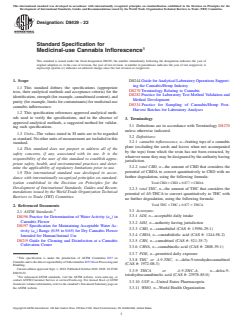
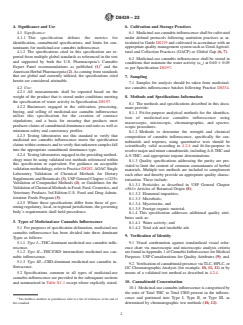
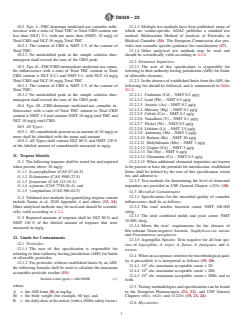
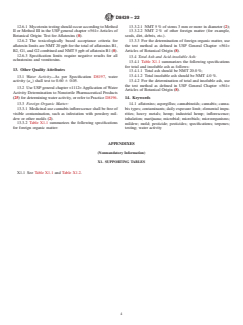
1.1 This standard defines the specifications (appropriate tests, their analytical methods and acceptance criteria) for the identification, strength (for example, cannabinoid content), and purity (for example, limits for contaminants) for medicinal-use cannabis inflorescence.
1.2 This specification references approved analytical methods used to verify the specifications, and in the absence of approved analytical methods, a suggested method for validating such specifications.
1.3 Units—The values stated in SI units are to be regarded as standard. No other units of measurement are included in this standard.
1.4 This standard does not purport to address all of the safety concerns, if any, associated with its use. It is the responsibility of the user of this standard to establish appropriate safety, health, and environmental practices and determine the applicability of regulatory limitations prior to use.
1.5 This international standard was developed in accordance with internationally recognized principles on standardization established in the Decision on Principles for the Development of International Standards, Guides and Recommendations issued by the World Trade Organization Technical Barriers to Trade (TBT) Committee.
- Status
- Published
- Publication Date
- 31-Aug-2022
- Technical Committee
- D37 - Cannabis
- Drafting Committee
- D37.04 - Processing and Handling
Overview
ASTM D8439-22: Standard Specification for Medicinal-use Cannabis Inflorescence provides comprehensive quality and testing requirements for cannabis inflorescence intended for medicinal use. Developed by ASTM Committee D37, this international standard specifies procedures for the identification, cannabinoid content, and purity of medicinal cannabis flower. It outlines acceptable analytical methods, reference values for strength, and establishes limits for contaminants including pesticides, heavy metals, microbials, and mycotoxins. The standard emphasizes product safety, consistency, and regulatory compliance, making it a foundational document for labs, producers, and regulatory bodies in the medicinal cannabis sector.
Key Topics
- Product Identification: Defines cannabis inflorescence as the fruiting tops of the cannabis plant, excluding seeds and certain leaves, with no resin extraction. Visual and microscopic criteria are specified for identity verification.
- Cannabinoid Content: Specifies testing for “total THC” and “total CBD” using chromatographic methods, along with the required ratio thresholds to classify products as THC-dominant, THC/CBD-intermediate, or CBD-dominant.
- Type I: THC-dominant (THC:CBD ≥ 5:1)
- Type II: Intermediate (0.2:1 ≤ THC:CBD < 5:1)
- Type III: CBD-dominant (THC:CBD < 0.2:1)
- Purity and Contaminant Limits: Details limits for pesticides (using Acceptable Daily Intake or ADI), elemental impurities (such as lead, arsenic, and mercury), total aerobic bacteria, molds, yeast, and mycotoxins like aflatoxins, ochratoxins, and vomitoxins.
- Terpene Profiling: Lists required terpenes for identification when above threshold concentrations, including β-caryophyllene, d-limonene, β-myrcene, α-pinene, and γ-terpinolene.
- Sampling and Analytical Methods: References established ASTM, USP, and international methods for sampling, laboratory validation, and analysis of cannabis inflorescence.
- Quality Attributes: Sets additional requirements for water activity, total ash, insoluble ash, and foreign matter to ensure overall product quality and shelf life.
Applications
- Medicinal Cannabis Quality Assurance: Used by cultivators, processors, testing laboratories, and buyers to ensure cannabis products meet consistent quality, potency, and safety specifications.
- Regulatory Compliance: Provides a reference framework for state, federal, and international regulators to harmonize quality standards in medicinal cannabis programs.
- Purchase and Supply Agreements: Serves as a contract standard to verify if batches of medicinal cannabis inflorescence comply with declared cannabinoid ratios, contaminant limits, and labeling requirements.
- Laboratory Testing: Guides analytical labs in selection of validated test methods for cannabinoids, terpenes, microbial contaminants, and chemical impurities.
- Labeling and Packaging: Supports manufacturers and distributors in delivering informative labeling, including cannabinoid content and terpene profile, supporting transparency for patients, healthcare providers, and consumers.
Related Standards
- ASTM D8196: Practice for Determination of Water Activity in Cannabis Flower
- ASTM D8197: Specification for Maintaining Acceptable Water Activity Range for Dry Cannabis
- ASTM D8219: Guide for Cleaning and Disinfection at Cannabis Cultivation Centers
- ASTM D8244: Guide for Analytical Laboratory Operations Supporting the Cannabis/Hemp Industry
- ASTM D8270: Terminology Relating to Cannabis
- ASTM D8282: Practice for Laboratory Test Method Validation and Method Development
- ASTM D8334: Practice for Sampling of Cannabis/Hemp Post-Harvest Batches for Laboratory Analyses
- USP General Chapters: <561> (Botanical origin), <233> (Elemental impurities), <61>, <62>, <1223> (Microbiological testing)
- Global GAP & GACP: Guidelines for good agricultural and collection practices relevant to medicinal plant cultivation
By adhering to ASTM D8439-22, stakeholders can ensure medicinal-use cannabis inflorescence meets rigorous quality, safety, and performance criteria, supporting industry credibility and patient health outcomes. The standard’s thorough approach to analytical testing, contaminant limits, and product labeling makes it essential for any entity involved in the medicinal cannabis supply chain.
Relations
- Refers
ASTM D8282-19 - Standard Practice for Laboratory Test Method Validation and Method Development - Effective Date
- 01-Sep-2019
- Effective Date
- 01-Jan-2019
Get Certified
Connect with accredited certification bodies for this standard

BSI Group
BSI (British Standards Institution) is the business standards company that helps organizations make excellence a habit.

TÜV Rheinland
TÜV Rheinland is a leading international provider of technical services.

TÜV SÜD
TÜV SÜD is a trusted partner of choice for safety, security and sustainability solutions.
Sponsored listings
Frequently Asked Questions
ASTM D8439-22 is a technical specification published by ASTM International. Its full title is "Standard Specification for Medicinal-use Cannabis Inflorescence". This standard covers: SCOPE 1.1 This standard defines the specifications (appropriate tests, their analytical methods and acceptance criteria) for the identification, strength (for example, cannabinoid content), and purity (for example, limits for contaminants) for medicinal-use cannabis inflorescence. 1.2 This specification references approved analytical methods used to verify the specifications, and in the absence of approved analytical methods, a suggested method for validating such specifications. 1.3 Units—The values stated in SI units are to be regarded as standard. No other units of measurement are included in this standard. 1.4 This standard does not purport to address all of the safety concerns, if any, associated with its use. It is the responsibility of the user of this standard to establish appropriate safety, health, and environmental practices and determine the applicability of regulatory limitations prior to use. 1.5 This international standard was developed in accordance with internationally recognized principles on standardization established in the Decision on Principles for the Development of International Standards, Guides and Recommendations issued by the World Trade Organization Technical Barriers to Trade (TBT) Committee.
SCOPE 1.1 This standard defines the specifications (appropriate tests, their analytical methods and acceptance criteria) for the identification, strength (for example, cannabinoid content), and purity (for example, limits for contaminants) for medicinal-use cannabis inflorescence. 1.2 This specification references approved analytical methods used to verify the specifications, and in the absence of approved analytical methods, a suggested method for validating such specifications. 1.3 Units—The values stated in SI units are to be regarded as standard. No other units of measurement are included in this standard. 1.4 This standard does not purport to address all of the safety concerns, if any, associated with its use. It is the responsibility of the user of this standard to establish appropriate safety, health, and environmental practices and determine the applicability of regulatory limitations prior to use. 1.5 This international standard was developed in accordance with internationally recognized principles on standardization established in the Decision on Principles for the Development of International Standards, Guides and Recommendations issued by the World Trade Organization Technical Barriers to Trade (TBT) Committee.
ASTM D8439-22 is classified under the following ICS (International Classification for Standards) categories: 11.120.99 - Other standards related to pharmaceutics. The ICS classification helps identify the subject area and facilitates finding related standards.
ASTM D8439-22 has the following relationships with other standards: It is inter standard links to ASTM D8282-19, ASTM D8219-19. Understanding these relationships helps ensure you are using the most current and applicable version of the standard.
ASTM D8439-22 is available in PDF format for immediate download after purchase. The document can be added to your cart and obtained through the secure checkout process. Digital delivery ensures instant access to the complete standard document.
Standards Content (Sample)
This international standard was developed in accordance with internationally recognized principles on standardization established in the Decision on Principles for the
Development of International Standards, Guides and Recommendations issued by the World Trade Organization Technical Barriers to Trade (TBT) Committee.
Designation:D8439 −22
Standard Specification for
Medicinal-use Cannabis Inflorescence
This standard is issued under the fixed designation D8439; the number immediately following the designation indicates the year of
original adoption or, in the case of revision, the year of last revision.Anumber in parentheses indicates the year of last reapproval.A
superscript epsilon (´) indicates an editorial change since the last revision or reapproval.
1. Scope D8244GuideforAnalyticalLaboratoryOperationsSupport-
ing the Cannabis/Hemp Industry
1.1 This standard defines the specifications (appropriate
D8270Terminology Relating to Cannabis
tests, their analytical methods and acceptance criteria) for the
D8282Practice for Laboratory Test Method Validation and
identification,strength(forexample,cannabinoidcontent),and
Method Development
purity(forexample,limitsforcontaminants)formedicinal-use
D8334 Practice for Sampling of Cannabis/Hemp Post-
cannabis inflorescence.
Harvest Batches for Laboratory Analyses
1.2 This specification references approved analytical meth-
ods used to verify the specifications, and in the absence of
3. Terminology
approved analytical methods, a suggested method for validat-
3.1 Definitions are in accordance with Terminology D8270
ing such specifications.
unless otherwise indicated.
1.3 Units—The values stated in SI units are to be regarded
3.2 Definitions:
asstandard.Nootherunitsofmeasurementareincludedinthis
3.2.1 cannabis inflorescence, n—fruiting tops of a cannabis
standard.
plant (excluding the seeds and leaves when not accompanied
1.4 This standard does not purport to address all of the
by the tops) from which the resin has not been extracted, by
safety concerns, if any, associated with its use. It is the
whatevernametheymaybedesignatedbytheauthorityhaving
responsibility of the user of this standard to establish appro-
jurisdiction.
priate safety, health, and environmental practices and deter-
3.2.2 total CBD, n—the amount of CBD that considers the
mine the applicability of regulatory limitations prior to use.
potential of CBDA to convert quantitatively to CBD with no
1.5 This international standard was developed in accor-
further degradation, using the following formula:
dance with internationally recognized principles on standard-
ization established in the Decision on Principles for the
TotalCBD=CBD+0.877 3CBDA
Development of International Standards, Guides and Recom-
3.2.3 total THC, n—the amount of THC that considers the
mendations issued by the World Trade Organization Technical
potential of ∆9-THCA to convert quantitatively to THC with
Barriers to Trade (TBT) Committee.
no further degradation, using the following formula:
TotalTHC=THC+0.877 3THCA
2. Referenced Documents
3.3 Acronyms:
2.1 ASTM Standards:
3.3.1 ADI, n—acceptable daily intake
D8196Practice for Determination of Water Activity (a )in
w
Cannabis Flower
3.3.2 AHJ, n—authority having jurisdiction
D8197Specification for Maintaining Acceptable Water Ac-
3.3.3 CBD, n—cannabidiol (CAS #: 13956-29-1)
tivity (a ) Range (0.55 to 0.65) for Dry Cannabis Flower
w
3.3.4 CBDA, n—cannabidiolic acid (CAS #: 1244-58-2)
Intended for Human/Animal Use
D8219Guide for Cleaning and Disinfection at a Cannabis
3.3.5 CBN, n—cannabinol (CAS #: 521-35-7)
Cultivation Center
3.3.6 CBNA, n—cannabinolic acid (CAS #: 2808-39-1)
3.3.7 PDE, n—permitted daily exposure
This specification is under the jurisdiction of ASTM Committee D37 on
3.3.8 THC or ∆-9-THC, n—delta-9-tetrahydrocannabinol
CannabisandisthedirectresponsibilityofSubcommitteeD37.04onProcessingand
(CAS #: 1972-08-3)
Handling.
Current edition approved Sept. 1, 2022. Published October 2022. DOI: 10.1520/
3.3.9 THCA or ∆-9-THC-A, n—delta-9-
D8439-22.
tetrahydrocannabinolic acid (CAS #: 23978-85-0)
For referenced ASTM standards, visit the ASTM website, www.astm.org, or
contact ASTM Customer Service at service@astm.org. For Annual Book of ASTM
3.3.10 USP, n—United States Pharmacopeia
Standards volume information, refer to the standard’s Document Summary page on
the ASTM website. 3.3.11 WHO, n—World Health Organization
Copyright © ASTM International, 100 Barr Harbor Drive, PO Box C700, West Conshohocken, PA 19428-2959. United States
D8439−22
4. Significance and Use 6. Cultivation and Storage Practices
4.1 Significance: 6.1 Medicinal-usecannabisinflorescenceshallbecultivated
under defined protocols following sanitation practices as ar-
4.1.1 This specification defines the metrics for
identification, cannabinoid specifications, and limits for con- ticulated in Guide D8219 and cultivated in accordance with an
appropriatequalitymanagementsystemsuchasGoodAgricul-
taminants for medicinal-use cannabis inflorescence.
4.1.2 The specifications cited in this specification are re- tural and Collection Practices (GACP) or Global Gap (6, 7).
ported from multiple global standards as referenced in the text
6.2 Medicinal-use cannabis inflorescence shall be stored in
and supported by both the U.S. Pharmacopeia’s Cannabis
conditions that maintain the water activity (a ) at 0.60 6 0.05
w
Expert Panel recommendations as published (1) and the
as per Specification D8197.
AmericanHerbalPharmacopeia (2).Ascomingfromstandards
that are global and currently utilized, the specifications cited
7. Sampling
herein are considered attainable.
7.1 Samples for analysis should be taken from medicinal-
4.2 Use:
use cannabis inflorescence batches following Practice D8334.
4.2.1 All measurements shall be reported based on the
weight of the product that is stored under conditions meeting 8. Methods and Specifications Information
the specification of water activity in Specification D8197.
8.1 The methods and specifications described in this docu-
4.2.2 Businesses engaged in the cultivation, processing,
ment provide:
buying, and selling of medicinal-use cannabis inflorescence
8.1.1 Fit-for-purpose analytical methods for the identifica-
utilize this specification for the creation of contract
tion of medicinal-use cannabis inflorescence using
stipulations, and a basis for ensuring that products meet
macroscopic, microscopic, chromatographic, and spectro-
producerclaimsofcannabinoiddominanceandratioaswellas
scopic procedures.
minimum safety and consistency profiles.
8.1.2 Methods to determine the strength and chemical
4.2.3 Testing laboratories use this standard to verify that
composition of cannabis inflorescence, specifically the can-
medicinal use cannabis inflorescence meets the specification
nabinoids and terpenes, using quantitative tests should be
claimswithincontractsandtoverifythatunknownsamplesfall
scientifically valid according to 4.2.4 and fit-for-purpose to
into the appropriate cannabinoid dominance type.
resolvemajorandminorcannabinoids,including∆-8-THCand
4.2.4 Testinglaboratoriesengagedintheprovidingmethod-
∆-9-THC; and appropriate terpene determinations.
ology must be using validated test methods referenced within
8.1.3 Quality specifications addressing the purity are pro-
this specification or equivalent. For guidance on acceptable
vided to limit the content of common contaminants of herbal
validationmethodology,refertoPracticeD8282,AOACSingle
materials. Multiple test methods are included to complement
Laboratory Validation of Chemical Methods for Dietary
each other and thereby provide an appropriate quality charac-
SupplementsandBotanicals (3),USPGeneralChapter<1225>
terization. These include:
Validation of Compendial Methods (4), or Guidelines for the
8.1.3.1 Pesticides as described in USP General Chapter
ValidationofChemicalMethodsinFood,Feed,Cosmetics,and
<561> Articles of Botanical Origin (8);
Veterinary Products 3rd Edition-U.S. Food and Drug Admin-
8.1.3.2 Elemental impurities;
istration Foods Program (5).
8.1.3.3 Microbials;
4.2.5 Where these specifications differ from those of gov-
8.1.3.4 Mycotoxins; and
erningregulatory,local,orregionaljurisdictions,thegoverning
8.1.3.5 Foreign organic material.
body’s requirements shall hold precedence.
8.1.4 This specification addresses additional quality attri-
butes such as:
5. Types of Medicinal-use Cannabis Inflorescence
8.1.4.1 Water activity; and
8.1.4.2 Total ash and insoluble ash.
5.1 For purposes of specification delineation, medicinal-use
cannabis inflorescence has been divided into three dominant
9. Verification of Identity
Types as follows:
5.1.1 Type I—THC-dominant medicinal-use cannabis inflo- 9.1 Visual confirmation against standardized visual refer-
rescence.
ence chart via macroscopic and microscopic analysis criteria
5.1.2 Type II—THC/CBD intermediate medicinal-use can- arefoundinAppendix1ofCannabisInflorescenceforMedical
nabis inflorescence. Purposes: USP Considerations for Quality Attributes (9); and
5.1.3 Type III—CBD-dominant medicinal-use cannabis in-
9.2 VerificationofcannabinoidpresenceviaTLC,HPLC,or
florescence.
GC ChromatographicAnalysis (for example, 10, 11, 12)orby
5.2 Specifications common to all types of medicinal-use means of a validated test method as described in 4.2.4.
cannabis inflorescence are provided in the subsequent sections
10. Cannabinoid Concentration
and summarized in Table X1.1 except where explicitly stated.
10.1 Medicinal-usecannabisinflorescenceiscategorizedby
the ratio of Total THC to Total CBD present in the inflores-
cence and portioned into Type I, Type II, or Type III, as
The boldface numbers in parentheses refer to a list of references at the end of
this standard. determined by chromatographic test methods (10, 12).
D8439−22
10.2 Type I—THC-dominant medicinal-use cannabis inflo- 12.1.3 Multiple test methods have been published, many of
rescence with a ratio of Total THC to Total CBD content not which are vendor-specific. AOAC publishes a standard test
less than (NLT) 5:1, with not more than (NMT) 10 mg/g of method: Multiresidue Method of Analysis of Pesticides in
Total CBD and NLT 10 mg/g Total THC. Medical Cannabis (16). The European Commission also pro-
10.2.1 The content of CBN is NMT 2% of the content of vides non-cannabis specific guidance for consideration (17).
Total THC. 12.1.4 Other analytical test methods may be used and
10.2.2 No unidentified peak in the sample solution chro- should be scientifically valid according to 4.2.4.
matogram shall exceed the area of the CBN peak.
12.2 Elemental Impurities:
10.3 Type II—THC/CBDintermediatemedicinal-usecanna- 12.2.1 The user of this specification is responsible for
bis inflorescence with a ratio of Total THC content to Total referring to their authority having jurisdiction (AHJ) for limits
CBD content is NLT 0.2:1 and NMT 5:1, with NLT 10 mg/g of allowable elements.
Total CBD and NLT 10 mg/g Total THC. 12.2.2 IntheabsenceofestablishedlimitsfromtheAHJ,the
10.3.1 The content of CBN is NMT 2% of the content of following list should be followed, and is summarized in Table
Total THC. X1.2.
10.3.2 No unidentified peak in the sample solution chro- 12.2.2.1 Cadmium (Cd) – NMT 0.2 µg/g
matogram shall exceed the area of the CBN peak. 12.2.2.2 Lead (Pb) – NMT 0.5 µg/g
12.2.2.3 Arsenic (As) – NMT 0.2 µg/g
10.4 Type III—CBD-dominant medicinal-use cannabis in-
12.2.2.4 Mercury (Hg) – NMT 0.1 µg/g
florescence with a ratio of Total THC content to Total CBD
12.2.2.5 Cobalt (Co) – NMT 0.3 µg/g
contentisNMT1:5andcontainsNMT10mg/gtotalTHCand
12.2.2.6 Vanadium (V) – NMT 0.1 µg/g
NLT 10 mg/g total CBD.
12.2.2.7 Nickel (Ni) – NMT 0.5 µg/g
10.5 All Types:
12.2.2.8 Lithium (Li) – NMT 2.5 µg/g
10.5.1 All cannabinoids present in an amount of 10 mg/g or
12.2.2.9 Antimony (Sb) – NMT 2 µg/g
more shall be identified with the name and amount.
12.2.2.10 Barium (Ba) – NMT 30 µg/g
10.5.2 All Types shall contain NLT 80% and NMT 120%
12.2.2.11 Molybdenum (Mo) – NMT 1 µg/g
of the labeled amount of cannabinoids measured in mg/g.
12.2.2.12 Copper (Cu) – NMT 3 µg/g
12.2.2.13 Tin (Sn) – NMT 6 µg/g
11. Terpene Identity
12.2.2.14 Chromium (Cr) – NMT 0.3 µg/g
12.2.2.15 When additional elemental impurities are known
11.1 The following terpenes shall be tested for and reported
to be present or have the potential for introduction, established
when present above 10 mg/g:
limits shall be defined by the user of this specification, tested
11.1.1 β-caryophyllene (CAS 87-44-5)
for, and adhered to.
11.1.2 D-limonene (CAS 5989-27-5)
11.1.3 β-myrcene (CAS 123-35-3) 12.2.3 Test methods for determining the level of elemental
impurities are provided in USP, General Chapter <233> (18).
11.1.4 α-pinene (CAS 7785-26-4), and
11.1.5 γ-terpinolene (CAS 586-62-9)
12.3 Microbial Contaminants:
12.3.1 Specifications for the microbial quality of cannabis
11.2 Validated test methods for quantifying terpene content
include Sarma et al. 2020 Appendix 4 and others (13, 14). inflorescence shall be as follows:
12.3.2 The total aerobic bacterial count: NMT 100000
Other analytical methods may be used and should be scientifi-
cally valid according to 4.2.4. cfu/g;
12.3.3 The total combined molds and yeast count: NMT
11.3 Reported amounts of terpenes shall be NLT 80% and
10000 cfu/g;
NMT 120% of the labeled amount of terpenes that were
12.3.4 Meets the tests’ requirements for the absence of
measured in mg/g.
bile-tolerant Gram-negative bacteria, Staphylococcus aureus
and Pseudomonas aeruginosa.
12. Limits for Contaminants
12.3.5 Aspergillus Species: Tests negative for all four spe-
12.1 Pesticides:
cies of Aspergillus, A. niger, A. flavus, A. fumigatus, and A.
12.1.1 The user of this specification is responsible for
terreus.
referring to their authority having jurisdiction (AHJ) for limits
12.4 Whenanacceptancecriterionformicrobiologicalqual-
of allowable pesticides.
ity is prescribed, it is interpreted as follows (19, 20):
12.1.2 For pesticides without established limits by anAHJ,
12.4.1 10 cfu: maximum acceptable count = 20;
the following formula shall be used to calculate the maximum
12.4.2 10 cfu: maximum acceptable count = 200;
acceptable pesticide residue (15):
12.4.3 10 cfu: maximum acceptable count = 2000; and so
ResidueLimit ~ppm!=AM/1000B (1)
forth.
where:
12.5 Testing methodologies and specifications can be found
in the European Pharmacopeia (21, 22), and USP General
A = the ADI from (8) in mg/kg;
M = the body weight (for example, 60 kg); and
Chapters <61>, <62>, and <1223> (19, 23, 24).
B = thedailydoseofthearticle(witha1000×safetyfactor).
12.6 Mycotoxins:
D8439−22
12.6.1 MycotoxintestingshouldoccuraccordingtoMethod 13.3.2.1 NMT 5% of stems 3 mm or more in diameter (2);
II or Method III in the USP general chapte
...