

ASTM C307-23
(Test Method)Standard Test Method for Tensile Strength of Chemical-Resistant Mortar, Grouts, and Monolithic Surfacings
General Information
- Abstract
SIGNIFICANCE AND USE
4.1 It is recognized that chemical-resistant mortars, grouts, and monolithic surfacings are not usually under tension when in service; however, such data are useful for purposes of determining the rate of cure and other properties.
4.2 This test method is not recommended for mortars, grouts, and monolithic surfacings containing aggregate greater than 1/4 in.
SCOPE
1.1 This test method covers the determination of tensile strength of cured chemical-resistant materials in the form of molded briquets. These materials include mortars, brick and tile grouts, machinery grouts, and monolithic surfacings. These materials shall be based on resin, silicate, silica, or sulfur binders.
1.2 The values stated in inch-pound units are to be regarded as standard. The values given in parentheses are mathematical conversions to SI units that are provided for information only and are not considered standard.
1.3 This standard does not purport to address all of the safety concerns, if any, associated with its use. It is the responsibility of the user of this standard to establish appropriate safety, health, and environmental practices and determine the applicability of regulatory limitations prior to use.
1.4 This international standard was developed in accordance with internationally recognized principles on standardization established in the Decision on Principles for the Development of International Standards, Guides and Recommendations issued by the World Trade Organization Technical Barriers to Trade (TBT) Committee.
- Status
- Published
- Publication Date
- 31-May-2023
- Technical Committee
- D01 - Paint and Related Coatings, Materials, and Applications
- Drafting Committee
- D01.46 - Industrial Protective Coatings
Buy Documents

ASTM C307-23 - Standard Test Method for Tensile Strength of Chemical-Resistant Mortar, Grouts, and Monolithic Surfacings
REDLINE ASTM C307-23 - Standard Test Method for Tensile Strength of Chemical-Resistant Mortar, Grouts, and Monolithic Surfacings
Overview
ASTM C307-23: Standard Test Method for Tensile Strength of Chemical-Resistant Mortar, Grouts, and Monolithic Surfacings specifies procedures for measuring the tensile strength of cured chemical-resistant materials molded as briquets. This international standard, developed by ASTM, is crucial for industries relying on the performance of mortars, grouts, and monolithic surfacings in aggressive chemical environments.
Chemical-resistant mortars and grouts are typically not under tension during service, but understanding their tensile strength provides insights into material curing, structural integrity, and suitability for demanding applications. ASTM C307-23 ensures consistent and reproducible assessment, supporting material selection, quality control, and research in construction and industrial projects.
Key Topics
- Scope of Application: Covers resin, silicate, silica, and sulfur-binder based chemical-resistant mortars, grouts, machinery grouts, and monolithic surfacings. Not recommended for mixes containing aggregates larger than 1/4 inch.
- Test Specimens: Standardized molded briquets are used to ensure uniform testing and reporting.
- Procedures:
- Preparation includes mixing components as specified by manufacturers and conditioning specimens at defined temperatures.
- Testing involves measuring depth and width at the waist of briquets and applying tension using calibrated machines.
- Calculation of Tensile Strength: Determined as the maximum load (stress) at failure, calculated using the formula provided in the standard.
- Reporting Results: Comprehensive documentation of materials, mixing ratios, conditioning, test conditions, and tensile strength results is required for quality assurance and comparability.
- Precision and Quality: Defines repeatability and reproducibility through interlaboratory studies, supporting consistent application across different settings. Faulty or inconsistent specimens are to be rejected.
- Safety and Compliance: Users must establish appropriate laboratory safety and regulatory adherence.
Applications
ASTM C307-23 is vital for industries and sectors where chemical resistance and structural performance of mortars and grouts are critical:
- Industrial Construction: Testing chemical-resistant mortars for secondary containment, flooring, and lining in chemical processing plants, refineries, and wastewater facilities.
- Machinery Installation: Ensuring the strength and durability of machinery grouts used for equipment support under aggressive environments.
- Brick and Tile Projects: Evaluating grouts used for brick and tile installations in laboratories and industrial settings where exposure to harsh chemicals is expected.
- Material Qualification and QC: Benchmarking material properties during product development, specification, acceptance, and routine quality control in manufacturing environments.
Understanding tensile strength helps engineers and materials scientists assess curing rates, select appropriate materials, and ensure the long-term reliability of installations subjected to chemical exposure.
Related Standards
For comprehensive evaluation and terminology, ASTM C307-23 references and is supported by other ASTM standards, including:
- ASTM C904: Terminology Relating to Chemical-Resistant Nonmetallic Materials
- ASTM E4: Practices for Force Calibration and Verification of Testing Machines
- ASTM E177: Practice for Use of the Terms Precision and Bias in ASTM Test Methods
- ASTM E691: Practice for Conducting an Interlaboratory Study to Determine the Precision of a Test Method
Together, these standards create a robust framework for testing, quality assurance, and compliance in projects involving chemical-resistant mortars, grouts, and monolithic surfacings.
Keywords: ASTM C307, chemical-resistant mortar, grout tensile strength, monolithic surfacing, resin binder, silicate mortar, sulfur mortar, industrial coatings, material testing standards, quality control.
Relations
- Refers
ASTM C904-01(2018) - Standard Terminology Relating to Chemical-Resistant Nonmetallic Materials - Effective Date
- 01-Nov-2018
- Effective Date
- 01-Jun-2014
- Effective Date
- 01-May-2014
- Effective Date
- 01-May-2013
- Effective Date
- 01-May-2013
- Refers
ASTM C904-01(2012) - Standard Terminology Relating to Chemical-Resistant Nonmetallic Materials - Effective Date
- 01-Aug-2012
- Effective Date
- 01-Nov-2011
- Effective Date
- 01-Oct-2010
- Effective Date
- 01-Jun-2010
- Effective Date
- 01-Nov-2009
- Effective Date
- 01-Apr-2009
- Effective Date
- 01-Dec-2008
- Effective Date
- 01-Oct-2008
- Effective Date
- 01-Oct-2008
- Effective Date
- 01-Jan-2007
Buy Documents
ASTM C307-23 - Standard Test Method for Tensile Strength of Chemical-Resistant Mortar, Grouts, and Monolithic Surfacings
REDLINE ASTM C307-23 - Standard Test Method for Tensile Strength of Chemical-Resistant Mortar, Grouts, and Monolithic Surfacings
Get Certified
Connect with accredited certification bodies for this standard

DIBt (Deutsches Institut für Bautechnik)
German Institute for Building Technology.
DIN CERTCO
DIN Group product certification.

Aboma Certification B.V.
Specialized in construction, metal, and transport sectors.
Sponsored listings
Frequently Asked Questions
ASTM C307-23 is a standard published by ASTM International. Its full title is "Standard Test Method for Tensile Strength of Chemical-Resistant Mortar, Grouts, and Monolithic Surfacings". This standard covers: SIGNIFICANCE AND USE 4.1 It is recognized that chemical-resistant mortars, grouts, and monolithic surfacings are not usually under tension when in service; however, such data are useful for purposes of determining the rate of cure and other properties. 4.2 This test method is not recommended for mortars, grouts, and monolithic surfacings containing aggregate greater than 1/4 in. SCOPE 1.1 This test method covers the determination of tensile strength of cured chemical-resistant materials in the form of molded briquets. These materials include mortars, brick and tile grouts, machinery grouts, and monolithic surfacings. These materials shall be based on resin, silicate, silica, or sulfur binders. 1.2 The values stated in inch-pound units are to be regarded as standard. The values given in parentheses are mathematical conversions to SI units that are provided for information only and are not considered standard. 1.3 This standard does not purport to address all of the safety concerns, if any, associated with its use. It is the responsibility of the user of this standard to establish appropriate safety, health, and environmental practices and determine the applicability of regulatory limitations prior to use. 1.4 This international standard was developed in accordance with internationally recognized principles on standardization established in the Decision on Principles for the Development of International Standards, Guides and Recommendations issued by the World Trade Organization Technical Barriers to Trade (TBT) Committee.
SIGNIFICANCE AND USE 4.1 It is recognized that chemical-resistant mortars, grouts, and monolithic surfacings are not usually under tension when in service; however, such data are useful for purposes of determining the rate of cure and other properties. 4.2 This test method is not recommended for mortars, grouts, and monolithic surfacings containing aggregate greater than 1/4 in. SCOPE 1.1 This test method covers the determination of tensile strength of cured chemical-resistant materials in the form of molded briquets. These materials include mortars, brick and tile grouts, machinery grouts, and monolithic surfacings. These materials shall be based on resin, silicate, silica, or sulfur binders. 1.2 The values stated in inch-pound units are to be regarded as standard. The values given in parentheses are mathematical conversions to SI units that are provided for information only and are not considered standard. 1.3 This standard does not purport to address all of the safety concerns, if any, associated with its use. It is the responsibility of the user of this standard to establish appropriate safety, health, and environmental practices and determine the applicability of regulatory limitations prior to use. 1.4 This international standard was developed in accordance with internationally recognized principles on standardization established in the Decision on Principles for the Development of International Standards, Guides and Recommendations issued by the World Trade Organization Technical Barriers to Trade (TBT) Committee.
ASTM C307-23 is classified under the following ICS (International Classification for Standards) categories: 91.100.10 - Cement. Gypsum. Lime. Mortar. The ICS classification helps identify the subject area and facilitates finding related standards.
ASTM C307-23 has the following relationships with other standards: It is inter standard links to ASTM C904-01(2018), ASTM E4-14, ASTM E177-14, ASTM E177-13, ASTM E691-13, ASTM C904-01(2012), ASTM E691-11, ASTM E177-10, ASTM E4-10, ASTM E4-09a, ASTM E4-09, ASTM E4-08, ASTM E691-08, ASTM E177-08, ASTM E4-07. Understanding these relationships helps ensure you are using the most current and applicable version of the standard.
ASTM C307-23 is available in PDF format for immediate download after purchase. The document can be added to your cart and obtained through the secure checkout process. Digital delivery ensures instant access to the complete standard document.
Standards Content (Sample)
This international standard was developed in accordance with internationally recognized principles on standardization established in the Decision on Principles for the
Development of International Standards, Guides and Recommendations issued by the World Trade Organization Technical Barriers to Trade (TBT) Committee.
Designation: C307 − 23
Standard Test Method for
Tensile Strength of Chemical-Resistant Mortar, Grouts, and
Monolithic Surfacings
This standard is issued under the fixed designation C307; the number immediately following the designation indicates the year of
original adoption or, in the case of revision, the year of last revision. A number in parentheses indicates the year of last reapproval. A
superscript epsilon (´) indicates an editorial change since the last revision or reapproval.
This standard has been approved for use by agencies of the U.S. Department of Defense.
1. Scope E4 Practices for Force Calibration and Verification of Test-
ing Machines
1.1 This test method covers the determination of tensile
E177 Practice for Use of the Terms Precision and Bias in
strength of cured chemical-resistant materials in the form of
ASTM Test Methods
molded briquets. These materials include mortars, brick and
E691 Practice for Conducting an Interlaboratory Study to
tile grouts, machinery grouts, and monolithic surfacings. These
Determine the Precision of a Test Method
materials shall be based on resin, silicate, silica, or sulfur
binders.
3. Terminology
1.2 The values stated in inch-pound units are to be regarded
3.1 Definitions:
as standard. The values given in parentheses are mathematical
3.1.1 For definitions of terms used in this test method, see
conversions to SI units that are provided for information only
Terminology C904.
and are not considered standard.
1.3 This standard does not purport to address all of the
4. Significance and Use
safety concerns, if any, associated with its use. It is the
4.1 It is recognized that chemical-resistant mortars, grouts,
responsibility of the user of this standard to establish appro-
and monolithic surfacings are not usually under tension when
priate safety, health, and environmental practices and deter-
in service; however, such data are useful for purposes of
mine the applicability of regulatory limitations prior to use.
determining the rate of cure and other properties.
1.4 This international standard was developed in accor-
dance with internationally recognized principles on standard-
4.2 This test method is not recommended for mortars,
ization established in the Decision on Principles for the
grouts, and monolithic surfacings containing aggregate greater
Development of International Standards, Guides and Recom-
than ⁄4 in.
mendations issued by the World Trade Organization Technical
Barriers to Trade (TBT) Committee.
5. Apparatus
5.1 Weighing Equipment, shall be capable of weighing
2. Referenced Documents
materials or specimens to 60.3 % accuracy.
2.1 ASTM Standards:
5.2 Specimen Molds—The molds for making briquet test
C904 Terminology Relating to Chemical-Resistant Nonme-
specimens shall be sufficiently rigid to prevent deformation
tallic Materials
during molding and shall be made of corrosion-resistant
material. Gang molds, when used, shall be of the type shown in
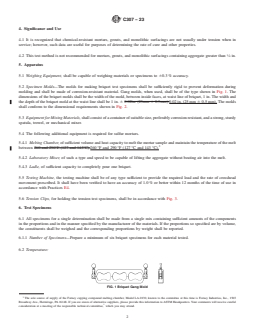
Fig. 1. The dimensions of the briquet molds shall be the width
This test method is under the jurisdiction of ASTM Committee D01 on Paint
of the mold, between inside faces, at waist line of briquet, 1 in.
and Related Coatings, Materials, and Applications and is the direct responsibility of
Subcommittee D01.46 on Industrial Protective Coatings.
The width and the depth of the briquet mold at the waist line
Current edition approved June 1, 2023. Published June 2023. Originally
shall be 1 in. 6 0.02 in. (25 mm 6 0.5 mm). The molds shall
published in 1953. Last previous edition approved in 2018 as C307 – 18. DOI:
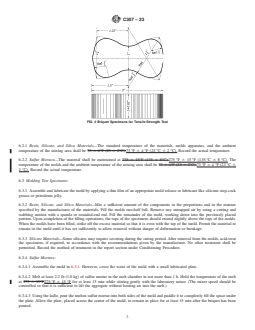
conform to the dimensional requirements shown in Fig. 2.
10.1520/C0307-23.
For referenced ASTM standards, visit the ASTM website, www.astm.org, or
5.3 Equipment for Mixing Materials, shall consist of a
contact ASTM Customer Service at service@astm.org. For Annual Book of ASTM
container of suitable size, preferably corrosion resistant, and a
Standards volume information, refer to the standard’s Document Summary page on
the ASTM website. strong, sturdy spatula, trowel, or mechanical mixer.
Copyright © ASTM International, 100 Barr Harbor Drive, PO Box C700, West Conshohocken, PA 19428-2959. United States
C307 − 23
5.4 The following additional equipment is required for
sulfur mortars.
5.4.1 Melting Chamber, of sufficient volume and heat ca-
pacity to melt the mortar sample and maintain the temperature
of the melt between 260 °F and 290 °F (127 °C and 143 °C).
FIG. 1 Briquet Gang Mold
5.4.2 Laboratory Mixer, of such a type and speed to be
capable of lifting the aggregate without beating air into the
melt.
5.4.3 Ladle, of sufficient capacity to completely pour one
briquet.
5.5 Testing Machine, the testing machine shall be of any
type sufficient to provide the required load and the rate of
crosshead movement prescribed. It shall have been verified to
have an accuracy of 1.0 % or better within 12 months of the
time of use in accordance with Practices E4.
5.6 Tension Clips, for holding the tension test specimens,
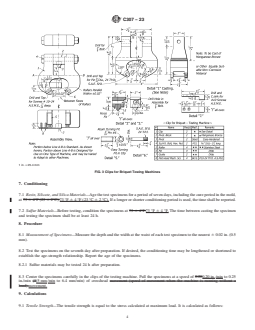
shall be in accordance with Fig. 3.
The sole source of supply of the Forney capping compound melting chamber,
Model LA-0130, known to the committee at this time is Forney Industries, Inc.,
1565 Broadway Ave., Hermitage, PA 16148. If you are aware of alternative
suppliers, please provide this information to ASTM Headquarters. Your comments
will receive careful consideration at a meeting of the responsible technical
committee, which you may attend.
FIG. 2 Briquet Specimens for Tensile Strength Test
1 in. = 25.4 mm
FIG. 3 Clips for Briquet Towing Machines
C307 − 23
6. Test Specimens 7. Conditioning
7.1 Resin, Silicate, and Silica Materials—Age the test
6.1 All specimens for a single determination shall be made
specimens for a period of seven days, including the cure period
from a single mix containing sufficient amounts of the com-
in the mold, at 73 °F 6 4 °F (23 °C 6 2 °C). If a longer or
ponents in the proportions and in the manner specified by the
shorter conditioning period is used, the time shall be reported.
manufacturer of the materials. If the proportions so specified
are by volume, the constituents shall be weighed and the
7.2 Sulfur Materials—Before testing, condition the speci-
corresponding proportions by weight shall be reported.
mens at 73 °F 6 4 °F. The time between casting the specimen
and testing the specimen shall be at least 24 h.
6.1.1 Number of Specimens—Prepare a minimum of six
briquet specimens for each material tested.
8. Procedure
6.2 Temperature:
8.1 Measurement of Specimens—Measure the depth and the
6.2.1 Resin, Silicate, and Silica Materials—The standard
width at the waist of each test specimen to the nearest 6 0.02
temperature of the materials, molds apparatus, and the ambient
in. (0.5 mm).
temperature of the mixing area shall be 73 °F 6 4 °F (23 °C 6
8.2 Test the specimens on the seventh day after preparation.
2 °C). Record the actual temperature.
If desired, the conditioning time may be lengthened or short-
6.2.2 Sulfur Mortars—The material shall be maintained at
ened to establish the age-strength relationship. Report the age
275 °F 6 15 °F (135 °C 6 8 °C). The temperature of the molds
of the specimens.
and the ambient temperature of the mixing area shall be 73 °F
8.2.1 Sulfur materials may be tested 24 h after preparation.
6 4 °F (23 °C 6 2 °C). Record the actual temperature.
8.3 Center the specimens carefully in the clips of the testing
6.3 Molding Test Specimens:
machine. Pull the specimens at a speed of 0.20 in. ⁄min to 0.25
6.3.1 Assemble and lubricate the mold by applying a thin in./min (5 mm ⁄min to 6.4 mm/min) of crosshead movement.
film of an appropriate mold release or lubricant like silicone
9. Calculations
stop-cock grease or petroleum jelly.
9.1 Tensile Strength—The tensile strength is equal to the
6.3.2 Resin, Silica
...
This document is not an ASTM standard and is intended only to provide the user of an ASTM standard an indication of what changes have been made to the previous version. Because
it may not be technically possible to adequately depict all changes accurately, ASTM recommends that users consult prior editions as appropriate. In all cases only the current version
of the standard as published by ASTM is to be considered the official document.
Designation: C307 − 18 C307 − 23
Standard Test Method for
Tensile Strength of Chemical-Resistant Mortar, Grouts, and
Monolithic Surfacings
This standard is issued under the fixed designation C307; the number immediately following the designation indicates the year of
original adoption or, in the case of revision, the year of last revision. A number in parentheses indicates the year of last reapproval. A
superscript epsilon (´) indicates an editorial change since the last revision or reapproval.
This standard has been approved for use by agencies of the U.S. Department of Defense.
1. Scope
1.1 This test method covers the determination of tensile strength of cured chemical-resistant materials in the form of molded
briquets. These materials include mortars, brick and tile grouts, machinery grouts, and monolithic surfacings. These materials shall
be based on resin, silicate, silica, or sulfur binders.
1.2 The values stated in inch-pound units are to be regarded as standard. The values given in parentheses are mathematical
conversions to SI units that are provided for information only and are not considered standard.
1.3 This standard does not purport to address all of the safety concerns, if any, associated with its use. It is the responsibility
of the user of this standard to establish appropriate safety, health, and environmental practices and determine the applicability of
regulatory limitations prior to use.
1.4 This international standard was developed in accordance with internationally recognized principles on standardization
established in the Decision on Principles for the Development of International Standards, Guides and Recommendations issued
by the World Trade Organization Technical Barriers to Trade (TBT) Committee.
2. Referenced Documents
2.1 ASTM Standards:
C904 Terminology Relating to Chemical-Resistant Nonmetallic Materials
E4 Practices for Force Calibration and Verification of Testing Machines
E177 Practice for Use of the Terms Precision and Bias in ASTM Test Methods
E691 Practice for Conducting an Interlaboratory Study to Determine the Precision of a Test Method
3. Terminology
3.1 Definitions:
3.1.1 For definitions of terms used in this test method, see Terminology C904.
This test method is under the jurisdiction of ASTM Committee D01 on Paint and Related Coatings, Materials, and Applications and is the direct responsibility of
Subcommittee D01.46 on Industrial Protective Coatings.
Current edition approved July 1, 2018June 1, 2023. Published November 2018June 2023. Originally published in 1953. Last previous edition approved in 20122018 as
C307C307 – 18. – 03 (2012). DOI: 10.1520/C0307-18. DOI: 10.1520/C0307-23.
For referenced ASTM standards, visit the ASTM website, www.astm.org, or contact ASTM Customer Service at service@astm.org. For Annual Book of ASTM Standards
volume information, refer to the standard’s Document Summary page on the ASTM website.
Copyright © ASTM International, 100 Barr Harbor Drive, PO Box C700, West Conshohocken, PA 19428-2959. United States
C307 − 23
4. Significance and Use
4.1 It is recognized that chemical-resistant mortars, grouts, and monolithic surfacings are not usually under tension when in
service; however, such data are useful for purposes of determining the rate of cure and other properties.
4.2 This test method is not recommended for mortars, grouts, and monolithic surfacings containing aggregate greater than ⁄4 in.
5. Apparatus
5.1 Weighing Equipment, shall be capable of weighing materials or specimens to 60.3 % accuracy.
5.2 Specimen Molds—The molds for making briquet test specimens shall be sufficiently rigid to prevent deformation during
molding and shall be made of corrosion-resistant material. Gang molds, when used, shall be of the type shown in Fig. 1. The
dimensions of the briquet molds shall be the width of the mold, between inside faces, at waist line of briquet, 1 in. The width and
the depth of the briquet mold at the waist line shall be 1 in. 6 0.02in. (25mm 6 0.5mm).0.02 in. (25 mm 6 0.5 mm). The molds
shall conform to the dimensional requirements shown in Fig. 2.
5.3 Equipment for Mixing Materials, shall consist of a container of suitable size, preferably corrosion resistant, and a strong, sturdy
spatula, trowel, or mechanical mixer.
5.4 The following additional equipment is required for sulfur mortars.
5.4.1 Melting Chamber, of sufficient volume and heat capacity to melt the mortar sample and maintain the temperature of the melt
between 260 and 290°F (127 and 143°C).260 °F and 290 °F (127 °C and 143 °C).
5.4.2 Laboratory Mixer, of such a type and speed to be capable of lifting the aggregate without beating air into the melt.
5.4.3 Ladle, of sufficient capacity to completely pour one briquet.
5.5 Testing Machine, the testing machine shall be of any type sufficient to provide the required load and the rate of crosshead
movement prescribed. It shall have been verified to have an accuracy of 1.0 % or better within 12 months of the time of use in
accordance with Practices E4.
5.6 Tension Clips, for holding the tension test specimens, shall be in accordance with Fig. 3.
6. Test Specimens
6.1 All specimens for a single determination shall be made from a single mix containing sufficient amounts of the components
in the proportions and in the manner specified by the manufacturer of the materials. If the proportions so specified are by volume,
the constituents shall be weighed and the corresponding proportions by weight shall be reported.
6.1.1 Number of Specimens—Prepare a minimum of six briquet specimens for each material tested.
6.2 Temperature:
FIG. 1 Briquet Gang Mold
The sole source of supply of the Forney capping compound melting chamber, Model LA-0130, known to the committee at this time is Forney Industries, Inc., 1565
Broadway Ave., Hermitage, PA 16148. If you are aware of alternative suppliers, please provide this information to ASTM Headquarters. Your comments will receive careful
consideration at a meeting of the responsible technical committee, which you may attend.
C307 − 23
FIG. 2 Briquet Specimens for Tensile Strength Test
6.2.1 Resin, Silicate, and Silica Materials—The standard temperature of the materials, molds apparatus, and the ambient
temperature of the mixing area shall be 73 6 4°F (23 6 2°C).73 °F 6 4 °F (23 °C 6 2 °C). Record the actual temperature.
6.2.2 Sulfur Mortars—The material shall be maintained at 275 6 15°F (135 6 8°C).275 °F 6 15 °F (135 °C 6 8 °C). The
temperature of the molds and the ambient temperature of the mixing area shall be 73 6 4°F (23 6 2°C).73 °F 6 4 °F (23 °C 6
2 °C). Record the actual temperature.
6.3 Molding Test Specimens:
6.3.1 Assemble and lubricate the mold by applying a thin film of an appropriate mold release or lubricant like silicone stop-cock
grease or petroleum jelly.
6.3.2 Resin, Silicate, and Silica Materials—Mix a sufficient amount of the components in the proportions and in the manner
specified by the manufacturer of the materials. Fill the molds one-half full. Remove any entrapped air by using a cutting and
stabbing motion with a spatula or rounded-end rod. Fill the remainder of the mold, working down into the previously placed
portion. Upon completion of the filling operations, the tops of the specimens should extend slightly above the tops of the molds.
When the molds have been filled, strike off the excess material so that it is even with the top of the mold. Permit the material to
remain in the mold until it has set sufficiently to allow removal without danger of deformation or breakage.
6.3.3 Silicate Materials—Some silicates may require covering during the curing period. After removal from the molds, acid-treat
the specimens, if required, in accordance with the recommendations given by the manufacturer. No other treatment shall be
permitted. Record the method of treatment in the report section under Conditioning Procedure.
6.3.4 Sulfur Mortars:
6.3.4.1 Assemble the mold in 6.3.1.
...