

ASTM C308-18(2023)
(Practice)Standard Practice for Working, Initial Setting, and Service Strength Setting Times of Chemical-Resistant Resin Mortars
General Information
- Abstract
SIGNIFICANCE AND USE
4.1 These methods offer a means of estimating the working time, initial setting time and service strength setting time of chemical-resistant resin mortars. The results obtained should serve as a guide in, but not as the sole basis for, selection of a chemical-resistant mortar for a particular application.
SCOPE
1.1 These methods are used to estimate the working, initial setting, and service strength setting times of chemical-resistant resin mortars.
1.2 The values stated in SI units are to be regarded as standard. The values given in parentheses are mathematical conversions to inch-pound units that are provided for information only and are not considered standard.
1.3 This standard does not purport to address all of the safety concerns, if any, associated with its use. It is the responsibility of the user of this standard to establish appropriate safety, health, and environmental practices and determine the applicability of regulatory limitations prior to use.
1.4 This international standard was developed in accordance with internationally recognized principles on standardization established in the Decision on Principles for the Development of International Standards, Guides and Recommendations issued by the World Trade Organization Technical Barriers to Trade (TBT) Committee.
- Status
- Published
- Publication Date
- 31-May-2023
- Technical Committee
- D01 - Paint and Related Coatings, Materials, and Applications
- Drafting Committee
- D01.46 - Industrial Protective Coatings


Overview
ASTM C308-18(2023) - Standard Practice for Working, Initial Setting, and Service Strength Setting Times of Chemical-Resistant Resin Mortars establishes standardized test methods to estimate the working time, initial setting time, and service strength setting time of chemical-resistant resin mortars. This practice provides a consistent basis for comparing products, supporting the selection and quality control of chemical-resistant mortars used in harsh industrial environments. However, results should complement, not exclusively dictate, material selection for specific applications.
Key Topics
Working Time: Indicates how long the chemical-resistant resin mortar remains usable and workable after mixing. Monitoring the working time helps applicators handle and install materials efficiently.
Initial Setting Time: Refers to the interval necessary for the resin mortar to start hardening, offering insight into when subsequent construction or finishing processes can begin.
Service Strength Setting Time: Determines the time required for the mortar to achieve at least 90% of the manufacturer's stated tensile strength. This ensures the installation reaches reliable performance before being placed in service.
Apparatus and Measurement: Utilizes specific equipment such as weighing devices, mixing pans, bricklayer’s trowels, prescribed brick types, and the Vicat apparatus for setting time characterization, ensuring repeatability and reliability in results.
Standard Temperature Compliance: All testing should be performed at a controlled temperature of 23°C ±2°C (73°F ±4°F) unless otherwise agreed between user and manufacturer.
Safety and Compliance: User responsibility includes adherence to safety, health, and environmental protocols, and compliance with relevant regulatory limitations.
Applications
ASTM C308-18(2023) is vital for professionals involved in the specification, application, and quality assurance of chemical-resistant resin mortars, including:
- Industrial Flooring: Ensuring prompt and durable installation of resin-based flooring in chemical processing plants, laboratories, and food & beverage facilities.
- Protective Linings: For tanks, secondary containment, or surfaces exposed to aggressive chemicals, accurate timing measurements minimize installation risks and optimize performance.
- Masonry Work: Application in projects requiring enhanced chemical resistance in bricks and block installations, ensuring appropriate cure times before exposure to harsh environments.
- Quality Control: Manufacturers and contractors can compare mortar performance, verify materials meet project timelines, and document compliance with contractual and regulatory requirements.
Adhering to the guidelines in ASTM C308-18(2023) supports project reliability, minimizes downtime, and ensures long-term chemical resistance of installations.
Related Standards
ASTM C308-18(2023) references and aligns with other key ASTM standards and terminology, including:
- ASTM C279 - Specification for Chemical-Resistant Masonry Units
- ASTM C307 - Test Method for Tensile Strength of Chemical-Resistant Mortar, Grouts, and Monolithic Surfacings
- ASTM C904 - Terminology Relating to Chemical-Resistant Nonmetallic Materials
These standards, collectively, offer a comprehensive framework for selecting, applying, and verifying chemical-resistant systems in industrial environments.
Keywords: ASTM C308, chemical-resistant resin mortars, working time, initial setting time, service strength setting time, industrial flooring, protective coatings, mortar application, standard practice, performance testing.
Relations
- Refers
ASTM C904-01(2018) - Standard Terminology Relating to Chemical-Resistant Nonmetallic Materials - Effective Date
- 01-Nov-2018
- Effective Date
- 15-Dec-2013
- Effective Date
- 01-Jun-2013
- Effective Date
- 01-Dec-2012
- Effective Date
- 01-Aug-2012
- Refers
ASTM C904-01(2012) - Standard Terminology Relating to Chemical-Resistant Nonmetallic Materials - Effective Date
- 01-Aug-2012
- Effective Date
- 01-Jun-2008
- Effective Date
- 01-Jun-2007
- Effective Date
- 10-Oct-2003
- Effective Date
- 01-Jan-2001
- Effective Date
- 10-Oct-1999
Get Certified
Connect with accredited certification bodies for this standard

DIBt (Deutsches Institut für Bautechnik)
German Institute for Building Technology.
DIN CERTCO
DIN Group product certification.

Aboma Certification B.V.
Specialized in construction, metal, and transport sectors.
Sponsored listings
Frequently Asked Questions
ASTM C308-18(2023) is a standard published by ASTM International. Its full title is "Standard Practice for Working, Initial Setting, and Service Strength Setting Times of Chemical-Resistant Resin Mortars". This standard covers: SIGNIFICANCE AND USE 4.1 These methods offer a means of estimating the working time, initial setting time and service strength setting time of chemical-resistant resin mortars. The results obtained should serve as a guide in, but not as the sole basis for, selection of a chemical-resistant mortar for a particular application. SCOPE 1.1 These methods are used to estimate the working, initial setting, and service strength setting times of chemical-resistant resin mortars. 1.2 The values stated in SI units are to be regarded as standard. The values given in parentheses are mathematical conversions to inch-pound units that are provided for information only and are not considered standard. 1.3 This standard does not purport to address all of the safety concerns, if any, associated with its use. It is the responsibility of the user of this standard to establish appropriate safety, health, and environmental practices and determine the applicability of regulatory limitations prior to use. 1.4 This international standard was developed in accordance with internationally recognized principles on standardization established in the Decision on Principles for the Development of International Standards, Guides and Recommendations issued by the World Trade Organization Technical Barriers to Trade (TBT) Committee.
SIGNIFICANCE AND USE 4.1 These methods offer a means of estimating the working time, initial setting time and service strength setting time of chemical-resistant resin mortars. The results obtained should serve as a guide in, but not as the sole basis for, selection of a chemical-resistant mortar for a particular application. SCOPE 1.1 These methods are used to estimate the working, initial setting, and service strength setting times of chemical-resistant resin mortars. 1.2 The values stated in SI units are to be regarded as standard. The values given in parentheses are mathematical conversions to inch-pound units that are provided for information only and are not considered standard. 1.3 This standard does not purport to address all of the safety concerns, if any, associated with its use. It is the responsibility of the user of this standard to establish appropriate safety, health, and environmental practices and determine the applicability of regulatory limitations prior to use. 1.4 This international standard was developed in accordance with internationally recognized principles on standardization established in the Decision on Principles for the Development of International Standards, Guides and Recommendations issued by the World Trade Organization Technical Barriers to Trade (TBT) Committee.
ASTM C308-18(2023) is classified under the following ICS (International Classification for Standards) categories: 91.100.10 - Cement. Gypsum. Lime. Mortar. The ICS classification helps identify the subject area and facilitates finding related standards.
ASTM C308-18(2023) has the following relationships with other standards: It is inter standard links to ASTM C904-01(2018), ASTM C279-13a, ASTM C279-13, ASTM C279-12, ASTM C307-03(2012), ASTM C904-01(2012), ASTM C307-03(2008), ASTM C279-88(2007), ASTM C307-03, ASTM C279-88(2001), ASTM C307-99. Understanding these relationships helps ensure you are using the most current and applicable version of the standard.
ASTM C308-18(2023) is available in PDF format for immediate download after purchase. The document can be added to your cart and obtained through the secure checkout process. Digital delivery ensures instant access to the complete standard document.
Standards Content (Sample)
This international standard was developed in accordance with internationally recognized principles on standardization established in the Decision on Principles for the
Development of International Standards, Guides and Recommendations issued by the World Trade Organization Technical Barriers to Trade (TBT) Committee.
Designation: C308 − 18 (Reapproved 2023)
Standard Practice for
Working, Initial Setting, and Service Strength Setting Times
of Chemical-Resistant Resin Mortars
This standard is issued under the fixed designation C308; the number immediately following the designation indicates the year of
original adoption or, in the case of revision, the year of last revision. A number in parentheses indicates the year of last reapproval. A
superscript epsilon (´) indicates an editorial change since the last revision or reapproval.
1. Scope 4. Significance and Use
1.1 These methods are used to estimate the working, initial 4.1 These methods offer a means of estimating the working
setting, and service strength setting times of chemical-resistant time, initial setting time and service strength setting time of
resin mortars. chemical-resistant resin mortars. The results obtained should
serve as a guide in, but not as the sole basis for, selection of a
1.2 The values stated in SI units are to be regarded as
chemical-resistant mortar for a particular application.
standard. The values given in parentheses are mathematical
conversions to inch-pound units that are provided for informa-
5. Apparatus
tion only and are not considered standard.
5.1 Weighing Equipment—Shall be capable of weighing
1.3 This standard does not purport to address all of the
materials or specimens to 60.3 % accuracy.
safety concerns, if any, associated with its use. It is the
responsibility of the user of this standard to establish appro- 5.2 Mixing Equipment:
priate safety, health, and environmental practices and deter- 5.2.1 Porcelain Enameled Pan—Measuring approximately
mine the applicability of regulatory limitations prior to use. 250 mm long by 400 mm wide by 50 mm deep (10 in. by 16
1.4 This international standard was developed in accor- in. by 2 in.).
dance with internationally recognized principles on standard- 5.2.2 Bricklayer’s Triangular Trowel—Approximately
ization established in the Decision on Principles for the 100 mm (4 in.) in length.
Development of International Standards, Guides and Recom-
5.3 Bricks—As per Specification C279, Type III.
mendations issued by the World Trade Organization Technical
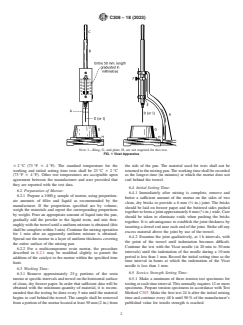
5.4 Vicat Apparatus—The Vicat apparatus shall consist of a
Barriers to Trade (TBT) Committee.
frame, A (see Fig. 1), bearing a movable rod, B, weighing
300 g, one end, C, the plunger end, being 10 mm in diameter
2. Referenced Documents
for a distance of at least 50 mm and the other end having a
2.1 ASTM Standards:
removable steel needle, D, for initial setting time
C279 Specification for Chemical-Resistant Masonry Units
determination, 1 mm in diameter and 50 mm in length. The rod,
C307 Test Method for Tensile Strength of Chemical-
B, is reversible, and can be held in any desired position by a set
Resistant Mortar, Grouts, and Monolithic Surfacings
screw, E, and has an adjustable indicator, F, which moves over
C904 Terminology Relating to Chemical-Resistant Nonme-
a scale (graduated in millimetres) attached to the frame, A. In
tallic Materials
addition to the above, the Vicat apparatus shall conform to the
following requirements:
3. Terminology
5.4.1 Weight of Plunger—300 g 6 0.5 g.
3.1 Definitions—For definitions of terms used in these test
5.4.2 Diameter of Larger End of Plunger—10 mm 6
methods, see Terminology C904. 0.05 mm.
5.4.3 Diameter of Needle—1 mm 6 0.05 mm.
5.4.4 Graduated Scale—The graduated scale, when com-
1 pared with a standard scale accurate to within 0.1 mm at all
This practice is under the jurisdiction of Committee D01 on Paint and Related
Coatings, Materials, and Applications and is the direct responsibility of D01.46 on points, shall not show a deviation at any point greater than
Industrial Protective Coatings.
0.25 mm.
Current edition approved June 1, 2023. Published June 2023. Originally
approved in 1953. Last previous edition approved in 2018 as C308 – 18. DOI:
6. Procedure
10.1520/C0308-18R23.
For referenced ASTM standards, visit the ASTM website, www.astm.org, or
6.1 Temperature:
contact ASTM Customer Service at service@astm.org. For Annual Book of ASTM
6.1.1 All materials used in this method shall be stored for at
Standards volume information, refer to the standard’s Document Summary page on
the ASTM website. least 16 h prior to use at the standard test temperature of 23 °C
Copyright © ASTM International, 100 Barr Harbor Drive, PO Box C700, West Conshohocken, PA 19428-2959. United States
C308 − 18 (2023)
NOTE 1—Ring, G, and plate, H, are not required for this test.
FIG. 1 Vicat Apparatus
6 2 °C (73 °F 6 4 °F). The standard temperature for the the side of the pan. The material used for tests shall not be
working and initial setting time tests shall be 23 °C 6 2 °C returned to the mixing pan. The working time shall be recorded
(73 °F 6 4 °F). Other test temp
...