

ASTM D5420-21
(Test Method)Standard Test Method for Impact Resistance of Flat, Rigid Plastic Specimen by Means of a Striker Impacted by a Falling Weight (Gardner Impact)
General Information
- Abstract
SIGNIFICANCE AND USE
5.1 Plastics are viscoelastic and it is possible that they are sensitive to changes in velocity of weights falling on their surfaces. However, the velocity of a free-falling object is a function of the square root of the drop height. A change of a factor of two in the drop height will cause a change of only 1.4 in velocity. Hagan, et al (2) found that the mean-failure energy of sheeting was constant at drop heights between 0.30 and 1.4 m. Different materials respond differently to changes in the velocity of impact.
5.2 The test conditions used in Geometry GA are the same as those used in Geometry FA of Test Method D5628 (see Table 1).
5.3 The test conditions of Geometry GB are equivalent to the geometry used for the Gardner Variable Height Impact Test (3).
5.4 The test conditions of Geometry GC cause a punch-shear type of failure because the support-plate hole is close to the diameter of the striker.
5.5 The test conditions of Geometry GD are the same as those in Test Method D3763.
5.6 The test conditions of Geometry GE are the same as those in Test Method D4226, impactor head configuration H.25.
5.7 Because of the nature of impact testing, the selection of a test method and striker must be somewhat arbitrary. Consider the end use environment and requirements when choosing from the available striker geometries. The selection of any one of the striker geometries is permitted.
Note 2: Material processing can have a significant affect on the development of a plastic's physical properties. Consult relevant material standards for processing guidelines
SCOPE
1.1 This test method covers the determination of the relative ranking of materials according to the energy required to crack or break flat, rigid plastic specimens under various specified conditions of impact of a striker impacted by a falling weight.
1.2 The values stated in SI units are to be regarded as the standard. The values given in parentheses are for information only.
1.3 This standard does not purport to address all of the safety concerns, if any, associated with its use. It is the responsibility of the user of this standard to establish appropriate safety, health, and environmental practices and determine the applicability of regulatory limitations prior to use.
Note 1: There is no known ISO equivalent to this standard.
1.4 This international standard was developed in accordance with internationally recognized principles on standardization established in the Decision on Principles for the Development of International Standards, Guides and Recommendations issued by the World Trade Organization Technical Barriers to Trade (TBT) Committee.
- Status
- Published
- Publication Date
- 14-Jan-2021
- Technical Committee
- D20 - Plastics
- Drafting Committee
- D20.10 - Mechanical Properties
Buy Documents
ASTM D5420-21 - Standard Test Method for Impact Resistance of Flat, Rigid Plastic Specimen by Means of a Striker Impacted by a Falling Weight (Gardner Impact)
REDLINE ASTM D5420-21 - Standard Test Method for Impact Resistance of Flat, Rigid Plastic Specimen by Means of a Striker Impacted by a Falling Weight (Gardner Impact)
Overview
ASTM D5420-21 is the internationally recognized standard test method for evaluating the impact resistance of flat, rigid plastic specimens using a striker impacted by a falling weight, commonly known as the Gardner Impact Test. Developed by ASTM Committee D20 on Plastics, this method provides a procedure to determine the relative ranking of materials based on the energy required to crack or break a plastic sample. This assessment is crucial for manufacturers, researchers, and quality assurance teams seeking to understand the durability and performance of plastic products under impact conditions.
The standard offers flexibility in test setup, allowing different striker diameters and support plate geometries to simulate various types of impact and failure modes, thus mimicking real-world application scenarios more effectively.
Key Topics
- Test Principle: The test measures the mean-failure energy by dropping a weighted striker from predefined heights onto the specimen. The energy causing 50% failure (mean-failure energy) is calculated, providing a quantitative measure of impact resistance.
- Striker and Geometry Options: Several standardized striker/support plate combinations (geometries GA, GB, GC, GD, GE) enable diverse testing conditions, mapping closely to different material behaviors or application needs.
- Failure Criteria: Failure is defined as any visible crack, split, or hole through which water or light can pass, or any dislodged chips, with detailed guidance on assessing incipient cracks.
- Conditioning and Sampling: Test specimens should be conditioned to standard temperature and humidity levels to ensure reproducibility. Proper sample selection and preparation are critical for reliable results.
- Data Interpretation: Results are reported as mean-failure height and mean-failure energy. Due to the dependence on test geometry, values are primarily for relative material rankings rather than absolute property quantification.
- Limitations: The method is intended for comparison under prescribed conditions and may not predict performance at velocities or environments significantly different from the test setup.
Applications
- Quality Control and Product Development: ASTM D5420-21 is widely used for quality assurance in manufacturing flat, rigid plastic components such as sheet goods, panels, and molded parts.
- Material Selection: Designers and engineers use the Gardner Impact Test to compare impact resistance across material types (e.g., polycarbonate, ABS, PVC) for applications where mechanical durability is critical.
- Compliance Testing: Manufacturers employ this standard to demonstrate that plastics meet industry or regulatory requirements for impact strength in packaging, automotive, building products, and electronics.
- Research and Development: Material scientists utilize ASTM D5420-21 to study the influence of additives, fillers, or processing conditions on impact performance.
- Troubleshooting: When in-service failures occur, this test assists in root-cause analysis by benchmarking available or new material options.
Related Standards
- ASTM D5628 – Test Method for Impact Resistance of Flat, Rigid Plastic Specimens by Means of a Falling Dart
- ASTM D3763 – Test Method for High Speed Puncture Properties of Plastics
- ASTM D4226 – Test Methods for Impact Resistance of Rigid Poly(Vinyl Chloride) (PVC) Building Products
- ASTM D2794 – Test Method for Resistance of Organic Coatings to Impact
- ASTM D618 – Practice for Conditioning Plastics for Testing
- ASTM D883 / D1600 – Terminology Relating to Plastics
Practical Value
Implementing ASTM D5420-21 facilitates fair material comparisons, helps ensure products withstand expected impact loads, and boosts confidence in both product safety and longevity. Its use is vital for ensuring that plastic components remain reliable across industries that demand proven impact resistance, and it allows organizations to maintain consistency in testing and reporting impact strength throughout the supply chain. For organizations operating on a global scale, adherence to established ASTM procedures helps meet international expectations for quality, even in the absence of a direct ISO equivalent.
Keywords: ASTM D5420-21, Gardner Impact, falling weight impact, impact resistance test, rigid plastic, mean-failure energy, plastic testing standard, quality control.
Relations
- Effective Date
- 01-Feb-2024
- Effective Date
- 15-Jan-2024
- Effective Date
- 01-Nov-2023
- Effective Date
- 01-Nov-2023
- Effective Date
- 01-Apr-2022
- Effective Date
- 01-Jan-2020
- Effective Date
- 01-Nov-2019
- Effective Date
- 01-Nov-2019
- Effective Date
- 01-Nov-2019
- Effective Date
- 01-Aug-2019
- Effective Date
- 15-Apr-2019
- Effective Date
- 01-Feb-2019
- Effective Date
- 01-Dec-2018
- Effective Date
- 01-Nov-2018
- Effective Date
- 01-Nov-2018
Buy Documents
ASTM D5420-21 - Standard Test Method for Impact Resistance of Flat, Rigid Plastic Specimen by Means of a Striker Impacted by a Falling Weight (Gardner Impact)
REDLINE ASTM D5420-21 - Standard Test Method for Impact Resistance of Flat, Rigid Plastic Specimen by Means of a Striker Impacted by a Falling Weight (Gardner Impact)
Get Certified
Connect with accredited certification bodies for this standard

DIN CERTCO
DIN Group product certification.

Smithers Quality Assessments
US management systems and product certification.
Sponsored listings
Frequently Asked Questions
ASTM D5420-21 is a standard published by ASTM International. Its full title is "Standard Test Method for Impact Resistance of Flat, Rigid Plastic Specimen by Means of a Striker Impacted by a Falling Weight (Gardner Impact)". This standard covers: SIGNIFICANCE AND USE 5.1 Plastics are viscoelastic and it is possible that they are sensitive to changes in velocity of weights falling on their surfaces. However, the velocity of a free-falling object is a function of the square root of the drop height. A change of a factor of two in the drop height will cause a change of only 1.4 in velocity. Hagan, et al (2) found that the mean-failure energy of sheeting was constant at drop heights between 0.30 and 1.4 m. Different materials respond differently to changes in the velocity of impact. 5.2 The test conditions used in Geometry GA are the same as those used in Geometry FA of Test Method D5628 (see Table 1). 5.3 The test conditions of Geometry GB are equivalent to the geometry used for the Gardner Variable Height Impact Test (3). 5.4 The test conditions of Geometry GC cause a punch-shear type of failure because the support-plate hole is close to the diameter of the striker. 5.5 The test conditions of Geometry GD are the same as those in Test Method D3763. 5.6 The test conditions of Geometry GE are the same as those in Test Method D4226, impactor head configuration H.25. 5.7 Because of the nature of impact testing, the selection of a test method and striker must be somewhat arbitrary. Consider the end use environment and requirements when choosing from the available striker geometries. The selection of any one of the striker geometries is permitted. Note 2: Material processing can have a significant affect on the development of a plastic's physical properties. Consult relevant material standards for processing guidelines SCOPE 1.1 This test method covers the determination of the relative ranking of materials according to the energy required to crack or break flat, rigid plastic specimens under various specified conditions of impact of a striker impacted by a falling weight. 1.2 The values stated in SI units are to be regarded as the standard. The values given in parentheses are for information only. 1.3 This standard does not purport to address all of the safety concerns, if any, associated with its use. It is the responsibility of the user of this standard to establish appropriate safety, health, and environmental practices and determine the applicability of regulatory limitations prior to use. Note 1: There is no known ISO equivalent to this standard. 1.4 This international standard was developed in accordance with internationally recognized principles on standardization established in the Decision on Principles for the Development of International Standards, Guides and Recommendations issued by the World Trade Organization Technical Barriers to Trade (TBT) Committee.
SIGNIFICANCE AND USE 5.1 Plastics are viscoelastic and it is possible that they are sensitive to changes in velocity of weights falling on their surfaces. However, the velocity of a free-falling object is a function of the square root of the drop height. A change of a factor of two in the drop height will cause a change of only 1.4 in velocity. Hagan, et al (2) found that the mean-failure energy of sheeting was constant at drop heights between 0.30 and 1.4 m. Different materials respond differently to changes in the velocity of impact. 5.2 The test conditions used in Geometry GA are the same as those used in Geometry FA of Test Method D5628 (see Table 1). 5.3 The test conditions of Geometry GB are equivalent to the geometry used for the Gardner Variable Height Impact Test (3). 5.4 The test conditions of Geometry GC cause a punch-shear type of failure because the support-plate hole is close to the diameter of the striker. 5.5 The test conditions of Geometry GD are the same as those in Test Method D3763. 5.6 The test conditions of Geometry GE are the same as those in Test Method D4226, impactor head configuration H.25. 5.7 Because of the nature of impact testing, the selection of a test method and striker must be somewhat arbitrary. Consider the end use environment and requirements when choosing from the available striker geometries. The selection of any one of the striker geometries is permitted. Note 2: Material processing can have a significant affect on the development of a plastic's physical properties. Consult relevant material standards for processing guidelines SCOPE 1.1 This test method covers the determination of the relative ranking of materials according to the energy required to crack or break flat, rigid plastic specimens under various specified conditions of impact of a striker impacted by a falling weight. 1.2 The values stated in SI units are to be regarded as the standard. The values given in parentheses are for information only. 1.3 This standard does not purport to address all of the safety concerns, if any, associated with its use. It is the responsibility of the user of this standard to establish appropriate safety, health, and environmental practices and determine the applicability of regulatory limitations prior to use. Note 1: There is no known ISO equivalent to this standard. 1.4 This international standard was developed in accordance with internationally recognized principles on standardization established in the Decision on Principles for the Development of International Standards, Guides and Recommendations issued by the World Trade Organization Technical Barriers to Trade (TBT) Committee.
ASTM D5420-21 is classified under the following ICS (International Classification for Standards) categories: 83.140.10 - Films and sheets. The ICS classification helps identify the subject area and facilitates finding related standards.
ASTM D5420-21 has the following relationships with other standards: It is inter standard links to ASTM D883-24, ASTM D2794-93(2024), ASTM D3763-23, ASTM D883-23, ASTM E456-13a(2022)e1, ASTM D883-20, ASTM D4066-13(2019), ASTM D4226-19, ASTM D4226-19e1, ASTM D883-19c, ASTM D883-19a, ASTM D883-19, ASTM D883-18a, ASTM D883-18, ASTM D3763-18. Understanding these relationships helps ensure you are using the most current and applicable version of the standard.
ASTM D5420-21 is available in PDF format for immediate download after purchase. The document can be added to your cart and obtained through the secure checkout process. Digital delivery ensures instant access to the complete standard document.
Standards Content (Sample)
This international standard was developed in accordance with internationally recognized principles on standardization established in the Decision on Principles for the
Development of International Standards, Guides and Recommendations issued by the World Trade Organization Technical Barriers to Trade (TBT) Committee.
Designation: D5420 − 21
Standard Test Method for
Impact Resistance of Flat, Rigid Plastic Specimen by Means
of a Striker Impacted by a Falling Weight (Gardner Impact)
This standard is issued under the fixed designation D5420; the number immediately following the designation indicates the year of
original adoption or, in the case of revision, the year of last revision.Anumber in parentheses indicates the year of last reapproval.A
superscript epsilon (´) indicates an editorial change since the last revision or reapproval.
1. Scope* D4226Test Methods for Impact Resistance of Rigid Poly-
(Vinyl Chloride) (PVC) Building Products
1.1 Thistestmethodcoversthedeterminationoftherelative
D5628Test Method for Impact Resistance of Flat, Rigid
ranking of materials according to the energy required to crack
Plastic Specimens by Means of a Falling Dart (Tup or
or break flat, rigid plastic specimens under various specified
Falling Mass)
conditions of impact of a striker impacted by a falling weight.
D5947Test Methods for Physical Dimensions of Solid
1.2 The values stated in SI units are to be regarded as the
Plastics Specimens
standard. The values given in parentheses are for information
E171Practice for Conditioning and Testing Flexible Barrier
only.
Packaging
1.3 This standard does not purport to address all of the E456Terminology Relating to Quality and Statistics
safety concerns, if any, associated with its use. It is the
E691Practice for Conducting an Interlaboratory Study to
responsibility of the user of this standard to establish appro- Determine the Precision of a Test Method
priate safety, health, and environmental practices and deter-
E2935Practice for Conducting Equivalence Tests for Com-
mine the applicability of regulatory limitations prior to use. paring Testing Processes
NOTE 1—There is no known ISO equivalent to this standard.
3. Terminology
1.4 This international standard was developed in accor-
3.1 Definitions—Definitions are in accordance with Termi-
dance with internationally recognized principles on standard-
nologies D883 and D1600, unless otherwise specified. For
ization established in the Decision on Principles for the
terms relating to precision and bias and associated issues, the
Development of International Standards, Guides and Recom-
terms used in this standard are defined in accordance with
mendations issued by the World Trade Organization Technical
Terminology E456.
Barriers to Trade (TBT) Committee.
3.2 Definitions of Terms Specific to This Standard:
2. Referenced Documents
3.2.1 failure (of test specimen)—the presence of any crack
2.1 ASTM Standards:
or split created by the impact of the falling weight that can be
D618Practice for Conditioning Plastics for Testing
seen by the naked eye under normal laboratory lighting
D883Terminology Relating to Plastics
conditions.
D1600TerminologyforAbbreviatedTermsRelatingtoPlas-
3.2.1.1 Discussion—Failure shall include the following:
tics
(1) complete shattering of the plaque; (2) any crack radiating
D2794Test Method for Resistance of Organic Coatings to
out toward the edges of the plaque on either surface of the
the Effects of Rapid Deformation (Impact)
plaque; (3) any radial crack within or just outside the impact
D3763Test Method for High Speed Puncture Properties of
area of the striker; (4) any hole in the plaque, whether due to
Plastics Using Load and Displacement Sensors
brittle or ductile puncture, where unobstructed light or water
D4066Classification System for Nylon Injection and Extru-
could pass through; (5) any brittle splitting of the bottom
sion Materials (PA)
surface of the plaque; and (6) any glassy-type chip dislodged
from or loosened from the plaque.
ThistestmethodisunderthejurisdictionofASTMCommitteeD20onPlastics
3.2.1.2 Discussion—Refertotheappropriatematerialspeci-
and is the direct responsibility of Subcommittee D20.10 on Mechanical Properties.
ficationforguidanceontheinterpretationoffailuredifferences
Current edition approved Jan. 15, 2021. Published February 2021. Originally
between material types.
approved in 1993. Last previous edition approved in 2016 as D5420-16. DOI:
10.1520/D5420-21.
3.2.1.3 Discussion—Cracks usually start at the surface op-
For referenced ASTM standards, visit the ASTM website, www.astm.org, or
posite the one that is struck. For example, in some cases
contact ASTM Customer Service at service@astm.org. For Annual Book of ASTM
incipient cracking in glass-reinforced polymers is difficult to
Standards volume information, refer to the standard’s Document Summary page on
the ASTM website. differentiate from the reinforcing fibers. In such cases, apply a
*A Summary of Changes section appears at the end of this standard
Copyright © ASTM International, 100 Barr Harbor Drive, PO Box C700, West Conshohocken, PA 19428-2959. United States
D5420 − 21
penetratingdyesuchasgentianviolettothestressedsurfaceto limited amounts of material. There is no known means for
determine the onset of crack formation. correlating the results of tests made by different methods or
procedures.
3.2.2 mean-failure energy (mean impact resistance)—the
energy required to produce 50% failures, equal to the product
5. Significance and Use
of the constant mass and mean failure height.
5.1 Plastics are viscoelastic and it is possible that they are
3.2.3 mean-failure height (impact-failure height)—the
sensitive to changes in velocity of weights falling on their
height at which a standard mass, when dropped on test
surfaces. However, the velocity of a free-falling object is a
specimens, will cause 50% failures.
function of the square root of the drop height. A change of a
factoroftwointhedropheightwillcauseachangeofonly1.4
in velocity. Hagan, et al (2) found that the mean-failure energy
of sheeting was constant at drop heights between 0.30 and 1.4
m. Different materials respond differently to changes in the
velocity of impact.
5.2 The test conditions used in Geometry GA are the same
as those used in Geometry FA of Test Method D5628 (see
Table 1).
5.3 The test conditions of Geometry GB are equivalent to
thegeometryusedfortheGardnerVariableHeightImpactTest
(3).
5.4 The test conditions of Geometry GC cause a punch-
shear type of failure because the support-plate hole is close to
the diameter of the striker.
5.5 The test conditions of Geometry GD are the same as
those in Test Method D3763.
5.6 The test conditions of Geometry GE are the same as
those in Test Method D4226, impactor head configuration
H.25.
5.7 Because of the nature of impact testing, the selection of
atestmethodandstrikermustbesomewhatarbitrary.Consider
theenduseenvironmentandrequirementswhenchoosingfrom
theavailablestrikergeometries.Theselectionofanyoneofthe
striker geometries is permitted.
NOTE 2—Material processing can have a significant affect on the
FIG. 1 Impact Tester development of a plastic’s physical properties. Consult relevant material
standards for processing guidelines
6. Interferences
4. Summary of Test Method
4.1 In this test method, a weight falls through a guide tube 6.1 Falling-weight-impact test results are dependent on the
and impacts a striker resting on top of a supported specimen. geometry of the falling weight, striker, and the support. Thus,
The fixed weight is dropped from various heights (see Fig. 1). use impact tests only to obtain relative rankings of materials.
Impact values cannot be considered absolute unless the geom-
4.2 The procedure determines the energy (mass×grav-
etryofthetestequipmentandspecimenconformtotheend-use
ity×height)thatwillcause50%ofthespecimenstestedtofail
(mean-failure energy).
4.3 The technique used to determine mean-failure energy is
TABLE 1 Striker and Specimen-Support-Plate Dimensions
commonly called the Bruceton Staircase Method, or the
Striker Diameter, Support Plate
Geometry
Up-and-Down Method (1). Testing is concentrated near the
mm (in.) Inside Diameter, mm (in.)
mean, reducing the number of specimens required to obtain a
GA 15.86 ± 0.10 76.0 ± 3.0
(0.625 ± 0.004) (3.00 ± 0.12)
reasonably precise estimate of the impact resistance.
GB 15.86 ± 0.10 31.75 ± 0.025
4.4 This test method permits the use of different striker
(0.625 ± 0.004) (1.25 ± 0.001)
GC 15.86 ± 0.10 16.26 ± 0.025
diameters and specimen support plate geometries to obtain
(0.625 ± 0.004) (0.640 ± 0.001)
different modes of failure, permit easier sampling, or test
GD 12.70 ± 0.10 76.0 ± 3.0
(0.500 ± 0.004) (3.00 ± 0.12)
GE 12.70 ± 0.10 16.26 ± 0.025
The boldface numbers in parentheses refer to the list of references found at the (0.500 ± 0.004) (0.640 ± 0.001)
end of this test method.
D5420 − 21
requirement. Data obtained with different geometries, cannot, 7.2.3 With Geometries GA and GD, a specimen-support
in general, be compared directly with each other. plate with a hole 76.0 6 3.0 mm (3.00 6 0.12 in.) in diameter
ismountedintheapparatus.AsuggesteddesignisgiveninFig.
6.1.1 Falling-weight-impact types of tests are not suitable
for predicting the relative ranking of materials at impact 2.
7.2.4 With Geometry GB, the specimen-support plate has a
velocities differing greatly from those imposed by these test
methods. 31.75 6 0.025-mm (1.25 6 0.001-in.) diameter hole. This
geometry can be achieved by removing the removable support
6.2 As cracks usually start at the surface opposite the one
ring on the standard Gardner instrument.
that is struck, the results obtained can be greatly influenced by
7.2.5 With Geometries GC and GE, the standard removable
the surface characteristics of the test specimens. Therefore,
specimen-support plate, with a hole 16.26 6 0.025 mm (0.640
factors including surface features (flaws, texturing, and so
6 0.001 in.) in diameter, is mounted in the specimen support
forth), surface composition, orientation due to specimen
anvil (see Fig. 3 for Geometry GC and Fig. 4 for Geometry
preparation, and so forth, are important variables and will
GE).
influence results.
7.3 Supporting Base—In order to minimize the energy
6.3 Impact properties of plastic materials can be very
absorption, compression, and deflection of the support, affix
sensitive to temperature. This test can be carried out at any
the tester to a dense, solid block or base weighing a minimum
reasonable temperature and humidity, thus representing actual-
of 375 lb (see Appendix X2). The main body of the block or
use environments. However, this test method is intended
base shall have maximum dimensions of 16 by 30 by 30 in.
primarily for rating materials under specific impact conditions.
(height by width by depth). Place this block or base at a height
6.4 It is possible that the apparatus used in this test method
suitable for ease of operation. It is not necessary to bolt blocks
will not have sufficient energy available to cause failure of
or bases of this weight to the floor. Alternatively, affix testers
some specimens under the conditions of this procedure.
directly to the floor. Use of rubber mats either directly under
the tester or supporting apparatus is prohibited.
6.5 Samplesmustnotcollapseintotheholeinthespecimen
support plate when driven by the striker. Sample collapse into
NOTE 3—Such block dimensions conform to commercially available
the hole during the impact test affects results.
butcher block tables.
6.6 When resting on the support plate and in contact with
the striker, the specimen must lie flat. Bowed samples will
affect test results.
7. Apparatus
7.1 Testing Mechanism—The apparatus is shown in Fig. 1.
Adapt the apparatus from Test Method D2794 for use in this
test method or obtain the apparatus commercially. The appa-
ratus shall consist of the following: suitable base to withstand
the impact shock; steel-rod impact mass, weighing 0.9 kg (2
lb), 1.8 kg (4 lb), or 3.6 kg (8 lb); a hardened steel striker
havingaroundnosewithdiameterdescribedin7.2.1and7.2.2
and Table 1; a slotted guide tube 1.0 m (40 in.) in length, in
which the impact mass slides, having graduations in newton-
metres (inch-pound increments) or multiples thereof. Use a
bracket to hold the tube in a vertical position by attaching it to
the base and also to hold the hand knob, which is a pivot arm
alignment for the striker, about 50 mm (2 in.) under the tube.
Mount this instrument firmly to a rigid table or bench. Round
the top edge of the opening in each specimen-support plate to
a 1.0 6 0.2-mm (0.039 6 0.008-in.) radius, except in Geom-
etry GE which has a radius of 0.75 mm (0.031 in.).
7.1.1 Thetestershallbemountedsothattheaxisofthetube
isplumbwhenmeasuredwithaspiritlevelatleast300mm(12
in.) in length.
7.2 Striker Geometries:
7.2.1 For Geometries GA, GB, and GC, the striker shall
have a rounded nose with a diameter of 15.86 6 0.10 mm
(0.625 6 0.004 in.).
7.2.2 For Geometries GD and GE the striker shall have a
rounded nose with a diameter of 12.70 6 0.1 mm (0.500 6
0.004 in.). FIG. 2 Specimen-Support Plate Used for Geometries GA and GD
D5420 − 21
8. Sampling
8.1 Sample using a statistically acceptable procedure. The
samples shall be representative of the lot under study. When
taken from a commercial production process, the process shall
be in a state of statistical control.
9. Test Specimens
9.1 The diameter or width of flat test specimens shall be at
least 25 mm (1.00 in.) greater than the diameter of the hole in
the support plate. The specimens shall be free of obvious
imperfections, unless the imperfections constitute a variable
under study. Test specimens must lay flat on the specimen
support plate during testing.
9.2 The thickness of any specimen in a sample shall not
differ by more than 5% from the average specimen thickness
of that sample. However, if variations greater than 5% are
unavoidableinasamplethatisobtainedfromparts,thesample
FIG. 3 Striker/Specimen/Support Plate Configuration for Geom-
shallbepermittedtobetested,butthedatashallnotbeusedfor
etries GB and GC (Geometry GC Shown)
referee purposes. Machining specimens to reduce thickness
variation is not permissible.
9.3 When the approximate mean-failure height for a given
sample is known, 20 specimens will usually yield sufficiently
precise results. If the approximate mean-failure height is
unknown, six or more additional specimens shall be used to
determine the appropriate starting point of the test.
9.4 Visually examine the specimens to ensure they are free
of cracks or other obvious imperfections or damages, unless
theseimperfectionsconstitutevariablesunderstudy.Forspeci-
fication purposes, do not test samples known to be defective.
Production parts shall be tested in the as-received condition to
NOTE 1—Depth of penetration when fully seated shall be 12.2 6 0.1
determine conformance to specified standards.
mm (0.48 6 0.04 in.).
9.5 Select a suitable method for making the specimen that
FIG. 4 Striker/Specimen/Support Plate Configuration for Geom-
willminimizetheeffectofspecimenpreparationontheimpact
etry GE
resistance of the material. Refer to the appropriate material
7.3.1 Boltsupportingbasesortableslighterthan375lbtoa
specification for requirements for specimen preparation.
concrete floor. For each different material tested, make com-
NOTE 5—As few as ten specimens often yield sufficiently reliable
parisonsbetweenmeanfailureenergydatageneratedusingthis
estimatesofthemean-failureheight.However,insuchcasestheestimated
support and one where the tester is fixed directly to the
standard deviation will be relatively large (1).
concrete floor. If mean failure energy differences between two
types of supports are found to be statistically nonsignificant,
10. Conditioning
use of the lighter support shall be allowed.
10.1 Unless otherwise specified by contract or relevant
7.3.2 If the weight of the butcher block that was originally
material specification, condition the test specimens in accor-
375 lb or greater decreases with time to less than 375 lb,
dance with Procedure A of Practice D618 or Specification
increase
...
This document is not an ASTM standard and is intended only to provide the user of an ASTM standard an indication of what changes have been made to the previous version. Because
it may not be technically possible to adequately depict all changes accurately, ASTM recommends that users consult prior editions as appropriate. In all cases only the current version
of the standard as published by ASTM is to be considered the official document.
Designation: D5420 − 16 D5420 − 21
Standard Test Method for
Impact Resistance of Flat, Rigid Plastic Specimen by Means
of a Striker Impacted by a Falling Weight (Gardner Impact)
This standard is issued under the fixed designation D5420; the number immediately following the designation indicates the year of
original adoption or, in the case of revision, the year of last revision. A number in parentheses indicates the year of last reapproval. A
superscript epsilon (´) indicates an editorial change since the last revision or reapproval.
1. Scope*
1.1 This test method covers the determination of the relative ranking of materials according to the energy required to crack or
break flat, rigid plastic specimens under various specified conditions of impact of a striker impacted by a falling weight.
1.2 The values stated in SI units are to be regarded as the standard. The values given in parentheses are for information only.
1.3 This standard does not purport to address all of the safety concerns, if any, associated with its use. It is the responsibility
of the user of this standard to establish appropriate safety safety, health, and healthenvironmental practices and determine the
applicability of regulatory limitations prior to use.
NOTE 1—There is no known ISO equivalent to this standard.
1.4 This international standard was developed in accordance with internationally recognized principles on standardization
established in the Decision on Principles for the Development of International Standards, Guides and Recommendations issued
by the World Trade Organization Technical Barriers to Trade (TBT) Committee.
2. Referenced Documents
2.1 ASTM Standards:
D618 Practice for Conditioning Plastics for Testing
D883 Terminology Relating to Plastics
D1600 Terminology for Abbreviated Terms Relating to Plastics
D2794 Test Method for Resistance of Organic Coatings to the Effects of Rapid Deformation (Impact)
D3763 Test Method for High Speed Puncture Properties of Plastics Using Load and Displacement Sensors
D4066 Classification System for Nylon Injection and Extrusion Materials (PA)
D4226 Test Methods for Impact Resistance of Rigid Poly(Vinyl Chloride) (PVC) Building Products
D5628 Test Method for Impact Resistance of Flat, Rigid Plastic Specimens by Means of a Falling Dart (Tup or Falling Mass)
D5947 Test Methods for Physical Dimensions of Solid Plastics Specimens
E171 Practice for Conditioning and Testing Flexible Barrier Packaging
E456 Terminology Relating to Quality and Statistics
E691 Practice for Conducting an Interlaboratory Study to Determine the Precision of a Test Method
E2935 Practice for Conducting Equivalence Tests for Comparing Testing Processes
This test method is under the jurisdiction of ASTM Committee D20 on Plastics and is the direct responsibility of Subcommittee D20.10 on Mechanical Properties.
Current edition approved May 1, 2016Jan. 15, 2021. Published May 2016February 2021. Originally approved in 1993. Last previous edition approved in 20102016 as
D5420 - 10.D5420 - 16. DOI: 10.1520/D5420-16.10.1520/D5420-21.
For referenced ASTM standards, visit the ASTM website, www.astm.org, or contact ASTM Customer Service at service@astm.org. For Annual Book of ASTM Standards
volume information, refer to the standard’s Document Summary page on the ASTM website.
*A Summary of Changes section appears at the end of this standard
Copyright © ASTM International, 100 Barr Harbor Drive, PO Box C700, West Conshohocken, PA 19428-2959. United States
D5420 − 21
3. Terminology
3.1 Definitions—For definitions of plastics terms used in this test method, see Definitions are in accordance with Terminologies
D883 and D1600, unless otherwise specified. For terms relating to precision and bias and associated issues, the terms used in this
standard are defined in accordance with Terminology E456.
3.2 Definitions of Terms Specific to This Standard:
3.2.1 failure (of test specimen)—the presence of any crack or split created by the impact of the falling weight that can be seen by
the naked eye under normal laboratory lighting conditions.
3.2.1.1 Discussion—
Failure shall include the following: (1) complete shattering of the plaque; (2) any crack radiating out toward the edges of the
plaque on either surface of the plaque; (3) any radial crack within or just outside the impact area of the striker; (4) any hole in
the plaque, whether due to brittle or ductile puncture, where unobstructed light or water could pass through; (5) any brittle splitting
of the bottom surface of the plaque; and (6) any glassy-type chip dislodged from or loosened from the plaque.
3.2.1.2 Discussion—
Since the interpretation of failure may be slightly different between material types, refer to the appropriate material specification
for guidance.Refer to the appropriate material specification for guidance on the interpretation of failure differences between
material types.
3.2.1.3 Discussion—
Cracks usually start at the surface opposite the one that is struck. For example, in some cases incipient cracking in glass-reinforced
polymers is difficult to differentiate from the reinforcing fibers. In such cases, apply a penetrating dye such as gentian violet to the
stressed surface to determine the onset of crack formation.
3.2.2 mean-failure energy (mean impact resistance)—the energy required to produce 50 % failures, equal to the product of the
constant mass and mean failure height.
3.2.3 mean-failure height (impact-failure height)—the height at which a standard mass, when dropped on test specimens, will
cause 50 % failures.
FIG. 1 Impact Tester
D5420 − 21
4. Summary of Test Method
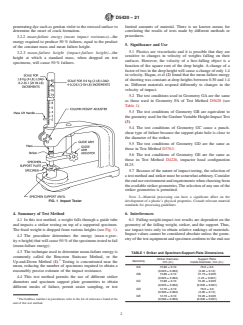
4.1 In this test method, a weight falls through a guide tube and impacts a striker resting on top of a supported specimen. The fixed
weight is dropped from various heights (see Fig. 1).
4.2 The procedure determines the energy (mass × gravity × height) that will cause 50 % of the specimens tested to fail
(mean-failure energy).
4.3 The technique used to determine mean-failure energy is commonly called the Bruceton Staircase Method, or the Up-and-Down
Method (1). Testing is concentrated near the mean, reducing the number of specimens required to obtain a reasonably precise
estimate of the impact resistance.
4.4 This test method permits the use of different striker diameters and specimen support plate geometries to obtain different modes
of failure, permit easier sampling, or test limited amounts of material. There is no known means for correlating the results of tests
made by different methods or procedures.
5. Significance and Use
5.1 Plastics are viscoelastic and it is possible that they are sensitive to changes in velocity of weights falling on their surfaces.
However, the velocity of a free-falling object is a function of the square root of the drop height. A change of a factor of two in
the drop height will cause a change of only 1.4 in velocity. Hagan, et al (2) found that the mean-failure energy of sheeting was
constant at drop heights between 0.30 and 1.4 m. Different materials respond differently to changes in the velocity of impact.
5.2 The test conditions used in Geometry GA are the same as those used in Geometry FA of Test Method D5628 (see Table 1).
5.3 The test conditions of Geometry GB are equivalent to the geometry used for the Gardner Variable Height Impact Test (3).
5.4 The test conditions of Geometry GC cause a punch-shear type of failure because the support-plate hole is close to the diameter
of the striker.
5.5 The test conditions of Geometry GD are the same as those in Test Method D3763.
5.6 The test conditions of Geometry GE are the same as those in Test Method D4226, impactor head configuration H.25.
TABLE 1 Striker and Specimen-Support-Plate Dimensions
Striker Diameter, Support Plate
Geometry
mm (in.) Inside Diameter, mm (in.)
GA 15.86 ± 0.10 76.0± 3.0
GA 15.86 ± 0.10 76.0 ± 3.0
(0.625 ± 0.004) (3.00 ± 0.12)
GB 15.86 ± 0.10 31.75± 0.025
GB 15.86 ± 0.10 31.75 ± 0.025
(0.625 ± 0.004) (1.25 ± 0.001)
(0.625 ± 0.004) (1.25 ± 0.001)
GC 15.86 ± 0.10 16.26 ± 0.025
(0.625 ± 0.004) (0.640 ± 0.001)
GC 15.86 ± 0.10 16.26 ± 0.025
(0.625 ± 0.004) (0.640 ± 0.001)
GD 12.70 ± 0.10 76.0 ± 3.0
GD 12.70 ± 0.10 76.0 ± 3.0
(0.500 ± 0.004) (3.00 ± 0.12)
(0.500 ± 0.004) (3.00 ± 0.12)
GE 12.70 ± 0.10 16.26 ± 0.025
(0.500 ± 0.004) (0.640 ± 0.001)
GE 12.70 ± 0.10 16.26 ± 0.025
(0.500 ± 0.004) (0.640 ± 0.001)
The boldface numbers in parentheses refer to the list of references found at the end of this test method.
D5420 − 21
5.7 Because of the nature of impact testing, the selection of a test method and striker must be somewhat arbitrary. Consider the
end use environment and requirements when choosing from the available striker geometries. The selection of any one of the striker
geometries is permitted.
NOTE 2—Material processing can have a significant affect on the development of a plastic’s physical properties. Consult relevant material standards for
processing guidelines
6. Interferences
6.1 Falling-weight-impact test results are dependent on the geometry of the falling weight, striker, and the support. Thus, use
impact tests only to obtain relative rankings of materials. Impact values cannot be considered absolute unless the geometry of the
test equipment and specimen conform to the end-use requirement. Data obtained with different geometries, cannot, in general, be
compared directly with each other.
6.1.1 Falling-weight-impact types of tests are not suitable for predicting the relative ranking of materials at impact velocities
differing greatly from those imposed by these test methods.
6.2 As cracks usually start at the surface opposite the one that is struck, the results obtained can be greatly influenced by the
surface characteristics of the test specimens. Therefore, factors including surface features (flaws, texturing, and so forth), surface
composition, orientation due to specimen preparation, and so forth, are important variables and will influence results.
6.3 Impact properties of plastic materials can be very sensitive to temperature. This test can be carried out at any reasonable
temperature and humidity, thus representing actual-use environments. However, this test method is intended primarily for rating
materials under specific impact conditions.
6.4 It is possible that the apparatus used in this test method will not have sufficient energy available to cause failure of some
specimens under the conditions of this procedure.
6.5 Samples must not collapse into the hole in the specimen support plate when driven by the striker. Sample collapse into the
hole during the impact test affects results.
6.6 When resting on the support plate and in contact with the striker, the specimen must lie flat. Bowed samples will affect test
results.
7. Apparatus
7.1 Testing Mechanism—The apparatus is shown in Fig. 1. Adapt the apparatus from Test Method D2794 for use in this test
method or obtain the apparatus commercially. The apparatus shall consist of the following: suitable base to withstand the impact
shock; steel-rod impact mass, weighing 0.9 kg (2 lb), 1.8 kg (4 lb), or 3.6 kg (8 lb); a hardened steel striker having a round nose
with diameter described in 7.2.1 and 7.2.2 and Table 1; a slotted guide tube 1.0 m (40 in.) in length, in which the impact mass
slides, having graduations in newton-metres (inch-pound increments) or multiples thereof. Use a bracket to hold the tube in a
vertical position by attaching it to the base and also to hold the hand knob, which is a pivot arm alignment for the striker, about
50 mm (2 in.) under the tube. Mount this instrument firmly to a rigid table or bench. Round the top edge of the opening in each
specimen-support plate to a 1.0 6 0.2-mm (0.039 6 0.008-in.) radius, except in Geometry GE which has a radius of 0.75 mm
(0.031 in.).
7.1.1 The tester shall be mounted so that the axis of the tube is plumb when measured with a spirit level at least 300 mm (12 in.)
in length.
7.2 Striker Geometries:
7.2.1 For Geometries GA, GB, and GC, the striker shall have a rounded nose with a diameter of 15.86 6 0.10 mm (0.625 6 0.004
in.).
7.2.2 For Geometries GD and GE the striker shall have a rounded nose with a diameter of 12.70 6 0.1 mm (0.500 6 0.004 in.).
D5420 − 21
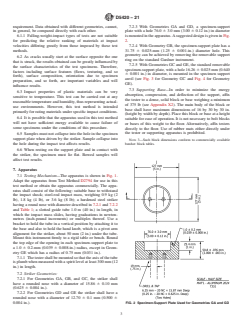
7.2.3 With Geometries GA and GD, a specimen-support plate with a hole 76.0 6 3.0 mm (3.00 6 0.12 in.) in diameter is mounted
in the apparatus. A suggested design is given in Fig. 2.
7.2.4 With Geometry GB, the specimen-support plate has a 31.75 6 0.025-mm (1.25 6 0.001-in.) diameter hole. This geometry
can be achieved by removing the removable support ring on the standard Gardner instrument.
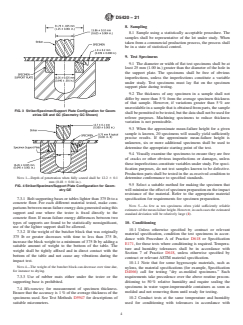
7.2.5 With Geometries GC and GE, the standard removable specimen-support plate, with a hole 16.26 6 0.025 mm (0.640 6
0.001 in.) in diameter, is mounted in the specimen support anvil (see Fig. 3 for Geometry GC and Fig. 4 for Geometry GE).
7.3 Supporting Base—In order to minimize the energy absorption, compression, and deflection of the support, affix the tester to
a dense, solid block or base weighing a minimum of 375 lb (see Appendix X2). The main body of the block or base shall have
maximum dimensions of 16 by 30 by 30 in. (height by width by depth). Place this block or base at a height suitable for ease of
operation. It is not necessary to bolt blocks or bases of this weight to the floor. Alternatively, affix testers directly to the floor. Use
of rubber mats either directly under the tester or supporting apparatus is prohibited.
NOTE 3—Such block dimensions conform to commercially available butcher block tables.
7.3.1 Bolt supporting bases or tables lighter than 375 lb to a concrete floor. For each different material tested, make comparisons
between mean failure energy data generated using this support and one where the tester is fixed directly to the concrete floor. If
mean failure energy differences between two types of supports are found to be statistically nonsignificant, use of the lighter support
shall be allowed.
7.3.2 If the weight of the butcher block that was originally 375 lb or greater decreases with time to less than 375 lb, increase the
block weight to a minimum of 375 lb by adding a suitable amount of weight to the bottom of the table. The weight shall be tightly
affixed and in direct contact with the bottom of the table and not cause any vibrations during the impact test.
FIG. 2 Specimen-Support Plate Used for Geometries GA and GD
D5420 − 21
FIG. 3 Striker/Specimen/Support Plate Configuration for Geometries GB and GC (Geometry GC Shown)
NOTE 1—Depth of penetration when fully seated shall be 12.2 6 0.1 mm (0.48 6 0.04 in.).
FIG. 4 Striker/Specimen/Support Plate Configuration for Geometry GE
NOTE 4—The weight of the butcher block can decrease over time due, for instance to drying.
7.3.3 Use of rubber mats either under the tester or the supporting base is prohibited.
7.4 Micrometer, for measurement of specimen thickness. Ensure that the accuracy is 1 % of the average thickness of the specimens
used. See Test Methods D5947 for descriptions of suitable micrometers.
8. Sampling
8.1 Sample using a statistically acceptable procedure. The samples shall be representative of the lot under study. When taken from
a commercial production process, the process shall be in a state of statistical control.
9. Test Specimens
9.1 The diameter or width of flat test specimens shall be at least 25 mm (1.00 in.) greater than the diameter of the hole in the
support plate. The specimens shall be free of obvious imperfections, unless the imperfections constitute a variable under study. Test
specimens must lay flat on the specimen support plate during testing.
9.2 The thickness of any specimen in a sample shall not differ by more than 5 % from the average specimen thickness of that
sample. However, if variations greater than 5 % are unavoidable in a sample that is obtained from parts, the sample shall be
permitted to be tested, but the data shall not be used for referee purposes. Machining specimens to reduce thickness variation is
not permissible.
D5420 − 21
9.3 When the approximate mean-failure height for a given sample is known, 20 specimens will usually yield sufficiently precise
results. If the approximate mean-failure height is unknown, six or more additional specimens shall be used to determine the
appropriate starting point of the test.
9.4 Visually examine the specimens to ensure they are free of cracks or other obvious imperfections or damages, unless these
imperfections constitute variables under study. For specification purposes, do not test samples known to be defective. Production
parts shall be tested in the as-received condition to determine conformance to specified standards.
9.5 Select a suitable method for making the specimen that will minimize the effect of specimen preparation on the impact
resistance of the material. Refer to the appropriate material specification for requirements for specimen preparation.
NOTE 5—As few as ten specimens often yield sufficiently reliable estimates of the mean-failure height. However, in such cases the estimated standard
deviation will be relatively large (1).
10. Conditioning
10.1 Unless otherwise specified by contract or relevant material specification, condition the test specimens in accordance with
Procedure A of Practice D618 or Specification E171, for those tests where conditioning is required. Temperature and humidity
tolerances shall be in accordance with Section 7 of Practice D618, unless otherwise specified by contract or relevant ASTM
material specification.
10.1.1 Note that for some hygroscopic materials, such as nylons, the material specifications (for example, Specification D4066)
call for testing “dry as-molded specimens.” Such requirements take precedence over the above routine preconditioning to 50 %
relative humidity and require sealing the specimens in water vapor-impermeable containers as soon as molded and not removing
them until ready for testing.
10.2 Conduct tests at the same temperature and humidity used for conditioning with tolerances in accordance with Section 7 of
Practice D618, unless otherwise specified by contract or relevant ASTM material specification.
11. Procedure
11.1 Determine the number of specimens for each sample to be tested, as specified in 9.3.
11.2 Mark the specimens and condition as specified in 10.1.
11.3 Prepare the test apparatus for the geometry (GA, GB, GC, GD, or GE) selected.
11.4 Measure and record the thickness of each specimen in the area of impact. In the case of injection molded specimens, it is
sufficient to measure and record thickness for one specimen when it has been previously demonstrated that the thickness does not
vary by more than 5 %.
11.5 Choose a specimen at random from the sample. Use a random numbers table if desired.
11.6 Position the specimen. Ensure that the same surface or area, or both, is targeted on all test specimens. (see 6.2).
NOTE 6—Normally the specimen is not clamped because the test apparatus does not have provision for clampi
...