

ASTM D4226-19e1
(Test Method)Standard Test Methods for Impact Resistance of Rigid Poly(Vinyl Chloride) (PVC) Building Products
General Information
- Abstract
SIGNIFICANCE AND USE
5.1 The impact strength values obtained on the flat sections of a building product profile are relevant only to the flat section that has been tested and these values do not necessarily indicate the impact resistance of the whole product, which is affected by the configuration of the profile (that is, corners, ribs, etc).
5.2 Constant weight and variable height, employed in these test methods, allow the velocity of impact to vary and, therefore, by Procedure B, can determine the energy of ductile-to-brittle transition, which cannot be determined if a variable weight is dropped from a constant height.
5.3 These test procedures have been found to be useful elements in rigid poly(vinyl chloride) (PVC) building product characterization. Compound qualification, finished product quality control, environmental and weatherability research and development studies, and fabrication tolerance prediction constitute useful applications.
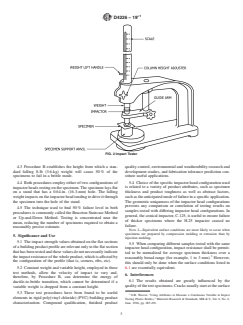
FIG. 2 Impact Tester
5.4 Choice of the specific impactor head configuration used is related to a variety of product attributes, such as specimen thickness and product toughness as well as abstract factors, such as the anticipated mode of failure in a specific application. The geometric uniqueness of the impactor head configurations prevents any comparison or correlation of testing results on samples tested with differing impactor head configurations. In general, the conical impactor, C.125, is useful to ensure failure of thicker specimens where the H.25 impactor caused no failure.
Note 2: Equivalent surface conditions are more likely to occur when specimens are prepared by compression molding or extrusion than by injection molding.
5.5 When comparing different samples tested with the same impactor head configuration, impact resistance shall be permitted to be normalized for average specimen thickness over a reasonably broad range (for example, 1 to 3 mm).3 However, this should only be done when the surface conditions listed in 6.1...
SCOPE
1.1 These test methods cover the determination of the energy required to crack or break rigid poly(vinyl chloride) (PVC) plastic sheeting and profile flat sections used in building products, as well as extruded or molded test samples, under specified conditions of impact from a freefalling standard weight striking an impactor with either of two configurations in contact with the specimen.
1.2 Two test procedures are included:
1.2.1 Procedure A, used to determine minimum impact energy required to cause failure (hole, crack, split, shatter, or tear).
1.2.2 Procedure B, used to determine minimum impact energy required to cause brittle failure.
1.3 The values stated in inch-pound units are to be regarded as standard. The values given in parentheses are mathematical conversions to SI units that are provided for information only and are not considered standard.
Note 1: There is no known ISO equivalent to this standard.
1.4 The text of this standard references notes and footnotes which provide explanatory material. These notes and footnotes (excluding, those in tables in figures) shall not be considered as requirements of this standard.
1.5 This standard does not purport to address all of the safety concerns, if any, associated with its use. It is the responsibility of the user of this standard to establish appropriate safety, health, and environmental practices and determine the applicability of regulatory limitations prior to use. Specific precautionary statements are given in Section 8.
1.6 This international standard was developed in accordance with internationally recognized principles on standardization established in the Decision on Principles for the Development of International Standards, Guides and Recommendations issued by the World Trade Organization Technical Barriers to Trade (TBT) Committee.
- Status
- Published
- Publication Date
- 31-Oct-2019
- Technical Committee
- D20 - Plastics
- Drafting Committee
- D20.24 - Plastic Building Products
Overview
ASTM D4226-19e1 - Standard Test Methods for Impact Resistance of Rigid Poly(Vinyl Chloride) (PVC) Building Products - establishes detailed procedures for determining the energy required to crack or break rigid PVC plastic sheeting and flat sections of building products. Developed by ASTM International, this widely referenced standard specifies test methods that use a falling weight impact test to evaluate impact resistance. The procedures covered under this standard are critical for manufacturers, quality control laboratories, and researchers who need to assess the durability and reliability of rigid PVC materials used in construction applications such as siding, profiles, and panels.
Key Topics
- Test Method Procedures: The standard includes two main procedures:
- Procedure A: Determines the minimum impact energy needed to cause any type of failure (hole, crack, split, shatter, or tear).
- Procedure B: Determines the minimum impact energy required to cause brittle failure.
- Specimen Conditions: Specimens are typically flat sections cut from rigid PVC building profiles or extruded/molded samples. Impact test values pertain only to the section tested, not the entire product, as product configuration (like corners or ribs) influences overall impact resistance.
- Impactor Head Configurations: Testing utilizes two specific impactor head shapes to account for differences in sample thickness and product toughness. It is important to note that results between configurations cannot be directly compared.
- Normalization and Comparisons: Impact resistance can be normalized for average specimen thickness, provided that surface conditions are equivalent across samples.
- Safety and Sampling: The standard includes best practices for safe operation of impact testing equipment and emphasizes statistically representative sampling and proper specimen conditioning before testing.
- Calculation and Reporting: ASTM D4226 details calculation methods for mean failure height, mean failure energy, and standardized reporting requirements to ensure reproducibility and transparency.
Applications
ASTM D4226 is essential for:
- Quality Control: Monitoring consistency and ensuring finished rigid PVC building products meet required impact resistance levels.
- Product Development and Qualification: Evaluating new compounds or product profiles for compliance and performance.
- Research on Environmental Durability: Assessing the effects of weathering, temperature, and other environmental factors on PVC products.
- Predicting Fabrication Tolerances: Understanding the expected behavior of PVC profiles during manufacturing and installation.
- Comparative Testing: Supporting research and development studies comparing new materials or manufacturing methods against established benchmarks.
Using ASTM D4226 helps manufacturers demonstrate compliance with building codes and customer requirements, minimize liability, and improve product performance in real-world installations.
Related Standards
- ASTM D618: Practice for Conditioning Plastics for Testing
- ASTM D883: Terminology Relating to Plastics
- ASTM D5947: Test Methods for Physical Dimensions of Solid Plastics Specimens
- ASTM E178: Practice for Dealing With Outlying Observations
- ASTM E456: Terminology Relating to Quality and Statistics
- ASTM E691: Practice for Conducting an Interlaboratory Study to Determine the Precision of a Test Method
- ASTM E2935: Practice for Conducting Equivalence Tests for Comparing Testing Processes
Note: There is no ISO equivalent for ASTM D4226-19e1.
By adhering to the procedures and requirements outlined in ASTM D4226-19e1, organizations can reliably assess and compare the impact resistance of rigid PVC building products, ensuring structural integrity and safety in construction applications. This standard plays a key role in building product certification, quality assurance, and research, delivering trusted methods to the plastics and construction industries.
Relations
- Effective Date
- 01-Nov-2019
- Effective Date
- 01-Feb-2024
- Effective Date
- 01-Nov-2023
- Effective Date
- 01-Apr-2022
- Effective Date
- 01-Jan-2020
- Effective Date
- 01-Aug-2019
- Effective Date
- 15-Apr-2019
- Effective Date
- 01-Feb-2019
- Effective Date
- 01-Dec-2018
- Effective Date
- 01-Nov-2018
- Effective Date
- 01-Oct-2017
- Refers
ASTM E2935-17 - Standard Practice for Conducting Equivalence Testing in Laboratory Applications - Effective Date
- 01-Oct-2017
- Effective Date
- 01-Oct-2017
- Effective Date
- 15-Aug-2017
- Refers
ASTM E2935-16 - Standard Practice for Conducting Equivalence Testing in Laboratory Applications - Effective Date
- 15-Nov-2016
Get Certified
Connect with accredited certification bodies for this standard

DIN CERTCO
DIN Group product certification.

Smithers Quality Assessments
US management systems and product certification.
Sponsored listings
Frequently Asked Questions
ASTM D4226-19e1 is a standard published by ASTM International. Its full title is "Standard Test Methods for Impact Resistance of Rigid Poly(Vinyl Chloride) (PVC) Building Products". This standard covers: SIGNIFICANCE AND USE 5.1 The impact strength values obtained on the flat sections of a building product profile are relevant only to the flat section that has been tested and these values do not necessarily indicate the impact resistance of the whole product, which is affected by the configuration of the profile (that is, corners, ribs, etc). 5.2 Constant weight and variable height, employed in these test methods, allow the velocity of impact to vary and, therefore, by Procedure B, can determine the energy of ductile-to-brittle transition, which cannot be determined if a variable weight is dropped from a constant height. 5.3 These test procedures have been found to be useful elements in rigid poly(vinyl chloride) (PVC) building product characterization. Compound qualification, finished product quality control, environmental and weatherability research and development studies, and fabrication tolerance prediction constitute useful applications. FIG. 2 Impact Tester 5.4 Choice of the specific impactor head configuration used is related to a variety of product attributes, such as specimen thickness and product toughness as well as abstract factors, such as the anticipated mode of failure in a specific application. The geometric uniqueness of the impactor head configurations prevents any comparison or correlation of testing results on samples tested with differing impactor head configurations. In general, the conical impactor, C.125, is useful to ensure failure of thicker specimens where the H.25 impactor caused no failure. Note 2: Equivalent surface conditions are more likely to occur when specimens are prepared by compression molding or extrusion than by injection molding. 5.5 When comparing different samples tested with the same impactor head configuration, impact resistance shall be permitted to be normalized for average specimen thickness over a reasonably broad range (for example, 1 to 3 mm).3 However, this should only be done when the surface conditions listed in 6.1... SCOPE 1.1 These test methods cover the determination of the energy required to crack or break rigid poly(vinyl chloride) (PVC) plastic sheeting and profile flat sections used in building products, as well as extruded or molded test samples, under specified conditions of impact from a freefalling standard weight striking an impactor with either of two configurations in contact with the specimen. 1.2 Two test procedures are included: 1.2.1 Procedure A, used to determine minimum impact energy required to cause failure (hole, crack, split, shatter, or tear). 1.2.2 Procedure B, used to determine minimum impact energy required to cause brittle failure. 1.3 The values stated in inch-pound units are to be regarded as standard. The values given in parentheses are mathematical conversions to SI units that are provided for information only and are not considered standard. Note 1: There is no known ISO equivalent to this standard. 1.4 The text of this standard references notes and footnotes which provide explanatory material. These notes and footnotes (excluding, those in tables in figures) shall not be considered as requirements of this standard. 1.5 This standard does not purport to address all of the safety concerns, if any, associated with its use. It is the responsibility of the user of this standard to establish appropriate safety, health, and environmental practices and determine the applicability of regulatory limitations prior to use. Specific precautionary statements are given in Section 8. 1.6 This international standard was developed in accordance with internationally recognized principles on standardization established in the Decision on Principles for the Development of International Standards, Guides and Recommendations issued by the World Trade Organization Technical Barriers to Trade (TBT) Committee.
SIGNIFICANCE AND USE 5.1 The impact strength values obtained on the flat sections of a building product profile are relevant only to the flat section that has been tested and these values do not necessarily indicate the impact resistance of the whole product, which is affected by the configuration of the profile (that is, corners, ribs, etc). 5.2 Constant weight and variable height, employed in these test methods, allow the velocity of impact to vary and, therefore, by Procedure B, can determine the energy of ductile-to-brittle transition, which cannot be determined if a variable weight is dropped from a constant height. 5.3 These test procedures have been found to be useful elements in rigid poly(vinyl chloride) (PVC) building product characterization. Compound qualification, finished product quality control, environmental and weatherability research and development studies, and fabrication tolerance prediction constitute useful applications. FIG. 2 Impact Tester 5.4 Choice of the specific impactor head configuration used is related to a variety of product attributes, such as specimen thickness and product toughness as well as abstract factors, such as the anticipated mode of failure in a specific application. The geometric uniqueness of the impactor head configurations prevents any comparison or correlation of testing results on samples tested with differing impactor head configurations. In general, the conical impactor, C.125, is useful to ensure failure of thicker specimens where the H.25 impactor caused no failure. Note 2: Equivalent surface conditions are more likely to occur when specimens are prepared by compression molding or extrusion than by injection molding. 5.5 When comparing different samples tested with the same impactor head configuration, impact resistance shall be permitted to be normalized for average specimen thickness over a reasonably broad range (for example, 1 to 3 mm).3 However, this should only be done when the surface conditions listed in 6.1... SCOPE 1.1 These test methods cover the determination of the energy required to crack or break rigid poly(vinyl chloride) (PVC) plastic sheeting and profile flat sections used in building products, as well as extruded or molded test samples, under specified conditions of impact from a freefalling standard weight striking an impactor with either of two configurations in contact with the specimen. 1.2 Two test procedures are included: 1.2.1 Procedure A, used to determine minimum impact energy required to cause failure (hole, crack, split, shatter, or tear). 1.2.2 Procedure B, used to determine minimum impact energy required to cause brittle failure. 1.3 The values stated in inch-pound units are to be regarded as standard. The values given in parentheses are mathematical conversions to SI units that are provided for information only and are not considered standard. Note 1: There is no known ISO equivalent to this standard. 1.4 The text of this standard references notes and footnotes which provide explanatory material. These notes and footnotes (excluding, those in tables in figures) shall not be considered as requirements of this standard. 1.5 This standard does not purport to address all of the safety concerns, if any, associated with its use. It is the responsibility of the user of this standard to establish appropriate safety, health, and environmental practices and determine the applicability of regulatory limitations prior to use. Specific precautionary statements are given in Section 8. 1.6 This international standard was developed in accordance with internationally recognized principles on standardization established in the Decision on Principles for the Development of International Standards, Guides and Recommendations issued by the World Trade Organization Technical Barriers to Trade (TBT) Committee.
ASTM D4226-19e1 is classified under the following ICS (International Classification for Standards) categories: 83.080.20 - Thermoplastic materials. The ICS classification helps identify the subject area and facilitates finding related standards.
ASTM D4226-19e1 has the following relationships with other standards: It is inter standard links to ASTM D4226-19, ASTM D883-24, ASTM D883-23, ASTM E456-13a(2022)e1, ASTM D883-20, ASTM D883-19c, ASTM D883-19a, ASTM D883-19, ASTM D883-18a, ASTM D883-18, ASTM E456-13A(2017)e1, ASTM E2935-17, ASTM E456-13A(2017)e3, ASTM D883-17, ASTM E2935-16. Understanding these relationships helps ensure you are using the most current and applicable version of the standard.
ASTM D4226-19e1 is available in PDF format for immediate download after purchase. The document can be added to your cart and obtained through the secure checkout process. Digital delivery ensures instant access to the complete standard document.
Standards Content (Sample)
This international standard was developed in accordance with internationally recognized principles on standardization established in the Decision on Principles for the
Development of International Standards, Guides and Recommendations issued by the World Trade Organization Technical Barriers to Trade (TBT) Committee.
´1
Designation: D4226 − 19 An American National Standard
Standard Test Methods for
Impact Resistance of Rigid Poly(Vinyl Chloride) (PVC)
Building Products
This standard is issued under the fixed designation D4226; the number immediately following the designation indicates the year of
original adoption or, in the case of revision, the year of last revision.Anumber in parentheses indicates the year of last reapproval.A
superscript epsilon (´) indicates an editorial change since the last revision or reapproval.
ε NOTE—Eq 4 was editorially corrected in August 2020.
1. Scope* mendations issued by the World Trade Organization Technical
Barriers to Trade (TBT) Committee.
1.1 These test methods cover the determination of the
energy required to crack or break rigid poly(vinyl chloride)
2. Referenced Documents
(PVC)plasticsheetingandprofileflatsectionsusedinbuilding
2.1 ASTM Standards:
products, as well as extruded or molded test samples, under
D618Practice for Conditioning Plastics for Testing
specified conditions of impact from a freefalling standard
D883Terminology Relating to Plastics
weightstrikinganimpactorwitheitheroftwoconfigurationsin
D5947Test Methods for Physical Dimensions of Solid
contact with the specimen.
Plastics Specimens
1.2 Two test procedures are included:
E178Practice for Dealing With Outlying Observations
1.2.1 Procedure A, used to determine minimum impact
E456Terminology Relating to Quality and Statistics
energy required to cause failure (hole, crack, split, shatter, or
E691Practice for Conducting an Interlaboratory Study to
tear).
Determine the Precision of a Test Method
1.2.2 Procedure B, used to determine minimum impact
E2935Practice for Conducting Equivalence Tests for Com-
energy required to cause brittle failure.
paring Testing Processes
1.3 Thevaluesstatedininch-poundunitsaretoberegarded
3. Terminology
as standard. The values given in parentheses are mathematical
3.1 Definitions—Definitions are in accordance with Termi-
conversions to SI units that are provided for information only
nology D883, unless otherwise specified. For terms relating to
and are not considered standard.
precision and bias and associated issues, the terms used in this
NOTE 1—There is no known ISO equivalent to this standard.
standard are defined in accordance with E456.
1.4 The text of this standard references notes and footnotes
3.2 Definitions of Terms Specific to This Standard:
whichprovideexplanatorymaterial.Thesenotesandfootnotes
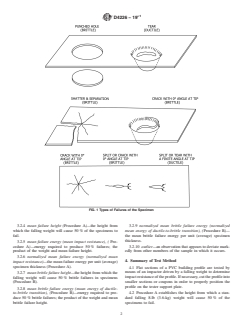
3.2.1 failure (of test specimen, as related to impact
(excluding,thoseintablesinfigures)shallnotbeconsideredas
resistance)—signified by the presence of a punched hole,
requirements of this standard.
crack,split,shatter,ortearthatwascreatedinthetargetareaby
1.5 This standard does not purport to address all of the
the impact of the falling weight (see Fig. 1).
safety concerns, if any, associated with its use. It is the
3.2.2 ductile failure (ductile break, as related to impact
responsibility of the user of this standard to establish appro-
resistance)—a tear or split having an angle greater than 0° at
priate safety, health, and environmental practices and deter-
the tip and extending through the entire thickness of the
mine the applicability of regulatory limitations prior to use.
specimen such that light is directly visible through the tear or
Specific precautionary statements are given in Section 8.
split (see Fig. 1).
1.6 This international standard was developed in accor-
3.2.3 brittle failure (brittle break, as related to impact
dance with internationally recognized principles on standard-
resistance)—a punched hole, split, or shatter where a piece of
ization established in the Decision on Principles for the
the specimen separates from the main part of the specimen or
Development of International Standards, Guides and Recom-
acrackthathasa0°angleatthetipasviewedbythenakedeye
(see Fig. 1).
These test methods are under the jurisdiction of ASTM Committee D20 on
Plastics and are the direct responsibility of Subcommittee D20.24 on Plastic
Building Products. For referenced ASTM standards, visit the ASTM website, www.astm.org, or
Current edition approved Nov. 1, 2019. Published December 2019. Originally contact ASTM Customer Service at service@astm.org. For Annual Book of ASTM
approved in 1983. Last previous edition approved in 2016 as D4226-16. DOI: Standards volume information, refer to the standard’s Document Summary page on
10.1520/D4226-19E01. the ASTM website.
*A Summary of Changes section appears at the end of this standard
Copyright © ASTM International, 100 Barr Harbor Drive, PO Box C700, West Conshohocken, PA 19428-2959. United States
´1
D4226 − 19
FIG. 1 Types of Failures of the Specimen
3.2.4 mean failure height (Procedure A)—the height from 3.2.9 normalized mean brittle failure energy (normalized
which the falling weight will cause 50% of the specimens to mean energy of ductile-to-brittle transition), (Procedure B)—
fail. the mean brittle failure energy per unit (average) specimen
thickness.
3.2.5 mean failure energy (mean impact resistance), ( Pro-
cedure A)—energy required to produce 50% failures; the 3.2.10 outlier—anobservationthatappearstodeviatemark-
product of the weight and mean failure height. edly from other members of the sample in which it occurs.
3.2.6 normalized mean failure energy (normalized mean
4. Summary of Test Method
impact resistance)—the mean failure energy per unit (average)
specimen thickness (Procedure A).
4.1 Flat sections of a PVC building profile are tested by
means of an impactor driven by a falling weight to determine
3.2.7 mean brittle failure height—theheightfromwhichthe
impactresistanceoftheprofile.Ifnecessary,cuttheprofileinto
falling weight will cause 50% brittle failures in specimens
smaller sections or coupons in order to properly position the
(Procedure B).
profile on the tester support plate.
3.2.8 mean brittle failure energy (mean energy of ductile-
to-brittle transition), (Procedure B)—energy required to pro- 4.2 Procedure A establishes the height from which a stan-
duce 50 % brittle failures; the product of the weight and mean dard falling 8-lb (3.6-kg) weight will cause 50% of the
brittle failure height. specimens to fail.
´1
D4226 − 19
FIG. 2 Impact Tester
4.3 Procedure B establishes the height from which a stan- quality control, environmental and weatherability research and
dard falling 8-lb (3.6-kg) weight will cause 50% of the development studies, and fabrication tolerance prediction con-
specimens to fail in a brittle mode. stitute useful applications.
4.4 Both procedures employ either of two configurations of 5.4 Choice of the specific impactor head configuration used
impactorheadsrestingonthespecimen.Thespecimenlaysflat is related to a variety of product attributes, such as specimen
on a stand that has a 0.64-in. (16.3-mm) hole. The falling thickness and product toughness as well as abstract factors,
suchastheanticipatedmodeoffailureinaspecificapplication.
weightimpactsontheimpactorheadtendingtodriveitthrough
the specimen into the hole of the stand. The geometric uniqueness of the impactor head configurations
prevents any comparison or correlation of testing results on
4.5 The technique used to find 50% failure level in both
samples tested with differing impactor head configurations. In
procedures is commonly called the Bruceton Staircase Method
general, the conical impactor, C.125, is useful to ensure failure
or Up-and-Down Method. Testing is concentrated near the
of thicker specimens where the H.25 impactor caused no
mean, reducing the number of specimens required to obtain a
failure.
reasonably precise estimate.
NOTE 2—Equivalent surface conditions are more likely to occur when
specimens are prepared by compression molding or extrusion than by
5. Significance and Use
injection molding.
5.1 The impact strength values obtained on the flat sections
5.5 When comparing different samples tested with the same
ofabuildingproductprofilearerelevantonlytotheflatsection
impactorheadconfiguration,impactresistanceshallbepermit-
thathasbeentestedandthesevaluesdonotnecessarilyindicate
ted to be normalized for average specimen thickness over a
theimpactresistanceofthewholeproduct,whichisaffectedby
reasonably broad range (for example, 1 to 3 mm). However,
the configuration of the profile (that is, corners, ribs, etc).
this should only be done when the surface conditions listed in
6.1 are essentially equivalent.
5.2 Constant weight and variable height, employed in these
test methods, allow the velocity of impact to vary and,
6. Interferences
therefore, by Procedure B, can determine the energy of
6.1 The results obtained are greatly influenced by the
ductile-to-brittle transition, which cannot be determined if a
qualityofthetestspecimens.Cracksusuallystartatthesurface
variable weight is dropped from a constant height.
5.3 These test procedures have been found to be useful
O.R. Weaver, “Using Attributes to Measure a Continuous Variable in Impact
elements in rigid poly(vinyl chloride) (PVC) building product
Testing Plastic Bottles,” Materials Research & Standards, MR & S, Vol. 6, No. 6,
characterization. Compound qualification, finished product June, 1996, pp. 285-291.
´1
D4226 − 19
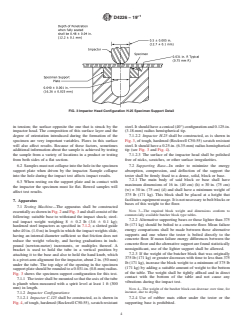
FIG. 3 Impactor Head Configuration H.25 Specimen Support Detail
in tension; the surface opposite the one that is struck by the steel.Itshouldhaveaconical(40°)configurationand0.125-in.
impactor head. The composition of this surface layer and the (3.18-mm) radius hemispherical tip.
degree of orientation introduced during the formation of the 7.1.2.2 Impactor H.25 shall be constructed, as is shown in
specimen are very important variables. Flaws in this surface Fig. 3, of tough, hardened (Rockwell C50-55) scratch resistant
will also affect results. Because of these factors, sometimes steel.Itshouldhavea0.25-in.(6.35-mm)radiushemispherical
additional information about the sample is achieved by testing tip (see Fig. 3 and Fig. 4).
the sample from a variety of locations in a product or testing 7.1.2.3 The surface of the impactor head shall be polished
from both sides of a flat section. free of nicks, scratches, or other surface irregularities.
7.2 Supporting Base—In order to minimize the energy
6.2 Samplesmustnotcollapseintotheholeinthespecimen
absorption, compression, and deflection of the support the
support plate when driven by the impactor. Sample collapse
tester shall be firmly fixed to a dense, solid, block or base.
into the hole during the impact test affects impact results.
7.2.1 The main body of said block or base shall have
6.3 When resting on the support plate and in contact with
maximum dimensions of 16 in. (40 cm) (h) × 30 in. (75 cm)
the impactor the specimen must lie flat. Bowed samples will
(w) × 30 in. (75 cm) (d) and shall have a minimum weight of
affect test results.
375 lb (171 kg). This block shall be placed at a height that
facilitatesequipmentusage.Itisnotnecessarytoboltblocksor
7. Apparatus
bases of this weight to the floor.
7.1 Testing Machine—The apparatus shall be constructed
NOTE 3—The required block weight and dimensions conform to
essentiallyasshowninFig.2andFig.3andshallconsistofthe
commercially available butcher block type tables.
following: suitable base to withstand the impact shock; steel-
7.2.2 Alternative supporting bases or those lighter than 375
rod impact weight weighing 8 6 0.2 lb (3.6 6 0.1 kg);
lb (171 kg) should be bolted to a concrete floor. Mean failure
hardened steel impactors as specified in 7.1.2; a slotted guide
energy comparisons shall be made between these alternative
tube40in.(1.0m)inlengthinwhichtheimpactweightsslide,
supports and one where the tester is bolted directly to the
having an internal diameter sufficient so that friction does not
concrete floor. If mean failure energy differences between the
reduce the weight velocity, and having graduations in inch-
concretefloorandthealternativesupportarefoundstatistically
pound (newton-meter) increments, or multiples thereof. A
nonsignificant, use of the lighter support shall be allowed.
bracket is used to hold the tube in a vertical position by
7.2.3 If the weight of the butcher block that was originally
attaching it to the base and also to hold the hand knob, which
375 lb (171 kg) or greater decreases with time to less than 375
is a pivot-arm alignment for the impactor, about 2 in. (50 mm)
lb (171 kg), increase the block weight to a minimum of 375 lb
under the tube. The top edge of the opening in the specimen
(171 kg) by adding a suitable amount of weight to the bottom
supportplateshouldberoundedtoa0.031-in.(0.8-mm)radius.
of the table. The weight shall be tightly affixed and in direct
Fig. 3 shows the specimen support configuration for this test.
contact with the bottom of the table and not cause any
7.1.1 Thetestershallbemountedsothattheaxisofthetube
vibrations during the impact test.
is plumb when measured with a spirit level at least 1 ft (300
mm) in length. NOTE 4—The weight of the butcher block can decrease over time, for
instance, due to drying.
7.1.2 Impactor Configurations:
7.1.2.1 Impactor C.125 shall be constructed, as is shown in 7.2.4 Use of rubber mats either under the tester or the
Fig.4,oftough,hardened(RockwellC50-55),scratchresistant supporting base is prohibited.
´1
D4226 − 19
FIG. 4 Impactor Head Configuration C.125
plateisrelatedtosamplethicknessandforthickersamplesit’spossibleto
7.3 Micrometer, for measurement of specimen thickness. It
use smaller samples.
should be accurate to1%ofthe average thickness of
specimens used. See Test Method D5947 for suitable microm- 10.2 When the approximate mean failure height for a given
eters. sample is known, 20 specimens usually yield sufficiently
precise results. If the mean failure height cannot be
8. Safety Precautions
approximated,
...