

ASTM E283/E283M-19
(Test Method)Standard Test Method for Determining Rate of Air Leakage Through Exterior Windows, Skylights, Curtain Walls, and Doors Under Specified Pressure Differences Across the Specimen
General Information
- Abstract
SIGNIFICANCE AND USE
5.1 This test method is a standard procedure for determining the air leakage characteristics under specified air pressure differences at ambient conditions.
Note 2: The air pressure differences acting across a building envelope vary greatly. The factors affecting air pressure differences and the implications or the resulting air leakage relative to the environment within buildings are discussed in the literature.4-6 These factors should be fully considered in specifying the test pressure differences to be used.
5.2 Rates of air leakage are sometimes used for comparison purposes. Such comparisons may not be valid unless the components being tested and compared are of essentially the same size, configuration, and design.
SCOPE
1.1 This test method covers a standard laboratory procedure for determining the air leakage rates of exterior windows, skylights, curtain walls, and doors under specified differential pressure conditions across the specimen. The test method described is for tests with constant temperature and humidity across the specimen. Persons interested in performing air leakage tests on units exposed to various temperature differences across the specimen should reference Test Method E1424.
1.2 This laboratory procedure is applicable to exterior windows, skylights, curtain walls, and doors and is intended to measure only such leakage associated with the assembly and not the installation. The test method can be adapted for the latter purpose.
Note 1: Performing tests under uncontrolled conditions or with a temperature differential across the specimen may affect the air leakage rate. This is not addressed by this test method.
1.3 This test method is intended for laboratory use. Persons interested in performing field air leakage tests on installed units should reference Test Method E783.
1.4 Persons interested in evaluating air permeance of building materials should reference Test Method E2178.
1.5 Persons interested in determining air leakage of air barrier assemblies should reference Test Method E2357.
1.6 Persons using this procedure should be knowledgeable in the areas of fluid mechanics, instrumentation practices, and shall have a general understanding of fenestration products and components.
1.7 The values stated in either SI units or inch-pound units are to be regarded separately as standard. The values stated in each system are not necessarily exact equivalents; therefore, to ensure conformance with the standard, each system shall be used independently of the other, and values from the two systems shall not be combined.
1.8 This standard does not purport to address all of the safety problems, if any, associated with its use. It is the responsibility of the user of this standard to establish appropriate safety, health, and environmental practices and determine the applicability of regulatory limitations prior to use. For specific hazard statement, see Section 7.
1.9 This international standard was developed in accordance with internationally recognized principles on standardization established in the Decision on Principles for the Development of International Standards, Guides and Recommendations issued by the World Trade Organization Technical Barriers to Trade (TBT) Committee.
- Status
- Published
- Publication Date
- 31-Jul-2019
- Technical Committee
- E06 - Performance of Buildings
- Drafting Committee
- E06.51 - Performance of Windows, Doors, Skylights and Curtain Walls
Buy Documents
ASTM E283/E283M-19 - Standard Test Method for Determining Rate of Air Leakage Through Exterior Windows, Skylights, Curtain Walls, and Doors Under Specified Pressure Differences Across the Specimen
REDLINE ASTM E283/E283M-19 - Standard Test Method for Determining Rate of Air Leakage Through Exterior Windows, Skylights, Curtain Walls, and Doors Under Specified Pressure Differences Across the Specimen
Overview
ASTM E283/E283M-19 establishes a standardized laboratory procedure for determining the rate of air leakage through exterior windows, skylights, curtain walls, and doors when subjected to specified pressure differences. This test method is essential for assessing the air permeability characteristics of fenestration assemblies under controlled temperature and humidity, facilitating comparison and verification of product performance in meeting energy efficiency, durability, and indoor air quality requirements.
The standard sets out requirements for specimen preparation, testing apparatus, test conditions, and calculation methods, ensuring repeatable and reliable results. It is not intended for evaluating installed units (field testing) or air permeance of materials, for which other ASTM standards are referenced.
Key Topics
Scope and Test Applicability
- Laboratory procedure for air leakage through assembled units of windows, skylights (including sloped glazing and tubular daylighting devices), curtain walls, and doors.
- Focuses solely on air leakage associated with the unit assembly-not the installation.
- Uses constant temperature and humidity across the specimen.
Test Apparatus and Conditions
- Requires a tightly controlled test chamber and calibrated air flow measurement equipment.
- Test pressure differences must be specified, as results can be significantly affected by variations in pressure, temperature, and humidity.
- Measurements are adjusted to standard atmospheric conditions for valid comparisons.
Calculation and Reporting
- Air leakage rate is calculated per unit area or per unit length of operable crack perimeter.
- The procedure includes requirements for correcting measured air flows to standardized temperature, pressure, and humidity.
Limitations
- Not suitable for field testing of installed assemblies (see ASTM E783).
- Does not address temperature differentials across specimens (see ASTM E1424 for such conditions).
- Precision and bias for this test method have not been specifically determined.
Applications
The ASTM E283/E283M-19 standard is widely used in various sectors of the building and construction industry, particularly in evaluating the quality and performance of fenestration products. Common applications include:
Product Certification and Quality Control
- Manufacturers utilize this method to demonstrate compliance with industry benchmarks for air tightness in windows, doors, curtain walls, and skylights.
- Provides a uniform basis for air leakage classification and product labeling.
Research and Development
- R&D teams use the test to improve designs for enhanced thermal performance and reduced infiltration/exfiltration rates, supporting building energy efficiency.
Building Codes and Regulatory Compliance
- The results generated by this method are often referenced in building codes and green building rating systems that require specific air leakage rates.
Comparative Performance Evaluation
- Enables side-by-side product comparisons, provided that specimens are of essentially the same size, configuration, and design.
Related Standards
For comprehensive evaluation or alternative testing scenarios, ASTM E283/E283M-19 references the following associated standards:
- ASTM E783 - Field Measurement of Air Leakage Through Installed Exterior Windows and Doors.
- ASTM E1424 - Air Leakage Testing Under Differential Pressure and Temperature Conditions.
- ASTM E2178 - Air Permeance of Building Materials.
- ASTM E2357 - Air Leakage Rates of Air Barrier Assemblies.
- ISO/IEC 17025 - General requirements for the competence of testing and calibration laboratories.
These related standards ensure that all aspects of air barrier systems and fenestration assemblies-from field performance to material-level permeability-are addressed under harmonized and internationally recognized methodologies.
Keywords: ASTM E283, air leakage, fenestration, curtain walls, windows, doors, skylights, air infiltration, pressure difference, building envelope, laboratory test method, energy efficiency, standard conditions.
Relations
- Refers
ASTM E2357-24 - Standard Test Method for Determining Air Leakage Rate of Air Barrier Assemblies - Effective Date
- 01-Jan-2024
- Effective Date
- 01-Oct-2018
- Effective Date
- 01-Jun-2017
- Effective Date
- 01-Mar-2015
- Effective Date
- 01-Nov-2014
- Effective Date
- 01-Nov-2011
- Effective Date
- 01-Sep-2011
- Effective Date
- 01-Oct-2010
- Effective Date
- 01-Sep-2008
- Effective Date
- 01-Jun-2006
- Effective Date
- 01-Oct-2005
- Effective Date
- 10-Aug-2003
- Effective Date
- 10-Oct-2002
- Effective Date
- 10-Oct-2002
- Effective Date
- 10-Dec-2001
Buy Documents
ASTM E283/E283M-19 - Standard Test Method for Determining Rate of Air Leakage Through Exterior Windows, Skylights, Curtain Walls, and Doors Under Specified Pressure Differences Across the Specimen
REDLINE ASTM E283/E283M-19 - Standard Test Method for Determining Rate of Air Leakage Through Exterior Windows, Skylights, Curtain Walls, and Doors Under Specified Pressure Differences Across the Specimen
Get Certified
Connect with accredited certification bodies for this standard

DIBt (Deutsches Institut für Bautechnik)
German Institute for Building Technology.
DIN CERTCO
DIN Group product certification.

Aboma Certification B.V.
Specialized in construction, metal, and transport sectors.
Sponsored listings
Frequently Asked Questions
ASTM E283/E283M-19 is a standard published by ASTM International. Its full title is "Standard Test Method for Determining Rate of Air Leakage Through Exterior Windows, Skylights, Curtain Walls, and Doors Under Specified Pressure Differences Across the Specimen". This standard covers: SIGNIFICANCE AND USE 5.1 This test method is a standard procedure for determining the air leakage characteristics under specified air pressure differences at ambient conditions. Note 2: The air pressure differences acting across a building envelope vary greatly. The factors affecting air pressure differences and the implications or the resulting air leakage relative to the environment within buildings are discussed in the literature.4-6 These factors should be fully considered in specifying the test pressure differences to be used. 5.2 Rates of air leakage are sometimes used for comparison purposes. Such comparisons may not be valid unless the components being tested and compared are of essentially the same size, configuration, and design. SCOPE 1.1 This test method covers a standard laboratory procedure for determining the air leakage rates of exterior windows, skylights, curtain walls, and doors under specified differential pressure conditions across the specimen. The test method described is for tests with constant temperature and humidity across the specimen. Persons interested in performing air leakage tests on units exposed to various temperature differences across the specimen should reference Test Method E1424. 1.2 This laboratory procedure is applicable to exterior windows, skylights, curtain walls, and doors and is intended to measure only such leakage associated with the assembly and not the installation. The test method can be adapted for the latter purpose. Note 1: Performing tests under uncontrolled conditions or with a temperature differential across the specimen may affect the air leakage rate. This is not addressed by this test method. 1.3 This test method is intended for laboratory use. Persons interested in performing field air leakage tests on installed units should reference Test Method E783. 1.4 Persons interested in evaluating air permeance of building materials should reference Test Method E2178. 1.5 Persons interested in determining air leakage of air barrier assemblies should reference Test Method E2357. 1.6 Persons using this procedure should be knowledgeable in the areas of fluid mechanics, instrumentation practices, and shall have a general understanding of fenestration products and components. 1.7 The values stated in either SI units or inch-pound units are to be regarded separately as standard. The values stated in each system are not necessarily exact equivalents; therefore, to ensure conformance with the standard, each system shall be used independently of the other, and values from the two systems shall not be combined. 1.8 This standard does not purport to address all of the safety problems, if any, associated with its use. It is the responsibility of the user of this standard to establish appropriate safety, health, and environmental practices and determine the applicability of regulatory limitations prior to use. For specific hazard statement, see Section 7. 1.9 This international standard was developed in accordance with internationally recognized principles on standardization established in the Decision on Principles for the Development of International Standards, Guides and Recommendations issued by the World Trade Organization Technical Barriers to Trade (TBT) Committee.
SIGNIFICANCE AND USE 5.1 This test method is a standard procedure for determining the air leakage characteristics under specified air pressure differences at ambient conditions. Note 2: The air pressure differences acting across a building envelope vary greatly. The factors affecting air pressure differences and the implications or the resulting air leakage relative to the environment within buildings are discussed in the literature.4-6 These factors should be fully considered in specifying the test pressure differences to be used. 5.2 Rates of air leakage are sometimes used for comparison purposes. Such comparisons may not be valid unless the components being tested and compared are of essentially the same size, configuration, and design. SCOPE 1.1 This test method covers a standard laboratory procedure for determining the air leakage rates of exterior windows, skylights, curtain walls, and doors under specified differential pressure conditions across the specimen. The test method described is for tests with constant temperature and humidity across the specimen. Persons interested in performing air leakage tests on units exposed to various temperature differences across the specimen should reference Test Method E1424. 1.2 This laboratory procedure is applicable to exterior windows, skylights, curtain walls, and doors and is intended to measure only such leakage associated with the assembly and not the installation. The test method can be adapted for the latter purpose. Note 1: Performing tests under uncontrolled conditions or with a temperature differential across the specimen may affect the air leakage rate. This is not addressed by this test method. 1.3 This test method is intended for laboratory use. Persons interested in performing field air leakage tests on installed units should reference Test Method E783. 1.4 Persons interested in evaluating air permeance of building materials should reference Test Method E2178. 1.5 Persons interested in determining air leakage of air barrier assemblies should reference Test Method E2357. 1.6 Persons using this procedure should be knowledgeable in the areas of fluid mechanics, instrumentation practices, and shall have a general understanding of fenestration products and components. 1.7 The values stated in either SI units or inch-pound units are to be regarded separately as standard. The values stated in each system are not necessarily exact equivalents; therefore, to ensure conformance with the standard, each system shall be used independently of the other, and values from the two systems shall not be combined. 1.8 This standard does not purport to address all of the safety problems, if any, associated with its use. It is the responsibility of the user of this standard to establish appropriate safety, health, and environmental practices and determine the applicability of regulatory limitations prior to use. For specific hazard statement, see Section 7. 1.9 This international standard was developed in accordance with internationally recognized principles on standardization established in the Decision on Principles for the Development of International Standards, Guides and Recommendations issued by the World Trade Organization Technical Barriers to Trade (TBT) Committee.
ASTM E283/E283M-19 is classified under the following ICS (International Classification for Standards) categories: 91.120.10 - Thermal insulation of buildings. The ICS classification helps identify the subject area and facilitates finding related standards.
ASTM E283/E283M-19 has the following relationships with other standards: It is inter standard links to ASTM E2357-24, ASTM E783-02(2018), ASTM E2357-17, ASTM E631-15, ASTM E631-14, ASTM E2178-11, ASTM E2357-11, ASTM E783-02(2010), ASTM E1424-91(2008), ASTM E631-06, ASTM E2357-05, ASTM E2178-03, ASTM E783-93, ASTM E783-02, ASTM E2178-01. Understanding these relationships helps ensure you are using the most current and applicable version of the standard.
ASTM E283/E283M-19 is available in PDF format for immediate download after purchase. The document can be added to your cart and obtained through the secure checkout process. Digital delivery ensures instant access to the complete standard document.
Standards Content (Sample)
This international standard was developed in accordance with internationally recognized principles on standardization established in the Decision on Principles for the
Development of International Standards, Guides and Recommendations issued by the World Trade Organization Technical Barriers to Trade (TBT) Committee.
Designation:E283/E283M −19
Standard Test Method for
Determining Rate of Air Leakage Through Exterior Windows,
Skylights, Curtain Walls, and Doors Under Specified
Pressure Differences Across the Specimen
This standard is issued under the fixed designation E283/E283M; the number immediately following the designation indicates the year
of original adoption or, in the case of revision, the year of last revision.Anumber in parentheses indicates the year of last reapproval.
A superscript epsilon (´) indicates an editorial change since the last revision or reapproval.
This standard has been approved for use by agencies of the U.S. Department of Defense.
1. Scope each system are not necessarily exact equivalents; therefore, to
ensure conformance with the standard, each system shall be
1.1 Thistestmethodcoversastandardlaboratoryprocedure
used independently of the other, and values from the two
for determining the air leakage rates of exterior windows,
systems shall not be combined.
skylights, curtain walls, and doors under specified differential
1.8 This standard does not purport to address all of the
pressure conditions across the specimen. The test method
safety problems, if any, associated with its use. It is the
described is for tests with constant temperature and humidity
responsibility of the user of this standard to establish appro-
across the specimen. Persons interested in performing air
priate safety, health, and environmental practices and deter-
leakage tests on units exposed to various temperature differ-
mine the applicability of regulatory limitations prior to use.
ences across the specimen should reference Test Method
For specific hazard statement, see Section 7.
E1424.
1.9 This international standard was developed in accor-
1.2 This laboratory procedure is applicable to exterior
dance with internationally recognized principles on standard-
windows, skylights, curtain walls, and doors and is intended to
ization established in the Decision on Principles for the
measure only such leakage associated with the assembly and
Development of International Standards, Guides and Recom-
not the installation. The test method can be adapted for the
mendations issued by the World Trade Organization Technical
latter purpose.
Barriers to Trade (TBT) Committee.
NOTE 1—Performing tests under uncontrolled conditions or with a
temperature differential across the specimen may affect the air leakage
2. Referenced Documents
rate. This is not addressed by this test method.
2.1 ASTM Standards:
1.3 This test method is intended for laboratory use. Persons
E631Terminology of Building Constructions
interestedinperformingfieldairleakagetestsoninstalledunits
E783Test Method for Field Measurement of Air Leakage
should reference Test Method E783.
Through Installed Exterior Windows and Doors
1.4 Persons interested in evaluating air permeance of build-
E1424TestMethodforDeterminingtheRateofAirLeakage
ing materials should reference Test Method E2178.
Through Exterior Windows, Curtain Walls, and Doors
Under Specified Pressure and Temperature Differences
1.5 Persons interested in determining air leakage of air
Across the Specimen
barrier assemblies should reference Test Method E2357.
E2178TestMethodforAirPermeanceofBuildingMaterials
1.6 Persons using this procedure should be knowledgeable
E2357TestMethodforDeterminingAirLeakageRateofAir
in the areas of fluid mechanics, instrumentation practices, and
Barrier Assemblies
shallhaveageneralunderstandingoffenestrationproductsand
2.2 ISO Standard:
components.
ISO/IEC 17025General requirements for the competence of
1.7 The values stated in either SI units or inch-pound units
testing and calibration laboratories
are to be regarded separately as standard. The values stated in
For referenced ASTM standards, visit the ASTM website, www.astm.org, or
This test method is under the jurisdiction of ASTM Committee E06 on contact ASTM Customer Service at service@astm.org. For Annual Book of ASTM
Performance of Buildings and is the direct responsibility of Subcommittee E06.51 Standards volume information, refer to the standard’s Document Summary page on
on Performance of Windows, Doors, Skylights and Curtain Walls. the ASTM website.
Current edition approved Aug. 1, 2019. Published September 2019. Originally Available from International Organization for Standardization (ISO), ISO
approved in 1965. Last previous edition approved in 2012 as E283–04(2012). DOI: Central Secretariat, BIBC II, Chemin de Blandonnet 8, CP 401, 1214 Vernier,
10.1520/E0283_E0283M–19. Geneva, Switzerland, http://www.iso.org.
Copyright © ASTM International, 100 Barr Harbor Drive, PO Box C700, West Conshohocken, PA 19428-2959. United States
E283/E283M−19
NOTE 2—The air pressure differences acting across a building envelope
3. Terminology
vary greatly. The factors affecting air pressure differences and the
3.1 Definitions—Terms used in this test method are defined
implicationsortheresultingairleakagerelativetotheenvironmentwithin
4-6
in Terminology E631.
buildings are discussed in the literature. These factors should be fully
considered in specifying the test pressure differences to be used.
3.2 Definitions of Terms Specific to This Standard:
2 3 2
3.2.1 air leakage rate (q or q), L/(s·m ) [ft /min·ft ], or
A l 5.2 Rates of air leakage are sometimes used for comparison
L/(s·m) [ft /min·ft]—the air leakage per unit of specimen area
purposes. Such comparisons may not be valid unless the
(A) or per unit length of operable crack perimeter (l).
components being tested and compared are of essentially the
3 3
same size, configuration, and design.
3.2.2 extraneous air leakage (Q ), m /s [ft /min]—the vol-
e
ume of air flowing per unit of time through the test chamber
6. Apparatus
and test apparatus, exclusive of the air flowing through the test
specimen, under a test pressure difference and test temperature
6.1 The description of the apparatus in this section is
difference, converted to standard conditions.
general in nature. Any suitable arrangement of equipment
3.2.2.1 Discussion—Extraneous leakage is the sum of all
capableofmaintainingtherequiredtesttolerancesispermitted.
leakage other than that intended to be measured by the test.
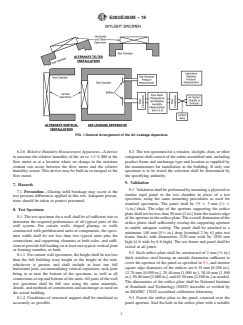
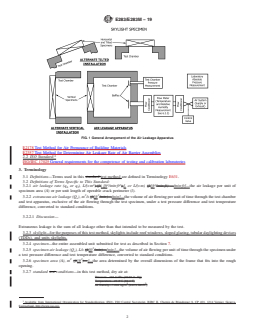
(See Fig. 1.)
3.2.3 skylight—for the purposes of this test method, sky-
6.2 Test Chamber—A well sealed box, wall, or other appa-
lights include roof windows, sloped glazing, tubular daylight-
ratus into or against which the specimen is mounted and
ing devices (TDDs), and units skylights.
secured for testing.An air supply shall be provided to allow a
3.2.4 specimen—theentireassembledunitsubmittedfortest
positive or negative pressure differential to be applied across
as described in Section 7.
the specimen without significant extraneous losses. The cham-
3.2.5 specimen air leakage (Q ), L/s [ft /min]—the volume ber shall be capable of withstanding the differential test
s
of air flowing per unit of time through the specimen under a pressures that may be encountered in this procedure. At least
test pressure difference and test temperature difference, con- one static air pressure tap shall be provided on each side of the
verted to standard conditions. specimentomeasurethetestpressuredifferences.Thepressure
2 2 tapshallbelocatedinanareaofthechamberinwhichpressure
3.2.6 specimen area (A), m [ft ]—the area determined by
readings will not be affected by any supply air. The air supply
the overall dimensions of the frame that fits into the rough
opening to the chamber shall be located in an area in which it
opening.
does not directly impinge upon the test specimen.
3.2.7 standard conditions—in this test method, dry air at:
6.2.1 Supply Air System—A controllable blower, exhaust
Pressure—101.3 kPa [29.92 in. Hg]
fan, or reversible blower designed to provide the required air
Temperature—20.8 °C [69.4 °F]
3 3
flowatthespecifiedtestpressuredifference.Thesystemshould
Air Density—1.202 kg/m [0.075 lbm/ft ]
provide essentially constant air flow at the specified test
3.2.8 test pressure differences, Pa [lbf/ft ]—the specified
pressure difference for a time period sufficient to obtain
differential static air pressure across the specimen.
readings of air flow. The inlet into the chamber (sealed box)
3.2.9 total air flow (Q), L/s [ft /min]—the volume of air
t
shall be located or be shielded with a baffle so that the air flow
flowing per unit of time through the test chamber and test
is not directed upon the test specimen.
apparatus, inclusive of the air flowing through the test
6.2.2 Pressure Measuring Apparatus—Adevice to measure
specimen, under a test pressure difference and test temperature
the differential test pressures to 62% of set point or 62.5 Pa
difference, converted to standard conditions.
[60.01 in. of water column], whichever is greater.
3.2.10 unit length of operable crack perimeter (l), m [ft]—
6.2.3 Air Flow Metering System—A device to measure the
thesumofallperimetersofoperableventilators,sash,ordoors
air flow to 65% into/out of the test chamber or through the
containedinthetestspecimen,basedontheoveralldimensions
testspecimen.Typicallyairflowismeasuredusingamassflow
of such parts. Where two such operable parts meet the two
meter or volumetric flow meter. Methods to adjust volumetric
adjacent lengths of perimeter shall be counted as only one
flow meter measurements to standard conditions are included
length.
in Section 12.
6.2.4 Air Temperature Measurement Apparatus—A device
4. Summary of Test Method
to measure the temperature of the air to 60.5 K at the flow
4.1 The test consists of sealing a test specimen into or
meter.Thisdevicemaybebuilt-inorintegraltotheflowmeter.
against one face of an air chamber, supplying air to or
6.2.5 Absolute Pressure Measurement Apparatus—Adevice
exhausting air from the chamber at the rate required to
to measure the absolute pressure to 62% within the labora-
maintain the specified test pressure difference across the
tory.
specimen, and measuring the resultant air flow through the
specimen. Measurements of the resultant air flow are adjusted
to standard conditions.
ASHRAE Handbook of Fundamentals, American Society of Heating,
5. Significance and Use
Refrigerating,andAir-ConditioningEngineers,Inc.(ASHRAE),Atlanta,GA,2013.
Fluid Meters—Their Theory and Application,5thEdition,AmericanSocietyof
5.1 Thistestmethodisastandardprocedurefordetermining
Mechanical Engineers (ASME), New York, NY, 1959.
the air leakage characteristics under specified air pressure
PowerTestCode,2ndEdition,Part5,Chapter4FlowMeasurements,American
differences at ambient conditions. Society of Mechanical Engineers (ASME), New York, NY, 1956.
E283/E283M−19
FIG. 1General Arrangement of the Air Leakage Apparatus
6.2.6 Relative Humidity Measurement Apparatus—Adevice 8.2 The test specimen for a window, skylight, door, or other
to measure the relative humidity of the air to 62% RH at the componentshallconsistoftheentireassembledunit,including
flow meter or at a location where no change in the moisture product frame and anchorage type and location as supplied by
content can occur between the flow meter and the relative the manufacturer for installation in the building. If only one
humidity sensor. This device may be built-in or integral to the specimen is to be tested the selection shall be determined by
flow meter. the specifying authority.
9. Validation
7. Hazards
9.1 Validationshallbeperformedbymountingaplywoodor
7.1 Precaution—Glazing infill breakage may occur at the
similar rigid panel to the test chamber in place of a test
test pressure differences applied in this test. Adequate precau-
specimen, using the same mounting procedures as used for
tions should be taken to protect personnel.
standard specimens. The panel shall be 19 63mm[ ⁄4 6
⁄8in.] thick. The edge of the aperture supporting the orifice
8. Test Specimen
plateshallnotbelessthan50mm[2in.]fromthenearestedge
8.1 Thetestspecimenforawallshallbeofsufficientsizeto
oftheapertureintheorificeplate.Theoveralldimensionofthe
determine the required performance of all typical parts of the
orifice plates shall sufficiently overlap the supporting aperture
wall system. For curtain walls, sloped glazing, or walls
to enable adequate sealing. The panel shall be attached to a
constructed with prefabricated units or components, the speci-
minimum 140 mm [5 ⁄2 in.] deep [nominal 2 by 6] pine test
men width shall be not less than two typical units plus the
frame (buck) with dimensions 1220 mm wide by 1830 mm
connections and supporting elements at both sides, and suffi-
high [4 ft wide by 6 ft high]. The test frame and panel shall be
cienttoprovidefullloadingonatleastonetypicalverticaljoint
sealed at all joints.
or framing member, or both.
9.2 Each orifice plate shall be constructed of 3 mm [ ⁄8 in.]
8.1.1 Forcurtainwallspecimens,theheightshallbenotless
thick stainless steel having an outside dimension sufficient to
than the full building story height or the height of the unit,
cover the aperture of the panel as specified in 9.1, and interior
whichever is greater, and shall include at least one full
square edge diameters of the orifices are 6.35 mm [0.250 in.],
horizontal joint, accommodating vertical expansion, such joint
12.70 mm [0.500 in.], 25.40mm [1.000 in.], 38.10 mm [1.500
being at or near the bottom of the specimen, as well as all
in.],50.80mm[2.000in.],and63.50mm[2.500in.]asneeded.
connectionsattopandbottomoftheunits.Allpartsofthewall
The dimensions of the orifice plate shall be National Institute
test specimen shall be full size using the same materials,
of Standards and Technology (NIST) traceable or verified by
details, and methods of construction and anchorage as used on
an ISO/IEC 17025 accredited calibration laboratory.
the actual building.
8.1.2 Conditions of structural support shall be simulated as 9.3 Fasten the orifice plate to the panel, centered over the
accurately as possible. panel aperture. Seal the hole in the orifice plate with a suitable
E283/E283M−19
adhesive tape so that an extraneous reading on the air flow 9.8 Validation shall be performed at least once every six
system can be obtained. Measure the amount of such leakage months using the method described above. Alternative orifice
with the orifice plate sealed, at the air pressure difference as mounting conditions may be used during interim validation
referencedin10.1.2.Afterdeterminingtheextraneousleakage, periodsforairflowcheckingpurposes,butthesemethodsshall
remove the adhesive tape from the hole in the orifice plate and be documented in the laboratory’s Operation Manual.
repeat the process to determine the total measured flow. The
measured air flows shall be corrected to standard conditions
10. Test Conditions
(see Section 12.)
10.1 The specifying authority shall supply the following
9.4 Validationoftheairleakagetestequipmentshallconsist
information:
of determining the flow through the air flow system to be
10.1.1 Specimen test size,
validated using all applicable orifice plate sizes for the design
10.1.2 Test pressure difference (if no value is designated,
range of the flow metering apparatus. The orifice plate to be
75Pa [1.57 lb/ft ]),
usedforthecorrespondingairflowrangesisindicatedinTable
10.1.3 Direction of air flow, exfiltration or infiltration. (If
1. When needed, additional orifice plate sizes may be used to
none is specified, the test shall be infiltration.), and
adequately cover the air flow system measuring range outside
10.1.4 Units of air leakage rate by operable crack perimeter
of Table 1 nominal flow ranges. It is also allowed to use other
or unit
...
This document is not an ASTM standard and is intended only to provide the user of an ASTM standard an indication of what changes have been made to the previous version. Because
it may not be technically possible to adequately depict all changes accurately, ASTM recommends that users consult prior editions as appropriate. In all cases only the current version
of the standard as published by ASTM is to be considered the official document.
Designation: E283 − 04 (Reapproved 2012) E283/E283M − 19
Standard Test Method for
Determining Rate of Air Leakage Through Exterior Windows,
Skylights, Curtain Walls, and Doors Under Specified
Pressure Differences Across the Specimen
This standard is issued under the fixed designation E283;E283/E283M; the number immediately following the designation indicates the
year of original adoption or, in the case of revision, the year of last revision. A number in parentheses indicates the year of last
reapproval. A superscript epsilon (´) indicates an editorial change since the last revision or reapproval.
This standard has been approved for use by agencies of the U.S. Department of Defense.
1. Scope
1.1 This test method covers a standard laboratory procedure for determining the air leakage rates of exterior windows, skylights,
curtain walls, and doors under specified differential pressure conditions across the specimen. The test method described is for tests
with constant temperature and humidity across the specimen. Persons interested in performing air leakage tests on units exposed
to various temperature differences across the specimen should reference Test Method E1424.
1.2 This laboratory procedure is applicable to exterior windows, skylights, curtain walls, and doors and is intended to measure
only such leakage associated with the assembly and not the installation. The test method can be adapted for the latter purpose.
NOTE 1—Performing tests at non-ambientunder uncontrolled conditions or with a temperature differential across the specimen may affect the air leakage
rate. This is not addressed by this test method.
1.3 This test method is intended for laboratory use. Persons interested in performing field air leakage tests on installed units
should reference Test Method E783.
1.4 Persons interested in evaluating air permeance of building materials should reference Test Method E2178.
1.5 Persons interested in determining air leakage of air barrier assemblies should reference Test Method E2357.
1.6 Persons using this procedure should be knowledgeable in the areas of fluid mechanics, instrumentation practices, and shall
have a general understanding of fenestration products and components.
1.7 The values stated in either SI units or inch-pound units are to be regarded separately as standard. The values givenstated
in parentheses are mathematical conversions to inch-pound units that are provided for information only and are not considered
standard.each system are not necessarily exact equivalents; therefore, to ensure conformance with the standard, each system shall
be used independently of the other, and values from the two systems shall not be combined.
1.8 This standard does not purport to address all of the safety problems, if any, associated with its use. It is the responsibility
of the user of this standard to establish appropriate safety safety, health, and healthenvironmental practices and determine the
applicability of regulatory limitations prior to use. For specific hazard statement, see Section 7.
1.9 This international standard was developed in accordance with internationally recognized principles on standardization
established in the Decision on Principles for the Development of International Standards, Guides and Recommendations issued
by the World Trade Organization Technical Barriers to Trade (TBT) Committee.
2. Referenced Documents
2.1 ASTM Standards:
E631 Terminology of Building Constructions
E783 Test Method for Field Measurement of Air Leakage Through Installed Exterior Windows and Doors
E1424 Test Method for Determining the Rate of Air Leakage Through Exterior Windows, Curtain Walls, and Doors Under
Specified Pressure and Temperature Differences Across the Specimen
This test method is under the jurisdiction of ASTM Committee E06 on Performance of Buildings and is the direct responsibility of Subcommittee E06.51 on Performance
of Windows, Doors, Skylights and Curtain Walls.
Current edition approved April 1, 2012Aug. 1, 2019. Published May 2012September 2019. Originally approved in 1965. Last previous edition approved in 20042012 as
E283 – 2004.E283–04(2012). DOI: 10.1520/E0283-04R12.10.1520/E0283_E0283M–19.
For referenced ASTM standards, visit the ASTM website, www.astm.org, or contact ASTM Customer Service at service@astm.org. For Annual Book of ASTM Standards
volume information, refer to the standard’s Document Summary page on the ASTM website.
Copyright © ASTM International, 100 Barr Harbor Drive, PO Box C700, West Conshohocken, PA 19428-2959. United States
E283/E283M − 19
FIG. 1 General Arrangement of the Air Leakage Apparatus
E2178 Test Method for Air Permeance of Building Materials
E2357 Test Method for Determining Air Leakage Rate of Air Barrier Assemblies
2.2 ISO Standard:
ISO/IEC 17025 General requirements for the competence of testing and calibration laboratories
3. Terminology
3.1 Definitions—Terms used in this standard test method are defined in Terminology E631.
3.2 Definitions of Terms Specific to This Standard:
2 3 2 3
3.2.1 air leakage rate (q or q ), L/(s·m ) (ft) [ft /min·ft ),], or L/(s·m) (ft[ft /min·ft) —/min·ft]—the air leakage per unit of
A l
specimen area (A) or per unit length of operable crack perimeter (l).
3 3
3.2.2 extraneous air leakage (Q ), m /s (ft[ft /min)—/min]—the volume of air flowing per unit of time through the test chamber
e
and test apparatus, exclusive of the air flowing through the test specimen, under a test pressure difference and test temperature
difference, converted to standard conditions.
3.2.2.1 Discussion—
Extraneous leakage is the sum of all leakage other than that intended to be measured by the test.
3.2.3 skylight—for the purposes of this test method, skylights include roof windows, sloped glazing, tubular daylighting devices
(TDDs), and units skylights.
3.2.4 specimen—the entire assembled unit submitted for test as described in Section 7.
3.2.5 specimen air leakage (Q ), L/s (ft[ft /min)—/min]—the volume of air flowing per unit of time through the specimen under
s
a test pressure difference and test temperature difference, converted to standard conditions.
2 2
3.2.6 specimen area (A), m (ft[ft )—]—the area determined by the overall dimensions of the frame that fits into the rough
opening.
3.2.7 standard test conditions—in this test method, dry air at:
Pressure—101.3 kPa (29.92 in. Hg)
Temperature—20.8°C (69.4°F)
3 3
Air Density—1.202 kg/m (0.075 lbm/ft )
Available from International Organization for Standardization (ISO), ISO Central Secretariat, BIBC II, Chemin de Blandonnet 8, CP 401, 1214 Vernier, Geneva,
Switzerland, http://www.iso.org.
E283/E283M − 19
Pressure—101.3 kPa [29.92 in. Hg]
Temperature—20.8 °C [69.4 °F]
3 3
Air Density—1.202 kg/m [0.075 lbm/ft ]
3.2.8 test pressure differences, Pa (lbf/ft[lbf/ft )—]—the specified differential static air pressure across the specimen.
3.2.9 total air flow (Q ), L/s (ft[ft /min)—/min]—the volume of air flowing per unit of time through the test chamber and test
t
apparatus, inclusive of the air flowing through the test specimen, under a test pressure difference and test temperature difference,
converted to standard conditions.
3.2.10 unit length of operable crack perimeter (l), m (ft)—[ft]—the sum of all perimeters of operable ventilators, sash, or doors
contained in the test specimen, based on the overall dimensions of such parts. Where two such operable parts meet the two adjacent
lengths of perimeter shall be counted as only one length.
4. Summary of Test Method
4.1 The test consists of sealing a test specimen into or against one face of an air chamber, supplying air to or exhausting air
from the chamber at the rate required to maintain the specified test pressure difference across the specimen, and measuring the
resultant air flow through the specimen. Measurements of the resultant air flow are adjusted to standard conditions.
5. Significance and Use
5.1 This test method is a standard procedure for determining the air leakage characteristics under specified air pressure
differences at ambient conditions.
NOTE 2—The air pressure differences acting across a building envelope vary greatly. The factors affecting air pressure differences and the implications
4-6,,
or the resulting air leakage relative to the environment within buildings are discussed in the literature. These factors should be fully considered in
specifying the test pressure differences to be used.
5.2 Rates of air leakage are sometimes used for comparison purposes. Such comparisons may not be valid unless the
components being tested and compared are of essentially the same size, configuration, and design.
6. Apparatus
6.1 The description of the apparatus in this section is general in nature. Any suitable arrangement of equipment capable of
maintaining the required test tolerances is permitted. (See Fig. 1.)
6.2 Test Chamber—A well sealed box, wall, or other apparatus into or against which the specimen is mounted and secured for
testing. An air supply shall be provided to allow a positive or negative pressure differential to be applied across the specimen
without significant extraneous losses. The chamber shall be capable of withstanding the differential test pressures that may be
encountered in this procedure. At least one static air pressure tap shall be provided on each side of the specimen to measure the
test pressure differences. The pressure tap shall be located in an area of the chamber in which pressure readings will not be affected
by any supply air. The air supply opening to the chamber shall be located in an area in which it does not directly impinge upon
the test specimen.
6.2.1 Supply Air System—A controllable blower, exhaust fan, or reversible blower designed to provide the required air flow at
the specified test pressure difference. The system should provide essentially constant air flow at the specified test pressure
difference for a time period sufficient to obtain readings of air flow. The inlet into the chamber (sealed box) shall be located or be
shielded with a baffle so that the air flow is not directed upon the test specimen.
6.2.2 Pressure Measuring Apparatus—A device to measure the differential test pressures to 62 % of setpoint set point or 62.5
Pa (60.01[60.01 in. of water column),column], whichever is greater.
6.2.3 Air Flow Metering System—A device to measure the air flow into to 65 % into/out of the test chamber or through the test
specimen. Typically air flow is measured using a mass flow meter or volumetric flow meter. Methods to adjust volumetric flow
meter measurements to standard conditions are included in Section 12.
6.2.4 Air Temperature Measurement Apparatus—A device to measure the temperature of the air to 60.5 K at the flow meter.
This device may be built-in or integral to the flow meter.
6.2.5 Absolute Pressure Measurement Apparatus—A device to measure the absolute pressure to 62 % within the laboratory.
Available from American Society of Heating, Refrigerating, and Air-Conditioning Engineers, Inc. (ASHRAE), 1791 Tullie Circle, NE, Atlanta, GA 30329,
http://www.ashrae.org.ASHRAE Handbook of Fundamentals, American Society of Heating, Refrigerating, and Air-Conditioning Engineers, Inc. (ASHRAE), Atlanta, GA,
2013.
Fluid Meters—Their Theory and Application, 5th Edition, American Society of Mechanical Engineers (ASME), New York, NY, 1959.
Available from American Society of Mechanical Engineers (ASME), ASME International Headquarters, Three Park Ave., New York, NY 10016-5990, http://
www.asme.org.Power Test Code, 2nd Edition, Part 5, Chapter 4 Flow Measurements, American Society of Mechanical Engineers (ASME), New York, NY, 1956.
E283/E283M − 19
6.2.6 Relative Humidity Measurement Apparatus—A device to measure the relative humidity of the air to 62 % RH at the flow
meter or at a location where no change in the moisture content can occur between the flow meter and the relative humidity sensor.
This device may be built-in or integral to the flow meter.
7. Hazards
7.1 Precaution—Glass —Glazing infill breakage may occur at the test pressure differences applied in this test. Adequate
precautions should be taken to protect personnel.
8. Test Specimen
8.1 The test specimen for a wall shall be of sufficient size to determine the required performance of all typical parts of the wall
system. For curtain walls walls, sloped glazing, or walls constructed with prefabricated units, units or components, the specimen
width shall be not less than two typical units plus the connections and supporting elements at both sides, and sufficient to provide
full loading on at least one typical vertical joint or framing member, or both. The height shall be not less than the full building
story height or the height of the unit, whichever is greater, and shall include at least on full horizontal joint, accommodating vertical
expansion, such joint being at or near the bottom of the specimen, as well as all connections at top and bottom of the units.
8.1.1 For curtain wall specimens, the height shall be not less than the full building story height or the height of the unit,
whichever is greater, and shall include at least one full horizontal joint, accommodating vertical expansion, such joint being at or
near the bottom of the specimen, as well as all connections at top and bottom of the units. All parts of the wall test specimen shall
be full size using the same materials, details, and methods of construction and anchorage as used on the actual building.
8.1.2 Conditions of structural support shall be simulated as accurately as possible.
8.2 The test specimen for a window, skylight, door, or other component shall consist of the entire assembled unit, including
product frame and anchorage type and location as supplied by the manufacturer for installation in the building. If only one
specimen is to be tested the selection shall be determined by the specifying authority.
NOTE 3—The air leakage rate is likely to be a function of size and geometry of the specimen.
9. CalibrationValidation
9.1 CalibrationValidation shall be performed by mounting a plywood or similar ridge blankrigid panel to the test chamber in
place of a test specimen, using the same mounting procedures as used for standard specimens. The blankpanel shall be 19 6 3 mm
3 1
([ ⁄4 6 ⁄8 in.) thick with a 150-mm (6-in.) diameter hole(s) over which NIST traceable orifice plates shall be mounted. The
blank in.] thick. The edge of the aperture supporting the orifice plate shall not be less than 50 mm [2 in.] from the nearest edge
of the aperture in the orifice plate. The overall dimension of the orifice plates shall sufficiently overlap the supporting aperture to
enable adequate sealing. The panel shall be attached to a minimum 140 mm (5 [5 ⁄2 in.)in.] deep (nominal[nominal 2 × 6)by 6]
pine test frame (buck) with dimensions 1220 mm wide by 1830 mm high (4[4 ft wide by 6 ft high).high]. The test frame and
blankpanel shall be sealed at all joints.
9.2 Each NIST traceable orifice plate shall be constructed of 3 mm ([ ⁄8 in.)in.] thick stainless steel having an outside diameter
of 200 mm (8 in.) dimension sufficient to cover the aperture of the panel as specified in 9.1, and interior square edge diameters
of 25.40 mm (1.000 in.), 38.10 mm (1.500 in.), and 50.80 mm (2.000 in.).the orifices are 6.35 mm [0.250 in.], 12.70 mm [0.500
in.], 25.40 mm [1.000 in.], 38.10 mm [1.500 in.], 50.80 mm [2.000 in.], and 63.50 mm [2.500 in.] as needed. The dimensions of
the orifice plate shall be National Institute of Standards and Technology (NIST) traceable or verified by an ISO/IEC 17025
accredited calibration laboratory.
9.3 Fasten the orifice plate to the blank,panel, centered over a 150–mm (6–inch) diameter hole. the panel aperture. Seal the hole
in the orifice plate with a suitable adhesive tape so that an extraneous reading on the air flow system can be obtained. Measure
the amount of such leakage with the orifice plate sealed, at the air pressure difference to be appliedas referenced in 10.1.2during
calibration. . After determining the extraneous leakage, remove the adhesive tape from the hole in the orifice plate and repeat the
process to determine the total measured flow. The measured air flows shall be corrected to standard conditions (see Section 12.)
9.4 CalibrationValidation of the air leakage test equipment shall consist of determining the flow through the air flow system to
be calibratedvalidated using all applicable orifice plate sizes for the design range of the flow metering apparatus. The orifice plate
to be used for each of the followingcorresponding air flow ranges is indicated in Table 1. When needed, additional orifice plate
sizes may be used to adequately cover the air flow system measuring range outside of Table 1 nominal flow ranges. It is also
allowed to use other means of validation for the air leakage equipment given that it can be demonstrated that the alternative method
yields accuracy of validation equal to or exceeding that of the orifice plate method. For ranges of nominal flow between 3.47 L/s
3 3
[7.36 ft /min] to 21.33 L/s [45.20 ft /min], the use of the corresponding orifice plates referenced in Table 1 is mandatory.
NOTE 3—Three A minimum of three orifice plates are used to allow the air flow measuring equipment to be used for a variety of specimen sizes and
chamber/wall setups.
NOTE 4—At test pressure other than 75 Pa (1.57 psf),[1.57 psf], the laboratory shall calibratevalidate the airflow measuring equipment with the
applicable orifice plates and record the measurements at the specified pressure(s). Using pressures greater than 75 Pa (1.57 psf)[1.57 psf] may not permit
E283/E283M − 19
TABLE 1 Orifice Plates Data
Orifice Plate Nominal Differential Pressure
Ho
...