

ASTM E3054/E3054M-23
(Guide)Standard Guide for Characterization and Use of Hygrothermal Models for Moisture Control Design in Building Envelopes
General Information
- Abstract
SIGNIFICANCE AND USE
4.1 This guide is intended to provide the framework for characterizing the functions of the hygrothermal model and the level of sophistication used as inputs for each analysis. Hygrothermal modeling has become an important practice in support of the decision-making design processes involved in moisture management of building envelope systems. Increasingly, hygrothermal models are an integral part of building envelope performance assessment, retrofit, and restoration studies and provide insight in the screening of alternative design approaches affecting water management of the envelope system. Hygrothermal models are used in decision making during the design process of building envelope systems. They may also be used to assess performance of the envelopes of existing buildings, or to predict envelope performance in buildings undergoing retrofit, change in use, restoration or flood remediation. It is, therefore, important to have a methodology to document the model used in a hygrothermal investigation. This documentation provides needed characterization of the hygrothermal model to assess its credibility and suitability. This becomes even more important because of the increasing complexity of the building envelope systems for which new hygrothermal models are being developed. There are many different hygrothermal models available, each with specific capabilities, operational characteristics, and limitations. If modeling is considered for a project, it is important to determine if a hygrothermal model is appropriate for that project, or if a model exists that can perform the simulations required in the project.
4.2 Quality assurance in a hygrothermal analysis using modeling is achieved by using the most appropriate model with all important transport mechanisms, initial conditions, and boundary conditions. A well-executed quality assurance program in hygrothermal modeling requires systematic and complete documentation of the model and the inputs followed by consisten...
SCOPE
1.1 This guide offers guidance for the characterization and use of hygrothermal models for moisture control design of building envelopes. In this context, “hygrothermal models” refers to the application of a mathematical model to the solution of a specific heat and moisture flow performance issue or problem. Hygrothermal models are used to predict and evaluate design considerations for the short-term and long-term thermal and moisture performance of building envelopes.
1.2 Each hygrothermal model has specific capabilities and limitations. Determining the most appropriate hygrothermal model for a particular application requires a thorough analysis of the problem at hand, understanding the required transport processes involved, and available resources to conduct the analysis. Users of this guide can describe the functionality of the hygrothermal model used in an analysis in a consistent manner.
1.3 This guide applies to hygrothermal models that range from complex research tools to simple design tools. This guide provides a protocol for matching the analysis needs and the capabilities of candidate models.
1.4 This guide applies to the use of models that include all or part of the following thermal and moisture storage and transport phenomena: (1) heat storage of dry and wet building materials, (2) heat transport by moisture-dependent thermal conduction, (3) phase change phenomena (for example, evaporation and condensation), (4) heat transport by air convection, (5) moisture retention by vapor adsorption and capillary forces, (6) moisture transport by vapor diffusion (molecular and effusion), (7) moisture transport by liquid transport (surface diffusion and capillary flow), and (8) moisture (vapor) transport by air convection.
1.5 This guide does not apply to cases requiring analysis of the following: (1) convection that occurs in a three-dimensional manner or through holes and cracks; (2) hydraulic, osmotic, or ...
- Status
- Published
- Publication Date
- 31-Dec-2022
- Technical Committee
- E06 - Performance of Buildings
- Drafting Committee
- E06.41 - Air Leakage and Ventilation Performance
Buy Documents
ASTM E3054/E3054M-23 - Standard Guide for Characterization and Use of Hygrothermal Models for Moisture Control Design in Building Envelopes
REDLINE ASTM E3054/E3054M-23 - Standard Guide for Characterization and Use of Hygrothermal Models for Moisture Control Design in Building Envelopes
Overview
ASTM E3054/E3054M-23: Standard Guide for Characterization and Use of Hygrothermal Models for Moisture Control Design in Building Envelopes provides essential guidance for selecting, describing, and documenting hygrothermal models. These models are mathematical representations used to analyze and predict heat and moisture transfer within building envelope systems, supporting the moisture control design process. By offering a framework for characterizing model capabilities and inputs, this standard assists building professionals in making informed decisions for new constructions, retrofits, restorations, and performance assessments.
Key Topics
- Hygrothermal Models: Mathematical tools that simulate heat and moisture transport performance in building envelopes, supporting both short-term and long-term decision making.
- Model Selection and Characterization: Emphasizes the importance of matching project needs with the capabilities and limitations of available hygrothermal models, whether simple design tools or complex research applications.
- Input and Output Documentation: Establishes principles for thorough reporting and repeatability of simulation results, including initial and boundary conditions, material properties, and environmental loads.
- Quality Assurance: Highlights the crucial role of systematic documentation and validation in achieving credible and reliable modeling outcomes.
- Analysis of Transport Phenomena: Includes heat storage, moisture advection and diffusion, phase changes (evaporation, condensation), capillary action, and air-leakage mechanisms.
- Boundary and Environmental Conditions: Addresses the significance of local climate data (such as temperature, humidity, precipitation, and wind) and realistic representation of both interior and exterior loads in simulations.
- Material Properties and System Inputs: Stresses the impact of accurate material data-such as density, permeability, and sorption-isotherms-on modeling accuracy.
- Performance Assessment and Reporting: Recommends structured methods for result display, evaluation, and interpretation, providing actionable insights for moisture control and risk assessment (e.g., mold growth, rot, corrosion).
Applications
The principles in ASTM E3054/E3054M-23 are applied broadly across the building industry, providing practical value in:
- Moisture Control Design: Supporting the development of building envelopes that manage moisture effectively, preventing deterioration and safeguarding occupant health.
- Performance Assessment: Evaluating new and existing buildings for likely moisture-related issues, including condensation, water penetration, and energy loss.
- Retrofit and Restoration Projects: Predicting the impact of design changes, changes of use, weather events, or restoration work on the hygrothermal performance of envelope systems.
- Model Validation and Quality Assurance: Allowing architects, engineers, and consultants to demonstrate model reliability and applicability through documentation and validation protocols.
- Regulation Compliance: Assisting in showing adherence to moisture control standards and building code requirements by using standardized analysis and reporting methods.
Related Standards
For a comprehensive approach to building envelope moisture analysis, practitioners should consider ASTM E3054/E3054M-23 in conjunction with these related standards:
- ASTM C168: Terminology Relating to Thermal Insulation
- ASTM E283/E283M: Air Leakage Through Exterior Windows, Skylights, Curtain Walls, and Doors
- ASTM E331: Water Penetration of Exterior Windows, Skylights, Doors, and Curtain Walls
- ASTM E631: Terminology of Building Constructions
- ASTM E2273: Drainage Efficiency of Exterior Insulation and Finish Systems (EIFS)
- ASTM E2357: Air Leakage Rate of Air Barrier Assemblies
- ANSI/ASHRAE 160-2009: Criteria for Moisture-Control Design Analysis in Buildings
- DIN EN 15026: Hygrothermal Performance of Building Components and Elements
- WTA Guideline 6-2-01: Simulation of Heat and Moisture Transfer
Conclusion
ASTM E3054/E3054M-23 is a key reference for those involved in building envelope design, assessment, and retrofitting. By standardizing the characterization, use, and documentation of hygrothermal models, it enhances the reliability of moisture control design and helps to reduce the risks of building failures due to moisture. The guide’s practical focus ensures its relevance for both routine and complex building projects, as well as for demonstrating compliance with industry codes and regulations.
Keywords: building envelope, hygrothermal modeling, moisture control design, heat and moisture transfer, building envelope assessment, ASTM standards, climate data, performance reporting, quality assurance, retrofit, restoration, moisture risk assessment.
Relations
- Effective Date
- 15-Apr-2024
- Refers
ASTM E2357-24 - Standard Test Method for Determining Air Leakage Rate of Air Barrier Assemblies - Effective Date
- 01-Jan-2024
- Effective Date
- 01-Sep-2018
- Effective Date
- 15-Apr-2018
- Effective Date
- 01-Jun-2017
- Effective Date
- 01-Jun-2017
- Effective Date
- 15-Oct-2015
- Effective Date
- 01-Jun-2015
- Effective Date
- 01-Mar-2015
- Effective Date
- 01-Nov-2014
- Effective Date
- 01-Apr-2013
- Effective Date
- 01-Sep-2011
- Effective Date
- 01-Apr-2011
- Effective Date
- 01-Jan-2010
- Effective Date
- 01-Feb-2009
Buy Documents
ASTM E3054/E3054M-23 - Standard Guide for Characterization and Use of Hygrothermal Models for Moisture Control Design in Building Envelopes
REDLINE ASTM E3054/E3054M-23 - Standard Guide for Characterization and Use of Hygrothermal Models for Moisture Control Design in Building Envelopes
Get Certified
Connect with accredited certification bodies for this standard

DIBt (Deutsches Institut für Bautechnik)
German Institute for Building Technology.
DIN CERTCO
DIN Group product certification.

Aboma Certification B.V.
Specialized in construction, metal, and transport sectors.
Sponsored listings
Frequently Asked Questions
ASTM E3054/E3054M-23 is a guide published by ASTM International. Its full title is "Standard Guide for Characterization and Use of Hygrothermal Models for Moisture Control Design in Building Envelopes". This standard covers: SIGNIFICANCE AND USE 4.1 This guide is intended to provide the framework for characterizing the functions of the hygrothermal model and the level of sophistication used as inputs for each analysis. Hygrothermal modeling has become an important practice in support of the decision-making design processes involved in moisture management of building envelope systems. Increasingly, hygrothermal models are an integral part of building envelope performance assessment, retrofit, and restoration studies and provide insight in the screening of alternative design approaches affecting water management of the envelope system. Hygrothermal models are used in decision making during the design process of building envelope systems. They may also be used to assess performance of the envelopes of existing buildings, or to predict envelope performance in buildings undergoing retrofit, change in use, restoration or flood remediation. It is, therefore, important to have a methodology to document the model used in a hygrothermal investigation. This documentation provides needed characterization of the hygrothermal model to assess its credibility and suitability. This becomes even more important because of the increasing complexity of the building envelope systems for which new hygrothermal models are being developed. There are many different hygrothermal models available, each with specific capabilities, operational characteristics, and limitations. If modeling is considered for a project, it is important to determine if a hygrothermal model is appropriate for that project, or if a model exists that can perform the simulations required in the project. 4.2 Quality assurance in a hygrothermal analysis using modeling is achieved by using the most appropriate model with all important transport mechanisms, initial conditions, and boundary conditions. A well-executed quality assurance program in hygrothermal modeling requires systematic and complete documentation of the model and the inputs followed by consisten... SCOPE 1.1 This guide offers guidance for the characterization and use of hygrothermal models for moisture control design of building envelopes. In this context, “hygrothermal models” refers to the application of a mathematical model to the solution of a specific heat and moisture flow performance issue or problem. Hygrothermal models are used to predict and evaluate design considerations for the short-term and long-term thermal and moisture performance of building envelopes. 1.2 Each hygrothermal model has specific capabilities and limitations. Determining the most appropriate hygrothermal model for a particular application requires a thorough analysis of the problem at hand, understanding the required transport processes involved, and available resources to conduct the analysis. Users of this guide can describe the functionality of the hygrothermal model used in an analysis in a consistent manner. 1.3 This guide applies to hygrothermal models that range from complex research tools to simple design tools. This guide provides a protocol for matching the analysis needs and the capabilities of candidate models. 1.4 This guide applies to the use of models that include all or part of the following thermal and moisture storage and transport phenomena: (1) heat storage of dry and wet building materials, (2) heat transport by moisture-dependent thermal conduction, (3) phase change phenomena (for example, evaporation and condensation), (4) heat transport by air convection, (5) moisture retention by vapor adsorption and capillary forces, (6) moisture transport by vapor diffusion (molecular and effusion), (7) moisture transport by liquid transport (surface diffusion and capillary flow), and (8) moisture (vapor) transport by air convection. 1.5 This guide does not apply to cases requiring analysis of the following: (1) convection that occurs in a three-dimensional manner or through holes and cracks; (2) hydraulic, osmotic, or ...
SIGNIFICANCE AND USE 4.1 This guide is intended to provide the framework for characterizing the functions of the hygrothermal model and the level of sophistication used as inputs for each analysis. Hygrothermal modeling has become an important practice in support of the decision-making design processes involved in moisture management of building envelope systems. Increasingly, hygrothermal models are an integral part of building envelope performance assessment, retrofit, and restoration studies and provide insight in the screening of alternative design approaches affecting water management of the envelope system. Hygrothermal models are used in decision making during the design process of building envelope systems. They may also be used to assess performance of the envelopes of existing buildings, or to predict envelope performance in buildings undergoing retrofit, change in use, restoration or flood remediation. It is, therefore, important to have a methodology to document the model used in a hygrothermal investigation. This documentation provides needed characterization of the hygrothermal model to assess its credibility and suitability. This becomes even more important because of the increasing complexity of the building envelope systems for which new hygrothermal models are being developed. There are many different hygrothermal models available, each with specific capabilities, operational characteristics, and limitations. If modeling is considered for a project, it is important to determine if a hygrothermal model is appropriate for that project, or if a model exists that can perform the simulations required in the project. 4.2 Quality assurance in a hygrothermal analysis using modeling is achieved by using the most appropriate model with all important transport mechanisms, initial conditions, and boundary conditions. A well-executed quality assurance program in hygrothermal modeling requires systematic and complete documentation of the model and the inputs followed by consisten... SCOPE 1.1 This guide offers guidance for the characterization and use of hygrothermal models for moisture control design of building envelopes. In this context, “hygrothermal models” refers to the application of a mathematical model to the solution of a specific heat and moisture flow performance issue or problem. Hygrothermal models are used to predict and evaluate design considerations for the short-term and long-term thermal and moisture performance of building envelopes. 1.2 Each hygrothermal model has specific capabilities and limitations. Determining the most appropriate hygrothermal model for a particular application requires a thorough analysis of the problem at hand, understanding the required transport processes involved, and available resources to conduct the analysis. Users of this guide can describe the functionality of the hygrothermal model used in an analysis in a consistent manner. 1.3 This guide applies to hygrothermal models that range from complex research tools to simple design tools. This guide provides a protocol for matching the analysis needs and the capabilities of candidate models. 1.4 This guide applies to the use of models that include all or part of the following thermal and moisture storage and transport phenomena: (1) heat storage of dry and wet building materials, (2) heat transport by moisture-dependent thermal conduction, (3) phase change phenomena (for example, evaporation and condensation), (4) heat transport by air convection, (5) moisture retention by vapor adsorption and capillary forces, (6) moisture transport by vapor diffusion (molecular and effusion), (7) moisture transport by liquid transport (surface diffusion and capillary flow), and (8) moisture (vapor) transport by air convection. 1.5 This guide does not apply to cases requiring analysis of the following: (1) convection that occurs in a three-dimensional manner or through holes and cracks; (2) hydraulic, osmotic, or ...
ASTM E3054/E3054M-23 is classified under the following ICS (International Classification for Standards) categories: 91.120.10 - Thermal insulation of buildings. The ICS classification helps identify the subject area and facilitates finding related standards.
ASTM E3054/E3054M-23 has the following relationships with other standards: It is inter standard links to ASTM C168-24, ASTM E2357-24, ASTM E2273-18, ASTM C168-18, ASTM E2357-17, ASTM C168-17, ASTM C168-15a, ASTM C168-15, ASTM E631-15, ASTM E631-14, ASTM C168-13, ASTM E2357-11, ASTM E2273-03(2011), ASTM C168-10, ASTM E331-00(2009). Understanding these relationships helps ensure you are using the most current and applicable version of the standard.
ASTM E3054/E3054M-23 is available in PDF format for immediate download after purchase. The document can be added to your cart and obtained through the secure checkout process. Digital delivery ensures instant access to the complete standard document.
Standards Content (Sample)
This international standard was developed in accordance with internationally recognized principles on standardization established in the Decision on Principles for the
Development of International Standards, Guides and Recommendations issued by the World Trade Organization Technical Barriers to Trade (TBT) Committee.
Designation: E3054/E3054M − 23
Standard Guide for
Characterization and Use of Hygrothermal Models for
Moisture Control Design in Building Envelopes
ThisstandardisissuedunderthefixeddesignationE3054/E3054M;thenumberimmediatelyfollowingthedesignationindicatestheyear
of original adoption or, in the case of revision, the year of last revision. A number in parentheses indicates the year of last reapproval.
A superscript epsilon (´) indicates an editorial change since the last revision or reapproval.
1. Scope diffusion and capillary flow), and (8) moisture (vapor) trans-
port by air convection.
1.1 This guide offers guidance for the characterization and
use of hygrothermal models for moisture control design of
1.5 This guide does not apply to cases requiring analysis of
building envelopes. In this context, “hygrothermal models”
the following: (1) convection that occurs in a three-
refers to the application of a mathematical model to the
dimensionalmannerorthroughholesandcracks; (2)hydraulic,
solution of a specific heat and moisture flow performance issue
osmotic, or electrophoretic forces; (3) salt or other solute
or problem. Hygrothermal models are used to predict and
transport; or (4) material properties that change with age.
evaluatedesignconsiderationsfortheshort-termandlong-term
1.6 This guide intends to provide guidance regarding the
thermal and moisture performance of building envelopes.
reliability of input and how the corresponding results can be
1.2 Each hygrothermal model has specific capabilities and
affected as well as a format for determining such information.
limitations. Determining the most appropriate hygrothermal
1.7 Units—The values stated in either SI units or inch-
model for a particular application requires a thorough analysis
pound units are to be regarded separately as standard. The
of the problem at hand, understanding the required transport
values stated in each system are not necessarily exact equiva-
processes involved, and available resources to conduct the
lents; therefore, to ensure conformance with the standard, each
analysis. Users of this guide can describe the functionality of
system shall be used independently of the other, and values
the hygrothermal model used in an analysis in a consistent
from the two systems shall not be combined.
manner.
1.3 This guide applies to hygrothermal models that range 1.8 This guide offers an organized characterization of
from complex research tools to simple design tools. This guide hygrothermal models and does not recommend a specific
provides a protocol for matching the analysis needs and the course of action. This document cannot replace education or
capabilities of candidate models.
experience and should be used in conjunction with professional
judgment. Not all aspects of this guide may be applicable in all
1.4 This guide applies to the use of models that include all
circumstances. This ASTM standard is not intended to repre-
or part of the following thermal and moisture storage and
sent or replace the standard of care by which the adequacy of
transport phenomena: (1) heat storage of dry and wet building
a given professional service must be judged, nor should this
materials, (2) heat transport by moisture-dependent thermal
document be applied without consideration of a project’s many
conduction, (3) phase change phenomena (for example, evapo-
unique aspects. The word “Standard” in the title of this
ration and condensation), (4) heat transport by air convection,
document means only that the document has been approved
(5)moistureretentionbyvaporadsorptionandcapillaryforces,
through the ASTM International consensus process.
(6) moisture transport by vapor diffusion (molecular and
effusion), (7) moisture transport by liquid transport (surface
1.9 This standard does not purport to address all of the
safety concerns, if any, associated with its use. It is the
responsibility of the user of this standard to establish appro-
priate safety, health, and environmental practices and deter-
This guide is under the jurisdiction of ASTM Committee E06 on Performance
mine the applicability of regulatory limitations prior to use.
of Buildings and is the direct responsibility of Subcommittee E06.41 on Air
Leakage and Ventilation Performance.
1.10 This international standard was developed in accor-
Current edition approved Jan. 1, 2023. Published January 2023. Originally
dance with internationally recognized principles on standard-
approved in 2016. Last previous edition approved in 2016 as E3054/E3054M–16.
DOI: 10.1520/E3054_E3054M-23. ization established in the Decision on Principles for the
Copyright © ASTM International, 100 Barr Harbor Drive, PO Box C700, West Conshohocken, PA 19428-2959. United States
E3054/E3054M − 23
Development of International Standards, Guides and Recom- 3.2.3.1 Discussion—For the purpose of this guide, the
mendations issued by the World Trade Organization Technical interior volume is the deliberately conditioned space within a
Barriers to Trade (TBT) Committee. building, generally not including attics, basements, and at-
tached structures, for example, garages, unless such spaces are
2. Referenced Documents
connected to the heating and air conditioning system, such as
a crawl space plenum. The outside environment may be
2.1 ASTM Standards:
weather conditions or any other known conditions that the
C168 Terminology Relating to Thermal Insulation
exterior of the building envelope is exposed to. An interior
E283/E283M Test Method for Determining Rate of Air
partition that separates two dissimilar environments such as a
Leakage Through Exterior Windows, Skylights, Curtain
cold storage facility adjacent to an occupied office can be
Walls, and Doors Under Specified Pressure Differences
treated as a building envelope element for modeling purposes.
Across the Specimen
E331 Test Method for Water Penetration of Exterior
3.2.4 building envelope model, n—portion of the building
Windows, Skylights, Doors, and Curtain Walls by Uni-
envelope, such as a wall, roof, floor, window, or door, or a
form Static Air Pressure Difference
combination thereof. The building envelope model comprises
E631 Terminology of Building Constructions
all of the components and materials as they are configured
E2273 Test Method for Determining the Drainage Efficiency
within the building envelope assembly (for example, the wall
of Exterior Insulation and Finish Systems (EIFS) Clad
or roof assembly) at a given location.
Wall Assemblies
3.2.5 computer code (computer program), n—assembly of
E2357 TestMethodforDeterminingAirLeakageRateofAir
numerical techniques, bookkeeping, and control language that
Barrier Assemblies
represents the model from acceptance of input data and
2.2 Other Standards:
instructions to delivery of output.
ANSI/ASHRAE 160-2009 Criteria for Moisture-Control
Design Analysis in Buildings
3.2.6 conceptual model, n—interpretation or working de-
DIN EN 15026 Hygrothermal performance of building com- scription of the characteristics and dynamics of the physical
ponents and building elements - Assessment of moisture
system.
transfer by numerical simulation
3.2.7 finite difference model, n—type of approximate, nu-
WTA Guideline 6-2-01 Simulation of Heat and Moisture
merical model that uses a discretization technique to linearize
Transfer
the governing partial differential equations (PDE) consisting of
replacing the continuous domain of interest by a finite array of
3. Terminology
spaced mesh or grid points (that is, nodes) spaced along the
3.1 Definitions: For definitions of terms used in this guide,
coordinate direction(s) of the one-, two-, or three-dimensional
see Terminologies C168 and E631.
geometric coordinate system. The grid points define a set of
3.2 Definitions of Terms Specific to This Standard:
control volumes representing volume-averaged subdomain
3.2.1 air-leakage rate, n—volume of air movement per unit
properties. The derivatives of the PDE for each of these points
time across the building envelope.
are approximated using finite differences. The resulting set of
3.2.1.1 Discussion—this movement includes flow through
linear or nonlinear algebraic equations are solved using direct
joints, cracks, and porous surfaces, or a combination thereof.
or iterative matrix-solving techniques.
The driving force for such an air leakage in service can be
3.2.8 finite element model, n—type of approximate, numeri-
mechanical pressurization and depressurization, natural wind
cal model that uses a discrete technique for solving the
pressures, or air temperature differentials between the building
governing PDE wherein the domain of interest is represented
interior and the outdoors, or a combination thereof.
by a finite number of mesh or grid points (that is, nodes),
3.2.2 analytical model, n—model that uses closed-form
information between these points is obtained by interpolation
solutions to the governing equations applicable to hygrother-
using piecewise continuous polynomials, and the resulting set
mal flow and transport processes.
of linear or nonlinear algebraic equations is solved using direct
3.2.3 building envelope, n—boundary or barrier separating
or iterative matrix-solving techniques.
the interior volume of a building from the outside environment
3.2.9 functionality, n—of a hygrothermal model, the set of
or different interior environment.
functions and features the model offers the user in terms of
building envelope framework geometry, simulated processes,
For referenced ASTM standards, visit the ASTM website, www.astm.org, or
initial and boundary conditions, and analytical and operational
contact ASTM Customer Service at service@astm.org. For Annual Book of ASTM
capabilities.
Standards volume information, refer to the standard’s Document Summary page on
the ASTM website.
3.2.10 hygrothermal model, n—a mathematical model that
Available from American Society of Heating, Refrigerating, and Air-
includes various thermal and moisture transport mechanisms
Conditioning Engineers, Inc. (ASHRAE), 1791 Tullie Circle, NE, Atlanta, GA
with boundary system performance under applied conditions to
30329, http://www.ashrae.org.
Available from Deutsches Institut für Normung e.V. (DIN), Am DIN-Platz, represent a building envelope system or subsystem.
Burggrafenstrasse 6, 10787 Berlin, Germany, http://www.din.de.
3.2.10.1 Discussion—May be either steady-state or transient
Available from Wissenschaftlich-Technische Arbeitsgemeinschaft für Bau-
approach and may be based on equations derived from basic
werkserhaltung und Denkmalpflege (WTA) e.V., Ingolstädter Str. 102, D-85276
Pfaffenhofen, Germany, http://www.wta-international.org. principles of physics, established engineering functional
E3054/E3054M − 23
relationships, statistical interpretations of empirical data, or a
D = liquid conduction coefficient (kg/ms [lb/ft•s])
ϕ
combination of all of these approaches.
4. Significance and Use
3.2.11 hygrothermal model code, n—computer code used in
hygrothermal modeling to represent a non-unique, simplified 4.1 This guide is intended to provide the framework for
characterizing the functions of the hygrothermal model and the
mathematicaldescriptionofthephysicalframework,geometry,
active processes, and initial and boundary conditions present in level of sophistication used as inputs for each analysis.
Hygrothermal modeling has become an important practice in
a building system.
support of the decision-making design processes involved in
3.2.12 model selection, n—process of choosing the appro-
moisture management of building envelope systems.
priatecomputermodelasananalysistoolcapableofsimulating
Increasingly, hygrothermal models are an integral part of
those characteristics of the physical system required to fulfill
building envelope performance assessment, retrofit, and resto-
the project’s objective(s).
rationstudiesandprovideinsightinthescreeningofalternative
3.2.13 Moisture Reference Year, MRY—a year of hourly
designapproachesaffectingwatermanagementoftheenvelope
weather data that have been selected for use in hygrothermal
system. Hygrothermal models are used in decision making
analysis.
during the design process of building envelope systems. They
may also be used to assess performance of the envelopes of
3.2.14 numerical model, n—model that uses numerical
existing buildings, or to predict envelope performance in
methods to solve the governing equations of the applicable
buildings undergoing retrofit, change in use, restoration or
problem.
flood remediation. It is, therefore, important to have a meth-
3.2.15 water penetration, n—a process in which water gains
odology to document the model used in a hygrothermal
access into a material or system by passing through the surface
investigation. This documentation provides needed character-
exposed to the water.
ization of the hygrothermal model to assess its credibility and
3.2.15.1 Discussion—For products with non-planar glazing
suitability. This becomes even more important because of the
surfaces (domes, vaults, pyramids, and so forth), the plane
increasing complexity of the building envelope systems for
definingwaterpenetrationistheplanedefinedbytheinnermost
which new hygrothermal models are being developed. There
edges of the unit frame.
are many different hygrothermal models available, each with
3.3 Symbols: specific capabilities, operational characteristics, and limita-
tions. If modeling is considered for a project, it is important to
2 2
q = mass flux rate of vapor flow (kg/m ·s [lb/ft s])
v
determine if a hygrothermal model is appropriate for that
3 3
X = vapor concentration (kg/m [lb/ft ])
project, or if a model exists that can perform the simulations
δ = water vapor permeability (kg/Pa·m·s [Perm-in])
p
required in the project.
h = specific latent heat of evaporation or condensation
e
4.2 Quality assurance in a hygrothermal analysis using
(J/kg [Btu/lb])
modelingisachievedbyusingthemostappropriatemodelwith
h = specific latent heat of fusion (freezing or melting)
f
all important transport mechanisms, initial conditions, and
(J/kg [Btu/lb])
2 2
boundary conditions. A well-executed quality assurance pro-
g = air mass flux (kg/m s [lb/ft s])
air
I = moisture content changing phase from ice to liquid gram in hygrothermal modeling requires systematic and com-
il
3 3
plete documentation of the model and the inputs followed by
(kg/m s [lb/ft s])
λ = thermal conductivity (W/mK [Btu/h·ft·°F])
consistent reporting of the results. This guide sets forth a
m = mass of dry material (kg [lb])
format for reporting hygrothermal modeling results.
dry
m = mass of wet material (kg [lb])
wet
P = air pressure (Pa [psi]) 5. Hygrothermal Model Analysis Inputs
air
P = exterior air pressure (Pa [psi])
e
5.1 There are many hygrothermal models available to
P = interior pressure (Pa [psi])
i
simulate, describe, or analyze different building envelope
3 3
ρ = density of water (kg/m [lb/ft ])
w
3 3 systems and the moisture migration characteristics that affect
ρ = dry density of material (kg/m [lb/ft ])
s
3 3
their performance. Therefore, it is important to understand the
ρ = dry density of material (kg/m [lb/ft ])
air
performance characteristics for which the model is intended to
c = specific heat capacity of liquid water (J/kgK
w
represent and recognize the evaluation of the model is only
[Btu⁄lb°F])
relevant for the performance characteristics it addresses. If the
c = specific heat capacity of dry material (J/kgK
s
appropriate analytical and input techniques are applied to the
[Btu⁄lb°F])
model,thentheresultsobtainedshouldprovideavalidsolution
c = specific heat capacity of dry air (J/kgK [Btu/lb°F])
a
η = dynamic viscosity (s·Pa [lb·s/ft ]) to address the system deficiencies. Fig. 1 displays the various
2 2
k = air permeability (m [ft ]) inputs and outputs needed for hygrothermal simulations. The
a
T = temperature (K [°F])
effectiveness of the results is largely a function of the degree to
ϕ = relative humidity (-)
which the model represents the system studied. Additionally,
2 2
q = liquid transport flow (kg/m s [lb/ft s])
l
the inputs (climate data, orientation inclination, and material
u = moisture content (kg/kg [lb/lb])
characteristics) are not addressed. Their influence on the
t = time (s)
calculation results is, however, very important (often more
x = x–coordinate
important than the capability of the hygrothermal model). This
E3054/E3054M − 23
FIG. 1 Input and Output Chart for Hygrothermal Simulations
guide is complementary to the ASHRAE 160 Standard, DIN come is deterministic. This depends largely on how influential
EN 15026, and WTA Guideline 6-2-01 that describes the the uncontrollable factors are in determining the outcome of a
decision and how much information the decision-maker has in
design criteria for use in hygrothermal models.
predictingthesefactors.Whentherecouldbearangeofcorrect
5.2 A descriptive approach that can be used to classify
answers for a particular problem, then the analysis is stoch
...
This document is not an ASTM standard and is intended only to provide the user of an ASTM standard an indication of what changes have been made to the previous version. Because
it may not be technically possible to adequately depict all changes accurately, ASTM recommends that users consult prior editions as appropriate. In all cases only the current version
of the standard as published by ASTM is to be considered the official document.
Designation: E3054/E3054M − 16 E3054/E3054M − 23
Standard Guide for
Characterization and Use of Hygrothermal Models for
Moisture Control Design in Building Envelopes
This standard is issued under the fixed designation E3054/E3054M; the number immediately following the designation indicates the year
of original adoption or, in the case of revision, the year of last revision. A number in parentheses indicates the year of last reapproval.
A superscript epsilon (´) indicates an editorial change since the last revision or reapproval.
1. Scope
1.1 This guide offers guidance for the characterization and use of hygrothermal models for moisture control design of building
envelopes. In this context, “hygrothermal models” refers to the application of a mathematical model to the solution of a specific
heat and moisture flow performance issue or problem. Hygrothermal models are used to predict and evaluate design considerations
for the short-term and long-term thermal and moisture performance of building envelopes.
1.2 Each hygrothermal model has specific capabilities and limitations. Determining the most appropriate hygrothermal model for
a particular application requires a thorough analysis of the problem at hand, understanding the required transport processes
involved, and available resources to conduct the analysis. Users of this guide can describe the functionality of the hygrothermal
model used in an analysis in a consistent manner.
1.3 This guide applies to hygrothermal models that range from complex research tools to simple design tools. This guide provides
a protocol for matching the analysis needs and the capabilities of candidate models.
1.4 This guide applies to the use of models that include all or part of the following thermal and moisture storage and transport
phenomena: (1) heat storage of dry and wet building materials, (2) heat transport by moisture-dependantmoisture-dependent
thermal conduction, (3) phase change phenomena (for example, evaporation and condensation), (4) heat transport by air
convection, (5) moisture retention by vapor adsorption and capillary forces, (6) moisture transport by vapor diffusion (molecular
and effusion), (7) moisture transport by liquid transport (surface diffusion and capillary flow), and (8) moisture (vapor) transport
by air convection.
1.5 This guide does not apply to cases requiring analysis of the following: (1) convection that occurs in a three-dimensional
manner or through holes and cracks; (2) hydraulic, osmotic, or electrophoretic forces; (3) salt or other solute transport; or (4)
material properties that change with age.
1.6 This guide intends to provide guidance regarding the reliability of input and how the corresponding results can be affected as
well as a format for determining such information.
1.7 Units—The values stated in either SI units or inch-pound units are to be regarded separately as standard. The values stated in
each system are not necessarily exact equivalents; therefore, to ensure conformance with the standard, each system shall be used
independently of the other, and values from the two systems shall not be combined.
This guide is under the jurisdiction of ASTM Committee E06 on Performance of Buildings and is the direct responsibility of Subcommittee E06.41 on Air Leakage and
Ventilation Performance.
Current edition approved March 15, 2016Jan. 1, 2023. Published May 2016January 2023. Originally approved in 2016. Last previous edition approved in 2016 as
E3054/E3054M–16. DOI: 10.1520/E3054_E3054M-16.10.1520/E3054_E3054M-23.
Copyright © ASTM International, 100 Barr Harbor Drive, PO Box C700, West Conshohocken, PA 19428-2959. United States
E3054/E3054M − 23
1.8 This guide offers an organized characterization of hygrothermal models and does not recommend a specific course of action.
This document cannot replace education or experience and should be used in conjunction with professional judgment. Not all
aspects of this guide may be applicable in all circumstances. This ASTM standard is not intended to represent or replace the
standard of care by which the adequacy of a given professional service must be judged, nor should this document be applied
without consideration of a project’s many unique aspects. The word “Standard” in the title of this document means only that the
document has been approved through the ASTM International consensus process.
1.9 This standard does not purport to address all of the safety concerns, if any, associated with its use. It is the responsibility
of the user of this standard to establish appropriate safety safety, health, and healthenvironmental practices and determine the
applicability of regulatory limitations prior to use.
1.10 This international standard was developed in accordance with internationally recognized principles on standardization
established in the Decision on Principles for the Development of International Standards, Guides and Recommendations issued
by the World Trade Organization Technical Barriers to Trade (TBT) Committee.
2. Referenced Documents
2.1 ASTM Standards:
C168 Terminology Relating to Thermal Insulation
E283E283/E283M Test Method for Determining Rate of Air Leakage Through Exterior Windows, Skylights, Curtain Walls, and
Doors Under Specified Pressure Differences Across the Specimen
E331 Test Method for Water Penetration of Exterior Windows, Skylights, Doors, and Curtain Walls by Uniform Static Air
Pressure Difference
E631 Terminology of Building Constructions
E2273 Test Method for Determining the Drainage Efficiency of Exterior Insulation and Finish Systems (EIFS) Clad Wall
Assemblies
E2357 Test Method for Determining Air Leakage Rate of Air Barrier Assemblies
2.2 Other Standards:
ANSI/ASHRAE 160-2009 Criteria for Moisture-Control Design Analysis in Buildings
DIN EN 15026 Hygrothermal performance of building components and building elements - Assessment of moisture transfer by
numerical simulation
WTA Guideline 6-2-01 Simulation of Heat and Moisture Transfer
3. Terminology
3.1 Definitions: For definitions of terms used in this guide, see Terminologies C168 and E631.
3.2 Definitions of Terms Specific to This Standard:
3.2.1 air-leakage rate, n—volume of air movement per unit time across the building envelope.
3.2.1.1 Discussion—
this movement includes flow through joints, cracks, and porous surfaces, or a combination thereof. The driving force for such an
air leakage in service can be mechanical pressurization and depressurization, natural wind pressures, or air temperature differentials
between the building interior and the outdoors, or a combination thereof.
3.2.2 analytical model, n—model that uses closed form closed-form solutions to the governing equations applicable to
hygrothermal flow and transport processes.
3.2.3 building envelope, n—boundary or barrier separating the interior volume of a building from the outside environment or
different interior environment.
3.2.3.1 Discussion—
For the purpose of this guide, the interior volume is the deliberately conditioned space within a building, generally not including
attics, basements, and attached structures, for example, garages, unless such spaces are connected to the heating and air
For referenced ASTM standards, visit the ASTM website, www.astm.org, or contact ASTM Customer Service at service@astm.org. For Annual Book of ASTM Standards
volume information, refer to the standard’sstandard’s Document Summary page on the ASTM website.
Available from American Society of Heating, Refrigerating, and Air-Conditioning Engineers, Inc. (ASHRAE), 1791 Tullie Circle, NE, Atlanta, GA 30329,
http://www.ashrae.org.
Available from Deutsches Institut für Normung e.V.(DIN), e.V. (DIN), Am DIN-Platz, Burggrafenstrasse 6, 10787 Berlin, Germany, http://www.din.de.
Available from WTA-Publications, Ingolstädter StraßeWissenschaftlich-Technische Arbeitsgemeinschaft für Bauwerkserhaltung und Denkmalpflege (WTA) e.V.,
Ingolstädter Str. 102, D-85276 Pfaffenhofen, Germany, http://www.wta-international.org/?L=2.http://www.wta-international.org.
E3054/E3054M − 23
conditioning system, such as a crawl space plenum. The outside environment may be weather conditions or any other known
conditions that the exterior of the building envelope is exposed to. An interior partition that separates two dissimilar environments
such as a cold storage facility adjacent to an occupied office can be treated as a building envelope element for the modeling
purposes.
3.2.4 building envelope model, n—portion of the building envelope, such as a wall, roof, floor, window, or door, or a combination
thereof. The building envelope model comprises all of the components and materials as they are configured within the
buidlingbuilding envelope assembly (for example, the wall or roof assembly) at a given location.
3.2.5 computer code (computer program), n—assembly of numerical techniques, bookkeeping, and control language that
represents the model from acceptance of input data and instructions to delivery of output.
3.2.6 conceptual model, n—interpretation or working description of the characteristics and dynamics of the physical system.
3.2.7 finite difference model, n—type of approximate, numerical model that uses a discretization technique to linearize the
governing partial differential equations (PDE) consisting of replacing the continuous domain of interest by a finite array of spaced
mesh or grid points (that is, nodes) spaced along the coordinate direction(s) of the one-, two-, or three-dimensional geometric
coordinate system. The grid points define a set of control volumes representing volume-averaged subdomain properties. The
derivatives of the PDE for each of these points are approximated using finite differences. The resulting set of linear or nonlinear
algebraic equations are solved using direct or iterative matrix-solving techniques.
3.2.8 finite element model, n—type of approximate, numerical model that uses a discrete technique for solving the governing PDE
wherein the domain of interest is represented by a finite number of mesh or grid points (that is, nodes), information between these
points is obtained by interpolation using piecewise continuous polynomials, and the resulting set of linear or nonlinear algebraic
equations is solved using direct or iterative matrix-solving techniques.
3.2.9 functionality, n—of a hygrothermal model, the set of functions and features the model offers the user in terms of building
envelope framework geometry, simulated processes, initial and boundary conditions, and analytical and operational capabilities.
3.2.10 hygrothermal model, n—a mathematical model that includes various thermal and moisture transport mechanisms with
boundary system performance under applied conditions to represent a building envelope system or subsystem.
3.2.10.1 Discussion—
May be either steady-state or transient approach and may be based on equations derived from basic principles of physics,
established engineering functional relationships, statistical interpretations of empirical data, or a combination of all of these
approaches.
3.2.11 hygrothermal model code, n—computer code used in hygrothermal modeling to represent a non-unique, simplified
mathematical description of the physical framework, geometry, active processes, and initial and boundary conditions present in a
building system.
3.2.12 model selection, n—process of choosing the appropriate computer model as an analysis tool capable of simulating those
characteristics of the physical system required to fulfill the project’s objective(s).
3.2.13 Moisture Reference Year, MRY—a year of hourly weather data that have been selected for use in hygrothermal analysis.
3.2.14 numerical model, n—model that uses numerical methods to solve the governing equations of the applicable problem.
3.2.15 water penetration, n—a process in which water gains access into a material or system by passing through the surface
exposed to the water.
3.2.15.1 Discussion—
For products with non-planar glazing surfaces (domes, vaults, pyramids, and so forth), the plane defining water penetration is the
plane defined by the innermost edges of the unit frame.
3.3 Symbols:
E3054/E3054M − 23
2 2
q = mass flux rate of vapor flow (kg/m ·s [lb/ft s])
v
3 3
X = vapor concentration (kg/m [lb/ft ])
δ = water vapor permeability (kg/Pa·m·s [Perm-in])
p
h = specific latent heat of evaporation or condensation (J/kg [Btu/lb])
e
h = specific latent heat of fusion (freezing or melting) (J/kg [Btu/lb])
f
2 2
g = air mass flux (kg/m s [lb/ft s])
air
3 3
I = moisture content changing phase from ice to liquid (kg/m s [lb/ft s])
il
λ = thermal conductivity (W/mK [Btu/h·ft·°F])
m = mass of dry material (kg [lb])
dry
m = mass of wet material (kg [lb])
wet
P = air pressure (Pa [psi])
air
P = exterior air pressure (Pa [psi])
e
P = interior pressure (Pa [psi])
i
3 3
ρ = density of water (kg/m [lb/ft ])
w
3 3
ρ = dry density of material (kg/m [lb/ft ])
s
3 3
ρ = dry density of material (kg/m [lb/ft ])
air
c = specific heat capacity of liquid water (J/kgK
w
[Btu ⁄lb°F])
c = specific heat capacity of dry material (J/kgK
s
[Btu ⁄lb°F])
c = specific heat capacity of dry air (J/kgK [Btu/lb°F])
a
η = dynamic viscosity (s·Pa [lb·s/ft ])
2 2
k = air permeability (m [ft ])
a
T = temperature (K [°F])
ϕ = relative humidity (-)
2 2
q = liquid transport flow (kg/m s [lb/ft s])
l
u = moisture content (kg/kg [lb/lb])
t = time (s) (s)
t = time (s)
x = x–coordinate
D = liquid conduction coefficient (kg/ms [lb/ft•s])
ϕ
4. Significance and Use
4.1 This guide is intended to provide the framework for characterizing the functions of the hygrothermal model and the level of
sophistication used as inputs for each analysis. Hygrothermal modeling has become an important practice in support of the
decision-making design processes involved in moisture management of building envelope systems. Increasingly, hygrothermal
models are an integral part of building envelope performance assessment, retrofit, and restoration studies and provide insight in
the screening of alternative design approaches affecting water management of the envelope system. Hygrothermal models are used
in decision making during the design process of building envelope systems. They may also be used to assess performance of the
envelopes of existing buildings, or to predict envelope performance in buildings undergoing retrofit, change in use, restoration or
flood remediation. It is, therefore, important to have a methodology to document the model used in a hygrothermal investigation.
This documentation provides needed characterization of the hygrothermal model to assess its credibility and suitability. This
becomes even more important because of the increasing complexity of the building envelope systems for which new hygrothermal
models are being developed. There are many different hygrothermal models available, each with specific capabilities, operational
characteristics, and limitations. If modeling is considered for a project, it is important to determine if a hygrothermal model is
appropriate for that project, or if a model exists that can perform the simulations required in the project.
4.2 Quality assurance in a hygrothermal analysis using modeling is achieved by using the most appropriate model with all
important transport mechanisms, initial conditions, and boundary conditions. A well-executed quality assurance program in
hygrothermal modeling requires systematic and complete documentation of the model and the inputs followed by consistent
reporting of the results. This guide sets forth a format for reporting hygrothermal modeling results.
5. Hygrothermal Model Analysis Inputs
5.1 There are many hygrothermal models available to simulate, describe, or analyze different building envelope systems and the
moisture migration characteristics that affect their performance. Therefore, it is important to understand the performance
characteristics for which the model is intended to represent and recognize the evaluation of the model is only relevant for the
performance characteristics it addresses. If the appropriate analytical and input techniques are applied to the model, then the results
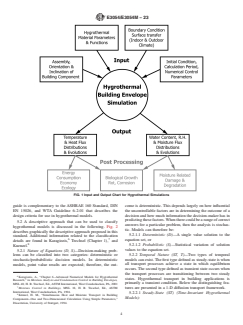
obtained should provide a valid solution to address the system deficiencies. Fig. 1 displays the various inputs and outputs needed
E3054/E3054M − 23
FIG. 1 Input and Output Chart for Hygrothermal Simulations
for hygrothermal simulations. The effectiveness of the results is largely a function of the degree to which the model represents the
system studied. Additionally, the inputs (climate data, orientation inclination, and material characteristics) are not addressed. Their
influence on the calculation results are,is, however, very important (often more important than the capability of the hygrothermal
model). This standardguide is complimentarycomplementary to the ASHRAE 160 Standard, DIN EN 15026, and WTA Guideline
6-2-01 that describes the design criteria for use in hygrothermal models.
5.2 A descriptive approach that can be used to classify hygrothermal models is discussed in the following. Fig. 2 describes
graphically the descriptive approach proposed in this standard. Additional information related to the classification details are found
6 7 8
in Karagiozis, Trechsel (Chapter 1), and Kuenzel.
5.2.1 Nature of Equations (D, S)—Decision-making problems can be classified into two ca
...