

ASTM E587-15(2020)
(Practice)Standard Practice for Ultrasonic Angle-Beam Contact Testing
General Information
- Abstract
SIGNIFICANCE AND USE
4.1 An electrical pulse is applied to a piezoelectric transducer which converts electrical to mechanical energy. In the angle-beam search unit, the piezoelectric element is generally a thickness expander which creates compressions and rarefactions. This longitudinal (compressional) wave travels through a wedge (generally a plastic). The angle between transducer face and the examination face of the wedge is equal to the angle between the normal (perpendicular) to the examination surface and the incident beam. Fig. 1 shows the incident angle φi, and the refracted angle φr, of the ultrasonic beam.
FIG. 1 Refraction
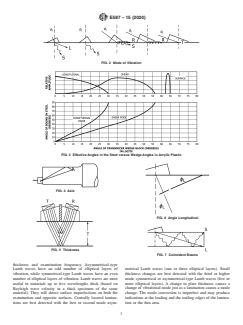
4.2 When the examination face of the angle-beam search unit is coupled to a material, ultrasonic waves may travel in the material. As shown in Fig. 2, the angle in the material (measured from the normal to the examination surface) and mode of vibration are dependent on the wedge angle, the ultrasonic velocity in the wedge, and the velocity of the wave in the examined material. When the material is thicker than a few wavelengths, the waves traveling in the material may be longitudinal and shear, shear alone, shear and Rayleigh, or Rayleigh alone. Total reflection may occur at the interface. (Refer to Fig. 3.) In thin materials (up to a few wavelengths thick), the waves from the angle-beam search unit traveling in the material may propagate in different Lamb wave modes.
FIG. 2 Mode of Vibration
FIG. 3 Effective Angles in the Steel versus Wedge Angles in Acrylic Plastic
4.3 All ultrasonic modes of vibration may be used for angle-beam examination of material. The material forms and the probable flaw locations and orientations determine selection of beam directions and modes of vibration. The use of angle beams and the selection of the proper wave mode presuppose a knowledge of the geometry of the object; the probable location, size, orientation, and reflectivity of the expected flaws; and the laws of physics governing the propagation of ultrasonic...
SCOPE
1.1 This practice covers ultrasonic examination of materials by the pulse-echo technique, using continuous coupling of angular incident ultrasonic vibrations.
1.2 This practice shall be applicable to development of an examination procedure agreed upon by the users of the practice.
1.3 The values stated in inch-pound units are regarded as standard. The values given in parentheses are mathematical conversions to SI units that are provided for information only and are not considered standard.
1.4 This standard does not purport to address all of the safety concerns, if any, associated with its use. It is the responsibility of the user of this standard to establish appropriate safety, health, and environmental practices and determine the applicability of regulatory limitations prior to use.
1.5 This international standard was developed in accordance with internationally recognized principles on standardization established in the Decision on Principles for the Development of International Standards, Guides and Recommendations issued by the World Trade Organization Technical Barriers to Trade (TBT) Committee.
- Status
- Published
- Publication Date
- 31-May-2020
- Technical Committee
- E07 - Nondestructive Testing
- Drafting Committee
- E07.06 - Ultrasonic Method
Overview
ASTM E587-15(2020) - Standard Practice for Ultrasonic Angle-Beam Contact Testing establishes guidelines for the nondestructive evaluation (NDE) of materials using ultrasonic angle-beam techniques. Developed by ASTM International, this practice is widely used to detect, size, and evaluate flaws such as cracks, laminations, and inclusions in a range of materials, particularly where direct ultrasonic paths are impractical. The standard covers the pulse-echo technique with angular incident ultrasonic vibrations and provides a basis for consistent, reliable examinations in various industrial sectors, including manufacturing, construction, and maintenance.
Key Topics
- Ultrasonic Angle-Beam Technique: Utilizes a piezoelectric transducer and wedge to introduce ultrasonic waves at specific angles into materials. This approach enables the inspection of internal structures by exploiting beam refraction and mode conversion.
- Wave Modes and Applications: Shear, longitudinal, Rayleigh, and Lamb waves can be tailored by adjusting the wedge angle and wave velocity, allowing examination of thick and thin materials, as well as evaluation of surface and subsurface flaws.
- Standardization and Equipment:
- Specifications for instrumentation and search units, ensuring compatibility with desired frequencies and energy levels.
- Detailed use of couplants to guarantee efficient transmission of ultrasonic energy between the transducer and the material.
- Use of reference reflectors (side-drilled holes, notches) to standardize distance and amplitude, supporting accurate and reproducible results.
- Procedure Development: Emphasizes the need for users to develop examination procedures tailored to specific applications and material conditions, ensuring optimum flaw detection sensitivity.
- Personnel and Agency Qualifications: Recommends qualification of NDT personnel and agencies according to recognized standards (e.g., ANSI/ASNT, ISO 9712).
Applications
Ultrasonic angle-beam contact testing is vital in industries requiring high safety and quality standards. Key applications include:
- Weld Inspection: Detects incomplete penetration, lack of fusion, slag inclusions, porosity, and cracks in welds of pipes, plates, and structural components.
- Component Evaluation: Assesses axles, shafts, and forgings for fatigue cracks, internal flaws, and laminar defects by directing angled beams into critical areas.
- Sheet and Plate Testing: Identifies laminations and thickness variations in metallic and non-metallic plates, enabling detection of central or near-surface flaws not accessible by straight-beam methods.
- Surface and Subsurface Flaw Detection: Utilizes Rayleigh and Lamb waves for surface-breaking defects or for evaluating thin materials where volume scanning is needed.
- Quality Assurance: Ensures conformance to safety and performance requirements in manufacturing and maintenance, supporting regulatory compliance and lifecycle reliability.
Related Standards
The practice references or is closely associated with several ASTM, ASNT, ISO, and industry-specific standards to ensure comprehensive and harmonized nondestructive testing procedures:
- ASTM E114: Practice for Ultrasonic Pulse-Echo Straight-Beam Contact Testing
- ASTM E317: Evaluating Performance Characteristics of Ultrasonic Testing Instruments
- ASTM E543: Specification for Agencies Performing Nondestructive Testing
- ASTM E1316: Terminology for Nondestructive Examinations
- ANSI/ASNT CP-189 & SNT-TC-1A: Qualification and Certification for NDT Personnel
- NAS 410: Aerospace standards for NDT personnel qualification
- ISO 9712: International standard for NDT personnel qualification and certification
Practical Value
By following ASTM E587-15(2020), organizations gain a systematic methodology for ultrasonic angle-beam NDT, leading to:
- Improved detection and characterization of internal and surface-connected flaws
- Enhanced inspection reliability and repeatability across different materials and geometries
- Compliance with industry best practices and international requirements for quality and safety in nondestructive examination
Proper implementation of this standard supports asset integrity management and underpins quality assurance programs in critical infrastructure and manufacturing sectors.
Relations
- Effective Date
- 01-Jun-2020
- Effective Date
- 01-Feb-2024
- Effective Date
- 01-Dec-2019
- Effective Date
- 01-Mar-2019
- Effective Date
- 01-Jan-2018
- Effective Date
- 15-Jun-2017
- Effective Date
- 01-Feb-2017
- Effective Date
- 01-Aug-2016
- Effective Date
- 01-Feb-2016
- Effective Date
- 01-Dec-2015
- Effective Date
- 01-Sep-2015
- Effective Date
- 01-Jun-2014
- Effective Date
- 01-Jun-2014
- Effective Date
- 01-Dec-2013
- Effective Date
- 15-Jun-2013
Get Certified
Connect with accredited certification bodies for this standard

Element Materials Technology
Materials testing and product certification.

Inštitut za kovinske materiale in tehnologije
Institute of Metals and Technology. Materials testing, metallurgical analysis, NDT.
IMP NDT d.o.o.
Non-destructive testing services. Radiography, ultrasonic, magnetic particle, penetrant, visual inspection.
Sponsored listings
Frequently Asked Questions
ASTM E587-15(2020) is a standard published by ASTM International. Its full title is "Standard Practice for Ultrasonic Angle-Beam Contact Testing". This standard covers: SIGNIFICANCE AND USE 4.1 An electrical pulse is applied to a piezoelectric transducer which converts electrical to mechanical energy. In the angle-beam search unit, the piezoelectric element is generally a thickness expander which creates compressions and rarefactions. This longitudinal (compressional) wave travels through a wedge (generally a plastic). The angle between transducer face and the examination face of the wedge is equal to the angle between the normal (perpendicular) to the examination surface and the incident beam. Fig. 1 shows the incident angle φi, and the refracted angle φr, of the ultrasonic beam. FIG. 1 Refraction 4.2 When the examination face of the angle-beam search unit is coupled to a material, ultrasonic waves may travel in the material. As shown in Fig. 2, the angle in the material (measured from the normal to the examination surface) and mode of vibration are dependent on the wedge angle, the ultrasonic velocity in the wedge, and the velocity of the wave in the examined material. When the material is thicker than a few wavelengths, the waves traveling in the material may be longitudinal and shear, shear alone, shear and Rayleigh, or Rayleigh alone. Total reflection may occur at the interface. (Refer to Fig. 3.) In thin materials (up to a few wavelengths thick), the waves from the angle-beam search unit traveling in the material may propagate in different Lamb wave modes. FIG. 2 Mode of Vibration FIG. 3 Effective Angles in the Steel versus Wedge Angles in Acrylic Plastic 4.3 All ultrasonic modes of vibration may be used for angle-beam examination of material. The material forms and the probable flaw locations and orientations determine selection of beam directions and modes of vibration. The use of angle beams and the selection of the proper wave mode presuppose a knowledge of the geometry of the object; the probable location, size, orientation, and reflectivity of the expected flaws; and the laws of physics governing the propagation of ultrasonic... SCOPE 1.1 This practice covers ultrasonic examination of materials by the pulse-echo technique, using continuous coupling of angular incident ultrasonic vibrations. 1.2 This practice shall be applicable to development of an examination procedure agreed upon by the users of the practice. 1.3 The values stated in inch-pound units are regarded as standard. The values given in parentheses are mathematical conversions to SI units that are provided for information only and are not considered standard. 1.4 This standard does not purport to address all of the safety concerns, if any, associated with its use. It is the responsibility of the user of this standard to establish appropriate safety, health, and environmental practices and determine the applicability of regulatory limitations prior to use. 1.5 This international standard was developed in accordance with internationally recognized principles on standardization established in the Decision on Principles for the Development of International Standards, Guides and Recommendations issued by the World Trade Organization Technical Barriers to Trade (TBT) Committee.
SIGNIFICANCE AND USE 4.1 An electrical pulse is applied to a piezoelectric transducer which converts electrical to mechanical energy. In the angle-beam search unit, the piezoelectric element is generally a thickness expander which creates compressions and rarefactions. This longitudinal (compressional) wave travels through a wedge (generally a plastic). The angle between transducer face and the examination face of the wedge is equal to the angle between the normal (perpendicular) to the examination surface and the incident beam. Fig. 1 shows the incident angle φi, and the refracted angle φr, of the ultrasonic beam. FIG. 1 Refraction 4.2 When the examination face of the angle-beam search unit is coupled to a material, ultrasonic waves may travel in the material. As shown in Fig. 2, the angle in the material (measured from the normal to the examination surface) and mode of vibration are dependent on the wedge angle, the ultrasonic velocity in the wedge, and the velocity of the wave in the examined material. When the material is thicker than a few wavelengths, the waves traveling in the material may be longitudinal and shear, shear alone, shear and Rayleigh, or Rayleigh alone. Total reflection may occur at the interface. (Refer to Fig. 3.) In thin materials (up to a few wavelengths thick), the waves from the angle-beam search unit traveling in the material may propagate in different Lamb wave modes. FIG. 2 Mode of Vibration FIG. 3 Effective Angles in the Steel versus Wedge Angles in Acrylic Plastic 4.3 All ultrasonic modes of vibration may be used for angle-beam examination of material. The material forms and the probable flaw locations and orientations determine selection of beam directions and modes of vibration. The use of angle beams and the selection of the proper wave mode presuppose a knowledge of the geometry of the object; the probable location, size, orientation, and reflectivity of the expected flaws; and the laws of physics governing the propagation of ultrasonic... SCOPE 1.1 This practice covers ultrasonic examination of materials by the pulse-echo technique, using continuous coupling of angular incident ultrasonic vibrations. 1.2 This practice shall be applicable to development of an examination procedure agreed upon by the users of the practice. 1.3 The values stated in inch-pound units are regarded as standard. The values given in parentheses are mathematical conversions to SI units that are provided for information only and are not considered standard. 1.4 This standard does not purport to address all of the safety concerns, if any, associated with its use. It is the responsibility of the user of this standard to establish appropriate safety, health, and environmental practices and determine the applicability of regulatory limitations prior to use. 1.5 This international standard was developed in accordance with internationally recognized principles on standardization established in the Decision on Principles for the Development of International Standards, Guides and Recommendations issued by the World Trade Organization Technical Barriers to Trade (TBT) Committee.
ASTM E587-15(2020) is classified under the following ICS (International Classification for Standards) categories: 19.100 - Non-destructive testing; 77.040.20 - Non-destructive testing of metals. The ICS classification helps identify the subject area and facilitates finding related standards.
ASTM E587-15(2020) has the following relationships with other standards: It is inter standard links to ASTM E587-15, ASTM E1316-24, ASTM E1316-19b, ASTM E1316-19, ASTM E1316-18, ASTM E1316-17a, ASTM E1316-17, ASTM E1316-16a, ASTM E1316-16, ASTM E1316-15a, ASTM E1316-15, ASTM E1316-14, ASTM E1316-14e1, ASTM E1316-13d, ASTM E1316-13c. Understanding these relationships helps ensure you are using the most current and applicable version of the standard.
ASTM E587-15(2020) is available in PDF format for immediate download after purchase. The document can be added to your cart and obtained through the secure checkout process. Digital delivery ensures instant access to the complete standard document.
Standards Content (Sample)
This international standard was developed in accordance with internationally recognized principles on standardization established in the Decision on Principles for the
Development of International Standards, Guides and Recommendations issued by the World Trade Organization Technical Barriers to Trade (TBT) Committee.
Designation: E587 − 15 (Reapproved 2020)
Standard Practice for
Ultrasonic Angle-Beam Contact Testing
This standard is issued under the fixed designation E587; the number immediately following the designation indicates the year of
original adoption or, in the case of revision, the year of last revision. A number in parentheses indicates the year of last reapproval. A
superscript epsilon (´) indicates an editorial change since the last revision or reapproval.
1. Scope* 2.2 ASNT Documents:
SNT-TC-1A Recommended Practice for Nondestructive
1.1 This practice covers ultrasonic examination of materials
Testing Personnel Qualification and Certification
by the pulse-echo technique, using continuous coupling of
ANSI/ASNT CP-189 Standard for Qualification and Certifi-
angular incident ultrasonic vibrations.
cation of Nondestructive Testing Personnel
1.2 This practice shall be applicable to development of an 4
2.3 Aerospace Industries Association Document:
examination procedure agreed upon by the users of the
NAS 410 Certification and Qualification of Nondestructive
practice.
Testing Personnel
1.3 The values stated in inch-pound units are regarded as
2.4 ISO Standard:
standard. The values given in parentheses are mathematical
ISO 9712 Non-Destructive Testing—Qualification and Cer-
conversions to SI units that are provided for information only
tification of NDT Personnel
and are not considered standard.
3. Terminology
1.4 This standard does not purport to address all of the
3.1 Definitions—For definitions of terms not specific to this
safety concerns, if any, associated with its use. It is the
responsibility of the user of this standard to establish appro- standard, see Terminology E1316.
3.2 Definitions of Terms Specific to This Standard:
priate safety, health, and environmental practices and deter-
mine the applicability of regulatory limitations prior to use. 3.2.1 group velocity—the sum of the individual waves
collectively known as the pulse that travels through the
1.5 This international standard was developed in accor-
dance with internationally recognized principles on standard- material.
ization established in the Decision on Principles for the
3.2.2 phase velocity—thespeedofthemaximumwavepoint
Development of International Standards, Guides and Recom-
as it travels from one point to another in the material.
mendations issued by the World Trade Organization Technical
Barriers to Trade (TBT) Committee. 4. Significance and Use
4.1 An electrical pulse is applied to a piezoelectric trans-
2. Referenced Documents
ducer which converts electrical to mechanical energy. In the
2.1 ASTM Standards:
angle-beam search unit, the piezoelectric element is generally
E114 Practice for Ultrasonic Pulse-Echo Straight-Beam
a thickness expander which creates compressions and rarefac-
Contact Testing
tions.Thislongitudinal(compressional)wavetravelsthrougha
E317 Practice for Evaluating Performance Characteristics of
wedge (generally a plastic).The angle between transducer face
Ultrasonic Pulse-Echo Testing Instruments and Systems
and the examination face of the wedge is equal to the angle
without the Use of Electronic Measurement Instruments
between the normal (perpendicular) to the examination surface
E543 Specification for Agencies Performing Nondestructive
and the incident beam. Fig. 1 shows the incident angle φ, and
i
Testing
the refracted angle φ , of the ultrasonic beam.
r
E1316 Terminology for Nondestructive Examinations
4.2 When the examination face of the angle-beam search
unit is coupled to a material, ultrasonic waves may travel in the
material. As shown in Fig. 2, the angle in the material
This practice is under the jurisdiction of ASTM Committee E07 on Nonde-
structive Testing and is the direct responsibility of Subcommittee E07.06 on
Ultrasonic Method.
CurrenteditionapprovedJune1,2020.PublishedJuly2020.Originallyapproved AvailablefromAmericanSocietyforNondestructiveTesting(ASNT),P.O.Box
in 1976. Last previous edition approved in 2015 as E587 – 15. DOI: 10.1520/ 28518, 1711 Arlingate Ln., Columbus, OH 43228-0518, http://www.asnt.org.
E0587-15R20. Available fromAerospace IndustriesAssociation ofAmerica, Inc. (AIA), 1000
For referenced ASTM standards, visit the ASTM website, www.astm.org, or WilsonBlvd.,Suite1700,Arlington,VA22209-3928,http://www.aia-aerospace.org.
contact ASTM Customer Service at service@astm.org. For Annual Book of ASTM Available from International Organization for Standardization (ISO), ISO
Standards volume information, refer to the standard’s Document Summary page on Central Secretariat, BIBC II, Chemin de Blandonnet 8, CP 401, 1214 Vernier,
the ASTM website. Geneva, Switzerland, http://www.iso.org.
*A Summary of Changes section appears at the end of this standard
Copyright © ASTM International, 100 Barr Harbor Drive, PO Box C700, West Conshohocken, PA 19428-2959. United States
E587 − 15 (2020)
angle up to 40° with respect to the examination surface,
provide optimum reflection to an angle-beam longitudinal
wave that is normal to the plane of the reflector. Angle-beam
longitudinal waves in the range from 45 to 85° become weaker
as the angle increases; at the same time, the coexisting
angle-beam shear waves become stronger. Equal amplitude
angle beams of approximately 55° longitudinal wave and 29°
shear wave will coexist in the material, as shown in Fig. 7.
Confusion created by two beams traveling at different angles
and at different velocities has limited use of this range of angle
beams.
4.3.2 Angle-Beam Shear Waves (Transverse Waves)—
FIG. 1 Refraction Angle-beam shear waves in the range from 40 to 75° are the
most used angle beams. They will detect imperfections in
materials by corner reflection and reradiation (as shown in Fig.
(measured from the normal to the examination surface) and
8) if the plane of the reflector is perpendicular to a material
mode of vibration are dependent on the wedge angle, the
surface, and by direct reflection if the ultrasonic beam is
ultrasonic velocity in the wedge, and the velocity of the wave
normal to the plane of the reflector (as shown in Fig. 9).
in the examined material. When the material is thicker than a
Reflectors parallel to the examination surface (such as lamina-
few wavelengths, the waves traveling in the material may be
tions in plate, as shown in Fig. 10) can rarely be detected by an
longitudinal and shear, shear alone, shear and Rayleigh, or
angle beam unless accompanied by another reflector; for
Rayleigh alone. Total reflection may occur at the interface.
example, a lamination at the edge of a plate (as shown in Fig.
(Refer to Fig. 3.) In thin materials (up to a few wavelengths
11) can be detected by corner reflection from the lamination
thick), the waves from the angle-beam search unit traveling in
and plate edge. Generally, laminations should be detected and
the material may propagate in different Lamb wave modes.
evaluated by the straight-beam technique. Angle-beam shear
4.3 All ultrasonic modes of vibration may be used for
waves applied to weld testing will detect incomplete penetra-
angle-beam examination of material. The material forms and
tion (as shown in Fig. 12) by corner reflection, incomplete
the probable flaw locations and orientations determine selec-
fusion (as shown in Fig. 13) by direct reflection (when the
tion of beam directions and modes of vibration. The use of
beam angle is chosen to be normal to the plane of the weld
angle beams and the selection of the proper wave mode
preparation), slag inclusion by cylindrical reflection (as shown
presuppose a knowledge of the geometry of the object; the
in Fig. 14), porosity by spherical reflection, and cracks (as
probable location, size, orientation, and reflectivity of the
shown in Fig. 15) by direct or corner reflection, depending on
expected flaws; and the laws of physics governing the propa-
their orientation. Angle-beam shear waves of 80 to 85° are
gation of ultrasonic waves. Characteristics of the examination
frequently accompanied by a Rayleigh wave traveling on the
system used and the ultrasonic properties of the material being
surface. Confusion created by two beams at slightly different
examined must be known or determined. Some materials,
angles, traveling at different velocities, has limited applications
because of unique microstructure, are difficult to examine
in this range of angle beams.
using ultrasonics. Austenitic material, particularly weld
4.3.3 Surface-Beam Rayleigh Waves—Surface-beam Ray-
material, is one example of this material condition. Caution
leigh waves travel at 90° to the normal of the examination
should be exercised when establishing examination practices
surface on the examination surface. In material greater than
for these type materials. While examination may be possible,
two wavelengths thick, the energy of the Rayleigh wave
sensitivity will be inferior to that achievable on ferritic
penetrates to a depth of approximately one wavelength; but,
materials. When examining materials with unique
duetotheexponentialdistributionoftheenergy,onehalfofthe
microstructures, empirical testing should be performed to
energyiswithinone-quarterwavelengthofthesurface.Surface
assure that the examination will achieve the desired sensitivity.
cracks with length perpendicular to the Rayleigh wave can be
This may be accomplished by incorporating known reflectors
detected and their depth evaluated by changing the frequency
in a mock up of the weld or part to be examined. For material
of the Rayleigh wave, thus changing its wavelength and depth
with such unique microstructures, a technique and procedure
of penetration. Wavelength equals velocity divided by fre-
shall be agreed upon between contracting parties.
quency.
4.3.1 Angle-Beam Longitudinal Waves—AsshowninFig.4,
V
angle-beam longitudinal waves with refracted angles in the
λ 5
f
range from 1 to 40° (where coexisting angle-beam shear waves
are weak, as shown in Fig. 3) may be used to detect fatigue Subsurface reflectors may be detected by Rayleigh waves if
cracks in axles and shafts from the end by direct reflection or they lie within one wavelength of the surface.
by corner reflection. As shown in Fig. 5, with a crossed-beam 4.3.4 Lamb Waves—Lamb waves travel at 90° to the normal
dual-transducer search unit configuration, angle-beam longitu- of the test surface and fill thin materials with elliptical particle
dinal waves may be used to measure thickness or to detect vibrations.These vibrations occur in various numbers of layers
reflectors parallel to the examination surface, such as lamina- and travel at velocities varying from slower than Rayleigh up
tions. As shown in Fig. 6, reflectors with a major plane at an to nearly longitudinal wave velocity, depending on material
E587 − 15 (2020)
FIG. 2 Mode of Vibration
FIG. 3 Effective Angles in the Steel versus Wedge Angles in Acrylic Plastic
FIG. 4 Axle
FIG. 6 Angle Longitudinal
FIG. 5 Thickness
FIG. 7 Coincident Beams
thickness and examination frequency. Asymmetrical-type
Lamb waves have an odd number of elliptical layers of metrical Lamb waves (one or three elliptical layers). Small
vibration, while symmetrical-type Lamb waves have an even thickness changes are best detected with the third or higher
number of elliptical layers of vibration. Lamb waves are most mode symmetrical or asymmetrical-type Lamb waves (five or
useful in materials up to five wavelengths thick (based on more elliptical layers). A change in plate thickness causes a
Rayleigh wave velocity in a thick specimen of the same change of vibrational mode just as a lamination causes a mode
material). They will detect surface imperfections on both the change. The mode conversion is imperfect and may produce
examination and opposite surfaces. Centrally located lamina- indications at the leading and the trailing edges of the lamina-
tions are best detected with the first or second mode asym- tion or the thin area.
E587 − 15 (2020)
FIG. 12 Incomplete Penetration
FIG. 8 Corner
FIG. 13 Incomplete Fusion
FIG. 9 Normal Plane
FIG. 14 Slag and Porosity
FIG. 10 Laminar
FIG. 15 Cracks
FIG. 11 Edge Lamination
5.1.2 Qualification of NondestructiveAgencies—Ifspecified
5. Basis of Application
in the contractual agreement, NDT agencies shall be qualified
and evaluated as described in Specification E543. The appli-
5.1 Purchaser-Supplier Agreements: The following items
cable edition of Specification E543 shall be specified in the
require agreement between using parties for this practice to be
contractual agreement.
used effectively:
5.1.1 Personnel Qualification—If specified in the contrac-
6. Apparatus
tual agreement, personnel performing examinations to this
practice shall be qualified in accordance with a nationally 6.1 A complete ultrasonic system shall include the follow-
recognized NDT personnel qualification practice or standard ing:
such as ANSI/ASNT-CP-189, SNT-TC-1A, NAS-410, ISO 6.1.1 Instrumentation—The ultrasonic instrument shall be
9712, or a similar document and certified by the employer or capable of generating, receiving, amplifying, and displaying
certifying agency, as applicable. The practice or standard used high-frequency electrical pulses.
and its applicable revision shall be identified in the contractual 6.1.2 Search Units—The ultrasonic search units shall be
agreement between the using parties. capable of transmitting and receiving ultrasonic waves in the
E587 − 15 (2020)
material at frequencies and energy levels necessary for discon- liquid-filled flexible tire. A minimum amount of couplant
tinuity detection as determined by the standardization proce- provides ultrasonic transmission into the examination surface
dure. The search units are fitted with wedges in order to since the elastic tire material is in rolling contact and conforms
transmit ultrasonic waves into the examination object at the closely to the surface.
desired angle and mode of operation. 6.1.4 Reference Reflectors—Reference reflectors of known
6.1.3 Couplant—A couplant, usually a liquid or semiliquid, dimension, artificial reflectors, or distance-amplitude relation-
is required between the face of the search unit and the ships of known reflector sizes for a particular search unit and
examination surface to permit the transmission of ultrasonic material may be used for standardization. The artificial reflec-
waves from the search unit into the material under examina- tors may be in the form of side-drilled holes, notches, or
tion. Typical couplants include glycerin, water, cellulose gel, flat-bottom holes. The reference standard and the production
oil, water-soluble oils, and grease. Corrosion inhibitors or material should have similar velocity, attenuation, curvature,
wetting agents or both may be used. Couplants must be and surface finish.
selected that are not detrimental to the product or the process.
The couplant used in standardization should be used for the 7. Standardization
examination. The standardization and examination surface
7.1 If quantitative information is to be obtained, vertical or
temperatures should be within 625°F (14°C) to avoid large
horizontal linearity or both should be checked in accordance
attenuation and velocity differences in the wedge material.
with Practice E317 or another procedure approved by the
6.1.3.1 The coupling medium should be selected so that its
examining agency and the customer. An acceptable linearity
viscosity is appropriate for the surface finish of the material to
performance may be agreed upon between the examining
be examined. The examination of rough surfaces generally
a
...