

ASTM F1674-18
(Test Method)Standard Test Method for Joint Restraint Products for Use with PVC Pipe
General Information
- Abstract
ABSTRACT
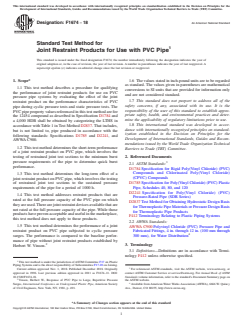
This test method describes a procedure for qualifying the performance of joint restraint products for use on PVC pressure pipe systems by evaluating the effect of the joint restraint product on the performance characteristics of PVC pipe during cyclic pressure tests and static pressure tests. This test method is useful for establishing any effects that a joint restraint product has on the performance of PVC pressure pipe. This test method is designed so that success in all three parts of the test provides reasonable assurance that a joint restraint product may be used on PVC pipe at the full pressure rating and capacity of the pipe. Pipe specimen length, minimum burst pressure test, sustained pressure test, and cyclic surge pressure test shall be performed to conform with the specified requirements.
SIGNIFICANCE AND USE
4.1 This test method is useful for establishing any effects that a joint restraint product has on the performance of PVC pressure pipe. This test method is designed so that success in all three parts of the test provides reasonable assurance that a joint restraint product may be used on PVC pipe at the full pressure rating and capacity of the pipe.
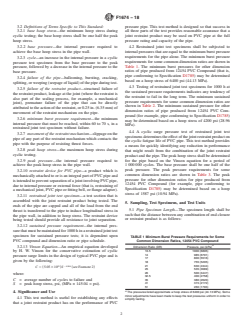
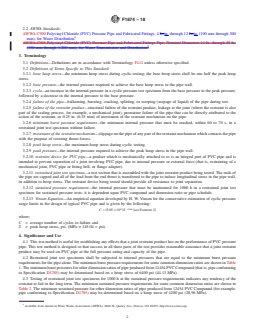
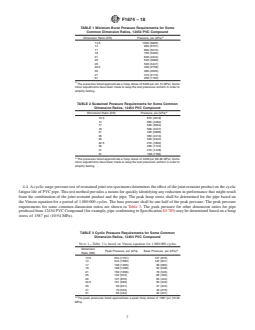
4.2 Restrained joint test specimens shall be subjected to internal pressures that are equal to the minimum burst pressure requirements for the pipe alone. The minimum burst pressure requirements for some common dimension ratios are shown in Table 1. The minimum burst pressures for other dimension ratios of pipe produced from 12454 PVC Compound (that is, pipe conforming to Specification D1785) may be determined based on a hoop stress of 6400 psi (44.13 MPa). (A) The pressures listed approximate a hoop stress of 6400 psi (44.13 MPa). Some minor adjustments have been made to keep the test pressures uniform in order to simplify testing.
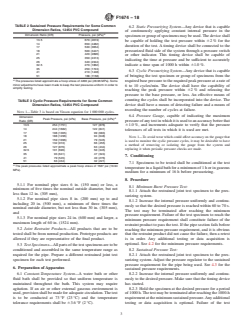
4.3 Testing of restrained joint test specimens for 1000 h at the sustained pressure requirements indicates any tendency of the restraint to fail in the long term. The minimum sustained pressure requirements for some common dimension ratios are shown in Table 2. The minimum sustained pressure for other dimension ratios of pipe produced from 12454 PVC Compound (for example, pipe conforming to Specification D1785) may be determined based on a hoop stress of 4200 psi (28.96 MPa). (A) The pressures listed approximate a hoop stress of 4200 psi (28.96 MPa). Some minor adjustments have been made to keep the test pressures uniform in order to simplify testing.
4.4 A cyclic surge pressure test of restrained joint test specimens determines the effect of the joint restraint product on the cyclic fatigue life of PVC pipe. This test method provides a means for quickly identifying any reduction in performance that might result from the combination of the joint restraint product and the pipe. The...
SCOPE
1.1 This test method describes a procedure for qualifying the performance of joint restraint products for use on PVC pressure pipe systems by evaluating the effect of the joint restraint product on the performance characteristics of PVC pipe during cyclic pressure tests and static pressure tests. The PVC pipe property values referenced in this test method are for the 12454 compound as described in Specification D1784 and a 4,000 HDB shall be obtained by categorizing the LTHS in accordance with Table 1 in Test Method D2837. That includes, but is not limited to, pipe produced in accordance with the following standards: Specifications D1785 and D2241, and AWWA C900.
1.2 This test method determines the short-term performance of a joint restraint product on PVC pipe, which involves the testing of restrained joint test sections to the minimum burst pressure requirements of the pipe to determine quick burst performance.
1.3 This test method determines the long-term effect of a joint restraint product on PVC pipe, which involves the testing of restrained joint test sections to the sustained pressure requirements of...
- Status
- Published
- Publication Date
- 31-Oct-2018
- Technical Committee
- F17 - Plastic Piping Systems
- Drafting Committee
- F17.20 - Joining

Overview
ASTM F1674-18, Standard Test Method for Joint Restraint Products for Use with PVC Pipe, defines procedures for evaluating the performance of joint restraint products used in Polyvinyl Chloride (PVC) pressure pipe systems. Developed by ASTM International, this test method assesses how joint restraints impact the performance characteristics of PVC pipes through a series of pressure-based tests, including cyclic (surge) and static (burst and sustained) pressure evaluations. Compliance with ASTM F1674-18 provides confidence that a joint restraint device is suitable for use at the full pressure rating and capacity of compatible PVC pipe systems.
Key Topics
Purpose of the Standard:
ASTM F1674-18 is designed to qualify the performance of joint restraint products used on PVC pressure pipe systems. It ensures that joint restraints do not compromise the pipe’s essential mechanical properties under various pressure conditions.Test Methods:
The standard outlines a methodology involving:- Minimum Burst Pressure Test: Short-term performance under rapidly applied high pressures.
- Sustained Pressure Test: Long-term resistance to pressure over 1000 hours.
- Cyclic Surge Pressure Test: Evaluation of product performance under repeated pressure cycles, simulating long-term operational stresses.
Key Definitions:
- Restrained Joint Test Specimen: A pipe section assembled with a joint restraint product, tested for resistance to joint separation under pressure.
- Failure Criteria: Includes events like pipe bursting, joint leakage, or slippage of the restraint mechanism.
- Pressure Requirements: Established for various dimension ratios (DR) of pipes, derived from established PVC material properties.
Referenced Materials and Pipes:
This standard is applicable to joint restraint products intended for use with pipes made from 12454 PVC Compound, conforming to ASTM D1785, D2241, and AWWA C900.
Applications
ASTM F1674-18 is crucial for manufacturers, engineers, and installers in the water distribution and municipal infrastructure sectors who seek to:
Qualify Joint Restraint Devices:
Demonstrate that new or existing joint restraint products are reliable when used on PVC pressure pipe systems.Ensure System Integrity:
Reduce the risk of pipe joint separation, leaks, and failures in systems carrying potable water or other pressurized liquids.Support Regulatory Compliance:
Meet specification requirements set by engineers, utilities, and public agencies that mandate conformance to ASTM test standards.Optimize Product Development:
Allow manufacturers to validate modifications or innovations in joint restraint designs against a recognized performance benchmark.Reduce Maintenance Costs:
By ensuring joint restraints perform as intended under real-world pressure conditions, utilities and system operators can minimize emergency repairs and downtime.
Related Standards
ASTM F1674-18 references and complements several other key standards in the field of PVC piping systems:
- ASTM D1784: Specification for Rigid Poly(Vinyl Chloride) (PVC) Compounds and Chlorinated Poly(Vinyl Chloride) (CPVC) Compounds.
- ASTM D1785: Specification for Poly(Vinyl Chloride) (PVC) Plastic Pipe, Schedules 40, 80, and 120.
- ASTM D2241: Specification for Poly(Vinyl Chloride) (PVC) Pressure-Rated Pipe (SDR Series).
- ASTM D2837: Test Method for Obtaining Hydrostatic Design Basis for Thermoplastic Pipe Materials.
- AWWA C900: Standard for PVC pressure pipe and fabricated fittings for water distribution.
- ASTM F412: Terminology Relating to Plastic Piping Systems.
Keywords: ASTM F1674-18, joint restraint products, PVC pipe, pressure tests, cyclic surge pressure, minimum burst pressure, sustained pressure, water distribution, piping system standards, test method, mechanical joint restraint, infrastructure reliability.
Relations
- Effective Date
- 01-Nov-2018
- Effective Date
- 01-Apr-2024
- Effective Date
- 01-Aug-2020
- Effective Date
- 01-Apr-2020
- Effective Date
- 15-Jan-2020
- Effective Date
- 01-Jan-2019
- Effective Date
- 01-Aug-2017
- Effective Date
- 01-Feb-2017
- Effective Date
- 15-Nov-2016
- Effective Date
- 01-Aug-2016
- Effective Date
- 01-Aug-2015
- Effective Date
- 01-Jun-2015
- Effective Date
- 01-Mar-2015
- Effective Date
- 15-Nov-2013
- Effective Date
- 15-Feb-2013
Get Certified
Connect with accredited certification bodies for this standard

Institut za varilstvo d.o.o. (Welding Institute)
Slovenia's leading welding institute since 1952. ISO 3834, EN 1090, pressure equipment certification, NDT personnel, welder qualification. Only IIW Au
Sponsored listings
Frequently Asked Questions
ASTM F1674-18 is a standard published by ASTM International. Its full title is "Standard Test Method for Joint Restraint Products for Use with PVC Pipe". This standard covers: ABSTRACT This test method describes a procedure for qualifying the performance of joint restraint products for use on PVC pressure pipe systems by evaluating the effect of the joint restraint product on the performance characteristics of PVC pipe during cyclic pressure tests and static pressure tests. This test method is useful for establishing any effects that a joint restraint product has on the performance of PVC pressure pipe. This test method is designed so that success in all three parts of the test provides reasonable assurance that a joint restraint product may be used on PVC pipe at the full pressure rating and capacity of the pipe. Pipe specimen length, minimum burst pressure test, sustained pressure test, and cyclic surge pressure test shall be performed to conform with the specified requirements. SIGNIFICANCE AND USE 4.1 This test method is useful for establishing any effects that a joint restraint product has on the performance of PVC pressure pipe. This test method is designed so that success in all three parts of the test provides reasonable assurance that a joint restraint product may be used on PVC pipe at the full pressure rating and capacity of the pipe. 4.2 Restrained joint test specimens shall be subjected to internal pressures that are equal to the minimum burst pressure requirements for the pipe alone. The minimum burst pressure requirements for some common dimension ratios are shown in Table 1. The minimum burst pressures for other dimension ratios of pipe produced from 12454 PVC Compound (that is, pipe conforming to Specification D1785) may be determined based on a hoop stress of 6400 psi (44.13 MPa). (A) The pressures listed approximate a hoop stress of 6400 psi (44.13 MPa). Some minor adjustments have been made to keep the test pressures uniform in order to simplify testing. 4.3 Testing of restrained joint test specimens for 1000 h at the sustained pressure requirements indicates any tendency of the restraint to fail in the long term. The minimum sustained pressure requirements for some common dimension ratios are shown in Table 2. The minimum sustained pressure for other dimension ratios of pipe produced from 12454 PVC Compound (for example, pipe conforming to Specification D1785) may be determined based on a hoop stress of 4200 psi (28.96 MPa). (A) The pressures listed approximate a hoop stress of 4200 psi (28.96 MPa). Some minor adjustments have been made to keep the test pressures uniform in order to simplify testing. 4.4 A cyclic surge pressure test of restrained joint test specimens determines the effect of the joint restraint product on the cyclic fatigue life of PVC pipe. This test method provides a means for quickly identifying any reduction in performance that might result from the combination of the joint restraint product and the pipe. The... SCOPE 1.1 This test method describes a procedure for qualifying the performance of joint restraint products for use on PVC pressure pipe systems by evaluating the effect of the joint restraint product on the performance characteristics of PVC pipe during cyclic pressure tests and static pressure tests. The PVC pipe property values referenced in this test method are for the 12454 compound as described in Specification D1784 and a 4,000 HDB shall be obtained by categorizing the LTHS in accordance with Table 1 in Test Method D2837. That includes, but is not limited to, pipe produced in accordance with the following standards: Specifications D1785 and D2241, and AWWA C900. 1.2 This test method determines the short-term performance of a joint restraint product on PVC pipe, which involves the testing of restrained joint test sections to the minimum burst pressure requirements of the pipe to determine quick burst performance. 1.3 This test method determines the long-term effect of a joint restraint product on PVC pipe, which involves the testing of restrained joint test sections to the sustained pressure requirements of...
ABSTRACT This test method describes a procedure for qualifying the performance of joint restraint products for use on PVC pressure pipe systems by evaluating the effect of the joint restraint product on the performance characteristics of PVC pipe during cyclic pressure tests and static pressure tests. This test method is useful for establishing any effects that a joint restraint product has on the performance of PVC pressure pipe. This test method is designed so that success in all three parts of the test provides reasonable assurance that a joint restraint product may be used on PVC pipe at the full pressure rating and capacity of the pipe. Pipe specimen length, minimum burst pressure test, sustained pressure test, and cyclic surge pressure test shall be performed to conform with the specified requirements. SIGNIFICANCE AND USE 4.1 This test method is useful for establishing any effects that a joint restraint product has on the performance of PVC pressure pipe. This test method is designed so that success in all three parts of the test provides reasonable assurance that a joint restraint product may be used on PVC pipe at the full pressure rating and capacity of the pipe. 4.2 Restrained joint test specimens shall be subjected to internal pressures that are equal to the minimum burst pressure requirements for the pipe alone. The minimum burst pressure requirements for some common dimension ratios are shown in Table 1. The minimum burst pressures for other dimension ratios of pipe produced from 12454 PVC Compound (that is, pipe conforming to Specification D1785) may be determined based on a hoop stress of 6400 psi (44.13 MPa). (A) The pressures listed approximate a hoop stress of 6400 psi (44.13 MPa). Some minor adjustments have been made to keep the test pressures uniform in order to simplify testing. 4.3 Testing of restrained joint test specimens for 1000 h at the sustained pressure requirements indicates any tendency of the restraint to fail in the long term. The minimum sustained pressure requirements for some common dimension ratios are shown in Table 2. The minimum sustained pressure for other dimension ratios of pipe produced from 12454 PVC Compound (for example, pipe conforming to Specification D1785) may be determined based on a hoop stress of 4200 psi (28.96 MPa). (A) The pressures listed approximate a hoop stress of 4200 psi (28.96 MPa). Some minor adjustments have been made to keep the test pressures uniform in order to simplify testing. 4.4 A cyclic surge pressure test of restrained joint test specimens determines the effect of the joint restraint product on the cyclic fatigue life of PVC pipe. This test method provides a means for quickly identifying any reduction in performance that might result from the combination of the joint restraint product and the pipe. The... SCOPE 1.1 This test method describes a procedure for qualifying the performance of joint restraint products for use on PVC pressure pipe systems by evaluating the effect of the joint restraint product on the performance characteristics of PVC pipe during cyclic pressure tests and static pressure tests. The PVC pipe property values referenced in this test method are for the 12454 compound as described in Specification D1784 and a 4,000 HDB shall be obtained by categorizing the LTHS in accordance with Table 1 in Test Method D2837. That includes, but is not limited to, pipe produced in accordance with the following standards: Specifications D1785 and D2241, and AWWA C900. 1.2 This test method determines the short-term performance of a joint restraint product on PVC pipe, which involves the testing of restrained joint test sections to the minimum burst pressure requirements of the pipe to determine quick burst performance. 1.3 This test method determines the long-term effect of a joint restraint product on PVC pipe, which involves the testing of restrained joint test sections to the sustained pressure requirements of...
ASTM F1674-18 is classified under the following ICS (International Classification for Standards) categories: 23.040.99 - Other pipeline components. The ICS classification helps identify the subject area and facilitates finding related standards.
ASTM F1674-18 has the following relationships with other standards: It is inter standard links to ASTM F1674-11, ASTM D2241-24, ASTM D2241-20, ASTM F412-20, ASTM D1784-20, ASTM F412-19, ASTM F412-17a, ASTM F412-17, ASTM F412-16a, ASTM F412-16, ASTM D1785-15, ASTM F412-15, ASTM D2241-15, ASTM D2837-13, ASTM F412-13. Understanding these relationships helps ensure you are using the most current and applicable version of the standard.
ASTM F1674-18 is available in PDF format for immediate download after purchase. The document can be added to your cart and obtained through the secure checkout process. Digital delivery ensures instant access to the complete standard document.
Standards Content (Sample)
This international standard was developed in accordance with internationally recognized principles on standardization established in the Decision on Principles for the
Development of International Standards, Guides and Recommendations issued by the World Trade Organization Technical Barriers to Trade (TBT) Committee.
Designation: F1674 − 18 An American National Standard
Standard Test Method for
Joint Restraint Products for Use with PVC Pipe
This standard is issued under the fixed designation F1674; the number immediately following the designation indicates the year of
original adoption or, in the case of revision, the year of last revision.Anumber in parentheses indicates the year of last reapproval.A
superscript epsilon (´) indicates an editorial change since the last revision or reapproval.
1. Scope* 1.6 Thevaluesstatedininch-poundunitsaretoberegarded
as standard. The values given in parentheses are mathematical
1.1 This test method describes a procedure for qualifying
conversions to SI units that are provided for information only
the performance of joint restraint products for use on PVC
and are not considered standard.
pressure pipe systems by evaluating the effect of the joint
1.7 This standard does not purport to address all of the
restraint product on the performance characteristics of PVC
safety concerns, if any, associated with its use. It is the
pipe during cyclic pressure tests and static pressure tests. The
responsibility of the user of this standard to establish appro-
PVCpipepropertyvaluesreferencedinthistestmethodarefor
priate safety, health, and environmental practices and deter-
the 12454 compound as described in Specification D1784 and
mine the applicability of regulatory limitations prior to use.
a 4,000 HDB shall be obtained by categorizing the LTHS in
1.8 This international standard was developed in accor-
accordance withTable 1 inTest MethodD2837.That includes,
dance with internationally recognized principles on standard-
but is not limited to, pipe produced in accordance with the
ization established in the Decision on Principles for the
following standards: Specifications D1785 and D2241, and
Development of International Standards, Guides and Recom-
AWWA C900.
mendations issued by the World Trade Organization Technical
1.2 Thistestmethoddeterminestheshort-termperformance
Barriers to Trade (TBT) Committee.
of a joint restraint product on PVC pipe, which involves the
testing of restrained joint test sections to the minimum burst
2. Referenced Documents
pressure requirements of the pipe to determine quick burst
2.1 ASTM Standards:
performance.
D1784Specification for Rigid Poly(Vinyl Chloride) (PVC)
Compounds and Chlorinated Poly(Vinyl Chloride)
1.3 This test method determines the long-term effect of a
(CPVC) Compounds
joint restraint product on PVC pipe, which involves the testing
D1785Specification for Poly(Vinyl Chloride) (PVC) Plastic
of restrained joint test sections to the sustained pressure
Pipe, Schedules 40, 80, and 120
requirements of the pipe for a period of 1000 h.
D2241 Specification for Poly(Vinyl Chloride) (PVC)
1.4 This test method addresses restraint products that are
Pressure-Rated Pipe (SDR Series)
rated at the full pressure capacity of the PVC pipe on which
D2837Test Method for Obtaining Hydrostatic Design Basis
theyareused.Therearejointrestraintdevicesavailablethatare
forThermoplasticPipeMaterialsorPressureDesignBasis
not rated at the full pressure capacity of the pipe. While those
for Thermoplastic Pipe Products
productshaveprovenacceptableandusefulinthemarketplace,
F412Terminology Relating to Plastic Piping Systems
this test method does not apply to those products.
2.2 AWWA Standards:
1.5 This test method determines the performance of a joint AWWA C900Polyvinyl Chloride (PVC) Pressure Pipe and
restraint product on PVC pipe subjected to cyclic pressure Fabricated Fittings, 4 in. through 12 in. (100 mm through
surges. The performance is compared to the baseline perfor-
300 mm), for Water Distribution
mance of pipe without joint restraint products established by
3. Terminology
Herbert W. Vinson.
3.1 Definitions—Definitions are in accordance with Termi-
nology F412 unless otherwise specified.
This test method is under the jurisdiction ofASTM Committee F17 on Plastic
Piping Systems and is the direct responsibility of Subcommittee F17.20 on Joining.
Current edition approved Nov. 1, 2018. Published December 2018. Originally For referenced ASTM standards, visit the ASTM website, www.astm.org, or
approved in 1996. Last previous edition approved in 2011 as F1674–11. DOI: contact ASTM Customer Service at service@astm.org. For Annual Book of ASTM
10.1520/F1674-18. Standards volume information, refer to the standard’s Document Summary page on
Vinson, Herbert W., Response of PVC Pipe to Large, Repetitive Pressure the ASTM website.
Surges, International Conference on Underground Plastic Pipe, American Society Available fromAmericanWaterWorksAssociation (AWWA), 6666W. Quincy
of Civil Engineers, New York, NY, 1981, p. 491. Ave., Denver, CO 80235, http://www.awwa.org.
*A Summary of Changes section appears at the end of this standard
Copyright © ASTM International, 100 Barr Harbor Drive, PO Box C700, West Conshohocken, PA 19428-2959. United States
F1674 − 18
3.2 Definitions of Terms Specific to This Standard: pressure pipe. This test method is designed so that success in
3.2.1 base hoop stress—the minimum hoop stress during all three parts of the test provides reasonable assurance that a
cyclic testing; the base hoop stress shall be one half the peak joint restraint product may be used on PVC pipe at the full
hoop stress. pressure rating and capacity of the pipe.
3.2.2 base pressure—the internal pressure required to
4.2 Restrained joint test specimens shall be subjected to
achieve the base hoop stress in the pipe wall.
internalpressuresthatareequaltotheminimumburstpressure
requirements for the pipe alone. The minimum burst pressure
3.2.3 cycle—an increase in the internal pressure in a cyclic
requirements for some common dimension ratios are shown in
pressure test specimen from the base pressure to the peak
Table 1. The minimum burst pressures for other dimension
pressure, followed by a decrease in the internal pressure to the
ratios of pipe produced from 12454 PVC Compound (that is,
base pressure.
pipe conforming to Specification D1785) may be determined
3.2.4 failure of the pipe—ballooning, bursting, cracking,
based on a hoop stress of 6400 psi (44.13 MPa).
splitting,orweeping(seepageofliquid)ofthepipeduringtest.
4.3 Testing of restrained joint test specimens for 1000 h at
3.2.5 failure of the restraint product—structural failure of
the sustained pressure requirements indicates any tendency of
the restraint product, leakage at the joint (where the restraint is
the restraint to fail in the long term. The minimum sustained
also part of the sealing process, for example, a mechanical
pressure requirements for some common dimension ratios are
joint), premature failure of the pipe that can be directly
shown in Table 2. The minimum sustained pressure for other
attributedtotheactionoftherestraint,or0.25in.(6.35mm)of
dimension ratios of pipe produced from 12454 PVC Com-
movement of the restraint mechanism on the pipe.
pound (for example, pipe conforming to Specification D1785)
3.2.6 minimum burst pressure requirement—the minimum
may be determined based on a hoop stress of 4200 psi (28.96
internal pressure that must be reached, within 60 to 70 s, in a
MPa).
restrained joint test specimen without failure.
4.4 A cyclic surge pressure test of restrained joint test
3.2.7 movement of the restraint mechanism—slippageonthe
specimensdeterminestheeffectofthejointrestraintproducton
pipe of any part of the restraint mechanism which contacts the
the cyclic fatigue life of PVC pipe. This test method provides
pipe with the purpose of resisting thrust forces.
a means for quickly identifying any reduction in performance
3.2.8 peak hoop stress—the maximum hoop stress during
that might result from the combination of the joint restraint
cyclic testing.
productandthepipe.Thepeakhoopstressshallbedetermined
3.2.9 peak pressure—the internal pressure required to for the pipe based on the Vinson equation for a period of
achieve the peak hoop stress in the pipe wall. 1000000 cycles. The base pressure shall be one half of the
peak pressure. The peak pressure requirements for some
3.2.10 restraint device for PVC pipe—a product which is
common dimension ratios are shown in Table 3. The peak
mechanicallyattachedtoorisanintegralpartofPVCpipeand
pressure for other dimension ratios for pipe produced from
isintendedtopreventseparationofajointinvolvingPVCpipe,
12454 PVC Compound (for example, pipe conforming to
due to internal pressure or external force (that is, restraining of
Specification D1785) may be determined based on a hoop
a mechanical joint, PVC pipe or fitting bell, or flange adapter).
stress of 1587 psi (10.94 MPa).
3.2.11 restrained joint test specimen—a test section that is
assembled with the joint restraint product being tested. The
5. Sampling, Test Specimens, and Test Units
ends of the pipe are capped and all of the load from the end
5.1 Pipe Specimen Length—The specimen length shall be
thrust is transferred to the pipe to induce longitudinal stress in
such that the distance between any combination of end closure
the pipe wall, in addition to hoop stress. The restraint device
or restraint product is as follows:
being tested should provide all resistance to joint separation.
3.2.12 sustained pressure requirement—the internal pres-
surethatmustbemaintainedfor1000hinarestrainedjointtest
specimen for sustained pressure tests; it is dependent upon
TABLE 1 Minimum Burst Pressure Requirements for Some
PVC compound and dimension ratio or pipe schedule.
Common Dimension Ratios, 12454 PVC Compound
A
3.2.13 Vinson Equation—An empirical equation developed Dimension Ratio (DR) Pressure, psi (kPa)
by H. W. Vinson for the conservative estimation of cyclic 13.5 1000 (6895)
14 985 (6791)
pressure surge limits in the design of typical PVC pipe and is
17 800 (5516)
given by the following:
18 755 (5205)
21 24.906 21 630 (4344)
C 5 5.05 310 S seeFootnote2
~ ! ~ !
25 535 (3689)
26 500 (3447)
where:
32.5 400 (2758)
C = average number of cycles to failure and 35 380 (2620)
41 315 (2172)
S = peak hoop stress, psi, (MPa × 145.04 = psi).
51 260 (1793)
A
4. Significance and Use
The pressures listed approximate a hoop stress of 6400 psi (44.13 MPa). Some
minor adjustments have been made to keep the test pressures unifor
...
This document is not an ASTM standard and is intended only to provide the user of an ASTM standard an indication of what changes have been made to the previous version. Because
it may not be technically possible to adequately depict all changes accurately, ASTM recommends that users consult prior editions as appropriate. In all cases only the current version
of the standard as published by ASTM is to be considered the official document.
Designation: F1674 − 11 F1674 − 18 An American National Standard
Standard Test Method for
Joint Restraint Products for Use with PVC Pipe
This standard is issued under the fixed designation F1674; the number immediately following the designation indicates the year of
original adoption or, in the case of revision, the year of last revision. A number in parentheses indicates the year of last reapproval. A
superscript epsilon (´) indicates an editorial change since the last revision or reapproval.
1. Scope*
1.1 This test method describes a procedure for qualifying the performance of joint restraint products for use on PVC pressure
pipe systems by evaluating the effect of the joint restraint product on the performance characteristics of PVC pipe during cyclic
pressure tests and static pressure tests. The PVC pipe property values referenced in this test method are for the 12454 compound
as described in Specification D1784 and a 4,000 HDB shall be obtained by categorizing the LTHS in accordance with Table 1 in
Test Method D2837. That includes, but is not limited to, pipe produced in accordance with the following standards: Specifications
D1785 and D2241, AWWA C900 , and AWWA C905. C900.
1.2 This test method determines the short-term performance of a joint restraint product on PVC pipe, which involves the testing
of restrained joint test sections to the minimum burst pressure requirements of the pipe to determine quick burst performance.
1.3 This test method determines the long-term effect of a joint restraint product on PVC pipe, which involves the testing of
restrained joint test sections to the sustained pressure requirements of the pipe for a period of 1000 h.
1.4 This test method addresses restraint products that are rated at the full pressure capacity of the PVC pipe on which they are
used. There are joint restraint devices available that are not rated at the full pressure capacity of the pipe. While those products
have proven acceptable and useful in the marketplace, this test method does not apply to those products.
1.5 This test method determines the performance of a joint restraint product on PVC pipe subjected to cyclic pressure surges.
The performance is compared to the baseline performance of pipe without joint restraint products established by Herbert W.
Vinson.
1.6 The values stated in inch-pound units are to be regarded as the standard. The values given in parentheses are for information
purposes only. mathematical conversions to SI units that are provided for information only and are not considered standard.
1.7 This standard does not purport to address all of the safety concerns, if any, associated with its use. It is the responsibility
of the user of this standard to establish appropriate safety safety, health, and healthenvironmental practices and determine the
applicability of regulatory limitations prior to use.
1.8 This international standard was developed in accordance with internationally recognized principles on standardization
established in the Decision on Principles for the Development of International Standards, Guides and Recommendations issued
by the World Trade Organization Technical Barriers to Trade (TBT) Committee.
2. Referenced Documents
2.1 ASTM Standards:
D1784 Specification for Rigid Poly(Vinyl Chloride) (PVC) Compounds and Chlorinated Poly(Vinyl Chloride) (CPVC)
Compounds
D1785 Specification for Poly(Vinyl Chloride) (PVC) Plastic Pipe, Schedules 40, 80, and 120
D2241 Specification for Poly(Vinyl Chloride) (PVC) Pressure-Rated Pipe (SDR Series)
D2837 Test Method for Obtaining Hydrostatic Design Basis for Thermoplastic Pipe Materials or Pressure Design Basis for
Thermoplastic Pipe Products
F412 Terminology Relating to Plastic Piping Systems
This test method is under the jurisdiction of ASTM Committee F17 on Plastic Piping Systems and is the direct responsibility of Subcommittee F17.20 on Joining.
Current edition approved April 1, 2011Nov. 1, 2018. Published April 2011December 2018. Originally approved in 1996. Last previous edition approved in 20052011 as
F1674–05.–11. DOI: 10.1520/F1674-11.10.1520/F1674-18.
Vinson, Herbert W., Response of PVC Pipe to Large, Repetitive Pressure Surges, International Conference on Underground Plastic Pipe, American Society of Civil
Engineers, New York, NY, 1981, p. 491.
For referenced ASTM standards, visit the ASTM website, www.astm.org, or contact ASTM Customer Service at service@astm.org. For Annual Book of ASTM Standards
volume information, refer to the standard’s Document Summary page on the ASTM website.
*A Summary of Changes section appears at the end of this standard
Copyright © ASTM International, 100 Barr Harbor Drive, PO Box C700, West Conshohocken, PA 19428-2959. United States
F1674 − 18
2.2 AWWA Standards:
AWWA C900 Polyvinyl Chloride (PVC) Pressure Pipe and Fabricated Fittings, 4 In.in. through 12 In.in. (100 mm through 300
mm), for Water Distribution
AWWA C905 Polyvinyl Chloride (PVC) Pressure Pipe and Fabricated Fittings Pipe, Nominal Diameters 14 In. through 48 In.
(350 mm through 1,200 mm), for Water Transmission and Distribution
3. Terminology
3.1 Definitions—Definitions are in accordance with Terminology F412 unless otherwise specified.
3.2 Definitions of Terms Specific to This Standard:
3.2.1 base hoop stress—the minimum hoop stress during cyclic testing; the base hoop stress shall be one half the peak hoop
stress.
3.2.2 base pressure—the internal pressure required to achieve the base hoop stress in the pipe wall.
3.2.3 cycle—an increase in the internal pressure in a cyclic pressure test specimen from the base pressure to the peak pressure,
followed by a decrease in the internal pressure to the base pressure.
3.2.4 failure of the pipe—ballooning, bursting, cracking, splitting, or weeping (seepage of liquid) of the pipe during test.
3.2.5 failure of the restraint product—structural failure of the restraint product, leakage at the joint (where the restraint is also
part of the sealing process, for example, a mechanical joint), premature failure of the pipe that can be directly attributed to the
action of the restraint, or 0.25 in. (6.35 mm) of movement of the restraint mechanism on the pipe.
3.2.6 minimum burst pressure requirement—the minimum internal pressure that must be reached, within 60 to 70 s, in a
restrained joint test specimen without failure.
3.2.7 movement of the restraint mechanism—slippage on the pipe of any part of the restraint mechanism which contacts the pipe
with the purpose of resisting thrust forces.
3.2.8 peak hoop stress—the maximum hoop stress during cyclic testing.
3.2.9 peak pressure—the internal pressure required to achieve the peak hoop stress in the pipe wall.
3.2.10 restraint device for PVC pipe—a product which is mechanically attached to or is an integral part of PVC pipe and is
intended to prevent separation of a joint involving PVC pipe, due to internal pressure or external force (that is, restraining of a
mechanical joint, PVC pipe or fitting bell, or flange adapter).
3.2.11 restrained joint test specimen—a test section that is assembled with the joint restraint product being tested. The ends of
the pipe are capped and all of the load from the end thrust is transferred to the pipe to induce longitudinal stress in the pipe wall,
in addition to hoop stress. The restraint device being tested should provide all resistance to joint separation.
3.2.12 sustained pressure requirement—the internal pressure that must be maintained for 1000 h in a restrained joint test
specimen for sustained pressure tests; it is dependent upon PVC compound and dimension ratio or pipe schedule.
3.2.13 Vinson Equation—An empirical equation developed by H. W. Vinson for the conservative estimation of cyclic pressure
surge limits in the design of typical PVC pipe and is given by the following:
21 24.906
C 5 5.05 310 S see Footnote 2
~ ! ~ !
where:
C = average number of cycles to failure and
S = peak hoop stress, psi, (MPa × 145.04 = psi).
4. Significance and Use
4.1 This test method is useful for establishing any effects that a joint restraint product has on the performance of PVC pressure
pipe. This test method is designed so that success in all three parts of the test provides reasonable assurance that a joint restraint
product may be used on PVC pipe at the full pressure rating and capacity of the pipe.
4.2 Restrained joint test specimens shall be subjected to internal pressures that are equal to the minimum burst pressure
requirements for the pipe alone. The minimum burst pressure requirements for some common dimension ratios are shown in Table
1. The minimum burst pressures for other dimension ratios of pipe produced from 12454 PVC Compound (that is, pipe conforming
to Specification D1785) may be determined based on a hoop stress of 6400 psi (44.13 MPa).
4.3 Testing of restrained joint test specimens for 1000 h at the sustained pressure requirements indicates any tendency of the
restraint to fail in the long term. The minimum sustained pressure requirements for some common dimension ratios are shown in
Table 2. The minimum sustained pressure for other dimension ratios of pipe produced from 12454 PVC Compound (for example,
pipe conforming to Specification D1785) may be determined based on a hoop stress of 4200 psi (28.96 MPa).
Available from American Water Works Association (AWWA), 6666 W. Quincy Ave., Denver, CO 80235, http://www.awwa.org.
F1674 − 18
TABLE 1 Minimum Burst Pressure Requirements for Some
Common Dimension Ratios, 12454 PVC Compound
A
Dimension Ratio (DR) Pressure, psi (kPa)
13.5 1000 (6895)
14 985 (6791)
17 800 (5516)
18 755 (5205)
21 630 (4344)
25 535 (3689)
26 500 (3447)
32.5 400 (2758)
35 380 (2620)
41 315 (2172)
51 260 (1793)
A
The pressures listed approximate a hoop stress of 6400 psi (44.13 MPa). Some
minor adjustments have been made to keep the test pressures uniform in order to
simplify testing.
TABLE 2 Sustained Pressure Requirements for Some Common
Dimension Ratios, 12454 PVC Compound
A
Dimension Ratio (DR) Pressure, psi (kPa)
13.5 670 (4619)
14 650 (4482)
17 530 (3654)
18 500 (3447)
21 420 (2896)
25 350 (2413)
26 340 (2344)
32.5 270 (1862)
35 250 (1724)
41 210 (1448)
51 168 (1158)
A
The pressures listed approximate a hoop stress of 4200 psi (28.96 MPa). Some
minor adjustments have been made to keep the test pressures uniform in order to
simplify testing.
4.4 A cyclic surge pressure test of restrained joint test specimens determines the effect of the joint restraint product on the cyclic
fatigue life of PVC pipe. This test method provides a means for quickly identifying any reduction in performance that might result
from the combination of the joint restraint product and the pipe. The peak hoop stre
...