

ASTM F2178/F2178M-23a
(Specification)Standard Specification for Arc Rated Eye or Face Protective Products
General Information
- Abstract
SIGNIFICANCE AND USE
9.1 This specification’s test method is used to determine an arc rating for eye or face protective products, including face shields, safety spectacles, goggles, or other applicable portions of the complete product that are required to meet the current version of ANSI/ISEA Z87.1. This excludes the textile or parts of the hood assemblies or other rated products that are not testable by ANSI/ISEA Z87.1. This standard does not measure optical and impact properties (see ANSI/ISEA Z87.1) but does specify requirements for optical and impact properties in accordance with that standard.
9.2 The test method is used to measure and describe the properties of materials, products, or assemblies in response to convective and radiant energy generated by an electric arc under controlled laboratory conditions and does not purport to predict damage from light other than the thermal aspects measured.
9.3 The specification’s test method is intended for the determination of the arc rating of a product/design, intended for use as eye or face protection for workers exposed to electric arcs. For whole body protection, additional personal protective equipment (PPE) will be required for parts not covered by this standard.
9.3.1 Because of the variability of the arc exposure, different heat transmission values may be observed at individual sensors. The results of each sensor are evaluated in accordance with Section 16.
9.4 This test method maintains the specimen in a static, vertical position and does not involve movement except that resulting from the exposure.
9.5 Different exposure conditions produce different incident energies and different heat fluxes. This standard exposure is used for comparison of products and hazard assessment methods may use multiplication factors or other means for determining protection.
9.6 The purchaser has the option to perform or have performed any of these tests to verify the performance of the eye or face protective product. Claims for failu...
SCOPE
1.1 This product specification is used to determine the arc rating and specify the requirements for products intended for use as eye or face protection for workers exposed to electric arcs. The arc rating is determined in the test with an arc which has a heat flux value of 2100 kW/m2 [50 cal/cm2/s]. Products are tested as sold.
1.2 The products covered by this standard are in the form of faceshields attached to the head by protective helmets (hard hats), headgear, hood assemblies, safety spectacles or goggles. Faceshields, safety spectacles or goggles are tested with or without other face and head protective products, for example, sock hoods, balaclavas, sweat shirt hoods or jacket hoods.
1.2.1 Fabric layers used in the design of face protection products such as in hood, neck guards, balaclava, meet the requirements of Specification F1506. When fabrics are designed into the protection provided for eye or face protective products, the arc rating of fabric system is first determined by Test Method F1959/F1959M.
1.2.2 The arc rating of the eye or face protective product which requires fabric to provide protection to the face or head will not be higher than the lower arc rating of either the fabric system or the shield/visor assembly.
1.3 The values stated in SI units shall be regarded as standard except as noted. Within the text, alternate units are shown in brackets. The values stated in each system may not be exact equivalents; therefore, alternate systems must be used independently of the other. Combining values from the systems described in the text may result in nonconformance with the method.
1.4 This standard does not purport to describe or appraise the effect of the electric arc fragmentation or propulsion of parts of equipment or molten metal splatter, deposited from the pressure wave containing molten metals and possible fragments of other materials except to the extent that heat energy transmissio...
- Status
- Published
- Publication Date
- 31-Aug-2023
- Technical Committee
- F18 - Electrical Protective Equipment for Workers
- Drafting Committee
- F18.65 - Wearing Apparel
Buy Documents
ASTM F2178/F2178M-23a - Standard Specification for Arc Rated Eye or Face Protective Products
REDLINE ASTM F2178/F2178M-23a - Standard Specification for Arc Rated Eye or Face Protective Products
Overview
ASTM F2178/F2178M-23a is the international standard specification for arc rated eye or face protective products. Developed by ASTM, this standard sets requirements and test methods for products designed to protect workers from the thermal hazards of electric arc exposure. These protective products include face shields, safety spectacles, goggles, and hood assemblies that are often used in electrical work environments where the risk of arc flash is present.
This specification focuses on determining the arc rating of eye and face protective equipment, helping manufacturers, purchasers, and safety professionals assess and select products that provide effective thermal protection. The standard does not evaluate optical or impact properties directly-these are covered by ANSI/ISEA Z87.1-but requires compliance with those criteria for a complete level of worker safety.
Key Topics
- Arc Rating Determination: The standard provides a method to test and assign an arc rating, expressed in calories per square centimeter (cal/cm²) or joules per square centimeter (J/cm²). The arc rating is a key metric for selecting appropriate personal protective equipment (PPE) for arc flash hazards.
- Types of Protective Products: Covered equipment includes face shields, safety goggles, safety spectacles, and integrated hoods used with helmets or other headgear.
- Testing Methodology: Test procedures simulate exposure to electric arcs under controlled, laboratory conditions to evaluate thermal resistance, using calibrated sensor heads and monitor sensors to measure transmitted heat.
- Physical Requirements: Products must meet ANSI/ISEA Z87.1 optical and impact standards. Additional properties such as flammability, corrosion resistance, cleanability, markings, and minimum thickness are also specified.
- System Evaluation: For products that include textile layers (such as hoods and neck guards), the arc rating of the combined system considers both the fabric and the shield/visor. The final arc rating will not exceed the lowest-rated component.
- Performance Evaluation: The standard outlines requirements for product performance, ensuring there is no ignition, melting, or dripping at energy levels below the determined arc rating.
Applications
Eye and face protective equipment conforming to ASTM F2178/F2178M-23a is widely used in:
- Electrical Utilities: Workers involved in power generation, transmission, and distribution operations where arc flash is a recognized hazard.
- Industrial Facilities: Maintenance personnel, electricians, and technicians exposed to electrical panels, switchgear, or energized components.
- Construction and Maintenance: Tradespeople working on live electrical systems or circuit troubleshooting.
- Hazard Assessments and Safety Programs: Safety managers and supervisors incorporate arc-rated PPE into their electrical safety policies according to NFPA 70E and OSHA requirements.
Compliance with this standard aids in selecting the right protection for high-risk roles, reducing the likelihood and severity of burn injuries to the eyes and face in the event of an arc flash.
Related Standards
For comprehensive electrical safety, ASTM F2178/F2178M-23a should be applied alongside other key standards:
- ANSI/ISEA Z87.1: American National Standard for Occupational and Educational Personal Eye and Face Protection Devices - sets out requirements for optical and impact protection.
- ASTM F1506: Performance Specification for Flame Resistant and Electric Arc Rated Protective Clothing for Workers Exposed to Flames and Electric Arcs - covers clothing fabrics.
- ASTM F1959/F1959M: Test Method for Determining the Arc Rating of Materials for Clothing - used for fabric layers in hooded PPE.
- NFPA 70E: Standard for Electrical Safety in the Workplace - provides guidelines for arc flash hazard assessments and PPE selection.
- OSHA 1910 Subpart I: Occupational Safety and Health Standards for personal protective equipment.
Selecting arc rated eye or face protective products certified to ASTM F2178/F2178M-23a ensures robust protection, regulatory compliance, and enhanced workplace safety in environments where electrical arc hazards are present.
Relations
- Effective Date
- 01-Mar-2024
- Refers
ASTM F1959/F1959M-24 - Standard Test Method for Determining the Arc Rating of Materials for Clothing - Effective Date
- 01-Jan-2024
- Effective Date
- 01-Dec-2023
- Refers
ASTM F1959/F1959M-23 - Standard Test Method for Determining the Arc Rating of Materials for Clothing - Effective Date
- 01-Oct-2023
- Effective Date
- 01-Dec-2019
- Effective Date
- 01-Aug-2019
- Effective Date
- 01-May-2018
- Effective Date
- 15-Apr-2018
- Effective Date
- 15-Nov-2017
- Effective Date
- 15-Nov-2017
- Effective Date
- 01-Oct-2017
- Effective Date
- 01-May-2017
- Effective Date
- 01-Mar-2017
- Effective Date
- 15-Feb-2016
- Effective Date
- 15-Feb-2016
Buy Documents
ASTM F2178/F2178M-23a - Standard Specification for Arc Rated Eye or Face Protective Products
REDLINE ASTM F2178/F2178M-23a - Standard Specification for Arc Rated Eye or Face Protective Products
Get Certified
Connect with accredited certification bodies for this standard

CIS Institut d.o.o.
Personal Protective Equipment (PPE) certification body. Notified Body NB-2890 for EU Regulation 2016/425 PPE.

Kiwa BDA Testing
Building and construction product certification.
Kmetijski inštitut Slovenije
Agricultural Institute of Slovenia. Soil testing, plant health, agricultural product analysis.
Sponsored listings
Frequently Asked Questions
ASTM F2178/F2178M-23a is a technical specification published by ASTM International. Its full title is "Standard Specification for Arc Rated Eye or Face Protective Products". This standard covers: SIGNIFICANCE AND USE 9.1 This specification’s test method is used to determine an arc rating for eye or face protective products, including face shields, safety spectacles, goggles, or other applicable portions of the complete product that are required to meet the current version of ANSI/ISEA Z87.1. This excludes the textile or parts of the hood assemblies or other rated products that are not testable by ANSI/ISEA Z87.1. This standard does not measure optical and impact properties (see ANSI/ISEA Z87.1) but does specify requirements for optical and impact properties in accordance with that standard. 9.2 The test method is used to measure and describe the properties of materials, products, or assemblies in response to convective and radiant energy generated by an electric arc under controlled laboratory conditions and does not purport to predict damage from light other than the thermal aspects measured. 9.3 The specification’s test method is intended for the determination of the arc rating of a product/design, intended for use as eye or face protection for workers exposed to electric arcs. For whole body protection, additional personal protective equipment (PPE) will be required for parts not covered by this standard. 9.3.1 Because of the variability of the arc exposure, different heat transmission values may be observed at individual sensors. The results of each sensor are evaluated in accordance with Section 16. 9.4 This test method maintains the specimen in a static, vertical position and does not involve movement except that resulting from the exposure. 9.5 Different exposure conditions produce different incident energies and different heat fluxes. This standard exposure is used for comparison of products and hazard assessment methods may use multiplication factors or other means for determining protection. 9.6 The purchaser has the option to perform or have performed any of these tests to verify the performance of the eye or face protective product. Claims for failu... SCOPE 1.1 This product specification is used to determine the arc rating and specify the requirements for products intended for use as eye or face protection for workers exposed to electric arcs. The arc rating is determined in the test with an arc which has a heat flux value of 2100 kW/m2 [50 cal/cm2/s]. Products are tested as sold. 1.2 The products covered by this standard are in the form of faceshields attached to the head by protective helmets (hard hats), headgear, hood assemblies, safety spectacles or goggles. Faceshields, safety spectacles or goggles are tested with or without other face and head protective products, for example, sock hoods, balaclavas, sweat shirt hoods or jacket hoods. 1.2.1 Fabric layers used in the design of face protection products such as in hood, neck guards, balaclava, meet the requirements of Specification F1506. When fabrics are designed into the protection provided for eye or face protective products, the arc rating of fabric system is first determined by Test Method F1959/F1959M. 1.2.2 The arc rating of the eye or face protective product which requires fabric to provide protection to the face or head will not be higher than the lower arc rating of either the fabric system or the shield/visor assembly. 1.3 The values stated in SI units shall be regarded as standard except as noted. Within the text, alternate units are shown in brackets. The values stated in each system may not be exact equivalents; therefore, alternate systems must be used independently of the other. Combining values from the systems described in the text may result in nonconformance with the method. 1.4 This standard does not purport to describe or appraise the effect of the electric arc fragmentation or propulsion of parts of equipment or molten metal splatter, deposited from the pressure wave containing molten metals and possible fragments of other materials except to the extent that heat energy transmissio...
SIGNIFICANCE AND USE 9.1 This specification’s test method is used to determine an arc rating for eye or face protective products, including face shields, safety spectacles, goggles, or other applicable portions of the complete product that are required to meet the current version of ANSI/ISEA Z87.1. This excludes the textile or parts of the hood assemblies or other rated products that are not testable by ANSI/ISEA Z87.1. This standard does not measure optical and impact properties (see ANSI/ISEA Z87.1) but does specify requirements for optical and impact properties in accordance with that standard. 9.2 The test method is used to measure and describe the properties of materials, products, or assemblies in response to convective and radiant energy generated by an electric arc under controlled laboratory conditions and does not purport to predict damage from light other than the thermal aspects measured. 9.3 The specification’s test method is intended for the determination of the arc rating of a product/design, intended for use as eye or face protection for workers exposed to electric arcs. For whole body protection, additional personal protective equipment (PPE) will be required for parts not covered by this standard. 9.3.1 Because of the variability of the arc exposure, different heat transmission values may be observed at individual sensors. The results of each sensor are evaluated in accordance with Section 16. 9.4 This test method maintains the specimen in a static, vertical position and does not involve movement except that resulting from the exposure. 9.5 Different exposure conditions produce different incident energies and different heat fluxes. This standard exposure is used for comparison of products and hazard assessment methods may use multiplication factors or other means for determining protection. 9.6 The purchaser has the option to perform or have performed any of these tests to verify the performance of the eye or face protective product. Claims for failu... SCOPE 1.1 This product specification is used to determine the arc rating and specify the requirements for products intended for use as eye or face protection for workers exposed to electric arcs. The arc rating is determined in the test with an arc which has a heat flux value of 2100 kW/m2 [50 cal/cm2/s]. Products are tested as sold. 1.2 The products covered by this standard are in the form of faceshields attached to the head by protective helmets (hard hats), headgear, hood assemblies, safety spectacles or goggles. Faceshields, safety spectacles or goggles are tested with or without other face and head protective products, for example, sock hoods, balaclavas, sweat shirt hoods or jacket hoods. 1.2.1 Fabric layers used in the design of face protection products such as in hood, neck guards, balaclava, meet the requirements of Specification F1506. When fabrics are designed into the protection provided for eye or face protective products, the arc rating of fabric system is first determined by Test Method F1959/F1959M. 1.2.2 The arc rating of the eye or face protective product which requires fabric to provide protection to the face or head will not be higher than the lower arc rating of either the fabric system or the shield/visor assembly. 1.3 The values stated in SI units shall be regarded as standard except as noted. Within the text, alternate units are shown in brackets. The values stated in each system may not be exact equivalents; therefore, alternate systems must be used independently of the other. Combining values from the systems described in the text may result in nonconformance with the method. 1.4 This standard does not purport to describe or appraise the effect of the electric arc fragmentation or propulsion of parts of equipment or molten metal splatter, deposited from the pressure wave containing molten metals and possible fragments of other materials except to the extent that heat energy transmissio...
ASTM F2178/F2178M-23a is classified under the following ICS (International Classification for Standards) categories: 13.340.20 - Head protective equipment. The ICS classification helps identify the subject area and facilitates finding related standards.
ASTM F2178/F2178M-23a has the following relationships with other standards: It is inter standard links to ASTM F1959/F1959M-24a, ASTM F1959/F1959M-24, ASTM F1959/F1959M-23a, ASTM F1959/F1959M-23, ASTM F1506-19a, ASTM F1506-19, ASTM D4391-18, ASTM F1506-18, ASTM F1506-17be1, ASTM F1506-17b, ASTM F1506-17a, ASTM F1506-17, ASTM D123-17, ASTM D4391-16, ASTM D4391-16e1. Understanding these relationships helps ensure you are using the most current and applicable version of the standard.
ASTM F2178/F2178M-23a is available in PDF format for immediate download after purchase. The document can be added to your cart and obtained through the secure checkout process. Digital delivery ensures instant access to the complete standard document.
Standards Content (Sample)
This international standard was developed in accordance with internationally recognized principles on standardization established in the Decision on Principles for the
Development of International Standards, Guides and Recommendations issued by the World Trade Organization Technical Barriers to Trade (TBT) Committee.
Designation: F2178/F2178M − 23a
Standard Specification for
Arc Rated Eye or Face Protective Products
This standard is issued under the fixed designation F2178/F2178M; the number immediately following the designation indicates the year
of original adoption or, in the case of revision, the year of last revision. A number in parentheses indicates the year of last reapproval.
A superscript epsilon (´) indicates an editorial change since the last revision or reapproval.
1. Scope 1.5 This standard shall not be used to describe or appraise
the fire hazard or fire risk of materials, products, or assemblies
1.1 This product specification is used to determine the arc
under actual fire conditions. However, results of this test may
rating and specify the requirements for products intended for
be used as elements of a fire assessment which takes into
use as eye or face protection for workers exposed to electric
account all of the factors which are pertinent to an assessment
arcs. The arc rating is determined in the test with an arc which
2 2 of the fire hazard of a particular end use.
has a heat flux value of 2100 kW/m [50 cal/cm /s]. Products
1.6 This standard does not purport to address all of the
are tested as sold.
safety concerns, if any, associated with its use. It is the
1.2 The products covered by this standard are in the form of
responsibility of the user of this standard to establish appro-
faceshields attached to the head by protective helmets (hard
priate safety, health, and environmental practices and deter-
hats), headgear, hood assemblies, safety spectacles or goggles.
mine the applicability of regulatory limitations prior to use.
Faceshields, safety spectacles or goggles are tested with or
For specific hazards see Section 11.
without other face and head protective products, for example,
1.7 This international standard was developed in accor-
sock hoods, balaclavas, sweat shirt hoods or jacket hoods.
dance with internationally recognized principles on standard-
1.2.1 Fabric layers used in the design of face protection
ization established in the Decision on Principles for the
products such as in hood, neck guards, balaclava, meet the
Development of International Standards, Guides and Recom-
requirements of Specification F1506. When fabrics are de-
mendations issued by the World Trade Organization Technical
signed into the protection provided for eye or face protective
Barriers to Trade (TBT) Committee.
products, the arc rating of fabric system is first determined by
Test Method F1959/F1959M.
2. Referenced Documents
1.2.2 The arc rating of the eye or face protective product
which requires fabric to provide protection to the face or head
2.1 ASTM Standards
will not be higher than the lower arc rating of either the fabric
C177 Test Method for Steady-State Heat Flux Measure-
system or the shield/visor assembly.
ments and Thermal Transmission Properties by Means of
the Guarded-Hot-Plate Apparatus
1.3 The values stated in SI units shall be regarded as
D123 Terminology Relating to Textiles
standard except as noted. Within the text, alternate units are
D4391 Terminology Relating to The Burning Behavior of
shown in brackets. The values stated in each system may not be
Textiles
exact equivalents; therefore, alternate systems must be used
F1494 Terminology Relating to Protective Clothing
independently of the other. Combining values from the systems
F1506 Performance Specification for Flame Resistant and
described in the text may result in nonconformance with the
Electric Arc Rated Protective Clothing Worn by Workers
method.
Exposed to Flames and Electric Arcs
1.4 This standard does not purport to describe or appraise
F1959/F1959M Test Method for Determining the Arc Rating
the effect of the electric arc fragmentation or propulsion of
of Materials for Clothing
parts of equipment or molten metal splatter, deposited from the
2.2 ANSI/IEEE Standards:
pressure wave containing molten metals and possible frag-
IEEE Standard Dictionary of Electrical and Electronics
ments of other materials except to the extent that heat energy
Terms
transmission due to these arc explosion phenomena is reduced
by test specimens.
1 2
This specification is under the jurisdiction of ASTM Committee F18 on For referenced ASTM standards, visit the ASTM website, www.astm.org, or
Electrical Protective Equipment for Workers and is the direct responsibility of contact ASTM Customer Service at service@astm.org. For Annual Book of ASTM
Subcommittee F18.65 on Wearing Apparel. Standards volume information, refer to the standard’s Document Summary page on
Current edition approved Sept. 1, 2023. Published September 2023. Originally the ASTM website.
approved in 2002. Last previous edition approved in 2023 as F2178/F2178M – 23. Available from Institute of Electrical and Electronics Engineers, Inc. (IEEE),
DOI: 10.1520/F2178_F2178M-23A. 445 Hoes Ln., Piscataway, NJ 08854-4141, http://www.ieee.org.
Copyright © ASTM International, 100 Barr Harbor Drive, PO Box C700, West Conshohocken, PA 19428-2959. United States
F2178/F2178M − 23a
ANSI/ISEA Z87.1 American National Standard for Occu- 3.2.8.2 Discussion—This rating may also be set to any value
pational and Educational Personal Eye and Face Protec- below the ATPV/EBT and meeting the ignition withstand to
tion Devices assure the product is safe for use with no ignition or melting
and dripping at or below the arc rating of the final product. This
3. Terminology
AR could also be set at the fabric arc rating or lower due to
Lim
an add-on such as a specialized adapter to place the faceshield
3.1 For definitions of other textile terms used in this
further from the face for respirator use, or due to the ignition of
specification, refer to Terminologies D123, D4391, F1494 and
a component in which demonstrates ignition at a level near the
the IEEE Standard Dictionary of Electrical and Electronics
arc rating such as a hook and loop closure, rivets, a flashlight
Terms.
or a fan system.
3.2 Definitions:
3.2.9 arc voltage, n—voltage across the gap caused by the
3.2.1 afterflame, n—persistent flaming of a material after the
current flowing through the resistance created by the arc gap
ignition source has been removed.
(V).
3.2.2 afterflame time, n—the length of time for which a
3.2.10 asymmetrical arc current, n—the total arc current
material continues to flame after the ignition source has been
produced during closure; it includes a direct component and a
removed.
symmetrical component, A.
3.2.3 arc duration, n—time duration of the arc, s.
3.2.11 blowout, n—the extinguishing of the arc caused by a
3.2.4 arc energy, n—sum of the instantaneous arc voltage
magnetic field.
values multiplied by the instantaneous arc current values
3.2.12 breakopen, n—in electric arc testing, a material
multiplied by the incremental time values during the arc, J.
response evidenced by the formation of one or more holes in
3.2.5 arc gap, n—distance between the arc electrodes, cm
the material which may allow thermal energy to pass through
[in.].
material.
3.2.6 arc rating, n—value attributed to materials that de-
3.2.12.1 Discussion—The specimen is considered to exhibit
scribes their performance to exposure to an electric arc
2 2
breakopen when any hole in the material or fabric is at least
discharge, J/cm [cal ⁄cm ].
2 2
1.6 cm [0.5 in. ] in area or at least 2.5 cm [1.0 in.] in any
3.2.6.1 Discussion—The arc rating is expressed in
2 2
dimension. For textile materials, single threads across the
J/cm [cal ⁄cm ] and is derived from the determined value of
opening or hole do not reduce the size of the hole for the
ATPV or EBT (should a material system exhibit a breakopen
purposes of this test method. In multiple layer specimens, if
response below the ATPV value) or the Arc Rating Limit. It can
some of the layers are ignitable, breakopen occurs when these
be expressed in short form as either AR , AR or AR .
ATPV EBT Lim
layers are exposed.
3.2.7 arc thermal performance value (ATPV), n—in arc
3.2.12.2 Discussion—A system having multi-layer fabric or
testing, the incident energy of a fabric or material that results
multi-layer shields may exhibit formation of holes (ablation) of
in 50 % probability that sufficient heat transfer through the
the outermost layers. Breakopen is not considered attained
specimen is predicted to cause the onset of a second-degree
until the formation of one or more holes has occurred in the
skin burn injury based on the Stoll curve.
innermost protective layer. This can include a hardhat.
3.2.8 arc rating limit (AR ), n—the maximum arc thermal
Lim
3.2.12.3 Discussion—Breakopen of a fabric which is on a
energy protection that has been assigned to the product based
hood system is only considered breakopen if the breakopen
on the manufacturer’s specifications after verification with
allows a clear line of sight to the mannequin. For instance, if
testing or limits of detection of the test method.
fabric is covering the interfacing between the hood and a
3.2.8.1 Discussion—For hoods, the AR could be a limit
Lim
hardhat it will only be considered breakopen if a clear line of
made by the test laboratory based on the equipment limits of
sight to any non-arc rated layer of fabric or the test mannequin.
2 2
the energy exposure (418.4 J/cm [100 cal/cm ] in many
3.2.13 breakopen threshold energy (EBT), n—the incident
laboratories) or the producer may deliberately specify an
energy on a fabric or material that results in a 50 % probability
incident energy value, which may be lower than the arc rating
of breakopen.
(ATPV or EBT) of the material or material assembly for the
2 2
3.2.13.1 Discussion—This is the value in J/cm [cal/cm ]
evaluation of the finished product. In this case, testing may
determined by use of logistic regression analysis representing
deliberately be carried out only at incident energy exposures
the energy at which breakopen of the layer occurred.
lower than the projected arc rating of the material or material
3.2.14 dripping, n—in electric arc testing, a material re-
assembly provided the system meets the visual assessment and
sponse evidenced by flowing of a specimen’s material of
all performance criteria.
composition.
3.2.14.1 Discussion—Dripping is exhibited by either the
Available from American National Standards Institute (ANSI), 25 W. 43rd St.,
fabric material or faceshield material, or other parts of eye or
4th Floor, New York, NY 10036, http://www.ansi.org.
Derived from Stoll, A. M., and Chianta, M. A., “Method and Rating System for
face protective products.
Evaluations of Thermal Protection,” Aerospace Medicine, Vol 40, 1969, pp.
3.2.15 heat flux, n—the thermal intensity indicated by the
1232-1238 and Stoll, A. M., and Chianta, M. A., “Heat Transfer through Fabrics as
amount of energy transmitted per area and time W/m [cal/
Related to Thermal Injury,” Transactions – New York Academy of Sciences, Vol
33(7), Nov. 1971, pp. 649-670. cm s].
F2178/F2178M − 23a
3.2.16 incident energy monitoring sensors, n—sensors 5.2 Scratch Resistance—Manufacturer shall certify if
mounted on each side of each head, using calorimeters, not scratch resistant coating is applied to window of eye or face
covered by specimens, used to measure incident energy. protective product.
3.2.17 incident exposure energy (E ), n—in arc testing, the
5.3 Fogging Resistance—Manufacturer shall certify if anti-
i
total incident energy delivered to monitor calorimeter sensors fog coating is applied to window of eye or face protective
2 2
from the arc exposure, J/cm [cal/cm ].
product.
5.4 For Hoods, Fabric Material Physical Requirements—
3.2.17.1 Discussion—in an arc test exposure, incident ex-
Fabric Material in the hood shall meet the requirements of
posure energy for a specimen is the average of the measured
Specification F1506.
incident energy from the respective two monitor sensors
adjacent to the test specimen.
6. Performance Requirements
3.2.18 material response, n—material response to an elec-
tric arc is indicated by the following terms: breakopen, melting, 6.1 The stitching, thread, findings, fasteners, or other com-
dripping, deformation, afterflame time, shrinkage, and electric ponents used to manufacture the eye or face protective product
arc ignition. shall not degrade the flame resistance or thermal performance
of the eye or face protective products.
3.2.19 melting, n—in arc testing, a material response evi-
denced by softening of the material. 6.2 Eye or face protective products shall conform to the
requirements of Section 7 for thermal resistance to an electric
3.2.20 peak arc current, n—maximum value of the AC arc
arc exposure.
current, A.
6.3 The results for all performance requirements and sub-
3.2.21 RMS arc current, n—root mean square of the AC arc
jective material evaluations shall be provided. Subjective
current, A.
material evaluations for at least two arc exposures at or above
3.2.22 shrinkage, n—in testing eye or face protective
the arc rating shall be reported. This report shall be made
products, a material response evidenced by reduction in
available to the purchaser of eye or face protective product
specimen size.
meeting this specification by the eye or face protective product
3.2.23 X/R ratio, n—the ratio of system inductive reactance
manufacturer.
to resistance. It is proportional to the L/R ratio of time constant,
NOTE 1—Example tables for reporting the test results and subjective
material evaluation are shown in Table 1 and Table 2.
and is, therefore, indicative of the rate of decay of any DC
offset. A large X/R ratio corresponds to a large time constant
6.4 Products tested for full face protection shall have an
and a slow rate of decay.
interface that is designed to prevent burns to parts of the face
not represented by sensors on the test mannequin head.
4. Ordering Information NOTE 2—If goggles as part of a full face protective system are tested for
full face protection, the system shall not have gaps in areas which are not
4.1 The following items should be considered by the pur-
sensored, such as the nose, around the eyes, etc. The interface shall
chaser when buying eye or face protective products under this
include the full face and be designed to provide the same performance
over the whole face area from the chin area all over the head.
specification and included, as necessary, in purchasing docu-
ments:
6.5 Products tested for full face protection which have
4.1.1 Arc Rating of the eye or face protective products,
removable parts shall be labeled or designed to make removal
2 2
J/cm [cal/cm ],
or use without proper assembly clear to the end user. Remov-
4.1.2 Type of material in the window of the eye or face
able faceshields, faceplates, goggles or other systems and the
protective product, properly matched hood or other protective parts of the system
4.1.3 Thickness of the eye or face protective product, mm shall be designed and marked in such a way that the proper
[in.], replacement parts are evident to the end user.
2 2
4.1.4 Type and weight, g/m [oz ⁄yd ] of hood fabric mate-
7. Thermal Performance Requirements
rial in the eye or face protective product for hoods,
4.1.5 Type and material of fasteners (buttons, snaps, zippers
7.1 The eye or face protective product shall be tested for
or hook and loop fasteners),
thermal resistance to an electric arc exposure by the use of this
4.1.6 Style and design or catalog number, test method. Test parameters shall be 8 kA 6 1 kA arc current,
4.1.7 Special identification markings (optional), and 30 cm [12 in.] electrode gap, stainless steel electrodes, 30 cm
[12 in.] distance between the arc center line and the mouth
4.1.8 Notation of conformance to this specification.
sensor surface. Modified test parameters may also be used and
the results reported on an optional basis.
5. Physical Requirements
NOTE 3—This test method is a design test.
5.1 The faceshield window, safety spectacle or goggle in the
7.2 For hoods, the arc rating of the fabric material shall be
eye or face protective product shall meet the requirements of
determined according to Test Method F1959/F1959M and
ANSI/ISEA Z87.1. Requirements include: Flammability, Cor-
reported.
rosion Resistance, Optical, Cleanability, Markings,
Penetration, Minimum Thickness, Drop ball, High Mass, and 7.3 The arc rating of the eye or face protective product shall
2 2
High Velocity. be equal to or greater than 4.0 cal/cm [16.74 J/cm ].
F2178/F2178M − 23a
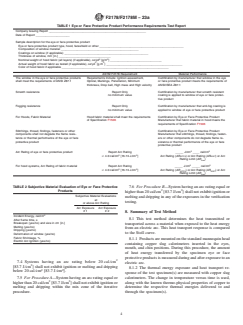
TABLE 1 Eye or Face Protective Product Performance Requirements Test Report
Company Issuing Report ____________________________________________________________
Date of Report _____________________
Sample description for the eye or face protective product
Eye or face protective product type, hood, faceshield or other ____________________________________________________
Composition of window material ________________________________________________
Coatings on window (if applicable) ____________________________________________________
Thickness of window, mm [in.] ________________________________
2 2
Nominal weight of hood fabric (all layers) (if applicable), oz/yd [g/m ] ________________________________
2 2
Actual weight of hood fabric as tested (if applicable), oz/yd [g ⁄m ] _______________________________________________
Color of hood fabric if applicable __________________________________________________________________
ASTM F2178 Requirement Material Performance
The window in the eye or face protective products Requirements Include: Ignition assessment, Certification by manufacturer that window in the eye
shall meet the requirements of ANSI Z87.1 Optical, Markings, Penetration, Minimum or face protective product meets the requirements of
thickness, Drop ball, High mass and High velocity ANSI/ISEA Z87.1
Scratch resistance Report Only Certification by manufacturer that scratch resistant
no minimum value coating is applied to window of eye or face protec-
tive product
Fogging resistance Report Only Certification by manufacturer that anti-fog coating is
no minimum value applied to window of eye or face protective product
For Hoods, Fabric Material Hood fabric material shall meet the requirements Certification by Eye or Face Protective Product
of Specification F1506 Manufacturer that fabric material in hood meets the
requirements of Specification F1506
Stitchings, thread, findings, fasteners or other Certification by Eye or Face Protective Product
components shall not degrade the flame resis- Manufacturer that stitchings, thread, findings, fasten-
tance or thermal performance of the eye or face ers or other components do not degrade flame re-
protective product sistance or thermal performance of the eye or face
protective product
2 2
Arc Rating of eye or face protective product Report Arc Rating _____ J/cm ____ cal/cm
2 2
$ 4.0 cal/cm [16.74 J/cm ] Arc Rating (AR ) or Arc Rating (AR ) or Arc
ATPV EBT
Rating Limit (AR )
Lim
2 2
For hood systems, Arc Rating of fabric material Report Arc Rating _____ J/cm _____ cal/cm
2 2
$ 4.0 cal/cm [16.74 J/cm ] Arc Rating (AR ) or Arc Rating (AR ) or Arc
ATPV EBT
Rating Limit (AR )
Lim
TABLE 2 Subjective Material Evaluation of Eye or Face Protective
7.6 For Procedure B—System having an arc rating equal or
Products 2 2
higher than 20 cal/cm [83.7 J/cm ] shall not exhibit ignition or
Subjective Material Evaluations
melting and dripping in any of the exposures in the verification
at
testing.
or above Arc Rating
Arc Exposure Arc Exposure
# 1 # 2
8. Summary of Test Method
Incident Energy, cal/cm
8.1 This test method determines the heat transmitted or
After flame time, s
Breakopen (yes/no) and size in cm [in.]
transported across a material when exposed to the heat energy
Melting (yes/no)
from an electric arc. This heat transport response is compared
Dripping (yes/no)
to the Stoll curve.
Deformation of window (yes/no)
Fabric Shrinkage, %
8.1.1 Products are mounted on the standard mannequin head
Electric Arc Ignition (yes/no)
containing copper slug calorimeters inserted in the eyes,
mouth, and chin positions. During this procedure, the amount
of heat energy transferred by the specimen eye or face
protective products is measured during and after exposure to an
7.4 Systems having an arc rating below 20 cal ⁄cm
electric arc.
[83.7 J ⁄cm ] shall not exhibit ignition or melting and dripping
8.1.2 The thermal energy exposure and heat transport re-
2 2
below 20 cal ⁄cm [83.7 J ⁄cm ].
sponse of the test specimen(s) are measured with copper slug
7.5 For Procedure A—System having an arc rating equal or calorimeters. The change in temperature versus time is used,
2 2
higher than 20 cal/cm [83.7 J/cm ] shall not exhibit ignition or
along with the known thermo-physical properties of copper to
melting and dripping within the mix zone of the iterative determine the respective thermal energies delivered to and
procedure. through the specimen(s).
F2178/F2178M − 23a
8.2 This procedure incorporates incident energy monitoring 9.6 The purchaser has the option to perform or have
sensors. performed any of these tests to verify the performance of the
eye or face protective product. Claims for failure to meet the
8.3 Product and material performance for this procedure are
specification are subject to verification by the manufacturer.
determined by using the incident energy generated by the arc
9.7 In addition to the standard set of exposure conditions,
flash measured by monitor sensors to compare the energy
transferred by or through the test specimen(s) and measured by other conditions representative of the expected hazard may be
used and shall be reported should this data be cited.
calorimeters on the mannequin head and compared to the Stoll
Curve Criteria to predict a protective value called an Arc
Rating. 10. Apparatus
10.1 General Arrangement for Determining Rating Using
8.4 Alternatively, if the Stoll Curve Criteria is not met, the
standard uses the EBT or AR to set the Arc Rating. Sensor Heads and Monitor Sensors—The test apparatus shall
Lim
consist of supply bus, arc controller, recorder, arc electrodes,
8.5 Product and material responses are further described by
two (or optionally three) four-sensor heads, and four (or
recording the observed effects of the electric arc exposure on
optionally six) incident energy monitoring sensors. The arc
the specimens using the terms in the Report section.
exposure shall be monitored with two incident energy-
8.6 Accessories for eyes and face protective products such
monitoring sensors for each sensored head.
as air supply or cooling devices, lamps, hearing protection or
10.2 Head Construction—Each four-sensor head and each
any other accessory attached to the protective product are
monitor sensor holder shall be constructed from electrically
evaluated for ignition, melt and drip in evaluating the protec-
insulating and flame- and heat-resistant material. The head
tion level of the product.
form shall have four sensors mounted as shown in Fig. 1. The
chin sensor shall be in the horizontal plane (perpendicular to
9. Significance and Use
the plane of the eye and mouth) under the chin as shown in Fig.
9.1 This specification’s test method is used to determine an 1. The chin sensor shall protrude below the lowest point of the
arc rating for eye or face protective products, including face chin by 3 mm [ ⁄8 in.].
shields, safety spectacles, goggles, or other applicable portions
10.3 Sensor Construction—The sensor mount used to hold
of the complete product that are required to meet the current
the calorimeter shall be constructed from a thermally stable
version of ANSI/ISEA Z87.1. This excludes the textile or parts
heat-resistant material with a minimum thermal conductivity
of the hood assemblies or other rated products that are not
value as indicated in Table 3 to prevent unwanted heat
testable by ANSI/ISEA Z87.1. This standard does not measure
conduction (such as Fire-Resistant Structural Insulation or
optical and impact properties (see ANSI/ISEA Z87.1) but does
equivalent). The dimensions of the sensor mount are shown in
specify requirements for optical and impact properties in
Fig. 2.
accordance with that standard.
10.3.1 The calorimeter shall be constructed from electrical
9.2 The test method is used to measure and describe the grade copper with purity greater than 99.9 %, UNS C11000.
The copper disc shall have a thickness of 1.6 mm 6 0.1 mm,
properties of materials, products, or assemblies in response to
convective and radiant energy generated by an electric arc a diameter of 40 mm 6 0.1 mm and a mass of 18 g 6 0.5 g.
under controlled laboratory conditions and does not purport to The thickness, diameter and mass of each copper disc shall be
predict damage from light other than the thermal aspects measured to determine the actual response coefficient for each
measured. calorimeter that is used in heat capacity calculations. In the
case of a group of copper discs having an average mass/area
9.3 The specification’s test method is intended for the
ratio within 60.008 g/cm , the average value for the group of
determination of the arc rating of a product/design, intended
calorimeters may be used.
for use as eye or face protection for workers exposed to electric
10.3.2 A type K (NiCr-NiAl) thermocouple having a cross
arcs. For whole body protection, additional personal protective
sectional area of 0.05 mm (No. 30 AWG) or equivalent shall
equipment (PPE) will be required for parts not covered by this
be used to construct the calorimeter. The thermocouple shall be
standard.
installed inside the hole of the copper disc as shown in Fig. 6.
9.3.1 Because of the variability of the arc exposure, differ-
The tip of the thermocouple shall be bare for the full length
ent heat transmission values may be observed at individual
inside the copper disc. Copper filler material may be used to
sensors. The results of each sensor are evaluated in accordance
mechanically secure the thermocouple tip in place. The ther-
with Section 16.
mocouple wires shall be separated immediately upon exiting
9.4 This test method maintains the specimen in a static,
the copper disc.
vertical position and does not involve movement except that
10.3.3 The calorimeter shall be inserted into the cavity of
resulting from the exposure.
the sensor mount. The copper disc shall be flush with the
surface of the sensor material. The copper disc can be secured
9.5 Different exposure conditions produce different incident
in place with stainless steel pins (3 or 4) spaced around the
energies and different heat fluxes. This standard exposure is
circumference of the disc.
used for comparison of products and hazard assessment meth-
ods may use multiplication factors or other means for deter-
NOTE 4—Stainless steel sewing pins cut to a few millimeters have been
mining protection. used successfully.
F2178/F2178M − 23a
FIG. 1 Mannequin Head and Head Sensor Locations
TABLE 3 Thermal Conductivity in accordance with Test Method
Fabric; ASTM F18.65.01 Testing Group Report on Arc Testing
C177 at Various Mean Temperatures
Analysis of the F1959/F1959M Standard Test Method—Phase
Thermal Conductivity
1.”
Temperature
Btu-in./ft , h, °F [W/m °K]
10.3.5 Alternate calorimeters are permitted for use as moni-
75 °F [24 °C] 1.15 [0.17]
tor sensors provided they are calibrated and have a similar
400 °F [205 °C] 1.13 [0.16]
600 °F [316 °C] 1.15 [0.17]
response. The use of a different thermocouple junction, ex-
800 °F [425 °C] 1.16 [0.17]
posed surface area, slug material, and mass is allowed; their
1000 °F [538 °C] 1.17 [0.17]
performance shall be documented in the test results.
10.4 Arrangement of the Four-Sensor Heads and Monitor
Sensors—The standard test set up is three four-sensor heads
spaced at 120° around the arc (Fig. 3). Each head shall be
10.3.4 The exposed surface of the copper slug calorimeters
located vertically to the arc electrodes as shown in Fig. 4 at a
shall be painted with a thin coating of a flat black high-
horizontal distance of 300 mm 6 5 mm [12 in.] from the mouth
temperature spray paint with an emissivity of >0.9. The painted
calorimeter to the center of the electrodes. Each four-sensor
sensor shall be dried before use and present a uniformly
head shall have two incident energy monitoring sensors. One
applied coating (no visual thick spots or surface irregularities).
monitoring sensor shall be located on each side of each
Note that an external heat source, for example, an external heat
four-sensor head as shown in Fig. 5 at a position and angle
lamp, may be required to completely drive off any remaining
indicated in Table 4. The face of the monitor sensors shall be
organic carriers in a freshly painted surface.
perpendicular to a radius line from the center of the electrode
10.3.4.1 An evaluation of the emissivity of the painted
to the center of the monitor sensor.
calorimeters used in this test method was conducted by
Committee F18; “ASTM Research Program on Electric Arc 10.4.1 The actual distance of the monitor sensors and
Test Method Development to Evaluate Protective Clothing four-sensor head shall be measured and the value used to
F2178/F2178M − 23a
FIG. 2 Sensor Mount
FIG. 3 Location of Mannequin Heads
FIG. 4 Vertical Location of Heads to Arc Electrodes
determine the multiplier for the incident energy calculation.
The multiplier factor shall be the square of the ratio of the
actual distance of the monitor sensor divided by the actual
distance of the four-sensor head to which the monitor is 305 mm and the incident energy monitors at 340 mm, the
positioned. Example: When having the four-sensor head at incident correction factor is (340/305) = 1.24.
F2178/F2178M − 23a
10.4.3 Each four-sensor head may be mounted on the
mannequin body to simulate a human body. Any clothing on
the mannequin (if used) shall be reported.
10.5 Supply Bus and Electrodes—A typical arrangement of
the supply bus and arc electrodes is shown in Fig. 4. The arc
shall be in a vertical position as shown.
10.5.1 Electrodes—Make the electrodes from stainless steel
(Alloy Type 303 or Type 304) rod of a nominal 19 mm
[0.75 in.] diameter. Lengths of 45.0 cm [18 in.] long initially
have been found to be adequate.
10.5.2 Fuse Wire—A fuse wire, connecting the ends of
opposing electrodes tips, is used to initiate the arc. This wire is
consumed during the test; therefore, its mass shall be very
small to reduce any effects on the testing. The fuse wire shall
be a copper wire with a diameter not greater than 0.5 mm
[0.02 in.].
10.5.3 Structural Cage Arrangement—The structural cage
arrangement shall be made of conductive tubes (for example,
metallic tubes such as aluminum or steel). The diameter of the
cage shall be between 2.0 m and 2.5 m. The height of the cage
shall be at least 3 m.
10.6 Electric Supply—The electric supply should be suffi-
cient to allow for the discharge of an electric arc with a gap of
up to 305 mm [12 in.] with alternating arc current of 8000 A
and with arc duration from 3 cycles (0.05 s) up to at least 90
cycles (1.5 s) (from a 60 Hz supply). The X/R ratio of the test
circuit shall be such that the test current contains a DC
component resulting in the first peak of the test current having
a magnitude of 2.3 6 0.1 times the symmetrical RMS value.
10.7 Test Circuit Control—The make switch shall be ca-
pable of point on wave closing within 60.5 ms from test to test
such that the closing angle will produce maximum asymmetri-
cal current with an X/R ratio of the test circuit as stated in 10.5.
The arc current, duration, and voltage shall be measured. The
FIG. 5 Mannequin Head with Monitor Sensors
arc current, duration, voltage, and energy shall be displayed in
graph form and stored in digital format.
TABLE 4 Position of Monitor Sensors Depending on Expected
Incident Energy
10.8 Data Acquisition System—The system shall be capable
Monitor Sensor Position Monitor Sensor Position
of recording voltage, current, and sufficient calorimeter outputs
1 2
as required by the test.
2 2
Incident energy on eyes 0 to 55 cal ⁄cm Over 40 cal/cm $
10.8.1 The temperature waveform data (calorimeter out-
and mouth calorimeters [230 J/cm] [167.4 J/cm]
puts) shall be acquired at a minimum sampling rate of 100
Distance D1, center of 340 mm ± 5 mm 410 mm ± 5 mm
samples per second per calorimeter. The acquisition system
electrode to monitor
including noise filtering shall have a frequency response of at
sensor
least 20 Hz [-3 dB]. The acquisition system shall be able to
Angle between 40º ± 5º 40º ± 5º
record temperatures to 500 °C. The temperature shall be
perpendicular line to
reported with 3 significant digits and have an accuracy of at
center of mouth
calorimeter and monitor
least 61 °C. (This does not include the accuracy of the
sensor surface
calorimeter).
NOTE 5—A minimum acquisition rate and frequency response of the
calorimeters is necessary to avoid introducing signal distortion and time
10.4.2 Only calorimetry data from heads that are viewed
shift into the waveform. synchronize the temperature curves with time
zero (t ). A sampling rate of 100 Hz provides a data point at 10 ms
from the front shall be used (a minimum 50 % view of the
intervals and a minimum 20 Hz bandwidth (corresponds to a 10 % to 90 %
facial area is required) to record subjective data during the test.
rise time of 17.5 ms) has been determined to be sufficient. The response
When one video camera is used to view the testing, it shall be
of the entire acquisition system can be checked by placing a sinusoidal
placed so that the front of two of the heads can be viewed. A
signal at the thermocouple input and analyzing the system response.
single head which is viewed from the rear may be removed to
NOTE 6—The response of the sensors during a calibration test can be
facilitate viewing. checked by examining the curve of each calorimeter and locating the
F2178/F2178M − 23a
beginning of the rising temperature region. The first data points of
12.2 Test specimens shall be mounted as they are normally
temperature rise on the sensor calorimeters should occur within 30 ms of
intended to be worn. If the position of the product is adjustable
the arc current initiation.
(such as faceshields with adjustable headgear), some tests shall
10.8.2 The waveform recorders for current and voltage data
be done in the fully in and fully out position to determine
shall be acquired at a minimum rate of 2000 samples per
which provides the lowest thermal protection. The actual
second and a frequency response of 200 Hz. The current and
distance of the shield/visor to the center line of the electrode
voltage acquisition system shall have an accuracy of at least
shall be measured and reported.
3 %.
12.2.1 Generally, the most extended position (shield furthest
10.8.3 All the waveform recorders for measuring the arc
away from the face) is more severe on the shield and allows for
current, voltage and calorimeter signals shall be synchronized
more thermal energy to go around the shield and yields the
to ensure the real time relationship between the waveforms is
lower amount of protection.
maintained and no time shift is introduced in the recorded
12.3 The thickness of the protective lens material shall be
signals.
measured with accuracy of 0.1 mm.
10.8.4 The arc initiation time (t ) corresponds to the start of
12.4 Laundering of the fabric material for hoods and bala-
the arc, and shall be reliably determined from the electrical
clavas is not required prior to testing.
signal of the arc current.
12.5 The fabric weight as tested (if applicable) for each
10.9 Data Acquisition System Protection—Due to the nature
layer shall be measured using die cut samples.
of this type of testing, the use of isolating devices on the
calorimeter outputs to protect the acquisition system is recom-
12.6 Before arc testing, the specimens shall be maintained
mended.
in laboratory conditions having a temperature between 18 °C
and 28 °C and the relative humidity between 45 % and 75 %
11. Hazards
for at least 24 h.
11.1 The test apparatus discharges large amounts of energy.
13. Calibration and Standardization
In addition, the electric arc produces very intense light. Care
shall be taken to protect personnel working in the area.
13.1 Calorimeter Calibration Check—After assembly, the
Workers shall be behind protective barriers or at a safe distance
monitor sensors and head sensors shall be checked to verify
to prevent electrocution and contact with molten metal. Work-
proper operation. The calorimeter shall be exposed to fixed
ers wishing to directly view the test shall don the appropriate
radiant heat source for 30 s while recording the output signal.
eye protection. If the test is conducted indoors, there shall be a
The temperature rise response from each calorimeter is plotted
method to ventilate the area to carry away combustion
and compared to the average. Any calorimeter having an
products, smoke, and fumes. Air currents can disturb the arc
abnormal response shall be suspected of faulty connections and
reducing the heat flux at the surface of any of the calorimeters.
shall be replaced or repaired.
The test apparatus shall be shielded by non-combustible
13.2 Another method to effectively check the response of
materials suitable for the test area. Outdoor tests shall be
each calorimeter against an average of other sensors or a
conducted in a manner appropriate to prevent exposure of the
reference calorimeter is acceptable.
test specimen to moisture and wind (the elements). The leads to
the test apparatus shall be positioned to prevent blowout of the 13.3 Each monitor sensor shall be positioned perpendicular
electric arc. The test apparatus shall be insulated from ground to the radius drawn from the center line of the electrodes to the
for the appropriate test voltage. center plane of the four-sensor head. The angle α between the
radius drawn to the center of each monitor sensor and the
11.2 The test apparatus, electrodes, and calorimeter assem-
radius drawn to the center line of the mannequin head face and
blies become hot during testing. Use protective gloves when
mouth sensor surfaces shall be 35° -0° /+ 5°, and it shall be
handling these hot objects.
possible to position each monitor sensor at the distances
11.3 Use care when the specimen ignites or releases com-
340 mm 6 5 mm or 410 mm 6 5 mm from the center line of
bustible gases. An appropriate fire extinguisher should be
the arc electrodes. Table 4 gives the distance D that has been
readily available. Ensure the materials are fully extinguished.
found to be practical, thus shall be selected for different
11.4 Immediately after each test, the electric supply shall be incident energy exposures.
13.3.1 For testing at higher incident energy ranges and for
shut off from the test apparatus and all other laboratory
equipment used to generate the arc, and the apparatus and other research, laboratories have found that allowance to adjust the
monitor sensor distance from 200 mm to 600 mm is desirable.
laboratory equipment shall be isolated and grounded. After
data acquisition has been completed, appropriate methods shall 13.3.2 The actual distance of each monitor sensor shall be
measured to a precision of 62 mm and the distance used for
be used to ventilate the test area before personnel entry. No one
the incident energy calculations.
shall enter the test area prior to exhausting all smoke and fumes
13.3.3 Examples of arrangement of six monitor sensors are
without the appropriate personal protection.
shown in Fig. 3.
12. Sampling and Specimen Preparation
13.4 Arc Exposure Calibration—Prior to each calibration,
12.1 Test specimens for four-sensor head test shall be position the electrodes of the test apparatus to produce a
representative of the product, as it will be sold. 30.5 cm [12 in.] gap. The face of the monitor sensors shall be
F2178/F2178M − 23a
parallel and normal to the center line of the electrodes. The sensors shall be cooled with a jet of air or by contact with a
midpoint of the electrode gap shall be at the same elevation as cold surface. If water is used to cool the sensors, be certain not
the center point of the monitor sensors (see Fig. 5). Connect the to over-wet the insulating material around the calorimeter as
fuse wire to the end of one electrode by making several wraps this can affect subsequent readings.
and twists and then to the end of the other electrode by the
14.2 Surface Reconditioning—While the sensor is hot, wipe
same method. The fuse wire shall be pulled tight and the excess
the sensor face immediately after each test to remove any
trimmed. Adjust the test controller to produce the desired arc
decomposition products that condense and could be a source of
current and duration.
future measurement error. If a deposit collects and appears to
13.5 Apparatus Calibration for the Four-Sensor Head and
be thicker than a thin layer of paint or the surface appears
Monitor Sensors—Position each four-sensor head so that the
irregular, the sensor surface requires reconditioning. Carefully
surface of each head is 30.5 cm [12 in.] from, parallel and
clean the cooled sensor with acetone or petroleum solvent,
normal to, the center line of the electrodes.
making certain to follow safe handling practices. Repaint the
13.5.1 Set the symmetrical arc exposure current to 8000 A
surface as noted in 10.3.4. Perform an arc exposure to cure the
6 500 A and the arc duration at 10 cycles [0.167 s].
paint and check calibration according to 13.3 after resurfacing
13.5.2 Discharge the arc.
the sensors.
13.5.3 Calculate the incident energy following the proce-
14.3 Sensor Care—The sensors shall be kept dry. For
dure in 15.9.
outdoor tests, the mannequin heads and monitor sensors shall
13.5.4 Compare the highest sensor reading and the average
be covered during long periods between tests to prevent excess
value obtained for all sensors (excluding the chin sensor), for
temperature rise resulting from exposure to the sun. Due to the
example, with the theoretical result of 10.1 cal/cm
destructive nature of the electric arc, the mannequin and head
[42.26 J ⁄cm ] for the calibration exposure of 8 kA for 0.167 s.
should be covered with the same paint as the sensors. The
Compare the total heat value determined by the sensors to the
heads should be re-coated periodically to reduce mannequin
value shown.
deterioration.
13.5.5 The average total heat calculated for the sensors shall
be at least 60 % of the value determined by calculation or that
15. Procedures for Determining the Arc Rating
shown. The highest measured total heat of any one sensor shall
be within 10 % of the calculated value. If these values are not 15.1 One of two procedures may be used for determining an
obtained, inspect the test setup and correct any possible arc rating by this standard.
problems that could produce less than desired results.
15.1.1 Devices such as spectacles, goggles or shields for eye
13.5.6 An arc exposure calibration test should be conducted
or face protection not having a fabric component shall follow
at the desired test level after each adjustment, and prior to the
Procedure A. See example flow chart in Fig. 6.
start and end of each day’s testing and after any equipment
15.1.2 System including goggles or shields in combination
adjustment or failure.
with a fabric component such as a hood, bib or balaclava shall
13.5.7 The arc generated in the testing apparatus may not
follow Procedure A or B. Procedure B may only be followed to
follow a path that is equidistant from each sensor and can result
establish performance verification once the protective level of
in a variation in measured values. To be considered calibrated,
the fabric system is known. See example flow chart in Fig. 7.
the highest total heat measured from any single sensor from a
15.2 Description of Procedure A—Procedure A is the itera-
10 cycle [0.167 s], 8000 A fault current shall not exceed
2 2 tive test procedure to determine the Arc Rating requiring
11 cal ⁄cm [46.1 J ⁄cm ] and the average total heat measured
2 minimum 20 data points and logistic regression analysis.
for all sensors in the apparatus shall be at least 6 cal ⁄cm
15.2.1 When a fabric componen
...
This document is not an ASTM standard and is intended only to provide the user of an ASTM standard an indication of what changes have been made to the previous version. Because
it may not be technically possible to adequately depict all changes accurately, ASTM recommends that users consult prior editions as appropriate. In all cases only the current version
of the standard as published by ASTM is to be considered the official document.
Designation: F2178/F2178M − 23 F2178/F2178M − 23a
Standard Specification for
Arc Rated Eye or Face Protective Products
This standard is issued under the fixed designation F2178/F2178M; the number immediately following the designation indicates the year
of original adoption or, in the case of revision, the year of last revision. A number in parentheses indicates the year of last reapproval.
A superscript epsilon (´) indicates an editorial change since the last revision or reapproval.
1. Scope
1.1 This product specification is used to determine the arc rating and specify the requirements for products intended for use as eye
or face protection for workers exposed to electric arcs. The arc rating is determined in the test with an arc which has a heat flux
2 2
value of 2100 kW/m [50 cal/cm /s]. Products are tested as sold.
1.2 The products covered by this standard are in the form of faceshields attached to the head by protective helmets (hard hats),
headgear, hood assemblies, safety spectacles or goggles. Faceshields, safety spectacles or goggles are tested with or without other
face and head protective products, for example, sock hoods, balaclavas, sweat shirt hoods or jacket hoods.
1.2.1 Fabric layers used in the design of face protection products such as in hood, neck guards, balaclava, meet the requirements
of Specification F1506. When fabrics are designed into the protection provided for eye or face protective products, the arc rating
of fabric system is first determined by Test Method F1959/F1959M.
1.2.2 The arc rating of the eye or face protective product which requires fabric to provide protection to the face or head will not
be higher than the lower arc rating of either the fabric system or the shield/visor assembly.
1.3 The values stated in SI units shall be regarded as standard except as noted. Within the text, alternate units are shown in
brackets. The values stated in each system may not be exact equivalents; therefore, alternate systems must be used independently
of the other. Combining values from the systems described in the text may result in nonconformance with the method.
1.4 This standard does not purport to describe or appraise the effect of the electric arc fragmentation or propulsion of parts of
equipment or molten metal splatter, deposited from the pressure wave containing molten metals and possible fragments of other
materials except to the extent that heat energy transmission due to these arc explosion phenomena is reduced by test specimens.
1.5 This standard shall not be used to describe or appraise the fire hazard or fire risk of materials, products, or assemblies under
actual fire conditions. However, results of this test may be used as elements of a fire assessment which takes into account all of
the factors which are pertinent to an assessment of the fire hazard of a particular end use.
1.6 This standard does not purport to address all of the safety concerns, if any, associated with its use. It is the responsibility
of the user of this standard to establish appropriate safety, health, and environmental practices and determine the applicability of
regulatory limitations prior to use. For specific hazards see Section 11.
1.7 This international standard was developed in accordance with internationally recognized principles on standardization
established in the Decision on Principles for the Development of International Standards, Guides and Recommendations issued
by the World Trade Organization Technical Barriers to Trade (TBT) Committee.
This specification is under the jurisdiction of ASTM Committee F18 on Electrical Protective Equipment for Workers and is the direct responsibility of Subcommittee
F18.65 on Wearing Apparel.
Current edition approved March 15, 2023Sept. 1, 2023. Published April 2023September 2023. Originally approved in 2002. Last previous edition approved in 20222023
as F2178 – 22.F2178/F2178M – 23. DOI: 10.1520/F2178_F2178M-23.10.1520/F2178_F2178M-23A.
Copyright © ASTM International, 100 Barr Harbor Drive, PO Box C700, West Conshohocken, PA 19428-2959. United States
F2178/F2178M − 23a
2. Referenced Documents
2.1 ASTM Standards
C177 Test Method for Steady-State Heat Flux Measurements and Thermal Transmission Properties by Means of the
Guarded-Hot-Plate Apparatus
D123 Terminology Relating to Textiles
D4391 Terminology Relating to The Burning Behavior of Textiles
F1494 Terminology Relating to Protective Clothing
F1506 Performance Specification for Flame Resistant and Electric Arc Rated Protective Clothing Worn by Workers Exposed to
Flames and Electric Arcs
F1959/F1959M Test Method for Determining the Arc Rating of Materials for Clothing
2.2 ANSI/IEEE Standards:
IEEE Standard Dictionary of Electrical and Electronics Terms
ANSI/ISEA Z87.1 American National Standard for Occupational and Educational Personal Eye and Face Protection Devices
3. Terminology
3.1 For definitions of other textile terms used in this specification, refer to Terminologies D123, D4391, F1494 and the IEEE
Standard Dictionary of Electrical and Electronics Terms.
3.2 Definitions:
3.2.1 afterflame, n—persistent flaming of a material after the ignition source has been removed.
3.2.2 afterflame time, n—the length of time for which a material continues to flame after the ignition source has been removed.
3.2.3 arc duration, n—time duration of the arc, s.
3.2.4 arc energy, n—sum of the instantaneous arc voltage values multiplied by the instantaneous arc current values multiplied by
the incremental time values during the arc, J.
3.2.5 arc gap, n—distance between the arc electrodes, cm [in.].
3.2.6 arc rating, n—value attributed to materials that describes their performance to exposure to an electric arc discharge,
2 2
J/cm [cal ⁄cm ].
3.2.6.1 Discussion—
2 2
The arc rating is expressed in J/cm [cal ⁄cm ] and is derived from the determined value of ATPV or EBT (should a material system
exhibit a breakopen response below the ATPV value) or the Arc Rating Limit. It can be expressed in short form as either
AR ,AR or AR .
ATPV EBT Lim
3.2.7 arc thermal performance value (ATPV), n—in arc testing, the incident energy of a fabric or material that results in 50 %
probability that sufficient heat transfer through the specimen is predicted to cause the onset of a second-degree skin burn injury
based on the Stoll curve.
3.2.8 arc rating limit (AR ), n—the maximum arc thermal energy protection that has been assigned to the product based on the
Lim
manufacturer’s specifications after verification with testing or limits of detection of the test method.
3.2.8.1 Discussion—
For hoods, the AR could be a limit made by the test laboratory based on the equipment limits of the energy exposure (418.4
Lim
2 2
J/cm [100 cal/cm ] in many laboratories) or the producer may deliberately specify an incident energy value, which may be lower
than the arc rating (ATPV or EBT) of the material or material assembly for the evaluation of the finished product. In this case,
For referenced ASTM standards, visit the ASTM website, www.astm.org, or contact ASTM Customer Service at service@astm.org. For Annual Book of ASTM Standards
volume information, refer to the standard’s Document Summary page on the ASTM website.
Available from Institute of Electrical and Electronics Engineers, Inc. (IEEE), 445 Hoes Ln., Piscataway, NJ 08854-4141, http://www.ieee.org.
Available from American National Standards Institute (ANSI), 25 W. 43rd St., 4th Floor, New York, NY 10036, http://www.ansi.org.
Derived from Stoll, A. M., and Chianta, M. A., “Method and Rating System for Evaluations of Thermal Protection,” Aerospace Medicine, Vol 40, 1969, pp. 1232-1238
and Stoll, A. M., and Chianta, M. A., “Heat Transfer through Fabrics as Related to Thermal Injury,” Transactions – New York Academy of Sciences, Vol 33(7), Nov. 1971,
pp. 649-670.
F2178/F2178M − 23a
testing may deliberately be carried out only at incident energy exposures lower than the projected arc rating of the material or
material assembly provided the system meets the visual assessment and all performance criteria.
3.2.8.2 Discussion—
This rating may also be set to any value below the ATPV/EBT and meeting the ignition withstand to assure the product is safe for
use with no ignition or melting and dripping at or below the arc rating of the final product. This AR could also be set at the fabric
Lim
arc rating or lower due to an add-on such as a specialized adapter to place the faceshield further from the face for respirator use,
or due to the ignition of a component in which demonstrates ignition at a level near the arc rating such as a hook and loop closure,
rivets, a flashlight or a fan system.
3.2.9 arc voltage, n—voltage across the gap caused by the current flowing through the resistance created by the arc gap (V).
3.2.10 asymmetrical arc current, n—the total arc current produced during closure; it includes a direct component and a
symmetrical component, A.
3.2.11 blowout, n—the extinguishing of the arc caused by a magnetic field.
3.2.12 breakopen, n—in electric arc testing, a material response evidenced by the formation of one or more holes in the material
which may allow thermal energy to pass through material.
3.2.12.1 Discussion—
2 2
The specimen is considered to exhibit breakopen when any hole in the material or fabric is at least 1.6 cm [0.5 in. ] in area or
at least 2.5 cm [1.0 in.] in any dimension. For textile materials, single threads across the opening or hole do not reduce the size
of the hole for the purposes of this test method. In multiple layer specimens, if some of the layers are ignitable, breakopen occurs
when these layers are exposed.
3.2.12.2 Discussion—
A system having multi-layer fabric or multi-layer shields may exhibit formation of holes (ablation) of the outermost layers.
Breakopen is not considered attained until the formation of one or more holes has occurred in the innermost protective layer. This
can include a hardhat.
3.2.12.3 Discussion—
Breakopen of a fabric which is on a hood system is only considered breakopen if the breakopen allows a clear line of sight to the
mannequin. For instance, if fabric is covering the interfacing between the hood and a hardhat it will only be considered breakopen
if a clear line of sight to any non-arc rated layer of fabric or the test mannequin.
3.2.13 breakopen threshold energy (EBT), n—the incident energy on a fabric or material that results in a 50 % probability of
breakopen.
3.2.13.1 Discussion—
2 2
This is the value in J/cm [cal/cm ] determined by use of logistic regression analysis representing the energy at which breakopen
of the layer occurred.
3.2.14 dripping, n—in electric arc testing, a material response evidenced by flowing of a specimen’s material of composition.
3.2.14.1 Discussion—
Dripping is exhibited by either the fabric material or faceshield material, or other parts of eye or face protective products.
2 2
3.2.15 heat flux, n—the thermal intensity indicated by the amount of energy transmitted per area and time W/m [cal/cm s].
3.2.16 incident energy monitoring sensors, n—sensors mounted on each side of each head, using calorimeters, not covered by
specimens, used to measure incident energy.
3.2.17 incident exposure energy (E ), n—in arc testing, the total incident energy delivered to monitor calorimeter sensors from the
i
2 2
arc exposure, J/cm [cal/cm ].
3.2.17.1 Discussion—
in an arc test exposure, incident exposure energy for a specimen is the average of the measured incident energy from the respective
two monitor sensors adjacent to the test specimen.
3.2.18 material response, n—material response to an electric arc is indicated by the following terms: breakopen, melting, dripping,
deformation, afterflame time, shrinkage, and electric arc ignition.
F2178/F2178M − 23a
3.2.19 melting, n—in arc testing, a material response evidenced by softening of the material.
3.2.20 peak arc current, n—maximum value of the AC arc current, A.
3.2.21 RMS arc current, n—root mean square of the AC arc current, A.
3.2.22 shrinkage, n—in testing eye or face protective products, a material response evidenced by reduction in specimen size.
3.2.23 X/R ratio, n—the ratio of system inductive reactance to resistance. It is proportional to the L/R ratio of time constant, and
is, therefore, indicative of the rate of decay of any DC offset. A large X/R ratio corresponds to a large time constant and a slow
rate of decay.
4. Ordering Information
4.1 The following items should be considered by the purchaser when buying eye or face protective products under this
specification and included, as necessary, in purchasing documents:
2 2
4.1.1 Arc Rating of the eye or face protective products, J/cm [cal/cm ],
4.1.2 Type of material in the window of the eye or face protective product,
4.1.3 Thickness of the eye or face protective product, mm [in.],
2 2
4.1.4 Type and weight, g/m [oz ⁄yd ] of hood fabric material in the eye or face protective product for hoods,
4.1.5 Type and material of fasteners (buttons, snaps, zippers or hook and loop fasteners),
4.1.6 Style and design or catalog number,
4.1.7 Special identification markings (optional), and
4.1.8 Notation of conformance to this specification.
5. Physical Requirements
5.1 The faceshield window, safety spectacle or goggle in the eye or face protective product shall meet the requirements of
ANSI/ISEA Z87.1. Requirements include: Flammability, Corrosion Resistance, Optical, Cleanability, Markings, Penetration,
Minimum Thickness, Drop ball, High Mass, and High Velocity.
5.2 Scratch Resistance—Manufacturer shall certify if scratch resistant coating is applied to window of eye or face protective
product.
5.3 Fogging Resistance—Manufacturer shall certify if anti-fog coating is applied to window of eye or face protective product.
5.4 For Hoods, Fabric Material Physical Requirements—Fabric Material in the hood shall meet the requirements of Specification
F1506.
6. Performance Requirements
6.1 The stitching, thread, findings, fasteners, or other components used to manufacture the eye or face protective product shall not
degrade the flame resistance or thermal performance of the eye or face protective products.
6.2 Eye or face protective products shall conform to the requirements of Section 7 for thermal resistance to an electric arc
exposure.
F2178/F2178M − 23a
6.3 The results for all performance requirements and subjective material evaluations shall be provided. Subjective material
evaluations for at least two arc exposures at or above the arc rating shall be reported. This report shall be made available to the
purchaser of eye or face protective product meeting this specification by the eye or face protective product manufacturer.
NOTE 1—Example tables for reporting the test results and subjective material evaluation are shown in Table 1 and Table 2.
6.4 Products tested for full face protection shall have an interface that is designed to prevent burns to parts of the face not
represented by sensors on the test mannequin head.
NOTE 2—If goggles as part of a full face protective system are tested for full face protection, the system shall not have gaps in areas which are not
sensored, such as the nose, around the eyes, etc. The interface shall include the full face and be designed to provide the same performance over the whole
face area from the chin area all over the head.
6.5 Products tested for full face protection which have removable parts shall be labeled or designed to make removal or use
without proper assembly clear to the end user. Removable faceshields, faceplates, goggles or other systems and the properly
matched hood or other protective parts of the system shall be designed and marked in such a way that the proper replacement parts
are evident to the end user.
7. Thermal Performance Requirements
7.1 The eye or face protective product shall be tested for thermal resistance to an electric arc exposure by the use of this test
method. Test parameters shall be 8 kA 6 1 kA arc current, 30 cm [12 in.] electrode gap, stainless steel electrodes, 30 cm [12 in.]
distance between the arc center line and the mouth sensor surface. Modified test parameters may also be used and the results
reported on an optional basis.
TABLE 1 Eye or Face Protective Product Performance Requirements Test Report
Company Issuing Report ____________________________________________________________
Date of Report _____________________
Sample description for the eye or face protective product
Eye or face protective product type, hood, faceshield or other ____________________________________________________
Composition of window material ________________________________________________
Coatings on window (if applicable) ____________________________________________________
Thickness of window, mm [in.] ________________________________
2 2
Nominal weight of hood fabric (all layers) (if applicable), oz/yd [g/m ] ________________________________
2 2
Actual weight of hood fabric as tested (if applicable), oz/yd [g ⁄m ] _______________________________________________
Color of hood fabric if applicable __________________________________________________________________
ASTM F2178 Requirement Material Performance
The window in the eye or face protective products Requirements Include: Ignition assessment, Certification by manufacturer that window in the eye
shall meet the requirements of ANSI Z87.1 Optical, Markings, Penetration, Minimum or face protective product meets the requirements of
thickness, Drop ball, High mass and High velocity ANSI/ISEA Z87.1
Scratch resistance Report Only Certification by manufacturer that scratch resistant
no minimum value coating is applied to window of eye or face protec-
tive product
Fogging resistance Report Only Certification by manufacturer that anti-fog coating is
no minimum value applied to window of eye or face protective product
For Hoods, Fabric Material Hood fabric material shall meet the requirements Certification by Eye or Face Protective Product
of Specification F1506 Manufacturer that fabric material in hood meets the
requirements of Specification F1506
Stitchings, thread, findings, fasteners or other Certification by Eye or Face Protective Product
components shall not degrade the flame resis- Manufacturer that stitchings, thread, findings, fasten-
tance or thermal performance of the eye or face ers or other components do not degrade flame re-
protective product sistance or thermal performance of the eye or face
protective product
2 2
Arc Rating of eye or face protective product Report Arc Rating _____ J/cm ____ cal/cm
2 2
$ 4.0 cal/cm [16.74 J/cm ] Arc Rating (AR ) or Arc Rating (AR ) or Arc
ATPV EBT
Rating Limit (AR )
Lim
2 2
For hood systems, Arc Rating of fabric material Report Arc Rating _____ J/cm _____ cal/cm
2 2
$ 4.0 cal/cm [16.74 J/cm ] Arc Rating (AR ) or Arc Rating (AR ) or Arc
ATPV EBT
Rating Limit (AR )
Lim
F2178/F2178M − 23a
TABLE 2 Subjective Material Evaluation of Eye or Face Protective
Products
Subjective Material Evaluations
at
or above Arc Rating
Arc Exposure Arc Exposure
# 1 # 2
Incident Energy, cal/cm
After flame time, s
Breakopen (yes/no) and size in cm [in.]
Melting (yes/no)
Dripping (yes/no)
Deformation of window (yes/no)
Fabric Shrinkage, %
Electric Arc Ignition (yes/no)
NOTE 3—This test method is a design test.
7.2 For hoods, the arc rating of the fabric material shall be determined according to Test Method F1959/F1959M and reported.
2 2
7.3 The arc rating of the eye or face protective product shall be equal to or greater than 4.0 cal/cm [16.74 J/cm ].
2 2
7.4 Systems having an arc rating below 20 cal ⁄cm [83.7 J ⁄cm ] shall not exhibit ignition or melting and dripping below
2 2
20 cal ⁄cm [83.7 J ⁄cm ].
2 2
7.5 For Procedure A—System having an arc rating equal or higher than 20 cal/cm [83.7 J/cm ] shall not exhibit ignition or
melting and dripping within the mix zone of the iterative procedure.
2 2
7.6 For Procedure B—System having an arc rating equal or higher than 20 cal/cm [83.7 J/cm ] shall not exhibit ignition or
melting and dripping in any of the exposures in the verification testing.
8. Summary of Test Method
8.1 This test method determines the heat transmitted or transported across a material when exposed to the heat energy from an
electric arc. This heat transport response is compared to the Stoll curve.
8.1.1 Products are mounted on the standard mannequin head containing copper slug calorimeters inserted in the eyes, mouth, and
chin positions. During this procedure, the amount of heat energy transferred by the specimen eye or face protective products is
measured during and after exposure to an electric arc.
8.1.2 The thermal energy exposure and heat transport response of the test specimen(s) are measured with copper slug calorimeters.
The change in temperature versus time is used, along with the known thermo-physical properties of copper to determine the
respective thermal energies delivered to and through the specimen(s).
8.2 This procedure incorporates incident energy monitoring sensors.
8.3 Product and material performance for this procedure are determined by using the incident energy generated by the arc flash
measured by monitor sensors to compare the energy transferred by or through the test specimen(s) and measured by calorimeters
on the mannequin head and compared to the Stoll Curve Criteria to predict a protective value called an Arc Rating.
8.4 Alternatively, if the Stoll Curve Criteria is not met, the standard uses the EBT or AR to set the Arc Rating.
Lim
8.5 Product and material responses are further described by recording the observed effects of the electric arc exposure on the
specimens using the terms in the Report section.
F2178/F2178M − 23a
8.6 Accessories for eyes and face protective products such as air supply or cooling devices, lamps, hearing protection or any other
accessory attached to the protective product are evaluated for ignition, melt and drip in evaluating the protection level of the
product.
9. Significance and Use
9.1 This specification’s test method is used to determine an arc rating for eye or face protective products, including face shields,
safety spectacles, goggles, or other applicable portions of the complete product that are required to meet the current version of
ANSI/ISEA Z87.1. This excludes the textile or parts of the hood assemblies or other rated products that are not testable by
ANSI/ISEA Z87.1. This standard does not measure optical and impact properties (see ANSI/ISEA Z87.1) but does specify
requirements for optical and impact properties in accordance with that standard.
9.2 The test method is used to measure and describe the properties of materials, products, or assemblies in response to convective
and radiant energy generated by an electric arc under controlled laboratory conditions and does not purport to predict damage from
light other than the thermal aspects measured.
9.3 The specification’s test method is intended for the determination of the arc rating of a product/design, intended for use as eye
or face protection for workers exposed to electric arcs. For whole body protection, additional personal protective equipment (PPE)
will be required for parts not covered by this standard.
9.3.1 Because of the variability of the arc exposure, different heat transmission values may be observed at individual sensors. The
results of each sensor are evaluated in accordance with Section 16.
9.4 This test method maintains the specimen in a static, vertical position and does not involve movement except that resulting from
the exposure.
9.5 Different exposure conditions produce different incident energies and different heat fluxes. This standard exposure is used for
comparison of products and hazard assessment methods may use multiplication factors or other means for determining protection.
9.6 The purchaser has the option to perform or have performed any of these tests to verify the performance of the eye or face
protective product. Claims for failure to meet the specification are subject to verification by the manufacturer.
9.7 In addition to the standard set of exposure conditions, other conditions representative of the expected hazard may be used and
shall be reported should this data be cited.
10. Apparatus
10.1 General Arrangement for Determining Rating Using Sensor Heads and Monitor Sensors—The test apparatus shall consist
of supply bus, arc controller, recorder, arc electrodes, two (or optionally three) four-sensor heads, and four (or optionally six)
incident energy monitoring sensors. The arc exposure shall be monitored with two incident energy-monitoring sensors for each
sensored head.
10.2 Head Construction—Each four-sensor head and each monitor sensor holder shall be constructed from electrically insulating
and flame- and heat-resistant material. The head form shall have four sensors mounted as shown in Fig. 1. The chin sensor shall
be in the horizontal plane (perpendicular to the plane of the eye and mouth) under the chin as shown in Fig. 1. The chin sensor
shall protrude below the lowest point of the chin by 3 mm [ ⁄8 in.].
10.3 Sensor Construction—The sensor mount used to hold the calorimeter shall be constructed from a thermally stable
heat-resistant material with a minimum thermal conductivity value as indicated in Table 3 to prevent unwanted heat conduction
(such as Fire-Resistant Structural Insulation or equivalent). The dimensions of the sensor mount are shown in Fig. 2.
10.3.1 The calorimeter shall be constructed from electrical grade copper with purity greater than 99.9 %, UNS C11000. The
copper disc shall have a thickness of 1.6 mm 6 0.1 mm, a diameter of 40 mm 6 0.1 mm and a mass of 18 g 6 0.5 g. The thickness,
diameter and mass of each copper disc shall be measured to determine the actual response coefficient for each calorimeter that is
F2178/F2178M − 23a
FIG. 1 Mannequin Head and Head Sensor Locations
TABLE 3 Thermal Conductivity in accordance with Test Method
C177 at Various Mean Temperatures
Thermal Conductivity
Temperature
Btu-in./ft , h, °F [W/m °K]
75 °F [24 °C] 1.15 [0.17]
400 °F [205 °C] 1.13 [0.16]
600 °F [316 °C] 1.15 [0.17]
800 °F [425 °C] 1.16 [0.17]
1000 °F [538 °C] 1.17 [0.17]
used in heat capacity calculations. In the case of a group of copper discs having an average mass/area ratio within 60.008 g/cm ,
the average value for the group of calorimeters may be used.
10.3.2 A type K (NiCr-NiAl) thermocouple having a cross sectional area of 0.05 mm (No. 30 AWG) or equivalent shall be used
to construct the calorimeter. The thermocouple shall be installed inside the hole of the copper disc as shown in Fig. 6. The tip of
the thermocouple shall be bare for the full length inside the copper disc. Copper filler material may be used to mechanically secure
the thermocouple tip in place. The thermocouple wires shall be separated immediately upon exiting the copper disc.
10.3.3 The calorimeter shall be inserted into the cavity of the sensor mount. The copper disc shall be flush with the surface of the
sensor material. The copper disc can be secured in place with stainless steel pins (3 or 4) spaced around the circumference of the
disc.
NOTE 4—Stainless steel sewing pins cut to a few millimeters have been used successfully.
F2178/F2178M − 23a
FIG. 2 Sensor Mount
10.3.4 The exposed surface of the copper slug calorimeters shall be painted with a thin coating of a flat black high-temperature
spray paint with an emissivity of >0.9. The painted sensor shall be dried before use and present a uniformly applied coating (no
visual thick spots or surface irregularities). Note that an external heat source, for example, an external heat lamp, may be required
to completely drive off any remaining organic carriers in a freshly painted surface.
10.3.4.1 An evaluation of the emissivity of the painted calorimeters used in this test method was conducted by Committee F18;
“ASTM Research Program on Electric Arc Test Method Development to Evaluate Protective Clothing Fabric; ASTM F18.65.01
Testing Group Report on Arc Testing Analysis of the F1959/F1959M Standard Test Method—Phase 1.”
10.3.5 Alternate calorimeters are permitted for use as monitor sensors provided they are calibrated and have a similar response.
The use of a different thermocouple junction, exposed surface area, slug material, and mass is allowed; their performance shall be
documented in the test results.
10.4 Arrangement of the Four-Sensor Heads and Monitor Sensors—The standard test set up is three four-sensor heads spaced at
120° around the arc (Fig. 3). Each head shall be located vertically to the arc electrodes as shown in Fig. 4 at a horizontal distance
of 300 mm 6 5 mm [12 in.] from the mouth calorimeter to the center of the electrodes. Each four-sensor head shall have two
incident energy monitoring sensors. One monitoring sensor shall be located on each side of each four-sensor head as shown in Fig.
5 at a position and angle indicated in Table 4. The face of the monitor sensors shall be perpendicular to a radius line from the center
of the electrode to the center of the monitor sensor.
10.4.1 The actual distance of the monitor sensors and four-sensor head shall be measured and the value used to determine the
multiplier for the incident energy calculation. The multiplier factor shall be the square of the ratio of the actual distance of the
monitor sensor divided by the actual distance of the four-sensor head to which the monitor is positioned. Example: When having
the four-sensor head at 305 mm and the incident energy monitors at 340 mm, the incident correction factor is (340/305) = 1.24.
10.4.2 Only calorimetry data from heads that are viewed from the front shall be used (a minimum 50 % view of the facial area
is required) to record subjective data during the test. When one video camera is used to view the testing, it shall be placed so that
the front of two of the heads can be viewed. A single head which is viewed from the rear may be removed to facilitate viewing.
10.4.3 Each four-sensor head may be mounted on the mannequin body to simulate a human body. Any clothing on the mannequin
(if used) shall be reported.
10.5 Supply Bus and Electrodes—A typical arrangement of the supply bus and arc electrodes is shown in Fig. 4. The arc shall be
in a vertical position as shown.
F2178/F2178M − 23a
FIG. 3 Location of Mannequin Heads
10.5.1 Electrodes—Make the electrodes from stainless steel (Alloy Type 303 or Type 304) rod of a nominal 19 mm [0.75 in.]
diameter. Lengths of 45.0 cm [18 in.] long initially have been found to be adequate.
10.5.2 Fuse Wire—A fuse wire, connecting the ends of opposing electrodes tips, is used to initiate the arc. This wire is consumed
during the test; therefore, its mass shall be very small to reduce any effects on the testing. The fuse wire shall be a copper wire
with a diameter not greater than 0.5 mm [0.02 in.].
10.5.3 Structural Cage Arrangement—The structural cage arrangement shall be made of conductive tubes (for example, metallic
tubes such as aluminum or steel). The diameter of the cage shall be between 2.02.0 m and 2.5 m. The height of the cage shall be
at least 3 m.
10.6 Electric Supply—The electric supply should be sufficient to allow for the discharge of an electric arc with a gap of up to 305
mm [12 in.] with alternating arc current of 8000 A and with arc duration from 3 cycles (0.05 s) up to at least 90 cycles (1.5 s) (from
a 60 Hz supply). The X/R ratio of the test circuit shall be such that the test current contains a DC component resulting in the first
peak of the test current having a magnitude of 2.3 6 0.1 times the symmetrical RMS value.
10.7 Test Circuit Control—The make switch shall be capable of point on wave closing within 60.5 ms from test to test such that
the closing angle will produce maximum asymmetrical current with an X/R ratio of the test circuit as stated in 10.5. The arc current,
duration, and voltage shall be measured. The arc current, duration, voltage, and energy shall be displayed in graph form and stored
in digital format.
10.8 Data Acquisition System—The system shall be capable of recording voltage, current, and sufficient calorimeter outputs as
required by the test.
10.8.1 The temperature waveform data (calorimeter outputs) shall be acquired at a minimum sampling rate of 100 samples per
second per calorimeter. The acquisition system including noise filtering shall have a frequency response of at least 20 Hz
F2178/F2178M − 23a
FIG. 4 Vertical Location of Heads to Arc Electrodes
(-3db).[-3 dB]. The acquisition system shall be able to record temperatures to 500 °C. The temperature shall be reported with 3
significant digits and have an accuracy of at least 61 °C. (This does not include the accuracy of the calorimeter).
NOTE 5—A minimum acquisition rate and frequency response of the calorimeters is necessary to avoid introducing signal distortion and time shift into
the waveform. synchronize the temperature curves with time zero (t ). A sampling rate of 100 Hz provides a data point at 10 ms intervals and a minimum
20 Hz bandwidth (corresponds to a 10 % to 90 % 10 % to 90 % rise time of 17.5 ms) has been determined to be sufficient. The response of the entire
acquisition system can be checked by placing a sinusoidal signal at the thermocouple input and analyzing the system response.
NOTE 6—The response of the sensors during a calibration test can be checked by examining the curve of each calorimeter and locating the beginning of
the rising temperature region. The first data points of temperature rise on the sensor calorimeters should occur within 30 ms of the arc current initiation.
10.8.2 The waveform recorders for current and voltage data shall be acquired at a minimum rate of 2000 samples per second and
a frequency response of 200 Hz. The current and voltage acquisition system shall have an accuracy of at least 3 %.
10.8.3 All the waveform recorders for measuring the arc current, voltage and calorimeter signals shall be synchronized to ensure
the real time relationship between the waveforms is maintained and no time shift is introduced in the recorded signals.
10.8.4 The arc initiation time (t ) corresponds to the start of the arc, and shall be reliably determined from the electrical signal
of the arc current.
10.9 Data Acquisition System Protection—Due to the nature of this type of testing, the use of isolating devices on the calorimeter
outputs to protect the acquisition system is recommended.
11. Hazards
11.1 The test apparatus discharges large amounts of energy. In addition, the electric arc produces very intense light. Care shall be
F2178/F2178M − 23a
FIG. 5 Mannequin Head with Monitor Sensors
TABLE 4 Position of Monitor Sensors Depending on Expected
Incident Energy
Monitor Sensor Position Monitor Sensor Position
1 2
2 2
Incident energy on eyes 0 to 55 cal/cm Over 40 cal/cm $
and mouth calorimeters [230 J/cm] [167.4 J/cm]
2 2
Incident energy on eyes 0 to 55 cal ⁄cm Over 40 cal/cm $
and mouth calorimeters [230 J/cm] [167.4 J/cm]
Distance D1, center of 340 mm ± 5 mm 410 mm ± 5 mm
electrode to monitor
sensor
Angle between 40º ± 5º 40º ± 5º
perpendicular line to
center of mouth
calorimeter and monitor
sensor surface
taken to protect personnel working in the area. Workers shall be behind protective barriers or at a safe distance to prevent
electrocution and contact with molten metal. Workers wishing to directly view the test shall don the appropriate eye protection.
If the test is conducted indoors, there shall be a method to ventilate the area to carry away combustion products, smoke, and fumes.
Air currents can disturb the arc reducing the heat flux at the surface of any of the calorimeters. The test apparatus shall be shielded
by non-combustible materials suitable for the test area. Outdoor tests shall be conducted in a manner appropriate to prevent
F2178/F2178M − 23a
exposure of the test specimen to moisture and wind (the elements). The leads to the test apparatus shall be positioned to prevent
blowout of the electric arc. The test apparatus shall be insulated from ground for the appropriate test voltage.
11.2 The test apparatus, electrodes, and calorimeter assemblies become hot during testing. Use protective gloves when handling
these hot objects.
11.3 Use care when the specimen ignites or releases combustible gases. An appropriate fire extinguisher should be readily
available. Ensure the materials are fully extinguished.
11.4 Immediately after each test, the electric supply shall be shut off from the test apparatus and all other laboratory equipment
used to generate the arc, and the apparatus and other laboratory equipment shall be isolated and grounded. After data acquisition
has been completed, appropriate methods shall be used to ventilate the test area before personnel entry. No one shall enter the test
area prior to exhausting all smoke and fumes without the appropriate personal protection.
12. Sampling and Specimen Preparation
12.1 Test specimens for four-sensor head test shall be representative of the product, as it will be sold.
12.2 Test specimens shall be mounted as they are normally intended to be worn. If the position of the product is adjustable (such
as faceshields with adjustable headgear), some tests shall be done in the fully in and fully out position to determine which provides
the lowest thermal protection. The actual distance of the shield/visor to the center line of the electrode shall be measured and
reported.
12.2.1 Generally, the most extended position (shield furthest away from the face) is more severe on the shield and allows for more
thermal energy to go around the shield and yields the lower amount of protection.
12.3 The thickness of the protective lens material shall be measured with accuracy of 0.1 mm.
12.4 Laundering of the fabric material for hoods and balaclavas is not required prior to testing.
12.5 The fabric weight as tested (if applicable) for each layer shall be measured using die cut samples.
12.6 Before arc testing, the specimens shall be maintained in laboratory conditions having a temperature between 18 °C and 28
°C and the relative humidity between 45 % and 75 % for at least 24 h.
13. Calibration and Standardization
13.1 Calorimeter Calibration Check—After assembly, the monitor sensors and head sensors shall be checked to verify proper
operation. The calorimeter shall be exposed to fixed radiant heat source for 30 s while recording the output signal. The temperature
rise response from each calorimeter is plotted and compared to the average. Any calorimeter having an abnormal response shall
be suspected of faulty connections and shall be replaced or repaired.
13.2 Another method to effectively check the response of each calorimeter against an average of other sensors or a reference
calorimeter is acceptable.
13.3 Each monitor sensor shall be positioned perpendicular to the radius drawn from the center line of the electrodes to the center
plane of the four-sensor head. The angle α between the radius drawn to the center of each monitor sensor and the radius drawn
to the center line of the mannequin head face and mouth sensor surfaces shall be 35° -0° /+ 5°, and it shall be possible to position
each monitor sensor at the distances 340 mm 6 5 mm or 410 mm 6 5 mm from the center line of the arc electrodes. Table 4 gives
the distance D that has been found to be practical, thus shall be selected for different incident energy exposures.
13.3.1 For testing at higher incident energy ranges and for research, laboratories have found that allowance to adjust the monitor
sensor distance from 200 mm to 600 mm is desirable.
F2178/F2178M − 23a
13.3.2 The actual distance of each monitor sensor shall be measured to a precision of 62 mm and the distance used for the incident
energy calculations.
13.3.3 Examples of arrangement of six monitor sensors are shown in Fig. 3.
13.4 Arc Exposure Calibration—Prior to each calibration, position the electrodes of the test apparatus to produce a 30.5 cm
[12-in.][12 in.] gap. The face of the monitor sensors shall be parallel and normal to the center line of the electrodes. The midpoint
of the electrode gap shall be at the same elevation as the center point of the monitor sensors (see Fig. 5). Connect the fuse wire
to the end of one electrode by making several wraps and twists and then to the end of the other electrode by the same method.
The fuse wire shall be pulled tight and the excess trimmed. Adjust the test controller to produce the desired arc current and
duration.
13.5 Apparatus Calibration for the Four-Sensor Head and Monitor Sensors—Position each four-sensor head so that the surface
of each head is 30.5 cm [12 in.] from, parallel and normal to, the center line of the electrodes.
13.5.1 Set the symmetrical arc exposure current to 8000 A 6 500 A and the arc duration at 10 cycles [0.167 s].
13.5.2 Discharge the arc.
13.5.3 Calculate the incident energy following the procedure in 15.9.
13.5.4 Compare the highest sensor reading and the average value obtained for all sensors (excluding the chin sensor), for example,
2 2
with the theoretical result of 10.1 cal/cm [42.26 J ⁄cm ] for the calibration exposure of 8 kA for 0.167 s. Compare the total heat
value determined by the sensors to the value shown.
13.5.5 The average total heat calculated for the sensors shall be at least 60 % of the value determined by calculation or that shown.
The highest measured total heat of any one sensor shall be within 10 % of the calculated value. If these values are not obtained,
inspect the test setup and correct any possible problems that could produce less than desired results.
13.5.6 An arc exposure calibration test should be conducted at the desired test level after each adjustment, and prior to the start
and end of each day’s testing and after any equipment adjustment or failure.
13.5.7 The arc generated in the testing apparatus may not follow a path that is equidistant from each sensor and can result in a
variation in measured values. To be considered calibrated, the highest total heat measured from any single sensor from a 10 cycle
2 2
[0.167 s], 8000 A fault current shall not exceed 11 11 cal cal/cm⁄cm [46.1 [46.1 J J/cm⁄cm ] and the average total heat measured
2 2
for all sensors in the apparatus shall be at least 6 6 cal cal/cm⁄cm [25.1 [25.1 J J/cm⁄cm ]. If these values are not achieved, check
the calibration of the sensor system, electrical conditions, and the physical setup of the apparatus and repeat the calibration
exposure until the required results are obtained.
13.5.8 If during testing the exposure values specified in 13.4 are not achieved in three consecutive tests, then suspend testing and
re-calibrate the system. If a change is made as a result of the re-calibration, reject the data from the last three tests.
13.6 Confirmation of Test Apparatus Setting—Confirm the test apparatus setting for each test from the controller equipment.
Report the values for peak arc current, RMS arc current, arc duration, arc energy, and arc voltage. Plot a graph of the arc current
to ensure proper wave form. Record ambient temperature and relative humidity.
14. Apparatus Care and Maintenance
14.1 Initial Temperature—Prior to each test, confirm that the sensors are at a temperature of 15 °C to 35 °C. If necessary, the
sensors shall be cooled with a jet of air or by contact with a cold surface. If water is used to cool the sensors, be certain not to
over-wet the insulating material around the calorimeter as this can affect subsequent readings.
14.2 Surface Reconditioning—While the sensor is hot, wipe the sensor face immediately after each test to remove any
decomposition products that condense and could be a source of future measurement error. If a deposit collects and appears to be
thicker than a thin laye
...