

ASTM E3368/E3368M-23a
(Specification)Standard Specification for Ballistic-Resistant Helmets Worn by U.S. Public Safety Officers
General Information
- Abstract
SCOPE
1.1 This specification specifies minimum performance requirements and test methods for the ballistic resistance of helmets used by U.S. public safety officers and intended to protect the head against handgun and rifle ammunition.
1.1.1 The test methods within this specification were developed and validated for broadly available helmet designs. Some helmet designs may require additional or different testing than that specified in this specification.
1.2 This specification addresses ballistic performance in terms of:
1.2.1 Helmet resistance to penetration (RTP) of shell, fasteners, and weak points;
1.2.2 Helmet shell ballistic limit (V50); and
1.2.3 Face shield RTP and deformation.
1.3 Helmets covered by this specification are classified into RTP ballistic protection levels (see Section 8).
1.4 This specification addresses non-ballistic performance in terms of:
1.4.1 Helmet impact attenuation;
1.4.2 Helmet shell compression resistance;
1.4.3 Face shield resistance to blunt impact, deflection, and projectile impact;
1.4.4 Face shield optics; and
1.4.5 Retention system strength.
1.5 Backface deformation (BFD) measurement is not addressed as a requirement for compliance with this specification. If the user of this specification is interested in BFD measurement, see Appendix X1.
1.6 Armor appliques are not addressed within this version of the specification.
1.7 This specification is applicable for compliance testing, verification testing, certification testing, or research and development testing.
1.8 This specification is divided into the following sections:
Section
Title
1
Scope
2
Referenced Documents
3
Terminology
4
Significance and Use
5
Test Threats, Equipment, and Materials
6
Test Item Requirements
7
Procedure for Visual Examination
8
Helmet Resistance to Penetration (RTP) Ballistic Protection Levels and Test Threats
9
Ballistic Performance Requirements for Helmet Shell RTP and BFD
10
Ballistic Performance Requirements for Face Shields
11
Ballistic Performance Requirements for Helmet Shell Ballistic Limit (V50)
12
Ballistic Performance Requirements for Fasteners
13
Ballistic Performance Requirements for Weak Points
14
Non-ballistic Performance Requirements for Helmets and Face Shields
15
Product Documentation Requirements
16
Product Label and Package Label Requirements
17
Test Report
18
Keywords
Annex A1
ASTM Helmet RTP Ballistic Protection Levels and Associated Test Threats
Annex A2
Ballistic Testing Summary
Annex A3
Non-ballistic Testing Summary
Appendix X1
Optional Backface Deformation Measurement Acceptance Criteria and Test Procedure
1.9 Units—The values stated in either SI units or inch-pound units are to be regarded separately as standard. The values stated in each system are not necessarily exact equivalents; therefore, to ensure conformance with the standard, each system shall be used independently of the other, and values from the two systems shall not be combined.
1.10 This standard does not purport to address all of the safety concerns, if any, associated with its use. It is the responsibility of the user of this standard to establish appropriate safety, health, and environmental practices and determine the applicability of regulatory limitations prior to use.
1.11 This international standard was developed in accordance with internationally recognized principles on standardization established in the Decision on Principles for the Development of International Standards, Guides and Recommendations issued by the World Trade Organization Technical Barriers to Trade (TBT) Committee.
- Status
- Published
- Publication Date
- 30-Apr-2023
- Technical Committee
- E54 - Homeland Security Applications
- Drafting Committee
- E54.04 - Public Safety Equipment
Buy Documents
ASTM E3368/E3368M-23a - Standard Specification for Ballistic-Resistant Helmets Worn by U.S. Public Safety Officers
REDLINE ASTM E3368/E3368M-23a - Standard Specification for Ballistic-Resistant Helmets Worn by U.S. Public Safety Officers
Overview
ASTM E3368/E3368M-23a: Standard Specification for Ballistic-Resistant Helmets Worn by U.S. Public Safety Officers sets forth the minimum performance requirements and validated test methods for ballistic-resistant helmets used by U.S. public safety officers, including law enforcement and other first responders. This standard aims to ensure that helmets protect the head against both handgun and rifle ammunition, while also addressing non-ballistic aspects such as impact attenuation, retention system strength, and face shield performance. The specification supports compliance testing, verification testing, certification, and research and development, providing a comprehensive benchmark for helmet performance and safety.
Key Topics
Ballistic Resistance:
- Resistance to penetration (RTP) of helmet shell, fasteners, and weak points
- Helmet shell ballistic limit (V50)
- Face shield RTP and deformation
Ballistic Protection Levels:
- Classification into RTP ballistic protection levels (HG1, HG2, RF1, RF2, RF3)
- Test methods developed for common helmet designs; additional testing may be required for unique designs
Non-Ballistic Performance:
- Impact attenuation
- Compression resistance
- Retention system strength
- Face shield resistance to blunt impact, deflection, projectile impact, and optics
Documentation and Labeling:
- Product and package label requirements
- Testing summary reports for both ballistic and non-ballistic performance
- Supplier documentation including warranty and usage guidelines
Testing Procedures:
- Test item conditioning (temperature, humidity, immersion, etc.)
- Visual examination before and after conditioning
- Standardized ballistic and non-ballistic testing sequences
Applications
This ASTM helmet standard holds significant value for various stakeholders in the public safety and protective equipment sectors:
Procurement and Certification:
- Used by purchasing agencies and certifying bodies to evaluate and select helmets that meet rigorous ballistic-resistance standards
- Provides objective criteria and test methods to assure consistent levels of protection in public safety helmets
Helmet Manufacturers:
- Framework for product design, quality assurance, and R&D testing to ensure compliance with recognized U.S. and international public safety requirements
Test Laboratories:
- Outlines methodologies for both ballistic and non-ballistic helmet testing, facilitating independent verification and certification processes
- Supports test report development in accordance with ISO/IEC 17025 requirements
End Users:
- Law enforcement, corrections officers, and first responders benefit from standardized protective helmet performance
- Ensures helmets provide effective protection from firearm threats and other hazards in operational environments
Regulatory Agencies and Standards Organizations:
- Aligns with internationally recognized principles and U.S. National Institute of Justice threat levels
- Supports harmonization of protective equipment standards in the public safety domain
Related Standards
- ASTM E3111/E3111M: Ballistic Resistant Head Protection Test Methods
- ASTM E3299/E3299M: Compression Resistance of Helmets
- ASTM E3342/E3342M: Nonballistic-Resistant Helmets for Law Enforcement
- ASTM E3343/E3343M: Nonballistic-Resistant Helmets Test Methods
- ASTM E3062/E3062M: Indoor Ballistic Test Ranges for Ballistic-Resistant Items
- ANSI/ISEA Z87.1: Occupational and Educational Eye and Face Protection Devices
- ISO/IEC 17025: Requirements for the competence of testing and calibration laboratories
Practical Value
Adopting ASTM E3368/E3368M-23a assures that ballistic-resistant helmets for U.S. public safety officers meet robust, transparent standards. The standard delivers practical assessment tools for performance verification, enabling safety equipment procurement teams, manufacturers, and testing laboratories to guarantee reliable protection for officers in the field. By addressing both ballistic threats and essential non-ballistic factors, this specification enhances the safety, durability, and usability of protective headgear across the public safety sector.
Relations
- Effective Date
- 01-Apr-2024
- Effective Date
- 01-Apr-2020
- Effective Date
- 01-Feb-2020
- Effective Date
- 01-May-2019
- Effective Date
- 01-Oct-2018
- Effective Date
- 01-Nov-2015
Buy Documents
ASTM E3368/E3368M-23a - Standard Specification for Ballistic-Resistant Helmets Worn by U.S. Public Safety Officers
REDLINE ASTM E3368/E3368M-23a - Standard Specification for Ballistic-Resistant Helmets Worn by U.S. Public Safety Officers
Get Certified
Connect with accredited certification bodies for this standard

CIS Institut d.o.o.
Personal Protective Equipment (PPE) certification body. Notified Body NB-2890 for EU Regulation 2016/425 PPE.

Kiwa BDA Testing
Building and construction product certification.
Kmetijski inštitut Slovenije
Agricultural Institute of Slovenia. Soil testing, plant health, agricultural product analysis.
Sponsored listings
Frequently Asked Questions
ASTM E3368/E3368M-23a is a technical specification published by ASTM International. Its full title is "Standard Specification for Ballistic-Resistant Helmets Worn by U.S. Public Safety Officers". This standard covers: SCOPE 1.1 This specification specifies minimum performance requirements and test methods for the ballistic resistance of helmets used by U.S. public safety officers and intended to protect the head against handgun and rifle ammunition. 1.1.1 The test methods within this specification were developed and validated for broadly available helmet designs. Some helmet designs may require additional or different testing than that specified in this specification. 1.2 This specification addresses ballistic performance in terms of: 1.2.1 Helmet resistance to penetration (RTP) of shell, fasteners, and weak points; 1.2.2 Helmet shell ballistic limit (V50); and 1.2.3 Face shield RTP and deformation. 1.3 Helmets covered by this specification are classified into RTP ballistic protection levels (see Section 8). 1.4 This specification addresses non-ballistic performance in terms of: 1.4.1 Helmet impact attenuation; 1.4.2 Helmet shell compression resistance; 1.4.3 Face shield resistance to blunt impact, deflection, and projectile impact; 1.4.4 Face shield optics; and 1.4.5 Retention system strength. 1.5 Backface deformation (BFD) measurement is not addressed as a requirement for compliance with this specification. If the user of this specification is interested in BFD measurement, see Appendix X1. 1.6 Armor appliques are not addressed within this version of the specification. 1.7 This specification is applicable for compliance testing, verification testing, certification testing, or research and development testing. 1.8 This specification is divided into the following sections: Section Title 1 Scope 2 Referenced Documents 3 Terminology 4 Significance and Use 5 Test Threats, Equipment, and Materials 6 Test Item Requirements 7 Procedure for Visual Examination 8 Helmet Resistance to Penetration (RTP) Ballistic Protection Levels and Test Threats 9 Ballistic Performance Requirements for Helmet Shell RTP and BFD 10 Ballistic Performance Requirements for Face Shields 11 Ballistic Performance Requirements for Helmet Shell Ballistic Limit (V50) 12 Ballistic Performance Requirements for Fasteners 13 Ballistic Performance Requirements for Weak Points 14 Non-ballistic Performance Requirements for Helmets and Face Shields 15 Product Documentation Requirements 16 Product Label and Package Label Requirements 17 Test Report 18 Keywords Annex A1 ASTM Helmet RTP Ballistic Protection Levels and Associated Test Threats Annex A2 Ballistic Testing Summary Annex A3 Non-ballistic Testing Summary Appendix X1 Optional Backface Deformation Measurement Acceptance Criteria and Test Procedure 1.9 Units—The values stated in either SI units or inch-pound units are to be regarded separately as standard. The values stated in each system are not necessarily exact equivalents; therefore, to ensure conformance with the standard, each system shall be used independently of the other, and values from the two systems shall not be combined. 1.10 This standard does not purport to address all of the safety concerns, if any, associated with its use. It is the responsibility of the user of this standard to establish appropriate safety, health, and environmental practices and determine the applicability of regulatory limitations prior to use. 1.11 This international standard was developed in accordance with internationally recognized principles on standardization established in the Decision on Principles for the Development of International Standards, Guides and Recommendations issued by the World Trade Organization Technical Barriers to Trade (TBT) Committee.
SCOPE 1.1 This specification specifies minimum performance requirements and test methods for the ballistic resistance of helmets used by U.S. public safety officers and intended to protect the head against handgun and rifle ammunition. 1.1.1 The test methods within this specification were developed and validated for broadly available helmet designs. Some helmet designs may require additional or different testing than that specified in this specification. 1.2 This specification addresses ballistic performance in terms of: 1.2.1 Helmet resistance to penetration (RTP) of shell, fasteners, and weak points; 1.2.2 Helmet shell ballistic limit (V50); and 1.2.3 Face shield RTP and deformation. 1.3 Helmets covered by this specification are classified into RTP ballistic protection levels (see Section 8). 1.4 This specification addresses non-ballistic performance in terms of: 1.4.1 Helmet impact attenuation; 1.4.2 Helmet shell compression resistance; 1.4.3 Face shield resistance to blunt impact, deflection, and projectile impact; 1.4.4 Face shield optics; and 1.4.5 Retention system strength. 1.5 Backface deformation (BFD) measurement is not addressed as a requirement for compliance with this specification. If the user of this specification is interested in BFD measurement, see Appendix X1. 1.6 Armor appliques are not addressed within this version of the specification. 1.7 This specification is applicable for compliance testing, verification testing, certification testing, or research and development testing. 1.8 This specification is divided into the following sections: Section Title 1 Scope 2 Referenced Documents 3 Terminology 4 Significance and Use 5 Test Threats, Equipment, and Materials 6 Test Item Requirements 7 Procedure for Visual Examination 8 Helmet Resistance to Penetration (RTP) Ballistic Protection Levels and Test Threats 9 Ballistic Performance Requirements for Helmet Shell RTP and BFD 10 Ballistic Performance Requirements for Face Shields 11 Ballistic Performance Requirements for Helmet Shell Ballistic Limit (V50) 12 Ballistic Performance Requirements for Fasteners 13 Ballistic Performance Requirements for Weak Points 14 Non-ballistic Performance Requirements for Helmets and Face Shields 15 Product Documentation Requirements 16 Product Label and Package Label Requirements 17 Test Report 18 Keywords Annex A1 ASTM Helmet RTP Ballistic Protection Levels and Associated Test Threats Annex A2 Ballistic Testing Summary Annex A3 Non-ballistic Testing Summary Appendix X1 Optional Backface Deformation Measurement Acceptance Criteria and Test Procedure 1.9 Units—The values stated in either SI units or inch-pound units are to be regarded separately as standard. The values stated in each system are not necessarily exact equivalents; therefore, to ensure conformance with the standard, each system shall be used independently of the other, and values from the two systems shall not be combined. 1.10 This standard does not purport to address all of the safety concerns, if any, associated with its use. It is the responsibility of the user of this standard to establish appropriate safety, health, and environmental practices and determine the applicability of regulatory limitations prior to use. 1.11 This international standard was developed in accordance with internationally recognized principles on standardization established in the Decision on Principles for the Development of International Standards, Guides and Recommendations issued by the World Trade Organization Technical Barriers to Trade (TBT) Committee.
ASTM E3368/E3368M-23a is classified under the following ICS (International Classification for Standards) categories: 13.340.20 - Head protective equipment. The ICS classification helps identify the subject area and facilitates finding related standards.
ASTM E3368/E3368M-23a has the following relationships with other standards: It is inter standard links to ASTM E3005-24, ASTM E3062/E3062M-20, ASTM E3005-20, ASTM E3062/E3062M-19, ASTM E3005-18, ASTM E3005-15. Understanding these relationships helps ensure you are using the most current and applicable version of the standard.
ASTM E3368/E3368M-23a is available in PDF format for immediate download after purchase. The document can be added to your cart and obtained through the secure checkout process. Digital delivery ensures instant access to the complete standard document.
Standards Content (Sample)
This international standard was developed in accordance with internationally recognized principles on standardization established in the Decision on Principles for the
Development of International Standards, Guides and Recommendations issued by the World Trade Organization Technical Barriers to Trade (TBT) Committee.
Designation: E3368/E3368M − 23a
Standard Specification for
Ballistic-Resistant Helmets Worn by U.S. Public Safety
Officers
This standard is issued under the fixed designation E3368/E3368M; the number immediately following the designation indicates the year
of original adoption or, in the case of revision, the year of last revision. A number in parentheses indicates the year of last reapproval.
A superscript epsilon (´) indicates an editorial change since the last revision or reapproval.
1. Scope 1.7 This specification is applicable for compliance testing,
verification testing, certification testing, or research and devel-
1.1 This specification specifies minimum performance re-
opment testing.
quirements and test methods for the ballistic resistance of
1.8 This specification is divided into the following sections:
helmets used by U.S. public safety officers and intended to
protect the head against handgun and rifle ammunition.
Section Title
1 Scope
1.1.1 The test methods within this specification were devel-
2 Referenced Documents
oped and validated for broadly available helmet designs. Some
3 Terminology
helmet designs may require additional or different testing than
4 Significance and Use
5 Test Threats, Equipment, and Materials
that specified in this specification.
6 Test Item Requirements
1.2 This specification addresses ballistic performance in
7 Procedure for Visual Examination
8 Helmet Resistance to Penetration (RTP) Ballistic Protection
terms of:
Levels and Test Threats
1.2.1 Helmet resistance to penetration (RTP) of shell,
9 Ballistic Performance Requirements for Helmet Shell RTP and
fasteners, and weak points; BFD
10 Ballistic Performance Requirements for Face Shields
1.2.2 Helmet shell ballistic limit (V50); and
11 Ballistic Performance Requirements for Helmet Shell Ballistic
1.2.3 Face shield RTP and deformation.
Limit (V50)
12 Ballistic Performance Requirements for Fasteners
1.3 Helmets covered by this specification are classified into
13 Ballistic Performance Requirements for Weak Points
14 Non-ballistic Performance Requirements for Helmets and
RTP ballistic protection levels (see Section 8).
Face Shields
1.4 This specification addresses non-ballistic performance 15 Product Documentation Requirements
16 Product Label and Package Label Requirements
in terms of:
17 Test Report
1.4.1 Helmet impact attenuation;
18 Keywords
Annex A1 ASTM Helmet RTP Ballistic Protection Levels and Associated
1.4.2 Helmet shell compression resistance;
Test Threats
1.4.3 Face shield resistance to blunt impact, deflection, and
Annex A2 Ballistic Testing Summary
projectile impact;
Annex A3 Non-ballistic Testing Summary
Appendix X1 Optional Backface Deformation Measurement Acceptance
1.4.4 Face shield optics; and
Criteria and Test Procedure
1.4.5 Retention system strength.
1.9 Units—The values stated in either SI units or inch-
1.5 Backface deformation (BFD) measurement is not ad-
pound units are to be regarded separately as standard. The
dressed as a requirement for compliance with this specification.
values stated in each system are not necessarily exact equiva-
If the user of this specification is interested in BFD
lents; therefore, to ensure conformance with the standard, each
measurement, see Appendix X1.
system shall be used independently of the other, and values
1.6 Armor appliques are not addressed within this version of from the two systems shall not be combined.
the specification.
1.10 This standard does not purport to address all of the
safety concerns, if any, associated with its use. It is the
responsibility of the user of this standard to establish appro-
priate safety, health, and environmental practices and deter-
This specification is under the jurisdiction of ASTM Committee E54 on
Homeland Security Applications and is the direct responsibility of Subcommittee
mine the applicability of regulatory limitations prior to use.
E54.04 on Public Safety Equipment.
1.11 This international standard was developed in accor-
Current edition approved May 1, 2023. Published June 2023. Originally
dance with internationally recognized principles on standard-
approved in 2023. Last previous edition approved in 2023 as E3368/E3368M – 23.
DOI: 10.1520/E3368_E3368M-23A. ization established in the Decision on Principles for the
Copyright © ASTM International, 100 Barr Harbor Drive, PO Box C700, West Conshohocken, PA 19428-2959. United States
E3368/E3368M − 23a
Development of International Standards, Guides and Recom- 3.1.7 fair hit, n—a test threat impact (on a test item) that
mendations issued by the World Trade Organization Technical meets all specified requirements in a particular test method.
Barriers to Trade (TBT) Committee.
3.1.8 model, n—the manufacturer’s design, with unique
specifications and characteristics, of a particular item.
2. Referenced Documents
2 3.1.9 shot-to-edge distance, n—the distance from the center
2.1 ASTM Standards:
of the projectile impact to the nearest test item edge.
E3005 Terminology for Body Armor
3.1.10 shot-to-shot distance, n—the distance from the center
E3062/E3062M Specification for Indoor Ballistic Test
of the projectile impact to the center of any other projectile
Ranges for Small Arms and Fragmentation Testing of
impact on the test item.
Ballistic-resistant Items
E3111/E3111M Test Methods for Ballistic Resistant Head
3.1.11 supplier, n—the party that is responsible for ensuring
Protection
that products meet and, if applicable, continue to meet, the
E3299/E3299M Test Methods for Compression Resistance
requirements of an ASTM specification, a purchase
of Helmets
specification, a contract, or an independent, third-party confor-
E3342/E3342M Specification for Nonballistic-resistant Hel-
mity assessment body (e.g., certifier, testing laboratory).
mets Specifically Designed to be Worn by Law Enforce-
3.1.12 test item, n—a single article intended for testing.
ment and Corrections Officers When Maintaining Order in
3.2 Definitions of Terms Specific to This Standard:
Violent Situations
3.2.1 armor applique, n—a removable unit of protective
E3343/E3343M Test Methods for Nonballistic-resistant Hel-
material (soft armor or hard armor) intended to be placed over
mets Worn by Law Enforcement and Corrections
the strike face of a protective product, such as a ballistic-
2.2 Other Standards:
resistant helmet or shield, to enhance ballistic protection in a
ANSI/SAAMI Glossary of Terms
localized area.
ANSI/ISEA Z87.1 American National Standard for Occupa-
tional and Educational Personal Eye and Face Protection
4. Significance and Use
Devices
4.1 The purpose of this specification is to provide perfor-
ISO/IEC 17025 General requirements for the competence of
4 mance requirements and test methods for the evaluation of
testing and calibration laboratories
ballistic helmets worn by public safety officers.
MIL-DTL-46593B (with Amendment 1) Detail Specifica-
tion: Projectile, Calibers .22, .30, .50, and 20 mm Frag- 4.2 This specification may be used by suppliers, certifica-
tion bodies, testing laboratories, research and development
ment Simulating
organizations, and others assessing the performance of ballistic
3. Terminology
helmets.
3.1 Definitions:
4.3 The specification may be used by purchasers in their
3.1.1 The following terms and definitions from Terminology
evaluation of products to meet their needs and requirements.
E3005 are applicable.
5. Test Threats, Equipment, and Materials
3.1.2 ammunition, n—one or more loaded cartridges con-
sisting of case, primer, propellant, and one or more projectiles.
5.1 The test range shall meet the requirements of Specifi-
3.1.3 backface deformation, BFD, n—the indentation in the cation E3062/E3062M (including the temperature and humid-
backing material caused by a projectile impact on the test item ity requirements).
during testing; synonymous with backface signature. 5.1.1 No firearms shall be used for testing.
3.1.4 ballistic resistance, n—a characteristic of protective
NOTE 1—Specification E3062/E3062M allows the use of a universal
equipment or materials describing their ability to provide receiver or firearm for testing. This specification does not allow use of
firearms for testing.
protection from projectiles.
5.2 The following equipment shall meet the requirements of
3.1.5 cartridge, n—a single assembled unit consisting of a
Test Methods E3111/E3111M, Section 6, Test Equipment and
bullet, propellant, primer, and the case; synonymous with
Apparatus: yaw-measuring equipment, headforms, test item
round.
fixtures, witness panels, conditioning chambers, dunk tanks,
3.1.6 conditioning, n—a process that exposes an item, prior
weatherometers, and laser scanning equipment.
to testing, to a specified controlled environment or physical
5.3 Equipment for non-ballistic testing shall meet the re-
stresses, or both.
quirements of the relevant sections of Test Methods E3343/
E3343M and E3299/E3299M.
For referenced ASTM standards, visit the ASTM website, www.astm.org, or
contact ASTM Customer Service at service@astm.org. For Annual Book of ASTM
5.4 Equipment for test item conditioning shall be as de-
Standards volume information, refer to the standard’s Document Summary page on
scribed in Test Methods E3111/E3111M, Section 10, Condi-
the ASTM website.
Available from American National Standards Institute (ANSI), 25 W. 43rd St.,
tioning of Test Items.
4th Floor, New York, NY 10036, http://www.ansi.org.
Available from International Organization for Standardization (ISO), ISO 6. Test Item Requirements
Central Secretariat, Chemin de Blandonnet 8, CP 401, 1214 Vernier, Geneva,
6.1 Test items shall be actual products that are sized as
Switzerland, https://www.iso.org.
Available online at ASSIST Quick Search, http://quicksearch.dla.mil. specified in Sections 9 – 14 of this specification.
E3368/E3368M − 23a
6.2 All test items shall be identical in materials of construc- 8.3 The RTP ballistic protection levels and associated test
tion and material configuration. threats are as shown in Table A1.1 of Annex A1.
NOTE 2—According to Test Methods E3111/E3111M the supplier shall
9. Ballistic Performance Requirements for Helmet Shell
supply a build sheet and dimensioned diagram.
RTP and BFD
6.3 Test items of the same size shall be identical in
9.1 The test item shall be tested as specified in Test Methods
construction.
E3111/E3111M, Section 11, Helmet Resistance to Penetration
(V0) and Back Face Deformation (BFD) Testing, with the
7. Procedure for Visual Examination
following modifications:
7.1 Verify the group of test items for correct quantity and
9.1.1 The test items shall be complete helmets (including
sizes.
face shields), sized to fit the required headform.
7.2 Examine the group of test items for variations in
9.1.2 The tolerance for headform dimensions in Test Meth-
appearance, materials, and manner of construction.
ods E3111/E3111M, Figs. A1.1 – A1.6, shall be 61 mm.
9.1.3 The test items shall be subjected to the sequence of
7.3 Prior to conditioning, photograph at least one test item
conditioning procedures from Test Methods E3111/E3111M,
of each size to document the features.
Section 10, prior to ballistic testing as shown in Fig. 1.
7.4 Following conditioning, examine the test items for
9.1.3.1 The water immersion conditioning procedure from
visible damage due to conditioning and photograph any test
Test Methods E3111/E3111M, subsection 10.3, shall be per-
items showing such damage.
formed with the modification that ballistic testing shall not
directly follow removal of the test item from the liquid.
8. Helmet Resistance to Penetration (RTP) Ballistic
(1) After removal from the liquid, the test item shall be
Protection Levels and Test Threats
drained crown side up at controlled ambient conditions for 24 h
8.1 Helmets submitted for testing to this specification shall
+ 2 h before the subsequent extreme temperature conditioning
be evaluated for RTP.
procedure.
8.1.1 The supplier shall declare the intended RTP ballistic
9.1.3.2 There is no specified waiting time required between
protection level for the helmet model being submitted for
controlled ambient conditioning, artificial weathering, and
testing to this specification.
water immersion.
8.2 This specification identifies five ASTM helmet RTP 9.1.4 Following extreme low or high-temperature
ballistic protection levels, two for handgun (HG) protection conditioning, ballistic testing shall be completed on the test
and three for rifle (RF) protection: item within 30 min of removal from conditioning.
8.2.1 ASTM-Helmet-HG1, 9.1.4.1 In accordance with Test Methods E3111/E3111M,
8.2.2 ASTM-Helmet-HG2, subsection 10.2.5, if ballistic testing cannot be completed
8.2.3 ASTM-Helmet-RF1, within 30 min and the test item has been out of temperature
8.2.4 ASTM-Helmet-RF2, and conditioning for 1 h or less, recondition the test item at the
8.2.5 ASTM-Helmet-RF3. extreme temperature for a minimum of 1 h before continuing
FIG. 1 Conditioning and Testing Sequence for Helmet Shell and Face Shield RTP
E3368/E3368M − 23a
ballistic testing. If the test item has been out of the temperature 10.1.5.1 In accordance with Test Methods E3111/E3111M,
conditioning chamber for more than 1 h, recondition the test subsection 10.2.5, if ballistic testing cannot be completed
item at the extreme temperature for at least 24 h before within 30 min and the test item has been out of temperature
continuing ballistic testing. conditioning for 1 h or less, recondition the test item at the
extreme temperature for a minimum of 1 h before continuing
9.2 RTP Performance Requirements:
ballistic testing. If the test item has been out of the temperature
9.2.1 Each test item shall withstand the required fair hits and
conditioning chamber for more than 1 h, recondition the test
shall experience no complete penetrations.
item at the extreme temperature for at least 24 h before
9.2.1.1 For helmet shell tests, a complete penetration occurs
continuing ballistic testing.
when the projectile or a fragment of the projectile passes
through the shell, as evidenced by the presence of that 10.2 Performance Requirements:
projectile or projectile fragment on, or in, the clay.
10.2.1 There shall be no complete penetration as evidenced
9.2.1.2 Nonmetallic material, such as paint, fibrous
by the projectile or any fragments from the projectile or face
materials, edging, or edging adhesive that is emitted from the
shield being present in the clay witness material.
helmet and rests on the outer surface of the clay impression is
10.2.2 Face shield deflection shall be less than 30.0 mm
not considered a complete penetration.
[1.18 in.] as evidenced by contact indicator material being
9.2.2 Any complete penetration by a fair hit shall be
present on the rear of the face shield.
considered a failure.
10.2.3 There shall be no visible damage to the face shield
attachment points.
10. Ballistic Performance Requirements for Face Shields
10.1 For helmets that have ballistic-resistant face shields,
11. Ballistic Performance Requirements for Helmet Shell
the test item shall be tested as specified in Test Methods
Ballistic Limit (V50)
E3111/E3111M, Section 13, Face Shield Ballistic Testing, with
11.1 The test item shall be tested as specified in Test
the following modifications:
Methods E3111/E3111M, Section 12, Helmet Ballistic Limit
10.1.1 At least six test items are required per test threat.
(V50) Testing, with the following modifications:
10.1.2 The test items shall be face shields that are mounted
11.1.1 At least three mid-sized test items are required, per
on helmets.
test threat, to perform the required controlled ambient condi-
10.1.3 For ballistic testing, the helmet shall be clamped in
tioning procedure from Test Methods E3111/E3111M, subsec-
the clamping fixture on each side and the rear of the helmet.
tion 10.2.1, prior to ballistic testing as shown in Fig. 2.
10.1.4 The test items shall be subjected to the sequence of
11.1.2 The required test threat shall be the 17-grain skirted
conditioning procedures from Test Methods E3111/E3111M,
fragment simulating projectile (FSP) as specified in MIL-DTL-
Section 10, prior to ballistic testing as shown in Fig. 1.
46593B, Amendment 1.
10.1.4.1 The water immersion conditioning procedure from
11.1.3 A V50 shall be calculated and documented for each
Test Methods E3111/E3111M, subsection 10.3, shall be per-
test item. From all of the documented V50 values, the lowest
formed with the modification that ballistic testing shall not
V50 value obtained shall be reported as the minimum V50 for
directly follow removal of the test item from the liquid.
the helmet.
(1) After removal from the liquid, the test item shall be
11.1.4 A complete penetration occurs when the test
drained crown side up at controlled ambient conditions for 24 h
+ 2 h before the subsequent extreme temperature conditioning projectile, any fragment of the test projectile, or any fragment
of the helmet shell, has damaged the witness panel such that
procedure.
the light from a light source equivalent to at least 800 lm can
10.1.4.2 There is no specified waiting time required be-
be seen through the witness panel.
tween controlled ambient conditioning, artificial weathering,
and water immersion. 11.1.4.1 If the witness panel is broken by the deformation of
10.1.5 Following extreme low or high temperature the helmet shell, then the determination of a partial penetration
conditioning, ballistic testing shall be completed on the test or complete penetration shall be made based on whether there
item within 30 min of removal from conditioning. is an evident perforation through the helmet shell. In this case,
FIG. 2 Conditioning and Testing Sequence for Helmet Shell Ballistic Limit
E3368/E3368M − 23a
the test laboratory shall determine whether there was a com- 13. Ballistic Performance Requirements for Weak Points
plete penetration. If it is unclear, then the shot will be repeated
13.1 The test item shall be tested as specified in Test
on the next shot location.
Methods E3111/E3111M, Section 15, Weak Point RTP Testing,
11.2 Performance Requirements:
with the following modifications:
11.2.1 There is no minimum V50 requirement.
13.1.1 The test items shall be submitted in sizes that fit the
required headform.
12. Ballistic Performance Requirements for Fasteners
13.1.1.1 For each unique weak point, three shots are
12.1 The test item shall be tested as specified in Test
required, taking a single shot on each of three identical weak
Methods E3111/E3111M, Section 14, Fastener RTP Testing,
points. These shots may be taken on more than one helmet, and
with the following modifications:
those helmets may have previously been ballistically tested or
12.1.1 The test items shall be submitted in sizes that fit the
may be untested.
required headform.
13.1.2 Each test item shall be subjected to controlled
12.1.2 For each unique type of fastener (whether the fas-
ambient conditioning from Test Methods E3111/E3111M, Sec-
tener goes partially into or through the shell), the following
tion 10, prior to ballistic testing.
shots are required:
12.1.2.1 A single shot is required to be taken on each of
13.2 Performance Requirements:
three fastener heads (see Test Methods E3111/E3111M, sub-
13.2.1 Each test item shall withstand the required number of
section 14.3.2). These shots may be taken on more than one
fair hits and shall experience no complete penetrations as
helmet, and those helmets may have previously been ballisti-
evidenced by the projectile or any fragments from the projec-
cally tested or may be untested.
tile being present in or
...
This document is not an ASTM standard and is intended only to provide the user of an ASTM standard an indication of what changes have been made to the previous version. Because
it may not be technically possible to adequately depict all changes accurately, ASTM recommends that users consult prior editions as appropriate. In all cases only the current version
of the standard as published by ASTM is to be considered the official document.
Designation: E3368/E3368M − 23 E3368/E3368M − 23a
Standard Specification for
Ballistic-Resistant Helmets Worn by U.S. Public Safety
Officers
This standard is issued under the fixed designation E3368/E3368M; the number immediately following the designation indicates the year
of original adoption or, in the case of revision, the year of last revision. A number in parentheses indicates the year of last reapproval.
A superscript epsilon (´) indicates an editorial change since the last revision or reapproval.
1. Scope
1.1 This specification specifies minimum performance requirements and test methods for the ballistic resistance of helmets used
by U.S. public safety officers and intended to protect the head against handgun and rifle ammunition.
1.1.1 The test methods within this specification were developed and validated for broadly available helmet designs. Some helmet
designs may require additional or different testing than that specified in this specification.
1.2 This specification addresses ballistic performance in terms of:
1.2.1 Helmet resistance to penetration (RTP) of shell, fasteners, and weak points;
1.2.2 Helmet shell ballistic limit (V50); and
1.2.3 Face shield RTP and deformation.
1.3 Helmets covered by this specification are classified into RTP ballistic protection levels (see Section 8).
1.4 This specification addresses non-ballistic performance in terms of:
1.4.1 Helmet impact attenuation;
1.4.2 Helmet shell compression resistance;
1.4.3 Face shield resistance to blunt impact, deflection, and projectile impact;
1.4.4 Face shield optics; and
1.4.5 Retention system strength.
1.5 Backface deformation (BFD) measurement is not addressed as a requirement for compliance with this specification. If the user
of this specification is interested in BFD measurement, see Appendix X1.
This specification is under the jurisdiction of ASTM Committee E54 on Homeland Security Applications and is the direct responsibility of Subcommittee E54.04 on
Public Safety Equipment.
Current edition approved Jan. 1, 2023May 1, 2023. Published February 2023June 2023. Originally approved in 2023. Last previous edition approved in 2023 as
E3368/E3368M – 23. DOI: 10.1520/E3368_E3368M-23.10.1520/E3368_E3368M-23A.
Copyright © ASTM International, 100 Barr Harbor Drive, PO Box C700, West Conshohocken, PA 19428-2959. United States
E3368/E3368M − 23a
1.6 Armor appliques are not addressed within this version of the specification.
1.7 This specification is applicable for compliance testing, verification testing, certification testing, or research and development
testing.
1.8 This specification is divided into the following sections:
Section Title
1 Scope
2 Referenced Documents
3 Terminology
4 Significance and Use
5 Test Threats, Equipment, and Materials
6 Test Item Requirements
7 Procedure for Visual Examination
8 Helmet Resistance to Penetration (RTP) Ballistic Protection Levels and Test Threats
9 Ballistic Performance Requirements for Helmet Shell RTP and BFD
10 Ballistic Performance Requirements for Face Shields
11 Ballistic Performance Requirements for Helmet Shell Ballistic Limit (V50)
12 Ballistic Performance Requirements for Fasteners
13 Ballistic Performance Requirements for Weak Points
14 Non-ballistic Performance Requirements for Helmets and Face Shields
15 Product Documentation Requirements
16 Product Label and Package Label Requirements
17 Test Report
18 Keywords
Annex A1 ASTM Helmet RTP Ballistic Protection Levels and Associated Test Threats
Annex A2 Ballistic Testing Summary
Annex A3 Non-ballistic Testing Summary
Appendix X1 Optional Backface Deformation Measurement Acceptance Criteria and Test Procedure
1.9 Units—The values stated in either SI units or inch-pound units are to be regarded separately as standard. The values stated in
each system are not necessarily exact equivalents; therefore, to ensure conformance with the standard, each system shall be used
independently of the other, and values from the two systems shall not be combined.
1.10 This standard does not purport to address all of the safety concerns, if any, associated with its use. It is the responsibility
of the user of this standard to establish appropriate safety, health, and environmental practices and determine the applicability of
regulatory limitations prior to use.
1.11 This international standard was developed in accordance with internationally recognized principles on standardization
established in the Decision on Principles for the Development of International Standards, Guides and Recommendations issued
by the World Trade Organization Technical Barriers to Trade (TBT) Committee.
2. Referenced Documents
2.1 ASTM Standards:
E3005 Terminology for Body Armor
E3062/E3062M Specification for Indoor Ballistic Test Ranges for Small Arms and Fragmentation Testing of Ballistic-resistant
Items
E3111/E3111M Test Methods for Ballistic Resistant Head Protection
E3236/E3236M Specification for Ballistic-resistant Barriers Used in Homeland Security or Public Safety Applications
E3299/E3299M Test Methods for Compression Resistance of Helmets
E3342/E3342M Specification for Nonballistic-resistant Helmets Specifically Designed to be Worn by Law Enforcement and
Corrections Officers When Maintaining Order in Violent Situations
E3343/E3343M Test Methods for Nonballistic-resistant Helmets Worn by Law Enforcement and Corrections
2.2 Other Standards:
ANSI/SAAMI Glossary of Terms
ANSI/ISEA Z87.1 American National Standard for Occupational and Educational Personal Eye and Face Protection Devices
For referenced ASTM standards, visit the ASTM website, www.astm.org, or contact ASTM Customer Service at service@astm.org. For Annual Book of ASTM Standards
volume information, refer to the standard’s Document Summary page on the ASTM website.
Available from American National Standards Institute (ANSI), 25 W. 43rd St., 4th Floor, New York, NY 10036, http://www.ansi.org.
E3368/E3368M − 23a
ISO/IEC 17025 General requirements for the competence of testing and calibration laboratories
MIL-DTL-46593B (with Amendment 1) Detail Specification: Projectile, Calibers .22, .30, .50, and 20 mm Fragment Simulating
3. Terminology
3.1 Definitions:
3.1.1 The following terms and definitions from Terminology E3005 are applicable.
3.1.2 ammunition, n—one or more loaded cartridges consisting of case, primer, propellant, and one or more projectiles.
3.1.3 backface deformation, BFD, n—the indentation in the backing material caused by a projectile impact on the test item during
testing; synonymous with backface signature.
3.1.4 ballistic resistance, n—a characteristic of protective equipment or materials describing their ability to provide protection
from projectiles.
3.1.5 cartridge, n—a single assembled unit consisting of a bullet, propellant, primer, and the case; synonymous with round.
3.1.6 conditioning, n—a process that exposes an item, prior to testing, to a specified controlled environment or physical stresses,
or both.
3.1.7 fair hit, n—a test threat impact (on a test item) that meets all specified requirements in a particular test method.
3.1.8 model, n—the manufacturer’s design, with unique specifications and characteristics, of a particular item.
3.1.9 shot-to-edge distance, n—the distance from the center of the projectile impact to the nearest test item edge.
3.1.10 shot-to-shot distance, n—the distance from the center of the projectile impact to the center of any other projectile impact
on the test item.
3.1.11 supplier, n—the party that is responsible for ensuring that products meet and, if applicable, continue to meet, the
requirements of an ASTM specification, a purchase specification, a contract, or an independent, third-party conformity assessment
body (e.g., certifier, testing laboratory).
3.1.12 test item, n—a single article intended for testing.
3.2 Definitions of Terms Specific to This Standard:
3.2.1 armor applique, n—a removable unit of protective material (soft armor or hard armor) intended to be placed over the strike
face of a protective product, such as a ballistic-resistant helmet or shield, to enhance ballistic protection in a localized area.
4. Significance and Use
4.1 The purpose of this specification is to provide performance requirements and test methods for the evaluation of ballistic
helmets worn by public safety officers.
4.2 This specification may be used by suppliers, certification bodies, testing laboratories, research and development organizations,
and others assessing the performance of ballistic helmets.
4.3 The specification may be used by purchasers in their evaluation of products to meet their needs and requirements.
Available from International Organization for Standardization (ISO), ISO Central Secretariat, Chemin de Blandonnet 8, CP 401, 1214 Vernier, Geneva, Switzerland,
https://www.iso.org.
Available online at ASSIST Quick Search, http://quicksearch.dla.mil.
E3368/E3368M − 23a
5. Test Threats, Equipment, and Materials
5.1 The test range shall meet the requirements of Specification E3062/E3062M (including the temperature and humidity
requirements).
5.1.1 No firearms shall be used for testing.
NOTE 1—Specification E3062/E3062M allows the use of a universal receiver or firearm for testing. This specification does not allow use of firearms for
testing.
5.2 The following equipment shall meet the requirements of Test Methods E3111/E3111M, Section 6, Test Equipment and
Apparatus: yaw-measuring equipment, headforms, test item fixtures, witness panels, conditioning chambers, dunk tanks,
weatherometers, and laser scanning equipment.
5.3 Equipment for non-ballistic testing shall meet the requirements of the relevant sections of Test Methods E3343/E3343M and
E3299/E3299M.
5.4 Equipment for test item conditioning shall be as described in Test Methods E3111/E3111M, Section 10, Conditioning of Test
ItemsItems.
6. Test Item Requirements
6.1 Test items shall be actual products that are sized as specified in Sections 9 – 14 of this specification.
6.2 All test items shall be identical in materials of construction and material configuration.
NOTE 2—According to Test Methods E3111/E3111M the supplier shall supply a build sheet and dimensioned diagram.
6.3 Test items of the same size shall be identical in construction.
7. Procedure for Visual Examination
7.1 Verify the group of test items for correct quantity and sizes.
7.2 Examine the group of test items for variations in appearance, materials, and manner of construction.
7.3 Prior to conditioning, photograph at least one test item of each size to document the features.
7.4 Following conditioning, examine the test items for visible damage due to conditioning and photograph any test items showing
such damage.
8. Helmet Resistance to Penetration (RTP) Ballistic Protection Levels and Test Threats
8.1 Helmets submitted for testing to this specification shall be evaluated for RTP.
8.1.1 The supplier shall declare the intended RTP ballistic protection level for the helmet model being submitted for testing to this
specification.
8.2 This specification identifies five ASTM helmet RTP ballistic protection levels, two for handgun (HG) protection and three for
rifle (RF) protection:
8.2.1 ASTM-Helmet-HG1,
8.2.2 ASTM-Helmet-HG2,
E3368/E3368M − 23a
8.2.3 ASTM-Helmet-RF1,
8.2.4 ASTM-Helmet-RF2, and
8.2.5 ASTM-Helmet-RF3.
8.3 The RTP ballistic protection levels and associated test threats are as shown in Table A1.1 of Annex A1.
9. Ballistic Performance Requirements for Helmet Shell RTP and BFD
9.1 The test item shall be tested as specified in Test Methods E3111/E3111M, Section 11, Helmet Resistance to Penetration (V0)
and Back Face Deformation (BFD) Testing, with the following modifications:
9.1.1 The test items shall be submitted in a size that fits complete helmets (including face shields), sized to fit the required
headform.
9.1.2 The tolerance for headform dimensions in Test MethodMethods E3111/E3111M, Figs. A1.1 – A1.6, shall be 61 mm.
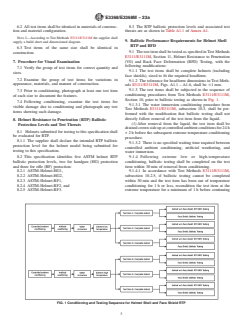
9.1.3 The test items shall be subjected to the sequence of conditioning procedures from Test Methods E3111/E3111M, Section 10,
prior to ballistic testing as shown in Fig. 1.
9.1.3.1 The water immersion conditioning procedure from Test Methods E3111/E3111M, subsection 10.3, shall be performed with
the modification that ballistic testing shall not directly follow removal of the test item from the liquid.
(1) After removal from the liquid, the test item shall be drained crown side up at controlled ambient conditions for 24 h + 2 h
before the subsequent extreme temperature conditioning procedure.
9.1.3.2 There is no specified waiting time required between controlled ambient conditioning, artificial weathering, and water
immersion.
9.1.4 Following extreme low or high-temperature conditioning, ballistic testing shall be completed on the test item within 30 min
of removal from conditioning.
9.1.4.1 In accordance with Test Methods E3111/E3111M, Sectionsubsection 10.2.5, if ballistic testing cannot be completed within
30 min and the test item has been out of temperature conditioning for 1 h or less, recondition the test item at the extreme
FIG. 1 Conditioning and Testing Sequence for Helmet Shell and Face Shield RTP
E3368/E3368M − 23a
temperature for a minimum of 1 h before continuing ballistic testing. If the test item has been out of the temperature conditioning
chamber for more than 1 h, recondition the test item at the extreme temperature for at least 24 h before continuing ballistic testing.
9.2 RTP Performance Requirements:
9.2.1 Each test item shall withstand the required fair hits and shall experience no complete penetrations.
9.2.1.1 For helmet shell tests, a complete penetration occurs when the projectile or a fragment of the projectile passes through the
shell, as evidenced by the presence of that projectile or projectile fragment on, or in, the clay.
9.2.1.2 Nonmetallic material, such as paint, fibrous materials, edging, or edging adhesive that is emitted from the helmet and rests
on the outer surface of the clay impression is not considered a complete penetration.
9.2.2 Any complete penetration by a fair hit shall be considered a failure.
10. Ballistic Performance Requirements for Face Shields
10.1 For helmets that have ballistic-resistant face shields, the test item shall be tested as specified in Test Methods E3111/E3111M,
Section 13, Face Shield Ballistic Testing, with the following modifications:
10.1.1 At least ninesix test items are required per test threat.
10.1.2 The test items shall be face shields that are mounted on helmets.
10.1.3 The For ballistic testing, the helmet shall be clamped in the clamping fixture on each side and the rear of the helmet.
10.1.4 The test items shall be subjected to the sequence of conditioning procedures from Test Methods E3111/E3111M, Section
10, prior to ballistic testing as shown in Fig. 1.
10.1.4.1 The water immersion conditioning procedure from Test Methods E3111/E3111M, subsection 10.3, shall be performed
with the modification that ballistic testing shall not directly follow removal of the test item from the liquid.
(1) After removal from the liquid, the test item shall be drained crown side up at controlled ambient conditions for 24 h + 2 h
before the subsequent extreme temperature conditioning procedure.
10.1.4.2 There is no specified waiting time required between controlled ambient conditioning, artificial weathering, and water
immersion.
10.1.5 Following extreme low or high temperature conditioning, ballistic testing shall be completed on the test item within 30 min
of removal from conditioning.
10.1.5.1 In accordance with Test Methods E3111/E3111M, subsection 10.2.5, if ballistic testing cannot be completed within
30 min and the test item has been out of temperature conditioning for 1 h or less, recondition the test item at the extreme
temperature for a minimum of 1 h before continuing ballistic testing. If the test item has been out of the temperature conditioning
chamber for more than 1 h, recondition the test item at the extreme temperature for at least 24 h before continuing ballistic testing.
10.2 Performance Requirements:
10.2.1 There shall be no complete penetration as evidenced by the projectile or any fragments from the projectile or face shield
being present in the clay witness material.
10.2.2 Face shield deflection shall be less than 30.0 mm [1.18 in.] as evidenced by contact indicator material being present on the
rear of the face shield.
10.2.3 There shall be no visible damage to the face shield attachment points.
E3368/E3368M − 23a
11. Ballistic Performance Requirements for Helmet Shell Ballistic Limit (V50)
11.1 The test item shall be tested as specified in Test Methods E3111/E3111M, Section 12, Helmet Ballistic Limit (V50) Testing,
with the following modifications:
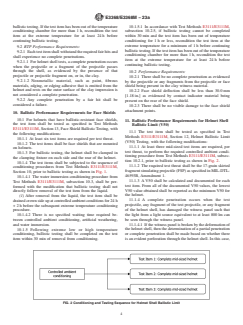
11.1.1 At least five three mid-sized test items are required per available helmet size in the marketplace, per required, per test threat,
to perform the required conditioning procedurescontrolled ambient conditioning procedure from Test Methods E3111/E3111M,
Section 10,subsection 10.2.1, prior to ballistic testing as shown in Fig. 2.
11.1.2 Following extreme low or high temperature conditioning, ballistic testing shall be completed on the test item within 30 min
of removal from conditioning.
11.1.2.1 In accordance with Test Methods E3111/E3111M, Section 10.2.5, if ballistic testing cannot be completed within 30 min
and the test item has been out of conditioning for 1 h or less, recondition the test item for a minimum of 1 h before continuing
ballistic testing. If the test item has been out of the conditioning chamber for more than 1 h, recondition the test item for at least
24 h before continuing ballistic testing.
11.1.2 The required test threat shall be the 17-grain skirted fragment simulating projectile (FSP) as specified in MIL-DTL46593B,
MIL-DTL-46593B, Amendment 1.
11.1.3 A V50 shall be calculated and documented for each helmet size for each conditioning procedure. test item. From all of the
documented V50 values, the lowest V50 value obtained shall be reported as the minimum V50 for the helmet.
11.1.4 A complete penetration occurs when the test projectile, any fragment of the test projectile, or any fragment of the helmet
shell, has damaged the witness panel such that the light from a light source equivalent to at least 800 lumens 800 lm can be seen
through the witness panel.
11.1.4.1 If the witness panel is broken by the deformation of the helmet shell, then the determination of a partial penetration or
complete penetration shall be made based on whether there is an evident perforation through the helmet shell. In this case, the test
laboratory shall determine whether there was a complete penetration. If it is unclear, then the shot will be repeated on the next shot
location.
11.2 Performance Requirements:
11.2.1 There is no minimum V50 requirement.
12. Ballistic Performance Requirements for Fasteners
12.1 The test item shall be tested as specified in Test Methods E3111/E3111M, Section 14, Fastener RTP Testing, with the
following modifications:
12.1.1 The test items shall be submitted in sizes that fit the required headform.
12.1.2 For each unique type of fastener (whether the fastener goes partially into or through the shell), the following shots are
required:
FIG. 2 Conditioning and Testing Sequence for Helmet Shell Ballistic Limit
E3368/E3368M − 23a
12.1.2.1 A single shot is required to be taken on each of three fastener heads (see Test Methods E3111/E3111M, Sectionsubsection
14.3.2). These shots may be taken on more than one helmet, and those helmets may have previously been ballistically tested or
may be untested.
12.1.2.2 A single shot is required to be taken glancing each of three fasteners (see Test Methods E3111/E3111M, Sectionsub-
section 14.3.3). These shots may be taken on one or more helmets, and those helmets may have previously been ballistically tested
or may be untested.
12.1.3 Each test item shall be subjected to controlled ambient conditioning from Test Methods E3111/E3111M, Section 10, prior
to ballistic testing.
12.2 Performance Requirements:
12.2.1 Each test item shall withstand the required number of fair hits and shall experience no complete penetrations as evidenced
by the projectile or any fragments from the projectile or fastener being present in or on the clay witness material. Any complete
penetration by a fair hit constitutes a failure.
12.2.2 Nonmetallic material, such as paint, fibrous materials, edging, or edging adhesive that is emitted from the helmet and rests
on the outer surface of the clay impression is not considered a complete penet
...