

ASTM E3343/E3343M-23
(Test Method)Test Methods for Nonballistic-resistant Helmets Worn by Law Enforcement and Corrections
General Information
- Abstract
SIGNIFICANCE AND USE
4.1 The purpose of these test methods is to provide reliable and repeatable nonballistic test methods and conditioning procedures for the evaluation of head protection used in law enforcement and corrections applications.
4.2 It is anticipated that these test methods will be referenced by certifiers, purchasers, or other users in order to meet their specific needs. Those users will specify which test methods and conditioning procedures are applicable, and will specify any performance categories or levels.
4.3 These test methods include some procedures and references to other standards to ensure that relevant properties are addressed.
SCOPE
1.1 This standard provides nonballistic test methods and conditioning procedures for assessing head protection (that is, helmet and face shield) worn by law enforcement and corrections officers.
1.1.1 Conditioning procedures are included to assess durability in terms of resistance to chemicals and cleaning products, extreme temperatures, weathering, and absorption of liquids.
1.1.2 Test methods are included to assess the protective performance against hazards including impact/bump, projectiles (other than bullets), flame, and liquids.
1.1.3 Test methods are included to assess safety and ergonomic aspects of retention system strength, stability of the helmet on the wearer’s head, corrosion resistance, and face shield visual acuity, field of view, scratch resistance, and anti-mist properties.
Note 1: These test methods reference published standards from ASTM International and other standards developing organizations. Appendix X1 contains a summary of test methods included in this standard, along with the source and purpose for each.
1.2 These test methods do not address eye protection other than face shields that are attached to the helmet.
1.3 It is anticipated that these test methods will be referenced by suppliers, certifiers, purchasers, or other users to meet their specific needs. Those users will specify, in other standards and specifications, which test methods and conditioning procedures are applicable and will specify any performance categories or levels.
1.3.1 If there is a discrepancy between these test methods and a user-supplied document, the user-supplied document shall take precedence.
1.4 In these test methods, “other standards and specifications” and “unless specified elsewhere” refer to documents (for example, military standards, purchase specifications) that require the use of these test methods. Purchasers and other users are responsible for the “other standards and specifications” and for specifying any requirements that supersede those of these test methods.
1.5 Units—The values stated in either SI units or inch-pound units are to be regarded separately as standard. The values stated in each system are not necessarily exact equivalents; therefore, to ensure conformance with the standard, each system shall be used independently of the other, and values from the two systems shall not be combined.
1.6 This standard does not purport to address all of the safety concerns, if any, associated with its use. It is the responsibility of the user of this standard to establish appropriate safety, health, and environmental practices and determine the applicability of regulatory limitations prior to use.
1.7 This international standard was developed in accordance with internationally recognized principles on standardization established in the Decision on Principles for the Development of International Standards, Guides and Recommendations issued by the World Trade Organization Technical Barriers to Trade (TBT) Committee.
- Status
- Published
- Publication Date
- 31-Jan-2023
- Technical Committee
- E54 - Homeland Security Applications
- Drafting Committee
- E54.04 - Public Safety Equipment
Buy Documents
ASTM E3343/E3343M-23 - Test Methods for Nonballistic-resistant Helmets Worn by Law Enforcement and Corrections
REDLINE ASTM E3343/E3343M-23 - Test Methods for Nonballistic-resistant Helmets Worn by Law Enforcement and Corrections
Overview
ASTM E3343/E3343M-23 outlines standardized test methods and conditioning procedures for evaluating the nonballistic protective performance of helmets and face shields worn by law enforcement and corrections personnel. The standard is developed by ASTM International, reflecting globally accepted principles for protective equipment standardization. It ensures that products provide consistent, reliable head protection against nonballistic threats encountered in law enforcement and corrections environments.
The document addresses the assessment of durability, resistance to various environmental conditions, protective capabilities against impacts, flame, liquids, and projectiles (excluding bullets), as well as ergonomic and safety attributes. This comprehensive approach ensures that helmets and attached face shields are tested for practical on-the-job hazards.
Key Topics
Nonballistic Protective Performance
Test methods evaluate helmets for protection against impacts (bump and blunt forces), secondary projectiles, flame, and the effects of liquids, ensuring safety from prevalent, non-firearm threats.Durability and Conditioning
Conditioning procedures evaluate helmet and face shield resistance to chemicals, cleaning agents, temperature extremes, accelerated weathering, and submersion. These procedures assess products’ durability under real-world law enforcement and correctional facility conditions.Ergonomics and Safety Features
The standard includes tests of retention system strength, helmet stability, component corrosion resistance, and comprehensive visual assessments for face shields (visual acuity, field of view, scratch resistance, and anti-mist properties). These aspects ensure both wearer safety and comfort in various operational scenarios.Reference and Integration with Other Standards
ASTM E3343/E3343M-23 references numerous established standards from ASTM, ANSI, CSA, ISO/IEC, NFPA, NIJ, and others, allowing alignment with broader regulatory and procurement requirements.
Applications
ASTM E3343/E3343M-23 is designed to serve a variety of stakeholders in public safety, including:
Law Enforcement and Corrections Agencies
Agencies use the standard to specify requirements for procurement, ensuring that personal protective equipment (PPE) meets rigorous, repeatable nonballistic performance benchmarks.Certification Bodies and Testing Laboratories
Certifiers and independent labs reference ASTM E3343/E3343M-23 to conduct uniform, credible evaluations for helmet and face shield products, supporting product certification and regulatory compliance.PPE Manufacturers and Suppliers
Manufacturers apply these test methods in product development and quality assurance, demonstrating performance to clients and differentiating their offerings.Purchasers and Procurement Specialists
The standard establishes clear, objective criteria for evaluating head protection, supporting transparent, evidence-based purchasing decisions.International and Government Standards Integration
The test methods are suitable for citation by international and government standards, including military and public procurement documents, ensuring global applicability and acceptance.
Related Standards
ASTM E3343/E3343M-23 incorporates and references several related standards, such as:
- ASTM B117, Salt Spray (Fog) Testing
- ASTM F1446, Test Methods for Protective Headgear
- ASTM F2220, Specification for Headforms
- AATCC Test Method 169, Weather Resistance of Textiles
- ANSI Z26.1, Safety Glazing for Motor Vehicles
- CSA Z262.6-14, Facially Featured Headforms
- NIJ 0104.02, Standard for Riot Helmets and Face Shields
- ISO/IEC 17025, General Requirements for Testing Laboratories
These referenced standards reinforce ASTM E3343/E3343M-23 as a comprehensive, interoperable resource for evaluating nonballistic head protection in safety-critical applications.
Keywords: ASTM E3343/E3343M-23, nonballistic helmet test methods, law enforcement head protection standards, corrections helmet testing, PPE standards, face shield performance, helmet durability testing, protective equipment certification.
Relations
- Effective Date
- 01-Apr-2020
- Effective Date
- 01-Oct-2019
- Effective Date
- 01-Nov-2015
- Effective Date
- 01-Nov-2015
- Effective Date
- 01-Nov-2014
- Effective Date
- 01-Jun-2014
- Effective Date
- 01-Dec-2012
- Effective Date
- 01-Nov-2012
- Effective Date
- 01-Jan-2012
- Effective Date
- 15-Dec-2011
- Effective Date
- 15-Dec-2011
- Effective Date
- 15-Dec-2011
- Effective Date
- 15-Dec-2011
- Effective Date
- 01-Oct-2011
- Effective Date
- 01-Apr-2011
Buy Documents
ASTM E3343/E3343M-23 - Test Methods for Nonballistic-resistant Helmets Worn by Law Enforcement and Corrections
REDLINE ASTM E3343/E3343M-23 - Test Methods for Nonballistic-resistant Helmets Worn by Law Enforcement and Corrections
Get Certified
Connect with accredited certification bodies for this standard

CIS Institut d.o.o.
Personal Protective Equipment (PPE) certification body. Notified Body NB-2890 for EU Regulation 2016/425 PPE.

Kiwa BDA Testing
Building and construction product certification.
Kmetijski inštitut Slovenije
Agricultural Institute of Slovenia. Soil testing, plant health, agricultural product analysis.
Sponsored listings
Frequently Asked Questions
ASTM E3343/E3343M-23 is a standard published by ASTM International. Its full title is "Test Methods for Nonballistic-resistant Helmets Worn by Law Enforcement and Corrections". This standard covers: SIGNIFICANCE AND USE 4.1 The purpose of these test methods is to provide reliable and repeatable nonballistic test methods and conditioning procedures for the evaluation of head protection used in law enforcement and corrections applications. 4.2 It is anticipated that these test methods will be referenced by certifiers, purchasers, or other users in order to meet their specific needs. Those users will specify which test methods and conditioning procedures are applicable, and will specify any performance categories or levels. 4.3 These test methods include some procedures and references to other standards to ensure that relevant properties are addressed. SCOPE 1.1 This standard provides nonballistic test methods and conditioning procedures for assessing head protection (that is, helmet and face shield) worn by law enforcement and corrections officers. 1.1.1 Conditioning procedures are included to assess durability in terms of resistance to chemicals and cleaning products, extreme temperatures, weathering, and absorption of liquids. 1.1.2 Test methods are included to assess the protective performance against hazards including impact/bump, projectiles (other than bullets), flame, and liquids. 1.1.3 Test methods are included to assess safety and ergonomic aspects of retention system strength, stability of the helmet on the wearer’s head, corrosion resistance, and face shield visual acuity, field of view, scratch resistance, and anti-mist properties. Note 1: These test methods reference published standards from ASTM International and other standards developing organizations. Appendix X1 contains a summary of test methods included in this standard, along with the source and purpose for each. 1.2 These test methods do not address eye protection other than face shields that are attached to the helmet. 1.3 It is anticipated that these test methods will be referenced by suppliers, certifiers, purchasers, or other users to meet their specific needs. Those users will specify, in other standards and specifications, which test methods and conditioning procedures are applicable and will specify any performance categories or levels. 1.3.1 If there is a discrepancy between these test methods and a user-supplied document, the user-supplied document shall take precedence. 1.4 In these test methods, “other standards and specifications” and “unless specified elsewhere” refer to documents (for example, military standards, purchase specifications) that require the use of these test methods. Purchasers and other users are responsible for the “other standards and specifications” and for specifying any requirements that supersede those of these test methods. 1.5 Units—The values stated in either SI units or inch-pound units are to be regarded separately as standard. The values stated in each system are not necessarily exact equivalents; therefore, to ensure conformance with the standard, each system shall be used independently of the other, and values from the two systems shall not be combined. 1.6 This standard does not purport to address all of the safety concerns, if any, associated with its use. It is the responsibility of the user of this standard to establish appropriate safety, health, and environmental practices and determine the applicability of regulatory limitations prior to use. 1.7 This international standard was developed in accordance with internationally recognized principles on standardization established in the Decision on Principles for the Development of International Standards, Guides and Recommendations issued by the World Trade Organization Technical Barriers to Trade (TBT) Committee.
SIGNIFICANCE AND USE 4.1 The purpose of these test methods is to provide reliable and repeatable nonballistic test methods and conditioning procedures for the evaluation of head protection used in law enforcement and corrections applications. 4.2 It is anticipated that these test methods will be referenced by certifiers, purchasers, or other users in order to meet their specific needs. Those users will specify which test methods and conditioning procedures are applicable, and will specify any performance categories or levels. 4.3 These test methods include some procedures and references to other standards to ensure that relevant properties are addressed. SCOPE 1.1 This standard provides nonballistic test methods and conditioning procedures for assessing head protection (that is, helmet and face shield) worn by law enforcement and corrections officers. 1.1.1 Conditioning procedures are included to assess durability in terms of resistance to chemicals and cleaning products, extreme temperatures, weathering, and absorption of liquids. 1.1.2 Test methods are included to assess the protective performance against hazards including impact/bump, projectiles (other than bullets), flame, and liquids. 1.1.3 Test methods are included to assess safety and ergonomic aspects of retention system strength, stability of the helmet on the wearer’s head, corrosion resistance, and face shield visual acuity, field of view, scratch resistance, and anti-mist properties. Note 1: These test methods reference published standards from ASTM International and other standards developing organizations. Appendix X1 contains a summary of test methods included in this standard, along with the source and purpose for each. 1.2 These test methods do not address eye protection other than face shields that are attached to the helmet. 1.3 It is anticipated that these test methods will be referenced by suppliers, certifiers, purchasers, or other users to meet their specific needs. Those users will specify, in other standards and specifications, which test methods and conditioning procedures are applicable and will specify any performance categories or levels. 1.3.1 If there is a discrepancy between these test methods and a user-supplied document, the user-supplied document shall take precedence. 1.4 In these test methods, “other standards and specifications” and “unless specified elsewhere” refer to documents (for example, military standards, purchase specifications) that require the use of these test methods. Purchasers and other users are responsible for the “other standards and specifications” and for specifying any requirements that supersede those of these test methods. 1.5 Units—The values stated in either SI units or inch-pound units are to be regarded separately as standard. The values stated in each system are not necessarily exact equivalents; therefore, to ensure conformance with the standard, each system shall be used independently of the other, and values from the two systems shall not be combined. 1.6 This standard does not purport to address all of the safety concerns, if any, associated with its use. It is the responsibility of the user of this standard to establish appropriate safety, health, and environmental practices and determine the applicability of regulatory limitations prior to use. 1.7 This international standard was developed in accordance with internationally recognized principles on standardization established in the Decision on Principles for the Development of International Standards, Guides and Recommendations issued by the World Trade Organization Technical Barriers to Trade (TBT) Committee.
ASTM E3343/E3343M-23 is classified under the following ICS (International Classification for Standards) categories: 13.340.20 - Head protective equipment. The ICS classification helps identify the subject area and facilitates finding related standards.
ASTM E3343/E3343M-23 has the following relationships with other standards: It is inter standard links to ASTM E3004-20, ASTM F803-19, ASTM E3004-15, ASTM E3004-15e1, ASTM F2220-14, ASTM F803-14, ASTM F1587-12a, ASTM F2220-12, ASTM F1587-12, ASTM E2771-11e1, ASTM E2771-11e3, ASTM E2771-11, ASTM E2771-11e2, ASTM B117-11, ASTM F803-11. Understanding these relationships helps ensure you are using the most current and applicable version of the standard.
ASTM E3343/E3343M-23 is available in PDF format for immediate download after purchase. The document can be added to your cart and obtained through the secure checkout process. Digital delivery ensures instant access to the complete standard document.
Standards Content (Sample)
This international standard was developed in accordance with internationally recognized principles on standardization established in the Decision on Principles for the
Development of International Standards, Guides and Recommendations issued by the World Trade Organization Technical Barriers to Trade (TBT) Committee.
Designation: E3343/E3343M − 23
Test Methods for
Nonballistic-resistant Helmets Worn by Law Enforcement
and Corrections
This standard is issued under the fixed designation E3343/E3343M; the number immediately following the designation indicates the year
of original adoption or, in the case of revision, the year of last revision. A number in parentheses indicates the year of last reapproval.
A superscript epsilon (´) indicates an editorial change since the last revision or reapproval.
1. Scope are responsible for the “other standards and specifications” and
for specifying any requirements that supersede those of these
1.1 This standard provides nonballistic test methods and
test methods.
conditioning procedures for assessing head protection (that is,
helmet and face shield) worn by law enforcement and correc-
1.5 Units—The values stated in either SI units or inch-
tions officers.
pound units are to be regarded separately as standard. The
1.1.1 Conditioning procedures are included to assess dura-
values stated in each system are not necessarily exact equiva-
bility in terms of resistance to chemicals and cleaning products,
lents; therefore, to ensure conformance with the standard, each
extreme temperatures, weathering, and absorption of liquids.
system shall be used independently of the other, and values
1.1.2 Test methods are included to assess the protective
from the two systems shall not be combined.
performance against hazards including impact/bump, projec-
1.6 This standard does not purport to address all of the
tiles (other than bullets), flame, and liquids.
safety concerns, if any, associated with its use. It is the
1.1.3 Test methods are included to assess safety and ergo-
responsibility of the user of this standard to establish appro-
nomic aspects of retention system strength, stability of the
priate safety, health, and environmental practices and deter-
helmet on the wearer’s head, corrosion resistance, and face
mine the applicability of regulatory limitations prior to use.
shield visual acuity, field of view, scratch resistance, and
anti-mist properties. 1.7 This international standard was developed in accor-
dance with internationally recognized principles on standard-
NOTE 1—These test methods reference published standards from ASTM
ization established in the Decision on Principles for the
International and other standards developing organizations. Appendix X1
Development of International Standards, Guides and Recom-
contains a summary of test methods included in this standard, along with
the source and purpose for each.
mendations issued by the World Trade Organization Technical
1.2 These test methods do not address eye protection other Barriers to Trade (TBT) Committee.
than face shields that are attached to the helmet.
2. Referenced Documents
1.3 It is anticipated that these test methods will be refer-
enced by suppliers, certifiers, purchasers, or other users to meet
2.1 ASTM Standards:
their specific needs. Those users will specify, in other standards
B117 Practice for Operating Salt Spray (Fog) Apparatus
and specifications, which test methods and conditioning pro-
E2771 Terminology for Homeland Security Applications
cedures are applicable and will specify any performance
E3004 Specification for Preparation and Verification of Clay
categories or levels.
Blocks Used in Ballistic-Resistance Testing of Torso Body
1.3.1 If there is a discrepancy between these test methods
Armor
and a user-supplied document, the user-supplied document
F803 Specification for Eye Protectors for Selected Sports
shall take precedence.
F1446 Test Methods for Equipment and Procedures Used in
Evaluating the Performance Characteristics of Protective
1.4 In these test methods, “other standards and specifica-
tions” and “unless specified elsewhere” refer to documents (for Headgear
F1587 Specification for Head and Face Protective Equip-
example, military standards, purchase specifications) that re-
quire the use of these test methods. Purchasers and other users ment for Ice Hockey Goaltenders
F2220 Specification for Headforms
These test methods are under the jurisdiction of ASTM Committee E54 on
Homeland Security Applications and is the direct responsibility of Subcommittee
E54.04 on Public Safety Equipment. For referenced ASTM standards, visit the ASTM website, www.astm.org, or
Current edition approved Feb. 1, 2023. Published March 2023. Originally contact ASTM Customer Service at service@astm.org. For Annual Book of ASTM
approved in 2022. Last previous edition approved in 2022 as E3343/E3343M – 22. Standards volume information, refer to the standard’s Document Summary page on
DOI: 10.1520/E3343_E3343M-23. the ASTM website.
Copyright © ASTM International, 100 Barr Harbor Drive, PO Box C700, West Conshohocken, PA 19428-2959. United States
E3343/E3343M − 23
2.2 AATCC Standards:
AATCC Test Method 169 Weather Resistance of Textiles:
Xenon Lamp Exposure
2.3 ANSI Standards:
ANSI Z26.1 Safety Glazing Materials for Glazing Motor
Vehicles and Motor Vehicle Equipment Operating on Land
Highways - Safety Standard
2.4 CSA Standards:
CAN/CSA Z611-02 Riot Helmets and Face shield Protection
CSA Z262.6-14 Specifications for Facially Featured Head-
forms
2.5 ISO/IEC Standards:
ISO/IEC 17025 General Requirements for the Competence
of Testing and Calibration Laboratories
2.6 NFPA Standards:
NFPA 1981 Standard on Open-circuit Self-contained Breath-
FIG. 1 Anatomical Planes
ing Apparatus (SCBA) for Emergency Services, 2019
2.7 NIJ Standards:
NIJ 0104.02 Standard for Riot Helmets and Face Shields
NIJ 0115.00 Stab Resistance of Personal Body Armor
2.8 SAE Standards:
SAE Recommended Practice J211/1_201403 Instrumenta-
tion for Impact Test - Part 1 - Electronic Instrumentation,
2.9 Other Documents:
Home Office Scientific Development Branch (PSDB) 21/
04 PSDB Protective Headwear Standard for UK Police
(2004), Public Order Helmet
3. Terminology
3.1 Definitions:
3.1.1 basic plane, n—an anatomical plane (Frankfort hori-
FIG. 2 Headform with Locations for Anatomical Planes
zontal plane) that includes the superior rim of the external
auditory meatus (upper edge of the external openings of the
ear) and the inferior margin of the orbit (the lowest point of the
floor of the eye socket) (see Fig. 1 and Fig. 2). 3.1.3 controlled ambient, n—conditions with temperature of
(Test Methods F1446) 20 °C 6 5.5 °C [68 °F 6 10 °F] and 50 % 6 20 % relative
humidity (RH). (Terminology E2771)
3.1.2 conditioning, n—a process that exposes an item, prior
to testing, to a specified controlled environment or physical 3.1.4 coronal plane, n—an anatomical plane perpendicular
stresses, or both. (Terminology E2771) to both the basic and midsagittal planes and passing through
the superior rims of the right and left auditory meatuses; the
transverse plane corresponds to the coronal plane (see Fig. 1
Available from American Association of Textile Chemists and Colorists
and Fig. 2). (Test Methods F1446)
(AATCC), P.O. Box 12215, Research Triangle Park, NC 27709-2215, http://
3.1.5 fair hit, n—a test threat impact (on a test item) that
www.aatcc.org.
Available from American National Standards Institute (ANSI), 25 W. 43rd St., meets all specified requirements in a particular test method.
4th Floor, New York, NY 10036, http://www.ansi.org.
(Terminology E2771)
Available from Canadian Standards Association (CSA), 178 Rexdale Blvd.,
3.1.6 field of vision, n—angle of vision as measured on the
Toronto, ON M9W 1R3, Canada, http://www.csagroup.org.
Available from International Organization for Standardization (ISO), ISO
reference headform (upward, downward, and peripheral).
Central Secretariat, Chemin de Blandonnet 8, CP 401, 1214 Vernier, Geneva,
(Test Methods F1446)
Switzerland, https://www.iso.org.
Available from National Fire Protection Association (NFPA), 1 Batterymarch 3.1.7 helmet, n—a protective device worn on the head in an
Park, Quincy, MA 02169-7471, http://www.nfpa.org.
effort to reduce or minimize injury to that portion of the head
Available from National Institute of Justice (NIJ), 810 7th St., NW, Washington,
that is within an area above the reference plane (as defined in
DC 20531, http://nij.gov.
the individual performance standards). (Test Methods F1446)
Available from SAE International (SAE), 400 Commonwealth Dr., Warrendale,
PA 15096, http://www.sae.org.
3.1.8 helmet position index (HPI), n—the vertical distance
Available from Home Office Direct Communications Unit, 2 Marsham Street,
from the brow of the helmet to the basic plane, when the
London, SW1P 4DF, United Kingdom, http://www.gov.uk/government/
organisations/home-office. helmet is placed on a reference headform; the manufacturer
E3343/E3343M − 23
shall specify the size of the headform and the vertical distance. 6.2 There shall be no variation in construction details
(Test Methods F1446) between individual test items or between any test item and the
supplier’s documentation for a given model.
3.1.9 mid-sagittal plane, n—an anatomical plane perpen-
dicular to the basic plane and containing the midpoint of the
7. Conditioning Requirements
line connecting the notches of the right and left inferior orbital
ridges and the midpoint of the line connecting the superior rims
7.1 Perform a visual inspection of test items both prior to
of the right and left external auditory meatus; the longitudinal
and after conditioning, and record observations and changes in
plane corresponds to the midsagittal plane (see Fig. 1 and Fig.
physical features.
2). (Test Methods F1446)
7.2 When conditioning is required prior to a performance
3.1.10 modular elastomer programmer (MEP), n—a
test involving impact to test items, unless specified elsewhere,
cylindrical-shaped pad used as the impact surface for the the following requirements apply for each type of conditioning:
spherical impactor. (Test Methods F1446)
7.2.1 Once testing begins, the test item shall not be out of
conditioning for more than 5 min at a time and then shall be
3.1.11 reference plane, n—a plane marked on the headforms
returned to conditioning for at least 15 min. There is no limit
at a specified distance above and parallel to the basic plane (see
to the number of times the test item can be returned to
Fig. 2). (Test Methods F1446)
conditioning over the test series.
3.1.12 retention system, n—the complete assembly that
NOTE 2—Each test, taking up to 5 min, is followed by at least 15 min
secures the helmet, in a stable position, on the wearer’s head.
of conditioning.
(Test Methods F1446)
3.1.13 test area, n—the area of the helmet on or above a
8. Temperature and Humidity Conditioning Procedures
specified reference plane, subject to impact or penetration
8.1 Environmental Chamber:
testing. (Test Methods F1446)
8.1.1 The environmental chamber shall be capable of
3.1.14 test item, n—a single article intended for testing.
achieving and maintaining the required temperature and hu-
(Terminology E2771)
midity within the specified tolerances for the duration of the
conditioning procedure.
4. Significance and Use
8.1.2 The monitoring equipment shall include measurement
and recording device(s), independent from the chamber con-
4.1 The purpose of these test methods is to provide reliable
trollers.
and repeatable nonballistic test methods and conditioning
8.1.3 The monitoring equipment shall provide and allow
procedures for the evaluation of head protection used in law
documentation of temperature and relative humidity measure-
enforcement and corrections applications.
ments inside the chamber.
4.2 It is anticipated that these test methods will be refer-
8.2 Controlled Ambient Conditioning:
enced by certifiers, purchasers, or other users in order to meet
8.2.1 Subject each test item to controlled ambient condi-
their specific needs. Those users will specify which test
tions of 20.0 °C 6 5.5 °C [68 °F 6 10 °F] and 50 % 6 20 %
methods and conditioning procedures are applicable, and will
relative humidity (RH) for at least 24 h.
specify any performance categories or levels.
8.3 Extreme Heat Conditioning:
4.3 These test methods include some procedures and refer-
8.3.1 Subject each test item to extreme heat conditioning for
ences to other standards to ensure that relevant properties are
between 24 h and 48 h at 71 °C 6 5.5 °C [160 °F 6 10 °F] and
addressed.
relative humidity of 50 % 6 20 % in a conditioning chamber.
5. Hazards
8.4 Extreme Cold Conditioning:
8.4.1 Subject each test item to extreme cold conditioning for
5.1 The tests described in these test methods have inherent
between 24 h and 48 h at -51 °C 6 5.5 °C [-60 °F 6 10 °F] in
hazards. It is the responsibility of the testing laboratory to
a conditioning chamber.
ensure adequate safeguards for personnel and property when
conducting these tests.
9. Artificial Weathering Conditioning Procedure
6. Test Item Requirements
9.1 Equipment:
9.1.1 The equipment shall be as described in AATCC Test
6.1 The test items to be used for each test method shall be
Method 169.
specified in the test method. For some tests, the helmet shell
alone is the test item while for other tests the test item is the 9.2 Weathering of test items shall be performed in accor-
helmet shell with its hardware, suspension system, and reten-
dance with AATCC Test Method 169 with the modifications
tion system. listed below:
9.2.1 The test apparatus shall be a xenon weatherometer
6.1.1 The face shield shall always be attached to the helmet
shell during face shield testing and shall be in the deployed with reflective panels.
position and locked or secured with supplied hardware, where 9.2.2 The test apparatus shall be equipped with an automatic
available. light monitor and shall be capable of automatically controlling
E3343/E3343M − 23
irradiance, temperature, and humidity. The apparatus shall be 11.1.3.1 The plain water shall be clean and shall be either
maintained in accordance with manufacturer recommenda- potable tap or demineralized water.
tions. 11.1.3.2 The salt water solution shall consist of 3 % by
9.2.3 The weathering cycle shall be a total of 180 min, weight sodium chloride and 0.5 % by weight magnesium
consisting of the following in order: 40 min of light, 20 min of chloride, and be adjusted to a pH of 8.2.
light with water spray on the test item, 60 min of light, and 11.1.3.3 The water shall be replaced anytime there are
60 min of darkness. The cycle shall be repeated until the total visible impurities in the water.
energy exposure is equal to 100 kJ/m , and the weathering 11.1.4 A “20-lb weight” may be used to prevent the test
cycle shall be terminated at that point. item from floating while immersed.
9.2.4 The spectral irradiance level shall be 0.55 W ⁄m /nm
11.2 Test Items:
6 0.01 W ⁄m /nm bandpass at 340 nm.
11.2.1 Each test item shall be a complete helmet, including
9.2.5 The glass filter combination shall be quartz inner filter
the helmet shell, face shield, and retention and suspension
and a borosilicate type “S” outer filter.
systems.
9.2.6 The temperatures and RH shall be as specified in Table
11.2.2 Each test item shall be conditioned according to 8.2,
1.
unless specified elsewhere.
9.3 After the required exposure period, the test items shall
11.3 Procedure:
be removed from the apparatus.
11.3.1 Weigh each test item to the nearest 1 g [0.002 lb]
9.4 Any area of the helmet shell may be tested due to the prior to immersion.
light reflecting off the panels used in the weatherometer. 11.3.2 Immerse the test item(s), with crown pointed down,
in water at a temperature between 16 °C and 26 °C [60 °F and
10. Chemical Exposure Conditioning
80 °F]. Each test item is required to be completely submerged,
with the uppermost part approximately 15 cm [6 in.] beneath
10.1 Equipment and Materials:
the surface of the water.
10.1.1 The chemicals to be used shall be specified by the
11.3.2.1 Test items shall not be stacked atop each other
user of these test methods.
during immersion but may be placed side-by-side.
10.2 The entire exterior of the test item (helmet shell and
11.3.2.2 If necessary to prevent floating while in fluid, place
face shield) shall be treated with at least 25 mL [0.85 oz] of the
a weight on each test item.
chemical. The chemical shall remain on the surface for at least
11.3.3 The test item(s) shall be immersed for 3 h to 4 h.
30 s.
11.3.3.1 Following immersion, allow the test item to drain
10.3 The test item shall be wiped with a clean cloth to crown up for 5 min 6 10 s to shed non-absorbed water before
remove excess chemical.
final weighing. Do not wipe excess moisture from the test item.
11.3.3.2 Promptly weigh the test item to the nearest 1 g
10.4 Subsequent performance tests on the test item shall not
[0.002 lb].
begin within 24 h of the chemical exposure
11.3.3.3 Examine the test item for softening, peeling,
blistering, cracking, or delamination.
11. Conditioning by Submersion in Water
11.3.3.4 Any subsequent performance test shall be com-
11.1 Equipment and Materials:
pleted within 2 h.
11.1.1 Equipment shall consist of a fluid container of
11.4 Documentation:
sufficient size to allow at least one test item of the largest size
11.4.1 The before and after weights, any weight gain, and
to be fully submersed.
observations of degradation shall be documented.
11.1.2 Appropriate range weight scale capable of measuring
to the nearest 0.5 g [0.001 lb] shall be used for weighing test
12. Performance Testing Requirements for Impact Tests
items.
12.1 Fair Hit Requirements:
11.1.3 The water may be either plain water or salt water.
12.1.1 Each impact on a test item shall be within 12.7 mm
[0.5 in.] of the marked impact location.
12.1.2 Each impact on a test item shall be at least 25 mm
TABLE 1 Temperature and Humidity for Weathering Procedure
[1.0 in.] from any attachment points, unless the test method
Dark Cycle Light Cycle
specifies impacting attachment points.
Black Panel 38 °C ± 3 °C 77 °C ± 3 °C
[100 °F ± 5 °F] [171 °F ± 5 °F]
13. Helmet Impact Attenuation Test Method
Conditioning Water 40 °C ± 3 °C 53 °C ± 3 °C 13.1 Equipment and Materials:
[104 °F ± 5 °F] [127 °F ± 5 °F]
13.1.1 Headforms:
13.1.1.1 Headforms shall be Department of Transportation
Wet Bulb Depression 0 °C ± 3 °C 10 °C ± 3 °C
[32 °F ± 5 °F] [50 °F ± 5 °F]
(DOT) MAG.K1A.
RH $ 95 % RH = 50 % ± 5 %
(This does not apply to NOTE 3—The reference plane is typically marked on DOT headforms.
light cycle with water
13.1.1.2 One of the following four headform sizes shall be
spray.)
used: A, B, C, or D.
E3343/E3343M − 23
13.1.1.3 The headform shall be appropriately sized for the
test item and include mountings for accelerometers situated at
the headform center of gravity.
13.1.2 Free Fall Test Setup:
13.1.2.1 The test setup shall consist of a guided free fall
system for a drop assembly and shall have a fixture for
supporting the headform and test item.
13.1.2.2 The headform or the fixture supporting the head-
form shall have an attachment point for the helmet chin strap
that, when tightened, prevents movement of the helmet on the
headform. See Fig. 3 for an example headform with chin strap
attachment point.
13.1.2.3 The drop assembly shall consist of the headform,
the accelerometer, and the supporting fixture. The center of
mass of the drop assembly shall lie within a cone with its axis
vertical and forming a 10° included angle with the vertex at the
point of impact (Test Methods F1446).
13.1.2.4 The supporting fixture shall not affect the measure-
ment of acceleration at the center of gravity of the headform.
13.1.2.5 An example test setup is shown in Fig. 4 (Specifi-
cation F1587).
13.1.3 Velocity Measuring System:
13.1.3.1 A velocity measuring system shall be used and
shall be capable of measuring the velocity of the test item FIG. 4 Example Helmet Impact Attenuation Test Setup
within 50 mm [2 in.] of the top of the test anvil with an
accuracy of 60.1 m/s [0.3 ft/s].
13.1.4 Accelerometer (Test Methods F1446): [6 in.] in diameter and 25 mm [1 in.] in thickness. The MEP
13.1.4.1 A uni-axial accelerometer capable of withstanding shall have a durometer of 60 6 2 Shore “A.” It is affixed to the
a shock of at least 9810 m/s [1000 g] in the headform, with a top surface of a flat, 6.35 mm [0.25-in.] thick aluminum plate.
minimum measuring range of 3923 m/s [0 g to 400 g] 13.1.5.2 A spherical impactor made of low resonance ma-
acceleration with an accuracy of 65 % shall be used. terial (for example, magnesium), aluminum alloy, or stainless
13.1.4.2 The accelerometer data channel, including all in- steel that couples mechanically with the ball arm connector of
strumentation which may alter the frequency content of the test the drop assembly shall be used in place of the headform.
data and all recoding and analysis procedures, shall comply When mounted, the device presents a spherically machined
with SAE Recommended Practice J211/1_201403 require-
impact face with a radius of 73 mm [3 in.] on its bottom
ments for channel class 1000. The minimum data sampling rate surface. All radii from the center of curvature of the impact
shall be 10 kHz. face to its outer edge shall form angles of no less than 40° with
13.1.5 Instrument System Check Equipment (Test Methods the downward vertical axis. The center of curvature shall be
F1446): within 5 mm [0.2 in.] of the vertical axis drawn through the
13.1.5.1 The impact surface for the instrument system check center of the ball arm.
shall be a flat modular elastomer programmer (MEP), 152 mm 13.1.6 Test Anvils (Test Methods F1446):
FIG. 3 Example Headform with Chin Strap Attachment Point
E3343/E3343M − 23
13.1.6.1 Five test anvils may be used:
(1) Flat Anvil—The flat anvil shall have a flat surface of a
minimum 125 mm [5-in.] diameter circle and shall be at least
24 mm [1-in.] thick (see Fig. 5). The anvil shall be made from
B01 tool steel with a hardness level of 54 to 56 HRC.
(2) Triangular Anvil—The triangular anvil shall have a 90°
6 0.5° striking edge with a 0.5 mm to 1.5 mm [0.02-in. to
0.06-in.] radius. The height shall be not less than 50 mm [2 in.],
and the length shall be not less than 200 mm [8 in.] (see Fig.
6). The anvil shall be made from B01 tool steel with a hardness
level of 54 to 56 HRC.
(3) Brick Corner Anvil—The brick corner anvil shall have
dimensions as shown in Fig. 7 and shall be made from B01 tool
steel with a hardness level of 54 to 56 HRC.
(4) Cylindrical Anvil—The cylindrical anvil shall have
FIG. 6 Triangular Anvil
dimensions as shown in Fig. 8 and shall be made from B01 tool
steel with a hardness level of 54 to 56 HRC.
(5) Hemispherical Anvil—The hemispherical anvil shall
have a spherical surface with a radius of 48 mm 6 1 mm
13.3 Instrument System Check (Test Methods F1446):
[1.9 in. 6 0.04 in.]. The spherical surface constitutes one half
13.3.1 The instrument system shall be checked before and
of the surface of a sphere. The anvil shall be made from B01
after each series of tests by dropping the spherical impactor
tool steel with a hardness level of 54 to 56 HRC.
onto the MEP pad at an impact velocity of 5.44 m/s [18 ft/s]
13.1.6.2 The test anvil shall be mounted on a solid block
(62 %).
having a minimum mass of 500 kg [1100 lb].
13.3.2 Impact velocity shall be measured during the last
13.1.6.3 The triangular anvil shall be positioned so that its
50 mm [2.0 in.] of free fall for each test.
long axis is perpendicular to the monorail that supports the
13.3.3 The weight of the drop assembly (which is the
headform, and the brick corner anvil shall be positioned so that
combined weight of the instrumented spherical impactor and
a side edge faces the monorail. See Fig. 9.
supporting assembly) for the drop test shall be 5 kg 6 0.1 kg
13.2 Test Items:
[11 lb 6 0.2 lb].
13.2.1 The user of these test methods shall specify the
13.3.4 Three such impacts, at intervals of 75 s to 90 s, shall
number of test items.
be performed before and after each series of tests.
13.2.1.1 Unless specified elsewhere, two test items of each
13.3.5 The peak acceleration obtained during impact shall
2 2
available helmet size are required.
be 3815 m ⁄s 6 78 m ⁄s [389 g 6 8 g].
13.2.2 Each test item shall be a complete helmet, including
13.3.5.1 If any of the three pre-test drops do not meet the
the helmet shell, retention system, and suspension system. If a
peak acceleration tolerance, checks of the mechanical condi-
face shield and nape guard are present, they shall be removed
tion of the drop system, the calibration of the instruments, and
from the helmet before impact testing.
transducers are required, and the three drops shall be repeated.
13.2.3 Each test item shall be marked with the impact
This process shall be continued until all three drops are within
locations.
tolerance.
13.2.4 The user of these test methods shall specify any
13.3.5.2 If the average peak acceleration obtained in the
conditioning procedures to be performed prior to testing.
three post-test drops differs by more than 5 % from the average
13.2.4.1 Unless specified elsewhere, one of each size test
peak acceleration obtained in the pre-test drops, this shall be
item shall be conditioned according to 8.3, and the other of
documented. The test shall be considered invalid and shall be
each size test item shall be conditioned according to 8.4.
repeated.
13.4 Test Requirements:
13.4.1 The minimum center-to-center impact spacing shall
be half the distance from crown impact to side impact, unless
multiple impacts in a single location are required.
13.4.2 Each test item shall be impacted in each of five
locations: front, side (left or right), back, crown, and a boss
location selected by the testing laboratory.
13.4.2.1 The front impact location shall be on the front
within 50 mm [2 in.] on either side of the midsagittal plane and
within 50 mm to 100 mm [2 in. to 4 in.] from the helmet front
edge or crease forming a brim, whichever is higher, and
ensuring that the shell is only impacted in a single location.
13.4.2.2 The side impact location shall be on the side
FIG. 5 Flat Anvil 50 mm [2 in.] to either side of the coronal plane. The impact
E3343/E3343M − 23
FIG. 7 Brick Corner Anvil (Details taken from PSDB 21/04)
FIG. 8 Cylindrical Anvil (Details taken from PSDB 21/04)
shall be within 50 mm to 100 mm [2 in. to 4 in.] of the 13.4.2.4 The crown impact location shall be at a point
reference plane, ensuring that the shell is only impacted in a
within 25 mm [1 in.] of the intersection of the midsagittal plane
single location.
and the coronal plane.
13.4.2.3 The rear impact location shall be at the rear within
13.4.3 The boss impact location shall be on the opposite
50 mm [2 in.] on either side of the midsagittal plane and within
side of side impact location of 13.4.2.2, approximately 45°
50 mm to 100 mm [2 in. to 4 in.] above the reference plane,
from the coronal plane (towards front or back), and within
ensuring that the shell is only impacted in a single location.
E3343/E3343M − 23
FIG. 9 Test Anvils Positioned Relative to Monorail in Test Setup
50 mm to 100 mm [2 in. to 4 in.] above the reference plane, 14.1.1.1 The test setup shall consist of a free fall system
ensuring that the shell is only impacted in a single location. with a fixture for supporting the headform and test item.
13.4.4 Testing shall begin promptly after the test item is 14.1.2 Striker:
removed from conditioning. 14.1.2.1 The striker shall be cylindrical and have a mass of
3000 g 6 45 g [6.6 lb 6 0.1 lb].
13.5 Procedure:
14.1.2.2 The point of the striker shall be a cone with an
13.5.1 Place the test item on the appropriately sized head-
included angle of 60° 6 0.5°, a height of 38 mm [1.5 in.], and
form so that it is securely fastened and adjusted according to
a tip radius of 0.5 mm 6 0.1 mm [0.02 in. 6 0.004 in.]. The
the manufacturer instructions and helmet positioning index
hardness of the striking tip shall be Rockwell scale-C 60.
(HPI).
14.1.3 Headforms:
13.5.2 Position the test item in the test setup such that the
14.1.3.1 Headforms shall meet the requirements of Specifi-
area to be tested is directly in line with the selected test anvil.
cation F2220.
13.5.3 Adjust the vertical drop height to achieve the re-
quired energy of 120 J.
NOTE 6—The headform may be non-instrumented for this test.
NOTE 4—Energy is specified, instead of velocity, because the drop 14.1.3.2 One of the following six headform sizes shall be
assembly mass changes depending on the headform and helmet. The drop
used: F2220-A, F2220-C, F2220-E, F2220-J, F2220-M, and
assembly is everything that is dropped onto the anvil, including the drop
F2220-O. The selected headform shall be the largest size
arm, components, headform, helmet, etc.
appropriate for each test item.
13.5.4 Deliver the impact to the test item. Record the
14.1.3.3 The headform shall be mounted on an assembly
acceleration-time history and the velocity for each impact.
which permits the headform to be rotated such that different
13.5.4.1 If multiple impacts in the same location are
locations can be impacted.
required, deliver the impacts with 65 s 6 5 s between impacts.
14.1.4 Contact Indicator:
14.1.4.1 A suitable means for verifying the contact between
NOTE 5—The test item may be realigned with the test anvil between
impacts. the striker and the headform shall be used (for example,
electrical contact, witness material).
13.5.5 Repeat all steps for all remaining impact locations
14.1.5 Velocity Measuring System:
for all test items.
14.1.5.1 A velocity measuring system shall be used and
13.6 Documentation:
shall be capable of measuring the velocity of the impactor
13.6.1 The impact velocity and acceleration-time history for
within 50 mm [2 in.] of the helmet surface with an accuracy of
each impact, the test result, and all observations shall be
60.1 m/s [0.3 ft/s].
documented.
14.1.6 An example test setup is provided in Fig. 10.
14. Helmet Shell Penetration Resistance Test
14.2 Test Items:
14.1 Equipment and Materials: 14.2.1 The user of these test methods shall specify the
14.1.1 Free Fall Test Setup: number of test items.
E3343/E3343M − 23
14.4.4 Repeat the above steps for a second location on the
same test item.
14.4.5 Repeat the above steps for all test items.
14.5 Documentation:
14.5.1 For each impact, the drop height, impact location,
impact velocity, any contact between striker and headform, and
all observations shall be documented.
15. Face Shield Deflection and Impact Test Method
15.1 Equipment and Materials:
15.1.1 Free Fall Test Setup:
15.1.1.1 The test setup shall consist of a guided free fall
system with a fixture for supporting the headform and test item,
such that the test item does not touch any other surface.
15.1.2 Velocity Measuring System:
15.1.2.1 A velocity measuring system shall be used and
shall be capable of measuring the velocity of the impactor
within 50 mm [2 in.] of the face shield surface with an
accuracy of 60.1 m/s [0.3 ft/s].
15.1.3 Contact Indicator:
15.1.4 A paste, grease, or other material shall be used to
indicate contact between the face shield and the headform.
15.1.5 Headform:
15.1.5.1 The headform shall be a facially featured headform
as specified in CSA Z262.6-14, having facial features including
FIG. 10 Example Penetration Resistance Test
a nose.
15.1.5.2 The headform shall be size 575 and shall be rigidly
attached in a horizontal face-up orientation to a base having a
14.2.1.1 Unless specified elsewhere, two test items of each
minimum mass of 500 kg [1100 lb].
available helmet size are required.
15.1.5.3 The test headform mounting shall provide for a
14.2.2 Each test item shall be a complete helmet, including
minimum static stiffness of <2 mm [0.1 in.] deflection upon a
the helmet shell, retention system, and suspension system. If a
20 kg [44 lb] static force applied to any opposing side of the
face shield and nape guard are present, they shall be removed
headform.
from the helmet, in accordance with supplier instructions,
15.1.6 Impactor:
before testing.
15.1.6.1 The impactor shall be a steel, constant diameter
14.2.3 The user of these test methods shall specify any
cylinder having a hemispherical end of diameter equal to the
conditioning procedures to be performed prior to testing.
cylinder diameter, and a smooth transition from the hemi-
14.2.3.1 Unless specified elsewhere, one of each size test
spherical end to the cylinder body.
item shall be conditioned according to 8.3, and the other of
each size test item shall be conditioned according to 8.4. 15.1.6.2 The impactor shall have a radius of 25 mm 6 5 mm
[1.0 in. 6 0.2 in.] and a mass of 1.0 kg 6 0.05 kg [2.2 lb 6
m
14.3 Test Requirements:
0.11 lb ].
m
14.3.1 Testing shall begin promptly after the test item is
removed from conditioning.
NOTE 7—The cylindrical impactor defined in Specification E3004 may
be used because it meets the requirements of these test methods.
14.4 Procedure:
14.4.1 Mount the appropriate size headform in the test 15.1.7 An example test setup is shown in Fig. 11.
setup.
15.2 Test Items:
14.4.2 Mount the test item on the headform and securely
15.2.1 The user of these test methods shall specify the
fasten according to the manufacturer instructions.
number of test items.
14.4.2.1 Adjust the vertical drop height between the striker
15.2.1.1 Unless specified elsewhere, four test items sized to
tip and the point of impact on the test item’s outer surface to
fit the headform are required.
achieve the required velocity of 7.6 m ⁄s 6 0.1 m ⁄s [25.0 ft ⁄s 6
15.2.2 The test item is a face shield, which shall be attached
0.3 ft ⁄s].
to the helmet shell, with retention and suspension systems
14.4.2.2 Drop the striker onto the test item anywhere above
installed. The face shield shall be sized to fit the appropriate
the reference plane and at least 75 mm [3 in.] from the center
helmet shell for the specified headform.
of a previous impact location.
14.4.3 Examine the contact indicator to determine whether
NOTE 8—The test item may have been previously subjected to other
contact was made between the striker tip and the headform. testing that did not damage the face shield.
E3343/E3343M − 23
FIG. 11 Example Face Shield Impact Test Setup
15.2.3 Unless specified elsewhere, the face shields of two 15.5.2 Impacts shall be done in the order listed, at (1) the
test items shall be conditioned according to 8.3, and the other headform nose, (2) left-right center of faceshield 2 in. below
two test items shall be conditioned according to 8.4. upper edge, (3) the headform chin, and (4) within 1 in. of an
attachment point between the faceshield and the helmet shell.
15.3 Test Requirements:
15.5.3 Align the test item and headform such that the
15.3.1 Testing shall begin promptly after the test item is
impactor is in the same vertical axis as the intended impact
removed from conditioning.
point.
15.3.2 One hot and one cold test item shall be used for each
15.5.4 Raise the impactor to a drop height between the
procedure.
surface of the face shield and the tip of the impactor so that a
15.4 Face Shield Deflection Test Procedure:
velocity of 7.6 m ⁄s 6 0.1 m ⁄s [25.0 ft ⁄s 6 0.3 ft ⁄s] is achieved
15.4.1 Place the test item on the headform so that it is
at the velocity measurement point.
positioned facing up and is securely fastened and adjusted
15.5.5 Release the impactor allowing it to fall freely.
according to the manufacturer instructions and HPI.
15.5.6 Attempt to raise and lower the face shield.
15.4.2 Apply contact indicator material to the tip of the
15.5.7 Document (1) the velocity of the impactor; (2) any
headform nose.
cracks, chips, indentations, and other visible damage; and (3)
15.4.3 Align the test item and headform such that the
inability of the face shield to be raised and lowered.
impactor is directly above the headform nose.
15.5.8 Repeat 15.5.3 – 15.5.7 for each intended impact
15.4.4 Raise the impactor to a drop height between the
point.
surface of the face shield and the tip of the impactor so that a
15.5.9 Repeat the above steps for each test item.
velocity of 4.7 m ⁄s 6 0.1 m ⁄s [15.4 ft ⁄s 6 0.3 ft ⁄s] is achieved
15.6 Documentation:
at the velocity measurement point.
15.6.1 For each impact, the drop height, velocity, and all
15.4.5 Release the impactor, allowing it to fall freely.
observations shall be documented.
15.4.6 Record velocity of the impactor and document any
contact between the face shield and the headform nose.
16. Face Shield Projectile Resistance Test
15.4.7 Repeat the above steps for the second test item.
16.1 Equipment and Materials:
15.5 Face Shield Impact Procedure:
15.5.1 Mount the test item on the appropriate size headform, 16.1.1 Test Headform:
facing up, and securely fasten according to the manufacturer 16.1.1.1 The headform shall be a facially featured headform
instructions. as specified in CSA Z262.6-14.
E3343/E3343M − 23
16.1.1.2 The headform shall be size 575 and shall be rigidly 16.3.4 Remove the helmet from the headform and examine
mounted within a safety enclosure and be adjustable to enable the test item.
alignment of the propulsion system barrel with the target areas 16.3.5 Repeat the above steps for all test projectiles, using
of the face shield. an unimpacted test item for each type of projectile.
16.1.2 Test Setup: 16.3.6 Repeat the above steps until all test items (both hot-
16.1.2.1 The propulsion system shall be capable of propel- and cold-conditioned) have been tested.
ling the required projectiles at the required velocity and may be 16.3.7 Examine the witness panel for evidence of complete
air-, gas-, or spring-powered. penetration using a light source of at least 800 lm to check for
16.1.3 Velocity Measuring System: visible light through the witness panel.
16.1.3.1 Instrumentation shall be capable of measuring the
16.4 Documentation:
projectile velocity with an accuracy of 62 m/s [6.6 ft/s].
16.4.1 The projectile details and velocities, witness panel
16.1.4 Projectiles:
complete penetrations, and all observations shall be docu-
16.1.4.1 The test projectiles may be any of the commer-
mented.
cially available projectiles shown in Table 2. Also listed in
Table 2 is the velocity +5/-0 m/s [+16.5/-0 ft/s] required for
17. Flammable Liquid Trap Test
each projectile to achieve the intended kinetic energy values.
17.1 Equipment and Materials:
16.1.5 Witness Panel:
17.1.1 Test Setup:
16.1.5.1 A witness panel, approximately 100 mm by
17.1.1.1 A fireproof test chamber shall be used.
150 mm [4 in. by 6 in.], shall be placed between the face shield
17.1.1.2 The headform, with the basic plane horizontal,
and the headform. The witness panel may be made larger, if
shall be mounted on a pedestal such that the lowest part of the
necessary, to catch all fragments from the test item.
helmet being tested does not touch the surface upon which the
16.1.5.2 The witness panel shall be a nominal 0.025 mm
pedestal rests.
[0.001 in.] thick sheet of aluminum foil draped over the face of
17.1.1.3 Absorbent material or a tray may be used to catch
and attached to the headform.
liquid.
16.1.6 An example test setup is shown in Fig. 12.
17.1.2 Flammable Liquid:
16.2 Test Items:
17.1.2.1 A mixture of 5 mL [0.18 oz] iso-octane and 5 mL
16.2.1 The user of these test methods shall specify the
[0.18 oz] toluene shall be used as the flammable liquid.
number of test items.
17.1.3 Headforms:
16.2.2 The test item is a face shield, which shall be attached
17.1.3.1 The headforms shall meet Specification F2220-J.
to the helmet shell, with retention and suspension systems
17.1.3.2 The headform, stand, and surrounding area shall be
installed. The face shield shall be sized to fit the appropriate
manufactured from non-flammable materials.
helmet shell for the specified headform.
17.1.4 Video camera with digital recording.
16.2.3 Unless specified elsewhere, half of the test items
shall be conditioned according to 8.3, and half of the test items 17.2 Test Items:
shall be conditioned according to 8.4. 17.2.1 The user of these test methods shall specify the
number of test items.
16.3 Procedure:
17.2.1.1 Unless specified elsewhere, two test items, sized to
16.3.1 Install the test item on the helmet and affix the helmet
fit the headform, are required.
to the headform so it is positioned and securely fastened
17.2.2 Each test item shall be a complete helmet, including
according to the manufacturer instructions, with the face shield
the helmet shell, face shield, and retention and suspension
deployed.
systems. If the helmet has a nape guard, it shall be installed on
16.3.2 Align the test item with the barrel to impact the left
the helmet.
eye position of the headform and launch a test projectile at the
17.2.3 Unless specified elsewhere, each test item shall be
selected velocity from Table 2 +5/-0 m/s [+16.5/-0 ft/s].
conditioned according to 8.2.
16.3.3 Align the test item with the barrel to impact the right
eye position of the headform and launch a test projectile at the
17.3 Procedure:
selected velocity from Table 2 +5/-0 m/s [+16.5/-0 ft/s]. 17.3.1 Place the test item on the headform so it is securely
fastened and adjusted according to the manufacturer instruc-
tions and HPI.
17.3.1.1 Tuck any excess strapping into the helmet. If this is
TABLE 2 Projectiles for Testing
not feasible, either tuck all strapping into the helmet or cut
Projectile Approximate Velocity Intended Kinetic
away the strapping, being careful not to affect the properties of
Mass Energy
1 the helmet.
⁄2 in. chrome steel ball 8.4 g [0.3 oz] 65 m/s 17.8 to 20.6 J
bearing [164.0 ft/s]
17.3.2 If used, place the absorbent material or tray under
the helmeted headform.
14 mm chrome steel ball 11.2 g [0.4 oz] 45 m/s 11.3 to 14.0 J
17.3.3 Initiate video recording.
bearing [147.6 ft/s]
17.3.4 Perform the following steps within 15 s:
6 mm chrome steel ball 0.9 g [0.03 oz] 200 m/s 18.0 to 18.9 J
17.3.4.1 Pour the flammable liquid over the crown of the
bearing [656.0 ft/s]
helmet ensuring an even coverage over the surface; and
E3343/E3343M − 23
FIG. 12 Example Face Shield Projectile Resistance Test Setup
17.3.4.2 10 s 6 1 s after pouring is complete, ignite the 18.3.1 Orient the head form so that the basic plane is
solvent by applying a flame briefly to the crown of the helmet. horizontal.
Ensure that any liquid shedding from the helmet does not catch
18.3.2 Cover the head form completely with the head
fire.
stocking, secure it in place, and mark the outline of the test
17.3.5 Record, to the nearest second, the time from ignition
item (including nape guard, if present).
to extinguishing of all flames on the helmet.
18.3.3 Affix the test item to the headform so it is positioned
17.3.6 Stop video recording.
and securely fastened as described in the manufacturer instruc-
17.3.7 Examine the exterior and interior of the test item for
tions. The face shield shall be in the down position.
evidence of damage.
18.3.4 Hold the detecting solution spray nozzle approxi-
mately 200 mm [8 in.] from the test item during spraying and
17.4 Documentation:
17.4.1 The time from ignition to extinguishing of flames, deliver approximately 2 mL/s [0.07 oz/s].
evidence of damage, and all observations shall be documented. 18.3.5 Spray the test items with 25 mL [0.8 oz] of detecting
The video recordings shall be part of the test report.
solution from all directions within the area above the reference
plane. The spray shall be normal to the test item surface and be
18. Liquid Penetration Resistance Test
in an area that has a lower bound defined by a plane parallel to
18.1 Equipment and Materials: and 50 mm below the basic plane.
18.1.1 Detecting Solution:
18.3.6 Wipe excess solution from the test item.
18.1.1.1 A solution of 5 g [0.18 oz] red dye powder dis-
18.3.7 Remove the test item from the headform.
solved in 500 mL [0.18 oz] of tap water shall be used as the
18.3.8 Examine the head stocking for any red color above
detecting solution.
the test item outline and take digital photographs of the head
18.1.1.2 The detecting solution shall be dispensed from an
stocking on the headform from enough angles to show all areas
all-purpose spray bottle.
of interest.
18.1.2 Headforms:
18.
...
This document is not an ASTM standard and is intended only to provide the user of an ASTM standard an indication of what changes have been made to the previous version. Because
it may not be technically possible to adequately depict all changes accurately, ASTM recommends that users consult prior editions as appropriate. In all cases only the current version
of the standard as published by ASTM is to be considered the official document.
Designation: E3343/E3343M − 22 E3343/E3343M − 23
Test Methods for
Nonballistic-resistant Helmets Worn by Law Enforcement
and Corrections
This standard is issued under the fixed designation E3343/E3343M; the number immediately following the designation indicates the year
of original adoption or, in the case of revision, the year of last revision. A number in parentheses indicates the year of last reapproval.
A superscript epsilon (´) indicates an editorial change since the last revision or reapproval.
1. Scope
1.1 This standard provides nonballistic test methods and conditioning procedures for assessing head protection (that is, helmet and
face shield) worn by law enforcement and corrections officers.
1.1.1 Conditioning procedures are included to assess durability in terms of resistance to chemicals and cleaning products, extreme
temperatures, weathering, and absorption of liquids.
1.1.2 Test methods are included to assess the protective performance against hazards including impact/bump, projectiles (other
than bullets), flame, and liquids.
1.1.3 Test methods are included to assess safety and ergonomic aspects of retention system strength, stability of the helmet on the
wearer’s head, corrosion resistance, and face shield visual acuity, field of view, scratch resistance, and anti-mist properties.
NOTE 1—These test methods reference published standards from ASTM International and other standards developing organizations. Appendix X1
contains a summary of test methods included in this standard, along with the source and purpose for each.
1.2 These test methods do not address eye protection other than face shields that are attached to the helmet.
1.3 It is anticipated that these test methods will be referenced by suppliers, certifiers, purchasers, or other users to meet their
specific needs. Those users will specify, in other standards and specifications, which test methods and conditioning procedures are
applicable and will specify any performance categories or levels.
1.3.1 If there is a discrepancy between these test methods and a user-supplied document, the user-supplied document shall take
precedence.
1.4 In these test methods, “other standards and specifications” and “unless specified elsewhere” refer to documents (for example,
military standards, purchase specifications) that require the use of these test methods. Purchasers and other users are responsible
for the “other standards and specifications” and for specifying any requirements that supersede those of these test methods.
1.5 Units—The values stated in either SI units or inch-pound units are to be regarded separately as standard. The values stated in
each system are not necessarily exact equivalents; therefore, to ensure conformance with the standard, each system shall be used
independently of the other, and values from the two systems shall not be combined.
These test methods are under the jurisdiction of ASTM Committee E54 on Homeland Security Applications and is the direct responsibility of Subcommittee E54.04 on
Personal Protective Equipment (PPE)Public Safety Equipment.
Current edition approved March 1, 2022Feb. 1, 2023. Published April 2022March 2023. Originally approved in 2022. Last previous edition approved in 2022 as
E3343/E3343MDOI: 10.1520/E3343_E3343M-22. – 22. DOI: 10.1520/E3343_E3343M-23.
Copyright © ASTM International, 100 Barr Harbor Drive, PO Box C700, West Conshohocken, PA 19428-2959. United States
E3343/E3343M − 23
1.6 This standard does not purport to address all of the safety concerns, if any, associated with its use. It is the responsibility
of the user of this standard to establish appropriate safety, health, and environmental practices and determine the applicability of
regulatory limitations prior to use.
1.7 This international standard was developed in accordance with internationally recognized principles on standardization
established in the Decision on Principles for the Development of International Standards, Guides and Recommendations issued
by the World Trade Organization Technical Barriers to Trade (TBT) Committee.
2. Referenced Documents
2.1 ASTM Standards:
B117 Practice for Operating Salt Spray (Fog) Apparatus
E2771 Terminology for Homeland Security Applications
E3004 Specification for Preparation and Verification of Clay Blocks Used in Ballistic-Resistance Testing of Torso Body Armor
F803 Specification for Eye Protectors for Selected Sports
F1446 Test Methods for Equipment and Procedures Used in Evaluating the Performance Characteristics of Protective Headgear
F1587 Specification for Head and Face Protective Equipment for Ice Hockey Goaltenders
F2220 Specification for Headforms
2.2 AATCC Standards:
AATCC Test Method 169 Weather Resistance of Textiles: Xenon Lamp Exposure
2.3 ANSI Standards:
ANSI Z26.1 Safety Glazing Materials for Glazing Motor Vehicles and Motor Vehicle Equipment Operating on Land Highways
- Safety Standard
2.4 CSA Standards:
CAN/CSA Z611-02 Riot Helmets and Face shield Protection
CSA Z262.6-14 Specifications for Facially Featured Headforms
2.5 ISO/IEC Standards:
ISO/IEC 17025 General Requirements for the Competence of Testing and Calibration Laboratories
2.6 NFPA Standards:
NFPA 1981 Standard on Open-circuit Self-contained Breathing Apparatus (SCBA) for Emergency Services, 2019
2.7 NIJ Standards:
NIJ 0104.02 Standard for Riot Helmets and Face Shields
NIJ 0115.00 Stab Resistance of Personal Body Armor
2.8 SAE Standards:
SAE Recommended Practice J211/1_201403 Instrumentation for Impact Test - Part 1 - Electronic Instrumentation, 2014
2.9 Other Documents:
Home Office Scientific Development Branch (PSDB) 21/04 PSDB Protective Headwear Standard for UK Police (2004), Public
Order Helmet
3. Terminology
3.1 Definitions:
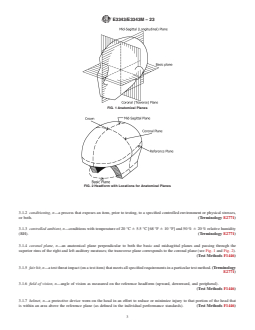
3.1.1 basic plane, n—an anatomical plane (Frankfort horizontal plane) that includes the superior rim of the external auditory
meatus (upper edge of the external openings of the ear) and the inferior margin of the orbit (the lowest point of the floor of the
eye socket) (see Fig. 1 and Fig. 2).
(Test Methods F1446)
For referenced ASTM standards, visit the ASTM website, www.astm.org, or contact ASTM Customer Service at service@astm.org. For Annual Book of ASTM Standards
volume information, refer to the standard’s Document Summary page on the ASTM website.
Available from American Association of Textile Chemists and Colorists (AATCC), P.O. Box 12215, Research Triangle Park, NC 27709-2215, http://www.aatcc.org.
Available from American National Standards Institute (ANSI), 25 W. 43rd St., 4th Floor, New York, NY 10036, http://www.ansi.org.
Available from Canadian Standards Association (CSA), 178 Rexdale Blvd., Toronto, ON M9W 1R3, Canada, http://www.csagroup.org.
Available from International Organization for Standardization (ISO), ISO Central Secretariat, Chemin de Blandonnet 8, CP 401, 1214 Vernier, Geneva, Switzerland,
https://www.iso.org.
Available from National Fire Protection Association (NFPA), 1 Batterymarch Park, Quincy, MA 02169-7471, http://www.nfpa.org.
Available from National Institute of Justice (NIJ), 810 7th St., NW, Washington, DC 20531, http://nij.gov.
Available from SAE International (SAE), 400 Commonwealth Dr., Warrendale, PA 15096, http://www.sae.org.
Available from Home Office Direct Communications Unit, 2 Marsham Street, London, SW1P 4DF, United Kingdom, http://www.gov.uk/government/organisations/
home-office.
E3343/E3343M − 23
FIG. 1 Anatomical Planes
FIG. 2 Headform with Locations for Anatomical Planes
3.1.2 conditioning, n—a process that exposes an item, prior to testing, to a specified controlled environment or physical stresses,
or both. (Terminology E2771)
3.1.3 controlled ambient, n—conditions with temperature of 20 °C 6 5.5 °C [68 °F 6 10 °F] and 50 % 6 20 % relative humidity
(RH). (Terminology E2771)
3.1.4 coronal plane, n—an anatomical plane perpendicular to both the basic and midsagittal planes and passing through the
superior rims of the right and left auditory meatuses; the transverse plane corresponds to the coronal plane (see Fig. 1 and Fig. 2).
(Test Methods F1446)
3.1.5 fair hit, n—a test threat impact (on a test item) that meets all specified requirements in a particular test method. (Terminology
E2771)
3.1.6 field of vision, n—angle of vision as measured on the reference headform (upward, downward, and peripheral).
(Test Methods F1446)
3.1.7 helmet, n—a protective device worn on the head in an effort to reduce or minimize injury to that portion of the head that
is within an area above the reference plane (as defined in the individual performance standards). (Test Methods F1446)
E3343/E3343M − 23
3.1.8 helmet position index (HPI), n—the vertical distance from the brow of the helmet to the basic plane, when the helmet is
placed on a reference headform; the manufacturer shall specify the size of the headform and the vertical distance. (Test Methods
F1446)
3.1.9 mid-sagittal plane, n—an anatomical plane perpendicular to the basic plane and containing the midpoint of the line
connecting the notches of the right and left inferior orbital ridges and the midpoint of the line connecting the superior rims of the
right and left external auditory meatus; the longitudinal plane corresponds to the midsagittal plane (see Fig. 1 and Fig. 2). (Test
Methods F1446)
3.1.10 modular elastomer programmer (MEP), n—a cylindrical-shaped pad used as the impact surface for the spherical impactor.
(Test Methods F1446)
3.1.11 reference plane, n—a plane marked on the headforms at a specified distance above and parallel to the basic plane (see Fig.
2). (Test Methods F1446)
3.1.12 retention system, n—the complete assembly that secures the helmet, in a stable position, on the wearer’s head. (Test
Methods F1446)
3.1.13 test area, n—the area of the helmet on or above a specified reference plane, subject to impact or penetration testing. (Test
Methods F1446)
3.1.14 test item, n—a single article intended for testing. (Terminology E2771)
4. Significance and Use
4.1 The purpose of these test methods is to provide reliable and repeatable nonballistic test methods and conditioning procedures
for the evaluation of head protection used in law enforcement and corrections applications.
4.2 It is anticipated that these test methods will be referenced by certifiers, purchasers, or other users in order to meet their specific
needs. Those users will specify which test methods and conditioning procedures are applicable, and will specify any performance
categories or levels.
4.3 These test methods include some procedures and references to other standards to ensure that relevant properties are addressed.
5. Hazards
5.1 The tests described in these test methods have inherent hazards. It is the responsibility of the testing laboratory to ensure
adequate safeguards for personnel and property when conducting these tests.
6. Test Item Requirements
6.1 The test items shall be eitherto be used (1)for complete helmets with retention and suspension systems, face shields, and
hardware; each test method shall be specified in the test method. (2) helmet shells; (3) face shields; or (4) coupons representing
face shields. For some tests, the helmet shell alone is the test item while for other tests the test item is the helmet shell with its
hardware, suspension system, and retention system.
6.1.1 The face shield shall always be attached to the helmet shell during face shield testing and shall be in the deployed position
and locked or secured with supplied hardware, where available.
6.2 There shall be no variation in construction details between individual test items or between any test item and the supplier’s
documentation for a given model.
E3343/E3343M − 23
7. Conditioning Requirements
7.1 Perform a visual inspection of test items both prior to and after conditioning, and record observations and changes in physical
features.
7.2 When conditioning is required prior to a performance test involving impact to test items, unless specified elsewhere, the
following requirements apply for each type of conditioning:
7.2.1 Once testing begins, the test item shall not be out of conditioning for more than 5 min at a time and then shall be returned
to conditioning for at least 15 min. There is no limit to the number of times the test item can be returned to conditioning over the
test series.
NOTE 2—Each test, taking up to 5 min, is followed by at least 15 min of conditioning.
8. Temperature and Humidity Conditioning Procedures
8.1 Environmental Chamber:
8.1.1 The environmental chamber shall be capable of achieving and maintaining the required temperature and humidity within the
specified tolerances for the duration of the conditioning procedure.
8.1.2 The monitoring equipment shall include measurement and recording device(s), independent from the chamber controllers.
8.1.3 The monitoring equipment shall provide and allow documentation of temperature and relative humidity measurements inside
the chamber.
8.2 Controlled Ambient Conditioning:
8.2.1 Subject each test item to controlled ambient conditions of 20.0 °C 6 5.5 °C [68 °F 6 10 °F] and 50 % 6 20 % relative
humidity (RH) for at least 24 h.
8.3 Extreme Heat Conditioning:
8.3.1 Subject each test item to extreme heat conditioning for between 24 h and 48 h at 71 °C 6 5.5 °C [160 °F 6 10 °F] and
relative humidity of 50 % 6 20 % in a conditioning chamber.
8.4 Extreme Cold Conditioning:
8.4.1 Subject each test item to extreme cold conditioning for between 24 h and 48 h at -51 °C 6 5.5 °C [-60 °F 6 10 °F] in a
conditioning chamber.
9. Artificial Weathering Conditioning Procedure
9.1 Equipment:
9.1.1 The equipment shall be as described in AATCC Test Method 169.
9.2 Weathering of test items shall be performed in accordance with AATCC Test Method 169 with the modifications listed below:
9.2.1 The test apparatus shall be a xenon weatherometer with reflective panels.
9.2.2 The test apparatus shall be equipped with an automatic light monitor and shall be capable of automatically controlling
irradiance, temperature, and humidity. The apparatus shall be maintained in accordance with manufacturer recommendations.
9.2.3 The weathering cycle shall be a total of 180 min, consisting of the following in order: 40 min of light, 20 min of light with
E3343/E3343M − 23
water spray on the test item, 60 min of light, and 60 min of darkness. The cycle shall be repeated until the total energy exposure
is equal to 100 kJ/m , and the weathering cycle shall be terminated at that point.
2 2
9.2.4 The spectral irradiance level shall be 0.55 W ⁄m /nm 6 0.01 W ⁄m /nm bandpass at 340 nm.
9.2.5 The glass filter combination shall be quartz inner filter and a borosilicate type “S” outer filter.
9.2.6 The temperatures and RH shall be as specified in Table 1.
9.3 After the required exposure period, the test items shall be removed from the apparatus.
9.4 Any area of the helmet shell may be tested due to the light reflecting off the panels used in the weatherometer.
10. Chemical Exposure Conditioning
10.1 Equipment and Materials:
10.1.1 The chemicals to be used shall be specified by the user of these test methods.
10.2 The entire exterior of the test item (helmet shell and face shield) shall be treated with at least 25 mL [0.85 oz] of the chemical.
The chemical shall remain on the surface for at least 30 s.
10.3 The test item shall be wiped with a clean cloth to remove excess chemical.
10.4 Subsequent performance tests on the test item shall not begin within 24 h of the chemical exposure
11. Conditioning by Submersion in Water
11.1 Equipment and Materials:
11.1.1 Equipment shall consist of a fluid container of sufficient size to allow at least one test item of the largest size to be fully
submersed.
11.1.2 Appropriate range weight scale capable of measuring to the nearest 0.5 g [0.001 lb] shall be used for weighing test items.
11.1.3 The water may be either plain water or salt water.
11.1.3.1 The plain water shall be clean and shall be either potable tap or demineralized water.
11.1.3.2 The salt water solution shall consist of 3 % by weight sodium chloride and 0.5 % by weight magnesium chloride, and be
adjusted to a pH of 8.2.
11.1.3.3 The water shall be replaced anytime there are visible impurities in the water.
TABLE 1 Temperature and Humidity for Weathering Procedure
Dark Cycle Light Cycle
Black Panel 38 °C ± 3 °C 77 °C ± 3 °C
[100 °F ± 5 °F] [171 °F ± 5 °F]
Conditioning Water 40 °C ± 3 °C 53 °C ± 3 °C
[104 °F ± 5 °F] [127 °F ± 5 °F]
Wet Bulb Depression 0 °C ± 3 °C 10 °C ± 3 °C
[32 °F ± 5 °F] [50 °F ± 5 °F]
RH $ 95 % RH = 50 % ± 5 %
(This does not apply to
light cycle with water
spray.)
E3343/E3343M − 23
11.1.4 A “20-lb weight” may be used to prevent the test item from floating while immersed.
11.2 Test Items:
11.2.1 Each test item shall be a complete helmet, including the helmet shell, face shield, and retention and suspension systems.
11.2.2 Each test item shall be conditioned according to 8.2, unless specified elsewhere.
11.3 Procedure:
11.3.1 Weigh each test item to the nearest 1 g [0.002 lb] prior to immersion.
11.3.2 Immerse the test item(s), with crown pointed down, in water at a temperature between 16 °C and 26 °C [60 °F and 80 °F].
Each test item is required to be completely submerged, with the uppermost part approximately 15 cm [6 in.] beneath the surface
of the water.
11.3.2.1 Test items shall not be stacked atop each other during immersion but may be placed side-by-side.
11.3.2.2 If necessary to prevent floating while in fluid, place a weight on each test item.
11.3.3 The test item(s) shall be immersed for 3 h to 4 h.
11.3.3.1 Following immersion, allow the test item to drain crown up for 5 min 6 10 s to shed non-absorbed water before final
weighing. Do not wipe excess moisture from the test item.
11.3.3.2 Promptly weigh the test item to the nearest 1 g [0.002 lb].
11.3.3.3 Examine the test item for softening, peeling, blistering, cracking, or delamination.
11.3.3.4 Any subsequent performance test shall be completed within 2 h.
11.4 Documentation:
11.4.1 The before and after weights, any weight gain, and observations of degradation shall be documented.
12. Performance Testing Requirements for Impact Tests
12.1 Fair Hit Requirements:
12.1.1 Each impact on a test item shall be within 12.7 mm [0.5 in.] of the marked impact location.
12.1.2 Each impact on a test item shall be at least 25 mm [1.0 in.] from any attachment points, unless the test method specifies
impacting attachment points.
13. Helmet Impact Attenuation Test Method
13.1 Equipment and Materials:
13.1.1 Headforms:
13.1.1.1 Headforms shall be Department of Transportation (DOT) MAG.K1A.
NOTE 3—The reference plane is typically marked on DOT headforms.
13.1.1.2 One of the following four headform sizes shall be used: A, B, C, or D.
E3343/E3343M − 23
13.1.1.3 The headform shall be appropriately sized for the test item and include mountings for accelerometers situated at the
headform center of gravity.
13.1.2 Free Fall Test Setup:
13.1.2.1 The test setup shall consist of a guided free fall system for a drop assembly and shall have a fixture for supporting the
headform and test item.
13.1.2.2 The headform or the fixture supporting the headform shall have an attachment point for the helmet chin strap that, when
tightened, prevents movement of the helmet on the headform. See Fig. 3 for an example headform with chin strap attachment point.
13.1.2.3 The drop assembly shall consist of the headform, the accelerometer, and the supporting fixture. The center of mass of the
drop assembly shall lie within a cone with its axis vertical and forming a 10° included angle with the vertex at the point of impact
(Test Methods F1446).
13.1.2.4 The supporting fixture shall not affect the measurement of acceleration at the center of gravity of the headform.
13.1.2.5 An example test setup is shown in Fig. 4 (Specification F1587).
13.1.3 Velocity Measuring System:
13.1.3.1 A velocity measuring system shall be used and shall be capable of measuring the velocity of the test item within 50 mm
[2 in.] of the top of the test anvil with an accuracy of 60.1 m/s [0.3 ft/s].
13.1.4 Accelerometer (Test Methods F1446):
13.1.4.1 A uni-axial accelerometer capable of withstanding a shock of at least 9810 m/s [1000 g] in the headform, with a
minimum measuring range of 3923 m/s [0 g to 400 g] acceleration with an accuracy of 65 % shall be used.
13.1.4.2 The accelerometer data channel, including all instrumentation which may alter the frequency content of the test data and
all recoding and analysis procedures, shall comply with SAE Recommended Practice J211/1_201403 requirements for channel
class 1000. The minimum data sampling rate shall be 10 kHz.
13.1.5 Instrument System Check Equipment (Test Methods F1446):
13.1.5.1 The impact surface for the instrument system check shall be a flat modular elastomer programmer (MEP), 152 mm [6 in.]
in diameter and 25 mm [1 in.] in thickness. The MEP shall have a durometer of 60 6 2 Shore “A.” It is affixed to the top surface
of a flat, 6.35 mm [0.25-in.] thick aluminum plate.
13.1.5.2 A spherical impactor made of low resonance material (for example, magnesium), aluminum alloy, or stainless steel that
FIG. 3 Example Headform with Chin Strap Attachment Point
E3343/E3343M − 23
FIG. 4 Example Helmet Impact Attenuation Test Setup
couples mechanically with the ball arm connector of the drop assembly shall be used in place of the headform. When mounted,
the device presents a spherically machined impact face with a radius of 73 mm [3 in.] on its bottom surface. All radii from the
center of curvature of the impact face to its outer edge shall form angles of no less than 40° with the downward vertical axis. The
center of curvature shall be within 5 mm [0.2 in.] of the vertical axis drawn through the center of the ball arm.
13.1.6 Test Anvils (Test Methods F1446):
13.1.6.1 Five test anvils may be used:
(1) Flat Anvil—The flat anvil shall have a flat surface of a minimum 125 mm [5-in.] diameter circle and shall be at least 24
mm [1-in.] thick (see Fig. 5). The anvil shall be made from B01 tool steel with a hardness level of 54 to 56 HRC.
(2) Triangular Anvil—The triangular anvil shall have a 90° 6 0.5° striking edge with a 0.5 mm to 1.5 mm [0.02-in. to 0.06-in.]
radius. The height shall be not less than 50 mm [2 in.], and the length shall be not less than 200 mm [8 in.] (see Fig. 6). The anvil
shall be made from B01 tool steel with a hardness level of 54 to 56 HRC.
(3) Brick Corner Anvil—The brick corner anvil shall have dimensions as shown in Fig. 7 and shall be made from B01 tool steel
with a hardness level of 54 to 56 HRC.
(4) Cylindrical Anvil—The cylindrical anvil shall have dimensions as shown in Fig. 8 and shall be made from B01 tool steel
with a hardness level of 54 to 56 HRC.
FIG. 5 Flat Anvil
E3343/E3343M − 23
FIG. 6 Triangular Anvil
(5) Hemispherical Anvil—The hemispherical anvil shall have a spherical surface with a radius of 48 mm 6 1 mm [1.9 in. 6
0.04 in.]. The spherical surface constitutes one half of the surface of a sphere. The anvil shall be made from B01 tool steel with
a hardness level of 54 to 56 HRC.
13.1.6.2 The test anvil shall be mounted on a solid block having a minimum mass of 500 kg [1100 lb].
13.1.6.3 The triangular anvil shall be positioned so that its long axis is perpendicular to the monorail that supports the headform,
and the brick corner anvil shall be positioned so that a side edge faces the monorail. See Fig. 9.
13.2 Test Items:
13.2.1 The user of these test methods shall specify the number of test items.
13.2.1.1 Unless specified elsewhere, two test items of each available helmet size are required.
13.2.2 Each test item shall be a complete helmet, including the helmet shell, retention system, and suspension system. If a face
shield and nape guard are present, they shall be removed from the helmet before impact testing.
13.2.3 Each test item shall be marked with the impact locations.
13.2.4 The user of these test methods shall specify any conditioning procedures to be performed prior to testing.
13.2.4.1 Unless specified elsewhere, one of each size test item shall be conditioned according to 8.3, and the other of each size
test item shall be conditioned according to 8.4.
13.3 Instrument System Check (Test Methods F1446):
13.3.1 The instrument system shall be checked before and after each series of tests by dropping the spherical impactor onto the
MEP pad at an impact velocity of 5.44 m/s [18 ft/s] (62 %).
13.3.2 Impact velocity shall be measured during the last 50 mm [2.0 in.] of free fall for each test.
13.3.3 The weight of the drop assembly (which is the combined weight of the instrumented spherical impactor and supporting
assembly) for the drop test shall be 5 kg 6 0.1 kg [11 lb 6 0.2 lb].
13.3.4 Three such impacts, at intervals of 75 s to 90 s, shall be performed before and after each series of tests.
2 2
13.3.5 The peak acceleration obtained during impact shall be 3815 m ⁄s 6 78 m ⁄s [389 g 6 8 g].
13.3.5.1 If any of the three pre-test drops do not meet the peak acceleration tolerance, checks of the mechanical condition of the
E3343/E3343M − 23
FIG. 7 Brick Corner Anvil (Details taken from PSDB 21/04)
FIG. 8 Cylindrical Anvil (Details taken from PSDB 21/04)
drop system, the calibration of the instruments, and transducers are required, and the three drops shall be repeated. This process
shall be continued until all three drops are within tolerance.
13.3.5.2 If the average peak acceleration obtained in the three post-test drops differs by more than 5 % from the average peak
acceleration obtained in the pre-test drops, this shall be documented. The test shall be considered invalid and shall be repeated.
13.4 Test Requirements:
E3343/E3343M − 23
FIG. 9 Test Anvils Positioned Relative to Monorail in Test Setup
13.4.1 The minimum center-to-center impact spacing shall be half the distance from crown impact to side impact, unless multiple
impacts in a single location are required.
13.4.2 Each test item shall be impacted in each of five locations: front, side (left or right), back, crown, and a boss location
selected by the testing laboratory.
13.4.2.1 The front impact location shall be on the front within 50 mm [2 in.] on either side of the midsagittal plane and within
50 mm to 100 mm [2 in. to 4 in.] from the helmet front edge or crease forming a brim, whichever is higher, and ensuring that the
shell is only impacted in a single location.
13.4.2.2 The side impact location shall be on the side 50 mm [2 in.] to either side of the coronal plane. The impact shall be within
50 mm to 100 mm [2 in. to 4 in.] of the reference plane, ensuring that the shell is only impacted in a single location.
13.4.2.3 The rear impact location shall be at the rear within 50 mm [2 in.] on either side of the midsagittal plane and within 50 mm
to 100 mm [2 in. to 4 in.] above the reference plane, ensuring that the shell is only impacted in a single location.
13.4.2.4 The crown impact location shall be at a point within 25 mm [1 in.] of the intersection of the midsagittal plane and the
coronal plane.
13.4.3 The boss impact location shall be on the opposite side of side impact location of 13.4.2.2, approximately 45° from the
coronal plane (towards front or back), and within 50 mm to 100 mm [2 in. to 4 in.] above the reference plane, ensuring that the
shell is only impacted in a single location.
13.4.4 Testing shall begin promptly after the test item is removed from conditioning.
13.5 Procedure:
13.5.1 Place the test item on the appropriately sized headform so that it is securely fastened and adjusted according to the
manufacturer instructions and helmet positioning index (HPI).
13.5.2 Position the test item in the test setup such that the area to be tested is directly in line with the selected test anvil.
E3343/E3343M − 23
13.5.3 Adjust the vertical drop height to achieve the required energy of 120 J.
NOTE 4—Energy is specified, instead of velocity, because the drop assembly mass changes depending on the headform and helmet. The drop assembly
is everything that is dropped onto the anvil, including the drop arm, components, headform, helmet, etc.
13.5.4 Deliver the impact to the test item. Record the acceleration-time history and the velocity for each impact.
13.5.4.1 If multiple impacts in the same location are required, deliver the impacts with 65 s 6 5 s between impacts.
NOTE 5—The test item may be realigned with the test anvil between impacts.
13.5.5 Repeat all steps for all remaining impact locations for all test items.
E3343/E3343M − 23
13.6 Documentation:
13.6.1 The impact velocity and acceleration-time history for each impact, the test result, and all observations shall be documented.
14. Helmet Shell Penetration Resistance Test
14.1 Equipment and Materials:
14.1.1 Free Fall Test Setup:
14.1.1.1 The test setup shall consist of a free fall system with a fixture for supporting the headform and test item.
14.1.2 Striker:
14.1.2.1 The striker shall be cylindrical and have a mass of 3000 g 6 45 g [6.6 lb 6 0.1 lb].
14.1.2.2 The point of the striker shall be a cone with an included angle of 60° 6 0.5°, a height of 38 mm [1.5 in.], and a tip radius
of 0.5 mm 6 0.1 mm [0.02 in. 6 0.004 in.]. The hardness of the striking tip shall be Rockwell scale-C 60.
14.1.3 Headforms:
14.1.3.1 Headforms shall meet the requirements of Specification F2220.
NOTE 6—The headform may be non-instrumented for this test.
14.1.3.2 One of the following six headform sizes shall be used: F2220-A, F2220-C, F2220-E, F2220-J, F2220-M, and F2220-O.
The selected headform shall be the largest size appropriate for each test item.
14.1.3.3 The headform shall be mounted on an assembly which permits the headform to be rotated such that different locations
can be impacted.
14.1.4 Contact Indicator:
14.1.4.1 A suitable means for verifying the contact between the striker and the headform shall be used (for example, electrical
contact, witness material).
14.1.5 Velocity Measuring System:
14.1.5.1 A velocity measuring system shall be used and shall be capable of measuring the velocity of the impactor within 50 mm
[2 in.] of the helmet surface with an accuracy of 60.1 m/s [0.3 ft/s].
14.1.6 An example test setup is provided in Fig. 10.
14.2 Test Items:
14.2.1 The user of these test methods shall specify the number of test items.
14.2.1.1 Unless specified elsewhere, two test items of each available helmet size are required.
14.2.2 Each test item shall be a complete helmet, including the helmet shell and retention and suspension systems.shell, retention
system, and suspension system. If a face shield and nape guard are present, they shall be removed from the helmet, in accordance
with supplier instructions, before testing.
14.2.3 The user of these test methods shall specify any conditioning procedures to be performed prior to testing.
E3343/E3343M − 23
FIG. 10 Example Penetration Resistance Test
14.2.3.1 Unless specified elsewhere, one of each size test item shall be conditioned according to 8.3, and the other of each size
test item shall be conditioned according to 8.4.
14.3 Test Requirements:
14.3.1 Testing shall begin promptly after the test item is removed from conditioning.
14.4 Procedure:
14.4.1 Mount the appropriate size headform in the test setup.
14.4.2 Mount the test item on the headform and securely fasten according to the manufacturer instructions.
14.4.2.1 Adjust the vertical drop height between the striker tip and the point of impact on the test item’s outer surface to achieve
the required velocity of 7.6 m ⁄s 6 0.1 m ⁄s [25.0 ft ⁄s 6 0.3 ft ⁄s].
14.4.2.2 Drop the striker onto the test item anywhere above the reference plane and at least 75 mm [3 in.] from the center of a
previous impact location.
14.4.3 Examine the contact indicator to determine whether contact was made between the striker tip and the headform.
14.4.4 Repeat the above steps for a second location on the same test item.
14.4.5 Repeat the above steps for all test items.
14.5 Documentation:
E3343/E3343M − 23
14.5.1 For each impact, the drop height, impact location, impact velocity, any contact between striker and headform, and all
observations shall be documented.
15. Face Shield Deflection and Impact Test Method
15.1 Equipment and Materials:
15.1.1 Free Fall Test Setup:
15.1.1.1 The test setup shall consist of a guided free fall system with a fixture for supporting the headform and test item, such that
the test item does not touch any other surface.
15.1.2 Velocity Measuring System:
15.1.2.1 A velocity measuring system shall be used and shall be capable of measuring the velocity of the impactor within 50 mm
[2 in.] of the face shield surface with an accuracy of 60.1 m/s [0.3 ft/s].
E3343/E3343M − 23
15.1.3 Contact Indicator:
15.1.4 A paste, grease, or other material shall be used to indicate contact between the face shield and the headform.
15.1.5 Headform:
15.1.5.1 The headform shall be a facially featured headform as specified in CSA Z262.6-14, having facial features including a
nose.
15.1.5.2 The headform shall be size 575 and shall be rigidly attached in a horizontal face-up orientation to a base having a
minimum mass of 500 kg [1100 lb].
15.1.5.3 The test headform mounting shall provide for a minimum static stiffness of <2 mm [0.1 in.] deflection upon a 20 kg [44
lb] static force applied to any opposing side of the headform.
15.1.6 Impactor:
15.1.6.1 The impactor shall be a steel, constant diameter cylinder having a hemispherical end of diameter equal to the cylinder
diameter, and a smooth transition from the hemispherical end to the cylinder body.
15.1.6.2 The impactor shall have a radius of 25 mm 6 5 mm [1.0 in. 6 0.2 in.] and a mass of 1.0 kg 6 0.05 kg [2.2 lb 6
m
0.11 lb ].
m
NOTE 7—The cylindrical impactor defined in Specification E3004 may be used because it meets the requirements of these test methods.
15.1.7 An example test setup is shown in Fig. 11.
FIG. 11 Example Face Shield Impact Test Setup
E3343/E3343M − 23
15.2 Test Items:
15.2.1 The user of these test methods shall specify the number of test items.
15.2.1.1 Unless specified elsewhere, four test items sized to fit the headform are required.
15.2.2 The test item is a face shield, which shall be attached to the helmet shell, with retention and suspension systems installed.
The face shield shall be sized to fit the appropriate helmet shell for the specified headform.
NOTE 8—The test item may have been previously subjected to other testing that did not damage the face shield.
15.2.3 Unless specified elsewhere, the face shields of two test items shall be conditioned according to 8.3, and the other two test
items shall be conditioned according to 8.4.
15.3 Test Requirements:
15.3.1 Testing shall begin promptly after the test item is removed from conditioning.
15.3.2 One hot and one cold test item shall be used for each procedure.
15.4 Face Shield Deflection Test Procedure:
15.4.1 Place the test item on the headform so that it is positioned facing up and is securely fastened and adjusted according to the
manufacturer instructions and HPI.
15.4.2 Apply contact indicator material to the tip of the headform nose.
15.4.3 Align the test item and headform such that the impactor is directly above the headform nose.
15.4.4 Raise the impactor to a drop height between the surface of the face shield and the tip of the impactor so that a velocity of
4.7 m ⁄s 6 0.1 m ⁄s [15.4 ft ⁄s 6 0.3 ft ⁄s] is achieved at the velocity measurement point.
15.4.5 Release the impactor, allowing it to fall freely.
15.4.6 Record velocity of the impactor and document any contact between the face shield and the headform nose.
15.4.7 Repeat the above steps for the second test item.
15.5 Face Shield Impact Procedure:
15.5.1 Mount the test item on the appropriate size headform, facing up, and securely fasten according to the manufacturer
instructions.
15.5.2 Impacts shall be done in the order listed, at (1) the headform nose, (2) left-right center of faceshield 2 in. below upper edge,
(3) the headform chin, and (4) within 1 in. of an attachment point between the faceshield and the helmet shell.
15.5.3 Align the test item and headform such that the impactor is in the same vertical axis as the intended impact point.
15.5.4 Raise the impactor to a drop height between the surface of the face shield and the tip of the impactor so that a velocity of
7.6 m ⁄s 6 0.1 m ⁄s [25.0 ft ⁄s 6 0.3 ft ⁄s] is achieved at the velocity measurement point.
15.5.5 Release the impactor allowing it to fall freely.
15.5.6 Attempt to raise and lower the face shield.
E3343/E3343M − 23
15.5.7 Document (1) the velocity of the impactor; (2) any cracks, chips, indentations, and other visible damage; and (3) inability
of the face shield to be raised and lowered.
15.5.8 Repeat 15.5.3 – 15.5.7 for each intended impact point.
15.5.9 Repeat the above steps for each test item.
15.6 Documentation:
15.6.1 For each impact, the drop height, velocity, and all observations shall be documented.
16. Face Shield Projectile Resistance Test
16.1 Equipment and Materials:
16.1.1 Test Headform:
16.1.1.1 The headform shall be a facially featured headform as specified in CSA Z262.6-14.
16.1.1.2 The headform shall be size 575 and shall be rigidly mounted within a safety enclosure and be adjustable to enable
alignment of the propulsion system barrel with the target areas of the face shield.
16.1.2 Test Setup:
16.1.2.1 The propulsion system shall be capable of propelling the required projectiles at the required velocity and may be air-,
gas-, or spring-powered.
16.1.3 Velocity Measuring System:
16.1.3.1 Instrumentation shall be capable of measuring the projectile velocity with an accuracy of 62 m/s [6.6 ft/s].
16.1.4 Projectiles:
16.1.4.1 The test projectiles may be any of the commercially available projectiles shown in Table 2. Also listed in Table 2 is the
velocity +5/-0 m/s [+16.5/-0 ft/s] required for each projectile to achieve the intended kinetic energy values.
16.1.5 Witness Panel:
16.1.5.1 A witness panel, approximately 100 mm by 150 mm [4 in. by 6 in.], shall be placed between the face shield and the
headform. The witness panel may be made larger, if necessary, to catch all fragments from the test item.
16.1.5.2 The witness panel shall be a nominal 0.025 mm [0.001 in.] thick sheet of aluminum foil draped over the face of and
attached to the headform.
16.1.6 An example test setup is shown in Fig. 12.
TABLE 2 Projectiles for Testing
Projectile Approximate Velocity Intended Kinetic
Mass Energy
⁄2 in. chrome steel ball 8.4 g [0.3 oz] 65 m/s 17.8 to 20.6 J
bearing [164.0 ft/s]
14 mm chrome steel ball 11.2 g [0.4 oz] 45 m/s 11.3 to 14.0 J
bearing [147.6 ft/s]
6 mm chrome steel ball 0.9 g [0.03 oz] 200 m/s 18.0 to 18.9 J
bearing [656.0 ft/s]
E3343/E3343M − 23
FIG. 12 Example Face Shield Projectile Resistance Test Setup
16.2 Test Items:
16.2.1 The user of these test methods shall specify the number of test items.
16.2.2 The test item is a face shield, which shall be attached to the helmet shell, with retention and suspension systems installed.
The face shield shall be sized to fit the appropriate helmet shell for the specified headform.
16.2.3 Unless specified elsewhere, half of the test items shall be conditioned according to 8.3, and half of the test items shall be
conditioned according to 8.4.
16.3 Procedure:
16.3.1 Install the test item on the helmet and affix the helmet to the headform so it is positioned and securely fastened according
to the manufacturer instructions, with the face shield deployed.
16.3.2 Align the test item with the barrel to impact the left eye position of the headform and launch a test projectile at the selected
velocity from Table 2 +5/-0 m/s [+16.5/-0 ft/s].
16.3.3 Align the test item with the barrel to impact the right eye position of the headform and launch a test projectile at the
selected velocity from Table 2 +5/-0 m/s [+16.5/-0 ft/s].
16.3.4 Remove the helmet from the headform and examine the test item.
16.3.5 Repeat the above steps for all test projectiles, using an unimpacted test item for each type of projectile.
16.3.6 Repeat the above steps until all test items (both hot- and cold-conditioned) have been tested.
16.3.7 Examine the witness panel for evidence of complete penetration using a light source of at least 800 lm to check for visible
light through the witness panel.
16.4 Documentation:
16.4.1 The projectile details and velocities, witness panel complete penetrations, and all observations shall be documented.
17. Flammable Liquid Trap Test
17.1 Equipment and Materials:
17.1.1 Test Setup:
17.1.1.1 A fireproof test chamber shall be used.
E3343/E3343M − 23
17.1.1.2 The headform, with the basic plane horizontal, shall be mounted on a pedestal such that the lowest part of the helmet
being tested does not touch the surface upon which the pedestal rests.
17.1.1.3 Absorbent material or a tray may be used to catch liquid.
17.1.2 Flammable Liquid:
17.1.2.1 A mixture of 5 mL [0.18 oz] iso-octane and 5 mL [0.18 oz] toluene shall be used as the flammable liquid.
17.1.3 Headforms:
17.1.3.1 The headforms shall meet Specification F2220-J.
17.1.3.2 The headform, stand, and surrounding area shall be manufactured from non-flammable materials.
17.1.4 Video camera with digital recording.
17.2 Test Items:
17.2.1 The user of these test methods shall specify the number of test items.
17.2.1.1 Unless specified elsewhere, two test items, sized to fit the headform, are required.
17.2.2 Each test item shall be a complete helmet, including the helmet shell, face shield, and retention and suspension systems.
If the helmet has a nape guard, it shall be installed on the helmet.
17.2.3 Unless specified elsewhere, each test item shall be conditioned according to 8.2.
E3343/E3343M − 23
17.3 Procedure:
17.3.1 Place the test item on the headform so it is securely fastened and adjusted according to the manufacturer instructions and
HPI.
17.3.1.1 Tuck any excess strapping into the helmet. If this is not feasible, either tuck all strapping into the helmet or cut away the
strapping, being careful not to affect the properties of the helmet.
17.3.2 If used, place the absorbent material or tray under the helmeted headform.
17.3.3 Initiate video recording.
17.3.4 Perform the following steps within 15 s:
17.3.4.1 Pour the flammable liquid over the crown of the helmet ensuring an even coverage over the surface; and
17.3.4.2 1010 s 6 1 s after pouring is complete, ignite the solvent by applying a flame briefly to the crown of the helmet. Ensure
that any liquid shedding from the helmet does not catch fire.
17.3.5 Record, to the nearest second, the time from ignition to extinguishing of all flames on the helmet.
17.3.6 Stop video recording.
17.3.7 Examine the exterior and interior of the test item for evidence of damage.
17.4 Documentation:
17.4.1 The time from ignition to extinguishing of flames, evidence of damage, and all observations shall be documented. The
video recordings shall be part of the test report.
18. Liquid Penetration Resistance Test
18.1 Equipment and Materials:
18.1.1 Detecting Solution:
18.1.1.1 A solution of 5 g [0.18 oz] red dye powder dissolved in 500 mL [0.18 oz] of tap water shall be used as the detecting
solution.
18.1.1.2 The detecting solution shall be dispensed from an all-purpose spray bottle.
18.1.
...