

ASTM E3111/E3111M-22
(Test Method)Standard Test Methods for Ballistic Resistant Head Protection
General Information
- Abstract
SIGNIFICANCE AND USE
5.1 U.S. Department of Defense and U.S. Department of Justice standards and specifications may require these test methods for assessing the penetration resistance and backface deformation of ballistic-resistant helmets and face shields.
5.2 These test methods may be used by private-sector and government laboratories, manufacturers, research and development organizations, and others assessing the ballistic resistance of helmets and face shields or performing research and development of new materials.
5.3 It is intended that these test methods will be referenced by other standards and specifications.
SCOPE
1.1 These test methods describe the tests for ballistic-resistant head protection which consists of helmets and face shields. Test methods address backface deformation, resistance to penetration, and ballistic limit. It is anticipated that these test methods will be referenced by purchasers or other users in specifications or performance standards for helmets in order to meet the user’s specific needs.
Note 1: ISO/IEC 17025 specifies the general requirements for the competence to carry out tests or calibrations, or both. It covers testing and calibration performed using standard methods, non-standard methods, and laboratory-developed methods.
1.2 These test methods do not address eye protection other than ballistic-resistant face shields that are attached to the helmet.
1.3 These test methods do not specify performance criteria or usages of the test results.
1.4 These test methods include procedures for conditioning of test items prior to ballistic testing.
1.5 In these test methods, “other standards and specifications” and “unless specified elsewhere” refer to documents (for example, military standards, purchase specifications) that require the use of these test methods. Purchasers and other users are responsible for the “other standards and specifications,” and for specifying any requirements that supersede those of these test methods.
1.5.1 Other standards and specifications will specify and describe the ballistic test threats to be used.
1.6 Units—Values stated in either the International System of Units (metric) or U.S. Customary units (inch-pound) are to be regarded separately as standard. The values stated in each system may not be exact equivalents. Both units are referenced to facilitate acquisition of materials internationally and minimize fabrication costs. Tests conducted using either system maintain repeatability and reproducibility of the test method and results are comparable.
1.7 If there is a discrepancy between these test methods and a user supplied document, the user supplied document takes precedence.
1.8 This standard does not purport to address all of the safety concerns, if any, associated with its use. It is the responsibility of the user of this standard to establish appropriate safety, health, and environmental practices and determine the applicability of regulatory limitations prior to use.
1.9 This international standard was developed in accordance with internationally recognized principles on standardization established in the Decision on Principles for the Development of International Standards, Guides and Recommendations issued by the World Trade Organization Technical Barriers to Trade (TBT) Committee.
- Status
- Published
- Publication Date
- 31-Jul-2022
- Technical Committee
- E54 - Homeland Security Applications
- Drafting Committee
- E54.04 - Public Safety Equipment
Overview
ASTM E3111/E3111M-22: Standard Test Methods for Ballistic Resistant Head Protection is an internationally recognized ASTM standard designed to provide comprehensive procedures for testing ballistic-resistant helmets and face shields. The standard specifies reliable test methods for assessing the penetration resistance, backface deformation, and ballistic limit of head protection equipment. Essential for both military and law enforcement applications, these test methods support performance evaluation, R&D, quality assurance, and regulatory compliance in the field of ballistic protective equipment.
Key Topics
- Penetration Resistance: Test methods for evaluating if a helmet or face shield prevents projectile penetration under specified conditions.
- Backface Deformation (BFD): Procedures to measure the extent of deformation caused on the interior (against a headform with clay backing) during ballistic testing, addressing potential injury risks.
- Ballistic Limit (V50, V0): Procedures for determining the velocity at which helmets resist ballistic threats without penetration or with defined deformation.
- Conditioning Procedures: Standardized pre-test conditioning (temperature extremes, immersion, artificial weathering) to ensure test relevance under realistic use scenarios.
- Test Equipment and Apparatus: Requirements for test fixtures, headforms, witness panels, and measurement devices, such as coordinate measuring machines and weatherometers.
- Fair Hit and Impact Locations: Definitions, minimum and maximum distances for shot placement, and acceptance criteria for valid test results.
- Documentation and Reporting: Requirements for marking test items, scanning impact sites, and recording observations and measurements.
Applications
ASTM E3111/E3111M-22 is critical for a wide range of stakeholders in the security and personal protective equipment (PPE) sectors:
- Defense and Law Enforcement: Used by the U.S. Department of Defense, Department of Justice, and related agencies to ensure compliance with procurement and performance specifications for ballistic helmets and face shields.
- Manufacturers and Testing Laboratories: Enables manufacturers and independent labs to reliably assess helmet and face shield performance, validate design improvements, and support quality control.
- Research and Development: Provides a standardized methodology to compare new materials, constructions, and prototype head protection systems.
- Regulatory and Procurement Bodies: Serves as a reference in drafting technical specifications, certifications, and performance standards for PPE acquisition.
- International Harmonization: By recognizing both metric and inch-pound units and referencing ISO/IEC 17025 competence requirements, the standard ensures global applicability and supports international trade and collaboration.
Related Standards
ASTM E3111/E3111M-22 frequently references and aligns with several related standards for ballistic testing and laboratory practices, including:
- ASTM E3004: Preparation and verification of clay blocks for ballistic-resistance testing.
- ASTM E3062: Specifications for indoor ballistic test ranges for small arms and fragmentation testing.
- NIJ Standard-0106.01: National Institute of Justice standard for ballistic helmets.
- MIL-STD-662F: U.S. military test for armor resistance.
- ISO/IEC 17025: General requirements for competence of testing and calibration laboratories.
- CSA Z262.2-14: Specifications for facially featured headforms used in PPE testing.
- AATCC Test Method 169: Methods for weather resistance testing.
- VPAM HVN 2009: Guidelines for bullet-resistant helmets with visor and neck guard.
Practical Value
Adoption of ASTM E3111/E3111M-22 improves the consistency, reliability, and reproducibility of ballistic helmet and face shield testing. The standard supports innovation in head protection technology, offers guidance for testing in varied environmental conditions, and helps ensure personnel safety by validating product claims with globally accepted methods. Its integration into defense and commercial procurement processes fosters transparency and assurance throughout the supply chain.
Keywords: ballistic helmet testing, face shield testing, penetration resistance, backface deformation, ballistic limit, head protection, ASTM E3111/E3111M-22, PPE compliance, defense helmet standards, laboratory testing methods, international ballistic standards.
Relations
- Effective Date
- 01-Apr-2024
- Effective Date
- 01-Apr-2020
- Effective Date
- 01-Feb-2020
- Effective Date
- 01-May-2019
- Effective Date
- 01-Oct-2018
- Effective Date
- 15-Jul-2016
- Effective Date
- 15-Jul-2016
- Effective Date
- 01-Nov-2015
- Effective Date
- 01-Nov-2015
- Effective Date
- 01-Nov-2015
- Effective Date
- 15-Jul-2008
- Effective Date
- 10-Aug-2003
- Effective Date
- 03-Feb-1999
Get Certified
Connect with accredited certification bodies for this standard

CIS Institut d.o.o.
Personal Protective Equipment (PPE) certification body. Notified Body NB-2890 for EU Regulation 2016/425 PPE.

Kiwa BDA Testing
Building and construction product certification.
Kmetijski inštitut Slovenije
Agricultural Institute of Slovenia. Soil testing, plant health, agricultural product analysis.
Sponsored listings
Frequently Asked Questions
ASTM E3111/E3111M-22 is a standard published by ASTM International. Its full title is "Standard Test Methods for Ballistic Resistant Head Protection". This standard covers: SIGNIFICANCE AND USE 5.1 U.S. Department of Defense and U.S. Department of Justice standards and specifications may require these test methods for assessing the penetration resistance and backface deformation of ballistic-resistant helmets and face shields. 5.2 These test methods may be used by private-sector and government laboratories, manufacturers, research and development organizations, and others assessing the ballistic resistance of helmets and face shields or performing research and development of new materials. 5.3 It is intended that these test methods will be referenced by other standards and specifications. SCOPE 1.1 These test methods describe the tests for ballistic-resistant head protection which consists of helmets and face shields. Test methods address backface deformation, resistance to penetration, and ballistic limit. It is anticipated that these test methods will be referenced by purchasers or other users in specifications or performance standards for helmets in order to meet the user’s specific needs. Note 1: ISO/IEC 17025 specifies the general requirements for the competence to carry out tests or calibrations, or both. It covers testing and calibration performed using standard methods, non-standard methods, and laboratory-developed methods. 1.2 These test methods do not address eye protection other than ballistic-resistant face shields that are attached to the helmet. 1.3 These test methods do not specify performance criteria or usages of the test results. 1.4 These test methods include procedures for conditioning of test items prior to ballistic testing. 1.5 In these test methods, “other standards and specifications” and “unless specified elsewhere” refer to documents (for example, military standards, purchase specifications) that require the use of these test methods. Purchasers and other users are responsible for the “other standards and specifications,” and for specifying any requirements that supersede those of these test methods. 1.5.1 Other standards and specifications will specify and describe the ballistic test threats to be used. 1.6 Units—Values stated in either the International System of Units (metric) or U.S. Customary units (inch-pound) are to be regarded separately as standard. The values stated in each system may not be exact equivalents. Both units are referenced to facilitate acquisition of materials internationally and minimize fabrication costs. Tests conducted using either system maintain repeatability and reproducibility of the test method and results are comparable. 1.7 If there is a discrepancy between these test methods and a user supplied document, the user supplied document takes precedence. 1.8 This standard does not purport to address all of the safety concerns, if any, associated with its use. It is the responsibility of the user of this standard to establish appropriate safety, health, and environmental practices and determine the applicability of regulatory limitations prior to use. 1.9 This international standard was developed in accordance with internationally recognized principles on standardization established in the Decision on Principles for the Development of International Standards, Guides and Recommendations issued by the World Trade Organization Technical Barriers to Trade (TBT) Committee.
SIGNIFICANCE AND USE 5.1 U.S. Department of Defense and U.S. Department of Justice standards and specifications may require these test methods for assessing the penetration resistance and backface deformation of ballistic-resistant helmets and face shields. 5.2 These test methods may be used by private-sector and government laboratories, manufacturers, research and development organizations, and others assessing the ballistic resistance of helmets and face shields or performing research and development of new materials. 5.3 It is intended that these test methods will be referenced by other standards and specifications. SCOPE 1.1 These test methods describe the tests for ballistic-resistant head protection which consists of helmets and face shields. Test methods address backface deformation, resistance to penetration, and ballistic limit. It is anticipated that these test methods will be referenced by purchasers or other users in specifications or performance standards for helmets in order to meet the user’s specific needs. Note 1: ISO/IEC 17025 specifies the general requirements for the competence to carry out tests or calibrations, or both. It covers testing and calibration performed using standard methods, non-standard methods, and laboratory-developed methods. 1.2 These test methods do not address eye protection other than ballistic-resistant face shields that are attached to the helmet. 1.3 These test methods do not specify performance criteria or usages of the test results. 1.4 These test methods include procedures for conditioning of test items prior to ballistic testing. 1.5 In these test methods, “other standards and specifications” and “unless specified elsewhere” refer to documents (for example, military standards, purchase specifications) that require the use of these test methods. Purchasers and other users are responsible for the “other standards and specifications,” and for specifying any requirements that supersede those of these test methods. 1.5.1 Other standards and specifications will specify and describe the ballistic test threats to be used. 1.6 Units—Values stated in either the International System of Units (metric) or U.S. Customary units (inch-pound) are to be regarded separately as standard. The values stated in each system may not be exact equivalents. Both units are referenced to facilitate acquisition of materials internationally and minimize fabrication costs. Tests conducted using either system maintain repeatability and reproducibility of the test method and results are comparable. 1.7 If there is a discrepancy between these test methods and a user supplied document, the user supplied document takes precedence. 1.8 This standard does not purport to address all of the safety concerns, if any, associated with its use. It is the responsibility of the user of this standard to establish appropriate safety, health, and environmental practices and determine the applicability of regulatory limitations prior to use. 1.9 This international standard was developed in accordance with internationally recognized principles on standardization established in the Decision on Principles for the Development of International Standards, Guides and Recommendations issued by the World Trade Organization Technical Barriers to Trade (TBT) Committee.
ASTM E3111/E3111M-22 is classified under the following ICS (International Classification for Standards) categories: 13.340.20 - Head protective equipment. The ICS classification helps identify the subject area and facilitates finding related standards.
ASTM E3111/E3111M-22 has the following relationships with other standards: It is inter standard links to ASTM E3005-24, ASTM E3004-20, ASTM E3005-20, ASTM E3110/E3110M-19, ASTM E3005-18, ASTM E3062-16e1, ASTM E3062-16, ASTM E3004-15, ASTM E3005-15, ASTM E3004-15e1, ASTM D1141-98(2008), ASTM D1141-98(2003), ASTM D1141-98e1. Understanding these relationships helps ensure you are using the most current and applicable version of the standard.
ASTM E3111/E3111M-22 is available in PDF format for immediate download after purchase. The document can be added to your cart and obtained through the secure checkout process. Digital delivery ensures instant access to the complete standard document.
Standards Content (Sample)
This international standard was developed in accordance with internationally recognized principles on standardization established in the Decision on Principles for the
Development of International Standards, Guides and Recommendations issued by the World Trade Organization Technical Barriers to Trade (TBT) Committee.
Designation: E3111/E3111M − 22
Standard Test Methods for
Ballistic Resistant Head Protection
ThisstandardisissuedunderthefixeddesignationE3111/E3111M;thenumberimmediatelyfollowingthedesignationindicatestheyear
of original adoption or, in the case of revision, the year of last revision.Anumber in parentheses indicates the year of last reapproval.
A superscript epsilon (´) indicates an editorial change since the last revision or reapproval.
1. Scope to facilitate acquisition of materials internationally and mini-
mize fabrication costs. Tests conducted using either system
1.1 These test methods describe the tests for ballistic-
maintain repeatability and reproducibility of the test method
resistant head protection which consists of helmets and face
and results are comparable.
shields.Testmethodsaddressbackfacedeformation,resistance
topenetration,andballisticlimit.Itisanticipatedthatthesetest
1.7 Ifthereisadiscrepancybetweenthesetestmethodsand
methods will be referenced by purchasers or other users in
a user supplied document, the user supplied document takes
specifications or performance standards for helmets in order to
precedence.
meet the user’s specific needs.
1.8 This standard does not purport to address all of the
NOTE 1—ISO/IEC 17025 specifies the general requirements for the
safety concerns, if any, associated with its use. It is the
competencetocarryouttestsorcalibrations,orboth.Itcoverstestingand
responsibility of the user of this standard to establish appro-
calibrationperformedusingstandardmethods,non-standardmethods,and
laboratory-developed methods. priate safety, health, and environmental practices and deter-
mine the applicability of regulatory limitations prior to use.
1.2 These test methods do not address eye protection other
1.9 This international standard was developed in accor-
than ballistic-resistant face shields that are attached to the
dance with internationally recognized principles on standard-
helmet.
ization established in the Decision on Principles for the
1.3 These test methods do not specify performance criteria
Development of International Standards, Guides and Recom-
or usages of the test results.
mendations issued by the World Trade Organization Technical
1.4 These test methods include procedures for conditioning
Barriers to Trade (TBT) Committee.
of test items prior to ballistic testing.
1.5 In these test methods, “other standards and specifica-
2. Referenced Documents
tions”and“unlessspecifiedelsewhere”refertodocuments(for
2.1 ASTM Standards:
example, military standards, purchase specifications) that re-
D1141Practice for Preparation of Substitute Ocean Water
quire the use of these test methods. Purchasers and other users
E3004Specification for Preparation andVerification of Clay
are responsible for the “other standards and specifications,”
BlocksUsedinBallistic-ResistanceTestingofTorsoBody
and for specifying any requirements that supersede those of
Armor
these test methods.
E3005Terminology for Body Armor
1.5.1 Other standards and specifications will specify and
E3062Specification for Indoor Ballistic Test Ranges for
describe the ballistic test threats to be used.
Small Arms and Fragmentation Testing of Ballistic-
1.6 Units—Values stated in either the International System
resistant Items
of Units (metric) or U.S. Customary units (inch-pound) are to
E3110/E3110MTest Method for Collection of Ballistic
be regarded separately as standard. The values stated in each
Limit Data for Ballistic-resistant Torso Body Armor and
systemmaynotbeexactequivalents.Bothunitsarereferenced
Shoot Packs
These test methods are under the jurisdiction of ASTM Committee E54 on
Homeland SecurityApplications and are the direct responsibility of Subcommittee
E54.04 on Public Safety Equipment. For referenced ASTM standards, visit the ASTM website, www.astm.org, or
Current edition approved Aug. 1, 2022. Published August 2022. Originally contact ASTM Customer Service at service@astm.org. For Annual Book of ASTM
approved in 2018. Last previous edition approved in 2021 as E3111/E3111M–21. Standards volume information, refer to the standard’s Document Summary page on
DOI: 10.1520/E3111_E3111M-22. the ASTM website.
Copyright © ASTM International, 100 Barr Harbor Drive, PO Box C700, West Conshohocken, PA 19428-2959. United States
E3111/E3111M − 22
2.2 Department of Defense Standards:
MIL-STD-662FV Test for Armor
Test Plan to Qualify a Contractor-selected, Non-contact
Back Face Deformation (BFD) Measurement System Rev
1,Release:November19,2020,U.S.ArmyAberdeenTest
Center
2.3 Other Standards:
AATCC Test Method 169Weather Resistance of Textiles:
Xenon Lamp Exposure
CSA Z262.2-14Specifications for facially featured head-
forms
ISO/IEC 17025General Requirements for the Competence
of Testing and Calibration Laboratories
NIJ Standard-0106.01NIJ Standard for Ballistic Helmets
VPAM HVN 2009: 2017Test Guideline: Bullet-resistant
Helmet with Visor and Neck Guard, Association of Test
Centres for Attack-resistant Materials and Constructions
(VPAM)
3. Terminology
3.1 For terms not defined in these test methods, the follow-
ing definitions of Terminology E3005 apply: backface
FIG. 1 Head Planes
deformation, clay block, conditioning, complete penetration,
controlled ambient, fair hit, obliquity, partial penetration,
shot-to-edge distance, shot-to-shot distance, strike face, test
andotherprotectiveproducts,fastenerspassintoorthroughthe
item, test series, test stand, unfair hit, V,V ,V ,V , and
x 0 05 50
protective material and include such devices as bolts, anchors,
witness panel.
screws, and rivets.
3.2 Definitions of Terms Specific to This Standard:
3.2.4 head protection, n—the ensemble consisting of
3.2.1 basic plane, n—the plane through the centers of the
helmet, face shield, straps, padding, and other accessories
external ear openings and the lower edges of the eye sockets.
designed to protect the user’s head.
3.2.1.1 Discussion—See Fig. 1 for a pictorial representation
3.2.5 mid-sagittal plane, n—the plane, perpendicular to the
of the location of the basic plane.
basic and coronal planes, which symmetrically bisects the
3.2.2 coronal plane, n—theplane,perpendiculartothebasic
head.
and mid-sagittal planes, which passes through the centers of
3.2.5.1 Discussion—SeeFig.1forapictorialrepresentation.
the external ear openings.
3.2.6 reference plane, n—theplane60mm 61mm[2.36in.
3.2.2.1 Discussion—SeeFig.1forapictorialrepresentation.
6 0.04 in.] above and parallel to the basic plane.
3.2.3 fastener, n—ahardwaredevicethatmechanicallyjoins
3.2.6.1 Discussion—SeeFig.1forapictorialrepresentation.
or affixes two or more objects together; for helmets, shields,
4. Summary of Test Methods
4.1 These test methods specify the methods for assessing
Available from U.S. Government Printing Office, Superintendent of
Documents, 732 N. Capitol St., NW, Washington, DC 20401-0001, http:// the penetration resistance, backface deformation, and ballistic
www.access.gpo.gov.
limit for ballistic-resistant helmets and for assessing the
Distribution authorized to the DOD and US DOD contractors only who are
penetration resistance and backface deformation for ballistic-
actively seeking to or are contracted to measure Back Face Deformation on Body
Armor and/or Helmets; November 2020. Other requests for this document shall be resistant face shields.
referred to the Materials & Measurements Test Branch, U.S. Army Aberdeen Test
4.2 A number of individual test items, some mounted on a
Center, 6943 Colleran Road, Building 400, Aberdeen Proving Ground, MD
21005-5059. headform and some clamped in a fixture, are impacted with
Available from American Association of Textile Chemists and Colorists
ballistictestthreats.Thetypeandvelocityofthetestthreatsare
(AATCC), P.O. Box 12215, Research Triangle Park, NC 27709-2215, http://
specifiedinotherstandardsandspecifications,andthequantity
www.aatcc.org.
6 of test items and shot patterns may be specified in other
Available from Canadian Standards Association (CSA), 178 Rexdale Blvd.,
Toronto, ON M9W 1R3, Canada, http://www.csagroup.org.
standards or specifications.
Available from International Organization for Standardization (ISO), ISO
Central Secretariat, BIBC II, Chemin de Blandonnet 8, CP 401, 1214 Vernier,
5. Significance and Use
Geneva, Switzerland, http://www.iso.org.
AvailablefromNationalInstituteofJustice(NIJ),8107thSt.,NW,Washington,
5.1 U.S. Department of Defense and U.S. Department of
DC 20531, http://nij.gov.
Justice standards and specifications may require these test
Available from the Association of Test Centers for Attack-resistant Materials
methods for assessing the penetration resistance and backface
and Constructions (VPAM), Zum Roten Berge 18-24 48165 Münster Germany
https://www.vpam.eu/pruefrichtlinien/aktuell/hvn-2009/. deformation of ballistic-resistant helmets and face shields.
E3111/E3111M − 22
required tolerance will be specified in other standards or specifications. It
5.2 These test methods may be used by private-sector and
isintendedthatadditionalheadformoptionswillbeaddedastheybecome
governmentlaboratories,manufacturers,researchanddevelop-
available.
mentorganizations,andothersassessingtheballisticresistance
(1)Thesetshallincludefiveseparateheadformsfortesting
of helmets and face shields or performing research and
the left, right, front, back, and crown locations, and shall
development of new materials.
include a mold for properly forming the clay in the headform.
5.3 It is intended that these test methods will be referenced
6.5.2 Fortestingthatrequiresaheadform,affixthetestitem
by other standards and specifications.
to the appropriate headform. The headform shall be rigidly
held by the test stand that permits the entire test item and
6. Test Equipment and Apparatus
headform to be shifted vertically and horizontally and to be
6.1 Test item details, including quantity, size, and
tiltedsuchthattheintendedimpactlocationsandanglescanbe
conditioning, shall be specified in other standards and specifi-
accomplished.
cations.
6.5.3 When scanning the headform, use a laser scanner
6.2 The ballistic test range shall meet the requirements of
attached to an articulating arm coordinate measuring machine
Specification E3062.
(LS/AACM) that meets the requirements of Test Plan to
6.3 Some systems for determining yaw are yaw cards, flash
Qualify a Contractor-selected, Non-contact Back Face Defor-
radiograph, or photography. Yaw shall be measured by the
mation (BFD) Measurement System Rev 1.
system to an accuracy of at least 1°.
6.6 For V testing, use a fixture that securely clamps the
6.4 When a backing assembly for validating the clay within
testitematthreepointsonthehelmet,suchastheearflapsand
a headform is required, the backing assembly shall be a clay
a point along the front or back mid-sagittal plane of the test
block and shall have a rigid metal frame with a plywood
item shell. The securing method shall be capable of retaining
bottom. The inside dimensions of the metal frame shall be
the shell and withstanding shock resulting from a ballistic
300mm 6 2 mm [12.0 in. 6 0.08 in.] by 300 mm 62mm
impact. The mount shall be capable of adjustment so that
[12.0in. 6 0.08 in.] with a depth of 100 mm 6 2 mm [4.0 in.
obliquityimpactscanbeachievedanywhereonthetestitem.A
6 0.08in.].The top and bottom edges of the metal frame shall
drawing of an acceptable fixture is located in Appendix X1.
be planar. Attach plywood, of any grade, that is nominally
6.6.1 For opaque test items such as the helmet, the witness
“ ⁄4in.” or “18mm,” to the outside of the frame to form the
panel shall be a 0.50 mm [0.020 in.] thick sheet of 2024-T3,
bottom of the fixture. Prior to attaching the plywood, add a
2024-T4, or 5052 aluminum alloy sheet.
plasticlinerasdefinedinSpecificationE3004.Fillthebacking
® 10
6.6.2 For transparent test items such as the face shield, the
assembly with ROMA Plastilina No. 1 .
witness panel shall be a nominal 0.025 mm [0.001 in.] thick
6.5 Some ballistic test methods require use of a headform.
sheet of aluminum foil.
6.5.1 For helmet shell and face shield testing that requires a
headform, the headform shall be one of the following:
6.7 The temperature conditioning chamber for test items
6.5.1.1 Cadex Model 100_00_HNME that meets the speci- shallbecapableofatemperaturerangeatleast–56°Cto77°C
fications given in the drawings in Annex A1 unless otherwise
[–70°F to 170°F].
directed by another specification or requirements document.
6.8 The immersion conditioning tank shall be capable of
NOTE2—TheCadex Model100_00_HNMEistheheadformcurrently
fully submerging the test items.
used for ballistic testing of helmets to National Institute of Justice and
U.S.Army standards. This headform is commonly referred to as the “NIJ
6.9 The weatherometer test apparatus shall be as defined in
ballistictestingheadform.”Itisintendedthatadditionalheadformoptions
American Association of Textile Chemists and Colorists
will be added as they become available.
(AATCC) Test Method 169.
6.5.1.2 Facially featured headform as specified in CSA
Z262.2-14 and shall be size 575.
7. Hazards
6.5.1.3 Set of “Cadex Ballistic Testing Headforms” or
7.1 The ballistic tests described in these test methods have
equivalently dimensioned headforms that are made from rigid
inherent hazards. Employ adequate safeguards for personnel
material and meet the specifications given in the drawings in
and property when conducting these tests.
Annex A2, unless otherwise directed by another specification
or requirements document.
8. Sampling and Test Items
NOTE 3—The Cadex Ballistic Testing Headforms are the newest
ballistic testing headforms available. The tolerances shown in Figs. 8.1 Thetestitemsshallbehelmetsorfaceshields.Forsome
A2.2-A2.6arenotrequiredtobeaspreciseasisshowninthefigures.The
tests,thehelmetshellaloneisthetestitemwhileforothertests
the test item is the helmet shell with its hardware, suspension
system, and retention system. The face shield will always be
10 ®
U.S. Government standards require ROMAPlastilina No. 1 , from Sculpture
attached to the helmet during face shield testing.
House, Inc., as the backing material for ballistic-resistance testing.
Information on Cadex Model 100_00_HNME headforms can be found at
8.2 Test item details, including quantity, size, and
http://www.cadexinc.com/nij_ballistic.php.
12 conditioning, shall be specified in other standards and specifi-
Information on the Cadex Ballistic Testing Headforms can be found by
contacting Cadex at http://www.cadexinc.com/contact_us.php. cations.
E3111/E3111M − 22
9. Test Requirements morethan44mm[1 ⁄4 in.]measuredfromtheimpactcenterto
the edge of the test item.
9.1 The intended obliquity or other shot direction details, if
9.2.8 A test threat projectile that impacts too close to the
any, for all shots shall be specified in other standards and
edge or to a prior hit, is of too high a velocity, but does not
specifications.
perforate shall be considered a fair hit.
NOTE 4—Typical obliquities are 0°, 30°, and 45°, with most obliquities
9.2.8.1 A test item which is impacted with a high velocity
being 0°.
shot (that is, velocity greater than allowed) that results in
partial penetration and an excessive BFD measurement, that
9.2 Fair Hits:
impact shall be considered an unfair hit, and that shot shall be
9.2.1 Tobeconsideredafairhit,unlessspecifiedelsewhere,
repeatedonasparetestitem.Ifthehighvelocityshotresultsin
each ballistic impact shall meet the requirements listed below.
apartialpenetrationwithanallowableBFDmeasurement,that
Appendix X2 contains a flowchart showing the decision tree.
impact shall be considered a fair hit.
9.2.2 Thetestthreatshallimpactthetestitematanobliquity
9.2.9 If the shot does not meet fair hit requirements due to
within 5° of the intended angle.
excessive velocity, do not use the test item for any subsequent
9.2.3 Verify the test threat yaw within 31 cm [12 in.] of the
testing. The test shall be continued on an identical spare test
test item.Yaw shall be≤3° for rifle threats or≤5° for fragment
item.
and handgun threats. Check yaw for every test threat shot.
9.3 If warmer rounds are needed for weapon or target
9.2.4 For backface deformation (BFD) and resistance to
alignmentorestablishmentofaspecificstrikingvelocity,firea
penetration (RTP) testing, the test threat velocity shall be
test threat through a witness panel to determine the exact point
within the specified range given in other standards and speci-
ofimpact.Thiswitnesspanelcanbeanymaterialthatcaptures
fications. If no specified range is given, the range shall be
the path of the projectile such as cardboard or paper. Fire
required velocity –0m⁄s + 15 m/s [–0ft⁄s + 50 ft/s]. For a test
additional test threats as necessary until the proper alignment
threat having a velocity lower than the specified range with a
and a stable striking velocity have been achieved. The propel-
complete penetration, the impact is considered a fair hit.
lant charge versus velocity curve for the weapon being used
9.2.5 Forallballistictesting,nooverlapofdamage(delami-
should be referred to as a guide for establishing the required
nation)causedbyimpactsisallowed,andthereshallbeatleast
velocity within a practical tolerance.
13 mm [0.5 in.] between damaged areas when inspected
visually.Ifnecessary,multipletestitemsshallbeusedtoallow
NOTE 5—Normally, this tolerance is approximately 68 m/s [625 ft/s].
two impacts in each section without overlapping damage.Any
9.4 Acceptance Criteria for Helmets:
shot, other than a weak point shot, that impacts within 25 mm
9.4.1 A complete penetration for resistance to penetration
[1 in.] of a potential weak point is an unfair hit. See 15.1.4 for
testing shall be specified in other standards and specifications.
details regarding weak points.
9.4.2 The backface deformation limit shall be specified in
9.2.6 Fortestthreatimpactstofasteners,thetestthreatshall
other standards and specifications.
impact the fastener as indicated below.
9.4.3 The V requirements shall be specified in other
9.2.6.1 Fastener Head Shot, 0-degree Obliquity—The shot
standards and specifications.
shall be placed such that the test threat projectile directly
9.5 Acceptance Criteria for Face Shields:
impacts the center of the fastener head. There shall be visual
9.5.1 After each shot, the face shield and witness material
evidence that the center of the fastener was impacted.
shall be inspected to determine if a complete penetration or
9.2.6.2 Fastener Glancing Shot, Slight Angle—The shot
faceshielddeflectionhasoccurred.Unlessspecifiedelsewhere,
shall be lined up at 0-degree obliquity on the fastener head
the acceptance criteria shall be:
center. Then, the headform shall be rotated slightly so that the
9.5.1.1 Thereshallbenocompletepenetrationasevidenced
test threat projectile will impact primarily the ballistic material
by the projectile or any fragments from the projectile or face
and partially the fastener edge. There shall be visual evidence
shield being present in the clay witness material.
that the fastener was impacted.
9.5.1.2 Face shield deflection shall be less than 30.0 mm
9.2.7 The test threat projectile shall impact the test item no
[1.18 in.] as evidenced by contact indicator material being
closer to the edge of the test item than the minimum shot-to-
present on the rear of the face shield.
edge distance and no closer to a prior hit than the minimum
shot-to-shotdistance.Takethemeasurementfromthecenterof
10. Conditioning of Test Items
the projectile impact to the edge of the ballistic material in the
test item or to the center of a previous impact. 10.1 When specific conditioning is required, unless speci-
fied elsewhere, the following conditioning requirements apply
9.2.7.1 Minimum Shot-to-Edge Distance—The minimum
foreachtypeofconditioning.Performavisualinspectionboth
shot-to-edge distance shall be no less than 25 mm [1 in.],
prior to and after conditioning and record any changes.
measured from the impact center to the edge of the test item.
9.2.7.2 Minimum Shot-to-Shot Distance—The minimum
10.2 Temperature Conditioning:
shot-to-shot distance shall be no less than 38 mm [1 ⁄2 in.],
10.2.1 Controlled Ambient Conditioning—Exposetestitems
measured center-to-center, from a prior impact.
to controlled ambient conditions (20°C 6 5.5°C [68°F 6
9.2.7.3 Maximum Shot-to-Edge Distance—For intended 10°F] and 50% 6 20% relative humidity (RH)) for at least
edge shots, the maximum shot-to-edge distance shall be no 24h.
E3111/E3111M − 22
TABLE 1 Temperatures and Humidities for Weathering Procedure
10.2.2 Extreme Heat Conditioning—Subject test items to
extreme heat conditioning for between 24h and 48 h at 71°C Dark Cycle Light Cycle
Black Panel 38 °C ± 3 °C 77 °C ± 3 °C
6 5.5°C [160°F 6 10°F] in a conditioning chamber.
[100 °F ± 5 °F] [171 °F ± 5 °F]
10.2.3 Extreme Cold Conditioning—Subject test items to
Conditioning 40°C±3°C[104°F±5°F] 53°C±3°C[127°F±5°F]
extremecoldconditioningforbetween24hand48hat–51°C
Water
6 5.5°C [–60°F 6 10°F] in a conditioning chamber.
10.2.4 At the end of each temperature conditioning activity, Wet Bulb 0°C±3°C[32°F±5°F] 10°C±3°C[50°F±5°F]
Depression RH$95 % RH=50%±5%
remove the test item(s) from the conditioning chamber and
(This does not apply to light
complete ballistic testing within 30 min of removal from the
cycle with water spray.)
conditioning chamber.
10.2.5 Ifballistictestingcannotbecompletedwithin30min
and the test item has been out of conditioning for 1 h or less,
recondition the test item for a minimum of 1 h. If the test item
10.4.2 After the required exposure period, the test items
has been out of the conditioning chamber for more than 1 h,
shallberemovedfromtheapparatus.Completeballistictesting
recondition the test item for at least 24 h.
within 96 h after completion of weathering.
10.3 Water Immersion Conditioning:
10.4.3 Anyareaofthehelmetshellmaybetestedduetothe
10.3.1 Expose complete test items, including the shell,
light reflecting off the panels used in the weatherometer.
hardware, suspension system, and retention system, to con-
trolled ambient temperature for a minimum of 3 h prior to
11. Helmet Resistance to Penetration (V ) and Backface
immersion in water. (See 10.2.1 for the controlled ambient
Deformation (BFD) Testing
temperature.)
11.1 Test item details, including quantity, size, and
10.3.2 Completelysubmergecompletetestitemsinwaterat
conditioning, shall be specified in other standards and specifi-
controlled ambient temperature for 3 h to 4 h. After
cations.
submersion, remove the test item, drain crown side up at
11.2 Test Items:
controlled ambient, and ballistically test. Complete ballistic
11.2.1 The test item shall be a complete helmet, including
testing within 24h 6 2 h after removal from the liquid.
the shell, hardware, suspension system, and retention system,
10.3.2.1 The water may be either plain water or salt water.
and the test item shall be mounted on a headform for testing.
Thewatershallbereplacedanytimetherearevisibleimpurities
The quantity of test items and other relevant test item details
in the water.
are specified in other standards or specifications. If the helmet
(1)The plain water shall be clean and shall be either
has a face shield, remove it prior to testing.
potable tap or demineralized water.
11.2.2 When the Cadex headform is specified for testing,
(2)The saltwater solution shall be as specified in Practice
only size large (nominally size 7 ⁄4, 58 cm) helmets shall be
D1141.
used.
10.3.3 A weight may be used to prevent the test item from
11.3 Test Item Marking:
floating while immersed.
11.3.1 Locate the internal crown benchmark on the shell,
10.4 Artificial Weathering Conditioning:
transpose to the external location, and mark the external
10.4.1 Perform weathering of test items in accordance with
location.Ifthereisnobenchmarkonthecrown,theneitherthe
AATCC Test Method 169 with the modifications listed below:
approximate center of the crown may be used or an alternate
10.4.1.1 The test apparatus shall be a xenon weatherometer
means may be used as specified in other standards or specifi-
with reflective panels. cations. Record the procedure used in the test report. Draw an
10.4.1.2 Equip the test apparatus with an automatic light approximately 127 mm [5 in.] diameter circle on the shell
usingtheexternalcrownbenchmarkasthecenter.Refrainfrom
monitor and that is capable of automatically controlling
irradiance, temperature, and humidity. placinganysharporpointedobjectonthetestitem.Makesure
all points are blunted.
10.4.1.3 The apparatus shall be maintained in accordance
11.3.2 Mark the 45°, 135°, 225°, and 315° positions of the
with manufacturer recommendations.
ring on the shell as shown in Fig. 2.
10.4.1.4 The weathering cycle shall be a total of 180 min,
11.3.3 Draw permanent lines that are aligned with the 45°,
consisting of the following in order: 40 min of light, 20 min of
135°,225°,and315°marksandtheexternalcrownbenchmark
light with water spray on to the test item, 60 min of light, and
but only extend from the edge of the shell to a point on the
60 min of darkness. Repeat the cycle until the total energy
circle.
exposure is equal to 100 kJ/m .Terminate the weather cycle at
that point.
11.4 Test Threats:
11.4.1 Test threats and velocities to be used shall be
10.4.1.5 The spectral irradiance level shall be
2 2
specified in other standards and specifications.
0.55W⁄m /nm 6 0.01 W/m /nm bandpass at 340 nm.
10.4.1.6 The glass filter combination shall be quartz inner
11.5 Headform Preparation:
filter and a borosilicate type “S” outer filter.
11.5.1 The headform shall be a Cadex Model 100_00_
10.4.1.7 SetthetemperatureandRHasspecifiedinTable1. HNME headform.
E3111/E3111M − 22
FIG. 2 Location of Helmet Sections ®
11.5.2 Use ROMA Plastilina No. 1 modeling clay as the 11.6 Clay Block and Headform Conditioning:
backingmaterialintheheadformtomakeBFDmeasurements,
11.6.1 Prepare one clay block according to Specification
preparing the headform as follows:
E3004, with the exception that the size of the clay block shall
11.5.2.1 Fill the bottom of the headform with one layer of
be as described in 6.4 of these test methods. ®
small flat thumb-sized pieces of ROMAPlastilina No. 1 clay.
11.6.2 Place the clay block and up to eight prepared
11.5.2.2 Usingthumbandfingers,blendeachpiecetogether
headforms in the conditioning chamber with the headforms
and work any voids and air bubbles to the outside of the
surrounding the clay block such that all clay in each headform
channels.
is within 304.8 mm [12 in.] of the nearest edge of the clay
11.5.2.3 Continuetoaddlayersofclaytotheheadformuntil
block (refer to Fig. 3).
the headform is filled with clay. Make sure the clay extends
slightly beyond the outside surface of the headform.
FIG. 3 Illustration of Clay Block-Headform Position During Conditioning
E3111/E3111M − 22
NOTE 6—The orientation of the headforms during conditioning is not
11.8.3.2 To shape the clay along the mid-sagittal channel,
significant.
use the mid-sagittal contour shaping tool to create a smooth
11.6.3 Heat each clay block and headform(s) such that the claysurfacethattransitionsuninterruptedtotheheadform.Use
clay will pass the verification drops listed in 11.7 according to the contour shaping tool to shape the entire mid-sagittal
the requirements below: channel, including the top where the mid-sagittal and coronal
11.6.3.1 New clay blocks and new headforms shall be planes intersect.
heated for at least 24 h.
NOTE 9—There is no specified order of the steps for using the contour
11.6.3.2 Anyclayblockorheadformthathasbeenoutofthe
shaping tools.
conditioning chamber shall be reheated for no less than 3 h.
11.8.3.3 To ensure that clay at the crown surface has been
11.6.3.3 Anyclayblockorheadformthathasbeenoutofthe
shaped to the contour of the headform, use the crown verifi-
conditioningchamberformorethan1hshallbereheatedforat
cation tool on the headform.
least three times the time out of the chamber. If the time
11.8.3.4 There shall be no gaps between the clay and the
requiredexceeds24h,therequirementfornewclayblocksand
tool.Ifgapsexist,addclayfromtheconditioningchamber,and
headforms applies.
repeat 11.8.3.
11.6.3.4 While 24 h is the maximum time required for
11.8.3.5 When the tool is removed, there shall be no marks
reheatinganyclayblockorheadform,aclayblockorheadform
or grooves left in the clay. If marks or grooves exist, repeat
may remain in the chamber indefinitely.
11.8.3.
11.7 Verification of the Clay Block and Headforms:
11.9 Repair of Clay-filled Headform:
11.7.1 Verify the clay block and headforms per Specifica-
11.9.1 After ballistic testing on the headform is complete,
tion E3004, with the following exceptions:
repair the headform using small pieces of clay that have been
11.7.1.1 Instead of using the impact location template of
temperatureconditionedthesameastheheadform.Ensurethat
Specification E3004, the impact locations shall be at least
the clay is sufficiently built up to extend slightly beyond the
76mm [3 in.] from the closest edge of the clay block when
surfaceoftheheadform.Returntheheadformtothecondition-
measured from the edge of the indentation. Allow at least
...
This document is not an ASTM standard and is intended only to provide the user of an ASTM standard an indication of what changes have been made to the previous version. Because
it may not be technically possible to adequately depict all changes accurately, ASTM recommends that users consult prior editions as appropriate. In all cases only the current version
of the standard as published by ASTM is to be considered the official document.
Designation: E3111/E3111M − 21 E3111/E3111M − 22
Standard Test Methods for
Ballistic Resistant Head Protection
This standard is issued under the fixed designation E3111/E3111M; the number immediately following the designation indicates the year
of original adoption or, in the case of revision, the year of last revision. A number in parentheses indicates the year of last reapproval.
A superscript epsilon (´) indicates an editorial change since the last revision or reapproval.
1. Scope
1.1 These test methods describe the tests for ballistic-resistant head protection which consists of helmets and face shields. Test
methods address backface deformation, resistance to penetration, and ballistic limit. It is anticipated that these test methods will
be referenced by purchasers or other users in specifications or performance standards for helmets in order to meet the user’s specific
needs.
NOTE 1—ISO/IEC 17025 specifies the general requirements for the competence to carry out tests or calibrations, or both. It covers testing and calibration
performed using standard methods, non-standard methods, and laboratory-developed methods.
1.2 These test methods do not address eye protection other than ballistic-resistant face shields that are attached to the helmet.
1.3 These test methods do not specify performance criteria or usages of the test results.
1.4 These test methods include procedures for conditioning of test items prior to ballistic testing.
1.5 In these test methods, “other standards and specifications” and “unless specified elsewhere” refer to documents (for example,
military standards, purchase specifications) that require the use of these test methods. Purchasers and other users are responsible
for the “other standards and specifications,” and for specifying any requirements that supersede those of these test methods.
1.5.1 Other standards and specifications will specify and describe the ballistic test threats to be used.
1.6 Units—Values stated in either the International System of Units (metric) or U.S. Customary units (inch-pound) are to be
regarded separately as standard. The values stated in each system may not be exact equivalents. Both units are referenced to
facilitate acquisition of materials internationally and minimize fabrication costs. Tests conducted using either system maintain
repeatability and reproducibility of the test method and results are comparable.
1.7 If there is a discrepancy between these test methods and a user supplied document, the user supplied document takes
precedence.
1.8 This standard does not purport to address all of the safety concerns, if any, associated with its use. It is the responsibility
of the user of this standard to establish appropriate safety, health, and environmental practices and determine the applicability of
regulatory limitations prior to use.
These test methods are under the jurisdiction of ASTM Committee E54 on Homeland Security Applications and are the direct responsibility of Subcommittee E54.04
on Personal ProtectivePublic Safety Equipment (PPE).
Current edition approved July 1, 2021Aug. 1, 2022. Published August 2021August 2022. Originally approved in 2018. Last previous edition approved in 20182021 as
E3111/E3111M – 18.E3111/E3111M – 21. DOI: 10.1520/E3111_E3111M-21.10.1520/E3111_E3111M-22.
Copyright © ASTM International, 100 Barr Harbor Drive, PO Box C700, West Conshohocken, PA 19428-2959. United States
E3111/E3111M − 22
1.9 This international standard was developed in accordance with internationally recognized principles on standardization
established in the Decision on Principles for the Development of International Standards, Guides and Recommendations issued
by the World Trade Organization Technical Barriers to Trade (TBT) Committee.
2. Referenced Documents
2.1 ASTM Standards:
D1141 Practice for Preparation of Substitute Ocean Water
E3004 Specification for Preparation and Verification of Clay Blocks Used in Ballistic-Resistance Testing of Torso Body Armor
E3005 Terminology for Body Armor
E3062 Specification for Indoor Ballistic Test Ranges for Small Arms and Fragmentation Testing of Ballistic-resistant Items
E3110/E3110M Test Method for Collection of Ballistic Limit Data for Ballistic-resistant Torso Body Armor and Shoot Packs
2.2 Department of Defense Standards:
MIL-STD-662F V Test for Armor
Test Plan to Qualify a Contractor-selected, Non-contact Back Face Deformation (BFD) Measurement System Rev 1, Release:
November 19, 2020, U.S. Army Aberdeen Test Center
2.3 Other Standards:
AATCC Test Method 169 Weather Resistance of Textiles: Xenon Lamp Exposure
CSA Z262.2-14 Specifications for facially featured headforms
ISO/IEC 17025 General Requirements for the Competence of Testing and Calibration Laboratories
NIJ Standard-0106.01 NIJ Standard for Ballistic Helmets
VPAM HVN 2009: 2017 Test Guideline: Bullet-resistant Helmet with Visor and Neck Guard, Association of Test Centres for
Attack-resistant Materials and Constructions (VPAM)
3. Terminology
3.1 For terms not defined in these test methods, the following definitions of Terminology E3005 apply: backface deformation, clay
block, conditioning, complete penetration, controlled ambient, fair hit, obliquity, partial penetration, shot-to-edge distance,
shot-to-shot distance, strike face, test item, test series, test stand, unfair hit, V , V , V , V , and witness panel.
x 0 05 50
3.2 Definitions of Terms Specific to This Standard:
3.2.1 basic plane, n—the plane through the centers of the external ear openings and the lower edges of the eye sockets.
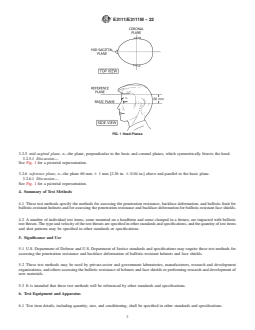
3.2.1.1 Discussion—
See Fig. 1 for a pictorial representation of the location of the basic plane.
3.2.2 coronal plane, n—the plane, perpendicular to the basic and mid-sagittal planes, which passes through the centers of the
external ear openings.
3.2.2.1 Discussion—
See Fig. 1 for a pictorial representation.
3.2.3 fastener, n—a hardware device that mechanically joins or affixes two or more objects together; for helmets, shields, and other
protective products, fasteners pass into or through the protective material and include such devices as bolts, anchors, screws, and
rivets.
3.2.4 head protection, n—the ensemble consisting of helmet, face shield, straps, padding, and other accessories designed to protect
the user’s head.
For referenced ASTM standards, visit the ASTM website, www.astm.org, or contact ASTM Customer Service at service@astm.org. For Annual Book of ASTM Standards
volume information, refer to the standard’s Document Summary page on the ASTM website.
Available from U.S. Government Printing Office, Superintendent of Documents, 732 N. Capitol St., NW, Washington, DC 20401-0001, http://www.access.gpo.gov.
Distribution authorized to the DOD and US DOD contractors only who are actively seeking to or are contracted to measure Back Face Deformation on Body Armor
and/or Helmets; November 2020. Other requests for this document shall be referred to the Materials & Measurements Test Branch, U.S. Army Aberdeen Test Center, 6943
Colleran Road, Building 400, Aberdeen Proving Ground, MD 21005-5059.
Available from American Association of Textile Chemists and Colorists (AATCC), P.O. Box 12215, Research Triangle Park, NC 27709-2215, http://www.aatcc.org.
Available from Canadian Standards Association (CSA), 178 Rexdale Blvd., Toronto, ON M9W 1R3, Canada, http://www.csagroup.org.
Available from International Organization for Standardization (ISO), ISO Central Secretariat, BIBC II, Chemin de Blandonnet 8, CP 401, 1214 Vernier, Geneva,
Switzerland, http://www.iso.org.
Available from National Institute of Justice (NIJ), 810 7th St., NW, Washington, DC 20531, http://nij.gov.
Available from the Association of Test Centers for Attack-resistant Materials and Constructions (VPAM), Zum Roten Berge 18-24 48165 Münster Germany
https://www.vpam.eu/pruefrichtlinien/aktuell/hvn-2009/.
E3111/E3111M − 22
FIG. 1 Head Planes
3.2.5 mid-sagittal plane, n—the plane, perpendicular to the basic and coronal planes, which symmetrically bisects the head.
3.2.5.1 Discussion—
See Fig. 1 for a pictorial representation.
3.2.6 reference plane, n—the plane 60 mm 6 1 mm [2.36 in. 6 0.04 in.] above and parallel to the basic plane.
3.2.6.1 Discussion—
See Fig. 1 for a pictorial representation.
4. Summary of Test Methods
4.1 These test methods specify the methods for assessing the penetration resistance, backface deformation, and ballistic limit for
ballistic-resistant helmets and for assessing the penetration resistance and backface deformation for ballistic-resistant face shields.
4.2 A number of individual test items, some mounted on a headform and some clamped in a fixture, are impacted with ballistic
test threats. The type and velocity of the test threats are specified in other standards and specifications, and the quantity of test items
and shot patterns may be specified in other standards or specifications.
5. Significance and Use
5.1 U.S. Department of Defense and U.S. Department of Justice standards and specifications may require these test methods for
assessing the penetration resistance and backface deformation of ballistic-resistant helmets and face shields.
5.2 These test methods may be used by private-sector and government laboratories, manufacturers, research and development
organizations, and others assessing the ballistic resistance of helmets and face shields or performing research and development of
new materials.
5.3 It is intended that these test methods will be referenced by other standards and specifications.
6. Test Equipment and Apparatus
6.1 Test item details, including quantity, size, and conditioning, shall be specified in other standards and specifications.
E3111/E3111M − 22
6.2 The ballistic test range shall meet the requirements of Specification E3062.
6.3 Some systems for determining yaw are yaw cards, flash radiograph, or photography. Yaw shall be measured by the system to
an accuracy of at least 1°.
6.4 When a backing assembly for validating the clay within a headform is required, the backing assembly shall be a clay block
and shall have a rigid metal frame with a plywood bottom. The inside dimensions of the metal frame shall be 300 mm 6 2 mm
[12.0 in. 6 0.08 in.] by 300 mm 6 2 mm [12.0 in. 6 0.08 in.] with a depth of 100 mm 6 2 mm [4.0 in. 6 0.08 in.]. The top and
bottom edges of the metal frame shall be planar. Attach plywood, of any grade, that is nominally “ ⁄4 in.” or “18 mm,” in.” or
“18 mm,” to the outside of the frame to form the bottom of the fixture. Prior to attaching the plywood, add a plastic liner as defined
® 10
in Specification E3004. Fill the backing assembly with ROMA Plastilina No. 1 . .
6.5 Some ballistic test methods require use of a headform.
6.5.1 For helmet shell and face shield testing that requires a headform, the headform shall be one of the following:
6.5.1.1 Cadex Model 100_00_HNME that meets the specifications given in the drawings in Annex A1 unless otherwise directed
by another specification or requirements document.
NOTE 2—The Cadex Model 100_00_HNME is the only headform currently used for ballistic testing of helmets to National Institute of Justice and U.S.
Army standards. This headform is commonly referred to as the “NIJ ballistic testing headform.” It is intended that additional headform options will be
added as they become available.
6.5.1.2 Facially featured headform as specified in CSA Z262.2-14 and shall be size 575.
6.5.1.3 Set of “Cadex Ballistic Testing Headforms” or equivalently dimensioned headforms that are made from rigid material and
meet the specifications given in the drawings in Annex A2, unless otherwise directed by another specification or requirements
document.
NOTE 3—The Cadex Ballistic Testing Headforms are the newest ballistic testing headforms available. The tolerances shown in Figs. A2.2-A2.6 are not
required to be as precise as is shown in the figures. The required tolerance will be specified in other standards or specifications. It is intended that
additional headform options will be added as they become available.
(1) The set shall include five separate headforms for testing the left, right, front, back, and crown locations, and shall include
a mold for properly forming the clay in the headform.
6.5.2 For testing that requires a headform, affix the test item to the appropriate headform. The headform shall be rigidly held by
the test stand that permits the entire test item and headform to be shifted vertically and horizontally and to be tilted such that the
intended impact locations and angles can be accomplished.
6.5.3 When scanning the headform, use a laser scanner attached to an articulating arm coordinate measuring machine (LS/AACM)
that meets the requirements of Test Plan to Qualify a Contractor-selected, Non-contact Back Face Deformation (BFD)
Measurement System Rev 1.
6.6 For V testing, use a fixture that securely clamps the test item at three points on the helmet, such as the ear flaps and a point
along the front or back mid-sagittal plane of the test item shell. The securing method shall be capable of retaining the shell and
withstanding shock resulting from a ballistic impact. The mount shall be capable of adjustment so that obliquity impacts can be
achieved anywhere on the test item. A drawing of an acceptable fixture is located in Appendix X1.
6.6.1 For opaque test items such as the helmet, the witness panel shall be a 0.50 mm [0.020 in.] thick sheet of 2024-T3, 2024-T4,
or 5052 aluminum alloy sheet. ®
U.S. Government standards require ROMA Plastilina No. 1 , from Sculpture House, Inc., as the backing material for ballistic-resistance testing.
Information on Cadex Model 100_00_HNME headforms can be found at http://www.cadexinc.com/nij_ballistic.php.
Information on the Cadex Ballistic Testing Headforms can be found by contacting Cadex at http://www.cadexinc.com/contact_us.php.
E3111/E3111M − 22
6.6.2 For transparent test items such as the face shield, the witness panel shall be a nominal 0.025 mm [0.001 in.] thick sheet of
aluminum foil.
6.7 The temperature conditioning chamber for test items shall be capable of a temperature range at least –56 °C to 77 °C [–70 °F
to 170 °F].
6.8 The immersion conditioning tank shall be capable of fully submerging the test items.
6.9 The weatherometer test apparatus shall be as defined in American Association of Textile Chemists and Colorists (AATCC) Test
Method 169.
7. Hazards
7.1 The ballistic tests described in these test methods have inherent hazards. Employ adequate safeguards for personnel and
property when conducting these tests.
8. Sampling and Test Items
8.1 The test items shall be helmets or face shields. For some tests, the helmet shell alone is the test item while for other tests the
test item is the helmet shell with its hardware, suspension system, and retention system. The face shield will always be attached
to the helmet during face shield testing.
8.2 Test item details, including quantity, size, and conditioning, shall be specified in other standards and specifications.
9. Test Requirements
9.1 The intended obliquity or other shot direction details, if any, for all shots shall be specified in other standards and
specifications.
NOTE 4—Typical obliquities are 0°, 30°, and 45°, with most obliquities being 0°.
9.2 Fair Hits:
9.2.1 To be considered a fair hit, unless specified elsewhere, each ballistic impact shall meet the requirements listed below.
Appendix X2 contains a flowchart showing the decision tree.
9.2.2 The test threat shall impact the test item at an obliquity within 5° of the intended angle.
9.2.3 Verify the test threat yaw within 31 cm [12 in.] of the test item. Yaw shall be ≤3° for rifle threats or ≤5° for fragment and
handgun threats. Check yaw for every test threat shot.
9.2.4 For backface deformation (BFD) and resistance to penetration (RTP) testing, the test threat velocity shall be within the
specified range given in other standards and specifications. If no specified range is given, the range shall be required velocity
–0 m ⁄s + 15 m/s [–0 ft ⁄s + 50 ft/s]. For a test threat having a velocity lower than the specified range with a complete penetration,
the impact is considered a fair hit.
9.2.5 For all ballistic testing, no overlap of damage (delamination) caused by impacts is allowed, and there shall be at least 13
mm [0.5 in.] between damaged areas when inspected visually. If necessary, multiple test items shall be used to allow two impacts
in each section without overlapping damage. Any shot shot, other than a weak point shot, that impacts within 25 mm [1 in.] of
a potential weak point, such as an earflap crease, hole,point is an unfair hit. See 15.1.4 or bolt, is an unfair hit.for details regarding
weak points.
9.2.6 For test threat impacts to hardware with a head such as a bolt, fasteners, the test threat shall impact the hardware head. An
impact is defined as the tip of the projectile impacting within the diameter of the hardware head as indicated by visual
examination.fastener as indicated below.
E3111/E3111M − 22
9.2.6.1 Fastener Head Shot, 0-degree Obliquity—The shot shall be placed such that the test threat projectile directly impacts the
center of the fastener head. There shall be visual evidence that the center of the fastener was impacted.
9.2.6.2 Fastener Glancing Shot, Slight Angle—The shot shall be lined up at 0-degree obliquity on the fastener head center. Then,
the headform shall be rotated slightly so that the test threat projectile will impact primarily the ballistic material and partially the
fastener edge. There shall be visual evidence that the fastener was impacted.
9.2.7 The test threat projectile shall impact the test item no closer to the edge of the test item than the minimum shot-to-edge
distance and no closer to a prior hit than the minimum shot-to-shot distance. Take the measurement from the center of the projectile
impact to the edge of the ballistic material in the test item or to the center of a previous impact.
9.2.7.1 Minimum Shot-to-Edge Distance—The minimum shot-to-edge distance shall be no less than 25 mm [1 in.], measured from
the impact center to the edge of the test item.
9.2.7.2 Minimum Shot-to-Shot Distance—The minimum shot-to-shot distance shall be no less than 38 mm [1 ⁄2 in.], measured
center-to-center, from a prior impact.
9.2.7.3 Maximum Shot-to-Edge Distance—For intended edge shots, the maximum shot-to-edge distance shall be no more than 44
mm [1 ⁄4 in.] measured from the impact center to the edge of the test item.
9.2.8 A test threat projectile that impacts too close to the edge or to a prior hit, is of too high a velocity, but does not perforate
shall be considered a fair hit.
9.2.8.1 A test item which is impacted with a high velocity shot (that is, velocity greater than allowed) that results in partial
penetration and an excessive BFD measurement, that impact shall be considered an unfair hit, and that shot shall be repeated on
a spare test item. If the high velocity shot results in a partial penetration with an allowable BFD measurement, that impact shall
be considered a fair hit.
9.2.9 If the shot does not meet fair hit requirements due to excessive velocity, do not use the test item for any subsequent testing.
The test shall be continued on an identical spare test item.
9.3 If warmer rounds are needed for weapon or target alignment or establishment of a specific striking velocity, fire a test threat
through a witness panel to determine the exact point of impact. This witness panel can be any material that captures the path of
the projectile such as cardboard or paper. Fire additional test threats as necessary until the proper alignment and a stable striking
velocity have been achieved. The propellant charge versus velocity curve for the weapon being used should be referred to as a
guide for establishing the required velocity within a practical tolerance.
NOTE 5—Normally, this tolerance is approximately 68 m/s [625 ft/s].
9.4 Acceptance Criteria for Helmets:
9.4.1 A complete penetration for resistance to penetration testing shall be specified in other standards and specifications.
9.4.2 The backface deformation limit shall be specified in other standards and specifications.
9.4.3 The V requirements shall be specified in other standards and specifications.
9.5 Acceptance Criteria for Face Shields:
9.5.1 After each shot, the face shield and witness material shall be inspected to determine if a complete penetration or face shield
deflection has occurred. Unless specified elsewhere, the acceptance criteria shall be:
9.5.1.1 There shall be no complete penetration as evidenced by the projectile or any fragments from the projectile or face shield
being present in the clay witness material.
E3111/E3111M − 22
9.5.1.2 Face shield deflection shall be less than 30.0 mm [1.18 in.] as evidenced by contact indicator material being present on
the rear of the face shield.
10. Conditioning of Test Items
10.1 When specific conditioning is required, unless specified elsewhere, the following conditioning requirements apply for each
type of conditioning. Perform a visual inspection both prior to and after conditioning and record any changes.
10.2 Temperature ConditioningConditioning:
10.2.1 Controlled Ambient Conditioning—Expose test items to controlled ambient conditions (20 °C 6 5.5 °C [68 °F 6 10 °F] and
50 % 6 20 % relative humidity (RH)) for at least 24 h.
10.2.2 Extreme Heat Conditioning—Subject test items to extreme heat conditioning for between 24 h and 48 h at 71 °C 6 5.5 °C
[160 °F 6 10 °F] in a conditioning chamber.
10.2.3 Extreme Cold Conditioning—Subject test items to extreme cold conditioning for between 24 h and 48 h at –51 °C 6 5.5 °C
[–60 °F 6 10 °F] in a conditioning chamber.
10.2.4 At the end of each temperature conditioning activity, remove the test item(s) from the conditioning chamber and complete
ballistic testing within 30 min of removal from the conditioning chamber.
10.2.5 If ballistic testing cannot be completed within 30 min and the test item has been out of conditioning for 1 h or less,
recondition the test item for a minimum of 1 h. If the test item has been out of the conditioning chamber for more than 1 h,
recondition the test item for at least 24 h.
10.3 Water Immersion ConditioningConditioning:
10.3.1 Expose complete test items, including the shell, hardware, suspension system, and retention system, to controlled ambient
temperature for a minimum of 3 h prior to immersion in water. (See 10.2.1 for the controlled ambient temperature.)
10.3.2 Completely submerge complete test items in water at controlled ambient temperature for 3 h to 4 h. After submersion,
remove the test item, drain crown side up at controlled ambient, and ballistically test. Complete ballistic testing within 24 h 6 2
h after removal from the liquid.
10.3.2.1 The water may be either plain water or salt water. The water shall be replaced anytime there are visible impurities in the
water.
(1) The plain water shall be clean and shall be either potable tap or demineralized water.
(2) The saltwater solution shall be as specified in Practice D1141.
10.3.3 A weight may be used to prevent the test item from floating while immersed.
10.4 Artificial Weathering ConditioningConditioning:
10.4.1 Perform weathering of test items in accordance with AATCC Test Method 169 with the modifications listed below:
10.4.1.1 The test apparatus shall be a xenon weatherometer with reflective panels.
10.4.1.2 Equip the test apparatus with an automatic light monitor and that is capable of automatically controlling irradiance,
temperature, and humidity.
10.4.1.3 The apparatus shall be maintained in accordance with manufacturer recommendations.
10.4.1.4 The weathering cycle shall be a total of 180 min, consisting of the following in order: 40 min of light, 20 min of light
with water spray on to the test item, 60 min of light, and 60 min of darkness. Repeat the cycle until the total energy exposure is
equal to 100 kJ/m . Terminate the weather cycle at that point.
E3111/E3111M − 22
2 2
10.4.1.5 The spectral irradiance level shall be 0.55 W ⁄m /nm 6 0.01 W/m /nm bandpass at 340 nm.
10.4.1.6 The glass filter combination shall be quartz inner filter and a borosilicate type “S” outer filter.
10.4.1.7 Set the temperature and RH as specified in Table 1.
10.4.2 After the required exposure period, the test items shall be removed from the apparatus. Complete ballistic testing within
96 h after completion of weathering.
10.4.3 Any area of the helmet shell may be tested due to the light reflecting off the panels used in the weatherometer.
11. Helmet Resistance to Penetration (V ) and Backface Deformation (BFD) Testing
11.1 Test item details, including quantity, size, and conditioning, shall be specified in other standards and specifications.
11.2 Test Items:
11.2.1 The test item shall be a complete helmet, including the shell, hardware, suspension system, and retention system, and the
test item shall be mounted on a headform for testing. The quantity of test items and other relevant test item details are specified
in other standards or specifications. If the helmet has a face shield, remove it prior to testing.
11.2.2 When the Cadex headform is specified for testing, only size large (nominally size 7 ⁄4, 58 cm) helmets shall be used.
11.3 Test Item Marking:
11.3.1 Locate the internal crown benchmark on the shell, transpose to the external location, and mark the external location. If there
is no benchmark on the crown, then either the approximate center of the crown may be used or an alternate means may be used
as specified in the governing test requirement documentation. other standards or specifications. Record the procedure used in the
test report. Draw an approximately 127 mm [5 in.] diameter circle on the shell using the external crown benchmark as the center.
Refrain from placing any sharp or pointed object on the test item. Make sure all points are blunted.
11.3.2 Mark the 45°, 135°, 225°, and 315° positions of the ring on the shell as shown in Fig. 2.
11.3.3 Draw permanent lines that are aligned with the 45°, 135°, 225°, and 315° marks and the external crown benchmark but only
extend from the edge of the shell to a point on the circle.
11.4 Test Threats:
11.4.1 Test threats and velocities to be used shall be specified in other standards and specifications.
11.5 Headform Preparation:
TABLE 1 Temperatures and Humidities for Weathering Procedure
Dark Cycle Light Cycle
Black Panel 38 °C ± 3 °C 77 °C ± 3 °C
[100 °F ± 5 °F] [171 °F ± 5 °F]
Conditioning 40 °C ± 3 °C [104 °F ± 5 °F] 53 °C ± 3 °C [127 °F ± 5 °F]
Water
Relative 0 °C ± 3 °C [32 °F ± 5 °F] 10 °C ± 3 °C [50 °F ± 5 °F]
Humidity RH $95 % RH = 50 % ± 5 %
(This does not apply to light
cycle with water spray.)
Wet Bulb 0 °C ± 3 °C [32 °F ± 5 °F] 10 °C ± 3 °C [50 °F ± 5 °F]
Depression RH $95 % RH = 50 % ± 5 %
(This does not apply to light
cycle with water spray.)
E3111/E3111M − 22
FIG. 2 Location of Helmet Sections
11.5.1 The headform shall be a Cadex Model 100_00_HNME headform. ®
11.5.2 Use ROMA Plastilina No. 1 modeling clay as the backing material in the headform to make BFD measurements, preparing
the headform as follows: ®
11.5.2.1 Fill the bottom of the headform with one layer of small flat thumb-sized pieces of ROMA Plastilina No. 1 clay.
11.5.2.2 Using thumb and fingers, blend each piece together and work any voids and air bubbles to the outside of the channels.
11.5.2.3 Continue to add layers of clay to the headform until the headform is filled with clay. Make sure the clay extends slightly
beyond the outside surface of the headform.
11.6 Clay Block and Headform Conditioning:
11.6.1 Prepare one clay block according to Specification E3004, with the exception that the size of the clay block shall be as
described in 6.4 of these test methods.
11.6.2 Place the clay block and up to eight prepared headforms in the conditioning chamber with the headforms surrounding the
clay block such that all clay in each headform is within 304.8 mm [12 in.] of the nearest edge of the clay block (refer to Fig. 3).
NOTE 6—The orientation of the headforms during conditioning is not significant.
11.6.3 Heat each clay block and headform(s) such that the clay will pass the verification drops listed in 11.7 according to the
requirements below:
11.6.3.1 New clay blocks and new headforms shall be heated for at least 24 h.
11.6.3.2 Any clay block or headform that has been out of the conditioning chamber shall be reheated for no less than 3 h.
11.6.3.3 Any clay block or headform that has been out of the conditioning chamber for more than 1 h shall be reheated for at least
three times the time out of the chamber. If the time required exceeds 24 h, the requirement for new clay blocks and headforms
applies.
11.6.3.4 While 24 h is the maximum time required for reheating any clay block or headform, a clay block or headform may remain
in the chamber indefinitely.
11.7 Verification of the Clay Block and Headforms:
E3111/E3111M − 22
FIG. 3 Illustration of Clay Block-Headform Position During Conditioning
11.7.1 Verify the clay block and headforms per Specification E3004, with the following exceptions:
11.7.1.1 Instead of using the impact location template of Specification E3004, the impact locations shall be at least 76 mm [3 in.]
from the closest edge of the clay block when measured from the edge of the indentation. Allow at least 76 mm [3 in.] between
the centers of each indentation (that is, 32 mm [1.25 in.] from edge-to-edge).
NOTE 7—A laser may be used as a positioning guide, and a template may be used to ensure that the distance between the edge of the indentations and
the edge of the clay block is maintained.
11.7.1.2 The impactor shall be the cylindrical clay verification impactor.
11.7.1.3 The acceptance requirement is that each impact indentation depth is 25.4 mm 6 2.5 mm [1.0 in. 6 0.1 in.].
11.7.1.4 The clay block and paired headforms are usable for a period of 4 h. The 4-h time limit starts at the completion of the third
verification impact on the clay block.
11.7.1.5 Return the clay block to the conditioning chamber after verification and repair.
11.8 Preparation of the Clay-filled Headform:
11.8.1 Remove one of the conditioned headforms from the con
...