

ASTM F2220-15(2023)
(Specification)Standard Specification for Headforms
General Information
- Abstract
ABSTRACT
This specification covers the materials, sizing, and manufacturing details of test headforms for use in the testing of protective headgear. This specification identifies the requirements for five test headform size codes: A, E, J, M, and O. All datum levels shall be quoted relative to the reference plane. The headforms shall be symmetrical about the midsagittal plane. Internal geometry may be defined to satisfy the requirements of the individual test specifications. The impact headforms shall be made of K1A-F magnesium, with the prescribed zirconium and magnesium composition, and shall conform to the specified requirements for: external dimensions, performance (resonant frequency), mass, and center of gravity. All impact headforms shall be marked with: headform size, basic plane, reference plane, and midsagittal (longitudinal) and coronal (transverse) planes through the vertical axis. Other headforms shall be made of material of sufficient strength and stiffness to maintain their geometry during testing and shall comply to the external dimension requirements.
SCOPE
1.1 This standard specifies the materials, sizing, and manufacturing details of test headforms for use in the testing of protective headgear. Details of the exterior dimension of the headforms are included.
1.2 The values stated in SI units are to be regarded as standard. No other units of measurement are included in this standard.
1.3 This international standard was developed in accordance with internationally recognized principles on standardization established in the Decision on Principles for the Development of International Standards, Guides and Recommendations issued by the World Trade Organization Technical Barriers to Trade (TBT) Committee.
- Status
- Published
- Publication Date
- 31-Jul-2023
- Technical Committee
- F08 - Sports Equipment, Playing Surfaces, and Facilities
- Drafting Committee
- F08.53 - Headgear and Helmets
Overview
ASTM F2220-15(2023): Standard Specification for Headforms establishes the requirements for the design, materials, and manufacturing of test headforms used in the evaluation of protective headgear. Developed by ASTM International, this standard specifies critical parameters to ensure that headforms used for helmet and headgear testing are consistent, reliable, and reflective of human anatomy for accurate and repeatable results. The specification covers six recognized headform size codes: A, C, E, J, M, and O. The standard defines external dimensions, materials, and marking requirements, catering to both impact and reference (non-impact) testing purposes.
Key Topics
Headform Material Requirements
- Impact headforms are constructed from K1A-F magnesium (in accordance with ASTM B92/B92M).
- Reference headforms may use other materials with sufficient strength and stiffness to maintain geometry during testing.
Sizing and Classification
- Six size codes are identified: A, C, E, J, M, and O, addressing a broad range of anthropometric requirements in headgear testing.
Geometric Specifications
- All headforms must be symmetrical about the midsagittal plane.
- Datum levels, reference planes, basic planes, coronal planes, midsagittal planes, and center of gravity are clearly defined.
- External dimensions and tolerances are comprehensively provided for each headform size.
Marking and Identification
- Impact headforms must be marked with size, basic plane, reference plane, midsagittal, and coronal planes.
Performance Criteria
- Impact headforms must meet specified frequency and mass requirements.
- Center of gravity is positioned accurately to mirror human head mass distribution.
Applications
ASTM F2220-15(2023) plays a critical role in various industries related to head protection and personal safety. Key applications include:
- Helmet Testing: Used extensively in laboratories and certification bodies for evaluating the impact resistance and protective capacity of helmets for sports, industrial, and recreational use.
- Protective Headgear Development: Manufacturers of protective headgear employ ASTM F2220 headforms to design, refine, and validate new helmet models in accordance with global safety requirements.
- Quality Control & Compliance: Assists regulatory agencies and testing facilities in ensuring that headgear products meet international safety standards.
- Research and Ergonomic Design: Supporting research institutions in biomechanics, forensic science, and anthropometry with standardized testing tools.
Adoption of ASTM F2220 headforms ensures meaningful test results that can be reliably compared across different tests, products, and countries, contributing to uniform protection standards for end-users.
Related Standards
Professionals utilizing ASTM F2220-15(2023) may also reference the following related standards to ensure comprehensive compliance:
- ASTM B92/B92M: Specification for Unalloyed Magnesium Ingot and Stick for Remelting, relevant for material selection of impact headforms.
- EN 960: Headforms for Use in the Testing of Protective Helmets (a standard closely aligned with the basis for ASTM F2220).
- Standards pertaining to specific helmet performance and testing methods, such as those for sports, industrial, or motorcycling headgear.
Practical Value
ASTM F2220-15(2023) is essential for anyone involved in the development, testing, certification, or regulation of protective headgear. Utilizing standardized headforms improves test uniformity, product safety, and global market access for helmet manufacturers. The clear specification of headform geometry, materials, and marking ensures repeatable test outcomes and supports innovation in head protection by providing a reliable test platform.
Keywords: ASTM F2220-15, headform specification, headgear testing, helmet safety, impact headforms, reference headforms, protective headgear standards, headform sizes, laboratory testing, helmet certification.
Relations
- Refers
ASTM B92/B92M-17 - Standard Specification for Unalloyed Magnesium Ingot and Stick For Remelting - Effective Date
- 01-May-2017
- Refers
ASTM B92/B92M-11 - Standard Specification for Unalloyed Magnesium Ingot and Stick For Remelting - Effective Date
- 01-May-2011
- Refers
ASTM B92/B92M-07 - Standard Specification for Unalloyed Magnesium Ingot and Stick For Remelting - Effective Date
- 01-Jun-2007
- Effective Date
- 01-Apr-2007
- Refers
ASTM B92/B92M-01 - Standard Specification for Unalloyed Magnesium Ingot and Stick For Remelting - Effective Date
- 10-Apr-2001
- Effective Date
- 10-Apr-2001
Get Certified
Connect with accredited certification bodies for this standard

CIS Institut d.o.o.
Personal Protective Equipment (PPE) certification body. Notified Body NB-2890 for EU Regulation 2016/425 PPE.

Kiwa BDA Testing
Building and construction product certification.
Kmetijski inštitut Slovenije
Agricultural Institute of Slovenia. Soil testing, plant health, agricultural product analysis.
Sponsored listings
Frequently Asked Questions
ASTM F2220-15(2023) is a technical specification published by ASTM International. Its full title is "Standard Specification for Headforms". This standard covers: ABSTRACT This specification covers the materials, sizing, and manufacturing details of test headforms for use in the testing of protective headgear. This specification identifies the requirements for five test headform size codes: A, E, J, M, and O. All datum levels shall be quoted relative to the reference plane. The headforms shall be symmetrical about the midsagittal plane. Internal geometry may be defined to satisfy the requirements of the individual test specifications. The impact headforms shall be made of K1A-F magnesium, with the prescribed zirconium and magnesium composition, and shall conform to the specified requirements for: external dimensions, performance (resonant frequency), mass, and center of gravity. All impact headforms shall be marked with: headform size, basic plane, reference plane, and midsagittal (longitudinal) and coronal (transverse) planes through the vertical axis. Other headforms shall be made of material of sufficient strength and stiffness to maintain their geometry during testing and shall comply to the external dimension requirements. SCOPE 1.1 This standard specifies the materials, sizing, and manufacturing details of test headforms for use in the testing of protective headgear. Details of the exterior dimension of the headforms are included. 1.2 The values stated in SI units are to be regarded as standard. No other units of measurement are included in this standard. 1.3 This international standard was developed in accordance with internationally recognized principles on standardization established in the Decision on Principles for the Development of International Standards, Guides and Recommendations issued by the World Trade Organization Technical Barriers to Trade (TBT) Committee.
ABSTRACT This specification covers the materials, sizing, and manufacturing details of test headforms for use in the testing of protective headgear. This specification identifies the requirements for five test headform size codes: A, E, J, M, and O. All datum levels shall be quoted relative to the reference plane. The headforms shall be symmetrical about the midsagittal plane. Internal geometry may be defined to satisfy the requirements of the individual test specifications. The impact headforms shall be made of K1A-F magnesium, with the prescribed zirconium and magnesium composition, and shall conform to the specified requirements for: external dimensions, performance (resonant frequency), mass, and center of gravity. All impact headforms shall be marked with: headform size, basic plane, reference plane, and midsagittal (longitudinal) and coronal (transverse) planes through the vertical axis. Other headforms shall be made of material of sufficient strength and stiffness to maintain their geometry during testing and shall comply to the external dimension requirements. SCOPE 1.1 This standard specifies the materials, sizing, and manufacturing details of test headforms for use in the testing of protective headgear. Details of the exterior dimension of the headforms are included. 1.2 The values stated in SI units are to be regarded as standard. No other units of measurement are included in this standard. 1.3 This international standard was developed in accordance with internationally recognized principles on standardization established in the Decision on Principles for the Development of International Standards, Guides and Recommendations issued by the World Trade Organization Technical Barriers to Trade (TBT) Committee.
ASTM F2220-15(2023) is classified under the following ICS (International Classification for Standards) categories: 13.340.20 - Head protective equipment. The ICS classification helps identify the subject area and facilitates finding related standards.
ASTM F2220-15(2023) has the following relationships with other standards: It is inter standard links to ASTM B92/B92M-17, ASTM B92/B92M-11, ASTM B92/B92M-07, ASTM B92/B92M-01(2007), ASTM B92/B92M-01, ASTM B92/B92M-89(1994)e1. Understanding these relationships helps ensure you are using the most current and applicable version of the standard.
ASTM F2220-15(2023) is available in PDF format for immediate download after purchase. The document can be added to your cart and obtained through the secure checkout process. Digital delivery ensures instant access to the complete standard document.
Standards Content (Sample)
This international standard was developed in accordance with internationally recognized principles on standardization established in the Decision on Principles for the
Development of International Standards, Guides and Recommendations issued by the World Trade Organization Technical Barriers to Trade (TBT) Committee.
Designation: F2220 − 15 (Reapproved 2023) An American National Standard
Standard Specification for
Headforms
This standard is issued under the fixed designation F2220; the number immediately following the designation indicates the year of
original adoption or, in the case of revision, the year of last revision. A number in parentheses indicates the year of last reapproval. A
superscript epsilon (´) indicates an editorial change since the last revision or reapproval.
INTRODUCTION
This specification identifies the headforms used for testing protective headgear in individual ASTM
International test methods and performance standards (standard specifications). This specification was
closely based on ISO DIS 6220, which was never published as an International Standard and is no
longer available. EN 960, a published standard, is also based on ISO DIS 6220 and has been used as
a basis for this standard.
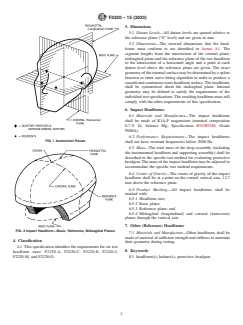
1. Scope 3.1.1 basic plane, n—an anatomical plane that includes the
superior rim of the external auditory meatuses (upper edge of
1.1 This standard specifies the materials, sizing, and manu-
the external openings of the ear) and the inferior margin of the
facturing details of test headforms for use in the testing of
orbit (the lowest point of the floor of the eye socket) (see Figs.
protective headgear. Details of the exterior dimension of the
1 and 2).
headforms are included.
3.1.2 coronal plane, n—an anatomical plane perpendicular
1.2 The values stated in SI units are to be regarded as
to both the basic and midsagittal planes and passing through
standard. No other units of measurement are included in this
the superior rims of the right and left external auditory
standard.
meatuses. The transverse plane corresponds to the coronal
1.3 This international standard was developed in accor-
plane (see Figs. 1 and 2).
dance with internationally recognized principles on standard-
3.1.3 impact headforms, n—headforms used for impact
ization established in the Decision on Principles for the
testing of protective headgear. Impact headforms shall conform
Development of International Standards, Guides and Recom-
to the external dimension defined in this specification. These
mendations issued by the World Trade Organization Technical
headforms shall meet the material, dimensions, mass, and
Barriers to Trade (TBT) Committee.
center of gravity requirements of this specification. These
headforms shall include surface markings corresponding to the
2. Referenced Documents
basic, coronal, midsagittal, and reference planes.
2.1 ASTM Standards:
3.1.4 midsagittal plane, n—an anatomical plane perpendicu-
B92/B92M Specification for Unalloyed Magnesium Ingot
lar to the basic plane and containing the midpoint of the line
and Stick For Remelting
connecting the notches of the right and left inferior orbital
2.2 Other Standards:
ridges and the midpoint of the line connecting the superior rims
EN 960 Headforms for Use in the Testing of Protective
of the right and left external auditory meatuses (see Figs. 1 and
Helmets
2).
3. Terminology 3.1.5 other (reference) headforms, n—headforms used for
other testing, other than impact, of protective headgear. They
3.1 Definitions:
shall conform to the external dimension requirements of each
particular headform size, as specified in this specification.
Reference headforms shall be made of material of sufficient
This specification is under the jurisdiction of ASTM Committee F08 on Sports
Equipment, Playing Surfaces, and Facilities and is the direct responsibility of strength and stiffness to maintain their geometry during testing.
Subcommittee F08.53 on Headgear and Helmets.
Full-chin headforms will be used as necessary. Reference
Current edition approved Aug. 1, 2023. Published August 2023. Originally
headforms shall include surface markings corresponding to the
approved in 2002. Last previous edition approved in 2015 as F2220 – 15. DOI:
basic, coronal, midsagittal, and reference planes.
10.1520/F2220-15R23.
For referenced ASTM standards, visit the ASTM website, www.astm.org, or
3.1.6 reference plane, n—a plane marked on the headforms
contact ASTM Customer Service at service@astm.org. For Annual Book of ASTM
at a specified distance above and parallel to the basic plane (see
Standards volume information, refer to the standard’s Document Summary page on
the ASTM website. Fig. 2).
Copyright © ASTM International, 100 Barr Harbor Drive, PO Box C700, West Conshohocken, PA 19428-2959. United States
F2220 − 15 (2023)
5. Dimensions
5.1 Datum Levels—All datum levels are quoted relative to
the reference plane (“0” level) and are given in mm.
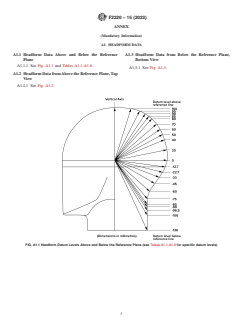
5.2 Dimensions—The external dimensions that the head-
forms must conform to are identified in Annex A1. The
segment lengths from the intersection of the coronal plane,
midsagittal plane and the reference plane of the test headform
to the intersection of a horizontal angle and a point at each
datum level above the reference plane are given. The exact
geometry of the external surface may be determined by a spline
function or other curve fitting algorithm in order to produce a
smooth and continuous outer headform surface. The headforms
shall be symmetrical about the midsagittal plane. Internal
geometry may be defined to satisfy the requirements of the
individual test specifications. The resulting headform must still
comply with the other requirements of this specification.
6. Impact Headforms
6.1 Materials and Manufacture—The impact headforms
shall be made of K1A-F magnesium (nominal composition
0.7 % Zr, balance Mg; Specification B92/B92M, Grade
9980A).
6.2 Performance Requirements—The impact headforms
FIG. 1 Anatomical Planes
shall not have resonant frequencies below 2000 Hz.
6.3 Mass—The total mass of the drop assembly (including
the instrumented headform and supporting assembly) shall be
described in the specific test method for evaluating protective
headgear. The mass of the impact headform may be adjusted to
accommodate the specific test method requirements.
6.4 Center of Gravity—The center of gravity of the impact
headform shall lie at a point on the central vertical axis, 12.7
mm above the reference plane.
6.5 Product Marking—All impact headforms shall be
marked with:
6.5.1 Headform size;
6.5.2 Basic plane;
6.5.3 Reference plane; and
6.5.4 Midsagittal (longitudinal) and coronal (transverse)
planes through the vertical axis.
7. Other (Reference) Headforms
FIG. 2 Impact Headform—Basic, Reference, Midsagittal Planes
7.1 Materials and Manufacture—Other headforms shall be
made of material of sufficient strength and stiffness to maintain
4. Classification
their geometry during testing.
4.1 This specification identifies the requirements for six test
8. Keywords
headform sizes: F2220-A, F2220-C, F2220-E, F2220-J,
F2220-M, and F2220-O. 8.1 headform(s); helmet(s); protective headgear
F2220 − 15 (2023)
ANNEX
(Mandatory Information)
A1. HEADFORM DATA
A1.1 Headform Data Above and Below the Reference A1.3 Headform Data from Below the Reference Plane,
Plane
Bottom View
A1.1.1 See Fig. A1.1 and Tables A1.1-A1.6.
A1.3.1 See Fig. A1.3.
A1.2 Headform Data from Above the Reference Plane, Top
View
A1.2.1 See Fig. A1.2.
FIG. A1.1 Headform Datum Levels Above and Below the Reference Plane (see Tables A1.1-A1.6 for specific datum levels)
F2220 − 15 (2023)
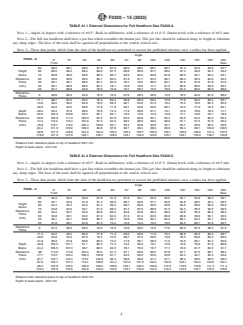
TABLE A1.1 External Dimensions for Full Headform Size F2220-A
NOTE 1—Angles in degrees with a tolerance of ±0.5°. Radii in millimetres, with a tolerance of ±1.0 %. Datum levels with a tolerance of ±0.5 mm.
NOTE 2—The full size headform shall have a jaw line which resembles the human jaw. This jaw line should be radiused along its length to eliminate
any sharp edges. The base of the neck shall be squared off perpendicular to the central vertical axis.
NOTE 3—Those data points which form the chin of the headform are permitted to exceed the published tolerance once a radius has been applied.
Angle
F2220 - A
0° 15° 30° 45° 60° 75° 90° 105° 120° 135° 150° 165° 180°
Front Rear
85 88.2 88.1 88.0 87.9 87.9 88.0 88.2 88.7 89.7 91.3 92.5 93.0 92.7
Height 80 88.2 88.3 88.4 88.0 87.2 86.8 86.9 87.7 89.2 91.4 93.5 93.4 93.2
Above 70 89.8 90.0 89.9 88.0 85.7 84.6 84.5 85.8 87.9 90.6 93.1 93.2 93.1
Reference 60 90.6 90.6 90.2 86.7 83.5 81.8 81.7 83.3 86.1 89.3 92.3 92.6 92.5
Plane
50 90.1 90.1 89.5 84.7 80.9 78.7 78.5 80.5 83.7 87.5 91.0 91.8 91.6
(mm) 40 89.1 89.0 88.2 82.4 78.1 76.0 75.6 77.7 81.2 85.6 89.5 90.9 90.7
20 87.7 86.8 84.9 78.0 72.8 70.1 69.7 72.5 76.3 81.2 86.2 88.9 89.0
Reference
0 88.0 86.5 83.0 75.5 70.0 67.0 66.5 69.5 73.5 78.5 84.0 87.0 88.0
Plane
-11.1 88.7 87.2 83.2 75.3 69.4 66.9 66.9 69.4 72.9 77.8 82.3 85.2 85.7
-19.9 90.2 90.2 84.9 76.6 69.4 66.1 64.6 67.5 70.4 75.2 79.5 82.4 82.9
-30.6 93.2 94.6 86.6 77.8 71.8 69.1 63.8 65.6 68.7 73.2 77.3 79.6 80.1
Depth -39.4 96.4 97.8 88.3 79.9 74.3 71.8 66.8 67.7 70.1 73.0 76.0 78.2 77.7
-52.5 102.5 103.8 93.2 85.1 80.1 75.3 73.5 73.9 75.0 77.1 79.0 79.7 78.6
Below
Reference -65.6 109.8 111.0 100.0 92.3 87.9 84.0 82.8 83.1 83.4 84.0 84.3 85.0 85.3
Plane -74.4 115.2 116.4 104.6 97.2 94.3 90.2 89.9 90.2 90.5 91.1 91.3 91.9 92.2
(mm) -78.8 118.1 119.2 106.4 100.6 93.1 93.3 93.6 93.9 94.1 94.7 95.0 95.5 95.8
-84.4 121.9 123.0 109.3 96.8 97.8 98.1 98.4 98.6 98.9 99.4 99.7 100.2 100.5
-92.8 127.9 128.9 104.3 104.3 105.2 105.4 105.7 105.9 106.1 106.6 106.9 107.4 107.6
-119.0 127.9 127.9 128.1 128.1 128.9 129.1 129.3 129.5 129.7 130.1 130.3 130.7 130.9
Distance from reference plane to top of headform: 89.7 mm
Depth to basic plane: -24.0 mm
TABLE A1.2 External Dimensions for Full Headform Size F2220-C
NOTE 1—Angles in degrees with a tolerance of ±0.5°. Radii in millimetres, with a tolerance of ±1.0 %. Datum levels with a tolerance of ±0.5 mm.
NOTE 2—The full size headform shall have a jaw line which resembles the human jaw. This jaw line should be radiused along its length to eliminate
any sharp edges. The base of the neck shall be squared off perpendicular to the central vertical axis.
NOTE 3—Those data points which form the chin of the headform are permitted to exceed the published tolerance once a radius has been applied.
Angle
F2220 - C
0° 15° 30° 45° 60° 75° 90° 105° 120° 135° 150° 165° 180°
Front Rear
90 92.3 92.2 92.0 91.9 91.9 91.9 92.1 92.5 93.2 94.1 94.9 95.2 95.1
85 92.1 92.0 91.8 91.4 90.9 90.7 90.9 91.7 93.0 94.8 96.2 96.4 96.3
Height
80 92.4 92.4 92.3 91.4 90.2 89.7 89.9 90.9 92.6 95.0 96.6 96.9 96.9
Above
70 93.8 93.5 93.1 91.0 88.5 87.4 87.6 88.9 91.3 94.3 96.3 96.9 96.9
Reference
60 94.2 93.7 93.0 89.8 86.3 84.6 84.6 86.3 89.3 92.8 95.3 96.2 96.3
Plane
50 93.8 93.1 92.2 87.9 83.6 81.5 81.4 83.5 86.9 90.8 93.9 95.1 95.5
(mm)
40 93.1 92.1 90.8 85.7 80.7 78.6 78.6 80.7 84.2 88.7 92.4 94.1 94.9
20 91.8 90.1 87.8 81.5 75.4 72.9 72.4 75.4 79.6 84.5 89.1 91.9 92.7
Reference
0 91.5 89.5 86.0 79.0 72.5 70.0 69.5 72.5 77.0 82.0 87.5 90.5 91.5
Plane
-11.5 92.2 90.2 86.3 77.9 71.9 69.5 69.5 71.9 75.4 80.8 85.3 88.3 88.7
-20.6 93.8 93.3 87.9 79.2 72.0 68.7 67.2 69.6 73.0 78.3 82.6 85.5 86.0
-31.8 96.9 97.8 89.8 80.5 74.2 71.9 66.1 68.3 71.5 76.0 80.1 82.4 82.8
Depth -40.8 100.2 101.1 91.1 82.3 77.2 74.2 69.3 70.1 72.6 75.9 78.9 81.0 80.6
Below -54.4 106.5 107.3 96.7 88.3 82.9 78.1 76.3 76.7 77.7 79.9 81.7 82.5 81.7
Reference -68 114.0 114.8 103.5 95.5 91.4 87.1 85.6 86.2 87.8 87.1 87.5 88.1 88.4
Plane -77.1 119.7 120.4 108.3 100.8 97.7 93.3 93.0 93.6 93.8 94.4 94.7 95.3 95.6
(mm) -81.7 122.7 123.4 110.2 102.9 96.3 96.6 96.8 97.4 97.7 98.2 98.5 99.0 99.3
-87.6 126.7 127.4 113.4 100.6 101.4 101.6 101.9 102.4 102.5 103.1 103.4 104.0 104.1
-96.2 132.8 133.5 108.0 108.2 108.9 109.1 109.4 109.8 110.0 110.5 110.8 111.3 111.4
-123.4 132.6 132.6 132.8 133.0 133.5 133.7 133.9 134.3 134.4 134.9 135.1 135.5 135.6
Distance from reference plane to top of headform: 93.0 mm
Depth to basic plane: -25.0 mm
-------------------
...