

ASTM F2019-22
(Practice)Standard Practice for Rehabilitation of Existing Pipelines and Conduits by the Pulled in Place Installation of Glass Reinforced Plastic Cured-in-Place (GRP-CIPP) Using the UV-Light Curing Method
General Information
- Abstract
SIGNIFICANCE AND USE
4.1 This practice is for use by designers and specifiers, regulatory agencies, owners and inspection organizations who are involved in the rehabilitation of conduits through the use of a resin-impregnated glass fiber tube, pulled in place through an existing pipe or conduit, subsequently inflated and then cured by a designed exposure to UV-light. As for any standard practice, modifications may be required for specific job conditions.
SCOPE
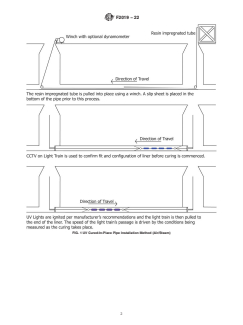
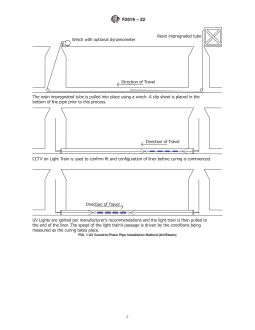
1.1 This practice covers the procedures for the reconstruction of pipelines and conduits (4 in. to 72 in. (100 mm to 1830 mm) diameter) by the pulled-in place installation of a resin-impregnated, glass fiber tube into an existing pipe or conduit followed by its inflation with compressed air pressure (see Fig. 1) to expand it firmly against the wall surface of the host structure. The photo-initiated resin system in the tube is then cured by exposure to ultraviolet (UV) light. When cured, the finished cured-in-place pipe will be a continuous and tight fitting pipe within a pipe. This type of reconstruction process can be used in a variety of gravity flow applications such as sanitary sewers, storm sewers, process piping, electrical conduits, and ventilation systems.
FIG. 1 UV Cured-In-Place Pipe Installation Method (Air/Steam)
1.2 The values stated in inch-pound units are to be regarded as standard. The values given in parentheses are mathematical conversions to SI units that are provided for information only and are not considered standard.
1.3 This standard does not purport to address all of the safety concerns, if any, associated with its use. It is the responsibility of the user of this standard to establish appropriate safety, health, and environmental practices and determine the applicability of regulatory limitations prior to use.
1.4 This international standard was developed in accordance with internationally recognized principles on standardization established in the Decision on Principles for the Development of International Standards, Guides and Recommendations issued by the World Trade Organization Technical Barriers to Trade (TBT) Committee.
- Status
- Published
- Publication Date
- 14-Nov-2022
- Technical Committee
- F17 - Plastic Piping Systems
- Drafting Committee
- F17.67 - Trenchless Plastic Pipeline Technology
Buy Documents
ASTM F2019-22 - Standard Practice for Rehabilitation of Existing Pipelines and Conduits by the Pulled in Place Installation of Glass Reinforced Plastic Cured-in-Place (GRP-CIPP) Using the UV-Light Curing Method
REDLINE ASTM F2019-22 - Standard Practice for Rehabilitation of Existing Pipelines and Conduits by the Pulled in Place Installation of Glass Reinforced Plastic Cured-in-Place (GRP-CIPP) Using the UV-Light Curing Method
Overview
ASTM F2019-22 is a standard developed by ASTM International that outlines the best practices for the rehabilitation of existing pipelines and conduits using glass reinforced plastic cured-in-place pipe (GRP-CIPP) with UV-light curing. This method involves installing a resin-impregnated glass fiber tube inside an existing pipeline, inflating it against the pipe wall, and curing it using ultraviolet (UV) light, resulting in a tight-fitting "pipe within a pipe." The process is particularly suitable for gravity flow applications such as sanitary sewers, storm sewers, process piping, electrical conduits, and ventilation systems within diameters ranging from 4 inches (100 mm) to 72 inches (1830 mm).
This standard practice is intended for use by project designers, engineers, regulatory agencies, pipeline owners, and inspection organizations engaged in the rehabilitation of pipeline infrastructure.
Key Topics
- Pulled-in-Place GRP-CIPP Installation: Provides detailed procedures for the installation of a resin-impregnated glass fiber tube within a host pipe, its inflation via compressed air, and subsequent UV-light curing.
- Material Requirements: Specifies that the glass fiber tube and resin system must meet strict performance criteria, with preference for suppliers certified under ISO 9001 or equivalent quality systems.
- UV-Light Curing Technology: Emphasizes the use of photoinitiated resins activated by UV-light, which cures the CIPP liner efficiently and provides robust structural integrity.
- Inspection and Quality Control: Includes recommendations for field sample preparation, testing (such as flexural strength and modulus), and post-installation inspections to ensure compliance with performance requirements.
- Safety and Environmental Considerations: Urges adherence to all relevant safety, health, and environmental practices, as users are responsible for determining applicable regulatory limits and safeguards.
Applications
ASTM F2019-22 delivers practical value through its structured guidance on the rehabilitation of aging or damaged pipelines and conduits, making it a preferred choice for:
- Municipal Sanitary and Storm Sewers: Restoring deteriorating underground infrastructure, reducing infiltration, and prolonging service life without major excavation.
- Industrial Process Piping: Minimizing downtime and maintaining operational efficiency by rapidly rehabilitating pipes in manufacturing and processing facilities.
- Electrical and Communication Conduits: Providing a non-disruptive method for reinforcing and sealing conduits carrying critical infrastructure cables.
- Ventilation Ducts: Lining and reinforcing air or fume ducts in industrial or commercial buildings without costly system shutdowns.
The standard is designed for gravity-fed systems, offering solutions where traditional excavation and pipe replacement would be challenging and disruptive.
Related Standards
- ASTM D5813 - Specification for Cured-In-Place Thermosetting Resin Sewer Piping Systems
- ASTM F1216 - Practice for Rehabilitation of Existing Pipelines and Conduits by the Inversion and Curing of a Resin-Impregnated Tube
- ASTM F1417 - Practice for Installation Acceptance of Plastic Non-pressure Sewer Lines Using Low-Pressure Air
- ISO 11296-4 - Plastics piping systems for renovation of underground non-pressure drainage and sewerage networks-Part 4: Lining with cured-in-place pipes
- ISO 9001 - Quality management systems
- ASTM D790 - Test Methods for Flexural Properties of Unreinforced and Reinforced Plastics and Electrical Insulating Materials
Conclusion
ASTM F2019-22 provides a comprehensive and standardized approach to trenchless pipeline rehabilitation using UV-cured, glass-reinforced CIPP liners. Its adherence to internationally recognized quality principles ensures durable, cost-effective pipe renovation solutions that address the growing need for infrastructure renewal with minimal surface disruption. Following the procedures and recommendations in this standard can help ensure successful, long-lasting repairs for a wide range of pipeline rehabilitation projects.
Keywords: ASTM F2019-22, GRP-CIPP, UV-light curing, pipeline rehabilitation, cured-in-place pipe, trenchless technology, conduit repair, sewer lining, infrastructure renewal.
Relations
- Effective Date
- 01-Oct-2023
- Effective Date
- 01-Apr-2020
- Effective Date
- 01-Aug-2019
- Effective Date
- 01-Aug-2019
- Effective Date
- 01-Jan-2019
- Effective Date
- 01-Oct-2018
- Refers
ASTM D1600-18 - Standard Terminology for Abbreviated Terms Relating to Plastics (Withdrawn 2024) - Effective Date
- 01-Jan-2018
- Effective Date
- 01-Aug-2017
- Effective Date
- 01-Jul-2017
- Effective Date
- 01-Mar-2017
- Effective Date
- 01-Feb-2017
- Effective Date
- 15-Nov-2016
- Effective Date
- 01-Aug-2016
- Effective Date
- 01-Dec-2015
- Effective Date
- 01-Dec-2015
Buy Documents
ASTM F2019-22 - Standard Practice for Rehabilitation of Existing Pipelines and Conduits by the Pulled in Place Installation of Glass Reinforced Plastic Cured-in-Place (GRP-CIPP) Using the UV-Light Curing Method
REDLINE ASTM F2019-22 - Standard Practice for Rehabilitation of Existing Pipelines and Conduits by the Pulled in Place Installation of Glass Reinforced Plastic Cured-in-Place (GRP-CIPP) Using the UV-Light Curing Method
Get Certified
Connect with accredited certification bodies for this standard

Institut za varilstvo d.o.o. (Welding Institute)
Slovenia's leading welding institute since 1952. ISO 3834, EN 1090, pressure equipment certification, NDT personnel, welder qualification. Only IIW Au
Sponsored listings
Frequently Asked Questions
ASTM F2019-22 is a standard published by ASTM International. Its full title is "Standard Practice for Rehabilitation of Existing Pipelines and Conduits by the Pulled in Place Installation of Glass Reinforced Plastic Cured-in-Place (GRP-CIPP) Using the UV-Light Curing Method". This standard covers: SIGNIFICANCE AND USE 4.1 This practice is for use by designers and specifiers, regulatory agencies, owners and inspection organizations who are involved in the rehabilitation of conduits through the use of a resin-impregnated glass fiber tube, pulled in place through an existing pipe or conduit, subsequently inflated and then cured by a designed exposure to UV-light. As for any standard practice, modifications may be required for specific job conditions. SCOPE 1.1 This practice covers the procedures for the reconstruction of pipelines and conduits (4 in. to 72 in. (100 mm to 1830 mm) diameter) by the pulled-in place installation of a resin-impregnated, glass fiber tube into an existing pipe or conduit followed by its inflation with compressed air pressure (see Fig. 1) to expand it firmly against the wall surface of the host structure. The photo-initiated resin system in the tube is then cured by exposure to ultraviolet (UV) light. When cured, the finished cured-in-place pipe will be a continuous and tight fitting pipe within a pipe. This type of reconstruction process can be used in a variety of gravity flow applications such as sanitary sewers, storm sewers, process piping, electrical conduits, and ventilation systems. FIG. 1 UV Cured-In-Place Pipe Installation Method (Air/Steam) 1.2 The values stated in inch-pound units are to be regarded as standard. The values given in parentheses are mathematical conversions to SI units that are provided for information only and are not considered standard. 1.3 This standard does not purport to address all of the safety concerns, if any, associated with its use. It is the responsibility of the user of this standard to establish appropriate safety, health, and environmental practices and determine the applicability of regulatory limitations prior to use. 1.4 This international standard was developed in accordance with internationally recognized principles on standardization established in the Decision on Principles for the Development of International Standards, Guides and Recommendations issued by the World Trade Organization Technical Barriers to Trade (TBT) Committee.
SIGNIFICANCE AND USE 4.1 This practice is for use by designers and specifiers, regulatory agencies, owners and inspection organizations who are involved in the rehabilitation of conduits through the use of a resin-impregnated glass fiber tube, pulled in place through an existing pipe or conduit, subsequently inflated and then cured by a designed exposure to UV-light. As for any standard practice, modifications may be required for specific job conditions. SCOPE 1.1 This practice covers the procedures for the reconstruction of pipelines and conduits (4 in. to 72 in. (100 mm to 1830 mm) diameter) by the pulled-in place installation of a resin-impregnated, glass fiber tube into an existing pipe or conduit followed by its inflation with compressed air pressure (see Fig. 1) to expand it firmly against the wall surface of the host structure. The photo-initiated resin system in the tube is then cured by exposure to ultraviolet (UV) light. When cured, the finished cured-in-place pipe will be a continuous and tight fitting pipe within a pipe. This type of reconstruction process can be used in a variety of gravity flow applications such as sanitary sewers, storm sewers, process piping, electrical conduits, and ventilation systems. FIG. 1 UV Cured-In-Place Pipe Installation Method (Air/Steam) 1.2 The values stated in inch-pound units are to be regarded as standard. The values given in parentheses are mathematical conversions to SI units that are provided for information only and are not considered standard. 1.3 This standard does not purport to address all of the safety concerns, if any, associated with its use. It is the responsibility of the user of this standard to establish appropriate safety, health, and environmental practices and determine the applicability of regulatory limitations prior to use. 1.4 This international standard was developed in accordance with internationally recognized principles on standardization established in the Decision on Principles for the Development of International Standards, Guides and Recommendations issued by the World Trade Organization Technical Barriers to Trade (TBT) Committee.
ASTM F2019-22 is classified under the following ICS (International Classification for Standards) categories: 23.040.20 - Plastics pipes. The ICS classification helps identify the subject area and facilitates finding related standards.
ASTM F2019-22 has the following relationships with other standards: It is inter standard links to ASTM C1920-23, ASTM F412-20, ASTM F1417-11a(2019), ASTM F1417-11A(2019)e1, ASTM F412-19, ASTM D5813-04(2018), ASTM D1600-18, ASTM F412-17a, ASTM D790-17, ASTM D2990-17, ASTM F412-17, ASTM F412-16a, ASTM F412-16, ASTM D790-15e1, ASTM D790-15. Understanding these relationships helps ensure you are using the most current and applicable version of the standard.
ASTM F2019-22 is available in PDF format for immediate download after purchase. The document can be added to your cart and obtained through the secure checkout process. Digital delivery ensures instant access to the complete standard document.
Standards Content (Sample)
This international standard was developed in accordance with internationally recognized principles on standardization established in the Decision on Principles for the
Development of International Standards, Guides and Recommendations issued by the World Trade Organization Technical Barriers to Trade (TBT) Committee.
Designation: F2019 − 22
Standard Practice for
Rehabilitation of Existing Pipelines and Conduits by the
Pulled in Place Installation of Glass Reinforced Plastic
Cured-in-Place (GRP-CIPP) Using the UV-Light Curing
Method
This standard is issued under the fixed designation F2019; the number immediately following the designation indicates the year of
original adoption or, in the case of revision, the year of last revision.Anumber in parentheses indicates the year of last reapproval.A
superscript epsilon (´) indicates an editorial change since the last revision or reapproval.
1. Scope* 2. Referenced Documents
2.1 ASTM Standards:
1.1 This practice covers the procedures for the reconstruc-
C1920Practice for Cleaning of Vitrified Clay Sanitary
tion of pipelines and conduits (4in. to 72 in. (100mm to 1830
Sewer Pipelines
mm) diameter) by the pulled-in place installation of a resin-
D543Practices for Evaluating the Resistance of Plastics to
impregnated, glass fiber tube into an existing pipe or conduit
Chemical Reagents
followedbyitsinflationwithcompressedairpressure(seeFig.
D578Specification for Glass Fiber Strands
1) to expand it firmly against the wall surface of the host
D790Test Methods for Flexural Properties of Unreinforced
structure. The photo-initiated resin system in the tube is then
and Reinforced Plastics and Electrical Insulating Materi-
cured by exposure to ultraviolet (UV) light. When cured, the
als
finished cured-in-place pipe will be a continuous and tight
D1600TerminologyforAbbreviatedTermsRelatingtoPlas-
fitting pipe within a pipe. This type of reconstruction process
tics
can be used in a variety of gravity flow applications such as
D2990Test Methods forTensile, Compressive, and Flexural
sanitary sewers, storm sewers, process piping, electrical
Creep and Creep-Rupture of Plastics
conduits, and ventilation systems.
D3567PracticeforDeterminingDimensionsof“Fiberglass”
1.2 The values stated in inch-pound units are to be regarded
(Glass-Fiber-Reinforced Thermosetting Resin) Pipe and
as standard. The values given in parentheses are mathematical
Fittings
conversions to SI units that are provided for information only
D5813 Specification for Cured-In-Place Thermosetting
and are not considered standard.
Resin Sewer Piping Systems
1.3 This standard does not purport to address all of the F412Terminology Relating to Plastic Piping Systems
safety concerns, if any, associated with its use. It is the F1216Practice for Rehabilitation of Existing Pipelines and
responsibility of the user of this standard to establish appro- Conduits by the Inversion and Curing of a Resin-
priate safety, health, and environmental practices and deter- Impregnated Tube
mine the applicability of regulatory limitations prior to use. F1417Practice for Installation Acceptance of Plastic Non-
pressure Sewer Lines Using Low-Pressure Air
1.4 This international standard was developed in accor-
dance with internationally recognized principles on standard-
2.2 ISO Standards:
ization established in the Decision on Principles for the
11296-4Plastics piping systems for renovation of under-
Development of International Standards, Guides and Recom-
ground non-pressure drainage and sewerage networks –
mendations issued by the World Trade Organization Technical
Part 4: Lining with cured-in-place pipes
Barriers to Trade (TBT) Committee.
For referenced ASTM standards, visit the ASTM website, www.astm.org, or
This practice is under the jurisdiction of ASTM Committee F17 on Plastic contact ASTM Customer Service at service@astm.org. For Annual Book of ASTM
Piping Systems and is the direct responsibility of Subcommittee F17.67 on Standards volume information, refer to the standard’s Document Summary page on
Trenchless Plastic Pipeline Technology. the ASTM website.
Current edition approved Nov. 15, 2022. Published December 2022. Originally Available from International Organization for Standardization (ISO), ISO
approved in 2000. Last previous edition approved in 2020 as F2019–20. DOI: Central Secretariat, BIBC II, Chemin de Blandonnet 8, CP 401, 1214 Vernier,
10.1520/F2019-22. Geneva, Switzerland, http://www.iso.org.
*A Summary of Changes section appears at the end of this standard
Copyright © ASTM International, 100 Barr Harbor Drive, PO Box C700, West Conshohocken, PA 19428-2959. United States
F2019 − 22
FIG. 1 UV Cured-In-Place Pipe Installation Method (Air/Steam)
F2019 − 22
7685Plastics piping systems – Glass-reinforced thermoset- sliding resistance and to protect the uncured resin saturated
ting plastics (GRP) pipes – Determination of initial glass fiber tube while being drawn into the host pipe.
specific ring stiffness
3.2.9 photo-initiated resin—a thermosetting resin system
178Plastics – Determination of Flexural Properties
that employs a photo-initiator molecule to absorb ultraviolet
9001Quality Management Systems
(UV)lightradiationandutilizingthatenergytotheninitiatethe
polymerization of the resin system.
2.3 AWWA Standard:
Manual on Cleaning and Lining Water Mains, M28
3.2.10 qualification test—one or more tests used to prove
the design of a product; not a routine quality control test.
2.4 NASSCO Standard:
Recommended Specifications for Sewer Collection System
3.2.11 quality control test—one or more tests used by the
Rehabilitation manufacturer of the CIPP system during its manufacture or
assembly.
3. Terminology
3.2.12 quality assurance testing—one or more tests used to
verify the physical properties of the finished, or as-installed,
3.1 General:
CIPP.
3.1.1 Definitions are in accordance withTerminology F412.
Abbreviations are in accordance with Abbreviations D1600,
4. Significance and Use
unless otherwise indicated.
4.1 This practice is for use by designers and specifiers,
3.2 Definitions of Terms Specific to This Standard:
regulatory agencies, owners and inspection organizations who
3.2.1 calibration hose—a UV-transparent, styrene or
areinvolvedintherehabilitationofconduitsthroughtheuseof
equivalent-impermeable inner film or inner coating installed
aresin-impregnatedglassfibertube,pulledinplacethroughan
inside the resin-impregnated glass fiber tube to facilitate the
existing pipe or conduit, subsequently inflated and then cured
inflation of the tube, causing it to be pressed firmly against the
by a designed exposure to UV-light. As for any standard
wall of the existing pipe or conduit until the resin is cured.
practice, modifications may be required for specific job condi-
Unless installed specifically to remain in place, the calibration
tions.
hose shall be removed when the installation is finished.
5. Recommended Materials and Manufacture
3.2.2 cured-in-place pipe (CIPP)—a hollow cylinder con-
5.1 General—The glass fiber tube, resin system and outer
sisting of a glass reinforced plastic (GRP) fabric tube with
cured thermosetting resin. External films are included. The film or external pre-liner shall produce a GRP-CIPPthat meets
the requirements of this practice.The supplier of the UVLight
CIPP is formed within an existing pipe and takes the shape of
the pipe. cured GRP-CIPP System shall be an ISO 9001 certified
producer or have implemented a quality system similar to that
3.2.3 delamination—a separation after curing between the
in the ISO 9001 requirements.
layers of a multi-layered glass fiber fabric wall in the CIPP.
5.2 CIPP Wall Composition—The wall shall consist of a
3.2.4 dry spot—anareaofthefabrictube,wherethefinished
corrosion resistant fiberglass fabric tube (Fig. 2) saturated with
CIPP is deficient or devoid of resin.
a thermosetting (cross-linked) resin.
3.2.5 fiberglass composite—a structural material that results
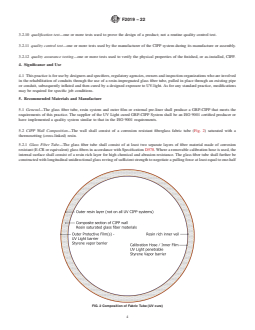
5.2.1 Glass Fiber Tube—Theglassfibertubeshallconsistof
from combining fiberglass layers, thermosetting resin, and
at least two separate layers of fiber material made of corrosion
other individual processing components that are within the
resistant (E-CR or equivalent) glass fibers in accordance with
finished CIPP structure to derive the desired material and
Specification D578. Where a removable calibration hose is
mechanical properties. The cured combination being resistant
used, the internal surface shall consist of a resin rich layer for
tonormalsewereffluentsastestedinaccordancewith6.4.1and
high chemical and abrasion resistance. The glass fiber tube
6.4.2 of Specification D5813.
shall further be constructed with longitudinal unidirectional
3.2.6 glass fiber tube—flexible fiberglass materials formed
glassrovingofsufficientstrengthtonegotiateapullingforceat
into a tubular shape which is saturated with resin prior to
least equal to one-half the weight of the liner. The glass fiber
installation and holds the resin in place as a permanent part of
tube shall tolerate circumferential changes in the existing
the installed cured-in-place pipe as further described in 5.2.1.
conduit. So as to produce a close-fit installation in deformed
host pipes and to minimize causing wrinkles in the finished
3.2.7 lift—a portion of the CIPPthat is a departure from the
CIPP, the glass fiber tube shall be undersized according to the
existing conduit wall forming a section of reverse curvature in
manufacturing method of the tube such that it will upon its
the CIPP.
expansioninthehostpipefullyfittheinteriorofsaidhostpipe
3.2.8 sliding sheet—a plastic sheeting material installed
withminimalornoannularspacesorcavitiesbetweenthehost
prior to the resin saturated glass fiber tube covering the lower
pipe and the liner which is essential in order to guarantee the
portion of the circumference of the existing pipe to reduce
fit condition assumed by the engineer in the wall thickness
design calculations.
5.2.2 External Films—The external films shall consist of
Available fromAmericanWaterWorksAssociation (AWWA), 6666W. Quincy
one or more layers of tube-shaped plastic films which are
Ave., Denver, CO 80235, http://www.awwa.org.
resistant and impermeable to moisture, UV-Light and styrene
AvailablefromNationalAssociationofSewerServiceCompanies,423W.King
Street, Suite 3000, Chambersburg, PA 17201. or equivalent.
F2019 − 22
FIG. 2 Composition of Fabric Tube (UV cure)
A
TABLE 1 CIPP Initial Structural Properties
5.2.3 Calibration hose—The calibration hose (inner film or
Property Test Method Minimum (MPA)
value, psi
coating; see Fig. 2) which is installed during the construction
B
Flexural Strength D790 Declared Declared Value, but
of the fabric tube, shall consist of a tube-shaped plastic film or
Value, but not not less than 103
resin-saturatedcoatedfelttubethatisUV-transparent,resistant
less than
15 000
and impermeable to moisture, styrene resistant and
B
Flexural Modulus D790 Declared Declared Value, but
impermeable, and able to resist temperatures up to 285°F
Value, but not not less than 5000
(140°C)whileexposedtotheinstallationpressuresufficientto
less than 725
keep the fabric tube tight against the pipe wall. It shall further
A
release easily from the inside wall for removal (in the case of The values in Table 1 are for test results on field specimens per product
manufacturer’stechnicaldatasheet.Thepurchasershallconsultthemanufacturer
an inner plastic film), when the installation is finished.
for the long-term structural properties.
5.2.4 Resin—The resin system shall consist of a chemically B
The value indicates minimum strength in the circumferential direction
resistant polyester or vinyl ester thermoset (UV-light-cured)
resinandcatalystsystemoranepoxyresinandhardenerthatis
compatible to the installation process. For UV-light cured
5.2.6.1 Wall Thickness—Themeanwallthickness, e ,ofthe
m
systems a photo-initiator system must be added to the resin composite’s structural wall section shall not be less than the
prior to the impregnation. The photo-initiator system shall be design wall thickness. The minimum wall thickness, e ,of
min
tuned to the UV-curing equipment used or vice-versa. the composite wall thickness shall not be less than 80% of the
5.2.5 Properties—The cured CIPP product shall at least design wall thickness, or 3.0 mm, whichever is the greater
have the initial structural properties given in Table 1. These value.
physical properties should be determined in accordance with 5.2.7 Chemical Resistance—The inner surface of the cured
Section 7 of this practice. resin/fabric matrix shall be evaluated in a laminate for quali-
5.2.6 CIPP Wall Structure—The thicknesses and relative fication testing of long term chemical exposure to a variety of
positions of each component layer of the CIPPwall, including chemical effluents and should be evaluated in a manner
tolerances, shall be specified as declared values by the CIPP consistentwith6.4.1and6.4.2SpecificationD5813.Theedges
system manufacturer. The composite’s structural wall thick- of the test coupons shall be sealed for this testing.
ness shall be the total wall thickness minus the inner veil resin
6. Installation Recommendations
thickness and the external layer thickness that is made up of
any resin migration, processing aids, etc. 6.1 Cleaning and Pre-Inspection:
F2019 − 22
6.1.1 Safety—Prior to entering access areas such as winch cable may be pulled through the line. The sliding sheet
manholes, and performing inspection and cleaning operations, shall cover approximately the lower third or up to half of the
an evaluation of the atmosphere to determine the presence of circumference of the pipe, as recommended by the CIPP
toxic or flammable vapors or lack of oxygen shall be under- system manufacturer.At the upstream end it is locked in place
taken in accordance with local, state or federal safety regula- bybeinginsertedunderneaththeplugusedtoblocktheflowin
tions. the manhole or other suitable anchoring arrangement.
6.1.2 Cleaning the Pipeline—All internal debris shall be
6.2.2 Pulling Head or Pulling Manifold and Invert Roller—
removed from the original pipeline.The pipes shall be cleaned
The liner is connected to the winch cable by forming a pulling
with hydraulically powered equipment, high velocity jet
head or using a pulling manifold.Apulling head can be made
cleaners, or mechanically powered equipment in accordance
by turning the end of the liner over into a loop. If a pulling
with manufacturers guidelines, Practice C1920 for VCP pipes
manifoldisuseditshallbeattachedtotheendofthelinerwith
or NASSCO Recommended Specifications for Sewer Collec-
sufficient strength to transfer the pulling force. It contains a
tion System Rehabilitation, as applicable.
mountingpointfortheair/streamhose.Duringthemountingof
6.1.3 Line Obstructions—The original pipeline should be
the pulling manifold care shall be taken to provide an airtight
clear of obstructions such as solids, dropped joints, protruding fit of the calibration hose to the manifold. If a pulling head has
service connections, collapsed pipe, and reductions in the
been used it shall be dismantled after pulling in the liner.Then
cross-sectional area that may hinder or prevent the installation a manifold is mounted airtight into the calibration hose. An
and curing of the resin impregnated fabric tube. Where the
invert guide roller is placed in the winch manhole. The invert
inspection reveals an obstruction that cannot be removed by roller shall allow the pulling head or manifold to enter the
conventional sewer cleaning equipment, then a robot with a
manhole before the pulling is terminated.Aswivel connection
cutter or other suitable tool should be used to remove the to the pulling cable must be added to avoid twisting the liner.
obstruction.
6.3 Resin Impregnation:
6.1.4 Inspection of Pipelines—Inspection of pipelines shall
6.3.1 Resin Impregnation—The glass fiber tube shall be
be performed by experienced personnel trained in locating
totally impregnated with resin (wet-out) in the manufacturer’s
breaks, obstacles and service connections by closed circuit
plant under quality controlled conditions. The impregnation
television or man entry. The interior of the pipeline shall be
equipment shall contain devices to secure a proper distribution
carefully inspected to determine the location of any conditions
of the resin. Certification documentation concerning date, type
that prevent proper installation of the impregnated tube, such
of resin, liner thickness, temperature, type of glass fiber, liner
as protruding service taps, collapsed or crushed pipe, and
type, manufacturing date and last installation date shall be
reductionsinthecross-sectionalarea.Theseconditionsshallbe
attached to the impregnated fabric tube or provided by the
noted and corrected prior to the installation.
CIPP manufacturer.
6.1.5 Pre-Measurement of Service Connections:
6.1.5.1 A pre-measuring of all service locations shall be 6.4 Storage and Transportation:
performed by experienced personnel. These measurements
6.4.1 UV-cured CIPP—The impregnated liner shall be
shall be made using a primary method and a back-up method;
stored, transported, and installed inside maximum and mini-
such as the counter value from the cable reel and a taped
mum temperatures not less than 45°F (7°C) or higher than
identification on the cable itself from a reference point on the
95°F (35°C) when being installed on site. UV cured CIPP
manhole ring. Visible indentations at the lateral connections
shall be stored in accordance with the manufacturer’s recom-
may not be readily identified.
mendations.
6.1.5.2 The measurements shall be noted in a log also
6.5 Pulling Resin Impregnated Tube into Position—The
containing information about the clockwise position of the
wet-out fabric tube shall be pulled in place using a power
opening.
winch. The fabric tube shall be pulled into place through an
6.1.6 Bypassing:
existingmanholeorotherapprovedaccesspointtofullyextend
6.1.6.1 Where bypassing the flow is required around the
to the designated manhole or termination point. If the product
sections of pipe designated for reconstruction, the bypass shall
is sensitive to pulling speed, the pulling speed should be
be made by plugging the line at the up-stream end of the pipe
monitored and not exceed the manufacturer’s specification.
to be reconstructed and pumping the flow to a downstream
When entered into the access point the fabric tube shall be
point or adjacent system.
folded as recommended by the CIPPsystem manufacturer and
6.1.6.2 The pump and bypass lines shall be of adequate
placed on top of the sliding sheet. Care shall be exercised not
capacity and size to handle the flow. Services within the reach
to damage the tube during the pulling phase, especially where
shall be temporarily out of service.
curved alignments, multilinear alignments, multiple off-sets,
6.1.7 Public advisory services shall be required to notify all
protruding elements and other friction producing pipe condi-
parties whose service laterals are out of commission and to
tions are present.As site conditions dictate, a lubricating fluid
advise against water usage until the lateral line is back in
such as a soapy water solution or biodegradable mineral oil
service.
may be poured or sprayed onto the sliding sheet at the liner
6.2 Installation Methods: insertion point. The pulling shall be considered completed
6.2.1 Sliding Sheet and Winch Cable—Upon verification of when the pulling head or manifold and 2ft to 3 ft (0.7m to
the removal of all debris and protrusions a sliding foil and a 1.0m) of impregnated tube has entered the termination point.
F2019 − 22
Thepoweredwinchusedinthepull-inprocessshallbecapable 6.8 Service Connections—After the new CIPP has been
of achieving a constant line-pull value set by the operator with installed, the existing service connections shall be reinstated.
the means to measure the pulling force changes and initiating This shall be done without excavation and in cases of non-
anyadjustmentsofthepayinorpayouttomaintainthispreset man-entry sized pipes from the interior of the pipeline by the
value; and keeping this force below the CIPPsystem’s recom- means of a television camera and a remotely controlled cutting
mendation for the tube being installed. device. Service connections shall be reinstated to at least 95%
of the original area as it enters the host pipe or conduit. All
6.6 Curing Methods-Ultraviolet Light Curing:
laterals where a plug by the end of the lateral was not visible
6.6.1 Installation Set-Up:
by the pre-inspection, shall be reinstated, if the purchase
6.6.1.1 The inlet air hose shall be connected to the installa-
agreement does not specify it differently.
tion equipment which shall be equipped with a positive
6.9 End Seals—the annular space at all locations where the
displacement blower or an air compressor (the latter requiring
CIPPenters and exits a manhole or other access structure shall
the ambient air temperature to be above 41°F (5°C) and
be made leak-tight by the installation of a pre-formed hydro-
rising) of sufficient volumetric capacity to expand the impreg-
philic material designed for sanitary sewer service that fully
nated fabric tube tightly against the host pipe using the CIPP
circles the circumference and has sufficient width to accom-
system manufacturer’s recommended level of internal pres-
modate any irregularities in the host pipe wall surface. The
sure. While the tube expands under pressure, a multi-lamp
location of its placement will be such that the seal is made
ultraviolet light curing assembly shall be drawn through the
within the confines of the manhole wall and back from the end
pipe.Duringthistravelthroughtheexpandedliner,theinstaller
of the host pipe by at least 1.5 in.
shall use the CCTV camera(s) mounted on the light train to
verify that the liner is properly fitted to the host pipe without
NOTE 1—A seal is not being made between the existing pipe and the
any wrinkles or fins that should be avoidable given the current fabric tube at the service connections due to the external film. If total
elimination of infiltration and inflow is desired, other means, which are
cross-sectional configuration (geometry) of the host pipe. If
beyond the scope of this standard, may be necessary to seal service
thesedefectsarefound,theyshallbecorrectedbeforeproceed-
connections and to rehabilitate service lines and manholes.
ing on to the UV-light curing process.
6.6.1.2 The ultraviolet curing lights shall be tuned or opti-
7. Recommended Inspection Practices
mized for the photo initiator system of the resin; or conversely
7.1 For each installation length as designated by the pur-
theinitiatorsystemoftheresinshallbeoptimizedtotheoutput
chaser in the purchase agreement, the preparation of CIPP
of the ultraviolet curing lights.
samples shall be required as given below:
6.6.2 Processing—Travel through the pipe shall be at a
7.1.1 ThesamplesshallbecutfromasectionofcuredCIPP
pre-determined speed per the CIPP system manufacturer’s
taken at an intermediate manhole or at the termination point
recommendations, provided to the owner’s representative for
thatshallbeinstalledthroughalikediametersectionofconduit
each installation length, which will facilitate the cross-linking/
or other tubular restraining means provided the invert channel
polymerizationoftheCIPPresin.Airpressureshallbeadjusted
is essentially straight through. The specimens shall allow
to sufficient pressure to hold the impregnated fabric tube tight
circumferential (hoop) directions of the Fiberglass reinforce-
to the pipe wall throughout the resin hardening process taking
mentintheCIPP.Fivespecimenwithawidthof2in.(50mm)
into account any additional pressure needed to overcome any
are needed.The overall length of the field sample must be able
external hydrostatic pressure from any visible signs of ground-
to produce this number of specimens. The samples are to be
water infiltration. The recommended pressure shall be main-
tested in a curved beam configuration where the minimum
tained by adjustment of the outlet valve.
beam width is 2 in. (50 mm). The specifics of the individual
6.6.3 CuringControl—Afullprotocolfortime,rateoftravel
specimenobtainedfromthissamplearediscussedinAppendix
oftheultravioletlighttrainassembly,pressures,temperatureof
X2.Alternatively,theinstallercanprepareeitherarestrainedor
the liner, and the amount and power of the lamps in operation
aflatplatesampleabovegroundusingthesameconditionsthat
shall be maintained as documentation for the correct curing of
were experienced by the liner inside the pipe being renewed
the fabric tube. The protocol shall be recorded automatically
(level of pressurization, stretch, light intensity, and duration of
from the beginning of inflation of the liner until the end of the
exposure). Preferably, a lamp (or lamps) shall be taken from
curing. It shall also show the basic information in a header,
the light train used to affect the curing.
such as project name, address, section, and date, to clearly
7.1.2 TheCIPPsamplesshallbelargeenoughtoprovidethe
identify the renovated section.
recommended five specimens for flexural testing. Where five
suitable specimens cannot be obtained from the sample; on
6.7 Workmanship—The finished CIPP shall be continuous
approval by the project engineer, the lab may be allowed to
overtheentirelengthofaninstallationandbefreeofdryspots,
conduct the flexural testing using a minimum of three speci-
lifts,anddelaminations.Wheretheseconditionsarepresentthe
mens. The flexural specimen shall be prepared in accordance
CIPP shall be evaluated for its ability to meet the applicable
with X2.3. Individual specimens shall be clearly marked for
requirements of Section 7. Where the CIPP does not meet the
easy identification and retained until final disposition for CIPP
requirementsofSection7orspecificallystatedrequirementsof
acceptance, or both, has been given.
the purchase agreement, or both, the affected portions of the
CIPP shall be removed and replaced with an acceptable repair 7.1.2.1 Short Term Flexural Properties—The initial tangent
as specified in 6.2 of Specification D5813. modulus of elasticity and flexural strength from field prepared
F2019 − 22
samples shall be measured in accordance with Test Method 7.2.1 Gravity Pipe:
D790, Test Method 1—ProcedureAas modified by Appendix 7.2.1.1 If required by the owner in the contract documents
X2andshallmeetorexceedtherequirementsofTable1within
or purchase order, gravity pipes shall be tested using an ex
the 16:1 length to depth constraints. The flexural properties filtrationtestmethodwheretheCIPP,afteritiscooleddownto
must be measured in the hoop direction as this is by design
ambient temperature and the calibration hose is removed
...
This document is not an ASTM standard and is intended only to provide the user of an ASTM standard an indication of what changes have been made to the previous version. Because
it may not be technically possible to adequately depict all changes accurately, ASTM recommends that users consult prior editions as appropriate. In all cases only the current version
of the standard as published by ASTM is to be considered the official document.
Designation: F2019 − 20 F2019 − 22
Standard Practice for
Rehabilitation of Existing Pipelines and Conduits by the
Pulled in Place Installation of Glass Reinforced Plastic
Cured-in-Place (GRP-CIPP) Using the UV-Light Curing
Method
This standard is issued under the fixed designation F2019; the number immediately following the designation indicates the year of
original adoption or, in the case of revision, the year of last revision. A number in parentheses indicates the year of last reapproval. A
superscript epsilon (´) indicates an editorial change since the last revision or reapproval.
1. Scope*
1.1 This practice covers the procedures for the reconstruction of pipelines and conduits (4(4 in. to 72 in. (100(100 mm to 1830
mm) diameter) by the pulled-in place installation of a resin-impregnated, glass fiber tube into an existing pipe or conduit followed
by its inflation with compressed air pressure (see Fig. 1) to expand it firmly against the wall surface of the host structure. The
photo-initiated resin system in the tube is then cured by exposure to ultraviolet (UV) light. When cured, the finished cured-in-place
pipe will be a continuous and tight fitting pipe within a pipe. This type of reconstruction process can be used in a variety of gravity
flow applications such as sanitary sewers, storm sewers, process piping, electrical conduits, and ventilation systems.
1.2 The values stated in inch-pound units are to be regarded as standard. The values given in parentheses are mathematical
conversions to SI units that are provided for information only and are not considered standard.
1.3 This standard does not purport to address all of the safety concerns, if any, associated with its use. It is the responsibility
of the user of this standard to establish appropriate safety, health, and environmental practices and determine the applicability of
regulatory limitations prior to use.
1.4 This international standard was developed in accordance with internationally recognized principles on standardization
established in the Decision on Principles for the Development of International Standards, Guides and Recommendations issued
by the World Trade Organization Technical Barriers to Trade (TBT) Committee.
2. Referenced Documents
2.1 ASTM Standards:
C1920 Practice for Cleaning of Vitrified Clay Sanitary Sewer Pipelines
D543 Practices for Evaluating the Resistance of Plastics to Chemical Reagents
D578 Specification for Glass Fiber Strands
D790 Test Methods for Flexural Properties of Unreinforced and Reinforced Plastics and Electrical Insulating Materials
D1600 Terminology for Abbreviated Terms Relating to Plastics
D2990 Test Methods for Tensile, Compressive, and Flexural Creep and Creep-Rupture of Plastics
D3567 Practice for Determining Dimensions of “Fiberglass” (Glass-Fiber-Reinforced Thermosetting Resin) Pipe and Fittings
D5813 Specification for Cured-In-Place Thermosetting Resin Sewer Piping Systems
This practice is under the jurisdiction of ASTM Committee F17 on Plastic Piping Systems and is the direct responsibility of Subcommittee F17.67 on Trenchless Plastic
Pipeline Technology.
Current edition approved Jan. 1, 2020Nov. 15, 2022. Published March 2020December 2022. Originally approved in 2000. Last previous edition approved in 20112020
as F2019 – 11.F2019 – 20. DOI: 10.1520/F2019-20.10.1520/F2019-22.
For referenced ASTM standards, visit the ASTM website, www.astm.org, or contact ASTM Customer Service at service@astm.org. For Annual Book of ASTM Standards
volume information, refer to the standard’s Document Summary page on the ASTM website.
*A Summary of Changes section appears at the end of this standard
Copyright © ASTM International, 100 Barr Harbor Drive, PO Box C700, West Conshohocken, PA 19428-2959. United States
F2019 − 22
FIG. 1 UV Cured-In-Place Pipe Installation Method (Air/Steam)
F2019 − 22
F412 Terminology Relating to Plastic Piping Systems
F1216 Practice for Rehabilitation of Existing Pipelines and Conduits by the Inversion and Curing of a Resin-Impregnated Tube
F1417 Practice for Installation Acceptance of Plastic Non-pressure Sewer Lines Using Low-Pressure Air
2.2 ISO Standards:
11296-4 Plastics piping systems for renovation of under-ground non-pressure drainage and sewerage networks – Part 4: Lining
with cured-in-place pipes
7685 Plastics piping systems – Glass-reinforced thermosetting plastics (GRP) pipes – Determination of initial specific ring
stiffness
178 Plastics – Determination of Flexural Properties
9001 Quality Management Systems
2.3 AWWA Standard:
Manual on Cleaning and Lining Water Mains, M28
2.4 NASSCO Standard:
Recommended Specifications for Sewer Collection System Rehabilitation
3. Terminology
3.1 General:
3.1.1 Definitions are in accordance with Terminology F412. Abbreviations are in accordance with Abbreviations D1600, unless
otherwise indicated.
3.2 Definitions of Terms Specific to This Standard:
3.2.1 calibration hose—a UV-transparent, styrene or equivalent-impermeable inner film or inner coating installed inside the
resin-impregnated glass fiber tube to facilitate the inflation of the tube, causing it to be pressed firmly against the wall of the
existing pipe or conduit until the resin is cured. Unless installed specifically to remain in place, the calibration hose shall be
removed when the installation is finished.
3.2.2 cured-in-place pipe (CIPP)—a hollow cylinder consisting of a glass reinforced plastic (GRP) fabric tube with cured
thermosetting resin. External films are included. The CIPP is formed within an existing pipe and takes the shape of the pipe.
3.2.3 delamination—a separation after curing between the layers of a multi-layered glass fiber fabric wall in the CIPP.
3.2.4 dry spot—an area of the fabric tube, where the finished CIPP is deficient or devoid of resin.
3.2.5 fiberglass composite—a structural material that results from combining fiberglass layers, thermosetting resin, and other
individual processing components that are within the finished CIPP structure to derive the desired material and mechanical
properties. The cured combination being resistant to normal sewer effluents as tested in accordance with 6.4.1 and 6.4.2 of
Specification D5813.
3.2.6 glass fiber tube—flexible fiberglass materials formed into a tubular shape which is saturated with resin prior to installation
and holds the resin in place as a permanent part of the installed cured-in-place pipe as further described in 5.2.1.
3.2.7 lift—a portion of the CIPP that is a departure from the existing conduit wall forming a section of reverse curvature in the
CIPP.
3.2.8 sliding sheet—a plastic sheeting material installed prior to the resin saturated glass fiber tube covering the lower portion of
the circumference of the existing pipe to reduce sliding resistance and to protect the uncured resin saturated glass fiber tube while
being drawn into the host pipe.
3.2.9 photo-initiated resin—a thermosetting resin system that employs a photo-initiator molecule to absorb ultraviolet (UV) light
radiation and utilizing that energy to then initiate the polymerization of the resin system.
Available from International Organization for Standardization (ISO), ISO Central Secretariat, BIBC II, Chemin de Blandonnet 8, CP 401, 1214 Vernier, Geneva,
Switzerland, http://www.iso.org.
Available from American Water Works Association (AWWA), 6666 W. Quincy Ave., Denver, CO 80235, http://www.awwa.org.
Available from National Association of Sewer Service Companies, 423 W. King Street, Suite 3000, Chambersburg, PA 17201.
F2019 − 22
3.2.10 qualification test—one or more tests used to prove the design of a product; not a routine quality control test.
3.2.11 quality control test—one or more tests used by the manufacturer of the CIPP system during its manufacture or assembly.
3.2.12 quality assurance testing—one or more tests used to verify the physical properties of the finished, or as-installed, CIPP.
4. Significance and Use
4.1 This practice is for use by designers and specifiers, regulatory agencies, owners and inspection organizations who are involved
in the rehabilitation of conduits through the use of a resin-impregnated glass fiber tube, pulled in place through an existing pipe
or conduit, subsequently inflated and then cured by a designed exposure to UV-light. As for any standard practice, modifications
may be required for specific job conditions.
5. Recommended Materials and Manufacture
5.1 General—The glass fiber tube, resin system and outer film or external pre-liner shall produce a GRP-CIPP that meets the
requirements of this practice. The supplier of the UV Light cured GRP-CIPP System shall be an ISO 9001 certified producer or
have implemented a quality system similar to that in the ISO 9001 requirements.
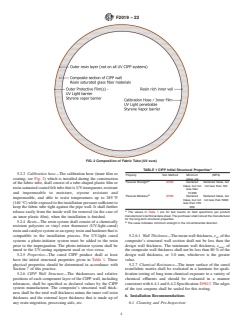
5.2 CIPP Wall Composition—The wall shall consist of a corrosion resistant fiberglass fabric tube (Fig. 2) saturated with a
thermosetting (cross-linked) resin.
5.2.1 Glass Fiber Tube—The glass fiber tube shall consist of at least two separate layers of fiber material made of corrosion
resistant (E-CR or equivalent) glass fibers in accordance with Specification D578. Where a removable calibration hose is used, the
internal surface shall consist of a resin rich layer for high chemical and abrasion resistance. The glass fiber tube shall further be
constructed with longitudinal unidirectional glass roving of sufficient strength to negotiate a pulling force at least equal to one-half
FIG. 2 Composition of Fabric Tube (UV cure)
F2019 − 22
the weight of the liner. The glass fiber tube shall tolerate circumferential changes in the existing conduit. So as to produce a close-fit
installation in deformed host pipes and to minimize causing wrinkles in the finished CIPP, the glass fiber tube shall be undersized
according to the manufacturing method of the tube such that it will upon its expansion in the host pipe fully fit the interior of said
host pipe with minimal or no annular spaces or cavities between the host pipe and the liner which is essential in order to guarantee
the fit condition assumed by the engineer in the wall thickness design calculations.
5.2.2 External Films—The external films shall consist of one or more layers of tube-shaped plastic films which are resistant and
impermeable to moisture, UV-Light and styrene or equivalent.
5.2.3 Calibration hose—The calibration hose (inner film or coating; see Fig. 2) which is installed during the construction of the
fabric tube, shall consist of a tube-shaped plastic film or resin-saturated coated felt tube that is UV-transparent, resistant and
impermeable to moisture, styrene resistant and impermeable, and able to resist temperatures up to 285 °F (140 °C) while exposed
to the installation pressure sufficient to keep the fabric tube tight against the pipe wall. It shall further release easily from the inside
wall for removal (in the case of an inner plastic film), when the installation is finished.
5.2.4 Resin—The resin system shall consist of a chemically resistant polyester or vinyl ester thermoset (UV-light-cured) resin and
catalyst system or an epoxy resin and hardener that is compatible to the installation process. For UV-light cured systems a
photo-initiator system must be added to the resin prior to the impregnation. The photo-initiator system shall be tuned to the
UV-curing equipment used or vice-versa.
5.2.5 Properties—The cured CIPP product shall at least have the initial structural properties given in Table 1. These physical
properties should be determined in accordance with Section 7 of this practice.
5.2.6 CIPP Wall Structure—The thicknesses and relative positions of each component layer of the CIPP wall, including tolerances,
shall be specified as declared values by the CIPP system manufacturer. The composite’s structural wall thickness shall be the total
wall thickness minus the inner veil resin thickness and the external layer thickness that is made up of any resin migration,
processing aids, etc.
5.2.6.1 Wall Thickness—The mean wall thickness, e , of the composite’s structural wall section shall not be less than the design
m
wall thickness. The minimum wall thickness, e , of the composite wall thickness shall not be less than 80 % of the design wall
min
thickness, or 3.0 mm, whichever is the greater value.
5.2.7 Chemical Resistance—The inner surface of the cured resin/fabric matrix shall be evaluated in a laminate for qualification
testing of long term chemical exposure to a variety of chemical effluents and should be evaluated in a manner consistent with 6.4.1
and 6.4.2 Specification D5813. The edges of the test coupons shall be sealed for this testing.
6. Installation Recommendations
6.1 Cleaning and Pre-Inspection:
6.1.1 Safety—Prior to entering access areas such as manholes, and performing inspection and cleaning operations, an evaluation
of the atmosphere to determine the presence of toxic or flammable vapors or lack of oxygen shall be undertaken in accordance with
local, state or federal safety regulations.
A
TABLE 1 CIPP Initial Structural Properties
Property Test Method Minimum (MPA)
value, psi
B
Flexural Strength D790 Declared Declared Value, but
Value, but not not less than 103
less than
15 000
B
Flexural Modulus D790 Declared Declared Value, but
Value, but not not less than 5000
less than 725
A
The values in Table 1 are for test results on field specimens per product
manufacturer’s technical data sheet. The purchaser shall consult the manufacturer
for the long-term structural properties.
B
The value indicates minimum strength in the circumferential direction
F2019 − 22
6.1.2 Cleaning the Pipeline—All internal debris shall be removed from the original pipeline. The pipes shall be cleaned with
hydraulically powered equipment, high velocity jet cleaners, or mechanically powered equipment in accordance with
manufacturers guidelines, Practice C1920 for VCP pipes or NASSCO Recommended Specifications for Sewer Collection System
Rehabilitation.Rehabilitation, as applicable.
6.1.3 Line Obstructions—The original pipeline should be clear of obstructions such as solids, dropped joints, protruding service
connections, collapsed pipe, and reductions in the cross-sectional area that may hinder or prevent the installation and curing of the
resin impregnated fabric tube. Where the inspection reveals an obstruction that cannot be removed by conventional sewer cleaning
equipment, then a robot with a cutter or other suitable tool should be used to remove the obstruction.
6.1.4 Inspection of Pipelines—Inspection of pipelines shall be performed by experienced personnel trained in locating breaks,
obstacles and service connections by closed circuit television or man entry. The interior of the pipeline shall be carefully inspected
to determine the location of any conditions that prevent proper installation of the impregnated tube, such as protruding service taps,
collapsed or crushed pipe, and reductions in the cross-sectional area. These conditions shall be noted and corrected prior to the
installation.
6.1.5 Pre-Measurement of Service Connections:
6.1.5.1 A pre-measuring of all service locations shall be performed by experienced personnel. These measurements shall be made
using a primary method and a back-up method; such as the counter value from the cable reel and a taped identification on the cable
itself from a reference point on the manhole ring. Visible indentations at the lateral connections may not be readily identified.
6.1.5.2 The measurements shall be noted in a log also containing information about the clockwise position of the opening.
6.1.6 Bypassing:
6.1.6.1 Where bypassing the flow is required around the sections of pipe designated for reconstruction, the bypass shall be made
by plugging the line at the up-stream end of the pipe to be reconstructed and pumping the flow to a downstream point or adjacent
system.
6.1.6.2 The pump and bypass lines shall be of adequate capacity and size to handle the flow. Services within the reach shall be
temporarily out of service.
6.1.7 Public advisory services shall be required to notify all parties whose service laterals are out of commission and to advise
against water usage until the lateral line is back in service.
6.2 Installation Methods:
6.2.1 Sliding Sheet and Winch Cable—Upon verification of the removal of all debris and protrusions a sliding foil and a winch
cable may be pulled through the line. The sliding sheet shall cover approximately the lower third or up to half of the circumference
of the pipe, as recommended by the CIPP system manufacturer. At the upstream end it is locked in place by being inserted
underneath the plug used to block the flow in the manhole or other suitable anchoring arrangement.
6.2.2 Pulling Head or Pulling Manifold and Invert Roller—The liner is connected to the winch cable by forming a pulling head
or using a pulling manifold. A pulling head can be made by turning the end of the liner over into a loop. If a pulling manifold is
used it shall be attached to the end of the liner with sufficient strength to transfer the pulling force. It contains a mounting point
for the air/stream hose. During the mounting of the pulling manifold care shall be taken to provide an airtight fit of the calibration
hose to the manifold. If a pulling head has been used it shall be dismantled after pulling in the liner. Then a manifold is mounted
airtight into the calibration hose. An invert guide roller is placed in the winch manhole. The invert roller shall allow the pulling
head or manifold to enter the manhole before the pulling is terminated. A swivel connection to the pulling cable must be added
to avoid twisting the liner.
6.3 Resin Impregnation:
6.3.1 Resin Impregnation—The glass fiber tube shall be totally impregnated with resin (wet-out) in the manufacturer’s plant under
quality controlled conditions. The impregnation equipment shall contain devices to secure a proper distribution of the resin.
F2019 − 22
Certification documentation concerning date, type of resin, liner thickness, temperature, type of glass fiber, liner type,
manufacturing date and last installation date shall be attached to the impregnated fabric tube or provided by the CIPP manufacturer.
6.4 Storage and Transportation:
6.4.1 UV-cured CIPP—The impregnated liner shall be stored, transported, and installed inside maximum and minimum
temperatures not less than 45°F (7°C)45 °F (7 °C) or higher than 95 °F (35 °C) when being installed on site. UV cured CIPP shall
be stored in accordance with the manufacturer’s recommendations.
6.5 Pulling Resin Impregnated Tube into Position—The wet-out fabric tube shall be pulled in place using a power winch. The
fabric tube shall be pulled into place through an existing manhole or other approved access point to fully extend to the designated
manhole or termination point. If the product is sensitive to pulling speed, the pulling speed should be monitored and not exceed
the manufacturer’s specification. When entered into the access point the fabric tube shall be folded as recommended by the CIPP
system manufacturer and placed on top of the sliding sheet. Care shall be exercised not to damage the tube during the pulling phase,
especially where curved alignments, multilinear alignments, multiple off-sets, protruding elements and other friction producing
pipe conditions are present. As site conditions dictate, a lubricating fluid such as a soapy water solution or biodegradable mineral
oil may be poured or sprayed onto the sliding sheet at the liner insertion point. The pulling shall be considered completed when
the pulling head or manifold and 22 ft to 3 ft (0.7(0.7 m to 1.0 m) of impregnated tube has entered the termination point. The
powered winch used in the pull-in process shall be capable of achieving a constant line-pull value set by the operator with the
means to measure the pulling force changes and initiating any adjustments of the pay in or pay out to maintain this preset value;
and keeping this force below the CIPP system’s recommendation for the tube being installed.
6.6 Curing Methods-Ultraviolet Light Curing:
6.6.1 Installation Set-Up:
6.6.1.1 The inlet air hose shall be connected to the installation equipment which shall be equipped with a positive displacement
blower or an air compressor (the latter requiring the ambient air temperature to be above 41 °F (5 °C) and rising) of sufficient
volumetric capacity to expand the impregnated fabric tube tightly against the host pipe using the CIPP system manufacturer’s
recommended level of internal pressure. While the tube expands under pressure, a multi-lamp ultraviolet light curing assembly
shall be drawn through the pipe. During this travel through the expanded liner, the installer shall use the CCTV camera(s) mounted
on the light train to verify that the liner is properly fitted to the host pipe without any wrinkles or fins that should be avoidable
given the current cross-sectional configuration (geometry) of the host pipe. If these defects are found, they shall be corrected before
proceeding on to the UV-light curing process.
6.6.1.2 The ultraviolet curing lights shall be tuned or optimized for the photo initiator system of the resin; or conversely the
initiator system of the resin shall be optimized to the output of the ultraviolet curing lights.
6.6.2 Processing—Travel through the pipe shall be at a pre-determined speed per the CIPP system manufacturer’s
recommendations, provided to the owner’s representative for each installation length, which will facilitate the cross-linking/
polymerization of the CIPP resin. Air pressure shall be adjusted to sufficient pressure to hold the impregnated fabric tube tight to
the pipe wall throughout the resin hardening process taking into account any additional pressure needed to overcome any external
hydrostatic pressure from any visible signs of groundwater infiltration. The recommended pressure shall be maintained by
adjustment of the outlet valve.
6.6.3 Curing Control—A full protocol for time, rate of travel of the ultraviolet light train assembly, pressures, temperature of the
liner, and the amount and power of the lamps in operation shall be maintained as documentation for the correct curing of the fabric
tube. The protocol shall be recorded automatically from the beginning of inflation of the liner until the end of the curing. It shall
also show the basic information in a header, such as project name, address, section, and date, to clearly identify the renovated
section.
6.7 Workmanship—The finished CIPP shall be continuous over the entire length of an installation and be free of dry spots, lifts,
and delaminations. Where these conditions are present the CIPP shall be evaluated for its ability to meet the applicable
requirements of Section 7. Where the CIPP does not meet the requirements of Section 7 or specifically stated requirements of the
purchase agreement, or both, the affected portions of the CIPP shall be removed and replaced with an acceptable repair as specified
in 6.2 of Specification D5813.
F2019 − 22
6.8 Service Connections—After the new CIPP has been installed, the existing service connections shall be reinstated. This shall
be done without excavation and in cases of non-man-entry sized pipes from the interior of the pipeline by the means of a television
camera and a remotely controlled cutting device. Service connections shall be reinstated to at least 95 % of the original area as
it enters the host pipe or conduit. All laterals where a plug by the end of the lateral was not visible by the pre-inspection, shall
be reinstated, if the purchase agreement does not specify it differently.
6.9 End Seals—the annular space at all locations where the CIPP enters and exits a manhole or other access structure shall be made
leak-tight by the installation of a pre-formed hydrophilic material designed for sanitary sewer service that fully circles the
circumference and has sufficient width to accommodate any irregularities in the host pipe wall surface. The location of its
placement will be such that the seal is made within the confines of the manhole wall and back from the end of the host pipe by
at least 1.5 in.
NOTE 1—A seal is not being made between the existing pipe and the fabric tube at the service connections due to the external film. If total elimination
of infiltration and inflow is desired, other means, which are beyond the scope of this standard, may be necessary to seal service connections and to
rehabilitate service lines and manholes.
7. Recommended Inspection Practices
7.1 For each installation length as designated by the purchaser in the purchase agreement, the preparation of CIPP samples shall
be required as given below:
7.1.1 The samples shall be cut from a section of cured CIPP taken at an intermediate manhole or at the termination point that shall
be installed through a like diameter section of conduit or other tubular restraining means provided the invert channel is essentially
straight through. The specimens shall allow circumferential (hoop) directions of the Fiberglass reinforcement in the CIPP. Five
specimen with a width of 2 in. (50 mm) are needed. The overall length of the field sample must be able to produce this number
of specimens. The samples are to be tested in a curved beam configuration where the minimum beam width is 2 in. (50 mm). The
specifics of the individual specimen obtained from this sample are discussed in Appendix X2. Alternatively, the installer can
prepare either a restrained or a flat plate sample above ground using the same conditions that were experienced by the liner inside
the pipe being renewed (level of pressurization, stretch, light intensity, and duration of exposure). Preferably, a lamp (or lamps)
shall be taken from the light train used to affect the curing.
7.1.2 The CIPP samples shall be large enough to provide the recommended five specimens for flexural testing. Where five suitable
specimens cannot be obtained from the sample; on approval by the project engineer, the lab may be allowed to conduct the flexural
testing using a minimum of three specimens. The flexural specimen shall be prepared in accordance with X2.3. Individual
specimens shall be clearly marked for easy identification and retained until final disposition for CIPP acceptance, or both, has been
given.
7.1.2.1 Short Term Flexural Properties—The initial tangent modulus of elasticity and flexural strength from field prepared samples
shall be measured in accordance with Test Method D790, Test Method 1—Procedure A as modified by Appendix X2 and shall meet
or exceed the requirements of Table 1 within the 16:1 length to depth constraints. The flexural properties must be measured in the
hoop direction as this is by design typically the direction of the primary reinforcement which is needed to deliver the dominant
in-place performance of the liner. The short term flexural strength shall be the value at first break; meaning the first break in the
glass fiber portion of the CIPP. Breaks in the curvature of the stress-strain curve attri
...