

ASTM F2778-09(2020)
(Test Method)Standard Test Method for Measurement of Percent Crystallinity of Polyetheretherketone (PEEK) Polymers by Means of Specular Reflectance Fourier Transform Infrared Spectroscopy (R-FTIR)
General Information
- Abstract
SIGNIFICANCE AND USE
4.1 Mechanical properties of PEEK polymers, such as stiffness or yield strength, are influenced by the level of crystallinity.5 The reported crystallinity index determined by this test method has been correlated with percent crystallinity in PEEK polymers by wide-angle X-ray scattering (WAXS) experiments.2, 3
4.2 This test method may be useful for both process development, process control, product development, and research.
SCOPE
1.1 This test method describes the collection of absorption spectra of polyetheretherketone (PEEK) polymer in filled and unfilled grades, as supplied by a vendor, and the subsequent calculation of the percent crystallinity. The material is evaluated by infrared spectroscopy. The intensity (height) of the absorbance peaks is related to the amount of crystalline regions present in the material.
1.2 This test method can be used for PEEK consolidated forms, such as injection molded parts, as long as the samples are optically flat and smooth.
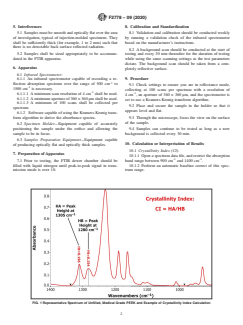
1.3 The applicability of the infrared method to industrial and medical grade PEEK materials has been demonstrated by scientific studies.2, 3 Percentage of crystallinity is related to R-FTIR measurement by calibration through wide-angle x-ray scattering (WAXS) crystallinity measurements.2, 3 It is anticipated that this test method, involving the peak heights near 1305 cm-1 and 1280 cm-1, will be evaluated in an Interlaboratory Study (ILS) conducted according to Test Method E691.
1.4 This test method does not suggest a desired range of crystallinity for specific applications.
1.5 The values stated in SI units are to be regarded as standard. No other units of measurement are included in this standard.
1.6 This standard may involve hazardous materials, operations, and equipment. This standard does not purport to address all of the safety concerns, if any, associated with its use. It is the responsibility of the user of this standard to establish appropriate safety, health, and environmental practices and determine the applicability of regulatory limitations prior to use.
1.7 This international standard was developed in accordance with internationally recognized principles on standardization established in the Decision on Principles for the Development of International Standards, Guides and Recommendations issued by the World Trade Organization Technical Barriers to Trade (TBT) Committee.
- Status
- Published
- Publication Date
- 31-Aug-2020
- Technical Committee
- F04 - Medical and Surgical Materials and Devices
- Drafting Committee
- F04.15 - Material Test Methods

Overview
ASTM F2778-09(2020) provides a standardized test method for determining the percent crystallinity of polyetheretherketone (PEEK) polymers using Specular Reflectance Fourier Transform Infrared Spectroscopy (R-FTIR). This standard is crucial as the level of crystallinity directly affects key mechanical properties of PEEK, such as stiffness and yield strength. By utilizing infrared spectroscopy, professionals can measure absorption spectra, enabling reliable calculation of crystallinity percentages in both filled and unfilled grades of PEEK, including consolidated forms such as injection molded parts.
This method is recognized and applicable for both industrial and medical-grade PEEK materials and has been calibrated by correlating R-FTIR results with established wide-angle x-ray scattering (WAXS) measurements. As an internationally recognized ASTM standard, F2778-09(2020) supports process development, quality control, research, and product development across various sectors requiring high-performance polymers.
Key Topics
Significance of Crystallinity in PEEK
- Crystallinity influences vital mechanical properties.
- Correlation between crystallinity index and percent crystallinity validated by WAXS.
Methodology
- Collection of absorption spectra for PEEK using R-FTIR.
- Calculation of the crystallinity index based on absorbance peak heights, specifically near 1305 cm⁻¹ and 1280 cm⁻¹.
- Applicable to both filled and unfilled PEEK, provided samples are optically flat and smooth.
Instrumentation & Calibration
- Requires an appropriately configured infrared spectrometer and software for data analysis.
- Regular validation and calibration against manufacturer’s instructions are necessary for accuracy.
Sample Requirements
- Samples must be smooth, optically flat, and of suitable thickness to avoid interference from back surface reflections.
- Confirmation that the method applies to various forms, including industrial and medical PEEK.
Safety and Compliance
- The standard outlines the need to consider safety, health, and environmental practices.
- Users are responsible for regulatory compliance and risk assessments.
Applications
Process Development
- Enable optimization of manufacturing parameters to achieve desired crystallinity and maximize performance in end-use applications.
Process Control
- Provides a reliable method for ongoing quality assurance during the production of PEEK components.
Product Development
- Assists in material selection and validation for new PEEK-based products, ensuring their mechanical properties meet specifications.
Research
- Facilitates advanced research on the structure-property relationships in PEEK and related high-performance thermoplastics.
Industrial and Medical Usage
- Suitable for both high-volume industrial applications and critical medical devices, supporting consistent and reproducible measurements across sectors.
Related Standards
- ASTM E691 - Practice for Conducting an Interlaboratory Study to Determine the Precision of a Test Method, referenced for evaluating method repeatability.
- ASTM Standards on FTIR - Guides and practices covering infrared spectroscopy techniques.
- ISO and Other ASTM PEEK Standards - Various references that complement the testing, characterization, and application of PEEK materials.
Keywords: ASTM F2778, PEEK crystallinity, R-FTIR, mechanical properties, polyetheretherketone, infrared spectroscopy, material testing, polymer analysis, process control, industrial polymers, medical polymers, WAXS calibration.
By following ASTM F2778-09(2020), material scientists, manufacturers, and quality assurance professionals can ensure accurate, efficient, and industry-accepted measurement of PEEK crystallinity, supporting the reliable application of this high-performance thermoplastic.
Relations
- Effective Date
- 01-May-2013
- Effective Date
- 01-Nov-2011
- Effective Date
- 01-Oct-2008
- Effective Date
- 01-Nov-2005
- Effective Date
- 10-May-1999
Get Certified
Connect with accredited certification bodies for this standard

DIN CERTCO
DIN Group product certification.

Smithers Quality Assessments
US management systems and product certification.
Sponsored listings
Frequently Asked Questions
ASTM F2778-09(2020) is a standard published by ASTM International. Its full title is "Standard Test Method for Measurement of Percent Crystallinity of Polyetheretherketone (PEEK) Polymers by Means of Specular Reflectance Fourier Transform Infrared Spectroscopy (R-FTIR)". This standard covers: SIGNIFICANCE AND USE 4.1 Mechanical properties of PEEK polymers, such as stiffness or yield strength, are influenced by the level of crystallinity.5 The reported crystallinity index determined by this test method has been correlated with percent crystallinity in PEEK polymers by wide-angle X-ray scattering (WAXS) experiments.2, 3 4.2 This test method may be useful for both process development, process control, product development, and research. SCOPE 1.1 This test method describes the collection of absorption spectra of polyetheretherketone (PEEK) polymer in filled and unfilled grades, as supplied by a vendor, and the subsequent calculation of the percent crystallinity. The material is evaluated by infrared spectroscopy. The intensity (height) of the absorbance peaks is related to the amount of crystalline regions present in the material. 1.2 This test method can be used for PEEK consolidated forms, such as injection molded parts, as long as the samples are optically flat and smooth. 1.3 The applicability of the infrared method to industrial and medical grade PEEK materials has been demonstrated by scientific studies.2, 3 Percentage of crystallinity is related to R-FTIR measurement by calibration through wide-angle x-ray scattering (WAXS) crystallinity measurements.2, 3 It is anticipated that this test method, involving the peak heights near 1305 cm-1 and 1280 cm-1, will be evaluated in an Interlaboratory Study (ILS) conducted according to Test Method E691. 1.4 This test method does not suggest a desired range of crystallinity for specific applications. 1.5 The values stated in SI units are to be regarded as standard. No other units of measurement are included in this standard. 1.6 This standard may involve hazardous materials, operations, and equipment. This standard does not purport to address all of the safety concerns, if any, associated with its use. It is the responsibility of the user of this standard to establish appropriate safety, health, and environmental practices and determine the applicability of regulatory limitations prior to use. 1.7 This international standard was developed in accordance with internationally recognized principles on standardization established in the Decision on Principles for the Development of International Standards, Guides and Recommendations issued by the World Trade Organization Technical Barriers to Trade (TBT) Committee.
SIGNIFICANCE AND USE 4.1 Mechanical properties of PEEK polymers, such as stiffness or yield strength, are influenced by the level of crystallinity.5 The reported crystallinity index determined by this test method has been correlated with percent crystallinity in PEEK polymers by wide-angle X-ray scattering (WAXS) experiments.2, 3 4.2 This test method may be useful for both process development, process control, product development, and research. SCOPE 1.1 This test method describes the collection of absorption spectra of polyetheretherketone (PEEK) polymer in filled and unfilled grades, as supplied by a vendor, and the subsequent calculation of the percent crystallinity. The material is evaluated by infrared spectroscopy. The intensity (height) of the absorbance peaks is related to the amount of crystalline regions present in the material. 1.2 This test method can be used for PEEK consolidated forms, such as injection molded parts, as long as the samples are optically flat and smooth. 1.3 The applicability of the infrared method to industrial and medical grade PEEK materials has been demonstrated by scientific studies.2, 3 Percentage of crystallinity is related to R-FTIR measurement by calibration through wide-angle x-ray scattering (WAXS) crystallinity measurements.2, 3 It is anticipated that this test method, involving the peak heights near 1305 cm-1 and 1280 cm-1, will be evaluated in an Interlaboratory Study (ILS) conducted according to Test Method E691. 1.4 This test method does not suggest a desired range of crystallinity for specific applications. 1.5 The values stated in SI units are to be regarded as standard. No other units of measurement are included in this standard. 1.6 This standard may involve hazardous materials, operations, and equipment. This standard does not purport to address all of the safety concerns, if any, associated with its use. It is the responsibility of the user of this standard to establish appropriate safety, health, and environmental practices and determine the applicability of regulatory limitations prior to use. 1.7 This international standard was developed in accordance with internationally recognized principles on standardization established in the Decision on Principles for the Development of International Standards, Guides and Recommendations issued by the World Trade Organization Technical Barriers to Trade (TBT) Committee.
ASTM F2778-09(2020) is classified under the following ICS (International Classification for Standards) categories: 83.080.20 - Thermoplastic materials. The ICS classification helps identify the subject area and facilitates finding related standards.
ASTM F2778-09(2020) has the following relationships with other standards: It is inter standard links to ASTM E691-13, ASTM E691-11, ASTM E691-08, ASTM E691-05, ASTM E691-99. Understanding these relationships helps ensure you are using the most current and applicable version of the standard.
ASTM F2778-09(2020) is available in PDF format for immediate download after purchase. The document can be added to your cart and obtained through the secure checkout process. Digital delivery ensures instant access to the complete standard document.
Standards Content (Sample)
This international standard was developed in accordance with internationally recognized principles on standardization established in the Decision on Principles for the
Development of International Standards, Guides and Recommendations issued by the World Trade Organization Technical Barriers to Trade (TBT) Committee.
Designation:F2778 −09 (Reapproved 2020)
Standard Test Method for
Measurement of Percent Crystallinity of
Polyetheretherketone (PEEK) Polymers by Means of
Specular Reflectance Fourier Transform Infrared
Spectroscopy (R-FTIR)
This standard is issued under the fixed designation F2778; the number immediately following the designation indicates the year of
original adoption or, in the case of revision, the year of last revision.Anumber in parentheses indicates the year of last reapproval.A
superscript epsilon (´) indicates an editorial change since the last revision or reapproval.
1. Scope 1.6 This standard may involve hazardous materials,
operations, and equipment. This standard does not purport to
1.1 This test method describes the collection of absorption
address all of the safety concerns, if any, associated with its
spectra of polyetheretherketone (PEEK) polymer in filled and
use. It is the responsibility of the user of this standard to
unfilled grades, as supplied by a vendor, and the subsequent
establish appropriate safety, health, and environmental prac-
calculation of the percent crystallinity. The material is evalu-
tices and determine the applicability of regulatory limitations
ated by infrared spectroscopy. The intensity (height) of the
prior to use.
absorbancepeaksisrelatedtotheamountofcrystallineregions
1.7 This international standard was developed in accor-
present in the material.
dance with internationally recognized principles on standard-
1.2 This test method can be used for PEEK consolidated ization established in the Decision on Principles for the
forms, such as injection molded parts, as long as the samples Development of International Standards, Guides and Recom-
are optically flat and smooth. mendations issued by the World Trade Organization Technical
Barriers to Trade (TBT) Committee.
1.3 The applicability of the infrared method to industrial
and medical grade PEEK materials has been demonstrated by
2. Referenced Documents
2,3
scientific studies. Percentage of crystallinity is related to 4
2.1 ASTM Standards:
R-FTIR measurement by calibration through wide-angle x-ray
E691Practice for Conducting an Interlaboratory Study to
2,3
scattering (WAXS) crystallinity measurements. It is antici-
Determine the Precision of a Test Method
pated that this test method, involving the peak heights near
-1 -1
3. Terminology
1305 cm and 1280 cm , will be evaluated in an Interlabora-
tory Study (ILS) conducted according to Test Method E691.
3.1 Definitions of Terms Specific to This Standard:
3.1.1 crystallinity index (CI), n—the ratio of the height
1.4 This test method does not suggest a desired range of
-1 -1
between the absorption peaks 1305 cm and 1280 cm .
crystallinity for specific applications.
4. Significance and Use
1.5 The values stated in SI units are to be regarded as
standard. No other units of measurement are included in this
4.1 Mechanical properties of PEEK polymers, such as
standard.
stiffness or yield strength, are influenced by the level of
crystallinity. The reported crystallinity index determined by
this test method has been correlated with percent crystallinity
1 in PEEK polymers by wide-angle X-ray scattering (WAXS)
ThistestmethodisunderthejurisdictionofASTMCommitteeF04onMedical
2,3
andSurgicalMaterialsandDevicesandisthedirectresponsibilityofSubcommittee
experiments.
F04.15 on Material Test Methods.
4.2 This test method may be useful for both process
Current edition approved Sept. 1, 2020. Published September 2020. Originally
approved in 2009. Last previous edition approved in 2015 as F2778–09(2015).
development, process control, product development, and re-
DOI: 10.1520/F2778–09R20.
search.
Chalmers J. M., Everall, N. J., Hewitson, K., Chesters, M. A., Pearson, M.,
Grady,A.,Kuzicka,B.,“FourierTransformInfraredMicroscopy:SomeAdvancesin
Techniques for Characterisation and Structure-Property Elucidations of Industrial For referenced ASTM standards, visit the ASTM website, www.astm.org, or
Material,” The Analyst, Vol 23, 1998, pp. 579–586. contact ASTM Customer Service at service@astm.org. For Annual Book of ASTM
Jaekel, D. J., Medel, F. J., Kurtz, S. M., “Validation of Crystallinity Measure- Standards volume information, refer to the standard’s Document Summary page on
ments of Medical Grade PEEK Using Specular Reflectance FTIR-microscopy,” the ASTM website.
Society of Plastics Engineers Annual Technical Conference 2009, Chicago 2009, Kurtz, S. M., Devine, J. N., “PEEK biomaterials in trauma, orthopedic, and
Manuscript ID ANTEC-0248-2009. spinal implants,” Biomaterials , Vol 28, No. 32, 2007, pp. 4845–4869.
Copyright © ASTM International, 100 Barr Harbor Drive, PO Box C700, West Conshohocken, PA 19428-2959. United States
F2778−09 (2020)
5. Interferences 8. Calibration and Standardization
5.1 Samples must be smooth and optically flat over the area 8.1 Validation and calibration should be conducted weekly
of investigation, typical of injection-molded specimens. They
by running a validation check of the infrared spectrometer
shall be sufficiently thick (for example, 1 to 2 mm) such that based on the manufacturer’s instructions.
there is no detectable back surface reflected radiation.
8.2 A background scan should be conducted at the start of
5.2 Samples shall be sized appropriately to be accommo-
testing and every 30 min thereafter for the duration of testing
dated in the FTIR apparatus.
while using the same scanning settings as the test parameters
dictate. The background scan should be
...