

ASTM D6365-99(2018)
(Practice)Standard Practice for Nondestructive Testing of Geomembrane Seams Using the Spark Test
General Information
- Abstract
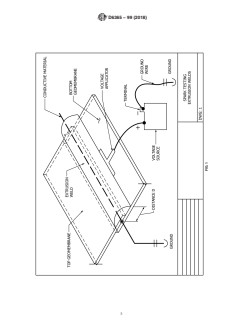
SIGNIFICANCE AND USE
5.1 Spark testing of geomembrane field seams is particularly useful in locations where other nondestructive test methods are not practical, for example in tight corners or a circumferential seam around a pipe.
SCOPE
1.1 This practice covers the nondestructive testing of field seams in geomembranes using the spark test. A suspect area is indicated by the generation of a spark. The test is applicable to seams made by the extrusion method, seams made by using welding tape (a strip of the same type of material as the geomembrane, that is welded over adjacent sections of geomembrane to create a seam), or seams where it is practical to insert a conductive material in the seam just prior to or during fabrication.
1.2 The spark test may produce an electrical spark and therefore can only be used where an electrical spark would not create a hazard.
1.3 Unless the voltages and distances prescribed are carefully adhered to, a “false positive” indication may result. This false positive occurs when the arc distance is too large for the voltage applied at the time and conditions of testing.
1.4 The values stated in SI units are to be regarded as standard. The values given in parentheses are for information only.
1.5 This standard does not purport to address all of the safety concerns, if any, associated with its use. It is the responsibility of the user of this standard to establish appropriate safety, health, and environmental practices and determine the applicability of regulatory limitations prior to use.
1.6 This international standard was developed in accordance with internationally recognized principles on standardization established in the Decision on Principles for the Development of International Standards, Guides and Recommendations issued by the World Trade Organization Technical Barriers to Trade (TBT) Committee.
- Status
- Published
- Publication Date
- 31-Jan-2018
- Technical Committee
- D35 - Geosynthetics
- Drafting Committee
- D35.10 - Geomembranes

Overview
ASTM D6365-99(2018) is the internationally recognized standard practice for nondestructive testing of geomembrane field seams using the spark test method. Developed by ASTM International, this standard details procedures for identifying suspect areas in geomembrane seams during or after installation, ensuring the integrity and performance of geosynthetic liners in a range of applications. The spark test is particularly valuable in situations where other nondestructive testing methods are impractical, such as tight corners or around pipe penetrations.
Key Topics
- Nondestructive Testing of Geomembranes: This standard outlines a testing procedure that does not damage the geomembrane, ensuring continued effectiveness of the liner.
- Spark Test Method: A conductive material is inserted into or near the seam during membrane fabrication. Using a high-voltage, low-current source, a voltage applicator is passed along the seam. The appearance of a spark indicates a suspect area, allowing for immediate identification and marking for repair.
- Applicable Seam Types:
- Seams formed by the extrusion method
- Seams created with welding tape (a strip of identical geomembrane material welded over adjacent panels)
- Seams where conductive material can be incorporated during fabrication
- Test Procedure Highlights:
- Prior to testing, ensure the area is dry and the conductive material is properly grounded.
- Select the correct test voltage based on seam configuration to prevent false positives.
- Move the voltage applicator at a uniform pace along the seam, maintaining close surface contact.
- Mark and record any suspect areas indicated by a spark for further evaluation and repair.
- Safety Considerations: The spark test must only be performed in environments where electrical sparks do not present a hazard. Proper safety, health, and environmental protocols must be observed.
Applications
ASTM D6365-99(2018) provides significant value in a range of industries where geomembrane liners are critical, including:
- Environmental Containment: Verifying the integrity of seams in landfill liners, storage ponds, and containment facilities.
- Water Management: Ensuring leak-proof joins in reservoirs, canals, and water treatment facilities.
- Mining and Industrial Projects: Quality assurance for geomembranes used in heap leach pads, tailings dams, and other containment applications.
- Infrastructure: Applicable to seams in geomembranes for tunnels, transportation projects, and civil engineering works where liquid containment is essential.
The spark test method is especially advantageous in challenging installation scenarios, such as:
- Seam testing in restricted spaces or sharp angles
- Circumferential seams around pipe penetrations
- Areas where traditional vacuum or air pressure testing is not feasible
Related Standards
For a comprehensive approach to geomembrane quality assurance, consider these related ASTM standards:
- ASTM D4439 - Terminology for Geosynthetics: Foundational definitions and descriptions of geosynthetic materials.
- ASTM D4491/D4491M - Test Methods for Water Permeability of Geotextiles by Permittivity: Relevant for assessing impermeability, a critical property for geomembrane liners.
- Other ASTM standards under Committee D35 on Geosynthetics address additional testing, installation, and performance requirements.
Keywords: ASTM D6365, spark test, geomembrane seams, nondestructive testing, geosynthetics, seam integrity, containment liners, welding tape, extrusion seams, field testing, quality assurance
By following ASTM D6365-99(2018), professionals can efficiently ensure the reliability of geomembrane seam construction, prevent leaks, and uphold environmental and operational standards in diverse containment applications.
Relations
- Effective Date
- 01-Feb-2018
- Effective Date
- 01-Feb-2024
- Effective Date
- 15-Apr-2018
- Effective Date
- 01-Aug-2017
- Refers
ASTM D4491/D4491M-17 - Standard Test Methods for Water Permeability of Geotextiles by Permittivity - Effective Date
- 01-Jan-2017
- Refers
ASTM D4491/D4491M-16 - Standard Test Methods for Water Permeability of Geotextiles by Permittivity - Effective Date
- 01-Jul-2016
- Effective Date
- 01-Sep-2015
- Effective Date
- 01-Jul-2015
- Refers
ASTM D4491/D4491M-15 - Standard Test Methods for Water Permeability of Geotextiles by Permittivity - Effective Date
- 01-Jul-2015
- Effective Date
- 01-Mar-2014
- Effective Date
- 01-Oct-2011
- Effective Date
- 01-Jun-2004
- Effective Date
- 10-Aug-2002
- Effective Date
- 10-Sep-2001
- Effective Date
- 10-Sep-2001
Get Certified
Connect with accredited certification bodies for this standard

DIN CERTCO
DIN Group product certification.
IMP NDT d.o.o.
Non-destructive testing services. Radiography, ultrasonic, magnetic particle, penetrant, visual inspection.
Inštitut za kovinske materiale in tehnologije
Institute of Metals and Technology. Materials testing, metallurgical analysis, NDT.
Sponsored listings
Frequently Asked Questions
ASTM D6365-99(2018) is a standard published by ASTM International. Its full title is "Standard Practice for Nondestructive Testing of Geomembrane Seams Using the Spark Test". This standard covers: SIGNIFICANCE AND USE 5.1 Spark testing of geomembrane field seams is particularly useful in locations where other nondestructive test methods are not practical, for example in tight corners or a circumferential seam around a pipe. SCOPE 1.1 This practice covers the nondestructive testing of field seams in geomembranes using the spark test. A suspect area is indicated by the generation of a spark. The test is applicable to seams made by the extrusion method, seams made by using welding tape (a strip of the same type of material as the geomembrane, that is welded over adjacent sections of geomembrane to create a seam), or seams where it is practical to insert a conductive material in the seam just prior to or during fabrication. 1.2 The spark test may produce an electrical spark and therefore can only be used where an electrical spark would not create a hazard. 1.3 Unless the voltages and distances prescribed are carefully adhered to, a “false positive” indication may result. This false positive occurs when the arc distance is too large for the voltage applied at the time and conditions of testing. 1.4 The values stated in SI units are to be regarded as standard. The values given in parentheses are for information only. 1.5 This standard does not purport to address all of the safety concerns, if any, associated with its use. It is the responsibility of the user of this standard to establish appropriate safety, health, and environmental practices and determine the applicability of regulatory limitations prior to use. 1.6 This international standard was developed in accordance with internationally recognized principles on standardization established in the Decision on Principles for the Development of International Standards, Guides and Recommendations issued by the World Trade Organization Technical Barriers to Trade (TBT) Committee.
SIGNIFICANCE AND USE 5.1 Spark testing of geomembrane field seams is particularly useful in locations where other nondestructive test methods are not practical, for example in tight corners or a circumferential seam around a pipe. SCOPE 1.1 This practice covers the nondestructive testing of field seams in geomembranes using the spark test. A suspect area is indicated by the generation of a spark. The test is applicable to seams made by the extrusion method, seams made by using welding tape (a strip of the same type of material as the geomembrane, that is welded over adjacent sections of geomembrane to create a seam), or seams where it is practical to insert a conductive material in the seam just prior to or during fabrication. 1.2 The spark test may produce an electrical spark and therefore can only be used where an electrical spark would not create a hazard. 1.3 Unless the voltages and distances prescribed are carefully adhered to, a “false positive” indication may result. This false positive occurs when the arc distance is too large for the voltage applied at the time and conditions of testing. 1.4 The values stated in SI units are to be regarded as standard. The values given in parentheses are for information only. 1.5 This standard does not purport to address all of the safety concerns, if any, associated with its use. It is the responsibility of the user of this standard to establish appropriate safety, health, and environmental practices and determine the applicability of regulatory limitations prior to use. 1.6 This international standard was developed in accordance with internationally recognized principles on standardization established in the Decision on Principles for the Development of International Standards, Guides and Recommendations issued by the World Trade Organization Technical Barriers to Trade (TBT) Committee.
ASTM D6365-99(2018) is classified under the following ICS (International Classification for Standards) categories: 19.100 - Non-destructive testing; 83.140.10 - Films and sheets. The ICS classification helps identify the subject area and facilitates finding related standards.
ASTM D6365-99(2018) has the following relationships with other standards: It is inter standard links to ASTM D6365-99(2011), ASTM D4439-24, ASTM D4439-18, ASTM D4439-17, ASTM D4491/D4491M-17, ASTM D4491/D4491M-16, ASTM D4439-15a, ASTM D4439-15, ASTM D4491/D4491M-15, ASTM D4439-14, ASTM D4439-11, ASTM D4439-04, ASTM D4439-02, ASTM D4439-00, ASTM D4439-01. Understanding these relationships helps ensure you are using the most current and applicable version of the standard.
ASTM D6365-99(2018) is available in PDF format for immediate download after purchase. The document can be added to your cart and obtained through the secure checkout process. Digital delivery ensures instant access to the complete standard document.
Standards Content (Sample)
This international standard was developed in accordance with internationally recognized principles on standardization established in the Decision on Principles for the
Development of International Standards, Guides and Recommendations issued by the World Trade Organization Technical Barriers to Trade (TBT) Committee.
Designation: D6365 − 99 (Reapproved 2018)
Standard Practice for
Nondestructive Testing of Geomembrane Seams Using the
Spark Test
This standard is issued under the fixed designation D6365; the number immediately following the designation indicates the year of
original adoption or, in the case of revision, the year of last revision. A number in parentheses indicates the year of last reapproval. A
superscript epsilon (´) indicates an editorial change since the last revision or reapproval.
1. Scope 2. Referenced Documents
2.1 ASTM Standards:
1.1 This practice covers the nondestructive testing of field
D4439 Terminology for Geosynthetics
seams in geomembranes using the spark test. A suspect area is
D4491/D4491M Test Methods for Water Permeability of
indicated by the generation of a spark. The test is applicable to
Geotextiles by Permittivity
seams made by the extrusion method, seams made by using
welding tape (a strip of the same type of material as the
3. Terminology
geomembrane, that is welded over adjacent sections of
3.1 Definitions:
geomembrane to create a seam), or seams where it is practical
3.1.1 geomembrane, n—anessentiallyimpermeablegeosyn-
to insert a conductive material in the seam just prior to or
thetic composed of one or more synthetic sheets.
during fabrication.
3.1.1.1 Discussion—In geotechnical engineering, “essen-
1.2 The spark test may produce an electrical spark and
tially impermeable” means that no measurable liquid flows
therefore can only be used where an electrical spark would not
through a geosynthetic when tested in accordance with Test
create a hazard.
Methods D4491/D4491M.
1.3 Unless the voltages and distances prescribed are care-
3.1.2 seam, n—a permanent joining of two or more materi-
fully adhered to, a “false positive” indication may result. This
als.
false positive occurs when the arc distance is too large for the
3.2 For definitions of other terms, see Terminology D4439.
voltage applied at the time and conditions of testing.
4. Summary of Practice
1.4 The values stated in SI units are to be regarded as
4.1 To use this practice, a conductive material is inserted
standard. The values given in parentheses are for information
into the field seam just prior to or during fabrication. The
only.
conductive material in the seam is connected to the negative
1.5 This standard does not purport to address all of the
terminal of the test apparatus, and a positive voltage is applied
safety concerns, if any, associated with its use. It is the
acrosstheseamedge.Asuspectareaintheseamisindicatedby
responsibility of the user of this standard to establish appro-
a spark from the voltage source to the conductive material.
priate safety, health, and environmental practices and deter-
mine the applicability of regulatory limitations prior to use. 5. Significance and Use
1.6 This international standard was developed in accor-
5.1 Spark testing of geomembrane field seams is particu-
dance with internationally recognized principles on standard-
larly useful in locations where other nondestructive test meth-
ization established in the Decision on Principles for the
ods are not practical, for example in tight corners or a
Development of International Standards, Guides and Recom-
circumferential seam around a pipe.
mendations issued by the World Trade Organization Technical
6. Apparatus
Barriers to Trade (TBT) Committee.
6.1 The test apparatus consists of a high-voltage, low-
current source with a negative terminal for ground and a
This practice is under the jurisdiction of ASTM Committee D35 on Geosyn-
thetics and is the direct responsibility of Subcommittee D35.10 on Geomembranes. For referenced ASTM standards, visit the ASTM website, www.astm.org, or
Current edition approved Feb. 1, 2018. Published February 2018. Originally contact ASTM Customer Service at service@astm.org. For Annual Book of ASTM
approved in 1999. Last previous edition approved in 2011 as D6365 – 99 (2011). Standards volume information, refer to the standard’s Document Summary page on
DOI: 10.1520/D6365-99R18. the ASTM website.
Copyright © ASTM International, 100 Barr Harbor Drive, PO Box C700, West Conshohocken, PA 19428-2959. United States
D6365 − 99 (2018)
positive terminal for a voltage applicator. A voltage applicator 7.2 Pri
...