

ASTM D8222-21a
(Guide)Standard Guide for Establishing a Quality Management System (QMS) for Consumer Use of Cannabis/Hemp Products
General Information
- Abstract
SIGNIFICANCE AND USE
5.1 Effective decision-making in a quality systems-controlled environment comes from an informed understanding of quality issues and associated risks. As such, management should monitor and review the performance of the QMS at pre-planned and regular intervals to ensure the system’s effectiveness and identify opportunities for improvement of the QMS itself. Management should also provide oversight of the QMS by an independent quality practitioner(s) to assure its effectiveness.
5.2 Moreover, risk-based decision-making encompasses all elements of the QMS and should be at the forefront of each decision. Consumer safety is the top priority, regardless of other considerations.
5.3 Aspects of risk should be considered relative to intended (or unintended) uses of a product to ensure consumer safety. Management should assign priorities and adequate resources to activities or actions based on assessing the risk, including the probability of harm and the potential severity of that harm. It is essential to engage appropriate parties in evaluating the risk. Such parties may include:
5.3.1 Consumers;
5.3.2 Manufacturing personnel;
5.3.3 Marketing personnel; and
5.3.4 Other stakeholders, as needed.
5.4 Implementation of risk management includes assessing the risks, implementing risk management controls commensurate with the level of risk, and evaluating the risk management efforts’ results. Risk management assessment is an iterative process and continues when additional information emerges that changes the potential risk’s nature.
5.5 Risk management works in conjunction with process understanding to manage and control change and helps drive continuous improvement.
SCOPE
1.1 This guide focuses on the core elements of an effective quality management system (QMS) necessary to optimize consumer and product safety, product quality, and conformance with requirements from industry, governmental agencies, and other authorities having jurisdiction. This guide incorporates basic quality principles, guidelines, and industry best practices necessary to establish a QMS adaptable to all organizations.
1.2 Laws and regulations from authorities having jurisdiction supersede recommendations within this guide.
1.3 This standard does not purport to address all of the safety concerns, if any, associated with its use. It is the responsibility of the user of this standard to establish appropriate safety, health, and environmental practices and determine the applicability of regulatory limitations prior to use.
1.4 This international standard was developed in accordance with internationally recognized principles on standardization established in the Decision on Principles for the Development of International Standards, Guides and Recommendations issued by the World Trade Organization Technical Barriers to Trade (TBT) Committee.
- Status
- Published
- Publication Date
- 14-Jul-2021
- Technical Committee
- D37 - Cannabis
- Drafting Committee
- D37.02 - Quality Management Systems
Buy Documents
ASTM D8222-21a - Standard Guide for Establishing a Quality Management System (QMS) for Consumer Use of Cannabis/Hemp Products
REDLINE ASTM D8222-21a - Standard Guide for Establishing a Quality Management System (QMS) for Consumer Use of Cannabis/Hemp Products
Overview
ASTM D8222-21a:Standard Guide for Establishing a Quality Management System (QMS) for Consumer Use of Cannabis/Hemp Products offers a comprehensive framework for organizations involved in the processing, packaging, labeling, quality control, and distribution of cannabis and hemp products for consumer use. This guide outlines the essential elements and best practices for implementing an effective QMS, focusing on optimizing consumer safety, product quality, and regulatory compliance in both recreational and medicinal contexts.
The guide incorporates basic quality management principles and a risk-based approach to decision-making, ensuring that all stakeholders, including management, quality professionals, manufacturing, and marketing personnel, maintain a clear focus on consumer safety and continuous improvement. Adopting ASTM D8222-21a helps organizations streamline operations, improve accountability, and meet the requirements of industry standards and governmental regulations.
Key Topics
Quality Management System (QMS) Core Elements:
- Quality manuals and documentation
- Change management and document control
- Deviation management (planned and unplanned)
- Corrective and preventive actions (CAPA)
- Complaint handling
- Product recall and removal procedures
- Supplier qualification and approval
Risk-Based Decision-Making:
- Implementation of risk assessment and risk management
- Use of tools such as Hazard Analysis Critical Control Points (HACCP) and Failure Mode and Effects Analysis (FMEA)
- Prioritizing actions based on consumer safety and probability/severity of harm
Personnel and Training:
- Defining and documenting qualification criteria
- Establishing and recording training protocols
- Ensuring roles and impact on quality and safety are understood
Facilities, Equipment, and Maintenance:
- Design, sanitation, verification, and pest control
- Equipment qualification, validation, calibration, and maintenance
Batch Records and Traceability:
- Master Batch Records (MBRs) and Batch Manufacturing Records (BMRs)
- Maintaining traceability throughout the product lifecycle
Internal Audits and Continuous Improvement:
- Audit planning, execution, and reporting
- Ongoing monitoring for continuous improvement of processes and product quality
Applications
ASTM D8222-21a is vital for organizations at every stage of the cannabis and hemp product supply chain, including:
- Cultivators and Processors: Ensuring safe and high-quality raw material handling and production processes.
- Manufacturers and Packagers: Maintaining conformity and safety in finished products through robust quality processes.
- Distributors and Retailers: Implementing recall, withdrawal, and complaint management procedures to safeguard consumers.
- Regulatory Compliance: Supporting adherence to government and industry requirements, reducing the risk of non-compliance.
- Product Development Teams: Enhancing product quality and consumer satisfaction via documented processes and continuous improvement initiatives.
A robust QMS aligned with this standard helps organizations respond effectively to quality issues, mitigate risks, and foster consumer trust in cannabis and hemp products.
Related Standards
To further strengthen QMS implementation in the cannabis and hemp industry, ASTM D8222-21a references several key standards:
- ASTM D8220: Guide for Conducting Recall/Removal Procedures for Products in the Cannabis Industry
- ASTM D8229: Guide for Corrective Action and Preventive Action (CAPA) for the Cannabis Industry
- ASTM D8250: Practice for Applying HACCP System for Cannabis Consumable Products
- ASTM D8286: Guide for Processing Cannabis Product Complaints
- ASTM D8308: Practice for Cannabis/Hemp Operation Compliance Audits
- ASTM D8270: Terminology Relating to Cannabis
- ASTM D8282: Practice for Laboratory Test Method Validation
- ASQ FMEA Resources: Failure Mode and Effects Analysis methodology
By applying ASTM D8222-21a alongside these related standards, businesses can achieve a holistic, risk-based quality management system that addresses the unique needs of the cannabis and hemp product sector.
Keywords: cannabis QMS, hemp product safety, quality management system, CAPA, risk management, batch records, product recall, regulatory compliance, ASTM D8222-21a, consumer safety in cannabis, hemp industry standards
Relations
- Effective Date
- 15-Apr-2020
- Effective Date
- 01-Oct-2019
- Refers
ASTM D8282-19 - Standard Practice for Laboratory Test Method Validation and Method Development - Effective Date
- 01-Sep-2019
- Effective Date
- 01-Jun-2019
- Effective Date
- 01-Mar-2019
Buy Documents
ASTM D8222-21a - Standard Guide for Establishing a Quality Management System (QMS) for Consumer Use of Cannabis/Hemp Products
REDLINE ASTM D8222-21a - Standard Guide for Establishing a Quality Management System (QMS) for Consumer Use of Cannabis/Hemp Products
Get Certified
Connect with accredited certification bodies for this standard

BSI Group
BSI (British Standards Institution) is the business standards company that helps organizations make excellence a habit.

TÜV Rheinland
TÜV Rheinland is a leading international provider of technical services.

TÜV SÜD
TÜV SÜD is a trusted partner of choice for safety, security and sustainability solutions.
Sponsored listings
Frequently Asked Questions
ASTM D8222-21a is a guide published by ASTM International. Its full title is "Standard Guide for Establishing a Quality Management System (QMS) for Consumer Use of Cannabis/Hemp Products". This standard covers: SIGNIFICANCE AND USE 5.1 Effective decision-making in a quality systems-controlled environment comes from an informed understanding of quality issues and associated risks. As such, management should monitor and review the performance of the QMS at pre-planned and regular intervals to ensure the system’s effectiveness and identify opportunities for improvement of the QMS itself. Management should also provide oversight of the QMS by an independent quality practitioner(s) to assure its effectiveness. 5.2 Moreover, risk-based decision-making encompasses all elements of the QMS and should be at the forefront of each decision. Consumer safety is the top priority, regardless of other considerations. 5.3 Aspects of risk should be considered relative to intended (or unintended) uses of a product to ensure consumer safety. Management should assign priorities and adequate resources to activities or actions based on assessing the risk, including the probability of harm and the potential severity of that harm. It is essential to engage appropriate parties in evaluating the risk. Such parties may include: 5.3.1 Consumers; 5.3.2 Manufacturing personnel; 5.3.3 Marketing personnel; and 5.3.4 Other stakeholders, as needed. 5.4 Implementation of risk management includes assessing the risks, implementing risk management controls commensurate with the level of risk, and evaluating the risk management efforts’ results. Risk management assessment is an iterative process and continues when additional information emerges that changes the potential risk’s nature. 5.5 Risk management works in conjunction with process understanding to manage and control change and helps drive continuous improvement. SCOPE 1.1 This guide focuses on the core elements of an effective quality management system (QMS) necessary to optimize consumer and product safety, product quality, and conformance with requirements from industry, governmental agencies, and other authorities having jurisdiction. This guide incorporates basic quality principles, guidelines, and industry best practices necessary to establish a QMS adaptable to all organizations. 1.2 Laws and regulations from authorities having jurisdiction supersede recommendations within this guide. 1.3 This standard does not purport to address all of the safety concerns, if any, associated with its use. It is the responsibility of the user of this standard to establish appropriate safety, health, and environmental practices and determine the applicability of regulatory limitations prior to use. 1.4 This international standard was developed in accordance with internationally recognized principles on standardization established in the Decision on Principles for the Development of International Standards, Guides and Recommendations issued by the World Trade Organization Technical Barriers to Trade (TBT) Committee.
SIGNIFICANCE AND USE 5.1 Effective decision-making in a quality systems-controlled environment comes from an informed understanding of quality issues and associated risks. As such, management should monitor and review the performance of the QMS at pre-planned and regular intervals to ensure the system’s effectiveness and identify opportunities for improvement of the QMS itself. Management should also provide oversight of the QMS by an independent quality practitioner(s) to assure its effectiveness. 5.2 Moreover, risk-based decision-making encompasses all elements of the QMS and should be at the forefront of each decision. Consumer safety is the top priority, regardless of other considerations. 5.3 Aspects of risk should be considered relative to intended (or unintended) uses of a product to ensure consumer safety. Management should assign priorities and adequate resources to activities or actions based on assessing the risk, including the probability of harm and the potential severity of that harm. It is essential to engage appropriate parties in evaluating the risk. Such parties may include: 5.3.1 Consumers; 5.3.2 Manufacturing personnel; 5.3.3 Marketing personnel; and 5.3.4 Other stakeholders, as needed. 5.4 Implementation of risk management includes assessing the risks, implementing risk management controls commensurate with the level of risk, and evaluating the risk management efforts’ results. Risk management assessment is an iterative process and continues when additional information emerges that changes the potential risk’s nature. 5.5 Risk management works in conjunction with process understanding to manage and control change and helps drive continuous improvement. SCOPE 1.1 This guide focuses on the core elements of an effective quality management system (QMS) necessary to optimize consumer and product safety, product quality, and conformance with requirements from industry, governmental agencies, and other authorities having jurisdiction. This guide incorporates basic quality principles, guidelines, and industry best practices necessary to establish a QMS adaptable to all organizations. 1.2 Laws and regulations from authorities having jurisdiction supersede recommendations within this guide. 1.3 This standard does not purport to address all of the safety concerns, if any, associated with its use. It is the responsibility of the user of this standard to establish appropriate safety, health, and environmental practices and determine the applicability of regulatory limitations prior to use. 1.4 This international standard was developed in accordance with internationally recognized principles on standardization established in the Decision on Principles for the Development of International Standards, Guides and Recommendations issued by the World Trade Organization Technical Barriers to Trade (TBT) Committee.
ASTM D8222-21a is classified under the following ICS (International Classification for Standards) categories: 11.120.99 - Other standards related to pharmaceutics. The ICS classification helps identify the subject area and facilitates finding related standards.
ASTM D8222-21a has the following relationships with other standards: It is inter standard links to ASTM D8220-20, ASTM D8286-19, ASTM D8282-19, ASTM D8229-19, ASTM D8250-19. Understanding these relationships helps ensure you are using the most current and applicable version of the standard.
ASTM D8222-21a is available in PDF format for immediate download after purchase. The document can be added to your cart and obtained through the secure checkout process. Digital delivery ensures instant access to the complete standard document.
Standards Content (Sample)
This international standard was developed in accordance with internationally recognized principles on standardization established in the Decision on Principles for the
Development of International Standards, Guides and Recommendations issued by the World Trade Organization Technical Barriers to Trade (TBT) Committee.
Designation: D8222 − 21a
Standard Guide for
Establishing a Quality Management System (QMS) for
Consumer Use of Cannabis/Hemp Products
This standard is issued under the fixed designation D8222; the number immediately following the designation indicates the year of
original adoption or, in the case of revision, the year of last revision. A number in parentheses indicates the year of last reapproval. A
superscript epsilon (´) indicates an editorial change since the last revision or reapproval.
1. Scope D8282 Practice for Laboratory Test Method Validation and
Method Development
1.1 This guide focuses on the core elements of an effective
D8286 Guide for Processing Cannabis Product Complaints
quality management system (QMS) necessary to optimize
2.2 ASQ Document:
consumerandproductsafety,productquality,andconformance
Failure Mode and Effects Analysis (FMEA) Brief Summary
with requirements from industry, governmental agencies, and
other authorities having jurisdiction. This guide incorporates
3. Terminology
basic quality principles, guidelines, and industry best practices
necessary to establish a QMS adaptable to all organizations. 3.1 Definitions of Terms Specific to This Standard:
3.1.1 controlled document, n—a document with an alpha-
1.2 Laws and regulations from authorities having jurisdic-
numeric assignment that is integrated into a QMS and subject
tion supersede recommendations within this guide.
to revision and revision tracking.
1.3 This standard does not purport to address all of the
3.1.2 equipment, n—non-expendable, tangible moveable
safety concerns, if any, associated with its use. It is the
property needed for the performance of a task or useful in
responsibility of the user of this standard to establish appro-
effecting an obligation.
priate safety, health, and environmental practices and deter-
3.1.3 instrumentation, n—equipment capable of performing
mine the applicability of regulatory limitations prior to use.
measurements used to generate analytical data (for example,
1.4 This international standard was developed in accor-
GC-MS, IR, NMR, balances, etc.).
dance with internationally recognized principles on standard-
ization established in the Decision on Principles for the
3.1.4 qualified individual, n—an individual who meets ap-
Development of International Standards, Guides and Recom-
plicable skill, experience, education, or other requirements of
mendations issued by the World Trade Organization Technical
an employment position that they hold or seek, and who can
Barriers to Trade (TBT) Committee.
perform the essential functions of the job with or without
reasonable accommodation.
2. Referenced Documents
3.1.5 planned deviation, n—pre-approved deviations from
2.1 ASTM Standards:
the current operational document or system, covering a speci-
D8220 Guide for Conducting Recall/Removal Procedures
fied period or number of batches.
for Products in the Cannabis Industry
D8229 Guide for Corrective Action and Preventive Action 3.1.5.1 Discussion—Planned deviations must be approved
(CAPA) for the Cannabis Industry before execution. Planned deviations should be handled
D8244 Guide forAnalytical Laboratory Operations Support- through approved change control procedures.
ing the Cannabis/Hemp Industry 3.1.6 recall, n—a product recall is the process of retrieving
D8250 Practice for Applying a Hazard Analysis Critical defective or potentially unsafe goods from consumers and
Control Points (HACCP) System for Cannabis Consum- providing those consumers with compensation.
able Products
3.1.7 removal, n—a product is removed from the supply
chain, but not for health and safety reasons.
This guide is under the jurisdiction ofASTM Committee D37 on Cannabis and
3.1.8 unplanned deviation, n—a state of nonconformance
is the direct responsibility of Subcommittee D37.02 on Quality Management
Systems. from the designed systems or procedures at any stage of
Current edition approved July 15, 2021. Published August 2021. Originally
manufacturing, packaging, testing, holding, or storage of the
approved in 2021. Last previous edition approved in 2021 as D8222 – 21. DOI:
product.
10.1520/D8222-21A.
For referenced ASTM standards, visit the ASTM website, www.astm.org, or
contact ASTM Customer Service at service@astm.org. For Annual Book of ASTM
Standards volume information, refer to the standard’s Document Summary page on Available from American Society for Quality (ASQ), 600 N. Plankinton Ave.,
the ASTM website. Milwaukee, WI 53203, http://www.asq.org.
Copyright © ASTM International, 100 Barr Harbor Drive, PO Box C700, West Conshohocken, PA 19428-2959. United States
D8222 − 21a
3.2 Abbreviated Terms: 5.3 Aspectsofriskshouldbeconsideredrelativetointended
3.2.1 BMR, n—batch manufacturing record (or unintended) uses of a product to ensure consumer safety.
Management should assign priorities and adequate resources to
3.2.2 CAPA, n—corrective actions/preventive actions
activities or actions based on assessing the risk, including the
3.2.3 CPP, n—critical process parameters
probability of harm and the potential severity of that harm. It is
3.2.4 CQA, n—critical quality attributes
essential to engage appropriate parties in evaluating the risk.
Such parties may include:
3.2.5 FMEA, n—Failure Mode and Effects Analysis; a
process for characterizing and mitigating risks by assigning 5.3.1 Consumers;
5.3.2 Manufacturing personnel;
risk priority numbers
5.3.3 Marketing personnel; and
3.2.6 IQ/OQ/PQ, n—installation, operational, and perfor-
5.3.4 Other stakeholders, as needed.
mance qualifications
5.4 Implementation of risk management includes assessing
3.2.7 IPC, n—in-process controls
the risks, implementing risk management controls commensu-
3.2.8 MBR, n—master batch records
rate with the level of risk, and evaluating the risk management
3.2.9 QA, n—quality assurance
efforts’ results. Risk management assessment is an iterative
3.2.10 QC, n—quality control process and continues when additional information emerges
that changes the potential risk’s nature.
3.2.11 QMS, n—quality management system
5.5 Risk management works in conjunction with process
3.2.12 SOPs, n—standard operating procedures
understanding to manage and control change and helps drive
4. Summary of Guide continuous improvement.
4.1 This guide encompasses both adult-use and medicinal
6. Quality Manual
cannabis/hemp activities associated with processing,
6.1 The quality manual is a document that summarizes the
packaging, labeling, quality control, and distribution.
implemented components of the QMS. It provides a general
4.2 This guide does not cover QMS elements as they relate
summary of the key elements comprising the content of the
to laboratory operations (Practice D8282 and Guide D8244).
QMS.
4.3 The QMS framework includes the core QMS elements
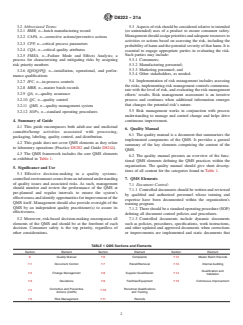
6.2 The quality manual presents an overview of the func-
as exhibited in Table 1.
tional QMS elements defining the QMS practices within the
organization. The quality manual should give short descrip-
5. Significance and Use
tions of all content for the categories found in Table 1.
5.1 Effective decision-making in a quality systems-
controlledenvironmentcomesfromaninformedunderstanding 7. QMS Elements
of quality issues and associated risks. As such, management
7.1 Document Control:
should monitor and review the performance of the QMS at
7.1.1 Controlled documents should be written and reviewed
pre-planned and regular intervals to ensure the system’s
by qualified and authorized personnel whose training and
effectiveness and identify opportunities for improvement of the
expertise have been documented within the organization’s
QMS itself. Management should also provide oversight of the
training program.
QMS by an independent quality practitioner(s) to assure its
7.1.2 There should be a standard operating procedure (SOP)
effectiveness.
defining all document control policies and procedures.
5.2 Moreover, risk-based decision-making encompasses all 7.1.3 Controlled documents include dynamic documents
elements of the QMS and should be at the forefront of each such as policies, procedures, specifications, work instructions,
decision. Consumer safety is the top priority, regardless of and other updated and approved documents when corrections
other considerations. or improvements are implemented and static documents that
TABLE 1 QMS Sections and Elements
Section Element Section Element Section Element
6 Quality Manual 7.6 Complaints 7.12 Master Batch Records
7.1 Document Control 7.7 Recall/Removal 7.13 Internal Auditing
Qualification and
7.2 Change Management 7.8 Supplier Qualification 7.14
Validation
7.3 Deviations 7.9 Facilities/Equipment 7.15 Continuous Improvement
Corrective and Preventive Personnel Qualifications
7.4 7.10
Actions (CAPA) and Training
7.5 Risk Management 7.11 Records
D8222 − 21a
are permanent records of what has occurred in the past. Prior 7.2.1 Change management should include a process for
versions of dynamic documents become permanent records tracking changes and their outcomes.
when new versions are approved.
7.2.2 ThereshouldbeanSOPthatdefinesallchangecontrol
7.1.4 Controlled documents include all documents and re- procedures.
cords that support the manufacturing operation and the QMS
7.2.3 Change management applies to any change within the
operation. These documents and records include but are not
QMS relative to procedures, instrumentation, equipment, raw
limited to the following:
material, process, or product specifications.
7.1.4.1 Policies;
7.2.4 Changes that occur within the following should be
7.1.4.2 SOPs and work instructions;
subjected to change management protocol:
7.1.4.3 Qualified individual criteria;
7.2.4.1 Facilities,
7.1.4.4 Internal training curriculum;
7.2.4.2 Equipment,
7.1.4.5 Master batch and batch manufacturing records;
7.2.4.3 Instrumentation,
7.1.4.6 Training records;
7.2.4.4 Software systems,
7.1.4.7 Maintenance records;
7.2.4.5 Key management/corporate structure/ownership,
7.1.4.8 Process, equipment, supplies, product, and other
7.2.4.6 Corporate policy,
verification and validation data;
7.2.4.7 Customer requirements,
7.1.4.9 Facility, process equipment, material, product, and
7.2.4.8 Product specifications,
other specifications;
7.2.4.9 The material used in the production or testing of the
7.1.4.10 Operation, owners, and user manuals;
product,
7.1.4.11 Schematics;
7.2.4.10 Processes that may affect product, and
7.1.4.12 Calibration records and test data;
7.2.4.11 Modifications to SOPs from revision or corrective
7.1.4.13 Corrective and preventive action records;
action/preventive action initiatives.
7.1.4.14 Deviation records;
7.2.5 The change management program should affect all
7.1.4.15 Complaint and recall records;
changes related to procedures and be fully documented and
7.1.4.16 Change management records;
verified such that all appropriate elements have been registered
7.1.4.17 Internal and external audit records; and
and all procedures and policies involved are updated to reflect
7.1.4.18 Supplier qualification records.
the changes. These changes should include:
7.1.5 Documents may exist as hard copies, electronic, or
7.2.5.1 Updating all relevant SOPs for procedural changes
both.
and listing the progressive chronology of these changes,
7.1.6 All changes made to procedures should be justified,
7.2.5.2 Modifying all documents supporting existing speci-
recorded, and only implemented after validation and approval.
fications affected by the change event, and
7.1.7 Current and authorized procedures and work instruc-
7.2.5.3 Supporting modified documentation resulting from
tions should be readily available to the staff responsible for
corrective and preventive actions (CAPA) efforts resulting in
executing their protocol at all times.
protocol change.
7.1.8 All obsolete procedures, work instructions,
specifications, and other such documents should be identified,
7.3 Deviations:
located, and secured in a manner that prevents accidental usage
7.3.1 The purpose of the deviation protocol is to ensure that
for the current operations.
deviations are documented and thoroughly investigated to
7.1.9 Quality assurance staff or other authorized personnel
determine their impact on quality. This investigation includes
should periodically review all documents and, when necessary,
root cause analysis to avoid recurrence.
revise them to ensure continuing suitability and compliance
7.3.2 There should be an SOP for handling all deviations.
with applicable requirements.
7.3.3 Deviation management and record-keeping may be
7.1.10 Documents should be uniquely identified and include
included in SOPs and work instructions.
the following:
7.3.4 Circumstances may require deviation from approved
7.1.10.1 Document identification (unique alpha-numeric
instructions to occur, resulting in a planned deviation. These
designation);
are known in advance, allowing for appropriate planning and
7.1.10.2 Document title;
consideration before their occurrence.
7.1.10.3 Date of effectiveness;
7.3.5 When a deviation occurs unexpectedly, it is consid-
7.1.10.4 Current revision date and chronological revision
ered as an unplanned deviation (nonconforming work) requir-
history;
ing a work stoppage and initiation of corrective action proce-
7.1.10.5 Page numbering, and
dures.
7.1.10.6 Identification of issuing/approval authorities.
7.3.6 Deviations from established instructions are subject to
7.1.11 All documents should be reviewed and approved for
investigation and quality assurance (QA) approval.
use by authorized personnel before implementation.
7.3.7 Deviation approval/closure is based on the adequacy
7.1.12 Current revision status and distribution of documents
of impact/risk analysis and any proposed corrective or preven-
should be established and readily available to preclude the use
tive actions.
of invalid or obsolete documents.
7.3.8 The information and data from the investigations
7.2 Change Management: resulting from the deviation should be included in the batch
D8222 − 21a
manufacturing record (BMR) of any affected product batch 7.6.5 Any associated deviation and CAPA numbers should
regardless of the final disposition. be logged with the specific complaint report and archived.
7.3.9 Each deviation should be assigned a unique number
7.7 Product Recall/Removal:
and archived as part of document control protocol.
7.7.1 Each manufacturer should establish and maintain
7.4 Corrective and Preventive Actions (CAPA):
procedures for identifying product during all material receipt,
7.4.1 The purpose of the CAPA procedures are to ensure production, inventory, and distribution stages.
that existing non-conformities are corrected, and their recur-
7.7.2 There should be an SOP for the organization’s proto-
rence is prevented. For information on this topic, see Guide
cols for handling recalls and product removals. For more
D8229.
information on this subject, see Guide D8220.
7.4.2 CAPA protocols capture and track the completion of
7.7.3 Throughout the life cycle of a cannabis/hemp product,
improvements identified in deviation and complaint
a label containing a unique identifier for the material should be
investigations, audits, and annual product reviews.
applied and maintained to ensure the cannabis/hemp product’s
7.4.3 In response to CAPA, changes in procedures,
traceability.
processes, or specifications are implemented and documented
7.7.4 A recall/removal system should be established to
through the change management program.
document, investigate properly, and follow-up on any potential
7.4.4 The CAPA protocol information is monitored,
problems related to products that have been affected by a
reviewed, approved, and
...
This document is not an ASTM standard and is intended only to provide the user of an ASTM standard an indication of what changes have been made to the previous version. Because
it may not be technically possible to adequately depict all changes accurately, ASTM recommends that users consult prior editions as appropriate. In all cases only the current version
of the standard as published by ASTM is to be considered the official document.
Designation: D8222 − 21 D8222 − 21a
Standard Guide for
Establishing a Quality Management System (QMS) for
Consumer Use of Cannabis/Hemp Products
This standard is issued under the fixed designation D8222; the number immediately following the designation indicates the year of
original adoption or, in the case of revision, the year of last revision. A number in parentheses indicates the year of last reapproval. A
superscript epsilon (´) indicates an editorial change since the last revision or reapproval.
1. Scope
1.1 This guide focuses on the core elements of an effective quality management system (QMS) necessary to assureoptimize
consumer and product safety, product quality, and conformance with requirements from industry, governmental agencies, and other
authorities having jurisdiction. This guide incorporates basic quality principles, guidelines, and industry best practices necessary
to establish a QMS adaptable to all organizations.
1.2 Laws and regulations from authorities having jurisdiction supersede recommendations within this guide.
1.3 This standard does not purport to address all of the safety concerns, if any, associated with its use. It is the responsibility
of the user of this standard to establish appropriate safety, health, and environmental practices and determine the applicability of
regulatory limitations prior to use.
1.4 This international standard was developed in accordance with internationally recognized principles on standardization
established in the Decision on Principles for the Development of International Standards, Guides and Recommendations issued
by the World Trade Organization Technical Barriers to Trade (TBT) Committee.
2. Referenced Documents
2.1 ASTM Standards:
D8220 Guide for Conducting Recall/Removal Procedures for Products in the Cannabis Industry
D8229 Guide for Corrective Action and Preventive Action (CAPA) for the Cannabis Industry
D8220D8244 Guide for Conducting Recall/Removal Procedures for Products in the CannabisAnalytical Laboratory Operations
Supporting the Cannabis/Hemp Industry
D8250 Practice for Applying a Hazard Analysis Critical Control Points (HACCP) System for Cannabis Consumable Products
D8286 Guide for Processing Cannabis Product Complaints
D8308 Practice for Cannabis/Hemp Operation Compliance Audits
D8270 Terminology Relating to Cannabis
D8282 Practice for Laboratory Test Method Validation and Method Development
D8244D8286 Guide for Analytical Laboratory Operations Supporting the Cannabis/Hemp IndustryProcessing Cannabis Product
Complaints
2.2 ASQ Document:
Failure Mode and Effects AnalysesAnalysis (FMEA) Brief Summary
This guide is under the jurisdiction of ASTM Committee D37 on Cannabis and is the direct responsibility of Subcommittee D37.02 on Quality Management Systems.
Current edition approved Feb. 1, 2021July 15, 2021. Published February 2021August 2021. Originally approved in 2021. Last previous edition approved in 2021 as D8222
– 21. DOI: 10.1520/D8222-21.10.1520/D8222-21A.
For referenced ASTM standards, visit the ASTM website, www.astm.org, or contact ASTM Customer Service at service@astm.org. For Annual Book of ASTM Standards
volume information, refer to the standard’s Document Summary page on the ASTM website.
Available from American Society for Quality (ASQ), 600 N. Plankinton Ave., Milwaukee, WI 53203, http://www.asq.org.
Copyright © ASTM International, 100 Barr Harbor Drive, PO Box C700, West Conshohocken, PA 19428-2959. United States
D8222 − 21a
3. Terminology
3.1 Definitions:Definitions of Terms Specific to This Standard:
3.1.1 controlled document, n—a document with an alpha-numeric assignment that is integrated into a QMS and subject to revision
and revision tracking.
3.1.2 equipment, n—non-expendable, tangible moveable property needed for the performance of a task or useful in effecting an
obligation.
3.1.3 instrumentation, n—equipment capable of performing measurements used to generate analytical data (for example, GC-MS,
IR, NMR, balances, etc.).
3.1.4 qualified individual, n—an individual who meets legitimateapplicable skill, experience, education, or other requirements of
an employment position that they hold or seek, and who can perform the essential functions of the job with or without reasonable
accommodation.
3.1.5 planned deviation, n—pre-approved deviations from the current operational document or system, covering a specified period
or number of batches.
3.1.5.1 Discussion—
Planned deviations must be approved before execution. Planned deviations should be handled through approved change control
procedures.
3.1.6 recall, n—a product recall is the process of retrieving defective or potentially unsafe goods from consumers and providing
those consumers with compensation.
3.1.7 withdrawal,removal, n—a product is removed from the supply chain, but not for health and safety reasons.
3.1.8 BMR, unplanned deviation, n—batch manufacturing recorda state of nonconformance from the designed systems or
procedures at any stage of manufacturing, packaging, testing, holding, or storage of the product.
3.1.5 CAPA, n—corrective actions/preventive actions
3.1.6 CPP, n—critical process parameters
3.1.7 CQA, n—critical quality attributes
3.1.8 FMEA, n—Failure Mode and Effects Analyses
3.1.9 IQ/OQ/PQ, n—installation, operational, and performance qualifications
3.1.10 IPC, n—in-process controls
3.1.11 MBR, n—master batch records
3.1.12 QA, n—quality assurance
3.1.13 QMS, n—quality management system
3.1.14 SOPs, n—standard operating procedures
3.2 Abbreviated Terms:
3.2.1 BMR, n—batch manufacturing record
D8222 − 21a
3.2.2 CAPA, n—corrective actions/preventive actions
3.2.3 CPP, n—critical process parameters
3.2.4 CQA, n—critical quality attributes
3.2.5 FMEA, n—Failure Mode and Effects Analysis; a process for characterizing and mitigating risks by assigning risk priority
numbers
3.2.6 IQ/OQ/PQ, n—installation, operational, and performance qualifications
3.2.7 IPC, n—in-process controls
3.2.8 MBR, n—master batch records
3.2.9 QA, n—quality assurance
3.2.10 QC, n—quality control
3.2.11 QMS, n—quality management system
3.2.12 SOPs, n—standard operating procedures
4. Summary of Guide
4.1 This guide encompasses both recreationaladult-use and medicinal cannabiscannabis/hemp activities associated with
processing, packaging, labeling, quality control, and distribution activities.distribution.
4.2 This guide does not cover QMS elements as they relate to laboratory operations. (See Practice operations (Practice D8282 and
Guide D8244.)).
4.3 The QMS framework includes the core QMS elements as exhibited in Table 1.
5. Significance and Use
5.1 Effective decision-making in a quality systems-controlled environment comes from an informed understanding of quality
issues and associated risks. As such, management should monitor and review the performance of the QMS at planned pre-planned
and regular intervals to ensure the system’s effectiveness and identify opportunities for improvement of the QMS itself.
Management should also provide oversight of the QMS by an independent quality practitioner(s) to assure its effectiveness.
TABLE 1 QMS Sections and Elements
Section Element Section Element Section Element
6 Quality Manual 7.6 Complaints 7.12 Master Batch Records
7.1 Document Control 7.7 Recall/Withdrawal 7.13 Internal Auditing
7.1 Document Control 7.7 Recall/Removal 7.13 Internal Auditing
Qualification and
7.2 Change Management 7.8 Supplier Qualification 7.14
Validation
7.3 Deviations 7.9 Facilities/Equipment 7.15 Continuous Improvement
Corrective and Preventive Personnel Qualifications
7.4 7.10
Actions (CAPA) and Training
7.5 Risk Management 7.11 Records
D8222 − 21a
5.2 Moreover, risk-based decision-making encompasses all elements of the QMS and should be at the forefront of each decision.
Consumer safety is the top priority, regardless of other considerations.
5.3 Aspects of risk should be considered relative to intended (or unintended) uses of a product to ensure consumer safety.
Management should assign priorities and adequate resources to activities or actions based on assessing the risk, including the
probability of harm and the potential severity of that harm. It is essential to engage appropriate parties in evaluating the risk. Such
parties may include:
5.3.1 Consumers;
5.3.2 Manufacturing personnel;
5.3.3 Marketing personnel; and
5.3.4 Other stakeholders, as needed.
5.4 Implementation of risk management includes assessing the risks, implementing risk management controls commensurate with
the level of risk, and evaluating the risk management efforts’ results. Risk management assessment is an iterative process and
continues when additional information emerges that changes the potential risk’s nature.
5.5 Risk management works in conjunction with process understanding to manage and control change and helps drive continuous
improvement.
6. Quality Manual
6.1 The quality manual is a document that summarizes the implemented components of the QMS. It provides a general summary
of the key elements comprising the content of the QMS.
6.2 The quality manual presents an overview of the functional QMS elements defining the QMS practices within the organization.
The quality manual should give short descriptions of all content for the categories found in Table 1.
7. QMS Elements
7.1 Document Control:
7.1.1 Controlled documents should be written and reviewed by personnel with the appropriate experience, education, and
training.qualified and authorized personnel whose training and expertise have been documented within the organization’s training
program.
7.1.2 There should be a standard operating procedure (SOP) defining all document control policies and procedures.
7.1.3 Controlled documents include dynamic documents such as policies, procedures, specifications, work instructions, and other
updated and approved documents when corrections or improvements are implemented and static documents that are permanent
records of what has occurred in the past. Prior versions of dynamic documents become permanent records when new versions are
approved.
7.1.3 There should be a standard operating procedure (SOP) defining all document control policies and procedures.
7.1.4 Controlled documents include all documents and records that support the manufacturing operation and the QMS operation.
These documents and records include but are not limited to the following:
7.1.4.1 Policies;
7.1.4.2 SOPs and work instructions;
7.1.4.3 Qualified individual criteria;
D8222 − 21a
7.1.4.4 Internal training curriculum;
7.1.4.5 Master batch and batch manufacturing records;
7.1.4.6 Training records;
7.1.4.7 Maintenance records;
7.1.4.8 Process, equipment, supplies, product, and other verification and validation data;
7.1.4.9 Facility, process equipment, material, product, and other specifications;
7.1.4.10 Operation, owners, and user manuals;
7.1.4.11 Schematics;
7.1.4.12 Calibration records and test data;
7.1.4.13 Corrective and preventive action records;
7.1.4.14 Deviation records;
7.1.4.15 Complaint and recall records;
7.1.4.16 Changes controlChange management records;
7.1.4.17 Internal and external audit records; and
7.1.4.18 Supplier qualification records.
7.1.5 Documents may exist as hard copies, electronic, or both.
7.1.6 All significant changes made to procedures should be justified, recorded, and only implemented after validation and
approval.
7.1.7 Current and authorized procedures and work instructions documents should be readily available to the staff responsible for
executing their protocol.protocol at all times.
7.1.8 All obsolete procedures, work instructions, specifications, and other such documents should be identified, located, and
secured in a manner that prevents accidental usage for the current operations.
7.1.9 Quality staff assurance staff or other authorized personnel should periodically review all documents and, when necessary,
revise them to ensure continuing suitability and compliance with applicable requirements.
7.1.10 Documents should be uniquely identified and include the following:
7.1.10.1 Document identification (unique alpha-numeric designation);
7.1.10.2 Document title;
7.1.10.3 Date of effectiveness;
7.1.10.4 Current revision;revision date and chronological revision history;
7.1.10.5 Page numbering, and
7.1.10.6 Identification of issuing/approval authority.authorities.
D8222 − 21a
7.1.11 All documents should be reviewed and approved for use by authorized personnel before release.implementation.
7.1.12 Current revision status and distribution of documents should be established and readily available to preclude the use of
invalid or obsolete documents.
7.2 Change Control and Change Management:
7.2.1 Change management should include a process for tracking changes and their outcomes.
7.2.2 There should be an SOP that defines all change control procedures.
7.2.3 Change management applies to any change within the QMS relative to procedures, instrumentation, equipment, raw
material, process, or product specifications.
7.2.4 Change management applies to any change within the QMS relative to procedures, instrumentation, equipment, raw
material, process, or product specifications. Changes that occur within the following should be subjected to change management
protocol:
7.2.4.1 Facilities,
7.2.4.2 Equipment/instrumentation,Equipment,
7.2.4.3 Instrumentation,
7.2.4.4 Software systems,
7.2.4.5 Key management/corporate structure/ownership,
7.2.4.6 Corporate policy,
7.2.4.7 Customer requirements,
7.2.4.8 Product specifications,
7.2.4.9 The material used in the production or testing of the product,
7.2.4.10 Processes that may affect product, and
7.2.4.11 Modifications to SOPs’SOPs from revision or corrective action/preventive action initiatives.
7.2.5 The change management program should affect all changes related to procedures and be fully documented and verified such
that all appropriate elements have been registered and all procedures and policies involved are updated to reflect the changes. These
changes should include:
7.2.5.1 Updating all relevant SOPs’SOPs for procedural changes and listing the progressive chronology of these changes,
7.2.5.2 Modifying all documents supporting existing specifications affected by the change event, and
7.2.5.3 Supporting modified documentation resulting from corrective and preventive actions (CAPA) efforts resulting in protocol
change.
7.3 Deviations:
7.3.1 The purpose of the deviation protocol is to ensure that deviations are documented and thoroughly investigated to determine
their impact on quality. This investigation includes root cause analysis to avoid recurrence.
7.3.2 There should be an SOP for handling all deviations.
D8222 − 21a
7.3.3 Deviation management and record-keeping may be included in SOPs and work instructions.
7.3.4 Circumstances may require deviation from approved instructions to occur, resulting in a planned deviation. These are known
in advance, allowing for appropriate planning and consideration before their occurrence.
7.3.5 When a deviation occurs unexpectedly, it is considered as an unplanned deviation.deviation (nonconforming work) requiring
a work stoppage and initiation of corrective action procedures.
7.3.6 Deviations from established instructions are subject to investigation and quality assurance (QA) approval.
7.3.7 Deviation approval/closure is based on the adequacy of impact/risk analysis and any proposed corrective or preventive
actions.
7.3.8 The information and data from the investigations resulting from the deviation should be included in the batch manufacturing
record (BMR) of any affected product batch regardless of the final disposition.
7.3.9 Each deviation should be assigned a unique number and archived as part of document control protocol.
7.4 Corrective and Preventive Actions (CAPA):
7.4.1 The purpose of the CAPA procedures are to ensure that existing non-conformities are corrected, and their recurrence is
avoided (Guide prevented. For information on this topic, see Guide D8229).
7.4.2 CAPA protocols capture and track the completion of improvements identified in deviation and complaint investigations,
audits, and annual product reviews.
7.4.3 Changes In response to CAPA, changes in procedures, processes, or specifications are implemented and documented through
the change controlmanagement program.
7.4.4 The CAPA protocol information is monitored, reviewed, approved, and tracked by QAs qualified individuals.personnel.
7.5 Risk Management:
7.5.1 The purpose of the risk management system is to provide a means to identify, evaluate, measure, and document risks,
including their likelihood to occur, probability, and potential impact on systems, processes, or materials within production and
storage facilities, or the products produced.
7.5.2 There should be an SOP for risk management assessment procedures.
7.5.3 The evaluation and mitigation of risks apply to all quality systems and operations throughout the manufacturing operations.
7.5.4 The level of effort, formality, and documentation of the quality risk management process is commensurate with the level of
risk.
7.5.5 Risk analysesanalysis can be measured using Hazard Analysis Critical Control Point (HACCP, see Practice D8250, Failure
Mode and Effects Analyses (FMEA), Analysis (FMEA), or other risk assessment tools where process risks are considered,
metricized,measured, and recommended actions implemented as part of a CAPA protocol.
7.6 Complaints:
7.6.1 All complaints and reasons for returned goods should be investigated (Guide evaluated. For information on this topic, see
Guide D8286).
7.6.2 There should be an SOP for handling consumer complaints. The SOP should include a protocol for logging and documenting
the results of complaint investigations.receiving, logging, verifying, tracking, and documenting.
D8222 − 21a
7.6.3 The complaint should be r
...