

ASTM D7499/D7499M-09(2023)
(Test Method)Standard Test Method for Measuring Geosynthetic-Soil Resilient Interface Shear Stiffness
General Information
- Abstract
SIGNIFICANCE AND USE
5.1 This test method is intended as a performance test to provide the user with a set of design values for the test conditions examined.
5.1.1 The test method is applicable to all geosynthetics and all soils when loaded in a cyclic manner.
5.1.2 This test method produces test data, which can be used in the design of geosynthetic-reinforced pavement structures or in applications where geosynthetics are subjected to cyclic loads.
5.1.3 The test results may also provide information related to the in-soil stress-strain response of a geosynthetic under confined loading conditions.
5.2 Information derived from this test may be a function of soil gradation, plasticity, as-placed dry unit weight, moisture content, length and surface characteristics of the geosynthetic, and other test parameters. Therefore, results are expressed in terms of the actual test conditions. The test measures the net effect of a combination of interface shear mechanisms, which may vary depending on type of geosynthetic specimen, embedment length, relative opening size, soil type, displacement rate, normal stress, and other factors.
5.3 Information between laboratories on precision is incomplete. In cases of dispute, comparative tests to determine if there is a statistical bias between laboratories may be advisable.
SCOPE
1.1 This test method details how cyclic loading is applied to geosynthetics embedded in soil to determine the apparent stiffness of the soil–geosynthetic interface.
1.2 Resilient interface shear stiffness describes the shear stiffness between a geosynthetic and its surrounding soil under conditions of small cyclic loads.
1.3 This test method is intended to provide properties for design. The test method was developed for mechanistic empirical pavement design methods requiring input of the resilient interface shear stiffness. The use of this parameter from this test method for other applications involving cyclic loading should be evaluated on a case-by-case basis. It can also be used to compare different geosynthetics, soil types, etc., and thereby be used as a research and development test procedure.
1.4 The values stated in either SI units or inch-pound units are to be regarded separately as standard. The values stated in each system may not be exact equivalents; therefore, each system shall be used independently of the other. Combining values from the two systems may result in nonconformance with the standard.
1.5 This standard does not purport to address all of the safety concerns, if any, associated with its use. It is the responsibility of the user of this standard to establish appropriate safety, health, and environmental practices and determine the applicability of regulatory limitations prior to use.
1.6 This international standard was developed in accordance with internationally recognized principles on standardization established in the Decision on Principles for the Development of International Standards, Guides and Recommendations issued by the World Trade Organization Technical Barriers to Trade (TBT) Committee.
- Status
- Published
- Publication Date
- 31-Jan-2023
- Technical Committee
- D35 - Geosynthetics
- Drafting Committee
- D35.01 - Mechanical Properties
Overview
ASTM D7499/D7499M-09(2023): Standard Test Method for Measuring Geosynthetic-Soil Resilient Interface Shear Stiffness establishes an internationally recognized procedure for evaluating the apparent shear stiffness at the interface between geosynthetics and soil under cyclic loading conditions. Developed by ASTM International, this test method is instrumental in providing critical design values for engineers and designers involved in geotechnical, transportation, and civil engineering projects where geosynthetics reinforce soil structures.
This standard is applicable to all geosynthetic types and soil compositions and is especially relevant to applications involving repetitive or cyclic loads, such as those encountered in pavements and infrastructure subjected to dynamic stress.
Key Topics
- Resilient Interface Shear Stiffness: This parameter measures the stiffness between a geosynthetic material and surrounding soil under repeated, small magnitude loads, offering insight into their combined deformation response.
- Cyclic Loading Procedures: The method details procedures for subjecting geosynthetic-soil systems to controlled cyclic forces and documenting displacement responses.
- Design-Relevant Data: The test delivers measurable data used in the design of geosynthetic-reinforced systems, especially mechanistic-empirical pavement design methods.
- Influencing Factors: Test results depend on soil gradation, plasticity, dry unit weight, moisture content, geosynthetic type, embedment length, normal stress, and displacement rate.
- Versatile Use: The test can be applied for both design and research purposes, including comparative evaluations of geosynthetic materials and soil types.
Applications
The ASTM D7499/D7499M-09(2023) standard is essential for:
- Geosynthetic-Reinforced Pavement Design: Using empirical data from the test method to optimize pavement systems where geosynthetics improve performance and durability under traffic loads.
- Road and Transportation Infrastructure: Supporting design validation where soil structures must withstand repeated vehicle loads, reducing deformation and increasing longevity.
- Retaining Structures and Embankments: Evaluating the stress-strain behavior at interfaces in soil-retaining structures that utilize geosynthetic reinforcement.
- Research & Product Development: Comparing performance characteristics of new or alternative geosynthetic materials and soil types for improved product selection and R&D.
- Quality Assurance & Specification Compliance: Assisting in establishing and verifying design parameters and construction quality for compliance with project specifications and regulatory guidelines.
Related Standards
For comprehensive geosynthetic and soil interface evaluation, the following ASTM standards complement ASTM D7499/D7499M-09(2023):
- ASTM D123 - Terminology Relating to Textiles
- ASTM D653 - Terminology Relating to Soil, Rock, and Contained Fluids
- ASTM D4354 - Practice for Sampling of Geosynthetics and Rolled Erosion Control Products (RECPs) for Testing
- ASTM D4439 - Terminology for Geosynthetics
Practical Value
Implementing the ASTM D7499/D7499M-09(2023) test method provides engineers and infrastructure designers with:
- Reliable Design Data: Quantifies the resilient interface shear stiffness under realistic, cyclic loading, leading to safer, more reliable, and optimized designs.
- Performance Benchmarking: Enables comparison between different geosynthetics and soil systems, supporting material selection and innovation.
- Consistent Results: Promotes uniform testing practices, supporting cross-laboratory comparisons when procedures are closely followed.
- Risk Reduction: Helps anticipate and mitigate issues related to soil-geosynthetic deformations, enhancing the durability and stability of critical structures.
Keywords
Geosynthetic-soil interface, resilient shear stiffness, cyclic loading, geosynthetic-reinforced pavement, ASTM D7499, soil-geosynthetic interaction, performance test, infrastructure design, pullout resistance, civil engineering standards.
Relations
- Effective Date
- 01-Feb-2024
- Effective Date
- 01-Nov-2023
- Effective Date
- 01-May-2020
- Effective Date
- 15-Apr-2018
- Effective Date
- 01-Aug-2017
- Effective Date
- 01-Mar-2017
- Effective Date
- 15-Sep-2015
- Effective Date
- 01-Sep-2015
- Effective Date
- 01-Sep-2015
- Effective Date
- 01-Jul-2015
- Effective Date
- 01-Apr-2015
- Effective Date
- 01-Aug-2014
- Effective Date
- 01-Mar-2014
- Effective Date
- 15-Jun-2013
- Effective Date
- 15-Jun-2013
Get Certified
Connect with accredited certification bodies for this standard

Control Union Certifications
Global certification for agriculture and sustainability.

Hohenstein Institut
Textile testing and certification.

Bureau Veritas Bangladesh
Bureau Veritas certification services in Bangladesh.
Sponsored listings
Frequently Asked Questions
ASTM D7499/D7499M-09(2023) is a standard published by ASTM International. Its full title is "Standard Test Method for Measuring Geosynthetic-Soil Resilient Interface Shear Stiffness". This standard covers: SIGNIFICANCE AND USE 5.1 This test method is intended as a performance test to provide the user with a set of design values for the test conditions examined. 5.1.1 The test method is applicable to all geosynthetics and all soils when loaded in a cyclic manner. 5.1.2 This test method produces test data, which can be used in the design of geosynthetic-reinforced pavement structures or in applications where geosynthetics are subjected to cyclic loads. 5.1.3 The test results may also provide information related to the in-soil stress-strain response of a geosynthetic under confined loading conditions. 5.2 Information derived from this test may be a function of soil gradation, plasticity, as-placed dry unit weight, moisture content, length and surface characteristics of the geosynthetic, and other test parameters. Therefore, results are expressed in terms of the actual test conditions. The test measures the net effect of a combination of interface shear mechanisms, which may vary depending on type of geosynthetic specimen, embedment length, relative opening size, soil type, displacement rate, normal stress, and other factors. 5.3 Information between laboratories on precision is incomplete. In cases of dispute, comparative tests to determine if there is a statistical bias between laboratories may be advisable. SCOPE 1.1 This test method details how cyclic loading is applied to geosynthetics embedded in soil to determine the apparent stiffness of the soil–geosynthetic interface. 1.2 Resilient interface shear stiffness describes the shear stiffness between a geosynthetic and its surrounding soil under conditions of small cyclic loads. 1.3 This test method is intended to provide properties for design. The test method was developed for mechanistic empirical pavement design methods requiring input of the resilient interface shear stiffness. The use of this parameter from this test method for other applications involving cyclic loading should be evaluated on a case-by-case basis. It can also be used to compare different geosynthetics, soil types, etc., and thereby be used as a research and development test procedure. 1.4 The values stated in either SI units or inch-pound units are to be regarded separately as standard. The values stated in each system may not be exact equivalents; therefore, each system shall be used independently of the other. Combining values from the two systems may result in nonconformance with the standard. 1.5 This standard does not purport to address all of the safety concerns, if any, associated with its use. It is the responsibility of the user of this standard to establish appropriate safety, health, and environmental practices and determine the applicability of regulatory limitations prior to use. 1.6 This international standard was developed in accordance with internationally recognized principles on standardization established in the Decision on Principles for the Development of International Standards, Guides and Recommendations issued by the World Trade Organization Technical Barriers to Trade (TBT) Committee.
SIGNIFICANCE AND USE 5.1 This test method is intended as a performance test to provide the user with a set of design values for the test conditions examined. 5.1.1 The test method is applicable to all geosynthetics and all soils when loaded in a cyclic manner. 5.1.2 This test method produces test data, which can be used in the design of geosynthetic-reinforced pavement structures or in applications where geosynthetics are subjected to cyclic loads. 5.1.3 The test results may also provide information related to the in-soil stress-strain response of a geosynthetic under confined loading conditions. 5.2 Information derived from this test may be a function of soil gradation, plasticity, as-placed dry unit weight, moisture content, length and surface characteristics of the geosynthetic, and other test parameters. Therefore, results are expressed in terms of the actual test conditions. The test measures the net effect of a combination of interface shear mechanisms, which may vary depending on type of geosynthetic specimen, embedment length, relative opening size, soil type, displacement rate, normal stress, and other factors. 5.3 Information between laboratories on precision is incomplete. In cases of dispute, comparative tests to determine if there is a statistical bias between laboratories may be advisable. SCOPE 1.1 This test method details how cyclic loading is applied to geosynthetics embedded in soil to determine the apparent stiffness of the soil–geosynthetic interface. 1.2 Resilient interface shear stiffness describes the shear stiffness between a geosynthetic and its surrounding soil under conditions of small cyclic loads. 1.3 This test method is intended to provide properties for design. The test method was developed for mechanistic empirical pavement design methods requiring input of the resilient interface shear stiffness. The use of this parameter from this test method for other applications involving cyclic loading should be evaluated on a case-by-case basis. It can also be used to compare different geosynthetics, soil types, etc., and thereby be used as a research and development test procedure. 1.4 The values stated in either SI units or inch-pound units are to be regarded separately as standard. The values stated in each system may not be exact equivalents; therefore, each system shall be used independently of the other. Combining values from the two systems may result in nonconformance with the standard. 1.5 This standard does not purport to address all of the safety concerns, if any, associated with its use. It is the responsibility of the user of this standard to establish appropriate safety, health, and environmental practices and determine the applicability of regulatory limitations prior to use. 1.6 This international standard was developed in accordance with internationally recognized principles on standardization established in the Decision on Principles for the Development of International Standards, Guides and Recommendations issued by the World Trade Organization Technical Barriers to Trade (TBT) Committee.
ASTM D7499/D7499M-09(2023) is classified under the following ICS (International Classification for Standards) categories: 59.080.70 - Geotextiles. The ICS classification helps identify the subject area and facilitates finding related standards.
ASTM D7499/D7499M-09(2023) has the following relationships with other standards: It is inter standard links to ASTM D4439-24, ASTM D3080/D3080M-23, ASTM D4354-12(2020), ASTM D4439-18, ASTM D4439-17, ASTM D123-17, ASTM D123-15b, ASTM D123-15a, ASTM D4439-15a, ASTM D4439-15, ASTM D123-15, ASTM D653-14, ASTM D4439-14, ASTM D123-13ae1, ASTM D123-13a. Understanding these relationships helps ensure you are using the most current and applicable version of the standard.
ASTM D7499/D7499M-09(2023) is available in PDF format for immediate download after purchase. The document can be added to your cart and obtained through the secure checkout process. Digital delivery ensures instant access to the complete standard document.
Standards Content (Sample)
This international standard was developed in accordance with internationally recognized principles on standardization established in the Decision on Principles for the
Development of International Standards, Guides and Recommendations issued by the World Trade Organization Technical Barriers to Trade (TBT) Committee.
Designation: D7499/D7499M − 09 (Reapproved 2023)
Standard Test Method for
Measuring Geosynthetic-Soil Resilient Interface Shear
Stiffness
This standard is issued under the fixed designation D7499/D7499M; the number immediately following the designation indicates the
year of original adoption or, in the case of revision, the year of last revision. A number in parentheses indicates the year of last
reapproval. A superscript epsilon (´) indicates an editorial change since the last revision or reapproval.
1. Scope 2. Referenced Documents
2.1 ASTM Standards:
1.1 This test method details how cyclic loading is applied to
D123 Terminology Relating to Textiles
geosynthetics embedded in soil to determine the apparent
D653 Terminology Relating to Soil, Rock, and Contained
stiffness of the soil–geosynthetic interface.
Fluids
1.2 Resilient interface shear stiffness describes the shear
D3080/D3080M Test Method for Direct Shear Test of Soils
stiffness between a geosynthetic and its surrounding soil under
Under Consolidated Drained Conditions (Withdrawn
conditions of small cyclic loads.
2020)
D4354 Practice for Sampling of Geosynthetics and Rolled
1.3 This test method is intended to provide properties for
Erosion Control Products (RECPs) for Testing
design. The test method was developed for mechanistic em-
D4439 Terminology for Geosynthetics
pirical pavement design methods requiring input of the resilient
interface shear stiffness. The use of this parameter from this
3. Terminology
test method for other applications involving cyclic loading
3.1 For definitions of other terms used in this test method
should be evaluated on a case-by-case basis. It can also be used
refer to Terminologies D123, D653, and D4439.
to compare different geosynthetics, soil types, etc., and thereby
be used as a research and development test procedure.
3.2 Definitions of Terms Specific to This Standard:
3.2.1 apertures, n—the open spaces in geogrids which
1.4 The values stated in either SI units or inch-pound units
enable soil interlocking to occur.
are to be regarded separately as standard. The values stated in
3.2.2 atmosphere for testing geosynthetics, n—air main-
each system may not be exact equivalents; therefore, each
tained at a relative humidity of 60 6 10 % and a temperature
system shall be used independently of the other. Combining
of 21 6 2 °C [70 6 4 °F].
values from the two systems may result in nonconformance
with the standard. 3.2.3 cross-machine direction, n—the direction in the plane
of the geosynthetic perpendicular to the direction of manufac-
1.5 This standard does not purport to address all of the
ture.
safety concerns, if any, associated with its use. It is the
3.2.4 failure, n—an arbitrary point at which a material
responsibility of the user of this standard to establish appro-
ceases to be functionally capable of its intended use.
priate safety, health, and environmental practices and deter-
mine the applicability of regulatory limitations prior to use. 3.2.5 geosynthetic, n—a planar product manufactured from
polymeric material used with soil, rock, earth, or other geo-
1.6 This international standard was developed in accor-
technical engineering related material as an integral part of a
dance with internationally recognized principles on standard-
man-made project, structure, or system.
ization established in the Decision on Principles for the
Development of International Standards, Guides and Recom- 3.2.6 geosynthetic-soil resilient interface shear stiffness,
mendations issued by the World Trade Organization Technical n—a parameter that describes the apparent stiffness of the
Barriers to Trade (TBT) Committee. interface between the soil and the geosynthetic determined by
1 2
This test method is under the jurisdiction of ASTM Committee D35 on For referenced ASTM standards, visit the ASTM website, www.astm.org, or
Geosynthetics and is the direct responsibility of Subcommittee D35.01 on Mechani- contact ASTM Customer Service at service@astm.org. For Annual Book of ASTM
cal Properties. Standards volume information, refer to the standard’s Document Summary page on
Current edition approved Feb. 1, 2023. Published February 2023. Originally the ASTM website.
approved in 2009. Last previous edition approved in 2014 as D7499/D7499M – 09 The last approved version of this historical standard is referenced on www.ast-
(2014). DOI: 10.1520/D7499_D7499M-09R23. m.org.
Copyright © ASTM International, 100 Barr Harbor Drive, PO Box C700, West Conshohocken, PA 19428-2959. United States
D7499/D7499M − 09 (2023)
calculating the slope of the shear stress, shear displacement 5. Significance and Use
curve as the embedded geosynthetic is subjected to a cyclic
5.1 This test method is intended as a performance test to
load.
provide the user with a set of design values for the test
3.2.7 junction, n—the point where geogrid ribs are intercon-
conditions examined.
nected in order to provide structure and dimensional stability.
5.1.1 The test method is applicable to all geosynthetics and
all soils when loaded in a cyclic manner.
3.2.8 machine direction, n—the direction in the plane of the
5.1.2 This test method produces test data, which can be used
geosynthetic parallel to the direction of manufacture.
in the design of geosynthetic-reinforced pavement structures or
3.2.9 pullout, n—the movement of a geosynthetic over its
in applications where geosynthetics are subjected to cyclic
entire embedded length, with initial pullout occurring when the
loads.
back of the specimen moves, and ultimate pullout occurring
5.1.3 The test results may also provide information related
when the movement is uniform over the entire embedded
to the in-soil stress-strain response of a geosynthetic under
length.
confined loading conditions.
3.2.10 pullout force, (kN), n—force required to pull a
5.2 Information derived from this test may be a function of
geosynthetic out of the soil during a pullout test.
soil gradation, plasticity, as-placed dry unit weight, moisture
3.2.11 pullout resistance, (kN/m), n—the pullout force per
content, length and surface characteristics of the geosynthetic,
width of geosynthetic measured at a specified condition of
and other test parameters. Therefore, results are expressed in
displacement.
terms of the actual test conditions. The test measures the net
3.2.12 rib, n—the continuous elements of a geogrid which
effect of a combination of interface shear mechanisms, which
are either in the machine or cross-machine direction as
may vary depending on type of geosynthetic specimen, em-
manufactured.
bedment length, relative opening size, soil type, displacement
rate, normal stress, and other factors.
3.2.13 wire gage, n—a displacement gage consisting of a
non-extensible wire attached to the geosynthetic and monitored
5.3 Information between laboratories on precision is incom-
by connection to a dial extensometer, or electronic displace-
plete. In cases of dispute, comparative tests to determine if
ment transducer.
there is a statistical bias between laboratories may be advis-
able.
4. Summary of Test Method
4.1 In this test method, a horizontal layer of geosynthetic is 6. Apparatus
embedded between two layers of soil. Six prescribed levels of
6.1 Test Box—An open rigid box consisting of two smooth
horizontal cyclic force are applied to the geosynthetic at five
parallel sides, a back wall, a horizontal split removable door, a
specified levels of normal stress confinement. The maximum
bottom plate, and a load transfer sleeve. The door is at the front
and minimum forces and corresponding displacements are
as defined by the direction of applied cyclic force. A typical
recorded for the last ten cycles of each combination of normal
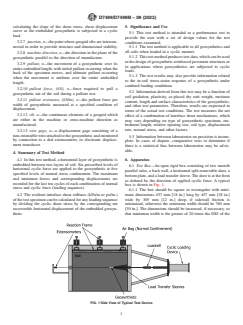
box is shown in Fig. 1.
stress and cyclic force (loading sequence).
6.1.1 The box should be square or rectangular with mini-
4.2 The resilient interface shear stiffness (kPa/m or psi/in.) mum dimensions 457 mm [18 in.] long by 457 mm [18 in.]
of the test specimen can be calculated for any loading sequence wide by 305 mm [12 in.] deep, if sidewall friction is
by dividing the cyclic shear stress by the corresponding net minimized, otherwise the minimum width should be 760 mm
recoverable horizontal displacement of the embedded geosyn- [30 in.]. The dimensions should be increased, if necessary, so
thetic that minimum width is the greater of 20 times the D85 of the
FIG. 1 Side View of Typical Test Device
D7499/D7499M − 09 (2023)
soil or six times the maximum soil particle size, and the load in the direction of the opening of the box. The force must
minimum length greater than five times the maximum geosyn- be at the same level with the specimen.
thetic aperture size. The box shall allow for a minimum depth
6.3.1 The cyclic force system must be able to apply multiple
of 150 mm [6 in.] above and below the geosynthetic. The depth
load repetitions using a haversine-shaped load pulse consisting
of the soil in the box above or below the geosynthetic shall be
of a 0.2 s load followed by a 0.80 s rest period. The loading
a minimum of six times the D85 of the soil or three times the
system must also be able to simultaneously maintain a mini-
maximum particle size of the soil, whichever is greater. The
mum seating load on the material during cyclic loading.
box must allow for at least 305 mm [12 in.] embedment length
6.3.2 Also, a device to measure the cyclic force (that is, a
beyond the load transfer sleeve.
load cell) must be incorporated into the system and shall be
NOTE 1—To remove side wall friction as much as possible a high
accurate within 60.5 % of its full-scale range.
density polyethylene (HDPE) geomembrane should be bonded to the
inside surfaces of the pullout box. The sidewalls may also be covered with 6.4 Displacement Indicators—Horizontal displacement of
a layer of silk fabric, which has been shown to eliminate adhesion and has
the geosynthetic is measured at the entrance of the box and at
a very low friction value. Alternatively, a lubricant can be spread on the
several locations on the embedded portion of the specimen.
sidewalls of the box and thin sheets of polyethylene film used to minimize
Measurements outside the door at the box entrance are made by
the side wall friction. It should be also noted that the effect of sidewall
friction on the soil-geosynthetic interface can also be eliminated if a electronic displacement transducers (for example, linear vari-
minimum distance is kept between the specimen and the side wall. This
able differential transformers (LVDTs) can be used) mounted to
minimum distance is recommended to be 150 mm [6 in.].
the box frame to read against a plate attached to the specimen
6.1.2 The box shall be fitted with a pair of metal sleeves
near the door.
(load transfer sleeves) at the entrance of the box to transfer the
6.4.1 Displacement measurements within the box may em-
force into the soil to a sufficient horizontal distance so as to
ploy any of several methods, which place sensors or gauge
significantly reduce the stress on the door of the box. The
connectors directly on the geosynthetic and monitor their
sleeves shall consist of two tapered (illustrated in Fig. 3) or
change in location remotely. One such device utilizes wire
non-tapered (no more than 13 mm [0.5 in.] thick) plates
gages, which are protected from normal stress by a surrounding
extending the full width of the pullout box and into the pullout
tube, which runs from a location mounted on the specimen to
box a minimum distance of 150 mm [6 in.], but it is
the outside of the box where displacements are measured by
recommended that this distance equal the total soil depth above
displacement transducers.
or below the geosynthetic. Both design types must possess
6.4.2 All electronic measurement devices must be accurate
tapered edges at the point of load application in the soil that are
to 60.01 mm. Locations of the devices must be accurately
no more then 3 mm [0.12 in.] thick. The plates shall be rigidly
determined and recorded. Minimum extension capabilities of
separated at the sides with spacers and be sufficiently stiff such
50 mm [2 in.] are recommended.
that normal stress is not transferred to the geosynthetic between
6.4.3 Determine the displacement of the geosynthetic at the
the plates.
front (leading end) and the rear (embedded end) of the
6.2 Normal Stress Loading Device—Normal stress applied
geosynthetic at several locations along its width; suggested
to the upper layer of soil above the geosynthetic must be
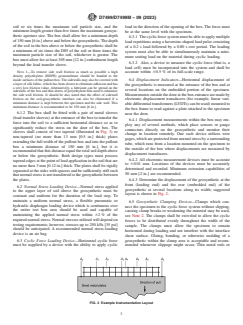
layout is shown in Fig. 2.
constant and uniform for the duration of the load step. To
maintain a uniform normal stress, a flexible pneumatic or
6.5 Geosynthetic Clamping Devices—Clamps which con-
hydraulic diaphragm loading device which is continuous over
nect the specimen to the cyclic force system without slipping,
the entire test box area should be used and capable of
causing clamp breaks or weakening the material may be used,
maintaining the applied normal stress within 62 % of the
see Note 2. The clamps shall be swiveled to allow the cyclic
required normal stress. Normal stresses utilized will depend on
forces to be distributed evenly throughout the width of the
testing requirements; however, stresses up to 250 kPa [35 psi]
sample. The clamps must allow the specimen to remain
should be anticipated. A recommended normal stress-loading
horizontal during loading and not interfere with the interface
device is an air bag.
shear surface. Gluing, bonding, or otherwise molding of a
geosynthetic within the clamp area is acceptable and recom-
6.3 Cyclic Force Loading Device—Horizontal cyclic force
must be supplied by a device with the ability to apply cyclic mended whenever slippage might occur. Thin metal rods or
FIG. 2 Example Instrumentation Layout
D7499/D7499M − 09 (2023)
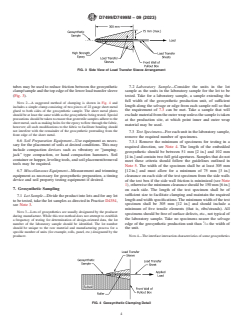
FIG. 3 Side View of Load Transfer Sleeve Arrangement
tubes may be used to reduce friction between the geosynthetic 7.2 Laboratory Sample—Consider the units in the lot
clamp/sample and the top edge of the lower load transfer sleeve sample as the units in the laboratory sample for the lot to be
(Fig. 3). tested. Take for a laboratory sample, a sample extending the
full width of the geosynthetic production unit, of sufficient
NOTE 2—A suggested method of clamping is shown in Fig. 4 and
length along the selvage or edge from each sample roll so that
includes a simple clamp consisting of two pieces of 22 gauge sheet metal
the requirement of 7.3 can be met. Take a sample that will
glued to both sides of the geosynthetic sample. The sheet metal plates
should be at least the same width as the geosynthetic being tested. Special
exclude material from the outer wrap unless the sample is taken
precautions should be taken to ensure that geotextile samples adhere to the
at the production site, at which point inner and outer wrap
sheet metal, such as making holes for the epoxy to flow through the fabric,
material may be used.
however; all such modifications to the fabric to facilitate bonding should
not interfere with the remainder of the geosynthetic protruding from the
7.3 Test Specimens—For each unit in the laboratory sample,
front edge of the sheet metal.
remove the required number of specimens.
6.6 Soil Preparation Equipment—Use equipment as neces-
7.3.1 Remove the minimum of specimens for testing in a
sary for the placement of soils at desired conditions. This may
required direction, see Note 4. The length of the embedded
include compaction devices such as vibratory or “jumping-
geosynthetic should be between 51 mm [2 in.] and 102 mm
jack” type compaction, or hand compaction hammers. Soil
[4 in.] and contain two full grid apertures. Samples that do not
container or hopper, leveling tools, and soil placement/removal
meet these criteria should follow the guidelines outlined in
tools may be required.
Note 5. The width of the specimen
...