


ASTM B327-21
(Specification)Standard Specification for Master Alloys Used in Making Zinc Die Casting Alloys
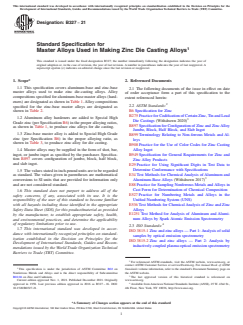
Standard Specification for Master Alloys Used in Making Zinc Die Casting Alloys
ABSTRACT
This specification covers aluminum-base and zinc-base master alloys used to make zinc die-casting alloys. The material may be made by any suitable process. The material covered by this specification shall be of uniform quality and shall be free of dross, flux, or other harmful contamination. If the material is in shot form, it shall be sound, uniform size, and free of a heavily oxidized surface coating, stringers, and moisture. Aluminum-base master alloys (hardeners) shall be tested and conform to the required chemical composition for aluminum, copper, iron, silicon, manganese, magnesium, zinc, chromium, nickel, tin, lead, and cadmium. Zinc-base master alloys shall conform to the color code requirements and to the required alloy composition for aluminum, magnesium, iron, copper, lead, cadmium, tin, and zinc. The weight of jumbo ingots shall conform to the required weight limits.
SCOPE
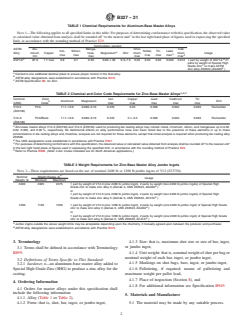
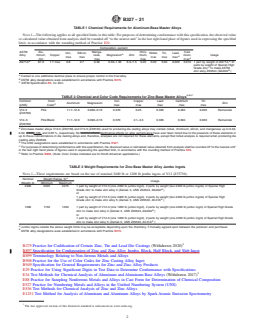
1.1 This specification covers aluminum-base and zinc-base master alloys used to make zinc die-casting alloys. Alloy compositions specified for aluminum-base master alloys (hardeners) are designated as shown in Table 1. Alloy compositions specified for the zinc-base master alloys are designated as shown in Table 2.
1.2 Aluminum alloy hardeners are added to Special High Grade zinc (per Specification B6) in the proper alloying ratios, as shown in Table 1, to produce zinc alloys for die casting.
1.3 Zinc-base master alloy is added to Special High Grade zinc (per Specification B6) in the proper alloying ratio, as shown in Table 3, to produce zinc alloy for die casting.
1.4 Master alloys may be supplied in the form of shot, bar, ingot, or jumbo ingot as specified by the purchaser. Specification B897 covers configuration of jumbo, block, half block, and slab ingot.
1.5 The values stated in inch-pound units are to be regarded as standard. The values given in parentheses are mathematical conversions to SI units that are provided for information only and are not considered standard.
1.6 This standard does not purport to address all of the safety concerns, if any, associated with its use. It is the responsibility of the user of this standard to become familiar with all hazards including those identified in the appropriate Safety Data Sheet (SDS) for this product/material as provided by the manufacturer, to establish appropriate safety, health, and environmental practices, and determine the applicability of regulatory limitations prior to use.
1.7 This international standard was developed in accordance with internationally recognized principles on standardization established in the Decision on Principles for the Development of International Standards, Guides and Recommendations issued by the World Trade Organization Technical Barriers to Trade (TBT) Committee.
General Information
- Status
- Published
- Publication Date
- 31-Oct-2021
- Technical Committee
- B02 - Nonferrous Metals and Alloys
- Drafting Committee
- B02.04 - Zinc and Cadmium
Relations
- Effective Date
- 01-Oct-2017
- Effective Date
- 15-Sep-2017
- Effective Date
- 01-Sep-2017
- Effective Date
- 01-Oct-2016
- Effective Date
- 01-Oct-2015
- Effective Date
- 01-Jun-2015
- Effective Date
- 01-Oct-2014
- Effective Date
- 01-Oct-2014
- Effective Date
- 01-Oct-2014
- Effective Date
- 01-Dec-2013
- Effective Date
- 01-Dec-2013
- Effective Date
- 01-Dec-2013
- Effective Date
- 01-Aug-2013
- Refers
ASTM B949-13 - Standard Specification for General Requirements for Zinc and Zinc Alloy Products - Effective Date
- 01-Aug-2013
- Effective Date
- 01-Feb-2013
Overview
ASTM B327-21 is the internationally recognized standard specification for master alloys used in the production of zinc die casting alloys. Developed by ASTM International, this standard covers requirements for both aluminum-base and zinc-base master alloys, which serve as key additives in creating zinc alloys for die casting applications. It is addressed primarily to producers, suppliers, and users of master alloys within the metals industry, ensuring materials meet strict quality, composition, and form criteria to maintain consistency and reliability in end-use applications.
Key Topics
Material Scope: ASTM B327-21 applies to aluminum-base and zinc-base master alloys designed for incorporation into zinc die casting alloys. These master alloys are fundamental in controlling the chemical composition and physical properties of the final zinc alloy product.
Allowed Forms: Master alloys may be supplied as shot, bar, ingot, or jumbo ingot according to purchaser requirements. The standard defines minimum and maximum weight limits for jumbo ingots to enable precise alloying and consistency.
Quality Requirements:
- Uniform quality, free of dross, flux, or other forms of contamination.
- Shot form must be of uniform size, sound, and free from heavy oxidation and moisture.
- Proper markings for identification and traceability on all forms.
Chemical Composition: Strict adherence to prescribed chemical composition is required for both aluminum- and zinc-base master alloys, including limits for elements such as aluminum, zinc, copper, iron, magnesium, silicon, lead, cadmium, tin, nickel, and chromium.
Color Coding: Zinc-base master alloys must follow color code conventions for identification. This standard provides guidance on recognized codes, particularly for North American use.
Sampling and Testing: The document outlines sampling protocols and refers to established ASTM and ISO test methods for determining chemical compliance, ensuring robust quality assurance in production and supply chains.
Safety & Compliance: Users must observe all relevant safety, health, and environmental practices, and consult appropriate Safety Data Sheets (SDS) before use.
Applications
ASTM B327-21 is crucial across industries utilizing zinc die casting, including:
- Automotive: Production of components requiring high strength, dimensional accuracy, and corrosion resistance.
- Consumer Goods: Fabrication of small appliances, handles, hardware, and more.
- Industrial Equipment: Manufacturing of housings, connectors, and machine parts where performance and repeatability are critical.
- Electronics: Producing heat sinks, connectors, and structural parts.
Manufacturers, alloy producers, and foundries benefit from this standard by achieving reliable, repeatable, and certified production of zinc die casting alloys that adhere to global quality benchmarks. Specifying ASTM B327-21 ensures uniform quality, traceability, and optimal performance of finished products.
Related Standards
Several other ASTM and ISO standards provide complementary specifications and guidance:
- ASTM B6 - Specification for Zinc
- ASTM B897 - Configuration of Zinc and Zinc Alloy Jumbo, Block, Half Block, and Slab Ingot
- ASTM B949 - General Requirements for Zinc and Zinc Alloy Products
- ASTM B908 - Use of Color Codes for Zinc Casting Alloy Ingot
- ASTM B899 - Terminology Relating to Nonferrous Metals and Alloys
- ISO 3815-1/2 - Analysis of Zinc and Zinc Alloys by Spectrometry
Together, these standards form a robust framework for the production, identification, and quality control of master alloys and finished zinc die casting alloys, promoting efficiency, interoperability, and market acceptance worldwide.
Keywords: ASTM B327, master alloys, zinc die casting, aluminum-base master alloy, zinc-base master alloy, chemical composition, alloy quality, industrial standards, foundry materials
Buy Documents

ASTM B327-21 - Standard Specification for Master Alloys Used in Making Zinc Die Casting Alloys
REDLINE ASTM B327-21 - Standard Specification for Master Alloys Used in Making Zinc Die Casting Alloys
Get Certified
Connect with accredited certification bodies for this standard

Element Materials Technology
Materials testing and product certification.

Inštitut za kovinske materiale in tehnologije
Institute of Metals and Technology. Materials testing, metallurgical analysis, NDT.
Sponsored listings
Frequently Asked Questions
ASTM B327-21 is a technical specification published by ASTM International. Its full title is "Standard Specification for Master Alloys Used in Making Zinc Die Casting Alloys". This standard covers: ABSTRACT This specification covers aluminum-base and zinc-base master alloys used to make zinc die-casting alloys. The material may be made by any suitable process. The material covered by this specification shall be of uniform quality and shall be free of dross, flux, or other harmful contamination. If the material is in shot form, it shall be sound, uniform size, and free of a heavily oxidized surface coating, stringers, and moisture. Aluminum-base master alloys (hardeners) shall be tested and conform to the required chemical composition for aluminum, copper, iron, silicon, manganese, magnesium, zinc, chromium, nickel, tin, lead, and cadmium. Zinc-base master alloys shall conform to the color code requirements and to the required alloy composition for aluminum, magnesium, iron, copper, lead, cadmium, tin, and zinc. The weight of jumbo ingots shall conform to the required weight limits. SCOPE 1.1 This specification covers aluminum-base and zinc-base master alloys used to make zinc die-casting alloys. Alloy compositions specified for aluminum-base master alloys (hardeners) are designated as shown in Table 1. Alloy compositions specified for the zinc-base master alloys are designated as shown in Table 2. 1.2 Aluminum alloy hardeners are added to Special High Grade zinc (per Specification B6) in the proper alloying ratios, as shown in Table 1, to produce zinc alloys for die casting. 1.3 Zinc-base master alloy is added to Special High Grade zinc (per Specification B6) in the proper alloying ratio, as shown in Table 3, to produce zinc alloy for die casting. 1.4 Master alloys may be supplied in the form of shot, bar, ingot, or jumbo ingot as specified by the purchaser. Specification B897 covers configuration of jumbo, block, half block, and slab ingot. 1.5 The values stated in inch-pound units are to be regarded as standard. The values given in parentheses are mathematical conversions to SI units that are provided for information only and are not considered standard. 1.6 This standard does not purport to address all of the safety concerns, if any, associated with its use. It is the responsibility of the user of this standard to become familiar with all hazards including those identified in the appropriate Safety Data Sheet (SDS) for this product/material as provided by the manufacturer, to establish appropriate safety, health, and environmental practices, and determine the applicability of regulatory limitations prior to use. 1.7 This international standard was developed in accordance with internationally recognized principles on standardization established in the Decision on Principles for the Development of International Standards, Guides and Recommendations issued by the World Trade Organization Technical Barriers to Trade (TBT) Committee.
ABSTRACT This specification covers aluminum-base and zinc-base master alloys used to make zinc die-casting alloys. The material may be made by any suitable process. The material covered by this specification shall be of uniform quality and shall be free of dross, flux, or other harmful contamination. If the material is in shot form, it shall be sound, uniform size, and free of a heavily oxidized surface coating, stringers, and moisture. Aluminum-base master alloys (hardeners) shall be tested and conform to the required chemical composition for aluminum, copper, iron, silicon, manganese, magnesium, zinc, chromium, nickel, tin, lead, and cadmium. Zinc-base master alloys shall conform to the color code requirements and to the required alloy composition for aluminum, magnesium, iron, copper, lead, cadmium, tin, and zinc. The weight of jumbo ingots shall conform to the required weight limits. SCOPE 1.1 This specification covers aluminum-base and zinc-base master alloys used to make zinc die-casting alloys. Alloy compositions specified for aluminum-base master alloys (hardeners) are designated as shown in Table 1. Alloy compositions specified for the zinc-base master alloys are designated as shown in Table 2. 1.2 Aluminum alloy hardeners are added to Special High Grade zinc (per Specification B6) in the proper alloying ratios, as shown in Table 1, to produce zinc alloys for die casting. 1.3 Zinc-base master alloy is added to Special High Grade zinc (per Specification B6) in the proper alloying ratio, as shown in Table 3, to produce zinc alloy for die casting. 1.4 Master alloys may be supplied in the form of shot, bar, ingot, or jumbo ingot as specified by the purchaser. Specification B897 covers configuration of jumbo, block, half block, and slab ingot. 1.5 The values stated in inch-pound units are to be regarded as standard. The values given in parentheses are mathematical conversions to SI units that are provided for information only and are not considered standard. 1.6 This standard does not purport to address all of the safety concerns, if any, associated with its use. It is the responsibility of the user of this standard to become familiar with all hazards including those identified in the appropriate Safety Data Sheet (SDS) for this product/material as provided by the manufacturer, to establish appropriate safety, health, and environmental practices, and determine the applicability of regulatory limitations prior to use. 1.7 This international standard was developed in accordance with internationally recognized principles on standardization established in the Decision on Principles for the Development of International Standards, Guides and Recommendations issued by the World Trade Organization Technical Barriers to Trade (TBT) Committee.
ASTM B327-21 is classified under the following ICS (International Classification for Standards) categories: 77.120.10 - Aluminium and aluminium alloys. The ICS classification helps identify the subject area and facilitates finding related standards.
ASTM B327-21 has the following relationships with other standards: It is inter standard links to ASTM E1251-17a, ASTM E1251-17, ASTM E88-11(2017), ASTM B899-16, ASTM B899-15, ASTM E536-15, ASTM B899-14, ASTM B908-14, ASTM B275-14, ASTM B897-13, ASTM B275-13e1, ASTM B275-13, ASTM B275-05(2013), ASTM B949-13, ASTM B899-13. Understanding these relationships helps ensure you are using the most current and applicable version of the standard.
ASTM B327-21 is available in PDF format for immediate download after purchase. The document can be added to your cart and obtained through the secure checkout process. Digital delivery ensures instant access to the complete standard document.
Standards Content (Sample)
This international standard was developed in accordance with internationally recognized principles on standardization established in the Decision on Principles for the
Development of International Standards, Guides and Recommendations issued by the World Trade Organization Technical Barriers to Trade (TBT) Committee.
Designation:B327 −21
Standard Specification for
Master Alloys Used in Making Zinc Die Casting Alloys
This standard is issued under the fixed designation B327; the number immediately following the designation indicates the year of
original adoption or, in the case of revision, the year of last revision. A number in parentheses indicates the year of last reapproval. A
superscript epsilon (´) indicates an editorial change since the last revision or reapproval.
1. Scope* 2. Referenced Documents
1.1 This specification covers aluminum-base and zinc-base
2.1 The following documents of the issue in effect on date
master alloys used to make zinc die-casting alloys. Alloy
of order acceptance form a part of this specification to the
compositions specified for aluminum-base master alloys (hard-
extent referenced herein:
eners) are designated as shown in Table 1.Alloy compositions
2.2 ASTM Standards:
specified for the zinc-base master alloys are designated as
B6 Specification for Zinc
shown in Table 2.
B275 PracticeforCodificationofCertainZinc,TinandLead
1.2 Aluminum alloy hardeners are added to Special High
Die Castings (Withdrawn 2020)
Grade zinc (per Specification B6) in the proper alloying ratios,
B897 Specification for Configuration of Zinc and ZincAlloy
as shown in Table 1, to produce zinc alloys for die casting.
Jumbo, Block, Half Block, and Slab Ingot
1.3 Zinc-base master alloy is added to Special High Grade
B899 Terminology Relating to Non-ferrous Metals and Al-
zinc (per Specification B6) in the proper alloying ratio, as
loys
shown in Table 3, to produce zinc alloy for die casting.
B908 Practice for the Use of Color Codes for Zinc Casting
1.4 Master alloys may be supplied in the form of shot, bar,
Alloy Ingot
ingot, or jumbo ingot as specified by the purchaser. Specifica-
B949 Specification for General Requirements for Zinc and
tion B897 covers configuration of jumbo, block, half block,
Zinc Alloy Products
and slab ingot.
E29 Practice for Using Significant Digits in Test Data to
Determine Conformance with Specifications
1.5 The values stated in inch-pound units are to be regarded
E34 Test Methods for Chemical Analysis of Aluminum and
as standard. The values given in parentheses are mathematical
conversions to SI units that are provided for information only Aluminum-Base Alloys (Withdrawn 2017)
E88 Practice for Sampling Nonferrous Metals and Alloys in
and are not considered standard.
Cast Form for Determination of Chemical Composition
1.6 This standard does not purport to address all of the
E527 Practice for Numbering Metals and Alloys in the
safety concerns, if any, associated with its use. It is the
Unified Numbering System (UNS)
responsibility of the user of this standard to become familiar
E536 Test Methods for Chemical Analysis of Zinc and Zinc
with all hazards including those identified in the appropriate
Alloys
Safety Data Sheet (SDS) for this product/material as provided
E1251 Test Method for Analysis of Aluminum and Alumi-
by the manufacturer, to establish appropriate safety, health,
and environmental practices, and determine the applicability num Alloys by Spark Atomic Emission Spectrometry
of regulatory limitations prior to use. 4
2.3 ISO Standards:
1.7 This international standard was developed in accor-
ISO 3815-1 Zinc and zinc alloys — Part 1:Analysis of solid
dance with internationally recognized principles on standard-
samples by optical emission spectrometry
ization established in the Decision on Principles for the
ISO 3815-2 Zinc and zinc alloys — Part 2: Analysis by
Development of International Standards, Guides and Recom-
inductively coupled plasma optical emission spectrometry
mendations issued by the World Trade Organization Technical
Barriers to Trade (TBT) Committee.
For referenced ASTM standards, visit the ASTM website, www.astm.org, or
contact ASTM Customer Service at service@astm.org. For Annual Book of ASTM
This specification is under the jurisdiction of ASTM Committee B02 on Standards volume information, refer to the standard’s Document Summary page on
Nonferrous Metals and Alloys and is the direct responsibility of Subcommittee the ASTM website.
B02.04 on Zinc and Cadmium. The last approved version of this historical standard is referenced on
Current edition approved Nov. 1, 2021. Published December 2021. Originally www.astm.org.
approved in 1958. Last previous edition approved in 2016 as B327 – 16. DOI: Available from American National Standards Institute (ANSI), 25 W. 43rd St.,
10.1520/B0327-21. 4th Floor, New York, NY 10036, http://www.ansi.org.
*A Summary of Changes section appears at the end of this standard
Copyright © ASTM International, 100 Barr Harbor Drive, PO Box C700, West Conshohocken, PA 19428-2959. United States
B327−21
TABLE 1 Chemical Requirements for Aluminum-Base Master Alloys
NOTE 1—The following applies to all specified limits in this table: For purposes of determining conformance with this specification, the observed value
or calculated value obtained from analysis shall be rounded off “to the nearest unit” in the last right hand place of figures used in expressing the specified
limit, in accordance with the rounding method of Practice E29.
Composition, percent
ASTM Alu- Manga- Chro- Cad-
Iron, Silicon, Nickel, Tin, Lead,
A
Alloy minum, Copper nese, Magnesium Zinc mium, mium, Usage
A
max max max max max
A
min max max max
B B
ZG71A 87.0 1.7 max 0.8 0.7 0.50 0.65–1.05 6.5–7.5 0.20 0.20 0.02 0.020 0.010 1 part by weight of ZG71A, 21
parts by weight of Special High
C
Grade zinc to make ASTM
B
zinc alloy Z33524 (AG40A )
A
Carried to one additional decimal place to ensure proper control in the final alloy.
B
ASTM alloy designations were established in accordance with Practice B275.
C
ASTM Specification B6, for Zinc.
A,B,C
TABLE 2 Chemical and Color Code Requirements for Zinc-Base Master Alloys
Common Color Iron Copper Lead Cadmium Tin
Aluminum Magnesium Zinc
D
(UNS) Code max max max max max
V12-3 Pink 11.7–12.6 0.090–0.16 0.070 0.25 0.005 0.004 0.003 Remainder
(Z33730)
V12–5 Pink/Black 11.7–12.6 0.090–0.16 0.070 2.1–3.3 0.005 0.004 0.003 Remainder
(Z35740)
A
Zinc-base master alloys V12-3 (Z33730) and V12-5 (Z35740) used for producing die casting alloys may contain nickel, chromium, silicon, and manganeseupto0.02,
0.02, 0.035, and 0.05 %, respectively. No detrimental effects on alloy performance have ever been noted due to the presence of these elements in up to these
concentrations in die casting alloys and, therefore, analyses are not required for these elements, except that nickel analysis is required when producing die casting alloy
Z33526.
B
The UNS assignations were established in accordance with Practice E527.
C
For purposes of determining conformance with this specification, the observed value or calculated value obtained from analysis shall be rounded off “to the nearest unit”
in the last right hand place of figures used in expressing the specified limit, in accordance with the rounding method of Practice E29.
D
Refer to Practice B908.(Note: Color Codes indicated are for North American applications.)
TABLE 3 Weight Requirements for Zinc-Base Master Alloy Jumbo Ingots
NOTE 1—These requirements are based on the use of nominal 2400 lb or 1200 lb jumbo ingots of V12 (Z33730).
A
Nominal Weight Range, lb
Usage
Weight, lb Minimum Maximum
2400 2325 2475 1 part by weight of V12-3 (one 2400 lb jumbo ingot), 2 parts by weight (two 2400 lb jumbo ingots) of Special High
B
Grade zinc to make zinc alloy 3 (Zamak 3, UNS Z33524, AG40A )
or
1 part by weight of V12-5 (one 2400 lb jumbo ingot), 2 parts by weight (two 2400 lb jumbo ingots) of Special High
B
Grade zinc to make zinc alloy 5 (Zamak 5, UNS Z35532, AC41A )
1200 1150 1250 1 part by weight of V12-3 (one 1200 lb jumbo ingot), 2 parts by weight (one 2400 lb jumbo ingot) of Special High Grade
B
zinc to make zinc alloy 3 (Zamak 3, UNS Z33524, AG40A )
or
1 part by weight of V12-5 (one 1200 lb jumbo ingot), 2 parts by weight (one 2400 lb jumbo ingot) of Special High Grade
B
zinc to make zinc alloy 5 (Zamak 5, UNS Z35532, AC41A )
A
Jumbo ingots outside the above weight limits may be acceptable depending upon the chemistry, if mutually agreed upon be
...
This document is not an ASTM standard and is intended only to provide the user of an ASTM standard an indication of what changes have been made to the previous version. Because
it may not be technically possible to adequately depict all changes accurately, ASTM recommends that users consult prior editions as appropriate. In all cases only the current version
of the standard as published by ASTM is to be considered the official document.
Designation: B327 − 16 B327 − 21
Standard Specification for
Master Alloys Used in Making Zinc Die Casting Alloys
This standard is issued under the fixed designation B327; the number immediately following the designation indicates the year of
original adoption or, in the case of revision, the year of last revision. A number in parentheses indicates the year of last reapproval. A
superscript epsilon (´) indicates an editorial change since the last revision or reapproval.
1. Scope*
1.1 This specification covers aluminum–basealuminum-base and zinc–basezinc-base master alloys used to make zinc die-casting
alloys. Alloy compositions specified for aluminum–basealuminum-base master alloys (hardeners) are designated as shown in Table
1. Alloy compositions specified for the zinc-base master alloys are designated as shown in Table 2.
1.2 Aluminum alloy hardeners are added to Special High Grade zinc (per Specification B6) in the proper alloying ratios, as shown
in Table 1, to produce zinc alloys for die casting.
1.3 Zinc-base master alloy is added to Special High Grade zinc (per Specification B6) in the proper alloying ratio, as shown in
Table 3, to produce zinc alloy for die casting.
1.4 Master alloys may be supplied in the form of shot, bar, ingot, or jumbo ingot as specified by the purchaser. Specification B897
covers configuration of jumbo, block, half block, and slab ingot.
1.5 The values stated in inch-pound units are to be regarded as standard. The values given in parentheses are mathematical
conversions to SI units that are provided for information only and are not considered standard.
1.6 This standard does not purport to address all of the safety concerns, if any, associated with its use. It is the responsibility
of the user of this standard to become familiar with all hazards including those identified in the appropriate Safety Data Sheet
(SDS) for this product/material as provided by the manufacturer, to establish appropriate safety safety, health, and healthenvi-
ronmental practices, and determine the applicability of regulatory limitations prior to use.
1.7 This international standard was developed in accordance with internationally recognized principles on standardization
established in the Decision on Principles for the Development of International Standards, Guides and Recommendations issued
by the World Trade Organization Technical Barriers to Trade (TBT) Committee.
2. Referenced Documents
2.1 The following documents of the issue in effect on date of order acceptance form a part of this specification to the extent
referenced herein:
2.2 ASTM Standards:
B6 Specification for Zinc
This specification is under the jurisdiction of ASTM Committee B02 on Nonferrous Metals and Alloys and is the direct responsibility of Subcommittee B02.04 on Zinc
and Cadmium.
Current edition approved May 1, 2016Nov. 1, 2021. Published July 2016December 2021. Originally approved in 1958. Last previous edition approved in 20132016 as
B327B327 – 16. – 13a. DOI: 10.1520/B0327-16.10.1520/B0327-21.
For referenced ASTM standards, visit the ASTM website, www.astm.org, or contact ASTM Customer Service at service@astm.org. For Annual Book of ASTM Standards
volume information, refer to the standard’s Document Summary page on the ASTM website.
*A Summary of Changes section appears at the end of this standard
Copyright © ASTM International, 100 Barr Harbor Drive, PO Box C700, West Conshohocken, PA 19428-2959. United States
B327 − 21
TABLE 1 Chemical Requirements for Aluminum-Base Master Alloys
NOTE 1—The following applies to all specified limits in this table: For purposes of determining conformance with this specification, the observed value
or calculated value obtained from analysis shall be rounded off “to the nearest unit” in the last right hand place of figures used in expressing the specified
limit, in accordance with the rounding method of Practice E29.
Composition, percent
ASTM Alu- Manga- Chro- Cad-
Iron, Silicon, Nickel, Tin, Lead,
A
Alloy minum, Copper nese, Magnesium Zinc mium, mium, Usage
A
max max max max max
A
min max max max
B B
ZG71A 87.0 1.7 max 0.8 0.7 0.50 0.65–1.05 6.5–7.5 0.20 0.20 0.02 0.020 0.010 1 part by weight of ZG71A, 21
parts by weight of Special High
C
Grade zinc to make ASTM
B
zinc alloy Z33524 (AG40A )
A
Carried to one additional decimal place to ensure proper control in the final alloy.
B
ASTM alloy designations were established in accordance with Practice B275.
C
ASTM Specification B6, for Zinc.
A,B,C
TABLE 2 Chemical and Color Code Requirements for Zinc-Base Master Alloys
Common Color Iron Copper Lead Cadmium Tin
Aluminum Magnesium Zinc
D
(UNS) Code max max max max max
V12-3 Pink 11.7–12.6 0.090–0.16 0.070 0.25 0.005 0.004 0.003 Remainder
(Z33730)
V12–5 Pink/Black 11.7–12.6 0.090–0.16 0.070 2.1–3.3 0.005 0.004 0.003 Remainder
(Z35740)
A
Zinc-base master alloys V12-3 (Z33730) and V12-5 (Z35740) used for producing die casting alloys may contain nickel, chromium, silicon, and manganese up to 0.02,
0.02, 0.0350.035, and 0.05 %, respectively. No harmful effects detrimental effects on alloy performance have ever been noted due to the presence of these elements in
up to these concentrations in die casting alloys and, therefore, analyses are not required for these elements, except that nickel analysis is required when producing die
casting alloy Z33526.
B
The UNS assignations were established in accordance with Practice E527.
C
For purposes of determining conformance with this specification, the observed value or calculated value obtained from analysis shall be rounded off “to the nearest unit”
in the last right hand place of figures used in expressing the specified limit, in accordance with the rounding method of Practice E29.
D
Refer to Practice B908. (Note: Color Codes indicated are for North American applications.)
TABLE 3 Weight Requirements for Zinc-Base Master Alloy Jumbo Ingots
NOTE 1—These requirements are based on the use of nominal 2400 lb or 1200 lb jumbo ingots of V12 (Z33730).
A
Nominal Weight Range, lb
Usage
Weight, lb Minimum Maximum
2400 2325 2475 1 part by weight of V12-3 (one 2400 lb jumbo ingot), 2 parts by weight (two 2400 lb jumbo ingots) of Special High
B
Grade zinc to make zinc alloy 3 (Zamak 3, UNS Z33524, AG40A )
or
1 part by weight of V12-5 (one 2400 lb jumbo ingot), 2 parts by weight (two 2400 lb jumbo ingots) of Special High
B
Grade zinc to make zinc alloy 5 (Zamak 5, UNS Z35532, AC41A )
1200 1150 1250 1 part by weight of V12-3 (one 1200 lb jumbo ingot), 2 parts by weight (one 2400 lb jumbo ingot) of Special High Grade
B
zinc to make zinc alloy 3 (Zamak 3, UNS Z33524, AG40A )
or
1 part by weight of V12-5 (one 1200 lb jumbo ingot), 2 parts by weight (one 2400 lb jumbo ingot) of Special High Grade
B
zinc to make zinc alloy 5 (Zamak 5, UNS Z35532, AC41A )
A
Jumbo ingots outside the above weight limits may be acceptable depending upon the chemistry, if mutually agreed upon between the producer and purchaser.
B
ASTM alloy designations were established in accordance with Practice B275.
B275 Practice for Codification of Certain Zinc, Tin and Lead Die Castings (Withdrawn 2020)
B897 Specification for Configuration of Zinc and Zinc Alloy Jumbo, Block, Half Block, and Slab Ingot
B899 Terminology Relating to Non-ferrous Metals and Alloys
B908 Practice for the Use of Color Codes for Zinc Casting Alloy Ingot
B949 Specification for General Requirements for Zinc and Zinc Alloy Products
E29 Practice for Using Significant Digits in Test Data to Determine Conformance with Specifications
E34 Test Methods for Chemical Analysis of Aluminum and Aluminum-Base Alloys (Withdrawn 2017)
E88 Practice for Sampling Nonferrous Metals and Alloys in Cast Form for Determination of Chemical Composition
E527 Practice for Numbering Metals and Alloys in the Unified Numbering System (UNS)
E536 Test Methods for Chemical Analysis of Zinc and Zinc Alloys
E1251 Test Method for Analysis of Aluminum and Aluminum Alloys by Spark Atomic Emission Spectrometry
The last approved version of this historical standard is referenced on www.astm.org.
B327 − 21
2.3 ISO Standards:
ISO 3815-1 Zinc and zinc alloys — Part 1: Analysis of solid samples by optical emission spectrometry
ISO 3815-2 Zinc and zinc alloys — Part 2: Analysis by inductively coupled plasma optical emission spectrometr
...
Questions, Comments and Discussion
Ask us and Technical Secretary will try to provide an answer. You can facilitate discussion about the standard in here.
Loading comments...