


ASTM B989-22
(Specification)Standard Specification for High Fluidity (HF) Zinc-Aluminum Alloy in Ingot Form for Thin Wall Die Castings
Standard Specification for High Fluidity (HF) Zinc-Aluminum Alloy in Ingot Form for Thin Wall Die Castings
ABSTRACT
This specification covers the chemical requirements for commercial high fluidity zinc-aluminum alloys in ingot form for remelting for the manufacture of thin wall pressure die castings. A table designates and specifies the requirements for aluminum, magnesium, copper, iron, lead, cadmium, tin, and zinc. The ingots shall conform to the requirements as to chemical composition as prescribed in this table. The specification also covers methods for the determination of chemical composition; dimensions, mass, and permissible variation; and shapes and sizes.
SCOPE
1.1 This specification covers a commercial zinc-aluminum alloy in ingot form for remelting for the manufacture of thin wall pressure die castings as designated and specified in Table 1.
1.2 Systems of nomenclature used to designate zinc and zinc-aluminum (ZA) alloys used for casting are described in Appendix X1.
1.3 The values stated in inch-pound units are to be regarded as standard. The values given in parentheses are mathematical conversions to SI units that are provided for information only and are not considered standard.
1.4 This standard does not purport to address all of the safety concerns, if any, associated with its use. It is the responsibility of the user of this standard to become familiar with all hazards including those identified in the appropriate Safety Data Sheet (SDS) for this product/material as provided by the manufacturer, to establish appropriate safety, health, and environmental practices, and determine the applicability of regulatory limitations prior to use.
1.5 This international standard was developed in accordance with internationally recognized principles on standardization established in the Decision on Principles for the Development of International Standards, Guides and Recommendations issued by the World Trade Organization Technical Barriers to Trade (TBT) Committee.
General Information
- Status
- Published
- Publication Date
- 31-Mar-2022
- Technical Committee
- B02 - Nonferrous Metals and Alloys
- Drafting Committee
- B02.04 - Zinc and Cadmium
Relations
- Effective Date
- 01-Oct-2016
- Effective Date
- 01-Oct-2015
- Effective Date
- 01-Jun-2015
- Effective Date
- 01-Oct-2014
- Effective Date
- 01-Oct-2014
- Effective Date
- 01-Dec-2013
- Refers
ASTM B949-13 - Standard Specification for General Requirements for Zinc and Zinc Alloy Products - Effective Date
- 01-Aug-2013
- Effective Date
- 01-Feb-2013
- Effective Date
- 01-Apr-2010
- Effective Date
- 01-Oct-2009
- Effective Date
- 01-Oct-2009
- Effective Date
- 01-Oct-2009
- Effective Date
- 01-Oct-2009
- Effective Date
- 01-Oct-2008
- Refers
ASTM B949-08 - Standard Specification for General Requirements for Zinc and Zinc Alloy Products - Effective Date
- 15-May-2008
Overview
ASTM B989-22: Standard Specification for High Fluidity (HF) Zinc-Aluminum Alloy in Ingot Form for Thin Wall Die Castings sets the requirements for commercial high fluidity zinc-aluminum alloy ingots used in the remelting process to manufacture thin wall pressure die castings. This standard ensures consistent chemical composition, dimensions, and product quality for die casting applications where thin wall sections and intricate shapes necessitate superior flow characteristics.
ASTM B989-22 covers:
- Required chemical composition of the ingot alloys, including aluminum, magnesium, copper, iron, lead, cadmium, tin, and zinc
- Methods for chemical analysis
- Nomenclature and designation for zinc and zinc-aluminum alloys
- Guidelines on shapes, sizes, and permissible variations for ingots
- Reference to relevant safety, inspection, and quality assurance practices
By adhering to ASTM B989-22, manufacturers and industry stakeholders benefit from reliable, standardized materials for high-precision thin wall die casting.
Key Topics
- High Fluidity Alloy Composition: Specifies strict ranges for alloying elements, ensuring suitability for thin wall die castings
- UNS Designation: The primary alloy is designated as HF Alloy, UNS Z33511, with a North American color code of Red/Brown
- Chemical Analysis Methods: Outlines approved methods, such as ASTM E536, ISO 3815-1, and ISO 3815-2, for verifying chemical content
- Product Nomenclature: Describes the coding system used to clearly identify zinc and zinc-aluminum alloys for casting
- Dimensions & Shapes: Standardizes the size and weight of ingots and bundles, supporting consistent feedstock for foundries
- Compliance & Safety: Includes provisions for safety data sheets (SDS), addressing health and environmental practices
Applications
Thin Wall Pressure Die Castings:
The primary application of ASTM B989-22 is in the production of thin wall die castings, where enhanced fluidity is critical for filling complex molds with minimal wall thickness. This is crucial for:
- Automotive components requiring reduced weight and intricate geometry
- Electronics housings and connectors with precise, thin features
- Consumer appliances with finely detailed exteriors
- Industrial parts demanding dimensional accuracy and repeatability
Remelting Feedstock:
The ingots specified in ASTM B989-22 serve as feedstock for remelting in die casting foundries, helping ensure final cast products meet mechanical and chemical performance requirements.
Quality Assurance:
Manufacturers use this standard to guarantee consistency in die casting operations, supporting high production rates and minimizing casting defects in mass-market and specialty applications.
Related Standards
Adherence to ASTM B989-22 often involves referencing additional standards for full compliance and best practices in zinc-aluminum casting:
- ASTM B897: Specification for configuration of zinc and zinc alloy ingots (shapes and sizes)
- ASTM B899: Terminology relating to non-ferrous metals and alloys
- ASTM B908: Guidelines for color codes for zinc alloy ingots
- ASTM B949: General requirements for zinc and zinc alloy products, covering sampling, inspection, and certification
- ASTM E29: Practice for significant digits in test data, essential for verifying chemical composition limits
- ASTM E527: Numbering metals and alloys in the Unified Numbering System (UNS)
- ISO 3815-1 & 3815-2: Analytical techniques for zinc and zinc alloys by optical emission spectrometry
Practical Value
ASTM B989-22 delivers practical advantages by:
- Enabling repeatable, high-quality thin wall die castings
- Improving material traceability and supplier communication via the Unified Numbering System (UNS)
- Reducing risks of out-of-specification castings, minimizing scrap, and supporting lean manufacturing
- Guiding die casting foundries and OEMs in selecting high fluidity zinc-aluminum alloys that meet internationally recognized specifications
Keywords: ASTM B989-22, high fluidity zinc-aluminum alloy, thin wall die castings, pressure die casting, alloy ingot, UNS Z33511, zinc casting alloys, chemical composition, die casting standards, remelting, foundry materials.
Buy Documents
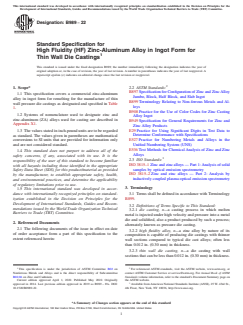
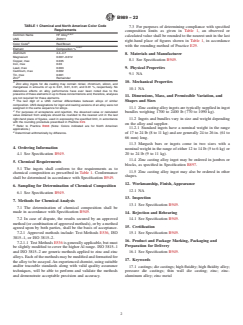


ASTM B989-22 - Standard Specification for High Fluidity (HF) Zinc-Aluminum Alloy in Ingot Form for Thin Wall Die Castings
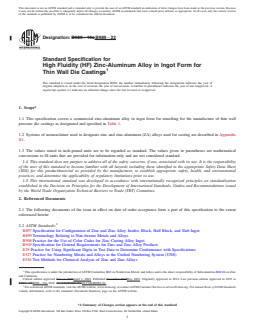
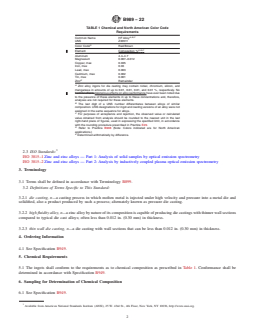
REDLINE ASTM B989-22 - Standard Specification for High Fluidity (HF) Zinc-Aluminum Alloy in Ingot Form for Thin Wall Die Castings
Get Certified
Connect with accredited certification bodies for this standard

Element Materials Technology
Materials testing and product certification.

Inštitut za kovinske materiale in tehnologije
Institute of Metals and Technology. Materials testing, metallurgical analysis, NDT.
Sponsored listings
Frequently Asked Questions
ASTM B989-22 is a technical specification published by ASTM International. Its full title is "Standard Specification for High Fluidity (HF) Zinc-Aluminum Alloy in Ingot Form for Thin Wall Die Castings". This standard covers: ABSTRACT This specification covers the chemical requirements for commercial high fluidity zinc-aluminum alloys in ingot form for remelting for the manufacture of thin wall pressure die castings. A table designates and specifies the requirements for aluminum, magnesium, copper, iron, lead, cadmium, tin, and zinc. The ingots shall conform to the requirements as to chemical composition as prescribed in this table. The specification also covers methods for the determination of chemical composition; dimensions, mass, and permissible variation; and shapes and sizes. SCOPE 1.1 This specification covers a commercial zinc-aluminum alloy in ingot form for remelting for the manufacture of thin wall pressure die castings as designated and specified in Table 1. 1.2 Systems of nomenclature used to designate zinc and zinc-aluminum (ZA) alloys used for casting are described in Appendix X1. 1.3 The values stated in inch-pound units are to be regarded as standard. The values given in parentheses are mathematical conversions to SI units that are provided for information only and are not considered standard. 1.4 This standard does not purport to address all of the safety concerns, if any, associated with its use. It is the responsibility of the user of this standard to become familiar with all hazards including those identified in the appropriate Safety Data Sheet (SDS) for this product/material as provided by the manufacturer, to establish appropriate safety, health, and environmental practices, and determine the applicability of regulatory limitations prior to use. 1.5 This international standard was developed in accordance with internationally recognized principles on standardization established in the Decision on Principles for the Development of International Standards, Guides and Recommendations issued by the World Trade Organization Technical Barriers to Trade (TBT) Committee.
ABSTRACT This specification covers the chemical requirements for commercial high fluidity zinc-aluminum alloys in ingot form for remelting for the manufacture of thin wall pressure die castings. A table designates and specifies the requirements for aluminum, magnesium, copper, iron, lead, cadmium, tin, and zinc. The ingots shall conform to the requirements as to chemical composition as prescribed in this table. The specification also covers methods for the determination of chemical composition; dimensions, mass, and permissible variation; and shapes and sizes. SCOPE 1.1 This specification covers a commercial zinc-aluminum alloy in ingot form for remelting for the manufacture of thin wall pressure die castings as designated and specified in Table 1. 1.2 Systems of nomenclature used to designate zinc and zinc-aluminum (ZA) alloys used for casting are described in Appendix X1. 1.3 The values stated in inch-pound units are to be regarded as standard. The values given in parentheses are mathematical conversions to SI units that are provided for information only and are not considered standard. 1.4 This standard does not purport to address all of the safety concerns, if any, associated with its use. It is the responsibility of the user of this standard to become familiar with all hazards including those identified in the appropriate Safety Data Sheet (SDS) for this product/material as provided by the manufacturer, to establish appropriate safety, health, and environmental practices, and determine the applicability of regulatory limitations prior to use. 1.5 This international standard was developed in accordance with internationally recognized principles on standardization established in the Decision on Principles for the Development of International Standards, Guides and Recommendations issued by the World Trade Organization Technical Barriers to Trade (TBT) Committee.
ASTM B989-22 is classified under the following ICS (International Classification for Standards) categories: 77.120.10 - Aluminium and aluminium alloys. The ICS classification helps identify the subject area and facilitates finding related standards.
ASTM B989-22 has the following relationships with other standards: It is inter standard links to ASTM B899-16, ASTM B899-15, ASTM E536-15, ASTM B899-14, ASTM B908-14, ASTM B897-13, ASTM B949-13, ASTM B899-13, ASTM B897-10, ASTM B899-09, ASTM B908-09, ASTM B897-09, ASTM B899-09e1, ASTM E29-08, ASTM B949-08. Understanding these relationships helps ensure you are using the most current and applicable version of the standard.
ASTM B989-22 is available in PDF format for immediate download after purchase. The document can be added to your cart and obtained through the secure checkout process. Digital delivery ensures instant access to the complete standard document.
Standards Content (Sample)
This international standard was developed in accordance with internationally recognized principles on standardization established in the Decision on Principles for the
Development of International Standards, Guides and Recommendations issued by the World Trade Organization Technical Barriers to Trade (TBT) Committee.
Designation:B989 −22
Standard Specification for
High Fluidity (HF) Zinc-Aluminum Alloy in Ingot Form for
Thin Wall Die Castings
This standard is issued under the fixed designation B989; the number immediately following the designation indicates the year of
original adoption or, in the case of revision, the year of last revision. A number in parentheses indicates the year of last reapproval. A
superscript epsilon (´) indicates an editorial change since the last revision or reapproval.
1. Scope* 2.2 ASTM Standards:
B897 Specification for Configuration of Zinc and ZincAlloy
1.1 This specification covers a commercial zinc-aluminum
Jumbo, Block, Half Block, and Slab Ingot
alloy in ingot form for remelting for the manufacture of thin
B899 Terminology Relating to Non-ferrous Metals and Al-
wall pressure die castings as designated and specified in Table
loys
1.
B908 Practice for the Use of Color Codes for Zinc Casting
1.2 Systems of nomenclature used to designate zinc and
Alloy Ingot
zinc-aluminum (ZA) alloys used for casting are described in
B949 Specification for General Requirements for Zinc and
Appendix X1.
Zinc Alloy Products
E29 Practice for Using Significant Digits in Test Data to
1.3 The values stated in inch-pound units are to be regarded
as standard. The values given in parentheses are mathematical Determine Conformance with Specifications
E527 Practice for Numbering Metals and Alloys in the
conversions to SI units that are provided for information only
and are not considered standard. Unified Numbering System (UNS)
E536 Test Methods for Chemical Analysis of Zinc and Zinc
1.4 This standard does not purport to address all of the
Alloys
safety concerns, if any, associated with its use. It is the
2.3 ISO Standards:
responsibility of the user of this standard to become familiar
ISO 3815–1 Zinc and zinc alloys — Part 1:Analysis of solid
with all hazards including those identified in the appropriate
samples by optical emission spectrometry
Safety Data Sheet (SDS) for this product/material as provided
ISO 3815–2 Zinc and zinc alloys — Part 2: Analysis by
by the manufacturer, to establish appropriate safety, health,
inductively coupled plasma optical emission spectrometry
and environmental practices, and determine the applicability
of regulatory limitations prior to use.
3. Terminology
1.5 This international standard was developed in accor-
dance with internationally recognized principles on standard- 3.1 Terms shall be defined in accordance with Terminology
ization established in the Decision on Principles for the
B899.
Development of International Standards, Guides and Recom-
3.2 Definitions of Terms Specific to This Standard:
mendations issued by the World Trade Organization Technical
3.2.1 die casting, n—a casting process in which molten
Barriers to Trade (TBT) Committee.
metal is injected under high velocity and pressure into a metal
die and solidified, also a product produced by such a process;
2. Referenced Documents
alternately known as pressure die casting.
2.1 The following documents of the issue in effect on date
3.2.2 high fluidity alloy, n—a zinc alloy by nature of its
of order acceptance form a part of this specification to the
composition is capable of producing die castings with thinner
extent referenced herein:
wall sections compared to typical die cast alloys; often less
than 0.012 in. (0.30 mm) in thickness.
3.2.3 thin wall die casting, n—a die casting with wall
sections that can be less than 0.012 in. (0.30 mm) in thickness.
1 2
This specification is under the jurisdiction of ASTM Committee B02 on For referenced ASTM standards, visit the ASTM website, www.astm.org, or
Nonferrous Metals and Alloys and is the direct responsibility of Subcommittee contact ASTM Customer Service at service@astm.org. For Annual Book of ASTM
B02.04 on Zinc and Cadmium. Standards volume information, refer to the standard’s Document Summary page on
Current edition approved April 1, 2022. Published May 2022. Originally the ASTM website.
approved in 2014. Last previous edition approved in 2019 as B989 – 19a. DOI: Available fromAmerican National Standards Institute (ANSI), 25 W. 43rd St.,
10.1520/B0989-22. 4th Floor, New York, NY 10036, http://www.ansi.org.
*A Summary of Changes section appears at the end of this standard
Copyright © ASTM International, 100 Barr Harbor Drive, PO Box C700, West Conshohocken, PA 19428-2959. United States
B989−22
TABLE 1 Chemical and North American Color Code
7.3 For purposes of determining compliance with specified
Requirements
composition limits as given in Table 1, an observed or
A,B,C
Common Name HF Alloy
calculated value shall be rounded to the nearest unit in the last
UNS Z33511
right-hand place of figures shown in Table 1, in accordance
D
Color Code Red/Brown
with the rounding method of Practice E29.
A,B,C
Element Composition %
Aluminum 4.4–4.7 8. Materials and Manufacturer
Magnesium 0.007–0.012
8.1 See Specification B949.
Copper, max 0.035
Iron, max 0.03
Lead, max 0.003 9. Physical Properties
Cadmium, max 0.002
9.1 NA
Tin, max 0.001
E
Zinc Remainder
A 10. Mechanical Properties
Zinc alloy ingots for die casting may contain nickel, chromium, silicon, and
manganese in amounts of up to 0.01, 0.01, 0.01, and 0.01 %, respectively. No
10.1 NA
deleterious effects on alloy performance have ever been noted due to the
presence of these elements in up to these concentrations and, therefore, analyses
11. Dimensions, Mass, and Permissible Variation, and
are not required for these elements.
B
Shapes and Sizes
The last digit of a UNS number differentiates between alloys of similar
composition. UNS designations for ingot and casting versions of an alloy were not
11.1 Zinc casting alloy ingots
...
This document is not an ASTM standard and is intended only to provide the user of an ASTM standard an indication of what changes have been made to the previous version. Because
it may not be technically possible to adequately depict all changes accurately, ASTM recommends that users consult prior editions as appropriate. In all cases only the current version
of the standard as published by ASTM is to be considered the official document.
Designation: B989 − 19a B989 − 22
Standard Specification for
High Fluidity (HF) Zinc-Aluminum Alloy in Ingot Form for
Thin Wall Die Castings
This standard is issued under the fixed designation B989; the number immediately following the designation indicates the year of
original adoption or, in the case of revision, the year of last revision. A number in parentheses indicates the year of last reapproval. A
superscript epsilon (´) indicates an editorial change since the last revision or reapproval.
1. Scope*
1.1 This specification covers a commercial zinc-aluminum alloy in ingot form for remelting for the manufacture of thin wall
pressure die castings as designated and specified in Table 1.
1.2 Systems of nomenclature used to designate zinc and zinc-aluminum (ZA) alloys used for casting are described in Appendix
X1.
1.3 The values stated in inch-pound units are to be regarded as standard. The values given in parentheses are mathematical
conversions to SI units that are provided for information only and are not considered standard.
1.4 This standard does not purport to address all of the safety concerns, if any, associated with its use. It is the responsibility
of the user of this standard to become familiar with all hazards including those identified in the appropriate Safety Data Sheet
(SDS) for this product/material as provided by the manufacturer, to establish appropriate safety, health, and environmental
practices, and determine the applicability of regulatory limitations prior to use.
1.5 This international standard was developed in accordance with internationally recognized principles on standardization
established in the Decision on Principles for the Development of International Standards, Guides and Recommendations issued
by the World Trade Organization Technical Barriers to Trade (TBT) Committee.
2. Referenced Documents
2.1 The following documents of the issue in effect on date of order acceptance form a part of this specification to the extent
referenced herein:
2.2 ASTM Standards:
B897 Specification for Configuration of Zinc and Zinc Alloy Jumbo, Block, Half Block, and Slab Ingot
B899 Terminology Relating to Non-ferrous Metals and Alloys
B908 Practice for the Use of Color Codes for Zinc Casting Alloy Ingot
B949 Specification for General Requirements for Zinc and Zinc Alloy Products
E29 Practice for Using Significant Digits in Test Data to Determine Conformance with Specifications
E527 Practice for Numbering Metals and Alloys in the Unified Numbering System (UNS)
E536 Test Methods for Chemical Analysis of Zinc and Zinc Alloys
This specification is under the jurisdiction of ASTM Committee B02 on Nonferrous Metals and Alloys and is the direct responsibility of Subcommittee B02.04 on Zinc
and Cadmium.
Current edition approved Nov. 1, 2019April 1, 2022. Published December 2019May 2022. Originally approved in 2014. Last previous edition approved in 2019 as
B989 – 19.B989 – 19a. DOI: 10.1520/B0989-19a.10.1520/B0989-22.
For referenced ASTM standards, visit the ASTM website, www.astm.org, or contact ASTM Customer Service at service@astm.org. For Annual Book of ASTM Standards
volume information, refer to the standard’s Document Summary page on the ASTM website.
*A Summary of Changes section appears at the end of this standard
Copyright © ASTM International, 100 Barr Harbor Drive, PO Box C700, West Conshohocken, PA 19428-2959. United States
B989 − 22
TABLE 1 Chemical and North American Color Code
Requirements
A,B,C
Common Name HF Alloy
UNS Z33511
D
Color Code Red/Brown
A,B,C
Element Composition %
Aluminum 4.4–4.7
Magnesium 0.007–0.012
Copper, max 0.035
Iron, max 0.03
Lead, max 0.003
Cadmium, max 0.002
Tin, max 0.001
E
Zinc Remainder
A
Zinc alloy ingots for die casting may contain nickel, chromium, silicon, and
manganese in amounts of up to 0.01, 0.01, 0.01, and 0.01 %, respectively. No
harmful effects deleterious effects on alloy performance have ever been noted due
to the presence of these elements in up to these concentrations and, therefore,
analyses are not required for these elements.
B
The last digit of a UNS number differentiates between alloys of similar
composition. UNS designations for ingot and casting versions of an alloy were not
assigned in the same sequence for alloys.
C
For purposes of acceptance and rejection, the observed value or calculated
value obtained from analysis should be rounded to the nearest unit in the last
right-hand place of figures, used in expressing the specified limit, in accordance
with the rounding procedure prescribed in Practice E29.
D
Refer to Practice B908 (Note: Colors indicated are for North American
applications.)
E
Determined arithmetically by difference.
2.3 ISO Standards:
ISO 3815–1 Zinc and zinc alloys — Part 1: Analysis of solid samples by optical emission spectrometry
ISO 3815–2 Zinc and zinc alloys — Part 2: Analysis by inductively coupled plasma optical emission spectrometry
3. Terminology
3.1 Terms shall be defined in accordance with Terminology B899.
3.2 Definitions of Terms Specific to This Standard:
3.2.1 die casting, n—a casting process in which molten metal is injected under high velocity and pressure into a metal die and
solidified, also a product produced by such a process; alternately known as pressure die casting.
3.2.2 high fluidity alloy, n—a zinc alloy by nature of its composition is capable of producing die castings with thinner wall sections
compared to typical die cast alloys; often less than 0.012 in. (0.30 mm) in thickness.
3.2.3 thin wall die casting, n—a die casting with wall sections that can be less than 0.012 in. (0.30 mm) in thickness.
4. Ordering Information
4.1 See Specification B949.
5. Chemical Requirements
5.1 The ingots shall conform to the requirements as to chemical composition as prescribed in Table 1. Conformance shall b
...
Questions, Comments and Discussion
Ask us and Technical Secretary will try to provide an answer. You can facilitate discussion about the standard in here.
Loading comments...