

ASTM C144-18
(Specification)Standard Specification for Aggregate for Masonry Mortar
General Information
- Abstract
ABSTRACT
This specification covers aggregate for use in masonry mortar. Aggregate for use in masonry mortar shall consist of natural sand or manufactured sand. Manufactured sand is the product obtained by crushing stone, gravel, or air-cooled iron blast-furnace slag specially processed to ensure suitable gradation. Aggregate for use in masonry mortar shall be graded within the limits prescribed. The amount of deleterious substances in aggregate for masonry mortar, each determined on independent samples complying with the grading requirements. Except as herein provided, aggregate subjected to five cycles of the soundness test shall show a loss, weighted in accordance with the grading of a sample complying with the limitations set forth. A density test shall be performed. The air content of mortars shall be calculated.
SCOPE
1.1 This specification covers aggregate for use in masonry mortar.
1.2 The values stated in SI units are to be regarded as the standard. The values given in parentheses are for information only.
1.3 The following precautionary caveat pertains only to the test methods portion, Section 8, of this standard. This standard does not purport to address all of the safety concerns, if any, associated with its use. It is the responsibility of the user of this standard to establish appropriate safety, health, and environmental practices and determine the applicability of regulatory limitations prior to use.
1.4 This international standard was developed in accordance with internationally recognized principles on standardization established in the Decision on Principles for the Development of International Standards, Guides and Recommendations issued by the World Trade Organization Technical Barriers to Trade (TBT) Committee.
- Status
- Published
- Publication Date
- 30-Nov-2018
- Technical Committee
- C12 - Mortars and Grouts for Unit Masonry
- Drafting Committee
- C12.04 - Specifications for Aggregates for Mortars




Overview
ASTM C144-18: Standard Specification for Aggregate for Masonry Mortar is an internationally recognized specification developed by ASTM International. This standard defines the requirements for natural and manufactured sand used as aggregate in masonry mortar. Its goals are to ensure the performance, durability, and workability of masonry mortars by restricting deleterious substances, controlling aggregate gradation, and specifying testing and compliance requirements. The use of standardized aggregates is essential for the strength, aesthetics, and longevity of masonry structures in residential, commercial, and infrastructure projects.
Key Topics
Aggregate Types:
- Natural sand
- Manufactured sand (from crushed stone, gravel, or air-cooled iron blast-furnace slag)
Grading Requirements:
- Both natural and manufactured sand must meet prescribed sieve limits for particle size distribution to ensure workability and mortar quality.
- Limits are set for percentage passing through various sieve sizes, controlling overall fineness and coarseness.
Deleterious Substances:
- Strict limits on organic impurities, lightweight particles, clay lumps, and friable particles to avoid compromising mortar strength or appearance.
Physical and Chemical Requirements:
- Soundness: Aggregate must pass five cycles of testing (using either sodium or magnesium sulfate) with minimal loss to ensure durability under environmental stress.
- Density and air content must be determined and meet specified criteria.
Test Methods:
- Sampling and testing procedures reference a suite of ASTM standards (such as C40, C88, C117, C123, C136, C142, C270, D75) for consistency and reliability.
Safety and Compliance:
- Users are responsible for standard safety, health, and environmental practices as well as adherence to local regulatory requirements.
Applications
ASTM C144-18 is vital for professionals engaged in the design, specification, and construction of unit masonry-such as brickwork, block work, and stone assemblies-by:
- Supporting architects and engineers in selecting appropriate mortar material for load-bearing and non-load-bearing walls
- Ensuring manufacturers and suppliers provide quality-controlled sand suitable for masonry applications
- Helping contractors and masons achieve consistent workability, durability, and resistance to environmental degradation in built structures
- Assisting testing laboratories and quality assurance teams with prescribed testing for compliance and performance evaluation
The specification is applicable in new construction, renovation, and restoration projects, including applications where historic preservation standards must be considered.
Related Standards
ASTM C144-18 references and aligns with a range of key industry standards, including:
- ASTM C40: Test Method for Organic Impurities in Fine Aggregates for Concrete
- ASTM C87: Test Method for Effect of Organic Impurities on Strength of Mortar
- ASTM C88: Soundness of Aggregates by Use of Sodium Sulfate or Magnesium Sulfate
- ASTM C117: Test Method for Materials Finer than 75-μm Sieve by Washing
- ASTM C123: Lightweight Particles in Aggregate
- ASTM C136: Sieve Analysis of Fine and Coarse Aggregates
- ASTM C270: Specification for Mortar for Unit Masonry
- ASTM C404: Aggregates for Masonry Grout
- ASTM C1713: Mortars for the Repair of Historic Masonry
- ASTM D75: Practice for Sampling Aggregates
- AASHTO M45: Aggregate for Masonry Mortar
Compliance with ASTM C144-18 helps construction teams, suppliers, and regulators ensure reliability and quality in masonry mortar aggregates, fostering safer and more durable structures.
Relations
- Effective Date
- 15-Jan-2024
- Effective Date
- 01-Jan-2024
- Effective Date
- 15-Dec-2023
- Effective Date
- 15-Nov-2023
- Refers
ASTM C142/C142M-17(2023) - Standard Test Method for Clay Lumps and Friable Particles in Aggregates - Effective Date
- 01-Oct-2023
- Effective Date
- 01-Nov-2019
- Effective Date
- 01-May-2019
- Effective Date
- 01-May-2019
- Effective Date
- 01-Feb-2019
- Effective Date
- 01-Dec-2018
- Effective Date
- 01-Dec-2018
- Effective Date
- 01-Aug-2018
- Effective Date
- 15-Dec-2017
- Effective Date
- 15-Mar-2017
- Refers
ASTM C40/C40M-16 - Standard Test Method for Organic Impurities in Fine Aggregates for Concrete - Effective Date
- 01-Dec-2016
Get Certified
Connect with accredited certification bodies for this standard

DIBt (Deutsches Institut für Bautechnik)
German Institute for Building Technology.
DIN CERTCO
DIN Group product certification.

Aboma Certification B.V.
Specialized in construction, metal, and transport sectors.
Sponsored listings
Frequently Asked Questions
ASTM C144-18 is a technical specification published by ASTM International. Its full title is "Standard Specification for Aggregate for Masonry Mortar". This standard covers: ABSTRACT This specification covers aggregate for use in masonry mortar. Aggregate for use in masonry mortar shall consist of natural sand or manufactured sand. Manufactured sand is the product obtained by crushing stone, gravel, or air-cooled iron blast-furnace slag specially processed to ensure suitable gradation. Aggregate for use in masonry mortar shall be graded within the limits prescribed. The amount of deleterious substances in aggregate for masonry mortar, each determined on independent samples complying with the grading requirements. Except as herein provided, aggregate subjected to five cycles of the soundness test shall show a loss, weighted in accordance with the grading of a sample complying with the limitations set forth. A density test shall be performed. The air content of mortars shall be calculated. SCOPE 1.1 This specification covers aggregate for use in masonry mortar. 1.2 The values stated in SI units are to be regarded as the standard. The values given in parentheses are for information only. 1.3 The following precautionary caveat pertains only to the test methods portion, Section 8, of this standard. This standard does not purport to address all of the safety concerns, if any, associated with its use. It is the responsibility of the user of this standard to establish appropriate safety, health, and environmental practices and determine the applicability of regulatory limitations prior to use. 1.4 This international standard was developed in accordance with internationally recognized principles on standardization established in the Decision on Principles for the Development of International Standards, Guides and Recommendations issued by the World Trade Organization Technical Barriers to Trade (TBT) Committee.
ABSTRACT This specification covers aggregate for use in masonry mortar. Aggregate for use in masonry mortar shall consist of natural sand or manufactured sand. Manufactured sand is the product obtained by crushing stone, gravel, or air-cooled iron blast-furnace slag specially processed to ensure suitable gradation. Aggregate for use in masonry mortar shall be graded within the limits prescribed. The amount of deleterious substances in aggregate for masonry mortar, each determined on independent samples complying with the grading requirements. Except as herein provided, aggregate subjected to five cycles of the soundness test shall show a loss, weighted in accordance with the grading of a sample complying with the limitations set forth. A density test shall be performed. The air content of mortars shall be calculated. SCOPE 1.1 This specification covers aggregate for use in masonry mortar. 1.2 The values stated in SI units are to be regarded as the standard. The values given in parentheses are for information only. 1.3 The following precautionary caveat pertains only to the test methods portion, Section 8, of this standard. This standard does not purport to address all of the safety concerns, if any, associated with its use. It is the responsibility of the user of this standard to establish appropriate safety, health, and environmental practices and determine the applicability of regulatory limitations prior to use. 1.4 This international standard was developed in accordance with internationally recognized principles on standardization established in the Decision on Principles for the Development of International Standards, Guides and Recommendations issued by the World Trade Organization Technical Barriers to Trade (TBT) Committee.
ASTM C144-18 is classified under the following ICS (International Classification for Standards) categories: 91.100.10 - Cement. Gypsum. Lime. Mortar. The ICS classification helps identify the subject area and facilitates finding related standards.
ASTM C144-18 has the following relationships with other standards: It is inter standard links to ASTM C404-24, ASTM C88/C88M-24, ASTM C123/C123M-23, ASTM C117-23, ASTM C142/C142M-17(2023), ASTM D75/D75M-19, ASTM C270-19ae1, ASTM C270-19a, ASTM C270-19, ASTM C1180-18, ASTM C404-18, ASTM C88/C88M-18, ASTM C404-11(2017), ASTM C142/C142M-17, ASTM C40/C40M-16. Understanding these relationships helps ensure you are using the most current and applicable version of the standard.
ASTM C144-18 is available in PDF format for immediate download after purchase. The document can be added to your cart and obtained through the secure checkout process. Digital delivery ensures instant access to the complete standard document.
Standards Content (Sample)
This international standard was developed in accordance with internationally recognized principles on standardization established in the Decision on Principles for the
Development of International Standards, Guides and Recommendations issued by the World Trade Organization Technical Barriers to Trade (TBT) Committee.
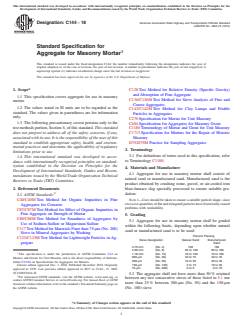
Designation: C144 −18 American Association State Highway and Transportation Officials Standard
AASHTO No.: M45-70 (1974)
Standard Specification for
Aggregate for Masonry Mortar
This standard is issued under the fixed designation C144; the number immediately following the designation indicates the year of
original adoption or, in the case of revision, the year of last revision. A number in parentheses indicates the year of last reapproval. A
superscript epsilon (´) indicates an editorial change since the last revision or reapproval.
This standard has been approved for use by agencies of the U.S. Department of Defense.
1. Scope* C128 Test Method for Relative Density (Specific Gravity)
and Absorption of Fine Aggregate
1.1 This specification covers aggregate for use in masonry
C136/C136M Test Method for Sieve Analysis of Fine and
mortar.
Coarse Aggregates
1.2 The values stated in SI units are to be regarded as the
C142/C142M Test Method for Clay Lumps and Friable
standard. The values given in parentheses are for information
Particles in Aggregates
only.
C270 Specification for Mortar for Unit Masonry
1.3 The following precautionary caveat pertains only to the C404 Specification for Aggregates for Masonry Grout
test methods portion, Section 8, of this standard. This standard
C1180 Terminology of Mortar and Grout for Unit Masonry
does not purport to address all of the safety concerns, if any, C1713 Specification for Mortars for the Repair of Historic
associatedwithitsuse.Itistheresponsibilityoftheuserofthis
Masonry
standard to establish appropriate safety, health, and environ- D75/D75M Practice for Sampling Aggregates
mental practices and determine the applicability of regulatory
3. Terminology
limitations prior to use.
3.1 For definitions of terms used in this specification, refer
1.4 This international standard was developed in accor-
to Terminology C1180.
dance with internationally recognized principles on standard-
ization established in the Decision on Principles for the
4. Materials and Manufacture
Development of International Standards, Guides and Recom-
4.1 Aggregate for use in masonry mortar shall consist of
mendations issued by the World Trade Organization Technical
natural sand or manufactured sand. Manufactured sand is the
Barriers to Trade (TBT) Committee.
product obtained by crushing stone, gravel, or air-cooled iron
2. Referenced Documents blast-furnace slag specially processed to ensure suitable gra-
2 dation.
2.1 ASTM Standards:
C40/C40M Test Method for Organic Impurities in Fine NOTE 1—Care should be taken to ensure a suitable particle shape, since
excessivequantitiesofflatandelongatedparticleshavehistoricallycaused
Aggregates for Concrete
problems with workability.
C87/C87M Test Method for Effect of Organic Impurities in
Fine Aggregate on Strength of Mortar
5. Grading
C88/C88M Test Method for Soundness of Aggregates by
5.1 Aggregate for use in masonry mortar shall be graded
Use of Sodium Sulfate or Magnesium Sulfate
within the following limits, depending upon whether natural
C117 Test Method for Materials Finer than 75-µm (No. 200)
sand or manufactured sand is to be used:
Sieve in Mineral Aggregates by Washing
Percent Passing
C123/C123M Test Method for Lightweight Particles in Ag-
Sieve Designation Natural Sand Manufactured
gregate
Sand
4.75-mm (No. 4) 100 100
2.36-mm (No. 8) 95 to 100 95 to 100
1.18-mm (No. 16) 70 to 100 70 to 100
This specification is under the jurisdiction of ASTM Committee C12 on
600-µm (No. 30) 40 to 75 40 to 75
Mortars and Grouts for Unit Masonry and is the direct responsibility of Subcom-
300-µm (No. 50) 10 to 35 20 to 40
mittee C12.04 on Specifications for Aggregates for Mortars.
150-µm (No. 100) 2 to 15 10 to 25
Current edition approved Dec. 1, 2018. Published December 2018. Originally
75-µm (No. 200) 0 to 5 0 to 10
approved in 1939. Last previous edition approved in 2017 as C144 – 17. DOI:
10.1520/C0144-18.
5.2 The aggregate shall not have more than 50 % retained
For referenced ASTM standards, visit the ASTM website, www.astm.org, or
between any two consecutive sieves of those listed in 5.1 nor
contact ASTM Customer Service at service@astm.org. For Annual Book of ASTM
more than 25 % between 300-µm (No. 50) and the 150-µm
Standards volume information, refer to the standard’s Document Summary page on
the ASTM website. (No. 100) sieve.
*A Summary of Changes section appears at the end of this standard
Copyright © ASTM International, 100 Barr Harbor Drive, PO Box C700, West Conshohocken, PA 19428-2959. United States
C144 − 18
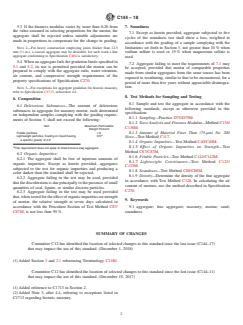
5.3 If the fineness modulus varies by more than 0.20 from 7. Soundness
the value assumed in selecting proportions for the mortar, the
7.1 Except as herein provided, aggregate subjected to five
aggregate shall be rejected unless suitable adjustments are
cycles of the soundness test shall show a loss, weighted in
made in proportions to compensate for the change i
...
This document is not an ASTM standard and is intended only to provide the user of an ASTM standard an indication of what changes have been made to the previous version. Because
it may not be technically possible to adequately depict all changes accurately, ASTM recommends that users consult prior editions as appropriate. In all cases only the current version
of the standard as published by ASTM is to be considered the official document.
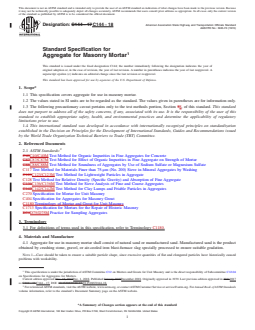
Designation: C144 − 17 C144 − 18 American Association State Highway and Transportation Officials Standard
AASHTO No.: M45-70 (1974)
Standard Specification for
Aggregate for Masonry Mortar
This standard is issued under the fixed designation C144; the number immediately following the designation indicates the year of
original adoption or, in the case of revision, the year of last revision. A number in parentheses indicates the year of last reapproval. A
superscript epsilon (´) indicates an editorial change since the last revision or reapproval.
This standard has been approved for use by agencies of the U.S. Department of Defense.
1. Scope*
1.1 This specification covers aggregate for use in masonry mortar.
1.2 The values stated in SI units are to be regarded as the standard. The values given in parentheses are for information only.
1.3 The following precautionary caveat pertains only to the test methods portion, Section 78, of this standard. This standard
does not purport to address all of the safety concerns, if any, associated with its use. It is the responsibility of the user of this
standard to establish appropriate safety, health, and environmental practices and determine the applicability of regulatory
limitations prior to use.
1.4 This international standard was developed in accordance with internationally recognized principles on standardization
established in the Decision on Principles for the Development of International Standards, Guides and Recommendations issued
by the World Trade Organization Technical Barriers to Trade (TBT) Committee.
2. Referenced Documents
2.1 ASTM Standards:
C40C40/C40M Test Method for Organic Impurities in Fine Aggregates for Concrete
C87C87/C87M Test Method for Effect of Organic Impurities in Fine Aggregate on Strength of Mortar
C88C88/C88M Test Method for Soundness of Aggregates by Use of Sodium Sulfate or Magnesium Sulfate
C117 Test Method for Materials Finer than 75-μm (No. 200) Sieve in Mineral Aggregates by Washing
C123C123/C123M Test Method for Lightweight Particles in Aggregate
C128 Test Method for Relative Density (Specific Gravity) and Absorption of Fine Aggregate
C136C136/C136M Test Method for Sieve Analysis of Fine and Coarse Aggregates
C142C142/C142M Test Method for Clay Lumps and Friable Particles in Aggregates
C270 Specification for Mortar for Unit Masonry
C404 Specification for Aggregates for Masonry Grout
C1180 Terminology of Mortar and Grout for Unit Masonry
C1713 Specification for Mortars for the Repair of Historic Masonry
D75D75/D75M Practice for Sampling Aggregates
3. Terminology
3.1 For definitions of terms used in this specification, refer to Terminology C1180.
4. Materials and Manufacture
4.1 Aggregate for use in masonry mortar shall consist of natural sand or manufactured sand. Manufactured sand is the product
obtained by crushing stone, gravel, or air-cooled iron blast-furnace slag specially processed to ensure suitable gradation.
NOTE 1—Care should be taken to ensure a suitable particle shape, since excessive quantities of flat and elongated particles have historically caused
problems with workability.
This specification is under the jurisdiction of ASTM Committee C12 on Mortars and Grouts for Unit Masonry and is the direct responsibility of Subcommittee C12.04
on Specifications for Aggregates for Mortars.
Current edition approved Dec. 15, 2017Dec. 1, 2018. Published January 2018December 2018. Originally approved in 1939. Last previous edition approved in 20112017
as C144 – 11.C144 – 17. DOI: 10.1520/C0144-17.10.1520/C0144-18.
For referenced ASTM standards, visit the ASTM website, www.astm.org, or contact ASTM Customer Service at service@astm.org. For Annual Book of ASTM Standards
volume information, refer to the standard’s Document Summary page on the ASTM website.
*A Summary of Changes section appears at the end of this standard
Copyright © ASTM International, 100 Barr Harbor Drive, PO Box C700, West Conshohocken, PA 19428-2959. United States
C144 − 18
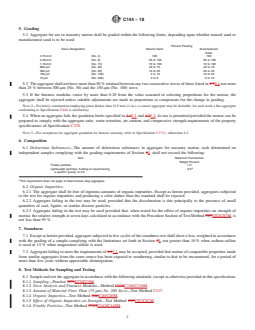
5. Grading
5.1 Aggregate for use in masonry mortar shall be graded within the following limits, depending upon whether natural sand or
manufactured sand is to be used:
Percent Passing
Sieve Designation Natural Sand Manufactured
Sand
4.75-mm (No. 4) 100 100
2.36-mm (No. 8) 95 to 100 95 to 100
1.18-mm (No. 16) 70 to 100 70 to 100
600-μm (No. 30) 40 to 75 40 to 75
300-μm (No. 50) 10 to 35 20 to 40
150-μm (No. 100) 2 to 15 10 to 25
75-μm (No. 200) 0 to 5 0 to 10
5.2 The aggregate shall not have more than 50 % retained between any two consecutive sieves of those listed in 4.15.1 nor more
than 25 % between 300-μm (No. 50) and the 150-μm (No. 100) sieve.
5.3 If the fineness modulus varies by more than 0.20 from the value assumed in selecting proportions for the mortar, the
aggregate shall be rejected unless suitable adjustments are made in proportions to compensate for the change in grading.
NOTE 2—For heavy construction employing joints thick
...