

ASTM A1038-19
(Test Method)Standard Test Method for Portable Hardness Testing by the Ultrasonic Contact Impedance Method
General Information
- Abstract
SIGNIFICANCE AND USE
4.1 The hardness of a material is a defined quantity having many scales and being dependent on the way the test is performed. In order to avoid the creation of a new method involving a new hardness scale, the UCI method converts into common hardness values, for example, HV, HRC, etc.
4.2 The UCI hardness test is a superficial determination, only measuring the hardness condition of the surface contacted. The results generated at a specific location do not represent the part at any other surface location and yield no information about the material at subsurface locations.
4.3 The UCI hardness test may be used on large or small components at various locations. It can be used to make hardness measurements on positions difficult to access, such as tooth flanks or roots of gears.
SCOPE
1.1 This test method covers the determination of comparative hardness values by applying the Ultrasonic Contact Impedance Method (UCI Method).
1.2 The values stated in SI units are to be regarded as standard. No other units of measurement are included in this standard.
1.2.1 Exception—Informational inch-pound units are provided in Note 1 and ksi is used in 12.1.
1.3 This standard does not purport to address all of the safety concerns, if any, associated with its use. It is the responsibility of the user of this standard to establish appropriate safety, health, and environmental practices and determine the applicability of regulatory limitations prior to use.
1.4 This international standard was developed in accordance with internationally recognized principles on standardization established in the Decision on Principles for the Development of International Standards, Guides and Recommendations issued by the World Trade Organization Technical Barriers to Trade (TBT) Committee.
- Status
- Published
- Publication Date
- 30-Sep-2019
- Technical Committee
- A01 - Steel, Stainless Steel and Related Alloys
Buy Documents
ASTM A1038-19 - Standard Test Method for Portable Hardness Testing by the Ultrasonic Contact Impedance Method
REDLINE ASTM A1038-19 - Standard Test Method for Portable Hardness Testing by the Ultrasonic Contact Impedance Method
Overview
ASTM A1038-19 specifies the standard test method for conducting portable hardness testing using the Ultrasonic Contact Impedance (UCI) method. Developed by ASTM, this international standard provides guidance for determining the comparative hardness values of metallic materials in various locations, including areas that are difficult to access. The UCI method measures superficial hardness at the contact surface using a portable device, enabling on-site and non-destructive testing.
This method is particularly useful for manufacturing, quality control, maintenance, and inspection applications where traditional bench-top hardness testers are impractical. It facilitates rapid hardness assessment and conversion to standardized hardness scales such as HV (Vickers), HRC (Rockwell), and others for easier comparison and compliance.
Key Topics
UCI Method Principle:
- The UCI (Ultrasonic Contact Impedance) method involves pressing a resonating rod equipped with a defined indenter, typically a Vickers diamond, into the test material using a controlled force.
- The device measures frequency shifts caused by the elastic contact between indenter and material, which correlates to the surface hardness.
Surface Measurement:
- The test only samples the superficial hardness at the precise point of contact.
- Results from a specific location do not reflect the hardness of other parts of the component or subsurface material.
Calibration and Verification:
- Calibration is essential for different material groups to accommodate varying elastic moduli.
- Frequent verification of the instrument’s accuracy with certified reference blocks is required.
Units and Conversions:
- SI units are the standard for reporting in ASTM A1038-19.
- Hardness values measured by the UCI method can be converted to common scales (e.g., HV, HRC) following standard conversion tables and with consideration for material-specific limitations.
Surface Preparation & Test Conditions:
- Proper surface cleanliness and roughness are crucial for accurate results.
- Thickness and support of test samples are important to prevent erroneous readings due to vibration or insufficient structural integrity.
Applications
Portable Hardness Testing by the UCI Method is widely used in:
Manufacturing and Production:
- On-site verification of material hardness for quality assurance in steel forgings, castings, and finished components.
- Inspection of welds, heat-affected zones, or surface-treated layers (e.g., induction-hardened, carburized, or ion-nitrided parts).
Maintenance and Repair:
- Evaluation of worn or in-service parts without requiring their removal from machinery.
- Hardness checks in hard-to-access positions, such as gear tooth flanks, roots, turbine blades, or internal pipe surfaces.
Research and Development:
- Comparative analysis of surface treatments or coatings.
- Testing small samples or thin components where conventional hardness testers are unsuitable.
Quality Control and Compliance:
- Ensuring components meet specified hardness requirements before further processing or dispatch.
- Field inspections in automotive, aerospace, power generation, and other industrial sectors.
Related Standards
For comprehensive material testing and hardness conversion, ASTM A1038-19 references and complements several related standards, including:
- ASTM E10: Test Method for Brinell Hardness of Metallic Materials
- ASTM E18: Test Methods for Rockwell Hardness of Metallic Materials
- ASTM E92: Test Methods for Vickers Hardness and Knoop Hardness of Metallic Materials
- ASTM E140: Hardness Conversion Tables for Metals
- ASTM E177: Practice for Precision and Bias in ASTM Test Methods
- ASTM E691: Practice for Interlaboratory Study to Determine the Precision of a Test Method
- ASTM A370: Test Methods and Definitions for Mechanical Testing of Steel Products
Keywords: ASTM A1038-19, UCI portable hardness testing, Ultrasonic Contact Impedance method, superficial hardness, Vickers hardness, quality control, material testing, surface measurement, calibration, non-destructive testing, metal hardness standards.
Relations
- Effective Date
- 01-Oct-2019
- Effective Date
- 01-Mar-2024
- Effective Date
- 01-Jul-2019
- Effective Date
- 01-Jul-2018
- Refers
ASTM A370-17a - Standard Test Methods and Definitions for Mechanical Testing of Steel Products - Effective Date
- 15-Nov-2017
- Effective Date
- 01-Jul-2017
- Effective Date
- 01-Jan-2017
- Effective Date
- 01-Nov-2015
- Effective Date
- 15-May-2014
- Effective Date
- 01-May-2014
- Effective Date
- 01-May-2014
- Effective Date
- 15-Nov-2013
- Effective Date
- 01-May-2013
- Effective Date
- 01-May-2013
- Effective Date
- 01-Dec-2012
Buy Documents
ASTM A1038-19 - Standard Test Method for Portable Hardness Testing by the Ultrasonic Contact Impedance Method
REDLINE ASTM A1038-19 - Standard Test Method for Portable Hardness Testing by the Ultrasonic Contact Impedance Method
Get Certified
Connect with accredited certification bodies for this standard

IMP NDT d.o.o.
Non-destructive testing services. Radiography, ultrasonic, magnetic particle, penetrant, visual inspection.
Inštitut za kovinske materiale in tehnologije
Institute of Metals and Technology. Materials testing, metallurgical analysis, NDT.
Q Techna d.o.o.
NDT and quality assurance specialist. 30+ years experience. NDT personnel certification per ISO 9712, nuclear and thermal power plant inspections, QA/
Sponsored listings
Frequently Asked Questions
ASTM A1038-19 is a standard published by ASTM International. Its full title is "Standard Test Method for Portable Hardness Testing by the Ultrasonic Contact Impedance Method". This standard covers: SIGNIFICANCE AND USE 4.1 The hardness of a material is a defined quantity having many scales and being dependent on the way the test is performed. In order to avoid the creation of a new method involving a new hardness scale, the UCI method converts into common hardness values, for example, HV, HRC, etc. 4.2 The UCI hardness test is a superficial determination, only measuring the hardness condition of the surface contacted. The results generated at a specific location do not represent the part at any other surface location and yield no information about the material at subsurface locations. 4.3 The UCI hardness test may be used on large or small components at various locations. It can be used to make hardness measurements on positions difficult to access, such as tooth flanks or roots of gears. SCOPE 1.1 This test method covers the determination of comparative hardness values by applying the Ultrasonic Contact Impedance Method (UCI Method). 1.2 The values stated in SI units are to be regarded as standard. No other units of measurement are included in this standard. 1.2.1 Exception—Informational inch-pound units are provided in Note 1 and ksi is used in 12.1. 1.3 This standard does not purport to address all of the safety concerns, if any, associated with its use. It is the responsibility of the user of this standard to establish appropriate safety, health, and environmental practices and determine the applicability of regulatory limitations prior to use. 1.4 This international standard was developed in accordance with internationally recognized principles on standardization established in the Decision on Principles for the Development of International Standards, Guides and Recommendations issued by the World Trade Organization Technical Barriers to Trade (TBT) Committee.
SIGNIFICANCE AND USE 4.1 The hardness of a material is a defined quantity having many scales and being dependent on the way the test is performed. In order to avoid the creation of a new method involving a new hardness scale, the UCI method converts into common hardness values, for example, HV, HRC, etc. 4.2 The UCI hardness test is a superficial determination, only measuring the hardness condition of the surface contacted. The results generated at a specific location do not represent the part at any other surface location and yield no information about the material at subsurface locations. 4.3 The UCI hardness test may be used on large or small components at various locations. It can be used to make hardness measurements on positions difficult to access, such as tooth flanks or roots of gears. SCOPE 1.1 This test method covers the determination of comparative hardness values by applying the Ultrasonic Contact Impedance Method (UCI Method). 1.2 The values stated in SI units are to be regarded as standard. No other units of measurement are included in this standard. 1.2.1 Exception—Informational inch-pound units are provided in Note 1 and ksi is used in 12.1. 1.3 This standard does not purport to address all of the safety concerns, if any, associated with its use. It is the responsibility of the user of this standard to establish appropriate safety, health, and environmental practices and determine the applicability of regulatory limitations prior to use. 1.4 This international standard was developed in accordance with internationally recognized principles on standardization established in the Decision on Principles for the Development of International Standards, Guides and Recommendations issued by the World Trade Organization Technical Barriers to Trade (TBT) Committee.
ASTM A1038-19 is classified under the following ICS (International Classification for Standards) categories: 19.100 - Non-destructive testing. The ICS classification helps identify the subject area and facilitates finding related standards.
ASTM A1038-19 has the following relationships with other standards: It is inter standard links to ASTM A1038-17, ASTM A370-24, ASTM A370-19, ASTM E18-18, ASTM A370-17a, ASTM E18-17, ASTM A370-17, ASTM A370-15, ASTM A370-14, ASTM E177-14, ASTM E10-14, ASTM A370-13, ASTM E177-13, ASTM E691-13, ASTM E18-12. Understanding these relationships helps ensure you are using the most current and applicable version of the standard.
ASTM A1038-19 is available in PDF format for immediate download after purchase. The document can be added to your cart and obtained through the secure checkout process. Digital delivery ensures instant access to the complete standard document.
Standards Content (Sample)
This international standard was developed in accordance with internationally recognized principles on standardization established in the Decision on Principles for the
Development of International Standards, Guides and Recommendations issued by the World Trade Organization Technical Barriers to Trade (TBT) Committee.
Designation: A1038 − 19
Standard Test Method for
Portable Hardness Testing by the Ultrasonic Contact
Impedance Method
This standard is issued under the fixed designation A1038; the number immediately following the designation indicates the year of
original adoption or, in the case of revision, the year of last revision.Anumber in parentheses indicates the year of last reapproval.A
superscript epsilon (´) indicates an editorial change since the last revision or reapproval.
1. Scope* Among Brinell Hardness, Vickers Hardness, Rockwell
Hardness, Superficial Hardness, Knoop Hardness, Sclero-
1.1 This test method covers the determination of compara-
scope Hardness, and Leeb Hardness
tive hardness values by applying the Ultrasonic Contact
E177Practice for Use of the Terms Precision and Bias in
Impedance Method (UCI Method).
ASTM Test Methods
1.2 The values stated in SI units are to be regarded as
E691Practice for Conducting an Interlaboratory Study to
standard. No other units of measurement are included in this
Determine the Precision of a Test Method
standard.
1.2.1 Exception—Informational inch-pound units are pro-
3. Terminology and Equations
vided in Note 1 and ksi is used in 12.1.
3.1 Definitions:
1.3 This standard does not purport to address all of the
3.1.1 calibration—determination of the specific values of
safety concerns, if any, associated with its use. It is the
the significant operating parameters of the UCI instrument by
responsibility of the user of this standard to establish appro-
comparisonwithvaluesindicatedbyastandardizedworkbench
priate safety, health, and environmental practices and deter-
hardness tester or by a set of certified reference test pieces.
mine the applicability of regulatory limitations prior to use.
3.1.2 surface finish—all references to surface finish in this
1.4 This international standard was developed in accor-
test method are defined as surface roughness (that is, Ra =
dance with internationally recognized principles on standard-
average roughness value).
ization established in the Decision on Principles for the
Development of International Standards, Guides and Recom-
3.1.3 UCI hardness test—a hardness testing method using a
mendations issued by the World Trade Organization Technical
calibrated instrument by pressing a resonating rod with a
Barriers to Trade (TBT) Committee.
defined indenter, for example, a Vickers diamond, with a fixed
force against the surface of the part to be tested.
2. Referenced Documents
3.1.4 UCI method—Ultrasonic Contact Impedance, a hard-
2.1 ASTM Standards:
ness testing method developed by Dr. Claus Kleesattel in 1961
A370Test Methods and Definitions for Mechanical Testing
based on the measurement of the frequency shift of a resonat-
of Steel Products
ingrodcausedbytheessentiallyelasticnatureofthefinitearea
E10Test Method for Brinell Hardness of Metallic Materials
of contact between the indenter and the test piece during the
E18Test Methods for Rockwell Hardness of Metallic Ma-
penetration.
terials
3.1.5 verification—checking or testing the UCI instrument
E92Test Methods for Vickers Hardness and Knoop Hard-
to ensure conformance with this test method.
ness of Metallic Materials
3.2 Equations:
E140Hardness Conversion Tables for Metals Relationship
3.2.1 The average x¯ of a set of n measurements x , x , ., x
1 2 n
is calculated as:
This test method is under the jurisdiction of ASTM Committee A01 on Steel,
x 1x 1.1x
Stainless Steel and RelatedAlloys and is the direct responsibility of Subcommittee 1 2 n
x¯ 5 (1)
A01.13 on Mechanical and Chemical Testing and Processing Methods of Steel n
Products and Processes.
where each of the individual measurements x , x , ., x is
1 2 n
Current edition approved Oct. 1, 2019. Published October 2019. Originally
the result from a single indentation.
approved in 2005. Last previous edition approved in 2017 as A1038–17. DOI:
10.1520/A1038–19.
3.2.2 The error E in the performance of an ultrasonic
For referenced ASTM standards, visit the ASTM website, www.astm.org, or
contact impedance hardness testing instrument at each hard-
contact ASTM Customer Service at service@astm.org. For Annual Book of ASTM
ness level, relative to a standardized reference value, is
Standards volume information, refer to the standard’s Document Summary page on
the ASTM website. calculated as an absolute percent error determined as:
*A Summary of Changes section appears at the end of this standard
Copyright © ASTM International, 100 Barr Harbor Drive, PO Box C700, West Conshohocken, PA 19428-2959. United States
A1038 − 19
x¯ 2 x means for the numerical evaluation, and (5) a digital display,
ref
E 5U100 3 U (2)
S D
x indicating the measured hardness number.
ref
5.2 UCI Probes—There are different probes available for
where:
UCIhardnesstesting.Theytypicallycoverstaticloadsranging
x¯ = the average (see 3.2.1)of n measurements made on a
from1Nto98N.See also Appendix X1. They also come in
standard reference block as part of a performance
different sizes with longer and shorter sensor rods for specials
verification, and
applications. And they are developed in two versions, that is,
x = the certified reference hardness reported for the stan-
ref
manually operated or equipped with a servo-motor for auto-
dard reference block.
matic testing.
4. Significance and Use
5.3 Summary of Test Method—In conventional workbench
hardness testing like Brinell or Vickers testing according to
4.1 The hardness of a material is a defined quantity having
many scales and being dependent on the way the test is Test Methods E10 and E92, the hardness value is determined
opticallybythesizeoftheindentationinthematerialgenerated
performed. In order to avoid the creation of a new method
by a certain test load, after the indenter has been removed. In
involving a new hardness scale, the UCI method converts into
the mobile hardness test under applied load according to the
common hardness values, for example, HV, HRC, etc.
UCI method, however, the size of the produced indents are not
4.2 The UCI hardness test is a superficial determination,
determined optically. Instead the contact area is derived from
only measuring the hardness condition of the surface con-
the electronically measured shift of an ultrasonic resonance
tacted. The results generated at a specific location do not
frequency.TocarryouttheUCItest,aprobecontainingtherod
represent the part at any other surface location and yield no
with the indenter is excited into a longitudinal ultrasonic
information about the material at subsurface locations.
oscillation of about 70 kHz by piezoelectric ceramics—the
4.3 The UCI hardness test may be used on large or small
so-called zero frequency, which occurs when the indenter is
components at various locations. It can be used to make
vibrating in air.
hardnessmeasurementsonpositionsdifficulttoaccess,suchas
5.3.1 A spring inside the probe applies the specified test
tooth flanks or roots of gears.
load, the vibrating tip penetrates into the material creating an
elasticcontact,whichresultsinapositivefrequencyshiftofthe
A. GENERAL DESCRIPTION OF INSTRUMENTS
resonatingrod.Thisshiftisrelatedtothesizeoftheindentarea
AND TEST PROCEDURE FOR UCI HARDNESS
(contact area of the indenter with the material). The size, in
TESTING
turn,isameasureforthehardnessofthetestmaterialatagiven
modulus of elasticity, for example, HV(UCI) according to Eq
5. Apparatus
3.
5.1 Instruments used for UCI hardness testing generally
5.3.2 Therefore, the frequency shift is relatively small for
consist of (1) a probe containing a rod with a defined indenter,
hard materials, because the indenter penetrates not very deep
forexample,aVickersdiamond,attachedtothecontactingend
into the test material leaving only a small indent.
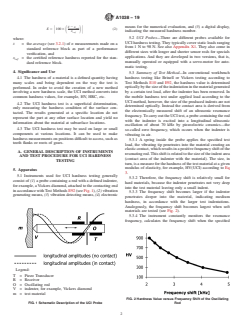
inaccordancewithTestMethodsE92(seeFig.1), (2)vibration
5.3.3 The frequency shift becomes larger if the indenter
generatingmeans, (3)vibrationdetectingmeans, (4)electronic
penetrates deeper into the material, indicating medium
hardness, in accordance with the larger test indentations.
Analogously, the frequency shift becomes largest when soft
materials are tested (see Fig. 2).
5.3.4 The instrument constantly monitors the resonance
frequency, calculates the frequency shift when the specified
Legend:
T = Piezo Transducer
R = Receiver
O = Oscillating rod
V = indenter, for example, Vickers diamond
m = test material
FIG. 2 Hardness Value versus Frequency Shift of the Oscillating
FIG. 1 Schematic Description of the UCI Probe Rod
A1038 − 19
test load has been reached either after the internal switch has surements when considering the dependency on the elastic
triggeredthecorrespondingmeasurementfrequencyinthecase modulus of the test piece.
of handheld probes or after a specific dwell time has been
7.2 After removing the test force, an indentation generated
elapsed in the case of motor driven probes. The instrument
by the UCI probe using a Vickers diamond as indenter and
carriesouttheevaluationandcalculations,anddisplaysinstan-
mounted in a test stand is practically identical to a Vickers
taneously the hardness value, for example, HV(UCI).
indentation produced by a workbench tester of the same load.
UCI Vickers (3) The indentation can be measured optically according to the
standard Vickers test if care is taken to apply the force
F
accordingtoTestMethodsE92andifaVickersindenterisused
∆f 5 f E ·A and HV 5
~ !
eff
A
in the UCI probe. In this case special arrangements or probe
attachments have to be used to provide verification of the
↑_________________↑
actual test force of the UCI probe.
5.3.5 The frequency shift is a function of the indentation
8. Test Piece
size of a defined indenter, for example, a Vickers diamond, at
a given modulus of elasticity of the measurement system.
8.1 Surface Preparation—Theappliedtestforce(thatis,the
5.3.6 Eq 3 describes the basic relation in comparison to the
selected UCI probe) must not only match the application but
definition of the Vickers hardness value: ∆f = Frequency shift,
also the surface quality and roughness of the material. While
A = indentation area, E =effective elastic modulus (contains
smooth, homogeneous surfaces can be tested with low test
eff
theelasticconstantsofboththeindenterandthetestpiece), HV
loads,rougherandcoarse-grainedsurfacesrequiretestloadsas
= Vickers hardness value, F = Force applied in the hardness
high as possible. However, the surface must always be free of
test.
any impurities (oil, dust, etc.) and rust.
8.1.1 Thesurfaceroughnessshouldnotexceed≈30%ofthe
5.4 The Influence of the Elastic Constants—As can be seen
penetration depth (Ra≤ 0.3 × h) with:
inEq3,thefrequencyshiftnotonlydependsonthesizeofthe
contact area but also on the elastic moduli of the materials in
Force N
@ #
h@mm# 50.062 3Π(4)
contact. To allow for differences in Young’s modulus, the
Hardness @HV#
instrument has to be calibrated for different groups of materi-
8.1.2 Penetration depth of theVickers diamond pyramid for
als. After calibration, the UCI method can be applied to all
a certain hardness (in HV) and test load (in N) id is shown in
materials, which have the corresponding Young’s modulus.
Eq 4.
5.4.1 Asmanufactured,theUCIinstrumentusuallyhasbeen
8.1.3 Table 1 provides the recommended minimal surface
calibrated on non-alloyed and low-alloyed steel, that is, certi-
roughnessforcertainUCIprobesthatuseaVickersindenter.If
fied hardness reference blocks according toTest Methods E92.
surfacepreparationisnecessary,caremustbetakennottoalter
Besides this, some instruments may be calibrated quickly, also
the surface hardness by overheating or cold working. Any
atthetestsite,formetalssuchashigh-alloyedsteels,aluminum
paint, scale or other surface coatings shall be completely
or titanium.
removed. Failure to provide adequate surface finish will
6. Calibration to Other Materials produce unsteady readings. Coarse finishes will tend to lower
the measured value.
6.1 A test piece of the particular material is needed. The
hardness value should then be determined with a standardized 8.2 Minimum Thickness—Thincoatingsorsurfacelayerson
workbench hardness tester like one for Vickers, Brinell or bulk material must have a minimum thickness of at least ten
Rockwell according to Test Methods and Definitions A370.It
times of the indentation depth of the indenter used (see Fig. 3
is recommended to take at least five readings and calculate the for a Vickers indenter) corresponding to the Bueckle’s rule:
average hardness value. Now carry out a set of at least five
S =10×h.
min
single UCI measurements on your test material according to
8.3 Minimum Wall Thickness—Distinct reading variations
instructions in 10.6, adjust the displayed average value to the
may especially occur with a specimen thickness of less than
before measured hardness of the material and thus find the
about 15 mm if the test material is excited to resonance or
calibration value which is necessary for further measurements
sympatheticoscillations(forexample,thinblocks,tubes,pipes,
on this particular material in the desired hardness scale and
etc.). Most disturbing are flexural vibrations excited by the
range.
vibrating tip. These should be suppressed by suitable means.
6.1.1 Some instruments allow storing all calibration data
Sometimes attaching the test piece to a heavy metal block by
and adjustment parameters for hardness testing of different
means of a viscous paste, grease or oil film suffices to quench
materials. They can be recalled to the instrument as needed.
the flexural waves. Nevertheless, a minimum wall thickness of
2 to 3 mm is recommended.
7. Comparison with Other Hardness Testing Methods
7.1 As opposed to conventional low load hardness testers,
TABLE 1 Surface Finish for Different Test Loads
the UCI instruments do not evaluate the indentation size
Test Load 98 N 50 N 10 N 3 N
microscopically but electronically according to the UCI
Ra # 15 µm # 10 µm #5µm # 2.5 µm
method. The UCI method yields comparative hardness mea-
A1038 − 19
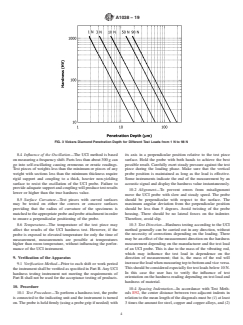
FIG. 3 Vickers Diamond Penetration Depth for Different Test Loads from1Nto98N
8.4 Influence of the Oscillation—The UCI method is based its axis in a perpendicular position relative to the test piece
onmeasuringafrequencyshift.Partslessthanabout300gcan surface. Hold the probe with both hands to achieve the best
go into self-oscillating causing erroneous or erratic readings. possible result. Carefully exert steady pressure against the test
Test pieces of weights less than the minimum or pieces of any piece during the loading phase. Make sure that the vertical
weight with sections less than the minimum thickness require probe position is maintained as long as the load is effective.
rigid support and coupling to a thick, heavier non-yielding Some instruments indicate the end of the measurement by an
surface to resist the oscillation of the UCI probe. Failure to acoustic signal and display the hardness value instantaneously.
provideadequatesupportandcouplingwillproducetestresults
10.2 Alignment—To prevent errors from misalignment
lower or higher than the true hardness value.
move the UCI probe with slow and steady speed. The probe
8.5 Surface Curvature—Test pieces with curved surfaces should be perpendicular with respect to the surface. The
maximum angular deviation from the perpendicular position
may be tested on either the convex or concave surfaces
providing that the radius of curvature of the specimens is should be less than 5 degrees. Avoid twisting of the probe
housing. There should be no lateral forces on the indenter.
matchedtotheappropriateprobeandprobeattachmentinorder
to ensure a perpendicular positioning of the probe. Therefore, avoid slip.
8.6 Temperature—The temperature of the test piece may 10.3 Test Direction—Hardness testing according to the UCI
method generally can be carried out in any direction, without
affect the results of the UCI hardness test. However, if the
probe is exposed to elevated temperature for only the time of the necessity of corrections depending on the loading. There
may be an effect of the measurement
...
This document is not an ASTM standard and is intended only to provide the user of an ASTM standard an indication of what changes have been made to the previous version. Because
it may not be technically possible to adequately depict all changes accurately, ASTM recommends that users consult prior editions as appropriate. In all cases only the current version
of the standard as published by ASTM is to be considered the official document.
Designation: A1038 − 17 A1038 − 19
Standard Test Method for
Portable Hardness Testing by the Ultrasonic Contact
Impedance Method
This standard is issued under the fixed designation A1038; the number immediately following the designation indicates the year of
original adoption or, in the case of revision, the year of last revision. A number in parentheses indicates the year of last reapproval. A
superscript epsilon (´) indicates an editorial change since the last revision or reapproval.
1. Scope*
1.1 This test method covers the determination of comparative hardness values by applying the Ultrasonic Contact Impedance
Method (UCI Method).
1.2 The values stated in SI units are to be regarded as standard. No other units of measurement are included in this standard.
1.2.1 Exception—Informational inch-pound units are provided in Note 1 and ksi is used in 12.1.
1.3 This standard does not purport to address all of the safety concerns, if any, associated with its use. It is the responsibility
of the user of this standard to establish appropriate safety, health, and environmental practices and determine the applicability of
regulatory limitations prior to use.
1.4 This international standard was developed in accordance with internationally recognized principles on standardization
established in the Decision on Principles for the Development of International Standards, Guides and Recommendations issued
by the World Trade Organization Technical Barriers to Trade (TBT) Committee.
2. Referenced Documents
2.1 ASTM Standards:
A370 Test Methods and Definitions for Mechanical Testing of Steel Products
E10 Test Method for Brinell Hardness of Metallic Materials
E18 Test Methods for Rockwell Hardness of Metallic Materials
E92 Test Methods for Vickers Hardness and Knoop Hardness of Metallic Materials
E140 Hardness Conversion Tables for Metals Relationship Among Brinell Hardness, Vickers Hardness, Rockwell Hardness,
Superficial Hardness, Knoop Hardness, Scleroscope Hardness, and Leeb Hardness
E177 Practice for Use of the Terms Precision and Bias in ASTM Test Methods
E384 Test Method for Microindentation Hardness of Materials
E691 Practice for Conducting an Interlaboratory Study to Determine the Precision of a Test Method
3. Terminology and Equations
3.1 Definitions:
3.1.1 calibration—determination of the specific values of the significant operating parameters of the UCI instrument by
comparison with values indicated by a standardized workbench hardness tester or by a set of certified reference test pieces.
3.1.2 surface finish—all references to surface finish in this test method are defined as surface roughness (that is, Ra = average
roughness value).
3.1.3 UCI hardness test—a hardness testing method using a calibrated instrument by pressing a resonating rod with a defined
indenter, for example, a Vickers diamond, with a fixed force against the surface of the part to be tested.
3.1.4 UCI method—Ultrasonic Contact Impedance, a hardness testing method developed by Dr. Claus Kleesattel in 1961 based
on the measurement of the frequency shift of a resonating rod caused by the essentially elastic nature of the finite area of contact
between the indenter and the test piece during the penetration.
This test method is under the jurisdiction of ASTM Committee A01 on Steel, Stainless Steel and Related Alloys and is the direct responsibility of Subcommittee A01.06
on Steel Forgings and Billets.
Current edition approved Nov. 1, 2017Oct. 1, 2019. Published December 2017October 2019. Originally approved in 2005. Last previous edition approved in 20132017
ɛ1
as A1038 – 13A1038 .–17. DOI: 10.1520/A1038-17.10.1520/A1038–19.
For referenced ASTM standards, visit the ASTM website, www.astm.org, or contact ASTM Customer Service at service@astm.org. For Annual Book of ASTM Standards
volume information, refer to the standard’s Document Summary page on the ASTM website.
*A Summary of Changes section appears at the end of this standard
Copyright © ASTM International, 100 Barr Harbor Drive, PO Box C700, West Conshohocken, PA 19428-2959. United States
A1038 − 19
3.1.5 verification—checking or testing the UCI instrument to ensure conformance with this test method.
3.2 Equations:
3.2.1 The average x¯ of a set of n measurements x ,x , ., x is calculated as:
1 2 n
x 1x 1.1x
1 2 n
x¯ 5 (1)
n
where each of the individual measurements x ,x , ., x is the result from a single indentation.
1 2 n
3.2.2 The error E in the performance of an ultrasonic contact impedance hardness testing instrument at each hardness level,
relative to a standardized reference value, is calculated as an absolute percent error determined as:
x¯ 2 x
ref
E 5 100 3 (2)
U S DU
x
ref
where:
x¯ = the average (see 3.2.1) of n measurements made on a standard reference block as part of a performance verification, and
x = the certified reference hardness reported for the standard reference block.
ref
4. Significance and Use
4.1 The hardness of a material is a defined quantity having many scales and being dependent on the way the test is performed.
In order to avoid the creation of a new method involving a new hardness scale, the UCI method converts into common hardness
values, for example, HV, HRC, etc.
4.2 The UCI hardness test is a superficial determination, only measuring the hardness condition of the surface contacted. The
results generated at a specific location do not represent the part at any other surface location and yield no information about the
material at subsurface locations.
4.3 The UCI hardness test may be used on large or small components at various locations. It can be used to make hardness
measurements on positions difficult to access, such as tooth flanks or roots of gears.
A. GENERAL DESCRIPTION OF INSTRUMENTS AND TEST PROCEDURE FOR UCI HARDNESS TESTING
5. Apparatus
5.1 Instruments used for UCI hardness testing generally consist of (1) a probe containing a rod with a defined indenter, for
example, a Vickers diamond, attached to the contacting end per Test Methodin accordance with Test Methods E384E92 (see Fig.
1), (2) vibration generating means, (3) vibration detecting means, (4) electronic means for the numerical evaluation, and (5) a
digital display, indicating the measured hardness number.
Legend:
T = Piezo Transducer
R = Receiver
O = Oscillating rod
V = indenter, for example, Vickers diamond
m = test material
FIG. 1 Schematic Description of the UCI Probe
A1038 − 19
5.2 UCI Probes—There are different probes available for UCI hardness testing. They typically cover static loads ranging from
1 N to 98 N. See also Appendix X1. They come also come in different sizes with longer and shorter sensor rods for specials
applications. And they are developed in two versions, that is, manually operated or equipped with a servo-motor for automatic
testing.
5.3 Summary of Test Method—In conventional workbench hardness testing like Brinell or Vickers testing according to Test
Methods E10 and E384E92, the hardness value is determined optically by the size of the indentation in the material generated by
a certain test load, after the indenter has been removed. In the mobile hardness test under applied load according to the UCI
method, however, the size of the produced indents are not determined optically. Instead the contact area is derived from the
electronically measured shift of an ultrasonic resonance frequency. To carry out the UCI test, a probe containing the rod with the
indenter is excited into a longitudinal ultrasonic oscillation of about 70 kHz by piezoelectric ceramics—the so-called zero
frequency, which occurs when the indenter is vibrating in air.
5.3.1 A spring inside the probe applies the specified test load, the vibrating tip penetrates into the material creating an elastic
contact, which results in a positive frequency shift of the resonating rod. This shift is related to the size of the indent area (contact
area of the indenter with the material). The size, in turn, is a measure for the hardness of the test material at a given modulus of
elasticity, for example, HV(UCI) according to Eq 3.
5.3.2 Therefore, the frequency shift is relatively small for hard materials, because the indenter penetrates not very deep into the
test material leaving only a small indent.
5.3.3 The frequency shift becomes larger if the indenter penetrates deeper into the material, indicating medium hardness, in
accordance with the larger test indentations. Analogously, the frequency shift becomes largest when soft materials are tested (see
Fig. 2).
5.3.4 The instrument constantly monitors the resonance frequency, calculates the frequency shift when the specified test load
has been reached either after the internal switch has triggered the corresponding measurement frequency in the case of handheld
probes or after a specific dwell time has been elapsed in the case of motor driven probes. The instrument carries out the evaluation
and calculations, and displays instantaneously the hardness value, for example, HV(UCI).
UCI Vickers (3)
F
Δf 5 f E ·A and HV 5
~ !
eff
A
↑_________________↑
5.3.5 The frequency shift is a function of the indentation size of a defined indenter, for example, a Vickers diamond, at a given
modulus of elasticity of the measurement system.
5.3.6 Eq 3 describes the basic relation in comparison to the definition of the Vickers hardness value: Δf = Frequency shift, A
= indentation area, E = effective elastic modulus (contains the elastic constants of both the indenter and the test piece), HV =
eff
Vickers hardness value, F = Force applied in the hardness test.
5.4 The Influence of the Elastic Constants—As can be seen in Eq 3, the frequency shift not only depends on the size of the
contact area but also on the elastic moduli of the materials in contact. To allow for differences in Young’s modulus, the instrument
has to be calibrated for different groups of materials. After calibration, the UCI method can be applied to all materials, which have
the corresponding Young’s modulus.
5.4.1 As manufactured, the UCI instrument usually has been calibrated on non-alloyed and low-alloyed steel, that is, certified
hardness reference blocks according to Test MethodMethods E384E92. Besides this, some instruments may be calibrated quickly,
also at the test site, for metals such as high-alloyed steels, aluminum or titanium.
FIG. 2 Hardness Value versus Frequency Shift of the Oscillating Rod
A1038 − 19
6. Calibration to Other Materials
6.1 A test piece of the particular material is needed. The hardness value should then be determined with a standardized
workbench hardness tester like one for Vickers, Brinell or Rockwell according to Test Methods and Definitions A370. It is
recommended to take at least five readings and calculate the average hardness value. Now carry out a set of at least five single
UCI measurements on your test material according to instructions in 10.6, adjust the displayed average value to the before
measured hardness of the material and thus find the calibration value which is necessary for further measurements on this particular
material in the desired hardness scale and range.
6.1.1 Some instruments allow storing all calibration data and adjustment parameters for hardness testing of different materials.
They can be recalled to the instrument as needed.
7. Comparison with Other Hardness Testing Methods
7.1 As opposed to conventional low load hardness testers, the UCI instruments do not evaluate the indentation size
microscopically but electronically according to the UCI method. The UCI method yields comparative hardness measurements
when considering the dependency on the elastic modulus of the test piece.
7.2 After removing the test force, an indentation generated by the UCI probe using a Vickers diamond as indenter and mounted
in a test stand is practically identical to a Vickers indentation produced by a workbench tester of the same load. The indentation
can be measured optically according to the standard Vickers test if care is taken to apply the force according to Test
MethodMethods E384E92 and if a Vickers indenter is used in the UCI probe. In this case special arrangements or probe
attachments have to be used to provide verification of the actual test force of the UCI probe.
8. Test Piece
8.1 Surface Preparation—The applied test force (that is, the selected UCI probe) must not only match the application but also
the surface quality and roughness of the material. While smooth, homogeneous surfaces can be tested with low test loads, rougher
and coarse-grained surfaces require test loads as high as possible. However, the surface must always be free of any impurities (oil,
dust, etc.) and rust.
8.1.1 The surface roughness should not exceed ≈30 % of the penetration depth (Ra ≤ 0.3 × h) with:
Force @N#
h mm 5 0.062 3 (4)
@ # Œ
Hardness HV
@ #
8.1.2 Penetration depth of the Vickers diamond pyramid for a certain hardness (in HV) and test load (in N) id is shown in Eq
4.
8.1.3 Table 1 provides the recommended minimal surface roughness for certain UCI probes that use a Vickers indenter. If
surface preparation is necessary, care must be taken not to alter the surface hardness by overheating or cold working. Any paint,
scale or other surface coatings shall be completely removed. Failure to provide adequate surface finish will produce unsteady
readings. Coarse finishes will tend to lower the measured value.
8.2 Minimum Thickness—Thin coatings or surface layers on bulk material must have a minimum thickness of at least ten times
of the indentation depth of the indenter used (see Fig. 3 for a Vickers indenter) corresponding to the Bueckle’s rule: S = 10 ×
min
h.
8.3 Minimum Wall Thickness—Distinct reading variations may especially occur with a specimen thickness of less than about 15
mm if the test material is excited to resonance or sympathetic oscillations (for example, thin blocks, tubes, pipes, etc.). Most
disturbing are flexural vibrations excited by the vibrating tip. These should be suppressed by suitable means. Sometimes attaching
the test piece to a heavy metal block by means of a viscous paste, grease or oil film suffices to quench the flexural waves.
Nevertheless, a minimum wall thickness of 2 to 3 mm is recommended.
TABLE 1 Surface Finish for Different Test Loads
Test Load 98 N 50 N 10 N 3 N
Ra # 15 μm # 10 μm # 5 μm # 2.5 μm
A1038 − 19
FIG. 3 Vickers Diamond Penetration Depth for Different Test Loads from 1 N to 98 N
8.4 Influence of the Oscillation—The UCI method is based on measuring a frequency shift. Parts less than about 300 g can go
into self-oscillating causing erroneous or erratic readings. Test pieces of weights less than the minimum or pieces of any weight
with sections less than the minimum thickness require rigid support and coupling to a thick, heavier non-yielding surface to resist
the oscillation of the UCI probe. Failure to provide adequate support and coupling will produce test results lower or higher than
the true hardness value.
8.5 Surface Curvature—Test pieces with curved surfaces may be tested on either the convex or concave surfaces providing that
the radius of curvature of the specimens is matched to the appropriate probe and probe attachment in order to ensure a
perpendicular positioning of the probe.
8.6 Temperature—The temperature of the test piece may affect the results of the UCI hardness test. However, if the probe is
exposed to elevated temperature for only the time of measurement, measurements are possible at temperatures higher than room
temperature, without influencing the performance of the UCI instrument.
9. Verification of the Apparatus
9.1 Verification Method—Prior to each shift or work period the instrument shall be verified as specified in Part B. Any UCI
hardness testing instrument not meeting the requirements of Part B shall not be used for the acceptance testing of products.
10. Procedure
10.1 Test Procedure—To perform a hardness test, the probe is connected to the indicating unit and the instrument is turned on.
The probe is held firmly (using a probe grip if needed) with its axis in a perpendicular position relative to the test piece surface.
Hold the probe with both hands to achieve the best possible result. Carefully exert steady pressure against the test piece during
the loading phase. Make sure that the vertical probe position is maintained as long as the load is effective. Some instruments
indicate the end of the measurement by an acoustic signal and display the hard
...