

ASTM E2619/E2619M-17
(Practice)Standard Practice for Measuring and Calculating Building Loss Features That Take Up Floor Area in Buildings
General Information
- Abstract
SIGNIFICANCE AND USE
4.1 Use this practice to identify and measure the amount of actual and effective floor area that will be unavailable to occupants for the placement of people’s workplaces, furniture, and equipment or for circulation.
4.2 Findings from use of this practice are intended for optional inclusion with reports of floor area measured in accordance with Practice E1836/E1836M or in accordance with ANSI/BOMA Z65.1–1996.
Note 1: The choice between using Practice E1836/E1836M or ANSI/BOMA Z65.1–1996 as the basis for measurement depends on the objectives of the analysis. Practice E1836/E1836M is oriented to the traditional interests of design professionals and would be particularly suitable for single-tenant buildings whereas some categories of space measured by ANSI/BOMA Z65.1–1996 are oriented to the leasing of multi-tenant buildings by real estate professionals.
4.3 this practice is not intended for use for regulatory purposes, nor for fire hazard assessment, nor for fire risk assessment.
SCOPE
1.1 This practice specifies how to measure certain characteristics of a building, known as building loss features, inside the exterior gross area of a floor and how to calculate the amount of actual and effective floor area that will be not be available for the placement of people’s workplaces, furniture, equipment, or for circulation, if using standard furnishings and orthogonal furniture systems.
1.2 This practice can be used to specify a performance requirement to limit the amount of floor area that may be taken up by building loss features.
1.3 This practice can be used to assess how well a design(s) for an office facility meets a performance requirement regarding floor area.
1.4 This practice can be used to assess how well a constructed office building has met a performance requirement regarding floor area.
1.5 This practice is not intended for and not suitable for use for regulatory purposes, fire hazard assessment, and fire risk assessment.
1.6 Users of this practice should recognize that, in some situations, the amount of certain actual and effective floor area losses may be mitigated to some degree at some cost by custom-tailoring spaces and creating specially fitted furnishings and carpentry to get some value from space which would not otherwise be usable.
1.7 The values stated in either SI units or inch-pound units are to be regarded separately as standard. The values stated in each system may not be exact equivalents; therefore, each system shall be used independently of the other. Combining values from the two systems may result in non-conformance with the standard.
1.8 This standard does not purport to address all of the safety concerns, if any, associated with its use. It is the responsibility of the user of this standard to establish appropriate safety, health, and environmental practices and determine the applicability of regulatory limitations prior to use.
1.9 This international standard was developed in accordance with internationally recognized principles on standardization established in the Decision on Principles for the Development of International Standards, Guides and Recommendations issued by the World Trade Organization Technical Barriers to Trade (TBT) Committee.
- Status
- Published
- Publication Date
- 30-Sep-2017
- Technical Committee
- E06 - Performance of Buildings
- Drafting Committee
- E06.25 - Whole Buildings and Facilities
Buy Documents
ASTM E2619/E2619M-17 - Standard Practice for Measuring and Calculating Building Loss Features That Take Up Floor Area in Buildings
REDLINE ASTM E2619/E2619M-17 - Standard Practice for Measuring and Calculating Building Loss Features That Take Up Floor Area in Buildings
Overview
ASTM E2619/E2619M-17, issued by ASTM International, provides standardized practice for measuring and calculating building loss features that occupy floor area in buildings. This practice enables facility managers, designers, and real estate professionals to correctly identify and quantify spaces within a building that are rendered unusable for occupants due to permanent construction elements, circulation needs, or regulatory constraints. By offering a consistent approach, this standard supports better space utilization analysis and decision-making for office layouts, tenant improvements, and performance evaluations of building designs.
Key Topics
Identifying Building Loss Features
The standard defines and guides measurement of features such as columns, shear walls, utility walls, ductwork, perimeter encroachments, and service spaces that reduce usable floor area.Actual vs. Effective Loss
- Actual Loss: Areas physically occupied by building elements or restricted by regulations.
- Effective Loss: Spaces rendered unusable due to layout inefficiencies or the configuration of building elements, often when using standard, modular furnishings.
Performance Requirements
Establishes procedures to set, measure, and limit the percentage of floor area lost to such features, supporting benchmarking and optimization during both the design and post-construction phases.Measurement Procedures
Details methods using both SI and inch-pound units for precise measurement and calculation of loss areas, ensuring clear and auditable documentation.Assessment Tools
Supports the use of CAD and CAFM (Computer-Aided Design/Facilities Management) for accurate quantification of loss features on both existing and proposed floor plans.
Applications
ASTM E2619/E2619M-17 is a crucial resource for a wide range of building and real estate professionals, particularly in the following scenarios:
Office Building Design & Optimization
Allows architects and designers to assess and minimize loss features, maximizing occupiable space for people’s workplaces, equipment, and circulation.Facility Management & Space Planning
Assists facility managers in identifying underutilized or unserviceable areas for better space allocation and future renovations.Tenant Fit-Out and Leasing
Supports real estate professionals and tenants in evaluating floor area efficiency, particularly when comparing buildings, leasing multi-tenant spaces, or negotiating usable square footage.Benchmarking and Reporting
Facilitates the optional inclusion of loss data in floor area measurement reports generated under related standards (ASTM E1836/E1836M, ANSI/BOMA Z65.1), providing additional transparency to stakeholders.Evaluating Space Efficiency
Offers objective criteria to rate and compare how well different buildings meet owner or tenant-driven performance requirements concerning available floor area.
Related Standards
Professionals utilizing ASTM E2619/E2619M-17 may also reference these standards for comprehensive building area measurement and management:
ASTM E1836/E1836M – Practice for Building Floor Area Measurements for Facility Management
Focuses on overall building floor area calculations for facility management purposes, complementing the loss assessment.ANSI/BOMA Z65.1 – Standard Method for Measuring Floor Area in Office Buildings
Widely used in the commercial real estate industry, particularly for leasing and multi-tenant buildings.ASHRAE 62.1 – Ventilation for Acceptable Indoor Air Quality
Referenced for definitions relevant to occupied zones and space planning.
Practical Value
By implementing ASTM E2619/E2619M-17, building professionals can enhance space efficiency, improve planning for tenant fit-outs, and support performance-based design evaluation. Accurate measurement of building loss features leads to informed decision-making, greater transparency, and optimized investment in commercial real estate projects. This practice is not suitable for regulatory or fire hazard assessments but serves as a robust tool for maximizing functional building area and supporting evidence-based space management.
Keywords: building loss features, floor area measurement, actual loss, effective loss, office building design, facility management, space planning, ASTM standards, area optimization, space utilization, building performance.
Relations
- Effective Date
- 01-Oct-2017
- Effective Date
- 01-Mar-2016
- Effective Date
- 01-Mar-2015
- Effective Date
- 01-Nov-2014
- Effective Date
- 01-Apr-2009
- Effective Date
- 01-Jun-2006
- Effective Date
- 28-Jul-2000
- Effective Date
- 01-Oct-2017
Buy Documents
ASTM E2619/E2619M-17 - Standard Practice for Measuring and Calculating Building Loss Features That Take Up Floor Area in Buildings
REDLINE ASTM E2619/E2619M-17 - Standard Practice for Measuring and Calculating Building Loss Features That Take Up Floor Area in Buildings
Get Certified
Connect with accredited certification bodies for this standard

DIBt (Deutsches Institut für Bautechnik)
German Institute for Building Technology.
DIN CERTCO
DIN Group product certification.

Aboma Certification B.V.
Specialized in construction, metal, and transport sectors.
Sponsored listings
Frequently Asked Questions
ASTM E2619/E2619M-17 is a standard published by ASTM International. Its full title is "Standard Practice for Measuring and Calculating Building Loss Features That Take Up Floor Area in Buildings". This standard covers: SIGNIFICANCE AND USE 4.1 Use this practice to identify and measure the amount of actual and effective floor area that will be unavailable to occupants for the placement of people’s workplaces, furniture, and equipment or for circulation. 4.2 Findings from use of this practice are intended for optional inclusion with reports of floor area measured in accordance with Practice E1836/E1836M or in accordance with ANSI/BOMA Z65.1–1996. Note 1: The choice between using Practice E1836/E1836M or ANSI/BOMA Z65.1–1996 as the basis for measurement depends on the objectives of the analysis. Practice E1836/E1836M is oriented to the traditional interests of design professionals and would be particularly suitable for single-tenant buildings whereas some categories of space measured by ANSI/BOMA Z65.1–1996 are oriented to the leasing of multi-tenant buildings by real estate professionals. 4.3 this practice is not intended for use for regulatory purposes, nor for fire hazard assessment, nor for fire risk assessment. SCOPE 1.1 This practice specifies how to measure certain characteristics of a building, known as building loss features, inside the exterior gross area of a floor and how to calculate the amount of actual and effective floor area that will be not be available for the placement of people’s workplaces, furniture, equipment, or for circulation, if using standard furnishings and orthogonal furniture systems. 1.2 This practice can be used to specify a performance requirement to limit the amount of floor area that may be taken up by building loss features. 1.3 This practice can be used to assess how well a design(s) for an office facility meets a performance requirement regarding floor area. 1.4 This practice can be used to assess how well a constructed office building has met a performance requirement regarding floor area. 1.5 This practice is not intended for and not suitable for use for regulatory purposes, fire hazard assessment, and fire risk assessment. 1.6 Users of this practice should recognize that, in some situations, the amount of certain actual and effective floor area losses may be mitigated to some degree at some cost by custom-tailoring spaces and creating specially fitted furnishings and carpentry to get some value from space which would not otherwise be usable. 1.7 The values stated in either SI units or inch-pound units are to be regarded separately as standard. The values stated in each system may not be exact equivalents; therefore, each system shall be used independently of the other. Combining values from the two systems may result in non-conformance with the standard. 1.8 This standard does not purport to address all of the safety concerns, if any, associated with its use. It is the responsibility of the user of this standard to establish appropriate safety, health, and environmental practices and determine the applicability of regulatory limitations prior to use. 1.9 This international standard was developed in accordance with internationally recognized principles on standardization established in the Decision on Principles for the Development of International Standards, Guides and Recommendations issued by the World Trade Organization Technical Barriers to Trade (TBT) Committee.
SIGNIFICANCE AND USE 4.1 Use this practice to identify and measure the amount of actual and effective floor area that will be unavailable to occupants for the placement of people’s workplaces, furniture, and equipment or for circulation. 4.2 Findings from use of this practice are intended for optional inclusion with reports of floor area measured in accordance with Practice E1836/E1836M or in accordance with ANSI/BOMA Z65.1–1996. Note 1: The choice between using Practice E1836/E1836M or ANSI/BOMA Z65.1–1996 as the basis for measurement depends on the objectives of the analysis. Practice E1836/E1836M is oriented to the traditional interests of design professionals and would be particularly suitable for single-tenant buildings whereas some categories of space measured by ANSI/BOMA Z65.1–1996 are oriented to the leasing of multi-tenant buildings by real estate professionals. 4.3 this practice is not intended for use for regulatory purposes, nor for fire hazard assessment, nor for fire risk assessment. SCOPE 1.1 This practice specifies how to measure certain characteristics of a building, known as building loss features, inside the exterior gross area of a floor and how to calculate the amount of actual and effective floor area that will be not be available for the placement of people’s workplaces, furniture, equipment, or for circulation, if using standard furnishings and orthogonal furniture systems. 1.2 This practice can be used to specify a performance requirement to limit the amount of floor area that may be taken up by building loss features. 1.3 This practice can be used to assess how well a design(s) for an office facility meets a performance requirement regarding floor area. 1.4 This practice can be used to assess how well a constructed office building has met a performance requirement regarding floor area. 1.5 This practice is not intended for and not suitable for use for regulatory purposes, fire hazard assessment, and fire risk assessment. 1.6 Users of this practice should recognize that, in some situations, the amount of certain actual and effective floor area losses may be mitigated to some degree at some cost by custom-tailoring spaces and creating specially fitted furnishings and carpentry to get some value from space which would not otherwise be usable. 1.7 The values stated in either SI units or inch-pound units are to be regarded separately as standard. The values stated in each system may not be exact equivalents; therefore, each system shall be used independently of the other. Combining values from the two systems may result in non-conformance with the standard. 1.8 This standard does not purport to address all of the safety concerns, if any, associated with its use. It is the responsibility of the user of this standard to establish appropriate safety, health, and environmental practices and determine the applicability of regulatory limitations prior to use. 1.9 This international standard was developed in accordance with internationally recognized principles on standardization established in the Decision on Principles for the Development of International Standards, Guides and Recommendations issued by the World Trade Organization Technical Barriers to Trade (TBT) Committee.
ASTM E2619/E2619M-17 is classified under the following ICS (International Classification for Standards) categories: 91.010.30 - Technical aspects. The ICS classification helps identify the subject area and facilitates finding related standards.
ASTM E2619/E2619M-17 has the following relationships with other standards: It is inter standard links to ASTM E2619/E2619M-09e1, ASTM E1836/E1836M-09(2016), ASTM E631-15, ASTM E631-14, ASTM E1836/E1836M-09e1, ASTM E631-06, ASTM E631-93a(1998)e1, ASTM E1664-19. Understanding these relationships helps ensure you are using the most current and applicable version of the standard.
ASTM E2619/E2619M-17 is available in PDF format for immediate download after purchase. The document can be added to your cart and obtained through the secure checkout process. Digital delivery ensures instant access to the complete standard document.
Standards Content (Sample)
This international standard was developed in accordance with internationally recognized principles on standardization established in the Decision on Principles for the
Development of International Standards, Guides and Recommendations issued by the World Trade Organization Technical Barriers to Trade (TBT) Committee.
Designation: E2619/E2619M − 17
Standard Practice for
Measuring and Calculating Building Loss Features That
Take Up Floor Area in Buildings
ThisstandardisissuedunderthefixeddesignationE2619/E2619M;thenumberimmediatelyfollowingthedesignationindicatestheyear
of original adoption or, in the case of revision, the year of last revision. A number in parentheses indicates the year of last reapproval.
A superscript epsilon (´) indicates an editorial change since the last revision or reapproval.
1. Scope responsibility of the user of this standard to establish appro-
priate safety, health, and environmental practices and deter-
1.1 This practice specifies how to measure certain charac-
mine the applicability of regulatory limitations prior to use.
teristics of a building, known as building loss features, inside
1.9 This international standard was developed in accor-
the exterior gross area of a floor and how to calculate the
dance with internationally recognized principles on standard-
amount of actual and effective floor area that will be not be
ization established in the Decision on Principles for the
available for the placement of people’s workplaces, furniture,
Development of International Standards, Guides and Recom-
equipment, or for circulation, if using standard furnishings and
mendations issued by the World Trade Organization Technical
orthogonal furniture systems.
Barriers to Trade (TBT) Committee.
1.2 This practice can be used to specify a performance
requirement to limit the amount of floor area that may be taken
2. Referenced Documents
up by building loss features.
2.1 ASTM Standards:
1.3 This practice can be used to assess how well a design(s)
E631 Terminology of Building Constructions
for an office facility meets a performance requirement regard-
E1836/E1836M Practice for Building Floor Area Measure-
ing floor area.
ments for Facility Management
1.4 This practice can be used to assess how well a con-
2.2 ANSI Standard:
structed office building has met a performance requirement
ANSI/BOMA Z65.1–1996 Standard Method for Measuring
regarding floor area.
Floor Area in Office Buildings
1.5 This practice is not intended for and not suitable for use
2.3 Other Standards:
for regulatory purposes, fire hazard assessment, and fire risk
ASHRAE 62.1–2007 Ventilation for Acceptable Indoor Air
assessment.
Quality
1.6 Users of this practice should recognize that, in some
3. Terminology
situations, the amount of certain actual and effective floor area
losses may be mitigated to some degree at some cost by
3.1 Definitions:
custom-tailoring spaces and creating specially fitted furnish-
3.1.1 facility, n—a physical setting used to serve a specific
ings and carpentry to get some value from space which would
purpose.
not otherwise be usable.
1.7 The values stated in either SI units or inch-pound units
are to be regarded separately as standard. The values stated in For referenced ASTM standards, visit the ASTM website, www.astm.org, or
contact ASTM Customer Service at service@astm.org. For Annual Book of ASTM
each system may not be exact equivalents; therefore, each
Standards volume information, refer to the standard’s Document Summary page on
system shall be used independently of the other. Combining
the ASTM website.
values from the two systems may result in non-conformance
Available fromAmerican National Standards Institute (ANSI), 25 W. 43rd St.,
4th Floor, New York, NY 10036, http://www.ansi.org.
with the standard.
Available from American Society of Heating, Refrigerating, and Air-
1.8 This standard does not purport to address all of the
Conditioning Engineers, Inc. (ASHRAE), 1791 Tullie Circle, NE, Atlanta, GA
30329, http://www.ashrae.org.
safety concerns, if any, associated with its use. It is the
Certain definitions of terms in this practice were agreed in 2007 by a Working
Group established jointly by the Building Owners and Managers Association
This practice is under the jurisdiction of ASTM Committee E06 on Perfor- (BOMA) International and the International Facility Management Association
mance of Buildings and is the direct responsibility of Subcommittee E06.25 on (IFMA). Certain terms were derived from referenced ASTM standards or from
Whole Buildings and Facilities. referenced ANSI standard, or from published IFMA documents. Ownership of
Current edition approved Oct. 1, 2017. Published November 2017. Originally copyright to specific terms is indicated by footnotes. Certain terms are quoted from
ɛ1
approvedin2008.Lastpreviouseditionapprovedin2009asE2619/E2619M – 09 . other ASTM standards, in which case the ASTM source is identified at the end of
DOI: 10.1520/E2619_E2619M-17. the definition.
Copyright © ASTM International, 100 Barr Harbor Drive, PO Box C700, West Conshohocken, PA 19428-2959. United States
E2619/E2619M − 17
3.1.1.1 Discussion—A facility may be within a building, a 3.2.8 floorplate, n—entire floor of a building, thought of as
whole building, or a building with its site and surrounding a solid plane with specific shape and dimensions.
environment; or it may be a construction that is not a building.
3.2.9 interior encroachment, n—base building element that
The term encompasses both the physical object and its use.
is located inside a building, not on an outer wall, and prevents
E631
theuseofthefloorareaforfurniture,equipment,circulation,or
other occupant function.
3.1.2 For standard definitions of additional terms applicable
3.2.9.1 Discussion—Examples include but are not limited
to this practice, see Terminology E631.
to: pilaster, convector, baseboard heating unit, radiator.
3.2 Definitions of Terms Specific to This Standard:
3.2.1 actual loss, n—of floor area, floor area not available
3.2.10 interior gross area, n—portion of the floor(s) that is
for the placement of people’s workplaces, furniture, or equip-
totally enclosed within the dominant portion.
mentorforcirculationbecauseoccupiedbyaphysicalbuilding
3.2.11 occupied zone, n—region within an occupied space
feature or required by law or regulation.
between planes 75 and 1800 mm [3 and 72 in.] above the floor
3.2.2 building loss factor, n—in a facility, expressed as a
and more than 600 mm [2 ft] from the walls or fixed
percentage of a facility’s exterior gross area, the space not
air-conditioning equipment (see ASHRAE 62.1–2007).
actually or effectively available for planning because of build-
3.2.12 orthogonal, n—relating to or composed of right
ing configuration.
angles.
3.2.2.1 Discussion—It is the floor area percentage that must
3.2.13 perimeter encroachment, n—base building element
be used for excess circulation, oversize footprints, “dead
or restricted area that is located inside the dominant portion of
space,” or encroachments because of floorplate configuration.
a building on the outer wall and that prevents the use of the
3.2.3 building loss feature, n—element of a building, or
floor area for furniture, equipment, circulation, or other occu-
aspect of its design, inside the exterior gross area, that cost
pant function.
floor area which could otherwise be used for the placement of
3.2.13.1 Discussion—Examples are windowsills inside the
people’s workplaces, furniture, or equipment or for circulation.
dominant portion, pilasters, and columns attached to the
3.2.4 dominant portion, n—the inside surface of the outside
outside walls and convectors.
wall. ANSI/BOMA Z65.1–1996
3.2.14 plannable area, n—plannable gross area less the area
3.2.5 effective loss, of floor area, n—floor area not available
taken up by major vertical penetrations, void areas, service
for the placement of people’s workplaces, furniture, or equip-
areas, and either primary circulation on an occupied or planned
ment or for circulation because of configuration of building
floor or base building circulation on an empty floor.
elements or legally binding document.
3.2.15 plannable gross area, n—portion of a floor that is
3.2.5.1 Discussion—Occurs typically if using standard or
totally enclosed within the interior face of perimeter encroach-
manufactured furnishings or orthogonal furniture system(s) in
ments at the floor plane and where there are no perimeter
a floorplate with a non-orthogonal configuration, but this
encroachments enclosed at the inside finished surface of the
sometimes may be partially mitigated by using specially-built 8
exterior walls.
or built-in furnishings. An example of a legally binding
3.2.15.1 Discussion—Plannable gross area typically ex-
document is a requirement in a lease.
cludes perimeter encroachments that prevent the placement of
3.2.6 exterior gross area, n—the area of the floor measured
the occupant’s furniture and equipment.
to the outside face of the walls that enclose the floor(s) of the
3.2.16 planning grid, n—grid to which building elements
building.
such as the ceiling, the partitions, and the columns are aligned.
3.2.6.1 Discussion—Areas which are not enclosed, such as
3.2.17 primary circulation, n—minimum path on a floor for
patios and balconies, are not part of exterior gross area.
access to egress stairs, elevator lobbies, toilet rooms, refuge
Cornices, pilasters, buttresses, and so forth that extend beyond
areas, building lobbies, and entrances.
the wall face are disregarded. The exterior gross area of a
3.2.18 standard space module, n—unit of floor area with
basement space includes the area measured to the outside face
dimensions set as standard for a category of offices or work-
of basement or foundation walls. A balcony that is not fully
stations.
enclosed, whether or not it extends beyond the line of the
outside wall face, is not included in the exterior gross area.
4. Significance and Use
3.2.7 floor area, n—area in the horizontal plane of the
4.1 Use this practice to identify and measure the amount of
bottom level of a story or stories in a building.
actual and effective floor area that will be unavailable to
occupants for the placement of people’s workplaces, furniture,
and equipment or for circulation.
In the 1996 edition, which is copyright by BOMA, the dominant portion is
4.2 Findings from use of this practice are intended for
defined as the inside face of the portion of the wall which is window glass where it
is more than 50 % of the vertical distance from finished floor to finished ceiling, and
optional inclusion with reports of floor area measured in
elsewhere is the inside face of the outside wall, or of a pilaster or column attached
to the outside wall where they occur. Note that the reader is cautioned that
ANSI/BOMA Z65.1–1996 is developed by and subject to the authority of BOMA ASTM International copyright is shared with BOMA International.
International, which may change it from time to time at its sole option. It is not New term for which copyright is shared by ASTM International and BOMA
defined as a part of this ASTM standard. International.
E2619/E2619M − 17
accordance with Practice E1836/E1836M or in accordance
with ANSI/BOMA Z65.1–1996.
NOTE 1—The choice between using Practice E1836/E1836M orANSI/
BOMA Z65.1–1996 as the basis for measurement depends on the
objectives of the analysis. Practice E1836/E1836M is oriented to the
traditional interests of design professionals and would be particularly
suitable for single-tenant buildings whereas some categories of space
measured by ANSI/BOMA Z65.1–1996 are oriented to the leasing of
multi-tenant buildings by real estate professionals.
4.3 this practice is not intended for use for regulatory
purposes, nor for fire hazard assessment, nor for fire risk
assessment.
5. Basis of Practice
5.1 Use this practice to specify a performance requirement
to limit the amount of floor area that is permitted to be taken
up, or is actually taken up by, building features inside the
exterior gross area, as measured in accordance with Practice
E1836/E1836M.
NOTE 1—A = 50 mm [2 in.]
5.2 Use this practice to assess how well a design(s) for an
B = 100 mm [4 in.]
office facility meets such a performance requirement.
C = 600 mm [24 in.]
5.3 Use this practice to assess how well an existing office
D = 700 mm [28 in.]
FIG. 1 No Actual or Effective Loss Due to Exterior Wall and Its
facility has met a performance requirement.
Relation to Ceiling Grid
5.4 Use this practice to compare how well different build-
ingsorfacilitiesmeetaperformancerequirement.Thispractice
6.4.4 Irregularexteriorwalls,non-orthogonalexteriorwalls,
is applicable despite differences such as location, structure,
and the dimensions of the space can severely limit and even
mechanical systems, age, and building shape.
dictate the nature of the fitup on a floor.
5.5 Use this practice to calculate the amount of variance
6.5 Exterior Wall and Its Relation to the Ceiling Grid:
from a performance target about floor area during design and
6.5.1 The example shown in shows a condition in which
construction phases.
there is no effective loss due to either the design of the
floorplate, the resulting dimensions formed by the building’s
6. Procedure for Measurement and Calculation
exterior building walls and dimensions of the ceiling grid.
6.1 This practice practice uses imperial units to measure
6.5.2 In this example, the ceiling grid line is located 50 mm
floor area. Other measurement units can be used to measure
[2 in.] (for example, one-half the thickness of a partition wall)
floor area.
inside the exterior wall and a result there is no actual or
effective loss for this feature.
6.2 For each building element or aspect of design, measure
6.5.3 IncontrasttoFig.1,thelocationoftheceilinggridsin
the actual loss of floor area and the effective loss using the
have slightly different alignments and demonstrates how effec-
method and measurement sequence in this practice.
tive loss has been introduced into the design.
6.3 Location of the Dominant Portion:
6.5.4 If the Condition Is—The ceiling grid is at the interior
6.3.1 Determine the location(s) of the Dominant Portion of
face of the exterior wall or some distance from the interior face
theinsidefaceoftheexteriorwalls,asdefinedinANSI/BOMA
of the exterior wall, then there is effective loss of floor area for
Z65.1–1996.
people, furniture, and equipment, as shown in Figs. 2 and 3.
6.5.5 Then the Measurement Rule Is—Measure the effective
6.4 Exterior Walls—Size, Shape, and Dimensions:
lossfromthefinishedsurfaceoftheinteriorfaceoftheexterior
6.4.1 Buildings vary in their capacity to accommodate
wall to the next ceiling grid. (Refer to Figs. 2 and 3.) The
different sizes and categories of occupants without excessive
hatchedareasineachofthesefiguresindicatethe effectiveloss,
waste of floor area, while maintaining other levels of service.
which is the amount of extra floor area that will be required to
6.4.2 The geometry of a building’s typical floors (for
align the office wall with the first ceiling grid. Sum the
example, shape and dimensions formed by the exterior build-
measurements to determine the effective loss for this feature.
ing walls and dimensions of its grid) will affect how much
space will be lost because it cannot be subdivided into rooms
6.6 Exterior Wall That Deviates from the Orthogonal:
or workstations.
6.6.1 If the Condition Is—Theexteriorwall(s)deviatesfrom
6.4.3 If designs for the geometry and building grid dimen- the orthogonal and reduces the proportion of floor area
sions do not take this into account, then the amount of floor available for planning and fitup.
area available for planning and fitup may be substantially 6.6.2 When an enclosed office is next to a non-orthogonal,
reduced. or irregular, wall the actual floor area that would be required to
E2619/E2619M − 17
FIG. 4 Effective Loss Due to Non-Orthogonal Exterior Wall
NOTE 1—A = 3660 mm [12 ft, 0 in.]
B = 50 mm [2 in.]
C = 600 mm [24 in.]
FIG. 2 Effective Loss Due to Alignment of Ceiling Grid at Face of
Exterior Wall
FIG. 5 Effective Loss Due to an Irregular Exterior Wall
NOTE 1—A = 3900 mm [13 ft, 0 in.]
B = 50 mm [2 in.]
6.7.1 The size, shape, and location of perimeter encroach-
C = 900 mm [36 in.]
mentsattheexteriorwallcanreducethedensityandefficiency,
FIG. 3 Effective Loss Due to Ceiling Grid Not Being Aligned at
or both, of floor area usage on a floorplate.
Face of Exterior Wall
6.7.2 Perimeter encroachments in the form of convector
heaters or cooling units usually occur under the windows.
layout the office would be larger than the area allowed for in
While a projection may be very small (for example, a 75-mm
the programming document. The floor area in excess of the
[3-in.] protrusion into the interior) when it repeats around the
allowed area is effective loss, as indicated by the hatched area
outside of a floor, the total floor area taken up by these 75-mm
in Figs. 4 and 5.
[3-in.] projections can easily equate to the floor area of one or
6.6.3 The same situation occurs when an open workstation
two workstations on a floor.
is next to non-orthogonal wall. In Fig. 4, the exterior wall
6.7.3 Projections and pilasters, or both, that occur at the
deviates from the orthogonal and creates effective loss as
exterior wall may also be intermittent, such as when columns
indicated by the hatched area.
and earthquake bracing embed only part of the way into an
6.6.4 Then the Measurement Rule Is—Measure the area
exterior wall—with the rest protruding into the interior space.
between the interior face of the exterior wall and the first
When they are not aligned with the grid, or are intermittent,
planning grid line at which a complete open workstation
they interfere with the layout of workstations and offices,
module or enclosed office module can be placed. Sum the
which can lead to significant amount of actual and effective
measurements to determine the effective loss.
losses. Effective losses will be even greater if perimeter
6.7 Perimeter Encroachments: projections are not uniformly projecting into the interior of the
E2619/E2619M − 17
FIG. 7 Actual and Effective Losses Due to Uniformly Projecting
Perimeter Encroachments
FIG. 6 Actual and Effective Losses Due to Perimeter Encroach-
ments
floor. However, if their location enables partitions that are
aligned under the ceiling grid lines to meet the outside wall at
the projection, the amount of actual and effective loss, or both,
may be reduced.
6.7.3.1 If the Condition Is—The floor area between adjacent
projecting perimeter encroachments cannot be used to place
workstations at the inside face of the exterior wall. (Refer to
Fig. 6.)
6.7.3.2 Then the Measurement Rule Is—Measure the effec-
tive loss to the inside finished face of the encroachment that
most projects into the floor to determine the effective loss. Sum
the measurements to determine the effective loss.
6.7.3.3 If the Condition Is—The floor area between uni-
formly projecting encroachments cannot be used effectively to
FIG. 8 Actual and Effective Losses Due to Non-Uniformly Project-
place workstations at the inside face of the exterior wall.
ing Perimeter Encroachments
6.7.3.4 Then the Measurement Rule Is—Measure to the
inside finished face of the projecting encroachment to deter-
mine the effective loss. (Refer to example in Fig. 7.) Sum the
measurements to determine the effective loss.
6.7.3.5 If the Condition Is—Perimeterencroachmentsdonot
uniformly project into the floor area. The floor area between
adjacent non-uniformly projecting perimeter encroachments
cannot be used to place workstations at the inside face of the
Fig. 8.)
exterior wall. (Refer to
6.7.3.6 Then the Measurement Rule Is—Measure from the
inside finished face of the exterior wall to the inside face of the
adjacentencroachmentthatmostprojectsintotheinterior.Sum
the measurements to determine the effective loss.
6.7.3.7 If the Condition Is—Aportion of the floor area must
bekeptcleartoaccessandservicetheseencroachments.(Refer
to Fig. 9.)
6.7.3.8 Then the Measurement Rule Is—Include the floor
area that must be kept clear in the measurement. Sum the
measurements to determine the effective loss.
FIG. 9 Actual and Effective Losses Due to Restricted Area Kept
Clear to Permit Service of Encroachment (Convector)
6.8 Major Vertical Penetrations:
6.8.1 Ducts and Other Openings Through the Floor:
6.8.1.1 Ducts and other openings through a floor can con-
strain layouts within
...
This document is not an ASTM standard and is intended only to provide the user of an ASTM standard an indication of what changes have been made to the previous version. Because
it may not be technically possible to adequately depict all changes accurately, ASTM recommends that users consult prior editions as appropriate. In all cases only the current version
of the standard as published by ASTM is to be considered the official document.
´1
Designation: E2619/E2619M − 09 E2619/E2619M − 17 An American National Standard
Standard Practice for
Measuring and Calculating Building Loss Features That
Take Up Floor Area in Buildings
This standard is issued under the fixed designation E2619/E2619M; the number immediately following the designation indicates the year
of original adoption or, in the case of revision, the year of last revision. A number in parentheses indicates the year of last reapproval.
A superscript epsilon (´) indicates an editorial change since the last revision or reapproval.
ε NOTE—Units information and designation was corrected editorially in April 2009.
1. Scope
1.1 This practice specifies how to measure certain characteristics of a building, known as building loss features, inside the
exterior gross area of a floor and how to calculate the amount of actual and effective floor area that will be not be available for
the placement of people’s workplaces, furniture, equipment, or for circulation, if using standard furnishings and orthogonal
furniture systems.
1.2 This practice can be used to specify a performance requirement to limit the amount of floor area that may be taken up by
building loss features.
1.3 This practice can be used to assess how well a design(s) for an office facility meets a performance requirement regarding
floor area.
1.4 This practice can be used to assess how well a constructed office building has met a performance requirement regarding floor
area.
1.5 This practice is not intended for and not suitable for use for regulatory purposes, fire hazard assessment, and fire risk
assessment.
1.6 Users of this practice should recognize that, in some situations, the amount of certain actual and effective floor area losses
may be mitigated to some degree at some cost by custom-tailoring spaces and creating specially fitted furnishings and carpentry
to get some value from space which would not otherwise be usable.
1.7 The values stated in either SI units or inch-pound units are to be regarded separately as standard. The values stated in each
system may not be exact equivalents; therefore, each system shall be used independently of the other. Combining values from the
two systems may result in non-conformance with the standard.
1.8 This standard does not purport to address all of the safety concerns, if any, associated with its use. It is the responsibility
of the user of this standard to establish appropriate safety safety, health, and healthenvironmental practices and determine the
applicability of regulatory limitations prior to use.
1.9 This international standard was developed in accordance with internationally recognized principles on standardization
established in the Decision on Principles for the Development of International Standards, Guides and Recommendations issued
by the World Trade Organization Technical Barriers to Trade (TBT) Committee.
2. Referenced Documents
2.1 ASTM Standards:
E631 Terminology of Building Constructions
E1836/E1836M Practice for Building Floor Area Measurements for Facility Management
2.2 ANSI Standard:
ANSI/BOMA Z65.1–1996 Standard Method for Measuring Floor Area in Office Buildings
This practice is under the jurisdiction of ASTM Committee E06 on Performance of Buildings and is the direct responsibility of Subcommittee E06.25 on Whole Buildings
and Facilities.
Current edition approved April 1, 2009Oct. 1, 2017. Published October 2009November 2017. Originally approved in 2008. Last previous edition approved in 20082009
ɛ1
as E2619 – 08.E2619/E2619M – 09 . DOI: 10.1520/E2619_E2619M-09E01.10.1520/E2619_E2619M-17.
For referenced ASTM standards, visit the ASTM website, www.astm.org, or contact ASTM Customer Service at service@astm.org. For Annual Book of ASTM Standards
volume information, refer to the standard’s Document Summary page on the ASTM website.
Available from American National Standards Institute (ANSI), 25 W. 43rd St., 4th Floor, New York, NY 10036, http://www.ansi.org.
Copyright © ASTM International, 100 Barr Harbor Drive, PO Box C700, West Conshohocken, PA 19428-2959. United States
E2619/E2619M − 17
2.3 Other Standards:
ASHRAE 62.1–2007 Ventilation for Acceptable Indoor Air Quality
3. Terminology
3.1 Definitions:
3.1.1 facility, n—a physical setting used to serve a specific purpose.
Available from American Society of Heating, Refrigerating, and Air-Conditioning Engineers, Inc. (ASHRAE), 1791 Tullie Circle, NE, Atlanta, GA 30329,
http://www.ashrae.org.
Certain definitions of terms in this practice were agreed in 2007 by a Working Group established jointly by the Building Owners and Managers Association (BOMA)
International and the International Facility Management Association (IFMA). Certain terms were derived from referenced ASTM standards or from referenced ANSI standard,
or from published IFMA documents. Ownership of copyright to specific terms is indicated by footnotes. Certain terms are quoted from other ASTM standards, in which case
the ASTM source is identified at the end of the definition.
3.1.1.1 Discussion—
A facility may be within a building, a whole building, or a building with its site and surrounding environment; or it may be a
construction that is not a building. The term encompasses both the physical object and its use. E631
3.1.2 For standard definitions of additional terms applicable to this practice, see Terminology E631.
3.2 Definitions of Terms Specific to This Standard:
3.2.1 actual loss, n—of floor area, floor area not available for the placement of people’s workplaces, furniture, or equipment
or for circulation because occupied by a physical building feature or required by law or regulation.
3.2.2 building loss factor, n—in a facility, expressed as a percentage of a facility’s exterior gross area, the space not actually
or effectively available for planning because of building configuration.
3.2.2.1 Discussion—
It is the floor area percentage that must be used for excess circulation, oversize footprints, “dead space,” or encroachments because
of floorplate configuration.
3.2.3 building loss feature, n—element of a building, or aspect of its design, inside the exterior gross area, that cost floor area
which could otherwise be used for the placement of people’s workplaces, furniture, or equipment or for circulation.
3.2.4 dominant portion, n—the inside surface of the outside wall. ANSI/BOMA Z65.1–1996
3.2.5 effective loss, of floor area, n—floor area not available for the placement of people’s workplaces, furniture, or equipment
or for circulation because of configuration of building elements or legally binding document.
In the 1996 edition, which is copyright by BOMA, the dominant portion is defined as the inside face of the portion of the wall which is window glass where it is more
than 50 % of the vertical distance from finished floor to finished ceiling, and elsewhere is the inside face of the outside wall, or of a pilaster or column attached to the outside
wall where they occur. Note that the reader is cautioned that ANSI/BOMA Z65.1–1996 is developed by and subject to the authority of BOMA International, which may change
it from time to time at its sole option. It is not defined as a part of this ASTM standard.
3.2.5.1 Discussion—
Occurs typically if using standard or manufactured furnishings or orthogonal furniture system(s) in a floorplate with a
non-orthogonal configuration, but this sometimes may be partially mitigated by using specially-built or built-in furnishings. An
example of a legally binding document is a requirement in a lease.
3.2.6 exterior gross area, n—the area of the floor measured to the outside face of the walls that enclose the floor(s) of the
building.
3.2.6.1 Discussion—
Areas which are not enclosed, such as patios and balconies, are not part of exterior gross area. Cornices, pilasters, buttresses, and
so forth that extend beyond the wall face are disregarded. The exterior gross area of a basement space includes the area measured
to the outside face of basement or foundation walls. A balcony that is not fully enclosed, whether or not it extends beyond the line
of the outside wall face, is not included in the exterior gross area.
3.2.7 floor area, n—area in the horizontal plane of the bottom level of a story or stories in a building.
3.2.8 floorplate, n—entire floor of a building, thought of as a solid plane with specific shape and dimensions.
E2619/E2619M − 17
3.2.9 interior encroachment, n—base building element that is located inside a building, not on an outer wall, and prevents the
use of the floor area for furniture, equipment, circulation, or other occupant function.
ASTM International copyright is shared with BOMA International.
3.2.9.1 Discussion—
Examples include but are not limited to: pilaster, convector, baseboard heating unit, radiator.
3.2.10 interior gross area, n—portion of the floor(s) that is totally enclosed within the dominant portion.
3.2.11 occupied zone, n—region within an occupied space between planes 75 and 1800 mm (3[3 and 72 in.)in.] above the floor
and more than 600 mm (2 ft)[2 ft] from the walls or fixed air-conditioning equipment (see ASHRAE 62.1–2007).
3.2.12 orthogonal, n—relating to or composed of right angles.
3.2.13 perimeter encroachment, n—base building element or restricted area that is located inside the dominant portion of a
building on the outer wall and that prevents the use of the floor area for furniture, equipment, circulation, or other occupant
function.
3.2.13.1 Discussion—
Examples are windowsills inside the dominant portion, pilasters, and columns attached to the outside walls and convectors.
3.2.14 plannable area, n—plannable gross area less the area taken up by major vertical penetrations, void areas, service areas,
and either primary circulation on an occupied or planned floor or base building circulation on an empty floor.
3.2.15 plannable gross area, n—portion of a floor that is totally enclosed within the interior face of perimeter encroachments
at the floor plane and where there are no perimeter encroachments enclosed at the inside finished surface of the exterior walls.
New term for which copyright is shared by ASTM International and BOMA International.
3.2.15.1 Discussion—
Plannable gross area typically excludes perimeter encroachments that prevent the placement of the occupant’s furniture and
equipment.
3.2.16 planning grid, n—grid to which building elements such as the ceiling, the partitions, and the columns are aligned.
3.2.17 primary circulation, n—minimum path on a floor for access to egress stairs, elevator lobbies, toilet rooms, refuge areas,
building lobbies, and entrances.
3.2.18 standard space module, n—unit of floor area with dimensions set as standard for a category of offices or workstations.
4. Significance and Use
4.1 Use this practice to identify and measure the amount of actual and effective floor area that will be unavailable to occupants
for the placement of people’s workplaces, furniture, and equipment or for circulation.
4.2 Findings from use of this practice are intended for optional inclusion with reports of floor area measured in accordance with
Practice E1836/E1836M or in accordance with ANSI/BOMA Z65.1–1996.
NOTE 1—The choice between using Practice E1836/E1836M or ANSI/BOMA Z65.1–1996 as the basis for measurement depends on the objectives of
the analysis. Practice E1836/E1836M is oriented to the traditional interests of design professionals and would be particularly suitable for single-tenant
buildings whereas some categories of space measured by ANSI/BOMA Z65.1–1996 are oriented to the leasing of multi-tenant buildings by real estate
professionals.
4.3 this practice is not intended for use for regulatory purposes, nor for fire hazard assessment, nor for fire risk assessment.
5. Basis of Practice
5.1 Use this practice to specify a performance requirement to limit the amount of floor area that is permitted to be taken up,
or is actually taken up by, building features inside the exterior gross area, as measured in accordance with Practice E1836/E1836M.
5.2 Use this practice to assess how well a design(s) for an office facility meets such a performance requirement.
5.3 Use this practice to assess how well an existing office facility has met a performance requirement.
5.4 Use this practice to compare how well different buildings or facilities meet a performance requirement. This practice is
applicable despite differences such as location, structure, mechanical systems, age, and building shape.
E2619/E2619M − 17
NOTE 1—A = 50 mm (2 in.)[2 in.]
B = 100 mm (4 in.)[4 in.]
C = 600 mm (24 in.)[24 in.]
D = 700 mm (28 in.)[28 in.]
FIG. 1 No Actual or Effective Loss Due to Exterior Wall and Its Relation to Ceiling Grid
5.5 Use this practice to calculate the amount of variance from a performance target about floor area during design and
construction phases.
6. Procedure for Measurement and Calculation
6.1 This practice practice uses imperial units to measure floor area. Other measurement units can be used to measure floor area.
6.2 For each building element or aspect of design, measure the actual loss of floor area and the effective loss using the method
and measurement sequence in this practice.
6.3 Location of the Dominant Portion:
6.3.1 Determine the location(s) of the Dominant Portion of the inside face of the exterior walls, as defined in ANSI/BOMA
Z65.1–1996.
6.4 Exterior Walls—Size, Shape, and Dimensions:
6.4.1 Buildings vary in their capacity to accommodate different sizes and categories of occupants without excessive waste of
floor area, while maintaining other levels of service.
6.4.2 The geometry of a building’s typical floors (for example, shape and dimensions formed by the exterior building walls and
dimensions of its grid) will affect how much space will be lost because it cannot be subdivided into rooms or workstations.
6.4.3 If designs for the geometry and building grid dimensions do not take this into account, then the amount of floor area
available for planning and fitup may be substantially reduced.
6.4.4 Irregular exterior walls, non-orthogonal exterior walls, and the dimensions of the space can severely limit and even dictate
the nature of the fitup on a floor.
6.5 Exterior Wall and Its Relation to the Ceiling Grid:
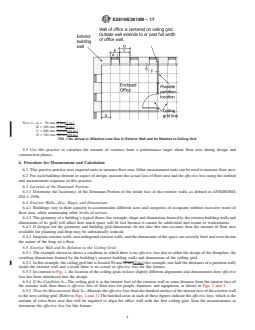
6.5.1 The example shown in shows a condition in which there is no effective loss due to either the design of the floorplate, the
resulting dimensions formed by the building’s exterior building walls and dimensions of the ceiling grid.
6.5.2 In this example, the ceiling grid line is located 50 mm (2 in.)[2 in.] (for example, one-half the thickness of a partition wall)
inside the exterior wall and a result there is no actual or effective loss for this feature.
6.5.3 In contrast to Fig. 1, the location of the ceiling grids in have slightly different alignments and demonstrates how effective
loss has been introduced into the design.
6.5.4 If the Condition Is—The ceiling grid is at the interior face of the exterior wall or some distance from the interior face of
the exterior wall, then there is effective loss of floor area for people, furniture, and equipment, as shown in Figs. 2 and 3.
6.5.5 Then the Measurement Rule Is—Measure the effective loss from the finished surface of the interior face of the exterior wall
to the next ceiling grid. (Refer to Figs. 2 and 3.) The hatched areas in each of these figures indicate the effective loss, which is the
amount of extra floor area that will be required to align the office wall with the first ceiling grid. Sum the measurements to
determine the effective loss for this feature.
E2619/E2619M − 17
NOTE 1—A = 3660 mm (12[12 ft, 0 in.)in.]
B = 50 mm (2 in.)[2 in.]
C = 600 mm (24 in.)[24 in.]
FIG. 2 Effective Loss Due to Alignment of Ceiling Grid at Face of Exterior Wall
NOTE 1—A = 3900 mm (13[13 ft, 0 in.)in.]
B = 50 mm (2 in.)[2 in.]
C = 900 mm (36 in.)[36 in.]
FIG. 3 Effective Loss Due to Ceiling Grid Not Being Aligned at Face of Exterior Wall
6.6 Exterior Wall That Deviates from the Orthogonal:
6.6.1 If the Condition Is—The exterior wall(s) deviates from the orthogonal and reduces the proportion of floor area available
for planning and fitup.
6.6.2 When an enclosed office is next to a non-orthogonal, or irregular, wall the actual floor area that would be required to layout
the office would be larger than the area allowed for in the programming document. The floor area in excess of the allowed area
is effective loss, as indicated by the hatched area in Figs. 4 and 5.
6.6.3 The same situation occurs when an open workstation is next to non-orthogonal wall. In Fig. 4, the exterior wall deviates
from the orthogonal and creates effective loss as indicated by the hatched area.
6.6.4 Then the Measurement Rule Is—Measure the area between the interior face of the exterior wall and the first planning grid
line at which a complete open workstation module or enclosed office module can be placed. Sum the measurements to determine
the effective loss.
6.7 Perimeter Encroachments:
6.7.1 The size, shape, and location of perimeter encroachments at the exterior wall can reduce the density and efficiency, or both,
of floor area usage on a floorplate.
E2619/E2619M − 17
FIG. 4 Effective Loss Due to Non-Orthogonal Exterior Wall
FIG. 5 Effective Loss Due to an Irregular Exterior Wall
6.7.2 Perimeter encroachments in the form of convector heaters or cooling units usually occur under the windows. While a
projection may be very small (for example, a 75-mm (3-in.)[3-in.] protrusion into the interior) when it repeats around the outside
of a floor, the total floor area taken up by these 75-mm (3-in.)[3-in.] projections can easily equate to the floor area of one or two
workstations on a floor.
6.7.3 Projections and pilasters, or both, that occur at the exterior wall may also be intermittent, such as when columns and
earthquake bracing embed only part of the way into an exterior wall—with the rest protruding into the interior space. When they
are not aligned with the grid, or are intermittent, they interfere with the layout of workstations and offices, which can lead to
significant amount of actual and effective losses. Effective losses will be even greater if perimeter projections are not uniformly
projecting into the interior of the floor. However, if their location enables partitions that are aligned under the ceiling grid lines
to meet the outside wall at the projection, the amount of actual and effective loss, or both, may be reduced.
6.7.3.1 If the Condition Is—The floor area between adjacent projecting perimeter encroachments cannot be used to place
workstations at the inside face of the exterior wall. (Refer to Fig. 6.)
6.7.3.2 Then the Measurement Rule Is—Measure the effective loss to the inside finished face of the encroachment that most
projects into the floor to determine the effective loss. Sum the measurements to determine the effective loss.
6.7.3.3 If the Condition Is—The floor area between uniformly projecting encroachments cannot be used effectively to place
workstations at the inside face of the exterior wall.
6.7.3.4 Then the Measurement Rule Is—Measure to the inside finished face of the projecting encroachment to determine the
effective loss. (Refer to example in Fig. 7.) Sum the measurements to determine the effective loss.
E2619/E2619M − 17
FIG. 6 Actual and Effective Losses Due to Perimeter Encroachments
FIG. 7 Actual and Effective Losses Due to Uniformly Projecting Perimeter Encroachments
6.7.3.5 If the Condition Is—Perimeter encroachments do not uniformly project into the floor area. The floor area between
adjacent non-uniformly projecting perimeter encroachments cannot be used to place workstations at the inside face of the exterior
wall. (Refer to Fig. 8.)
6.7.3.6 Then the Measurement Rule Is—Measure from the inside finished face of the exterior wall to the inside face of the
adjacent encroachment that most projects into the interior. Sum the measurements to determine the effective loss.
6.7.3.7 If the Condition Is—A portion of the floor area must be kept clear to access and service these encroachments. (Refer to
Fig. 9.)
6.7.3.8 Then the Measurement Rule Is—Include the floor area that must be kept clear in the measurement. Sum the
measurements to determine the effective loss.
6.8 Major Vertical Penetrations:
6.8.1 Ducts and Other Openings Through the Floor:
6.8.1.1 Ducts and other openings through a floor can constrain layouts within the plannable area. In some instances,
...