

ASTM F3055-14a(2021)
(Specification)Standard Specification for Additive Manufacturing Nickel Alloy (UNS N07718) with Powder Bed Fusion
General Information
- Abstract
ABSTRACT
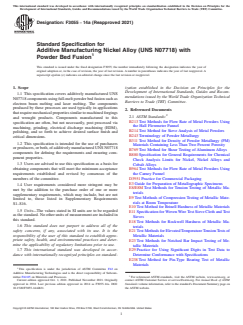
This specification defines the requirements for additive manufacturing of nickel alloy (UNS N07718) using full-melt powder bed fusion such as electron beam melting and laser melting. The standard may be used by purchasers and producers of additively manufactured UNS N07718 components to specify the requirements and ensure component properties, and by users to obtain components that will satisfy the minimum acceptance requirements. The standard covers terminology and classification as well as the requirements with respect to ordering information, manufacturing plan, feedstock, thermal processing, chemical composition, microstructure, mechanical properties, hot isostatic pressing, dimensions and permissible variations, retests, inspection, rejection, certification, product marking and packaging, maintenance of a quality program, and the significance of numerical limits.
SCOPE
1.1 This specification covers additively manufactured UNS N07718 components using full-melt powder bed fusion such as electron beam melting and laser melting. The components produced by these processes are used typically in applications that require mechanical properties similar to machined forgings and wrought products. Components manufactured to this specification are often, but not necessarily, post processed via machining, grinding, electrical discharge machining (EDM), polishing, and so forth to achieve desired surface finish and critical dimensions.
1.2 This specification is intended for the use of purchasers or producers, or both, of additively manufactured UNS N07718 components for defining the requirements and ensuring component properties.
1.3 Users are advised to use this specification as a basis for obtaining components that will meet the minimum acceptance requirements established and revised by consensus of the members of the committee.
1.4 User requirements considered more stringent may be met by the addition to the purchase order of one or more supplementary requirements, which may include, but are not limited to, those listed in Supplementary Requirements S1–S16.
1.5 Units—The values stated in SI units are to be regarded as the standard. No other units of measurement are included in this standard.
1.6 This standard does not purport to address all of the safety concerns, if any, associated with its use. It is the responsibility of the user of this standard to establish appropriate safety, health, and environmental practices and determine the applicability of regulatory limitations prior to use.
1.7 This international standard was developed in accordance with internationally recognized principles on standardization established in the Decision on Principles for the Development of International Standards, Guides and Recommendations issued by the World Trade Organization Technical Barriers to Trade (TBT) Committee.
- Status
- Published
- Publication Date
- 30-Sep-2021
- Technical Committee
- F42 - Additive Manufacturing Technologies
- Drafting Committee
- F42.05 - Materials and Processes
Overview
ASTM F3055-14a(2021) is a comprehensive standard published by ASTM International that establishes the requirements for the additive manufacturing of nickel alloy UNS N07718 components using full-melt powder bed fusion processes, including electron beam melting (EBM) and laser melting (SLM, DMLS). This specification provides clear guidelines for purchasers and producers to ensure that additively manufactured UNS N07718 parts meet essential mechanical, chemical, and quality requirements, paralleling properties typically expected from conventionally machined or wrought products.
Components produced under this specification often undergo post-processing such as machining, polishing, or grinding to achieve the desired surface finish and critical dimensions. The standard also covers a range of aspects essential for quality assurance, from terminology and classification to manufacturing plans, feedstock control, thermal processing, testing, certification, and packaging.
Key Topics
- Process Scope: Covers components made with full-melt powder bed fusion, primarily using nickel alloy (UNS N07718).
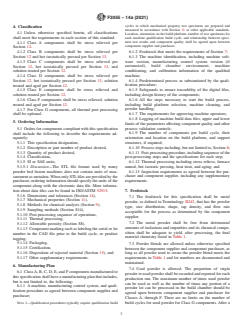
- Product Classes: Defines multiple component classes (A through G) with graded requirements for stress relief, hot isostatic pressing (HIP), solution treatment, and aging, allowing flexibility to meet varying application demands.
- Feedstock Requirements: Specifies permissible powder characteristics, including chemical composition and the use of virgin or recycled powder, along with requirements for powder testing, sieving, and documentation.
- Manufacturing Plan: Requires a defined process plan addressing machine qualification, build parameters, post-processing steps, operator approval, and traceability of digital files.
- Mechanical and Chemical Testing: Outlines minimum mechanical properties, methods for tension, hardness, and additional testing as needed; ensures conformity to chemical composition requirements.
- Post-Processing and Inspection: Includes rules for post-processing (machining, HIP, surface finish), inspection practices, acceptance criteria, and retest protocols.
- Quality Management: Mandates that suppliers maintain a robust quality program, such as ISO 9001 or ASQ C1, to ensure traceability and compliance.
Applications
ASTM F3055-14a(2021) is particularly valuable for industries where high-performance, corrosion-resistant nickel alloy components are required, and where additive manufacturing's ability to produce complex geometries is advantageous. Typical application areas include:
- Aerospace and Defense: Components needing superior mechanical properties at elevated temperatures, such as turbine blades or engine parts.
- Energy and Power Generation: Parts exposed to extreme environments, including gas turbines and high-stress fittings.
- Medical Devices: Implants or surgical instruments benefiting from custom geometries and biocompatibility.
- Automotive: High-performance parts where weight reduction and material strength are critical.
- Industrial Equipment: Custom or low-volume components requiring precise material properties and durability.
The standard helps ensure that additive manufacturing processes for nickel alloy UNS N07718 result in components that meet the rigorous requirements of these demanding sectors.
Related Standards
ASTM F3055-14a(2021) references and aligns with several important standards to ensure globally recognized best practices, including:
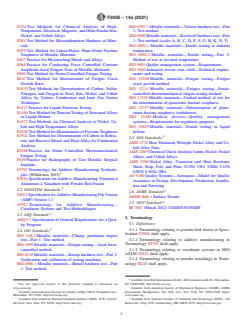
- ASTM Standards:
- E8/E8M: Tension Testing of Metallic Materials
- E18, E10, E384: Hardness Testing Methods
- F2924: Additive Manufacturing Titanium-6 Aluminum-4 Vanadium with Powder Bed Fusion
- B214: Sieve Analysis of Metal Powders
- E1417: Liquid Penetrant Testing
- ISO Standards:
- ISO 9001: Quality Management Systems
- ISO 6892-1/2: Tensile Testing of Metallic Materials
- ISO/ASTM 52915: Additive Manufacturing File Format (AMF)
- ISO 6506/6508/6507: Brinell, Rockwell, and Vickers Hardness Testing
- SAE AMS 5596, AMS 2774, AMS 2269: Nickel Alloy Material and Heat Treatment
- Other Reference Standards: ASQ C1 for quality programs, ASME B46.1 for surface texture, and NIST Guidelines for mechanical property testing.
By adhering to ASTM F3055-14a(2021), manufacturers and clients in additive manufacturing gain confidence in obtaining reliable, traceable, and high-performing nickel alloy components suitable for critical applications. This standard plays a vital role in supporting the growth and acceptance of additive manufacturing technologies across various high-value industries.
Relations
- Effective Date
- 01-Apr-2024
- Effective Date
- 01-Jan-2024
- Effective Date
- 15-Nov-2023
- Effective Date
- 01-Nov-2023
- Effective Date
- 01-Oct-2023
- Refers
ASTM B213-20 - Standard Test Methods for Flow Rate of Metal Powders Using the Hall Flowmeter Funnel - Effective Date
- 01-Apr-2020
- Effective Date
- 01-Feb-2020
- Effective Date
- 01-Jan-2020
- Effective Date
- 01-Jan-2020
- Effective Date
- 01-Nov-2018
- Effective Date
- 01-Nov-2018
- Effective Date
- 01-Oct-2018
- Effective Date
- 01-Jul-2018
- Effective Date
- 01-May-2018
- Effective Date
- 01-May-2018
Get Certified
Connect with accredited certification bodies for this standard

Element Materials Technology
Materials testing and product certification.

Inštitut za kovinske materiale in tehnologije
Institute of Metals and Technology. Materials testing, metallurgical analysis, NDT.
Sponsored listings
Frequently Asked Questions
ASTM F3055-14a(2021) is a technical specification published by ASTM International. Its full title is "Standard Specification for Additive Manufacturing Nickel Alloy (UNS N07718) with Powder Bed Fusion". This standard covers: ABSTRACT This specification defines the requirements for additive manufacturing of nickel alloy (UNS N07718) using full-melt powder bed fusion such as electron beam melting and laser melting. The standard may be used by purchasers and producers of additively manufactured UNS N07718 components to specify the requirements and ensure component properties, and by users to obtain components that will satisfy the minimum acceptance requirements. The standard covers terminology and classification as well as the requirements with respect to ordering information, manufacturing plan, feedstock, thermal processing, chemical composition, microstructure, mechanical properties, hot isostatic pressing, dimensions and permissible variations, retests, inspection, rejection, certification, product marking and packaging, maintenance of a quality program, and the significance of numerical limits. SCOPE 1.1 This specification covers additively manufactured UNS N07718 components using full-melt powder bed fusion such as electron beam melting and laser melting. The components produced by these processes are used typically in applications that require mechanical properties similar to machined forgings and wrought products. Components manufactured to this specification are often, but not necessarily, post processed via machining, grinding, electrical discharge machining (EDM), polishing, and so forth to achieve desired surface finish and critical dimensions. 1.2 This specification is intended for the use of purchasers or producers, or both, of additively manufactured UNS N07718 components for defining the requirements and ensuring component properties. 1.3 Users are advised to use this specification as a basis for obtaining components that will meet the minimum acceptance requirements established and revised by consensus of the members of the committee. 1.4 User requirements considered more stringent may be met by the addition to the purchase order of one or more supplementary requirements, which may include, but are not limited to, those listed in Supplementary Requirements S1–S16. 1.5 Units—The values stated in SI units are to be regarded as the standard. No other units of measurement are included in this standard. 1.6 This standard does not purport to address all of the safety concerns, if any, associated with its use. It is the responsibility of the user of this standard to establish appropriate safety, health, and environmental practices and determine the applicability of regulatory limitations prior to use. 1.7 This international standard was developed in accordance with internationally recognized principles on standardization established in the Decision on Principles for the Development of International Standards, Guides and Recommendations issued by the World Trade Organization Technical Barriers to Trade (TBT) Committee.
ABSTRACT This specification defines the requirements for additive manufacturing of nickel alloy (UNS N07718) using full-melt powder bed fusion such as electron beam melting and laser melting. The standard may be used by purchasers and producers of additively manufactured UNS N07718 components to specify the requirements and ensure component properties, and by users to obtain components that will satisfy the minimum acceptance requirements. The standard covers terminology and classification as well as the requirements with respect to ordering information, manufacturing plan, feedstock, thermal processing, chemical composition, microstructure, mechanical properties, hot isostatic pressing, dimensions and permissible variations, retests, inspection, rejection, certification, product marking and packaging, maintenance of a quality program, and the significance of numerical limits. SCOPE 1.1 This specification covers additively manufactured UNS N07718 components using full-melt powder bed fusion such as electron beam melting and laser melting. The components produced by these processes are used typically in applications that require mechanical properties similar to machined forgings and wrought products. Components manufactured to this specification are often, but not necessarily, post processed via machining, grinding, electrical discharge machining (EDM), polishing, and so forth to achieve desired surface finish and critical dimensions. 1.2 This specification is intended for the use of purchasers or producers, or both, of additively manufactured UNS N07718 components for defining the requirements and ensuring component properties. 1.3 Users are advised to use this specification as a basis for obtaining components that will meet the minimum acceptance requirements established and revised by consensus of the members of the committee. 1.4 User requirements considered more stringent may be met by the addition to the purchase order of one or more supplementary requirements, which may include, but are not limited to, those listed in Supplementary Requirements S1–S16. 1.5 Units—The values stated in SI units are to be regarded as the standard. No other units of measurement are included in this standard. 1.6 This standard does not purport to address all of the safety concerns, if any, associated with its use. It is the responsibility of the user of this standard to establish appropriate safety, health, and environmental practices and determine the applicability of regulatory limitations prior to use. 1.7 This international standard was developed in accordance with internationally recognized principles on standardization established in the Decision on Principles for the Development of International Standards, Guides and Recommendations issued by the World Trade Organization Technical Barriers to Trade (TBT) Committee.
ASTM F3055-14a(2021) is classified under the following ICS (International Classification for Standards) categories: 77.150.40 - Nickel and chromium products. The ICS classification helps identify the subject area and facilitates finding related standards.
ASTM F3055-14a(2021) has the following relationships with other standards: It is inter standard links to ASTM E23-24, ASTM E8/E8M-24, ASTM E647-23b, ASTM E407-23, ASTM D3951-18(2023), ASTM B213-20, ASTM F629-20, ASTM E1820-20, ASTM E1820-20e1, ASTM E1820-18a, ASTM E1820-18ae1, ASTM B243-18, ASTM E18-18, ASTM E1820-18, ASTM D3951-18. Understanding these relationships helps ensure you are using the most current and applicable version of the standard.
ASTM F3055-14a(2021) is available in PDF format for immediate download after purchase. The document can be added to your cart and obtained through the secure checkout process. Digital delivery ensures instant access to the complete standard document.
Standards Content (Sample)
This international standard was developed in accordance with internationally recognized principles on standardization established in the Decision on Principles for the
Development of International Standards, Guides and Recommendations issued by the World Trade Organization Technical Barriers to Trade (TBT) Committee.
Designation:F3055 −14a (Reapproved 2021)
Standard Specification for
Additive Manufacturing Nickel Alloy (UNS N07718) with
Powder Bed Fusion
This standard is issued under the fixed designation F3055; the number immediately following the designation indicates the year of
original adoption or, in the case of revision, the year of last revision. A number in parentheses indicates the year of last reapproval. A
superscript epsilon (´) indicates an editorial change since the last revision or reapproval.
1. Scope ization established in the Decision on Principles for the
Development of International Standards, Guides and Recom-
1.1 This specification covers additively manufactured UNS
mendations issued by the World Trade Organization Technical
N07718componentsusingfull-meltpowderbedfusionsuchas
Barriers to Trade (TBT) Committee.
electron beam melting and laser melting. The components
produced by these processes are used typically in applications
2. Referenced Documents
thatrequiremechanicalpropertiessimilartomachinedforgings
2.1 ASTM Standards:
and wrought products. Components manufactured to this
B213 Test Methods for Flow Rate of Metal Powders Using
specification are often, but not necessarily, post processed via
the Hall Flowmeter Funnel
machining, grinding, electrical discharge machining (EDM),
B214 Test Method for Sieve Analysis of Metal Powders
polishing, and so forth to achieve desired surface finish and
B243 Terminology of Powder Metallurgy
critical dimensions.
B311 Test Method for Density of Powder Metallurgy (PM)
1.2 This specification is intended for the use of purchasers
Materials Containing Less Than Two Percent Porosity
orproducers,orboth,ofadditivelymanufacturedUNSN07718
B769 Test Method for Shear Testing of Aluminum Alloys
components for defining the requirements and ensuring com-
B880 Specification for General Requirements for Chemical
ponent properties.
Check Analysis Limits for Nickel, Nickel Alloys and
1.3 Users are advised to use this specification as a basis for
Cobalt Alloys
obtaining components that will meet the minimum acceptance B964 Test Methods for Flow Rate of Metal Powders Using
requirements established and revised by consensus of the
the Carney Funnel
members of the committee. D3951 Practice for Commercial Packaging
E3 Guide for Preparation of Metallographic Specimens
1.4 User requirements considered more stringent may be
E8/E8M Test Methods for Tension Testing of Metallic Ma-
met by the addition to the purchase order of one or more
terials
supplementary requirements, which may include, but are not
E9 Test Methods of Compression Testing of Metallic Mate-
limited to, those listed in Supplementary Requirements
rials at Room Temperature
S1–S16.
E10 Test Method for Brinell Hardness of Metallic Materials
1.5 Units—The values stated in SI units are to be regarded
E11 Specification for Woven Wire Test Sieve Cloth and Test
as the standard. No other units of measurement are included in
Sieves
this standard.
E18 Test Methods for Rockwell Hardness of Metallic Ma-
1.6 This standard does not purport to address all of the
terials
safety concerns, if any, associated with its use. It is the
E21 TestMethodsforElevatedTemperatureTensionTestsof
responsibility of the user of this standard to establish appro-
Metallic Materials
priate safety, health, and environmental practices and deter-
E23 Test Methods for Notched Bar Impact Testing of Me-
mine the applicability of regulatory limitations prior to use.
tallic Materials
1.7 This international standard was developed in accor-
E29 Practice for Using Significant Digits in Test Data to
dance with internationally recognized principles on standard-
Determine Conformance with Specifications
E238 Test Method for Pin-Type Bearing Test of Metallic
Materials
This specification is under the jurisdiction of ASTM Committee F42 on
Additive Manufacturing Technologies and is the direct responsibility of Subcom-
mittee F42.05 on Materials and Processes. For referenced ASTM standards, visit the ASTM website, www.astm.org, or
Current edition approved Oct. 1, 2021. Published November 2021. Originally contact ASTM Customer Service at service@astm.org. For Annual Book of ASTM
approved in 2014. Last previous edition approved in 2014 as F3055-14a. DOI: Standards volume information, refer to the standard’s Document Summary page on
10.1520/F3055-14AR21. the ASTM website.
Copyright © ASTM International, 100 Barr Harbor Drive, PO Box C700, West Conshohocken, PA 19428-2959. United States
F3055−14a (2021)
E354 Test Methods for Chemical Analysis of High- ISO 6507-1 Metallic materials—Vickers hardness test—Part
Temperature,Electrical,Magnetic,andOtherSimilarIron, 1: Test method
Nickel, and Cobalt Alloys ISO 6508 Metallic materials—Rockwell hardness test—Part
E384 Test Method for Microindentation Hardness of Mate- 1: Test method (scales A, B, C, D, E, F, G, H, K, N, T)
rials ISO 6892-1 Metallic materials—Tensile testing at ambient
E399 Test Method for Linear-Elastic Plane-Strain Fracture temperature
Toughness of Metallic Materials ISO 6892-2 Metallic materials—Tensile testing—Part 2:
E407 Practice for Microetching Metals and Alloys Method of test at elevated temperature
E466 Practice for Conducting Force Controlled Constant ISO 9001 Quality management system—Requirements
Amplitude Axial Fatigue Tests of Metallic Materials ISO 9044 Industrial woven wire cloth—Technical require-
E606 Test Method for Strain-Controlled Fatigue Testing ments and testing
E647 Test Method for Measurement of Fatigue Crack ISO 12108 Metallic materials—Fatigue testing—Fatigue
Growth Rates crack growth method
E1019 Test Methods for Determination of Carbon, Sulfur, ISO 12111 Metallic materials—Fatigue testing—Strain-
Nitrogen, and Oxygen in Steel, Iron, Nickel, and Cobalt controlled thermomechanical fatigue testing method
Alloys by Various Combustion and Inert Gas Fusion ISO 12135 Metallic materials—Unified method of test for
Techniques the determination of quasistatic fracture toughness
E1417 Practice for Liquid Penetrant Testing ISO 12737 Metallic materials—Determination of plane-
E1450 Test Method for Tension Testing of StructuralAlloys strain fracture toughness (withdrawn)
in Liquid Helium ISO 13485 Medical devices—Quality management
E1473 Test Methods for Chemical Analysis of Nickel, Co- systems—Requirements for regulatory purposes
balt and High-Temperature Alloys ISO 19819 Metallic materials—Tensile testing in liquid
E1820 Test Method for Measurement of Fracture Toughness helium
E1941 Test Method for Determination of Carbon in Refrac- 6
2.5 SAE Standards:
toryandReactiveMetalsandTheirAlloysbyCombustion
AMS 2774 Heat Treatment Wrought Nickel Alloy and Co-
Analysis
balt Alloy Parts
E2368 Practice for Strain Controlled Thermomechanical
AMS 2269 Chemical Check Analysis Limits Nickel, Nickel
Fatigue Testing
Alloys, and Cobalt Alloys
F629 Practice for Radiography of Cast Metallic Surgical
AMS 5596 Nickel Alloy, Corrosion and Heat Resistant,
Implants
Sheet, Strip, Foil, and Plate 52.5Ni 19Cr 3.0Mo 5.1Cb
F2792 Terminology for Additive Manufacturing Technolo-
0.90Ti 0.50Al 18Fe
gies (Withdrawn 2015)
AS 9100 Quality Systems—Aerospace—Model for Quality
F2924 Specification for Additive Manufacturing Titanium-6
Assurance in Design, Development, Production, Installa-
Aluminum-4 Vanadium with Powder Bed Fusion
tion and Servicing
2.2 ISO/ASTM Standards:
2.6 ASME Standard:
52915 Specification forAdditive Manufacturing File Format
ASME B46.1 Surface Texture
(AMF) Version 1.1
2.7 NIST Standard:
52921 Terminology for Additive Manufacturing—
IR 7847 (March 2012) CODEN:NTNOEF
Coordinate Systems and Test Methodologies
2.3 ASQ Standard:
3. Terminology
ASQ C1 Specification of General Requirements for a Qual-
3.1 Definitions:
ity Program
3.1.1 Terminology relating to powder bed fusion in Speci-
2.4 ISO Standards:
fication F2924 shall apply.
ISO 148-1 Metallic materials—Charpy pendulum impact
3.1.2 Terminology relating to additive manufacturing in
test—Part 1: Test method
Terminology F2792 shall apply.
ISO 1099 Metallic materials—Fatigue testing—Axial force-
3.1.3 Terminology relating to coordinate systems in ISO/
controlled method
ASTM 52921 shall apply.
ISO 4545 Metallic materials—Knoop hardness test—Part 2:
Verification and calibration of testing machines 3.1.4 Terminology relating to powder metallurgy in Termi-
nology B243 shall apply.
ISO 6506-1 Metallic materials—Brinell hardness test—Part
1: Test method
Available from SAE International (SAE), 400 Commonwealth Dr.,Warrendale,
The last approved version of this historical standard is referenced on PA 15096-0001, http://www.sae.org.
www.astm.org. Available from American Society of Mechanical Engineers (ASME), ASME
Available from American Society for Quality (ASQ), 600 N. Plankinton Ave., International Headquarters, Two Park Ave., New York, NY 10016-5990, http://
Milwaukee, WI 53203, http://www.asq.org. www.asme.org.
5 8
Available fromAmerican National Standards Institute (ANSI), 25 W. 43rd St., Available from National Institute of Standards and Technology (NIST), 100
4th Floor, New York, NY 10036, http://www.ansi.org. Bureau Dr., Stop 1070, Gaithersburg, MD 20899-1070, http://www.nist.gov.
F3055−14a (2021)
cycles in which mechanical property test specimens are prepared and
4. Classification
measured in accordance with Section 11 or other applicable standards.
4.1 Unless otherwise specified herein, all classifications
Location, orientation on the build platform, number of test specimens for
shall meet the requirements in each section of this standard.
each machine qualification build cycle, and relationship between speci-
men test results and component quality shall be agreed upon between
4.1.1 Class A components shall be stress relieved per
component supplier and purchaser.
Section 12.
6.1.2 Feedstock that meets the requirements of Section 7;
4.1.2 Class B components shall be stress relieved per
Section 12 and hot isostatically pressed per Section 13. 6.1.3 The machine identification, including machine soft-
ware version, manufacturing control system version (if
4.1.3 Class C components shall be stress relieved per
Section 12, hot isostatically pressed per Section 13, and automated), build chamber environment, machine
conditioning, and calibration information of the qualified
solution treated per Section 12.
4.1.4 Class D components shall be stress relieved per machine;
6.1.4 Predetermined process as substantiated by the quali-
Section 12, hot isostatically pressed per Section 13, solution
treated and aged per Section 12. fication procedure;
6.1.5 Safeguards to ensure traceability of the digital files,
4.1.5 Class E components shall be stress relieved and
including design history of the components;
solution treated per Section 12.
4.1.6 Class F components shall be stress relieved, solution 6.1.6 All the steps necessary to start the build process,
treated and aged per Section 12. including build platform selection, machine cleaning, and
4.1.7 For Class G components, all thermal post processing powder handling;
shall be optional. 6.1.7 The requirements for approving machine operators;
6.1.8 Logging of machine build data files, upper and lower
5. Ordering Information
limits of the parameters affecting component quality and other
process validation controls;
5.1 Orders for components compliant with this specification
shall include the following to describe the requirements ad- 6.1.9 The number of components per build cycle, their
orientation and location on the build platform, and support
equately:
5.1.1 This specification designation, structures, if required;
6.1.10 Process steps including, but not limited to, Section 8;
5.1.2 Description or part number of product desired,
5.1.3 Quantity of product desired, 6.1.11 Post-processingprocedure,includingsequenceofthe
post-processing steps and the specifications for each step;
5.1.4 Classification,
5.1.5 SI or SAE units, 6.1.12 Thermal processing including stress relieve, furnace
5.1.5.1 Discussion—The STL file format used by many anneal, hot isostatic pressing, heat treat, and aging; and
powder bed fusion machines does not contain units of mea- 6.1.13 Inspection requirements as agreed between the pur-
surementasmetadata.WhenonlySTLfilesareprovidedbythe chaser and component supplier, including any supplementary
purchaser, ordering information should specify the units of the requirements.
component along with the electronic data file. More informa-
tion about data files can be found in ISO/ASTM 52915. 7. Feedstock
5.1.6 Dimensions and tolerances (Section 14),
7.1 The feedstock for this specification shall be metal
5.1.7 Mechanical properties (Section 11),
powder, as defined in Terminology B243, that has the powder
5.1.8 Methods for chemical analysis (Section 9),
type, size distribution, shape, tap density, and flow rate
5.1.9 Sampling methods (Section S14),
acceptable for the process as determined by the component
5.1.10 Post-processing sequence of operations,
supplier.
5.1.11 Thermal processing,
7.2 The metal powder shall be free from detrimental
5.1.12 Allowable porosity (Section S8),
amounts of inclusions and impurities and its chemical compo-
5.1.13 Component marking such as labeling the serial or lot
sition shall be adequate to yield, after processing, the final
number in the CAD file prior to the build cycle, or product
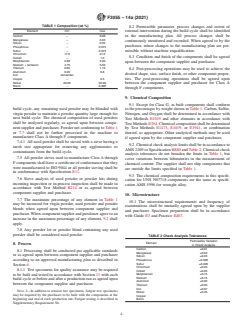
material chemistry listed in Table 1.
tagging,
5.1.14 Packaging,
7.3 Powder blends are allowed unless otherwise specified
5.1.15 Certification,
between the component supplier and component purchaser, as
5.1.16 Disposition of rejected material (Section 15), and
long as all powder used to create the powder blend meets the
5.1.17 Other supplementary requirements.
requirements in Table 1 and lot numbers are documented and
maintained.
6. Manufacturing Plan
7.4 Used powder is allowed. The proportion of virgin
6.1 ClassA, B, C, D, E, and F components manufactured to
powder to used powder shall be recorded and reported for each
thisspecificationshallhaveamanufacturingplanthatincludes,
production run. The maximum number of times used powder
but is not limited to, the following:
can be used as well as the number of times any portion of a
6.1.1 A machine, manufacturing control system, and quali-
powder lot can be processed in the build chamber should be
fication procedure as agreed between component supplier and
agreed upon between component supplier and purchaser for
purchaser;
Classes A, through F. There are no limits on the number of
NOTE 1—Qualification procedures typically require qualification build build cycles for used powder for Class G components. After a
F3055−14a (2021)
TABLE 1 Composition (wt %)
8.2 Permissible parameter, process changes and extent of
Element min max external intervention during the build cycle shall be identified
Carbon – 0.08 in the manufacturing plan. All process changes shall be
Manganese – 0.35
continuously monitored and recorded. When agreed to by the
Silicon – 0.35
purchaser, minor changes to the manufacturing plan are per-
Phosphorus – 0.015
Sulfur – 0.015 missible without machine requalification.
Chromium 17.0 21.0
8.3 Condition and finish of the components shall be agreed
Cobalt – 1.0
Molybdenum 2.80 3.30
upon between the component supplier and purchaser.
Niobium + tantalum 4.75 5.50
Titanium 0.65 1.15
8.4 Post-processing operations may be used to achieve the
Aluminum 0.20 0.8
desired shape, size, surface finish, or other component proper-
Iron remainder
ties. The post-processing operations shall be agreed upon
Copper – 0.3
Nickel 50.00 55.00
between the component supplier and purchaser for Class A
Boron – 0.006
through F components.
9. Chemical Composition
9.1 Except for Class G, as built components shall conform
build cycle, any remaining used powder may be blended with
to the percentages by weight shown in Table 1. Carbon, Sulfur,
virgin powder to maintain a powder quantity large enough for
Nitrogen, and Oxygen shall be determined in accordance with
next build cycle. The chemical composition of used powders
Test Methods E1019 and other elements in accordance with
shall be analyzed regularly, as agreed upon between compo-
TestMethodsE354.Chemicalcompositionshallbedetermined
nent supplier and purchaser. Powder not conforming to Table 1
by Test Methods E1473, E1019,or E1941, or combination
or 7.7 shall not be further processed in the machine to
thereof, as appropriate. Other analytical methods may be used
manufacture Class A through F components.
if agreed upon by the component supplier and purchaser.
7.4.1 All used powder shall be sieved with a sieve having a
9.2 Chemical check analysis limits shall be in accordance to
mesh size appropriate for removing any agglomerates or
AMS 2269 or Specification B880 and Table 2. Chemical check
contaminants from the build cycle.
analysis tolerances do not broaden the limits in Table 1, but
7.5 All powder sieves used to manufacture ClassAthrough
cover variations between laboratories in the measurement of
F components shall have a certificate of conformance that they
chemical content. The supplier shall not ship components that
were manufactured to ISO 9044 or all powder sieving shall be
are outside the limits specified in Table 1.
in conformance with Specification E11.
9.3 The chemical composition requirements in this specifi-
7.6 Sieve analysis of used powder or powder lots during
cation for UNS N07718 components are the same as specifi-
incoming inspection or in-process inspection shall be made in
cation AMS 5596 for wrought alloy.
accordance with Test Method B214 or
...