

ASTM E642-19
(Practice)Standard Practice for Determining Application Rates and Distribution Patterns from Aerial Application Equipment
General Information
- Abstract
ABSTRACT
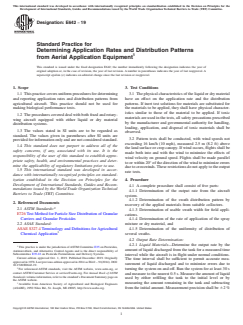
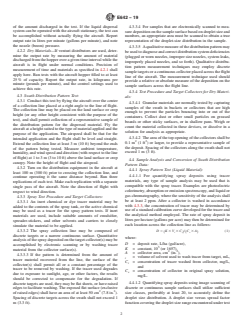
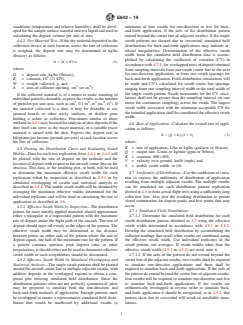
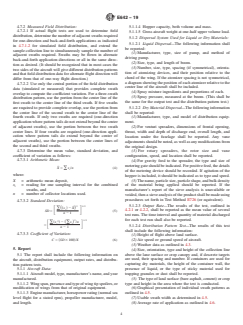
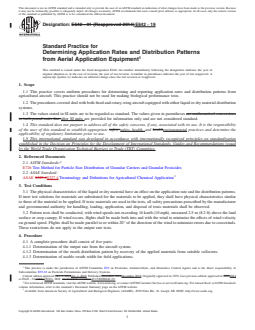
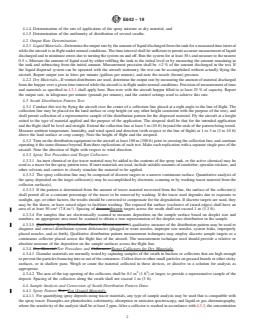
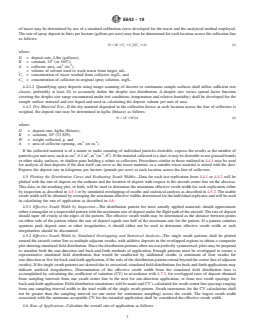
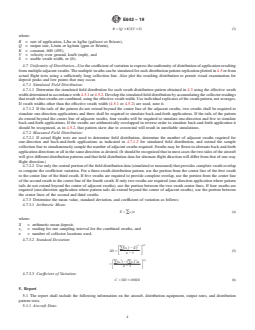
This practice covers uniform procedures for determining and reporting application rates and distribution patterns from agricultural aircraft. The procedures covered deal with both fixed and rotary-wing aircraft equipped with either liquid or dry material distribution systems. The physical characteristics of the liquid or dry material have an effect on the application rate and the distribution patterns. If inert test solutions for materials are substituted for the materials to be applied, they shall have physical characteristics similar to those of the material to be applied. If toxic materials are used in the tests, all safety precautions prescribed. A complete procedure shall consist of five parts: the first part is the determination of the output rate from the aircraft system, the second part involves the determination of the swath distribution pattern by recovery of the applied materials from suitable collectors, the third part covers the determination of usable swath width for field applications, the fourth part discusses the determination of the rate of application of the spray mixture or dry material, and the fifth and last part is the determination of the uniformity of distribution of several swaths.
SCOPE
1.1 This practice covers uniform procedures for determining and reporting application rates and distribution patterns from agricultural aircraft. This practice should not be used for making biological performance tests.
1.2 The procedures covered deal with both fixed and rotary-wing aircraft equipped with either liquid or dry material distribution systems.
1.3 The values stated in SI units are to be regarded as standard. The values given in parentheses after SI units are provided for information only and are not considered standard.
1.4 This standard does not purport to address all of the safety concerns, if any, associated with its use. It is the responsibility of the user of this standard to establish appropriate safety, health, and environmental practices and determine the applicability of regulatory limitations prior to use.
1.5 This international standard was developed in accordance with internationally recognized principles on standardization established in the Decision on Principles for the Development of International Standards, Guides and Recommendations issued by the World Trade Organization Technical Barriers to Trade (TBT) Committee.
- Status
- Published
- Publication Date
- 30-Sep-2019
- Technical Committee
- E35 - Pesticides, Antimicrobials, and Alternative Control Agents
- Drafting Committee
- E35.22 - Pesticide Formulations and Delivery Systems
Buy Documents
ASTM E642-19 - Standard Practice for Determining Application Rates and Distribution Patterns from Aerial Application Equipment
REDLINE ASTM E642-19 - Standard Practice for Determining Application Rates and Distribution Patterns from Aerial Application Equipment
Overview
ASTM E642-19 is the internationally recognized standard practice for determining application rates and distribution patterns from aerial application equipment. Developed and published by ASTM International, this standard outlines procedures to consistently evaluate and report how agricultural aircraft distribute materials such as pesticides, fertilizers, or seeds, whether in liquid or dry form. The procedures are applicable to both fixed-wing and rotary-wing (helicopter) aircraft equipped with various distribution systems. Reliable assessment of application rates and distribution patterns from aerial equipment is critical to achieving effective and environmentally responsible agricultural applications.
Key Topics
Uniform Test Methods: Standardized procedures ensure the uniform determination and reporting of:
- Output rates from aircraft application systems for both liquid and dry materials
- Distribution (swath) patterns and usable swath widths, crucial for effective field coverage
- Application rates and uniformity of field distribution over multiple overlapping swaths
Applicability:
- Covers both fixed-wing and rotary-wing aircraft used in agricultural applications
- Addresses equipment for both liquid dispersal (e.g., sprayers) and dry material distribution (e.g., seeders, granular pesticide distributors)
Material and Test Substances:
- Tests should use materials with similar physical characteristics to the operational product
- Special safety measures must be taken when toxic or hazardous materials are involved, aligning with manufacturer and regulatory guidelines
Environmental Considerations:
- Test conditions account for variables such as wind speed and weather, ensuring the accuracy of application assessments under real-world conditions
Data Analysis and Reporting:
- Outlines comprehensive reporting requirements, including aircraft and equipment specifications, environmental data, and graphical presentations of swath patterns
- Requires statistical evaluation of distribution uniformity (mean, standard deviation, coefficient of variation)
Applications
ASTM E642-19 is vital for:
Aerial Applicators and Agribusiness:
- Ensures precise calibration and pattern testing of agricultural aircraft for the even dispersal of agrochemicals and seeds, reducing waste and maximizing effectiveness
Aviation Maintenance and Equipment Manufacturers:
- Provides a framework for validating new aircraft equipment or modifications intended for aerial application
Regulatory Compliance:
- Supports compliance with environmental and safety guidelines by promoting standardized and auditable application practices
Research and Extension Services:
- Enables comparative studies of distribution systems and methods, supporting advances in aerial application technologies
Contracting and Quality Assurance:
- Helps contractors and producers verify that application operations meet required field coverage and efficiency criteria
Related Standards
- ASTM E726: Standard Test Method for Particle Size Distribution of Granular Carriers and Granular Pesticides. This standard assists in material characterization for more accurate distribution assessments.
- ASAE S327-series (ASABE): Covers terminology and definitions for agricultural chemical application, supporting clear communication and consistent interpretation industry-wide.
Keywords: aerial application equipment, agricultural aircraft, application rates, distribution patterns, swath width, pesticide spray calibration, aviation dispersal systems, ASTM standards.
By following ASTM E642-19, stakeholders in agricultural aviation ensure the precision, safety, and environmental stewardship necessary for modern crop protection and management practices.
Relations
- Effective Date
- 01-Oct-2019
- Effective Date
- 01-Aug-2011
- Effective Date
- 01-Nov-2006
- Effective Date
- 10-Apr-2001
- Effective Date
- 10-Apr-2001
- Effective Date
- 01-Oct-2019
Buy Documents
ASTM E642-19 - Standard Practice for Determining Application Rates and Distribution Patterns from Aerial Application Equipment
REDLINE ASTM E642-19 - Standard Practice for Determining Application Rates and Distribution Patterns from Aerial Application Equipment
Get Certified
Connect with accredited certification bodies for this standard

Control Union Certifications
Global certification for agriculture and sustainability.

ECOCERT
Organic and sustainability certification.

FSC International
Forest Stewardship Council certification.
Sponsored listings
Frequently Asked Questions
ASTM E642-19 is a standard published by ASTM International. Its full title is "Standard Practice for Determining Application Rates and Distribution Patterns from Aerial Application Equipment". This standard covers: ABSTRACT This practice covers uniform procedures for determining and reporting application rates and distribution patterns from agricultural aircraft. The procedures covered deal with both fixed and rotary-wing aircraft equipped with either liquid or dry material distribution systems. The physical characteristics of the liquid or dry material have an effect on the application rate and the distribution patterns. If inert test solutions for materials are substituted for the materials to be applied, they shall have physical characteristics similar to those of the material to be applied. If toxic materials are used in the tests, all safety precautions prescribed. A complete procedure shall consist of five parts: the first part is the determination of the output rate from the aircraft system, the second part involves the determination of the swath distribution pattern by recovery of the applied materials from suitable collectors, the third part covers the determination of usable swath width for field applications, the fourth part discusses the determination of the rate of application of the spray mixture or dry material, and the fifth and last part is the determination of the uniformity of distribution of several swaths. SCOPE 1.1 This practice covers uniform procedures for determining and reporting application rates and distribution patterns from agricultural aircraft. This practice should not be used for making biological performance tests. 1.2 The procedures covered deal with both fixed and rotary-wing aircraft equipped with either liquid or dry material distribution systems. 1.3 The values stated in SI units are to be regarded as standard. The values given in parentheses after SI units are provided for information only and are not considered standard. 1.4 This standard does not purport to address all of the safety concerns, if any, associated with its use. It is the responsibility of the user of this standard to establish appropriate safety, health, and environmental practices and determine the applicability of regulatory limitations prior to use. 1.5 This international standard was developed in accordance with internationally recognized principles on standardization established in the Decision on Principles for the Development of International Standards, Guides and Recommendations issued by the World Trade Organization Technical Barriers to Trade (TBT) Committee.
ABSTRACT This practice covers uniform procedures for determining and reporting application rates and distribution patterns from agricultural aircraft. The procedures covered deal with both fixed and rotary-wing aircraft equipped with either liquid or dry material distribution systems. The physical characteristics of the liquid or dry material have an effect on the application rate and the distribution patterns. If inert test solutions for materials are substituted for the materials to be applied, they shall have physical characteristics similar to those of the material to be applied. If toxic materials are used in the tests, all safety precautions prescribed. A complete procedure shall consist of five parts: the first part is the determination of the output rate from the aircraft system, the second part involves the determination of the swath distribution pattern by recovery of the applied materials from suitable collectors, the third part covers the determination of usable swath width for field applications, the fourth part discusses the determination of the rate of application of the spray mixture or dry material, and the fifth and last part is the determination of the uniformity of distribution of several swaths. SCOPE 1.1 This practice covers uniform procedures for determining and reporting application rates and distribution patterns from agricultural aircraft. This practice should not be used for making biological performance tests. 1.2 The procedures covered deal with both fixed and rotary-wing aircraft equipped with either liquid or dry material distribution systems. 1.3 The values stated in SI units are to be regarded as standard. The values given in parentheses after SI units are provided for information only and are not considered standard. 1.4 This standard does not purport to address all of the safety concerns, if any, associated with its use. It is the responsibility of the user of this standard to establish appropriate safety, health, and environmental practices and determine the applicability of regulatory limitations prior to use. 1.5 This international standard was developed in accordance with internationally recognized principles on standardization established in the Decision on Principles for the Development of International Standards, Guides and Recommendations issued by the World Trade Organization Technical Barriers to Trade (TBT) Committee.
ASTM E642-19 is classified under the following ICS (International Classification for Standards) categories: 65.060.40 - Plant care equipment. The ICS classification helps identify the subject area and facilitates finding related standards.
ASTM E642-19 has the following relationships with other standards: It is inter standard links to ASTM E642-91(2014), ASTM E726-01(2011)e1, ASTM E726-01(2006), ASTM E726-96, ASTM E726-01, ASTM F1738-23. Understanding these relationships helps ensure you are using the most current and applicable version of the standard.
ASTM E642-19 is available in PDF format for immediate download after purchase. The document can be added to your cart and obtained through the secure checkout process. Digital delivery ensures instant access to the complete standard document.
Standards Content (Sample)
This international standard was developed in accordance with internationally recognized principles on standardization established in the Decision on Principles for the
Development of International Standards, Guides and Recommendations issued by the World Trade Organization Technical Barriers to Trade (TBT) Committee.
Designation: E642 − 19
Standard Practice for
Determining Application Rates and Distribution Patterns
from Aerial Application Equipment
This standard is issued under the fixed designation E642; the number immediately following the designation indicates the year of
original adoption or, in the case of revision, the year of last revision. A number in parentheses indicates the year of last reapproval. A
superscript epsilon (´) indicates an editorial change since the last revision or reapproval.
1. Scope 3. Test Conditions
1.1 Thispracticecoversuniformproceduresfordetermining 3.1 The physical characteristics of the liquid or dry material
and reporting application rates and distribution patterns from have an effect on the application rate and the distribution
agricultural aircraft. This practice should not be used for patterns. If inert test solutions for materials are substituted for
making biological performance tests. the materials to be applied, they shall have physical character-
istics similar to those of the material to be applied. If toxic
1.2 The procedures covered deal with both fixed and rotary-
materials are used in the tests, all safety precautions prescribed
wing aircraft equipped with either liquid or dry material
by the manufacturer and governmental authority for handling,
distribution systems.
loading, application, and disposal of toxic materials shall be
1.3 The values stated in SI units are to be regarded as
observed.
standard. The values given in parentheses after SI units are
3.2 Pattern tests shall be conducted, with wind speeds not
provided for information only and are not considered standard.
exceeding 16 km/h (10 mph), measured 2.5 m (8.2 ft) above
1.4 This standard does not purport to address all of the
the land surface or crop canopy. If wind occurs, flights shall be
safety concerns, if any, associated with its use. It is the
made both into and with the wind to minimize the effects of
responsibility of the user of this standard to establish appro-
wind velocity on ground speed. Flights shall be made parallel
priate safety, health, and environmental practices and deter-
to or within 20° of the direction of the wind to minimize errors
mine the applicability of regulatory limitations prior to use.
due to crosswinds.These restrictions do not apply to the output
1.5 This international standard was developed in accor-
rate tests.
dance with internationally recognized principles on standard-
4. Procedure
ization established in the Decision on Principles for the
Development of International Standards, Guides and Recom-
4.1 A complete procedure shall consist of five parts:
mendations issued by the World Trade Organization Technical
4.1.1 Determination of the output rate from the aircraft
Barriers to Trade (TBT) Committee.
system.
4.1.2 Determination of the swath distribution pattern by
2. Referenced Documents
recovery of the applied materials from suitable collectors.
2.1 ASTM Standards:
4.1.3 Determination of usable swath width for field appli-
E726 Test Method for Particle Size Distribution of Granular
cations.
Carriers and Granular Pesticides
4.1.4 Determination of the rate of application of the spray
2.2 ASAE Standard: mixture or dry material, and
ASAE S327.4 Terminology and Definitions for Agricultural 4.1.5 Determination of the uniformity of distribution of
Chemical Application several swaths.
4.2 Output Rate Determination:
4.2.1 Liquid Materials—Determine the output rate by the
This practice is under the jurisdiction of ASTM Committee E35 on Pesticides,
amount of liquid discharged from the tank for a measured time
Antimicrobials, and Alternative Control Agents and is the direct responsibility of
Subcommittee E35.22 on Pesticide Formulations and Delivery Systems.
interval while the aircraft is in flight under normal conditions.
Current edition approved Oct. 1, 2019. Published December 2019. Originally
The time interval shall be sufficient to permit accurate mea-
approvedin1978.Lastpreviouseditionapprovedin2014asE642 – 91(2014).DOI:
surement of liquid discharged and to minimize errors due to
10.1520/E0642-19.
turning the system on and off. Run the system for at least 30 s
For referenced ASTM standards, visit the ASTM website, www.astm.org, or
contact ASTM Customer Service at service@astm.org. For Annual Book of ASTM
and measure to the nearest 0.5 s. Measure the amount of liquid
Standards volume information, refer to the standard’s Document Summary page on
used by either refilling the tank to the initial level or by
the ASTM website.
measuring the amount remaining in the tank and subtracting
Available from American Society of Agricultural and Biological Engineers
(ASABE), 2950 Niles Rd., St. Joseph, MI 49085, http://www.asabe.org. from the initial amount. Measurement precision shall be 62%
Copyright © ASTM International, 100 Barr Harbor Drive, PO Box C700, West Conshohocken, PA 19428-2959. United States
E642 − 19
of the amount discharged in the test. If the liquid dispersal 4.3.3.4 For samples that are electronically scanned to mea-
system can be operated with the aircraft stationary, the test can suredepositiononthesamplesurfacebasedondropletsizeand
be accomplished without actually flying the aircraft. Report
numbers, an appropriate area must be scanned to obtain a true
output rate in litres per minute (gallons per minute), and note
representation of the droplet-size distribution in the sample.
the nozzle (boom) pressure.
4.3.3.5 Aqualitativemeasureofthedistributionpatternmay
4.2.2 Dry Materials—If venturi distributors are used, deter-
beusedtodiagnoseandcorrectdistributionsystemdeficiencies
mine the output rate by measuring the amount of material
(plugged or worn nozzles, improper size nozzles, system leaks,
dischargedfromthehopperoveragiventimeintervalwhilethe
improperly placed nozzles, and so forth). Qualitative distribu-
aircraft is in flight under normal conditions. Precision of
tion pattern measurement techniques may employ discrete
measurement of time and materials as specified in 4.2.1 shall
sampletargetsoracontinuouscollectorplacedacrosstheflight
apply here. Run tests with the aircraft hopper filled to at least
line of the aircraft. The measurement technique used should
25 % of capacity. Report the output rate, in kilograms per
provide a relative or absolute measure of the deposition on the
minute (pounds per minute), and the control settings used to
sample surfaces across the flight line.
achieve this rate.
4.3.4 Test Procedure and Target Collectors for Dry Materi-
4.3 Swath Distribution Pattern Test:
als:
4.3.1 Conduct this test by flying the aircraft over the center
4.3.4.1 Granular materials are normally tested by capturing
of a collection line placed at a right angle to the line of flight.
samples of the swath in buckets or collectors that are high
The collection line may be placed on the land surface or crop
enough to prevent the particles bouncing into or out of the
height (or any other height consistent with the purpose of the
containers. Collect dust or other small particles on greased
test), and shall permit collection of a representative sample of
boards or other sticky surfaces, or in shallow pans. Weigh or
the distribution pattern for the dispersed material. Fly the
count the material collected in these devices, or dissolve in a
aircraftataheightsuitedtothetypeofmaterialappliedandthe
solution for analysis as appropriate.
purpose of the application. The airspeed shall be that for the
4.3.4.2 The area of the top opening of the collectors shall be
intended application and the flight shall be level and straight.
2 2
0.1 m (1 ft ) or larger, to provide a representative sample of
Extend the collection line at least 3 m (10 ft) beyond the ends
the deposit. Spacing of the collectors along the swath shall not
of the pattern being tested. Measure ambient temperature,
exceed1m(3 ft).
humidity,andwindspeedanddirection(withrespecttotheline
of flight) at 1 to3m(3to10ft) above the land surface or crop
4.4 Sample Analysis and Conversion of Swath Distribution
canopy. Note the height of flight and the airspeed.
Pattern Data:
4.3.2 Turn on the distribution equipment in the aircraft at
4.4.1 Spray Pattern Test (Liquid Material):
least 100 m (300 ft) prior to crossing the collection line, and
4.4.1.1 For quantifying spray deposits using tracer
continue operating it the same distance beyond. Run three
materials, any type of sample analysis may be used that is
replications of each test. Make each replication with a separate
compatible with the spray tracer. Examples are photoelectric
single pass of the aircraft. Note the direction of flight with
colorimetry, absorption or emission spectroscopy, and liquid or
respect to wind direction.
gas chromatography, where the sensitivity of the analysis shall
4.3.3 Spray Test Procedure and Target Collectors:
be at least 2 ppm. After a collector is washed in accordance
4.3.3.1 An inert chemical or dye tracer material may be
with 4.3.3, the concentration of tracer may be determined by
added to the contents of the spray tank, or the active chemical
use of a standard calibration curve developed for the tracer and
may be used as a tracer for the spray pattern tests. If inert
the analytical method employed. The rate of spray deposit in
materials are used, include suitable amounts of emulsifier,
litres per hectare (gallons per acre) may then be determined for
spreader-stickers, and other solvents and carriers to closely
each location across the collection line as follows:
simulate the material to be applied.
4.3.3.2 The spray collection line may be composed of
D 5 K 3 V 3 C / C 3 A (1)
~ ! ~ !
t t s
discrete targets or a narrow continuous surface. Quantitative
where:
analysisofthespraydepositedonthetargetcollector(s)maybe
D = deposit rate, L/ha (gal/acre),
accomplished by electronic scanning or by washing tracer
K = constant, 10 (or 1657),
material from the collector surface(s).
2 2
A = collector area, cm (in. ),
4.3.3.3 If the pattern is determined from the amount of
= volume of solvent used to wash tracer from target, mL,
t
tracer material recovered from the line, the surface of the
C = concentration of tracer washed from collector, mg/L,
t
collector(s) shall permit all or a constant percentage of the
and
tracer to be removed by washing. If the tracer used degrades
C = concentration of collector in original spray solution,
s
due to exposure to sunlight, age, or other factors, the results
mg/L.
should be corrected to compensate for the degradation. If
4.4.1.2 Quantifying spray deposits using image scanning of
discrete targets are used, they may be flat sheets, or have raised
discrete or continuous sample surfaces shall utilize sufficient
edges to facilitate washing.The exposed flat surface (exclusive
2 2
of raised edges) shall have an area of at least 50 cm (7.8 in. ). size classes, preferably at least 20, to accurately define the
droplet size distribution. A droplet size versus spread factor
Spacing of discrete targets across the swath shall not exceed 1
m (3.3 ft). function covering the droplet size range encountered under test
E642 − 19
conditions (temperature and relative humidity) shall be devel- minimum of four swaths for one-direction or five for back-
oped for the sample surface material and test liquid and used in and-forth application, if the tails of the distribution pattern
calculating the deposit volume per unit of area. extend beyond the center line of adjacent swaths). If the single
swath patterns are skewed due to crosswind, simulated field
4.4.2 Dry Material Test—If the dry material deposited in the
distributions for back-and-forth applications may indicate ar-
collection device at each location across the line of collectors
tificial irregularities. Determination of the effective swath
is weighed, the deposit rate may be determined in kg/ha
width from the simulated field distribution data is accom-
(lb/acre) as follows:
plished by calculating the coefficient of variation (CV) in
D 5 K 3 W /A (2)
~ !
accordance with 4.7.3, for overlapped rates of deposit obtained
where:
from sampling intervals from one swath center line to the next
for one-direction application, or from two swath spacings for
D = deposit rate, kg/ha (lb/acre),
K = constant, 10 (13 829),
back-and-forth application. Field distribution simulations will
W = weight collected, g, and
be made and CV’s calculated fo
...
This document is not an ASTM standard and is intended only to provide the user of an ASTM standard an indication of what changes have been made to the previous version. Because
it may not be technically possible to adequately depict all changes accurately, ASTM recommends that users consult prior editions as appropriate. In all cases only the current version
of the standard as published by ASTM is to be considered the official document.
Designation: E642 − 91 (Reapproved 2014) E642 − 19
Standard Practice for
Determining Application Rates and Distribution Patterns
from Aerial Application Equipment
This standard is issued under the fixed designation E642; the number immediately following the designation indicates the year of
original adoption or, in the case of revision, the year of last revision. A number in parentheses indicates the year of last reapproval. A
superscript epsilon (´) indicates an editorial change since the last revision or reapproval.
1. Scope
1.1 This practice covers uniform procedures for determining and reporting application rates and distribution patterns from
agricultural aircraft. This practice should not be used for making biological performance tests.
1.2 The procedures covered deal with both fixed and rotary-wing aircraft equipped with either liquid or dry material distribution
systems.
1.3 The values stated in SI units are to be regarded as standard. The values given in parentheses are mathematical conversions
to inch-pound units that after SI units are provided for information only and are not considered standard.
1.4 This standard does not purport to address all of the safety concerns, if any, associated with its use. It is the responsibility
of the user of this standard to establish appropriate safety safety, health, and healthenvironmental practices and determine the
applicability of regulatory limitations prior to use.
1.5 This international standard was developed in accordance with internationally recognized principles on standardization
established in the Decision on Principles for the Development of International Standards, Guides and Recommendations issued
by the World Trade Organization Technical Barriers to Trade (TBT) Committee.
2. Referenced Documents
2.1 ASTM Standards:
E726 Test Method for Particle Size Distribution of Granular Carriers and Granular Pesticides
2.2 ASAE Standard:
ASAE S327.1S327.4 Terminology and Definitions for Agricultural Chemical Application
3. Test Conditions
3.1 The physical characteristics of the liquid or dry material have an effect on the application rate and the distribution patterns.
If inert test solutions for materials are substituted for the materials to be applied, they shall have physical characteristics similar
to those of the material to be applied. If toxic materials are used in the tests, all safety precautions prescribed by the manufacturer
and governmental authority for handling, loading, application, and disposal of toxic materials shall be observed.
3.2 Pattern tests shall be conducted, with wind speeds not exceeding 16 km/h (10 mph), measured 2.5 m (8.2 ft) above the land
surface or crop canopy. If wind occurs, flights shall be made both into and with the wind to minimize the effects of wind velocity
on ground speed. Flights shall be made parallel to or within 20° of the direction of the wind to minimize errors due to crosswinds.
These restrictions do not apply to the output rate tests.
4. Procedure
4.1 A complete procedure shall consist of five parts:
4.1.1 Determination of the output rate from the aircraft system.
4.1.2 Determination of the swath distribution pattern by recovery of the applied materials from suitable collectors.
4.1.3 Determination of usable swath width for field applications.
This practice is under the jurisdiction of ASTM Committee E35 on Pesticides, Antimicrobials, and Alternative Control Agents and is the direct responsibility of
Subcommittee E35.22 on Pesticide Formulations and Delivery Systems.
Current edition approved Oct. 1, 2014Oct. 1, 2019. Published December 2014December 2019. Originally approved in 1978. Last previous edition approved in 20082014
as E642 – 91(2008).(2014). DOI: 10.1520/E0642-91R14.10.1520/E0642-19.
For referenced ASTM standards, visit the ASTM website, www.astm.org, or contact ASTM Customer Service at service@astm.org. For Annual Book of ASTM Standards
volume information, refer to the standard’s Document Summary page on the ASTM website.
Available from American Society of Agricultural and Biological Engineers (ASABE), 2950 Niles Rd., St. Joseph, MI 49085, http://www.asabe.org.
Copyright © ASTM International, 100 Barr Harbor Drive, PO Box C700, West Conshohocken, PA 19428-2959. United States
E642 − 19
4.1.4 Determination of the rate of application of the spray mixture or dry material, and
4.1.5 Determination of the uniformity of distribution of several swaths.
4.2 Output Rate Determination:
4.2.1 Liquid Materials—Determine the output rate by the amount of liquid discharged from the tank for a measured time interval
while the aircraft is in flight under normal conditions. The time interval shall be sufficient to permit accurate measurement of liquid
discharged and to minimize errors due to turning the system on and off. Run the system for at least 30 s and measure to the nearest
0.5 s. Measure the amount of liquid used by either refilling the tank to the initial level or by measuring the amount remaining in
the tank and subtracting from the initial amount. Measurement precision shall be 62 % of the amount discharged in the test. If
the liquid dispersal system can be operated with the aircraft stationary, the test can be accomplished without actually flying the
aircraft. Report output rate in litres per minute (gallons per minute), and note the nozzle (boom) pressure.
4.2.2 Dry Materials—If venturi distributors are used, determine the output rate by measuring the amount of material discharged
from the hopper over a given time interval while the aircraft is in flight under normal conditions. Precision of measurement of time
and materials as specified in 4.2.1 shall apply here. Run tests with the aircraft hopper filled to at least 25 % of capacity. Report
the output rate, in kilograms per minute (pounds per minute), and the control settings used to achieve this rate.
4.3 Swath Distribution Pattern Test:
4.3.1 Conduct this test by flying the aircraft over the center of a collection line placed at a right angle to the line of flight. The
collection line may be placed on the land surface or crop height (or any other height consistent with the purpose of the test), and
shall permit collection of a representative sample of the distribution pattern for the dispersed material. Fly the aircraft at a height
suited to the type of material applied and the purpose of the application. The airspeed shall be that for the intended application
and the flight shall be level and straight. Extend the collection line at least 3 m (10 ft) beyond the ends of the pattern being tested.
Measure ambient temperature, humidity, and wind speed and direction (with respect to the line of flight) at 1 to 3 m (3 to 10 ft)
above the land surface or crop canopy. Note the height of flight and the airspeed.
4.3.2 Turn on the distribution equipment in the aircraft at least 100 m (300 ft) prior to crossing the collection line, and continue
operating it the same distance beyond. Run three replications of each test. Make each replication with a separate single pass of the
aircraft. Note the direction of flight with respect to wind direction.
4.3.3 Spray Test Procedure and Target Collectors:
4.3.3.1 An inert chemical or dye tracer material may be added to the contents of the spray tank, or the active chemical may be
used as a tracer for the spray pattern tests. If inert materials are used, include suitable amounts of emulsifier, spreader-stickers, and
other solvents and carriers to closely simulate the material to be applied.
4.3.3.2 The spray collection line may be composed of discrete targets or a narrow continuous surface. Quantitative analysis of
the spray deposited on the target collector(s) may be accomplished by electronic scanning or by washing tracer material from the
collector surface(s).
4.3.3.3 If the pattern is determined from the amount of tracer material recovered from the line, the surface of the collector(s)
shall permit all or a constant percentage of the tracer to be removed by washing. If the tracer used degrades due to exposure to
sunlight, age, or other factors, the results should be corrected to compensate for the degradation. If discrete targets are used, they
may be flat sheets, or have raised edges to facilitate washing. The exposed flat surface (exclusive of raised edges) shall have an
2 2
area of at least 50 cm (7.8 in. ). Spacing of descretediscrete targets across the swath shall not exceed 1 m (3.3 ft).
4.3.3.4 For samples that are electronically scanned to measure deposition on the sample surface based on droplet size and
numbers, an appropriate area must be scanned to obtain a true representation of the droplet-size distribution in the sample.
4.3.3.5 Qualitative Spray Distribution Pattern Measurement—A qualitative measure of the distribution pattern may be used to
diagnose and correct distribution system deficiencies (plugged or worn nozzles, improper size nozzles, system leaks, improperly
placed nozzles, and so forth). Qualitative distribution pattern measurement techniques may employ discrete sample targets or a
continuous collector placed across the flight line of the aircraft. The measurement technique used should provide a relative or
absolute measure of the deposition on the sample surfaces across the flight line.
4.3.4 Dry Material Test Procedure and Collectors: Target Collectors for Dry Materials:
4.3.4.1 Granular materials are normally tested by capturing samples of the swath in buckets or collectors that are high enough
to prevent the particles bouncing into or out of the containers. Collect dust or other small particles on greased boards or other sticky
surfaces, or in shallow pans. Weigh or count the material collected in these devices, or dissolve in a solution for analysis as
appropriate.
2 2
4.3.4.2 The area of the top opening of the collectors shall be 0.1 m (1 ft ) or larger, to provide a representative sample of the
deposit. Spacing of the collectors along the swath shall not exceed 1 m (3 ft).
4.4 Sample Analysis and Conversion of Swath Distribution Pattern Data:
4.4.1 Spray Pattern Test: Test (Liquid Material):
4.4.1.1 For quantifying spray deposits using tracer materials, any type of sample analysis may be used that is compatible with
the spray tracer. Examples are photoelectric colorimetry, absorption or emission spectroscopy, and liquid or gas chromatography,
where the sensitivity of the analysis shall be at least 2 ppm. After a collector is washed in accordance with 4.3.3, the concentration
E642 − 19
of tracer may be determined by use of a standard calibration curve developed for the tracer and the analytical method employed.
The rate of spray deposit in litres per hectare (gallons per acre) may then be determined for each location across the collection line
as follows:
D 5 ~K 3V 3C !/~C 3A! (1)
t t s
where:
D = deposit rate, L/ha (gal/acre),
K = constant, 10 (or 1657),
2 2
A = collector area, cm (in. ),
= volume of solvent used to wash tracer from target, mL,
t
C = concentration of tracer washed from collector, mg/L, and
t
C = concentration of collector in original spray solution, mg/L.
s
4.4.1.2 Quantifying spray deposits using image scanning of discrete or continuous sample surfaces shall utilize sufficient size
classes, preferably at least 20, to accurately define the droplet size distribution. A droplet size versus spread factor function
covering the droplet size range encountered under test conditions (temperature and relative humidity) shall be developed for the
sample surface material and test liquid and used in calculating the deposit volume per unit of area.
4.4.2 Dry Material Test—If the dry material deposited in the collection device at each location across the line of collectors is
weighed, the deposit rate may be determined in kg/ha (lb/acre) as follows:
D 5 K 3W /A (2)
~ !
where:
D = deposit rate, kg/ha (lb/acre),
K = constant, 10 (13 829),
W = weight collected, g, and
2 2
A = area of collector opening, cm (or in. ).
If the collected material is of a nature to make counting of individual particles desirable, express the results as the number of
2 2 2 2 2
particles per unit area, such as cm , 0.1 m , m (in. , ft ). If the material collected is a dust, it may be desirable to use greased boards
or other sticky surfaces, or shallow pans holding a solute as collectors. Procedures similar to those outlined in 4.4.1 may be used
for analysis of dust deposits if the dust itself can serve as the tracer material, or a suitable tracer material is mixed with the dust.
...