


ASTM D7997-21
(Practice)Standard Practice for Polyurethane Raw Materials: Gel Tests for Polyurethane Non-Foam Formulations
Standard Practice for Polyurethane Raw Materials: Gel Tests for Polyurethane Non-Foam Formulations
SIGNIFICANCE AND USE
5.1 General Utility:
5.1.1 This practice is suitable for research, quality control, specification testing and process control.
5.1.2 It is useful to define and verify the reactivity of non-foam polyurethane formulations.
5.2 Limitations:
5.2.1 Operator-to-operator variability and lab-to-lab variability can be significant.
5.2.2 The variability of this practice is dependent on the equipment used to measure the gel time. It is recommended that the testing laboratory and the client agree on the equipment and the conditions to be used that include the following:
5.2.2.1 Gel Tester and gel point criteria,
5.2.2.2 Speed/rpm of the mixer,
5.2.2.3 Type and shape of the mix blades,
5.2.2.4 Size and type (for example, shape, lined or unlined) of container for mixing the components and for measuring the gel time, and
5.2.2.5 The volume (or height) of material to be placed in the container for measuring the gel time and the depth of the measuring wire or spindle of the gel tester from the bottom of the container.
5.2.3 Users of this practice shall develop their own precision data to determine if these procedures meet their requirements.
5.2.4 It is possible that low-levels (ppm, ppb) of contaminants will not be detected using this practice.
SCOPE
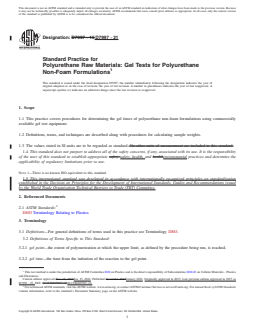
1.1 This practice covers procedures for determining the gel times of polyurethane non-foam formulations using commercially available gel test equipment.
1.2 Definitions, terms, and techniques are described along with procedures for calculating sample weights.
1.3 The values stated in SI units are to be regarded as standard.
1.4 This standard does not purport to address all of the safety concerns, if any, associated with its use. It is the responsibility of the user of this standard to establish appropriate safety, health, and environmental practices and determine the applicability of regulatory limitations prior to use.
Note 1: There is no known ISO equivalent to this standard.
1.5 This international standard was developed in accordance with internationally recognized principles on standardization established in the Decision on Principles for the Development of International Standards, Guides and Recommendations issued by the World Trade Organization Technical Barriers to Trade (TBT) Committee.
General Information
- Status
- Published
- Publication Date
- 14-Jan-2021
- Technical Committee
- D20 - Plastics
- Drafting Committee
- D20.22 - Cellular Materials - Plastics and Elastomers
Relations
- Effective Date
- 01-Feb-2024
- Effective Date
- 01-Nov-2023
- Effective Date
- 01-Jan-2020
- Effective Date
- 01-Aug-2019
- Effective Date
- 15-Apr-2019
- Effective Date
- 01-Feb-2019
- Effective Date
- 01-Dec-2018
- Effective Date
- 01-Nov-2018
- Effective Date
- 15-Aug-2017
- Effective Date
- 15-Nov-2012
- Effective Date
- 15-May-2011
- Effective Date
- 01-Mar-2008
- Effective Date
- 01-May-2007
- Effective Date
- 10-Aug-2000
Overview
ASTM D7997-21 is the Standard Practice for Polyurethane Raw Materials: Gel Tests for Polyurethane Non-Foam Formulations, developed by ASTM International. This standard outlines procedures for determining the gel times of polyurethane non-foam formulations using commercially available gel test equipment. Gel time is a key indicator of reactivity in polyurethane systems and is critical for both process control and product quality assurance. The practice is applicable in research, quality control, specification testing, and production environments.
Gel tests as defined by ASTM D7997-21 allow users to measure the time required for a polyurethane formulation to reach a specific viscosity threshold - the "gel point" - essential for evaluating material behavior during processing.
Key Topics
Gel Time Determination:
- Measures the interval from mixing reactive polyurethane raw materials until a specific viscosity is achieved.
- Utilizes standard gel meters or equivalent equipment to monitor the polymerization process.
Suitability and Application Areas:
- Recommended for use in research labs, process development, and production quality control.
- Useful for assessing and verifying the reactivity characteristics of non-foam polyurethane formulations.
Limitations:
- Results may vary due to differences in operator techniques, laboratory conditions, and equipment.
- Equipment parameters such as mixer speed, blade shape, container type, and sample size can significantly affect outcomes.
- Not sensitive enough for detecting low-level (ppm, ppb) contaminants.
User-Defined Parameters:
- Laboratory and client must agree on specific equipment and test conditions, including gel point criteria and mixing procedures, to ensure result consistency.
- Users are advised to develop precision data adequate for their own requirements.
Safety Considerations:
- Isocyanate components are hazardous; appropriate safety, health, and environmental practices must be established.
Applications
ASTM D7997-21 gel tests for polyurethane non-foam formulations are highly valued in:
- Research & Development: Provides insight into the reactivity and processing characteristics of new polyurethane non-foam materials.
- Quality Control: Ensures batch-to-batch consistency by verifying gel time against predefined standards, allowing for the detection of formulation variations or contaminations.
- Specification Compliance: Assists manufacturers and suppliers in validating that non-foam polyurethane raw materials meet contractual or regulatory specifications.
- Process Optimization: Used in industrial settings to fine-tune polyurethane formulation processes, improving manufacturing efficiency and end-product quality.
Common application fields include automotive parts, coatings, adhesives, sealants, and elastomeric products where non-foam polyurethane performance is critical.
Related Standards
For users of ASTM D7997-21, the following standards and documents are often referenced or relevant:
- ASTM D883 - Terminology Relating to Plastics: Provides foundational definitions used in the context of plastics and polyurethane.
- Product-Specific Safety Data Sheets (SDS): Offer crucial safety and handling information for isocyanate and polyol components involved in gel testing.
- No ISO Equivalent: As stated in the standard, there is currently no known ISO standard covering the same scope as ASTM D7997-21.
Practical Value
Implementing ASTM D7997-21 ensures that manufacturers and users of polyurethane non-foam raw materials can reliably measure gel time, improving process control and product quality. By adhering to standardized testing protocols, organizations can confidently communicate technical parameters to stakeholders, meet regulatory or contractual obligations, and maintain high safety standards in handling polyurethane materials.
Keywords: polyurethane, gel time, non-foam formulations, ASTM D7997-21, polymerization, quality control, process control, reactivity, raw materials, isocyanate, resin blend, gel test
Buy Documents
ASTM D7997-21 - Standard Practice for Polyurethane Raw Materials: Gel Tests for Polyurethane Non-Foam Formulations
REDLINE ASTM D7997-21 - Standard Practice for Polyurethane Raw Materials: Gel Tests for Polyurethane Non-Foam Formulations
Get Certified
Connect with accredited certification bodies for this standard

Smithers Quality Assessments
US management systems and product certification.

DIN CERTCO
DIN Group product certification.
Sponsored listings
Frequently Asked Questions
ASTM D7997-21 is a standard published by ASTM International. Its full title is "Standard Practice for Polyurethane Raw Materials: Gel Tests for Polyurethane Non-Foam Formulations". This standard covers: SIGNIFICANCE AND USE 5.1 General Utility: 5.1.1 This practice is suitable for research, quality control, specification testing and process control. 5.1.2 It is useful to define and verify the reactivity of non-foam polyurethane formulations. 5.2 Limitations: 5.2.1 Operator-to-operator variability and lab-to-lab variability can be significant. 5.2.2 The variability of this practice is dependent on the equipment used to measure the gel time. It is recommended that the testing laboratory and the client agree on the equipment and the conditions to be used that include the following: 5.2.2.1 Gel Tester and gel point criteria, 5.2.2.2 Speed/rpm of the mixer, 5.2.2.3 Type and shape of the mix blades, 5.2.2.4 Size and type (for example, shape, lined or unlined) of container for mixing the components and for measuring the gel time, and 5.2.2.5 The volume (or height) of material to be placed in the container for measuring the gel time and the depth of the measuring wire or spindle of the gel tester from the bottom of the container. 5.2.3 Users of this practice shall develop their own precision data to determine if these procedures meet their requirements. 5.2.4 It is possible that low-levels (ppm, ppb) of contaminants will not be detected using this practice. SCOPE 1.1 This practice covers procedures for determining the gel times of polyurethane non-foam formulations using commercially available gel test equipment. 1.2 Definitions, terms, and techniques are described along with procedures for calculating sample weights. 1.3 The values stated in SI units are to be regarded as standard. 1.4 This standard does not purport to address all of the safety concerns, if any, associated with its use. It is the responsibility of the user of this standard to establish appropriate safety, health, and environmental practices and determine the applicability of regulatory limitations prior to use. Note 1: There is no known ISO equivalent to this standard. 1.5 This international standard was developed in accordance with internationally recognized principles on standardization established in the Decision on Principles for the Development of International Standards, Guides and Recommendations issued by the World Trade Organization Technical Barriers to Trade (TBT) Committee.
SIGNIFICANCE AND USE 5.1 General Utility: 5.1.1 This practice is suitable for research, quality control, specification testing and process control. 5.1.2 It is useful to define and verify the reactivity of non-foam polyurethane formulations. 5.2 Limitations: 5.2.1 Operator-to-operator variability and lab-to-lab variability can be significant. 5.2.2 The variability of this practice is dependent on the equipment used to measure the gel time. It is recommended that the testing laboratory and the client agree on the equipment and the conditions to be used that include the following: 5.2.2.1 Gel Tester and gel point criteria, 5.2.2.2 Speed/rpm of the mixer, 5.2.2.3 Type and shape of the mix blades, 5.2.2.4 Size and type (for example, shape, lined or unlined) of container for mixing the components and for measuring the gel time, and 5.2.2.5 The volume (or height) of material to be placed in the container for measuring the gel time and the depth of the measuring wire or spindle of the gel tester from the bottom of the container. 5.2.3 Users of this practice shall develop their own precision data to determine if these procedures meet their requirements. 5.2.4 It is possible that low-levels (ppm, ppb) of contaminants will not be detected using this practice. SCOPE 1.1 This practice covers procedures for determining the gel times of polyurethane non-foam formulations using commercially available gel test equipment. 1.2 Definitions, terms, and techniques are described along with procedures for calculating sample weights. 1.3 The values stated in SI units are to be regarded as standard. 1.4 This standard does not purport to address all of the safety concerns, if any, associated with its use. It is the responsibility of the user of this standard to establish appropriate safety, health, and environmental practices and determine the applicability of regulatory limitations prior to use. Note 1: There is no known ISO equivalent to this standard. 1.5 This international standard was developed in accordance with internationally recognized principles on standardization established in the Decision on Principles for the Development of International Standards, Guides and Recommendations issued by the World Trade Organization Technical Barriers to Trade (TBT) Committee.
ASTM D7997-21 is classified under the following ICS (International Classification for Standards) categories: 83.080.10 - Thermosetting materials. The ICS classification helps identify the subject area and facilitates finding related standards.
ASTM D7997-21 has the following relationships with other standards: It is inter standard links to ASTM D883-24, ASTM D883-23, ASTM D883-20, ASTM D883-19c, ASTM D883-19a, ASTM D883-19, ASTM D883-18a, ASTM D883-18, ASTM D883-17, ASTM D883-12e1, ASTM D883-11, ASTM D883-08, ASTM D883-07, ASTM D883-00. Understanding these relationships helps ensure you are using the most current and applicable version of the standard.
ASTM D7997-21 is available in PDF format for immediate download after purchase. The document can be added to your cart and obtained through the secure checkout process. Digital delivery ensures instant access to the complete standard document.
Standards Content (Sample)
This international standard was developed in accordance with internationally recognized principles on standardization established in the Decision on Principles for the
Development of International Standards, Guides and Recommendations issued by the World Trade Organization Technical Barriers to Trade (TBT) Committee.
Designation: D7997 − 21
Standard Practice for
Polyurethane Raw Materials: Gel Tests for Polyurethane
Non-Foam Formulations
This standard is issued under the fixed designation D7997; the number immediately following the designation indicates the year of
original adoption or, in the case of revision, the year of last revision. A number in parentheses indicates the year of last reapproval. A
superscript epsilon (´) indicates an editorial change since the last revision or reapproval.
1. Scope 3.2.2 geltime—thetimefromtheinitiationofthereactionto
the gel point.
1.1 This practice covers procedures for determining the gel
3.2.3 resin blend (formulated polyol)—complete ingredient
times of polyurethane non-foam formulations using commer-
formulation without the isocyanate component.
cially available gel test equipment.
3.2.4 index—the ratio of the equivalents of the isocyanate
1.2 Definitions, terms, and techniques are described along
component to the equivalents of the resin blend of a polyure-
with procedures for calculating sample weights.
thane formulation.
1.3 The values stated in SI units are to be regarded as
standard.
4. Summary of Practice
1.4 This standard does not purport to address all of the
4.1 The gel time of a polyurethane non-foam formulation is
safety concerns, if any, associated with its use. It is the
determined by measuring the time required for the viscosity of
responsibility of the user of this standard to establish appro-
the polymerizing system to increase to a set level using a gel
priate safety, health, and environmental practices and deter-
meter. It is recommended that the torque of the gel meter be
mine the applicability of regulatory limitations prior to use.
verified with a gauge certified to NIST standards.
NOTE 1—There is no known ISO equivalent to this standard.
5. Significance and Use
1.5 This international standard was developed in accor-
5.1 General Utility:
dance with internationally recognized principles on standard-
5.1.1 This practice is suitable for research, quality control,
ization established in the Decision on Principles for the
specification testing and process control.
Development of International Standards, Guides and Recom-
5.1.2 It is useful to define and verify the reactivity of
mendations issued by the World Trade Organization Technical
non-foam polyurethane formulations.
Barriers to Trade (TBT) Committee.
5.2 Limitations:
2. Referenced Documents
5.2.1 Operator-to-operator variability and lab-to-lab vari-
2.1 ASTM Standards: ability can be significant.
5.2.2 The variability of this practice is dependent on the
D883 Terminology Relating to Plastics
equipment used to measure the gel time. It is recommended
3. Terminology
thatthetestinglaboratoryandtheclientagreeontheequipment
and the conditions to be used that include the following:
3.1 Definitions—Forgeneraldefinitionsoftermsusedinthis
5.2.2.1 Gel Tester and gel point criteria,
practice see Terminology D883.
5.2.2.2 Speed/rpm of the mixer,
3.2 Definitions of Terms Specific to This Standard:
5.2.2.3 Type and shape of the mix blades,
3.2.1 gel point—the extent of polymerization at which the
5.2.2.4 Size and type (for example, shape, lined or unlined)
upper limit, as defined by the procedure being run, is reached.
of container for mixing the components and for measuring the
gel time, and
This test method is under the jurisdiction ofASTM Committee D20 on Plastics
5.2.2.5 The volume (or height) of material to be placed in
and is the direct responsibility of Subcommittee D20.22 on Cellular Materials -
the container for measuring the gel time and the depth of the
Plastics and Elastomers.
measuring wire or spindle of the gel tester from the bottom of
Current edition approved Jan. 15, 2021. Published January 2021. Originally
the container.
approved in 2015. Last previous edition approved in 2015 as D7997 - 15. DOI:
10.1520/D7997–21.
5.2.3 Usersofthispracticeshalldeveloptheirownprecision
For referenced ASTM standards, visit the ASTM website, www.astm.org, or
data to determine if these procedures meet their requirements.
contact ASTM Customer Service at service@astm.org. For Annual Book of ASTM
5.2.4 It is possible that low-levels (ppm, ppb) of contami-
Standards volume information, refer to the standard’s Document Summary page on
the ASTM website. nants will not be detected using this practice.
Copyright © ASTM International, 100 Barr Harbor Drive, PO Box C700, West Conshohocken, PA 19428-2959. United States
D7997 − 21
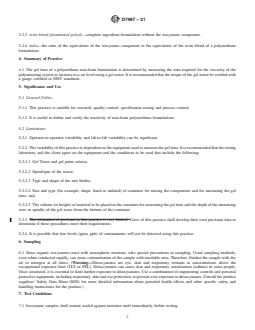
6. Sampling 9.1.4 Stop the timer when the reaction reaches the gel point.
Many commercial units will shut off automatically at the
6.1 Since organic isocyanates react with atmospheric
defined gel point.
moisture, take special precautions in sampling. Usual sampling
9.1.5 Record the gel time.
methods, even when conducted rapidly, can cause contamina-
tion of the sample with insoluble urea. Therefore, blanket the
10. Sample Calculations
sample with dry air or nitrogen at all times. (Warning—
10.1 Calculate the equivalent weight, EW , of the resin
p
Diisocyanates are eye, skin and respiratory irritants at concen-
blend as follows:
trations above the occupational exposure limit (TLV or PEL).
Diisocyanates can cause skin and respiratory sensitization 100
EW 5 (1)
p
(asthma)insomepeople.Oncesensitized,itisessentialtolimit OH 1Ac 100 %W
~ !
further exposure to diisocyanates. Use a combination of
56100 9
engineering controls and personal protective equipment, in-
where:
cluding respiratory, skin and eye protection, to prevent over-
OH = the hydroxyl number of the resin blend in milli-
exposure to diisocyanates. Consult the product suppliers’
grams of KOH per gram of sample,
Safety Data Sheet (SDS) for more detailed information about
Ac = the acid number of the resin blend in milligrams of
potential health effects and other specific safety and handling
KOH per gram of sample,
instructions for the product.)
%W = the percent water in the resin blend,
56100 = the equivalent weight of KOH in milligrams of
7. Test Conditions
KOH per equivalent, and
7.1 Isocyanate samples shall remain sealed against moisture
9 = the equivalent weight of water in grams per
until immediately before testing.
equivalent.
8. Equipment and Reagents
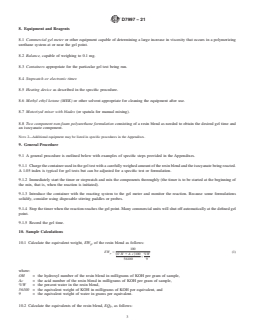
10.2 Calculate the equivalents of the resin blend, EQ,as
p
follows:
8.1 Commercial gel meter or other equipment capable of
determining a large increase in viscosity that occurs in a EQ 5 X ⁄EW (2)
p p p
polymerizing urethane system at or near the gel point.
where:
8.2 Balance, capable of weighing to 0.1 mg.
X = the amount of resin blend to be reacted with the
p
8.3 Containers appropriate for the particular gel test being isocyanate component in grams
run.
10.3 Calculate the equivalents, EQ, of the isocyanate com-
i
8.4 Stopwatch or electronic timer. ponent needed to prepare the batch at an index of 1.05 as
follows:
8.5 Heating device as described in the specific procedure.
EQ 5 1.05 3EQ (3)
i p
8.6 Methyl ethyl ketone (MEK) or other solvent appropriate
for cleaning the equipment after use.
where:
8.7 Motorized mixer with blades (or spatula for manual 1.05 = the index of the batch
mixing).
10.4 Calculate the equivalent weight, EW, of the isocyanate
i
8.8 Two component non-foam polyurethane formulation component as follows:
consisting of a resin blend as needed to obtain the desired gel
42.02 3100
EW 5 (4)
time and an isocyanate component.
i
%NCO
NOTE 2—Additional equipment may be listed in specific procedures in
the Appendixes.
where:
%NCO = the percent by weight of NCO groups present in
9. General Procedure
the sample and
9.1 Ageneral procedure is outlined below with examples of
42.02 = grams NCO per equivalent of NCO.
specific steps provided in the Appendixes.
10.5 Calculate the weight, W, of isocyanate in grams
i
9.1.1 Charge the container used in the gel test with a
needed to prepare the batch as follows:
carefullyweighedamountoftheresinblendandtheisocyanate
being reacted. A 1.05 index is typical for gel tests but can be W 5EW 3EQ (5)
i i i
adjusted for a specific test or formulation.
11. Report
9.1.2 Immediately start the timer or stopwatch and mix the
11.1 Report the gel time and the procedure used.
components thoroughly (the timer is to be started at the
beginning of the mix, that is, when the reaction is initiated).
12. Keywords
9.1.3 Introduce the container with the reacting system to the
gelmeterandmonitorthereaction.Becausesomeformulations 12.1 gel time; isocyanate; polyol; polyurethane; raw mate-
solidify, consider using disposable stirring paddles or probes. rial; resin blend
D7997 − 21
APPENDIXES
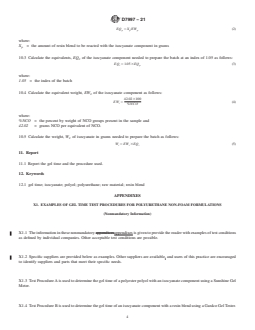
X1. EXAMPLES OF GEL TIME TEST PROCEDURES FOR POLYURETHANE NON-FOAM FORMULATIONS
(Nonmandatory Information)
X1.1 The information in these nonmandatory appendixes is a polyester polyol with an isocyanate component using a
given to provide the reader with examples of test conditions as Sunshine Gel Meter.
defined by individual companies. Other acceptable test condi-
X1.4 Test Procedure B is used to determine the gel time of
tions are possible.
anisocyanatecomponentwitharesinblendusingaGardcoGel
X1.2 Specific suppliers are provided below as examples. Tester.
Other suppliers are available, and users of this practice are
X1.5 Test Procedure C is used to determine the gel time of
encouraged to identify suppliers and parts that meet their
a two-component elastomer system using a Shyodu Gel Timer
specific needs.
andincludesinformationonverifyingthetorqueoftheShyodu
X1.3 Test Procedure A is used to determine the gel time of Gel Timer with a desktop IMADA DTX-15B Torque Tester.
X2. TEST PROCEDURE A: GEL TIME OF A POLYESTER POLYOL WITH AN ISOCYANATE COMPONENT USING A SUN-
SHINE GEL METER
X2.1 Scope X2.4.3 Weigh the appropriate amount of isocyanate to the
nearest 0.1 g. (See X2.5.) Remove the jar of polyester polyol
X2.1.1 This procedure determines the reactivity of a poly-
from the circulating air oven and rapidly add the isocyanate.
ester polyol by measuring the gel time of a non-foam polyure-
X2.4.4 Start the stopwatch as soon as the isocyanate is
thane formulation using a Sunshine Gel Meter.
added.
X2.2 Summary of Practice
X2.4.5 Immediately mix with a spatula for 1.5 min and fill
an 18-mm by 150-mm test tube to a height of 9.5 cm from the
X2.2.1 Apolyester polyol is reacted with an isocyanate and
bottom of the tube.
the reactivity is determined by measuring the time required for
the viscosity of the polymerizing system to increase to a set
X2.4.6 Place the tube in the gel meter bath and install the
level using a gel meter.
spindle so that it remains 2.5 cm off the bottom of the tube.
X2.4.7 Start the gel meter and stop the stopwatch at the
X2.3 Equipment and Chemicals
same time. Record the time, SW, on the stopwatch to the
X2.3.1 Gel meter, Sunshine Scientific Instruments.
nearest second.
X2.3.2 Balance, analytical, 0.01-g readability.
X2.4.8 When the gel meter stops and the buzzer sounds,
record the gel meter time, G, to the nearest second.
X2.3.3 Oven, circulating air, 110°C.
X2.4.9 Immediately remove the spindle from the unit and
X2.3.4 Baths, oil, circulating high temperature.
clean it with MEK.
X2.3.5 Stopwatch.
X2.5 Calculations
X2.3.6 Methyl ethyl ketone (MEK).
X2.5.1 Calculate the equivalent weight, EW , of the poly-
X2.3.7 Polymeric MDI reagent. PE
ester polyol as follows (see Note X2.1):
X2.3.8 Oil, high temperature silicone bath.
56.1 31000
EW 5 (X2.1)
X2.3.9 Test tubes, 18-mm by 150-mm. PE
OH
X2.3.10 Jar, glass, 237-mL (8-oz).
where:
X2.3.11 Spatula.
EW = the equivalent weight of the polyester polyol
PE
sample,
X2.4 Procedure 56.1 = the equivalent weight of KOH in milligrams per
milliequivalents,
X2.4.1 Weigh 50 g of polyester polyol into a 237-mL(8-oz)
1000 = the factor for converting milliequivalents to
jar. Cover and place the jar in the 110°C oven for one hour.
equivalents, and
X2.4.2 Set the oil bath to the desired temperature (example: OH = the hydroxyl number of the polyester polyol sample
For a polyester polyol with hydroxyl number of 35 mgKOH/g,
in milligrams of KOH per gram of sample as
set oil bath temperature to 130°C). Set up the gel meter as determined by the appropriate specification method.
described in the operation manual. NOTE X2.1—Equation in X2.5.1 assumes negligible contribution from
D7997 − 21
theacidnumberandwatercontentofthepolyesterpolyol.Theuserofthis
X2.5.4 Calculate the weight, W , of isocyanate to be used in
I
practice must validate this assumption for their particular system
the reactivity test as follows:
X2.5.2 Calculate the equivalents, E ,in50gofthe
PE
W 5 E 3EW (X2.4)
I PE I
polyester polyol as follows:
where:
E 5 (X2.2)
PE W = the weight of the isocyanate in grams
I
...
This document is not an ASTM standard and is intended only to provide the user of an ASTM standard an indication of what changes have been made to the previous version. Because
it may not be technically possible to adequately depict all changes accurately, ASTM recommends that users consult prior editions as appropriate. In all cases only the current version
of the standard as published by ASTM is to be considered the official document.
Designation: D7997 − 15 D7997 − 21
Standard Practice for
Polyurethane Raw Materials: Gel Tests for Polyurethane
Non-Foam Formulations
This standard is issued under the fixed designation D7997; the number immediately following the designation indicates the year of
original adoption or, in the case of revision, the year of last revision. A number in parentheses indicates the year of last reapproval. A
superscript epsilon (´) indicates an editorial change since the last revision or reapproval.
1. Scope
1.1 This practice covers procedures for determining the gel times of polyurethane non-foam formulations using commercially
available gel test equipment.
1.2 Definitions, terms, and techniques are described along with procedures for calculating sample weights.
1.3 The values stated in SI units are to be regarded as standard. No other units of measurement are included in this standard.
1.4 This standard does not purport to address all of the safety concerns, if any, associated with its use. It is the responsibility
of the user of this standard to establish appropriate safety safety, health, and healthenvironmental practices and determine the
applicability of regulatory limitations prior to use.
NOTE 1—There is no known ISO equivalent to this standard.
1.5 This international standard was developed in accordance with internationally recognized principles on standardization
established in the Decision on Principles for the Development of International Standards, Guides and Recommendations issued
by the World Trade Organization Technical Barriers to Trade (TBT) Committee.
2. Referenced Documents
2.1 ASTM Standards:
D883 Terminology Relating to Plastics
3. Terminology
3.1 Definitions—For general definitions of terms used in this practice see Terminology D883.
3.2 Definitions of Terms Specific to This Standard:
3.2.1 gel point—the extent of polymerization at which the upper limit, as defined by the procedure being run, is reached.
3.2.2 gel time—the time from the initiation of the reaction to the gel point.
This test method is under the jurisdiction of ASTM Committee D20 on Plastics and is the direct responsibility of Subcommittee D20.22 on Cellular Materials - Plastics
and Elastomers.
Current edition approved Nov. 15, 2015Jan. 15, 2021. Published December 2015January 2021. Originally approved in 2015. Last previous edition approved in 2015 as
D7997 - 15. DOI: 10.1520/D7997–15.10.1520/D7997–21.
For referenced ASTM standards, visit the ASTM website, www.astm.org, or contact ASTM Customer Service at service@astm.org. For Annual Book of ASTM Standards
volume information, refer to the standard’s Document Summary page on the ASTM website.
Copyright © ASTM International, 100 Barr Harbor Drive, PO Box C700, West Conshohocken, PA 19428-2959. United States
D7997 − 21
3.2.3 resin blend (formulated polyol)—complete ingredient formulation without the isocyanate component.
3.2.4 index—the ratio of the equivalents of the isocyanate component to the equivalents of the resin blend of a polyurethane
formulation.
4. Summary of Practice
4.1 The gel time of a polyurethane non-foam formulation is determined by measuring the time required for the viscosity of the
polymerizing system to increase to a set level using a gel meter. It is recommended that the torque of the gel meter be verified with
a gauge certified to NIST standards.
5. Significance and Use
5.1 General Utility:
5.1.1 This practice is suitable for research, quality control, specification testing and process control.
5.1.2 It is useful to define and verify the reactivity of non-foam polyurethane formulations.
5.2 Limitations:
5.2.1 Operator-to-operator variability and lab-to-lab variability can be significant.
5.2.2 The variability of this practice is dependent on the equipment used to measure the gel time. It is recommended that the testing
laboratory and the client agree on the equipment and the conditions to be used that include the following:
5.2.2.1 Gel Tester and gel point criteria,
5.2.2.2 Speed/rpm of the mixer,
5.2.2.3 Type and shape of the mix blades,
5.2.2.4 Size and type (for example, shape, lined or unlined) of container for mixing the components and for measuring the gel
time, and
5.2.2.5 The volume (or height) of material to be placed in the container for measuring the gel time and the depth of the measuring
wire or spindle of the gel tester from the bottom of the container.
5.2.3 The estimation of precision in this practice is very limited. Users of this practice shall develop their own precision data to
determine if these procedures meet their requirements.
5.2.4 It is possible that low-levels (ppm, ppb) of contaminants will not be detected using this practice.
6. Sampling
6.1 Since organic isocyanates react with atmospheric moisture, take special precautions in sampling. Usual sampling methods,
even when conducted rapidly, can cause contamination of the sample with insoluble urea. Therefore, blanket the sample with dry
air or nitrogen at all times. (Warning—Diisocyanates are eye, skin and respiratory irritants at concentrations above the
occupational exposure limit (TLV or PEL). Diisocyanates can cause skin and respiratory sensitization (asthma) in some people.
Once sensitized, it is essential to limit further exposure to diisocyanates. Use a combination of engineering controls and personal
protective equipment, including respiratory, skin and eye protection, to prevent over-exposure to diisocyanates. Consult the product
suppliers’ Safety Data Sheet (SDS) for more detailed information about potential health effects and other specific safety and
handling instructions for the product.)
7. Test Conditions
7.1 Isocyanate samples shall remain sealed against moisture until immediately before testing.
D7997 − 21
8. Equipment and Reagents
8.1 Commercial gel meter or other equipment capable of determining a large increase in viscosity that occurs in a polymerizing
urethane system at or near the gel point.
8.2 Balance, capable of weighing to 0.1 mg.
8.3 Containers appropriate for the particular gel test being run.
8.4 Stopwatch or electronic timer.
8.5 Heating device as described in the specific procedure.
8.6 Methyl ethyl ketone (MEK) or other solvent appropriate for cleaning the equipment after use.
8.7 Motorized mixer with blades (or spatula for manual mixing).
8.8 Two component non-foam polyurethane formulation consisting of a resin blend as needed to obtain the desired gel time and
an isocyanate component.
NOTE 2—Additional equipment may be listed in specific procedures in the Appendixes.
9. General Procedure
9.1 A general procedure is outlined below with examples of specific steps provided in the Appendixes.
9.1.1 Charge the container used in the gel test with a carefully weighed amount of the resin blend and the isocyanate being reacted.
A 1.05 index is typical for gel tests but can be adjusted for a specific test or formulation.
9.1.2 Immediately start the timer or stopwatch and mix the components thoroughly (the timer is to be started at the beginning of
the mix, that is, when the reaction is initiated).
9.1.3 Introduce the container with the reacting system to the gel meter and monitor the reaction. Because some formulations
solidify, consider using disposable stirring paddles or probes.
9.1.4 Stop the timer when the reaction reaches the gel point. Many commercial units will shut off automatically at the defined gel
point.
9.1.5 Record the gel time.
10. Sample Calculations
10.1 Calculate the equivalent weight, EW , of the resin blend as follows:
p
EW 5 (1)
p
~O H 1 A c!100 %W
56100 9
where:
OH = the hydroxyl number of the resin blend in milligrams of KOH per gram of sample,
Ac = the acid number of the resin blend in milligrams of KOH per gram of sample,
%W = the percent water in the resin blend,
56100 = the equivalent weight of KOH in milligrams of KOH per equivalent, and
9 = the equivalent weight of water in grams per equivalent.
10.2 Calculate the equivalents of the resin blend, EQ , as follows:
p
D7997 − 21
EQ 5 X ⁄EW (2)
p p p
where:
X = the amount of resin blend to be reacted with the isocyanate component in grams
p
10.3 Calculate the equivalents, EQ , of the isocyanate component needed to prepare the batch at an index of 1.05 as follows:
i
EQ 5 1.05 3EQ (3)
i p
where:
1.05 = the index of the batch
10.4 Calculate the equivalent weight, EW , of the isocyanate component as follows:
i
42.02 3100
EW 5 (4)
i
%NCO
where:
%NCO = the percent by weight of NCO groups present in the sample and
42.02 = grams NCO per equivalent of NCO.
10.5 Calculate the weight, W , of isocyanate in grams needed to prepare the batch as follows:
i
W 5 EW 3EQ (5)
i i i
11. Report
11.1 Report the gel time and the procedure used.
12. Keywords
12.1 gel time; isocyanate; polyol; polyurethane; raw material; resin blend
APPENDIXES
X1. EXAMPLES OF GEL TIME TEST PROCEDURES FOR POLYURETHANE NON-FOAM FORMULATIONS
(Nonmandatory Information)
X1.1 The information in these nonmandatory appendicesappendixes is given to provide the reader with examples of test conditions
as defined by individual companies. Other acceptable test conditions are possible.
X1.2 Specific suppliers are provided below as examples. Other suppliers are available, and users of this practice are encouraged
to identify suppliers and parts that meet their specific needs.
X1.3 Test Procedure A is used to determine the gel time of a polyester polyol with an isocyanate component using a Sunshine Gel
Meter.
X1.4 Test Procedure B is used to determine the gel time of an isocyanate component with a resin blend using a Gardco Gel Tester.
D7997 − 21
X1.5 Test Procedure C is used to determine the gel time of a two component two-component elastomer system using a Shyodu
Gel Timer and includes information on verifying the torque of the Shyodu Gel Timer with a desktop IMADA DTX-15B Torque
Tester.
X2. TEST PROCEDURE A: GEL TIME OF A POLYESTER POLYOL WITH AN ISOCYANATE COMPONENT USING A SUN-
SHINE GEL METER
X2.1 Scope
X2.1.1 This procedure determines the reactivity of a polyester polyol by measuring the gel time of a non-foam polyurethane
formulation using a Sunshine gel meter.Gel Meter.
X2.2 Summary of Practice
X2.2.1 A polyester polyol is reacted with an isocyanate and the reactivity is determined by measuring the time required for the
viscosity of the polymerizing system to increase to a set level using a gel meter.
X2.3 Equipment and Chemicals
X2.3.1 Gel meter, Sunshine Scientific Instruments.
X2.3.2 Balance, analytical, 0.01-g readability,.readability.
X2.3.3 Oven, circulating air, 110°C.
X2.3.4 Baths, oil, circulating high temperature.
X2.3.5 Stopwatch.
X2.3.6 Methyl ethyl ketone (MEK).
X2.3.7 Polymeric MDI reagent.
X2.3.8 Oil, high temperature silicone bath.
X2.3.9 Test tubes, 18-mm by 150-mm.
D7997 − 21
X2.3.10 Jar, glass, 237-mL (8-oz).
X2.3.11 Spatula.
X2.4 Procedure
X2.4.1 Weigh 50 g of polyester polyol into a 237-mL (8-oz) jar. Cover and place the jar in the 110°C oven for one hour.
X2.4.2 Set the oil bath to the desired temperature (example: For a polyester polyol with hydroxyl number of 35 mgKOH/g, set
oil bath temperature to 130°C). Set up the gel meter as described in the operation manual.
X2.4.3 Weigh the appropriate amount of isocyanate to the nearest 0.1 g. (See X2.5.) Remove the jar of polyester polyol from the
circulating air oven and rapidly add the isocyanate.
X2.4.4 Start the stopwatch as soon as the isocyanate is added.
X2.4.5 Immediately mix with a spatula for 1.5 min and fill an 18-mm by 150-mm test tube to a height of 9.5 cm from the bottom
of the tube.
X2.4.6 Place the tube in the gel meter bath and install the spindle so that it remains 2.5 cm off the bottom of the tube.
X2.4.7 Start the gel meter and stop the stopwatch at the same time. Record the time, SW, on the stopwatch to the nearest second.
X2.4.8 When the gel meter stops and the buzzer sounds, record the gel meter time, G, to the nearest second.
X2.4.9 Immediately remove the spindle from the unit and clean it with MEK.
X2.5 Calculations
X2.5.1 Calculate the equivalent weight, EW , of the polyester polyol as follows (see Note X2.1):
PE
56.1 31000
EW 5 (X2.1)
PE
OH
where:
EW = the equivalent weight of the polyester polyol sample,
PE
56.1 = the equivalent weight of KOH in milligrams per milliequivalents,
D7997 − 21
1000 = the factor for converting milliequivalents to equivalents, and
OH = the hydroxyl number of the polyester polyol sample in milligrams of KOH per gram of sample as determined by the
appropriate specification method.
NOTE X2.1—Equation in X2.5.1 assumes negligible contribution from the acid number and water content of the polyester polyol. The user of this practice
must validate this assumption for their particular system
X2.5.2 Calculate the equivalents, E , in 50 g of the polyester polyol as follows:
PE
E 5 (X2.2)
PE
EW
PE
where:
50 = the amount of the polyester polyol used in the reactivity test in grams
X2.5.3 Calculate the equivalent weight, EW , of the appropriate isocyanate as follows:
I
42.02 3100
EW 5 (X2.3)
I
%NCO
where:
42.02 = the equivalent weight of
...
Questions, Comments and Discussion
Ask us and Technical Secretary will try to provide an answer. You can facilitate discussion about the standard in here.
Loading comments...