

ASTM D3349-21
(Test Method)Standard Test Method for Absorption Coefficient of Ethylene Polymer Material Pigmented with Carbon Black
General Information
- Abstract
SIGNIFICANCE AND USE
4.1 The absorption coefficient of polyolefin polymer pigmented with carbon black is useful to judge the degree and uniformity of dispersion of the pigment, and the adequacy of the quantitative level of pigment addition. These factors are used to predict the performance of the polymer material in response to prolonged exposure to ultraviolet light as evidenced by minimal changes in specific properties.
Note 1: This test method was developed to evaluate ethylene polymer materials pigmented with small particle size carbon blacks suitable for UV protection. It is not known how accurate and reproducible the test would be with larger (35 nm or greater) particle size blacks. However, for larger particle sizes of carbon black, such as furnace black at 275 nm, when there is at least 5 or higher percent of carbon black, the material pigmented as such has suitable UV protection.
SCOPE
1.1 This test method measures the amount of light transmitted through a film of carbon black pigmented ethylene polymer.
1.2 After calculation of the amount of light and film thickness, an absorption coefficient is calculated.
1.3 Whenever two sets of values are presented, in different units, the values in the first set are the standard, while those in parentheses are for information only.
1.4 This standard does not purport to address all of the safety concerns, if any, associated with its use. It is the responsibility of the user of this standard to establish appropriate safety, health, and environmental practices and determine the applicability of regulatory limitations prior to use.
1.5 This international standard was developed in accordance with internationally recognized principles on standardization established in the Decision on Principles for the Development of International Standards, Guides and Recommendations issued by the World Trade Organization Technical Barriers to Trade (TBT) Committee.
- Status
- Published
- Publication Date
- 31-Aug-2021
- Technical Committee
- D09 - Electrical and Electronic Insulating Materials
- Drafting Committee
- D09.07 - Electrical Insulating Materials
Buy Documents
ASTM D3349-21 - Standard Test Method for Absorption Coefficient of Ethylene Polymer Material Pigmented with Carbon Black
REDLINE ASTM D3349-21 - Standard Test Method for Absorption Coefficient of Ethylene Polymer Material Pigmented with Carbon Black
Overview
ASTM D3349-21: Standard Test Method for Absorption Coefficient of Ethylene Polymer Material Pigmented with Carbon Black specifies a reliable procedure for determining the absorption coefficient of ethylene polymer films containing carbon black pigment. By measuring the amount of light transmitted through the film and evaluating the effect of film thickness, this test method assesses both the degree and uniformity of carbon black dispersion, as well as the adequacy of pigment loading levels. These results are critical for predicting how ethylene polymer materials, particularly those used in outdoor applications, will perform under prolonged ultraviolet (UV) exposure.
This standard is designed for use with small particle-size carbon black, known for providing effective UV protection in polyolefin materials. It plays an essential role in quality assurance, manufacturing consistency, and product performance for polyethylene and related polymer applications.
Keywords: absorption coefficient, ethylene polymer, carbon black, ASTM D3349, UV protection, light transmission, pigment dispersion
Key Topics
Absorption Coefficient Measurement
- Establishes a precise method to measure light absorption in carbon black-pigmented ethylene polymer films.
- Calculation accounts for both light transmission and film thickness.
Assessment of Pigment Dispersion
- Evaluates the uniformity and adequacy of carbon black distribution in the polymer matrix.
- Helps identify issues with mixing, processing, or formulation.
UV Protection Evaluation
- The absorption coefficient directly correlates to the material’s capability to resist UV-induced degradation.
- Ensures the intended level of UV protection is achieved, critical for materials exposed to sunlight.
Quality Control
- Supports consistency between product batches by standardizing the measurement process.
- Enables manufacturers to verify pigment loading and dispersion within formulated specifications.
Testing Apparatus
- Recommends using a properly calibrated spectrophotometer and specialized mounting equipment to ensure accurate absorbance readings.
Applications
ASTM D3349-21 is widely adopted in various sectors where ethylene polymers with carbon black pigmentation are used. Its applications include:
Plastic Film and Sheet Manufacturers
- Quality assurance testing for polyethylene films used in packaging, agriculture, construction, or electrical insulation.
Wire and Cable Insulation
- Assessment of polyethylene plastics extrusion materials as described in related standards such as ASTM D1248.
Outdoor and UV-Exposed Products
- Evaluation of materials intended for prolonged sun exposure, ensuring durability and longevity through proper UV stabilization.
Material Development and Formulation
- R&D support for developing new polymer blends that meet specific UV resistance and aesthetic requirements.
Regulatory and Specification Compliance
- Helps manufacturers and buyers agree on pigment levels and UV protection standards for contractual or regulatory needs.
Related Standards
The following ASTM standards are commonly used alongside ASTM D3349-21 to ensure comprehensive polymer material testing:
- ASTM D1248 - Specification for Polyethylene Plastics Extrusion Materials for Wire and Cable
- ASTM E60 - Practice for Analysis of Metals, Ores, and Related Materials by Spectrophotometry
These and other relevant ASTM standards help ensure rigorous testing and consistent quality control in polymer manufacturing and product validation.
By following ASTM D3349-21, organizations can confidently evaluate the optical properties, pigment dispersion, and long-term performance of carbon black-pigmented ethylene polymers, securing product reliability in critical and UV-exposed applications.
Relations
- Effective Date
- 15-Nov-2016
- Effective Date
- 01-Apr-2012
- Effective Date
- 01-Mar-2005
- Effective Date
- 01-May-2004
- Effective Date
- 01-Mar-2004
- Effective Date
- 10-Apr-2002
- Effective Date
- 10-Apr-2002
- Effective Date
- 10-May-1998
Buy Documents
ASTM D3349-21 - Standard Test Method for Absorption Coefficient of Ethylene Polymer Material Pigmented with Carbon Black
REDLINE ASTM D3349-21 - Standard Test Method for Absorption Coefficient of Ethylene Polymer Material Pigmented with Carbon Black
Get Certified
Connect with accredited certification bodies for this standard

DIN CERTCO
DIN Group product certification.

Smithers Quality Assessments
US management systems and product certification.
Sponsored listings
Frequently Asked Questions
ASTM D3349-21 is a standard published by ASTM International. Its full title is "Standard Test Method for Absorption Coefficient of Ethylene Polymer Material Pigmented with Carbon Black". This standard covers: SIGNIFICANCE AND USE 4.1 The absorption coefficient of polyolefin polymer pigmented with carbon black is useful to judge the degree and uniformity of dispersion of the pigment, and the adequacy of the quantitative level of pigment addition. These factors are used to predict the performance of the polymer material in response to prolonged exposure to ultraviolet light as evidenced by minimal changes in specific properties. Note 1: This test method was developed to evaluate ethylene polymer materials pigmented with small particle size carbon blacks suitable for UV protection. It is not known how accurate and reproducible the test would be with larger (35 nm or greater) particle size blacks. However, for larger particle sizes of carbon black, such as furnace black at 275 nm, when there is at least 5 or higher percent of carbon black, the material pigmented as such has suitable UV protection. SCOPE 1.1 This test method measures the amount of light transmitted through a film of carbon black pigmented ethylene polymer. 1.2 After calculation of the amount of light and film thickness, an absorption coefficient is calculated. 1.3 Whenever two sets of values are presented, in different units, the values in the first set are the standard, while those in parentheses are for information only. 1.4 This standard does not purport to address all of the safety concerns, if any, associated with its use. It is the responsibility of the user of this standard to establish appropriate safety, health, and environmental practices and determine the applicability of regulatory limitations prior to use. 1.5 This international standard was developed in accordance with internationally recognized principles on standardization established in the Decision on Principles for the Development of International Standards, Guides and Recommendations issued by the World Trade Organization Technical Barriers to Trade (TBT) Committee.
SIGNIFICANCE AND USE 4.1 The absorption coefficient of polyolefin polymer pigmented with carbon black is useful to judge the degree and uniformity of dispersion of the pigment, and the adequacy of the quantitative level of pigment addition. These factors are used to predict the performance of the polymer material in response to prolonged exposure to ultraviolet light as evidenced by minimal changes in specific properties. Note 1: This test method was developed to evaluate ethylene polymer materials pigmented with small particle size carbon blacks suitable for UV protection. It is not known how accurate and reproducible the test would be with larger (35 nm or greater) particle size blacks. However, for larger particle sizes of carbon black, such as furnace black at 275 nm, when there is at least 5 or higher percent of carbon black, the material pigmented as such has suitable UV protection. SCOPE 1.1 This test method measures the amount of light transmitted through a film of carbon black pigmented ethylene polymer. 1.2 After calculation of the amount of light and film thickness, an absorption coefficient is calculated. 1.3 Whenever two sets of values are presented, in different units, the values in the first set are the standard, while those in parentheses are for information only. 1.4 This standard does not purport to address all of the safety concerns, if any, associated with its use. It is the responsibility of the user of this standard to establish appropriate safety, health, and environmental practices and determine the applicability of regulatory limitations prior to use. 1.5 This international standard was developed in accordance with internationally recognized principles on standardization established in the Decision on Principles for the Development of International Standards, Guides and Recommendations issued by the World Trade Organization Technical Barriers to Trade (TBT) Committee.
ASTM D3349-21 is classified under the following ICS (International Classification for Standards) categories: 83.080.20 - Thermoplastic materials. The ICS classification helps identify the subject area and facilitates finding related standards.
ASTM D3349-21 has the following relationships with other standards: It is inter standard links to ASTM D1248-16, ASTM D1248-12, ASTM D1248-05, ASTM E60-98(2004), ASTM D1248-04, ASTM D1248-00a, ASTM D1248-02, ASTM E60-98. Understanding these relationships helps ensure you are using the most current and applicable version of the standard.
ASTM D3349-21 is available in PDF format for immediate download after purchase. The document can be added to your cart and obtained through the secure checkout process. Digital delivery ensures instant access to the complete standard document.
Standards Content (Sample)
This international standard was developed in accordance with internationally recognized principles on standardization established in the Decision on Principles for the
Development of International Standards, Guides and Recommendations issued by the World Trade Organization Technical Barriers to Trade (TBT) Committee.
Designation: D3349 − 21
Standard Test Method for
Absorption Coefficient of Ethylene Polymer Material
Pigmented with Carbon Black
This standard is issued under the fixed designation D3349; the number immediately following the designation indicates the year of
original adoption or, in the case of revision, the year of last revision. A number in parentheses indicates the year of last reapproval. A
superscript epsilon (´) indicates an editorial change since the last revision or reapproval.
1. Scope* used to calculate an absorption coefficient that is a reciprocal
function of transmission after correction for thickness.
1.1 This test method measures the amount of light transmit-
ted through a film of carbon black pigmented ethylene poly-
4. Significance and Use
mer.
4.1 The absorption coefficient of polyolefin polymer pig-
1.2 After calculation of the amount of light and film
mented with carbon black is useful to judge the degree and
thickness, an absorption coefficient is calculated.
uniformity of dispersion of the pigment, and the adequacy of
the quantitative level of pigment addition. These factors are
1.3 Whenever two sets of values are presented, in different
units, the values in the first set are the standard, while those in used to predict the performance of the polymer material in
response to prolonged exposure to ultraviolet light as evi-
parentheses are for information only.
denced by minimal changes in specific properties.
1.4 This standard does not purport to address all of the
safety concerns, if any, associated with its use. It is the
NOTE 1—This test method was developed to evaluate ethylene polymer
responsibility of the user of this standard to establish appro- materialspigmentedwithsmallparticlesizecarbonblackssuitableforUV
protection. It is not known how accurate and reproducible the test would
priate safety, health, and environmental practices and deter-
be with larger (35 nm or greater) particle size blacks. However, for larger
mine the applicability of regulatory limitations prior to use.
particlesizesofcarbonblack,suchasfurnaceblackat275 nm,whenthere
1.5 This international standard was developed in accor-
is at least 5 or higher percent of carbon black, the material pigmented as
dance with internationally recognized principles on standard-
such has suitable UV protection.
ization established in the Decision on Principles for the
5. Apparatus
Development of International Standards, Guides and Recom-
mendations issued by the World Trade Organization Technical 5.1 Spectrophotometer—An instrument in accordance with
Barriers to Trade (TBT) Committee. Practice E60 is required.
NOTE 2—Consult the spectrophotometer’s operation manual or consult
2. Referenced Documents
the manufacturer of the instrument for the calibration procedure.
2.1 ASTM Standards:
5.2 Mold—A mold in accordance with Figs. 1 and 2. Make
D1248 Specification for Polyethylene Plastics Extrusion
the mold of Ketos steel (or equivalent) hardened to Rockwell
Materials for Wire and Cable
C45, with mold surfaces chromium plated to 0.005 mm
E60 Practice for Analysis of Metals, Ores, and Related
(0.0002-in.) minimum thickness.
Materials by Spectrophotometry
5.3 Specimen Holder—Cut two concentric rings from
phenolic-paper laminate or other suitable material to the
3. Summary of Test Method
dimensionsshowninFig.3.Slipfittheringssnuglyonewithin
3.1 The transmission of light of a specified wavelength
the other.
through thin ethylene polymer film is measured. The result is
5.4 Reference Material—A reference material is required
having an absorbance value of 1.0 to 1.2 at 375 nm as
measured by the instrument used for testing.
This test method is under the jurisdiction of ASTM Committee D09 on
5.4.1 Neutral Density Filter, M-type carbon 0.85 density,
Electrical and Electronic Insulating Materials and is the direct responsibility of
Subcommittee D09.07 on Electrical Insulating Materials.
laminated between cellulose acetate sheets has been found
Current edition approved Sept. 1, 2021. Published October 2021. Originally
approved in 1974. Last previous edition approved in 2017 as D3349 – 17. DOI:
10.1520/D3349-21. The sole source of supply of the apparatus known to the committee at this time
For referenced ASTM standards, visit the ASTM website, www.astm.org, or is The Kodak neutral density filter, No. 5, available from the Eastman Kodak Co. If
contact ASTM Customer Service at service@astm.org. For Annual Book of ASTM you are aware of alternative suppliers, please provide this information to ASTM
Standards volume information, refer to the standard’s Document Summary page on International Headquarters. Your comments will receive careful consideration at a
the ASTM website. meeting of the responsible technical committee, which you may attend.
*A Summary of Changes section appears at the end of this standard
Copyright © ASTM International, 100 Barr Harbor Drive, PO Box C700, West Conshohocken, PA 19428-2959. United States
D3349 − 21
FIG. 1 Mold, Top Platen
satisfactory. Since this material is furnished as a rigid sheet, it nearest to zero on the absorbance scale. With the reference
cannot be mounted as described in Section 7. Instead, a special
material still in the beam, readjust the slit width to bring the
mount must be prepared by cutting Ring 1 of Fig. 3 in half reading back to zero. Recheck the infinity value.
around its circumference to give two rings about 2 mm
(0.08 in.) thick. Cut a 22 mm (0.87-in.) circle from the
7. Conditioning
laminated filter, sandwich this between the two 2 mm rings,
7.1 No special conditioning is required.
and slide the outer ring (Ring 2 of Fig. 3) over this composite.
5.4.2 An alternative reference material can be prepared by
8. Specimen Preparation
any user of this test method. Prepare an alternative reference
material consisting of a highly uniform sample ofASTM Type
8.1 Prepare three test specimens from each lot of material
I polyethylene (see Specification D1248) containing about 1 %
by hot-pressing the ethylene polymer at a suitable temperature
of a 20-nm carbon black (either channel or furnace type). Press
between highly polished plates, such as those shown in Figs. 1
out a uniform film of this material and mount as in Section 8
and 2, using a charge sufficient to yield a specimen 40 to
to meet the above requirements. Reference materials so pre-
50 mm in diameter and approximately 0.01 mm in thickness.
pared shall show no more than 6 4 % variation from the
Double pressing expedites the preparation of satisfactory
average absorbance value when measured at any point at
specimens, that is, pressing to approximately 0.05 mm thick-
375 nm in the instrument used for testing.
ness and then pressing a section of that sheet to the required
0.01 mm thickness. Use of a silicone mold release agent is also
6. Calibration and Standardization
recommended.Foreachspecimeninturn,carefullytransferthe
6.1 Allow the spectrophotometer to stabilize. Using the
specimen to the inner ring of the specimen holder
...
This document is not an ASTM standard and is intended only to provide the user of an ASTM standard an indication of what changes have been made to the previous version. Because
it may not be technically possible to adequately depict all changes accurately, ASTM recommends that users consult prior editions as appropriate. In all cases only the current version
of the standard as published by ASTM is to be considered the official document.
Designation: D3349 − 17 D3349 − 21
Standard Test Method for
Absorption Coefficient of Ethylene Polymer Material
Pigmented with Carbon Black
This standard is issued under the fixed designation D3349; the number immediately following the designation indicates the year of
original adoption or, in the case of revision, the year of last revision. A number in parentheses indicates the year of last reapproval. A
superscript epsilon (´) indicates an editorial change since the last revision or reapproval.
1. Scope*
1.1 This test method measures the amount of light transmitted through a film of carbon black pigmented ethylene polymer.
1.2 After calculation of the amount of light and film thickness, an absorption coefficient is calculated.
1.3 Whenever two sets of values are presented, in different units, the values in the first set are the standard, while those in
parentheses are for information only.
1.4 This standard does not purport to address all of the safety concerns, if any, associated with its use. It is the responsibility
of the user of this standard to establish appropriate safety safety, health, and healthenvironmental practices and determine the
applicability of regulatory limitations prior to use.
1.5 This international standard was developed in accordance with internationally recognized principles on standardization
established in the Decision on Principles for the Development of International Standards, Guides and Recommendations issued
by the World Trade Organization Technical Barriers to Trade (TBT) Committee.
2. Referenced Documents
2.1 ASTM Standards:
D1248 Specification for Polyethylene Plastics Extrusion Materials for Wire and Cable
E60 Practice for Analysis of Metals, Ores, and Related Materials by Spectrophotometry
D1248 Specification for Polyethylene Plastics Extrusion Materials for Wire and Cable
3. Summary of Test Method
3.1 The transmission of light of a specified wavelength through thin ethylene polymer film is measured. The result is used to
calculate an absorption coefficient that is a reciprocal function of transmission after correction for thickness.
4. Significance and Use
4.1 The absorption coefficient of polyolefin polymer pigmented with carbon black is useful to judge the degree and uniformity of
This test method is under the jurisdiction of ASTM Committee D09 on Electrical and Electronic Insulating Materials and is the direct responsibility of Subcommittee
D09.07 on Electrical Insulating Materials.
Current edition approved March 1, 2017Sept. 1, 2021. Published March 2017October 2021. Originally approved in 1974. Last previous edition approved in 20122017 as
D3349 – 12.D3349 – 17. DOI: 10.1520/D3349-17.10.1520/D3349-21.
For referenced ASTM standards, visit the ASTM website, www.astm.org, or contact ASTM Customer Service at service@astm.org. For Annual Book of ASTM Standards
volume information, refer to the standard’s Document Summary page on the ASTM website.
*A Summary of Changes section appears at the end of this standard
Copyright © ASTM International, 100 Barr Harbor Drive, PO Box C700, West Conshohocken, PA 19428-2959. United States
D3349 − 21
dispersion of the pigment, and the adequacy of the quantitative level of pigment addition. These factors are used to predict the
performance of the polymer material in response to prolonged exposure to ultraviolet light as evidenced by minimal changes in
specific properties.
NOTE 1—This test method was developed to evaluate ethylene polymer materials pigmented with small particle size carbon blacks suitable for UV
protection. It is not known how accurate and reproducible the test would be with larger (35 nm or greater) particle size blacks. However, for larger particle
sizes of carbon black, such as furnace black at 275 nm, when there is at least 5 or higher percent of carbon black, the material pigmented as such has
suitable UV protection.
5. Apparatus
5.1 Spectrophotometer—An instrument in accordance with Practice E60 is required.
NOTE 2—Consult the spectrophotometer’s operation manual or consult the manufacturer of the instrument for the calibration procedure.
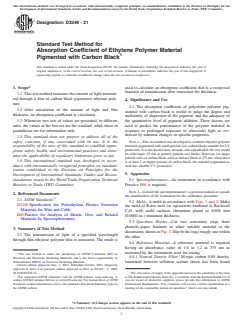
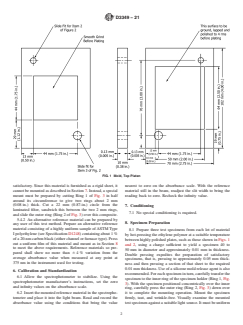
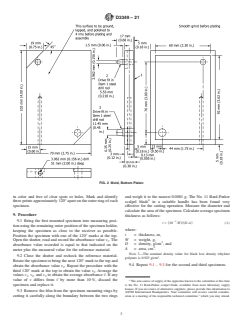
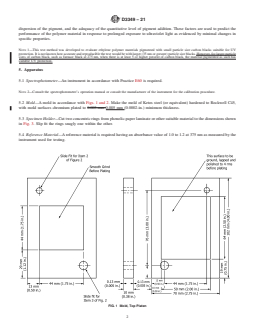
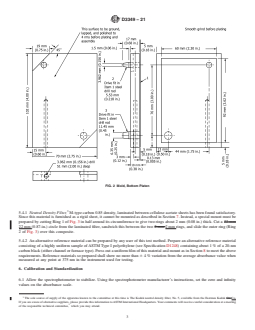
5.2 Mold—A mold in accordance with Figs. 1 and 2. Make the mold of Ketos steel (or equivalent) hardened to Rockwell C45,
with mold surfaces chromium plated to 0.005-mm 0.005 mm (0.0002-in.) minimum thickness.
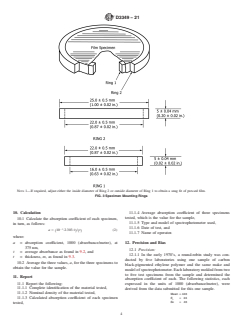
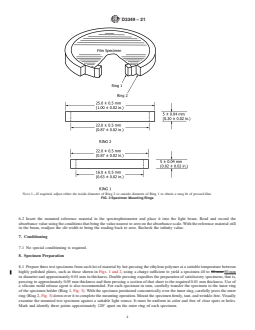
5.3 Specimen Holder—Cut two concentric rings from phenolic-paper laminate or other suitable material to the dimensions shown
in Fig. 3. Slip fit the rings snugly one within the other.
5.4 Reference Material—A reference material is required having an absorbance value of 1.0 to 1.2 at 375 nm as measured by the
instrument used for testing.
FIG. 1 Mold, Top Platen
D3349 − 21
FIG. 2 Mold, Bottom Platen
5.4.1 Neutral Density Filter, M-type carbon 0.85 density, laminated between cellulose acetate sheets has been found satisfactory.
Since this material is furnished as a rigid sheet, it cannot be mounted as described in Section 7. Instead, a special mount must be
prepared by cutting Ring 1 of Fig. 3 in half around its circumference to give two rings about 2 mm (0.08 in.) thick. Cut a 22-mm
22 mm (0.87-in.) circle from the laminated filter, sandwich this between the two 2-mm 2 mm rings, and slide the outer ring (Ring
2 of Fig. 3) over this composite.
5.4.2 An alternative reference material can be prepared by any user of this test method. Prepare an alternative reference material
consisting of a highly uniform sample of ASTM Type I polyethylene (see Specification D1248) containing about 1 % of a 20-nm
carbon black (either channel or furnace type). Press out a uniform film of this material and mount as in Section 8 to meet the above
requirements. Reference materials so prepared shall show no more than 6 4 % variation from the average absorbance value when
measured at any point at 375 nm in the instrument used for testing.
6. Calibration and Standardization
6.1 Allow the spectrophotometer to stabilize. Using the spectrophotometer manufacturer’s instructions, set the zero and infinity
values on the absorbance scale.
The sole source of supply of the apparatus known to the committee at this time is The Kodak neutral density filter, No. 5, available from the Eastman Kodak Co.Co.
If you are aware of alternative suppliers, please provide this information to ASTM International Headquarters. Your comments will receive careful consideration at a meeting
of the responsible technical committee, which you may attend.
D3349 − 21
NOTE 1—If required, adjust either the inside diameter of Ring 2 or outside diameter of Ring 1 to obtain a snug fit of pressed film.
FIG. 3 Specimen Mounting Rings
6.2 Insert the mounted reference material in the spectrophotometer and place it into the light beam. Read and record the
absorbance value using the conditions that bring the value nearest to zero on the absorbance scale. With the reference material still
in the beam, readjust the slit width to bring the reading back to zero. Recheck the infinity value.
7. Conditioning
7.1 No special conditioning is required.
8. Specimen Preparation
8.1 Prepare three test specimens from each lot of material by hot-pressing
...