

ASTM B848/B848M-21
(Specification)Standard Specification for Powder Forged (PF) Ferrous Materials
General Information
- Abstract
ABSTRACT
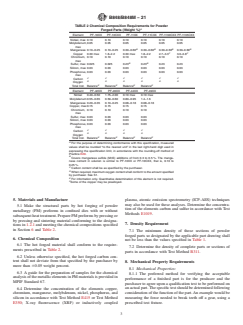
This specification covers the powder forged ferrous materials fabricated by hot densification of atomized prealloyed or iron powders and intended for use as structural parts. The strcutural parts shall be made by hot forging of powder metallurgy preforms in confined dies with or without subsequent heat treatment. The materials shall conform to the required chemical composition for nickel, molybdenum, manganese, copper, chromium, sulfur, silicon, phosphorus, carbon, and oxygen. The mechanical properties such as yield strength, elongation, Rockwell hardness, impact energy, compressive yield strength and fatigue shal be determined using the tensile test method, Charpy V-notch impact energy test method, and hardness test method. The materials shall conform to the required surface finger oxide penetration, interparticle oxide networks, decarburization depth, and nonmetallic inclusion level.
SCOPE
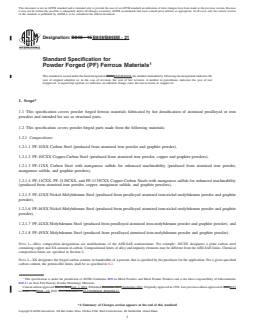
1.1 This specification covers powder forged ferrous materials fabricated by hot densification of atomized prealloyed or iron powders and intended for use as structural parts.
1.2 This specification covers powder forged parts made from the following materials:
1.2.1 Compositions:
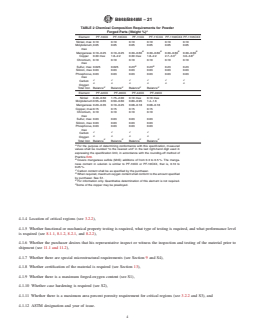
1.2.1.1 PF-10XX Carbon Steel (produced from atomized iron powder and graphite powder),
1.2.1.2 PF-10CXX Copper-Carbon Steel (produced from atomized iron powder, copper and graphite powders),
1.2.1.3 PF-11XX Carbon Steel with manganese sulfide for enhanced machinability (produced from atomized iron powder, manganese sulfide, and graphite powders),
1.2.1.4 PF-11CXX, PF-1130CXX, and PF-1135CXX Copper-Carbon Steels with manganese sulfide for enhanced machinability (produced from atomized iron powder, copper, manganese sulfide, and graphite powders),
1.2.1.5 PF-42XX Nickel-Molybdenum Steel (produced from prealloyed atomized iron-nickel-molybdenum powder and graphite powder),
1.2.1.6 PF-46XX Nickel-Molybdenum Steel (produced from prealloyed atomized iron-nickel-molybdenum powder and graphite powder),
1.2.1.7 PF-44XX Molybdenum Steel (produced from prealloyed atomized iron-molybdenum powder and graphite powder), and
1.2.1.8 PF-49XX Molybdenum Steel (produced from prealloyed atomized iron-molybdenum powder and graphite powder).
Note 1: Alloy composition designations are modifications of the AISI-SAE nomenclature. For example: 10CXX designates a plain carbon steel containing copper and XX amount of carbon. Compositional limits of alloy and impurity elements may be different from the AISI-SAE limits. Chemical composition limits are specified in Section 6.
Note 2: XX designates the forged carbon content, in hundredths of a percent, that is specified by the purchaser for the application. For a given specified carbon content, the permissible limits shall be as specified in 6.2.
Note 3: The old acronym for powder forging P/F has been replaced by PF throughout the document. The change in the prefix for the material designations is just to match the currently approved acronym for powder forging. No change has been made to the material specification and performance characteristics for the various powder forged materials.
1.2.2 Grades:
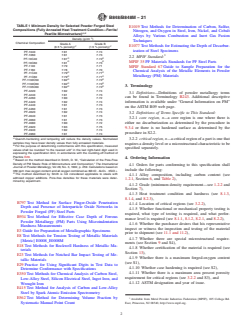
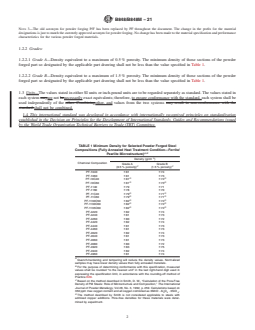
1.2.2.1 Grade A—Density equivalent to a maximum of 0.5 % porosity. The minimum density of those sections of the powder forged part so designated by the applicable part drawing shall not be less than the value specified in Table 1.
1.2.2.2 Grade B—Density equivalent to a maximum of 1.5 % porosity. The minimum density of those sections of the powder forged part so designated by the applicable part drawing shall not be less than the value specified in Table 1.
1.3 Units—The values stated in either SI units or inch-pound units are to be regarded separately as standard. The values stated in each system are not necessarily exact equivalents; therefore, to ensure conformance with the standard, each system shall be used independently of the other, and values from the two systems shall not be ...
- Status
- Published
- Publication Date
- 31-Aug-2021
- Technical Committee
- B09 - Metal Powders and Metal Powder Products
- Drafting Committee
- B09.11 - Near Full Density Powder Metallurgy Materials
Buy Documents
ASTM B848/B848M-21 - Standard Specification for Powder Forged (PF) Ferrous Materials
REDLINE ASTM B848/B848M-21 - Standard Specification for Powder Forged (PF) Ferrous Materials
Overview
ASTM B848/B848M-21: Standard Specification for Powder Forged (PF) Ferrous Materials establishes requirements for the composition, mechanical properties, and quality of powder forged ferrous materials used as structural components. Developed by ASTM International, this standard applies to parts manufactured by hot densification of atomized prealloyed or iron powders, which are then hot forged within confined dies. Powder forged ferrous parts are increasingly favored for their mechanical performance, near-net shape capabilities, and cost efficiency in automotive and industrial applications.
Key Topics
Material Compositions:
The specification covers a range of PF steel types, including:- PF-10XX (carbon steel from iron powder and graphite)
- PF-10CXX (copper-carbon steel)
- PF-11XX and PF-11CXX series (carbon steel with manganese sulfide for machinability, copper additions)
- PF-42XX, PF-44XX, PF-46XX, PF-49XX (nickel-molybdenum and molybdenum alloy steels)
Grades and Density Requirements:
- Grade A: Maximum 0.5% porosity, higher minimum density.
- Grade B: Maximum 1.5% porosity, lower minimum density.
- Minimum densities depend on the material grade and composition.
Chemical Composition:
- Elements regulated include nickel, molybdenum, manganese, copper, chromium, sulfur, silicon, phosphorus, carbon, and oxygen.
- Specified limits ensure material consistency and performance.
- Analytical methods include spectrometry, X-ray fluorescence, and combustion techniques.
Mechanical Properties:
- Properties such as yield strength, elongation, Rockwell hardness, impact energy, compressive yield strength, and fatigue are determined by standardized test methods.
- Qualification testing and acceptance criteria must meet purchaser and drawing requirements.
Microstructural and Quality Requirements:
- Control of surface oxide penetration, interparticle oxide networks, decarburization, and nonmetallic inclusion levels.
- Supplementary requirements may address case hardening depth and microstructural uniformity as specified by the purchaser.
Applications
Powder forged (PF) ferrous materials produced under ASTM B848/B848M-21 are widely used for structural parts where strength, durability, and dimensional precision are essential. Key application areas include:
Automotive Industry:
High-load gears, connecting rods, and chassis components benefit from PF materials' strength, fatigue resistance, and cost-effectiveness.Industrial Machinery:
Power transmission components, couplings, and supports that require toughness and reliability.General Engineering:
Any application demanding near full-density ferrous structural components with controlled properties.
The standard supports manufacturers and designers by offering predictable material performance, streamlined quality control, and compatibility with established powder metallurgy processes.
Related Standards
ASTM B848/B848M-21 references and works alongside several key ASTM and industry standards, such as:
- ASTM B243: Terminology for Powder Metallurgy
- ASTM B311: Test Method for Density of PM Materials
- ASTM B796/B797: Methods for assessing nonmetallic inclusions and oxide penetration
- ASTM E8/E8M: Tension Testing of Metallic Materials
- ASTM E18: Rockwell Hardness Testing
- ASTM E23: Notched Bar Impact Testing
- MPIF 35 & MPIF Standard 67: Powder Forged Materials and Sample Preparation Guidance
Using ASTM B848/B848M-21 ensures compatibility with these standards, facilitating quality assurance, sourcing, and specification compliance throughout the supply chain.
Keywords: powder forged steel, PF structural parts, ASTM B848, powder metallurgy, density standards, PF ferrous materials, mechanical properties, powder forging ASTM, automotive PF parts, quality requirements PF steel
Relations
- Effective Date
- 01-Apr-2024
- Effective Date
- 15-Nov-2023
- Effective Date
- 01-Apr-2020
- Effective Date
- 15-Aug-2019
- Effective Date
- 01-Oct-2018
- Effective Date
- 01-Sep-2018
- Effective Date
- 01-Jul-2018
- Effective Date
- 01-Jul-2017
- Effective Date
- 01-Jul-2016
- Effective Date
- 01-Apr-2016
- Effective Date
- 01-Jan-2016
- Effective Date
- 01-Oct-2014
- Effective Date
- 01-Sep-2014
- Effective Date
- 01-Mar-2014
- Effective Date
- 01-Nov-2013
Buy Documents
ASTM B848/B848M-21 - Standard Specification for Powder Forged (PF) Ferrous Materials
REDLINE ASTM B848/B848M-21 - Standard Specification for Powder Forged (PF) Ferrous Materials
Get Certified
Connect with accredited certification bodies for this standard

Element Materials Technology
Materials testing and product certification.

Inštitut za kovinske materiale in tehnologije
Institute of Metals and Technology. Materials testing, metallurgical analysis, NDT.
Sponsored listings
Frequently Asked Questions
ASTM B848/B848M-21 is a technical specification published by ASTM International. Its full title is "Standard Specification for Powder Forged (PF) Ferrous Materials". This standard covers: ABSTRACT This specification covers the powder forged ferrous materials fabricated by hot densification of atomized prealloyed or iron powders and intended for use as structural parts. The strcutural parts shall be made by hot forging of powder metallurgy preforms in confined dies with or without subsequent heat treatment. The materials shall conform to the required chemical composition for nickel, molybdenum, manganese, copper, chromium, sulfur, silicon, phosphorus, carbon, and oxygen. The mechanical properties such as yield strength, elongation, Rockwell hardness, impact energy, compressive yield strength and fatigue shal be determined using the tensile test method, Charpy V-notch impact energy test method, and hardness test method. The materials shall conform to the required surface finger oxide penetration, interparticle oxide networks, decarburization depth, and nonmetallic inclusion level. SCOPE 1.1 This specification covers powder forged ferrous materials fabricated by hot densification of atomized prealloyed or iron powders and intended for use as structural parts. 1.2 This specification covers powder forged parts made from the following materials: 1.2.1 Compositions: 1.2.1.1 PF-10XX Carbon Steel (produced from atomized iron powder and graphite powder), 1.2.1.2 PF-10CXX Copper-Carbon Steel (produced from atomized iron powder, copper and graphite powders), 1.2.1.3 PF-11XX Carbon Steel with manganese sulfide for enhanced machinability (produced from atomized iron powder, manganese sulfide, and graphite powders), 1.2.1.4 PF-11CXX, PF-1130CXX, and PF-1135CXX Copper-Carbon Steels with manganese sulfide for enhanced machinability (produced from atomized iron powder, copper, manganese sulfide, and graphite powders), 1.2.1.5 PF-42XX Nickel-Molybdenum Steel (produced from prealloyed atomized iron-nickel-molybdenum powder and graphite powder), 1.2.1.6 PF-46XX Nickel-Molybdenum Steel (produced from prealloyed atomized iron-nickel-molybdenum powder and graphite powder), 1.2.1.7 PF-44XX Molybdenum Steel (produced from prealloyed atomized iron-molybdenum powder and graphite powder), and 1.2.1.8 PF-49XX Molybdenum Steel (produced from prealloyed atomized iron-molybdenum powder and graphite powder). Note 1: Alloy composition designations are modifications of the AISI-SAE nomenclature. For example: 10CXX designates a plain carbon steel containing copper and XX amount of carbon. Compositional limits of alloy and impurity elements may be different from the AISI-SAE limits. Chemical composition limits are specified in Section 6. Note 2: XX designates the forged carbon content, in hundredths of a percent, that is specified by the purchaser for the application. For a given specified carbon content, the permissible limits shall be as specified in 6.2. Note 3: The old acronym for powder forging P/F has been replaced by PF throughout the document. The change in the prefix for the material designations is just to match the currently approved acronym for powder forging. No change has been made to the material specification and performance characteristics for the various powder forged materials. 1.2.2 Grades: 1.2.2.1 Grade A—Density equivalent to a maximum of 0.5 % porosity. The minimum density of those sections of the powder forged part so designated by the applicable part drawing shall not be less than the value specified in Table 1. 1.2.2.2 Grade B—Density equivalent to a maximum of 1.5 % porosity. The minimum density of those sections of the powder forged part so designated by the applicable part drawing shall not be less than the value specified in Table 1. 1.3 Units—The values stated in either SI units or inch-pound units are to be regarded separately as standard. The values stated in each system are not necessarily exact equivalents; therefore, to ensure conformance with the standard, each system shall be used independently of the other, and values from the two systems shall not be ...
ABSTRACT This specification covers the powder forged ferrous materials fabricated by hot densification of atomized prealloyed or iron powders and intended for use as structural parts. The strcutural parts shall be made by hot forging of powder metallurgy preforms in confined dies with or without subsequent heat treatment. The materials shall conform to the required chemical composition for nickel, molybdenum, manganese, copper, chromium, sulfur, silicon, phosphorus, carbon, and oxygen. The mechanical properties such as yield strength, elongation, Rockwell hardness, impact energy, compressive yield strength and fatigue shal be determined using the tensile test method, Charpy V-notch impact energy test method, and hardness test method. The materials shall conform to the required surface finger oxide penetration, interparticle oxide networks, decarburization depth, and nonmetallic inclusion level. SCOPE 1.1 This specification covers powder forged ferrous materials fabricated by hot densification of atomized prealloyed or iron powders and intended for use as structural parts. 1.2 This specification covers powder forged parts made from the following materials: 1.2.1 Compositions: 1.2.1.1 PF-10XX Carbon Steel (produced from atomized iron powder and graphite powder), 1.2.1.2 PF-10CXX Copper-Carbon Steel (produced from atomized iron powder, copper and graphite powders), 1.2.1.3 PF-11XX Carbon Steel with manganese sulfide for enhanced machinability (produced from atomized iron powder, manganese sulfide, and graphite powders), 1.2.1.4 PF-11CXX, PF-1130CXX, and PF-1135CXX Copper-Carbon Steels with manganese sulfide for enhanced machinability (produced from atomized iron powder, copper, manganese sulfide, and graphite powders), 1.2.1.5 PF-42XX Nickel-Molybdenum Steel (produced from prealloyed atomized iron-nickel-molybdenum powder and graphite powder), 1.2.1.6 PF-46XX Nickel-Molybdenum Steel (produced from prealloyed atomized iron-nickel-molybdenum powder and graphite powder), 1.2.1.7 PF-44XX Molybdenum Steel (produced from prealloyed atomized iron-molybdenum powder and graphite powder), and 1.2.1.8 PF-49XX Molybdenum Steel (produced from prealloyed atomized iron-molybdenum powder and graphite powder). Note 1: Alloy composition designations are modifications of the AISI-SAE nomenclature. For example: 10CXX designates a plain carbon steel containing copper and XX amount of carbon. Compositional limits of alloy and impurity elements may be different from the AISI-SAE limits. Chemical composition limits are specified in Section 6. Note 2: XX designates the forged carbon content, in hundredths of a percent, that is specified by the purchaser for the application. For a given specified carbon content, the permissible limits shall be as specified in 6.2. Note 3: The old acronym for powder forging P/F has been replaced by PF throughout the document. The change in the prefix for the material designations is just to match the currently approved acronym for powder forging. No change has been made to the material specification and performance characteristics for the various powder forged materials. 1.2.2 Grades: 1.2.2.1 Grade A—Density equivalent to a maximum of 0.5 % porosity. The minimum density of those sections of the powder forged part so designated by the applicable part drawing shall not be less than the value specified in Table 1. 1.2.2.2 Grade B—Density equivalent to a maximum of 1.5 % porosity. The minimum density of those sections of the powder forged part so designated by the applicable part drawing shall not be less than the value specified in Table 1. 1.3 Units—The values stated in either SI units or inch-pound units are to be regarded separately as standard. The values stated in each system are not necessarily exact equivalents; therefore, to ensure conformance with the standard, each system shall be used independently of the other, and values from the two systems shall not be ...
ASTM B848/B848M-21 is classified under the following ICS (International Classification for Standards) categories: 77.160 - Powder metallurgy. The ICS classification helps identify the subject area and facilitates finding related standards.
ASTM B848/B848M-21 has the following relationships with other standards: It is inter standard links to ASTM E23-24, ASTM E350-23, ASTM B796-20, ASTM E562-19e1, ASTM B243-18, ASTM A255-10(2018), ASTM E18-18, ASTM E18-17, ASTM B243-16, ASTM E23-16a, ASTM E23-16, ASTM A255-10(2014), ASTM B796-14, ASTM E415-14, ASTM B243-13. Understanding these relationships helps ensure you are using the most current and applicable version of the standard.
ASTM B848/B848M-21 is available in PDF format for immediate download after purchase. The document can be added to your cart and obtained through the secure checkout process. Digital delivery ensures instant access to the complete standard document.
Standards Content (Sample)
This international standard was developed in accordance with internationally recognized principles on standardization established in the Decision on Principles for the
Development of International Standards, Guides and Recommendations issued by the World Trade Organization Technical Barriers to Trade (TBT) Committee.
Designation:B848/B848M −21
Standard Specification for
Powder Forged (PF) Ferrous Materials
This standard is issued under the fixed designation B848/B848M; the number immediately following the designation indicates the year
of original adoption or, in the case of revision, the year of last revision. A number in parentheses indicates the year of last reapproval.
A superscript epsilon (´) indicates an editorial change since the last revision or reapproval.
NOTE3—TheoldacronymforpowderforgingP/Fhasbeenreplacedby
1. Scope*
PF throughout the document. The change in the prefix for the material
1.1 This specification covers powder forged ferrous materi-
designations is just to match the currently approved acronym for powder
als fabricated by hot densification of atomized prealloyed or forging. No change has been made to the material specification and
performance characteristics for the various powder forged materials.
iron powders and intended for use as structural parts.
1.2.2 Grades:
1.2 This specification covers powder forged parts made
1.2.2.1 Grade A—Density equivalent to a maximum of
from the following materials:
0.5 % porosity. The minimum density of those sections of the
1.2.1 Compositions:
powder forged part so designated by the applicable part
1.2.1.1 PF-10XX Carbon Steel (produced from atomized
drawing shall not be less than the value specified in Table 1.
iron powder and graphite powder),
1.2.2.2 Grade B—Density equivalent to a maximum of
1.2.1.2 PF-10CXX Copper-Carbon Steel (produced from
1.5 % porosity. The minimum density of those sections of the
atomized iron powder, copper and graphite powders),
powder forged part so designated by the applicable part
1.2.1.3 PF-11XX Carbon Steel with manganese sulfide for
drawing shall not be less than the value specified in Table 1.
enhanced machinability (produced from atomized iron powder,
manganese sulfide, and graphite powders),
1.3 Units—The values stated in either SI units or inch-
1.2.1.4 PF-11CXX, PF-1130CXX, and PF-1135CXX
pound units are to be regarded separately as standard. The
Copper-Carbon Steels with manganese sulfide for enhanced
values stated in each system are not necessarily exact equiva-
machinability (produced from atomized iron powder, copper,
lents; therefore, to ensure conformance with the standard, each
manganese sulfide, and graphite powders),
system shall be used independently of the other, and values
1.2.1.5 PF-42XX Nickel-Molybdenum Steel (produced
from the two systems shall not be combined.
from prealloyed atomized iron-nickel-molybdenum powder
1.4 This international standard was developed in accor-
and graphite powder),
dance with internationally recognized principles on standard-
1.2.1.6 PF-46XX Nickel-Molybdenum Steel (produced
ization established in the Decision on Principles for the
from prealloyed atomized iron-nickel-molybdenum powder
Development of International Standards, Guides and Recom-
and graphite powder),
mendations issued by the World Trade Organization Technical
1.2.1.7 PF-44XX Molybdenum Steel (produced from preal-
Barriers to Trade (TBT) Committee.
loyed atomized iron-molybdenum powder and graphite
powder), and
2. Referenced Documents
1.2.1.8 PF-49XX Molybdenum Steel (produced from preal-
2.1 ASTM Standards:
loyed atomized iron-molybdenum powder and graphite pow-
A255 Test Methods for Determining Hardenability of Steel
der).
B243 Terminology of Powder Metallurgy
NOTE 1—Alloy composition designations are modifications of the
B311 Test Method for Density of Powder Metallurgy (PM)
AISI-SAE nomenclature. For example: 10CXX designates a plain carbon
Materials Containing Less Than Two Percent Porosity
steel containing copper and XX amount of carbon. Compositional limits
B795 Test Method for Determining the Percentage of Al-
ofalloyandimpurityelementsmaybedifferentfromtheAISI-SAElimits.
loyed or Unalloyed Iron Contamination Present in Powder
Chemical composition limits are specified in Section 6.
NOTE 2—XX designates the forged carbon content, in hundredths of a Forged (PF) Steel Materials
percent, that is specified by the purchaser for the application. For a given
B796 Test Method for Nonmetallic Inclusion Content of
specifiedcarboncontent,thepermissiblelimitsshallbeasspecifiedin6.2.
Ferrous Powders Intended for Powder Forging (PF) Ap-
plications
This specification is under the jurisdiction ofASTM Committee B09 on Metal
Powders and Metal Powder Products and is the direct responsibility of Subcom-
mittee B09.11 on Near Full Density Powder Metallurgy Materials. For referenced ASTM standards, visit the ASTM website, www.astm.org, or
Current edition approved Sept. 1, 2021. Published September 2021. Originally contact ASTM Customer Service at service@astm.org. For Annual Book of ASTM
approved in 1994. Last previous edition approved in 2015 as B848 – 15. DOI: Standards volume information, refer to the standard’s Document Summary page on
10.1520/B0848_B0848M-21. the ASTM website.
*A Summary of Changes section appears at the end of this standard
Copyright © ASTM International, 100 Barr Harbor Drive, PO Box C700, West Conshohocken, PA 19428-2959. United States
B848/B848M−21
TABLE 1 Minimum Density for Selected Powder Forged Steel
E1019 Test Methods for Determination of Carbon, Sulfur,
Compositions (Fully Annealed Heat Treatment Condition—Ferrite/
Nitrogen, and Oxygen in Steel, Iron, Nickel, and Cobalt
A,B
Pearlite Microstructure)
Alloys by Various Combustion and Inert Gas Fusion
Density (g/cm )
Techniques
Chemical Composition
Grade A Grade B
E1077 Test Methods for Estimating the Depth of Decarbur-
C C
(0.5 % porosity) (1.5 % porosity)
ization of Steel Specimens
PF-1040 7.81 7.74
PF-1060 7.81 7.73 3
2.2 MPIF Standard:
D D
PF-10C40 7.81 7.74
D D
MPIF 35 PF Materials Standards for PF Steel Parts
PF-10C60 7.81 7.73
PF-1140 7.79 7.71
MPIF Standard 67 Guide to Sample Preparation for the
PF-1160 7.78 7.70
Chemical Analysis of the Metallic Elements in Powder
D D
PF-11C40 7.79 7.71
D D
Metallurgy (PM) Materials
PF-11C60 7.79 7.71
D D
PF-1130C50 7.82 7.74
D D
PF-1130C60 7.82 7.74
3. Terminology
D D
PF-1135C60 7.82 7.74
PF-4220 7.82 7.74
3.1 Definitions—Definitions of powder metallurgy terms
PF-4240 7.81 7.73
can be found in Terminology B243. Additional descriptive
PF-4260 7.80 7.72
PF-4420 7.82 7.74 information is available under “General Information on PM”
PF-4440 7.81 7.73
on the ASTM B09 web page.
PF-4460 7.81 7.73
PF-4620 7.82 7.74
3.2 Definitions of Terms Specific to This Standard:
PF-4640 7.81 7.73
3.2.1 core region, n—a core region is one where there is
PF-4660 7.81 7.73
PF-4680 7.80 7.72 either no decarburization as determined by the procedure in
PF-4920 7.83 7.75
9.3.4 or there is no hardened surface as determined by the
PF-4940 7.82 7.74
procedure in S2.2.
PF-4960 7.81 7.74
A
Quench-hardening and tempering will reduce the density values. Normalized 3.2.2 critical region, n—a critical region of a part is one that
samples may have lower density values then fully annealed materials.
requires a density level or a microstructural characteristic to be
B
For the purpose of determining conformance with this specification, measured
specified separately.
values shall be rounded “to the nearest unit” in the last right-hand digit used in
expressing the specification limit, in accordance with the rounding-off method of
Practice E29.
4. Ordering Information
C
Based on the method described in Smith, D. W., “Calculation of the Pore-Free
Density of PM Steels: Role of Microstructure and Composition,” The International
4.1 Orders for parts conforming to this specification shall
Journal of Powder Metallurgy, Vol 28, No. 3, 1992, p. 259. Calculations based on
include the following:
350 ppm max oxygen content and all oxygen combined as 3MnO · Al O · 3SiO .
2 3 2
D
The method described by Smith is not considered applicable to steels with
4.1.1 Alloy composition, including carbon content (see
admixed copper additions. Pore-free densities for these materials were deter-
1.2.1, Section 6, and Table 2),
mined by experiment.
4.1.2 Grade (minimum density requirement—see 1.2.2 and
Section 7),
4.1.3 Heat treatment condition and hardness (see 8.1.3,
8.1.4, and 8.2.3),
B797 Test Method for Surface Finger-Oxide Penetration
4.1.4 Location of critical regions (see 3.2.2),
Depth and Presence of Interparticle Oxide Networks in
4.1.5 Whether functional or mechanical property testing is
Powder Forged (PF) Steel Parts
required, what type of testing is required, and what perfor-
B934 Test Method for Effective Case Depth of Ferrous
mance level is required (see 8.1.1, 8.1.2, 8.2.1, and 8.2.2),
Powder Metallurgy (PM) Parts Using Microindentation
4.1.6 Whether the purchaser desires that his representative
Hardness Measurements
inspect or witness the inspection and testing of the material
E3 Guide for Preparation of Metallographic Specimens
prior to shipment (see 11.1 and 11.2),
E8 Test Methods for Tension Testing of Metallic Materials
4.1.7 Whether there are special microstructural require-
[Metric] E0008_E0008M
ments (see Section 9 and S4),
E18 Test Methods for Rockwell Hardness of Metallic Ma-
4.1.8 Whether certification of the material is required (see
terials
Section 13),
E23 Test Methods for Notched Bar Impact Testing of Me-
4.1.9 Whether there is a maximum forged-oxygen content
tallic Materials
(see S1),
E29 Practice for Using Significant Digits in Test Data to
4.1.10 Whether case hardening is required (see S2),
Determine Conformance with Specifications
4.1.11 Whether there is a maximum area percent porosity
E350 Test Methods for Chemical Analysis of Carbon Steel,
requirement for critical regions (see 3.2.2 and S3), and
Low-Alloy Steel, Silicon Electrical Steel, Ingot Iron, and
4.1.12 ASTM designation and year of issue.
Wrought Iron
E415 Test Method for Analysis of Carbon and Low-Alloy
Steel by Spark Atomic Emission Spectrometry
E562 Test Method for Determining Volume Fraction by
Available from Metal Powder Industries Federation (MPIF), 105 College Rd.
Systematic Manual Point Count East, Princeton, NJ 08540, http://www.mpif.org.
B848/B848M−21
TABLE 2 Chemical Composition Requirements for Powder
A
Forged Parts (Weight %)
Element PF-10XX PF-10CXX PF-11XX PF-11CXX PF-1130CXX PF-1135CXX
Nickel, max 0.10 0.10 0.10 0.10 0.10 0.10
Molybdenum,0.05 0.05 0.05 0.05 0.05 0.05
max
B B B B
Manganese 0.10–0.25 0.10–0.25 0.30–0.60 0.30–0.60 0.30–0.60 0.30–0.60
F F
Copper 0.30 max 1.8–2.2 0.30 max 1.8–2.2 2.7–3.3 3.0–3.8
Chromium, 0.10 0.10 0.10 0.10 0.10 0.10
max
B B
Sulfur, max 0.025 0.025 0.23 0.23 0.23 0.23
Silicon, max 0.03 0.03 0.03 0.03 0.03 0.03
Phosphorus, 0.03 0.03 0.03 0.03 0.03 0.03
max
CC CC C C
Carbon
DD DD D D
Oxygen
E E E E
Total Iron Balance Balance Balance Balance
Element PF-42XX PF-46XX PF-44XX PF-49XX
Nickel 0.40–0.50 1.75–2.00 0.10 max 0.10 max
Molybdenum0.55–0.65 0.50–0.60 0.80–0.95 1.4–1.6
Manganese 0.20–0.35 0.10–0.25 0.08–0.18 0.08–0.18
Copper, max0.15 0.15 0.15 0.15
Chromium, 0.10 0.10 0.10 0.10
max
Sulfur, max 0.03 0.03 0.03 0.03
Silicon, max 0.03 0.03 0.03 0.03
Phosphorus, 0.03 0.03 0.03 0.03
max
CC CC
Carbon
DD DD
Oxygen
E E E E
Total Iron Balance Balance Balance Balance
A
For the purpose of determining conformance with this specification, measured
values shall be rounded “to the nearest unit” in the last right-hand digit used in
expressing the specification limit, in accordance with the rounding-off method of
Practice E29.
B
Covers manganese sulfide (MnS) additions of from 0.3 to 0.5 %. The manga-
nese content in solution is similar to PF-10XX or PF-10CXX, that is, 0.10 to
0.25 %.
C
Carbon content shall be as specified by the purchaser.
D
When required, maximum oxygen content shall conform to the amount specified
by purchaser. See S1.
E
For information only. Quantitative determination of this element is not required.
F
Some of the copper may be prealloyed.
5. Materials and Manufacture plasma, atomic emission spectrometry (ICP-AES) techniques
may also be used for these analyses. Determine the concentra-
5.1 Make the structural parts by hot forging of powder
tion of the elements carbon and sulfur in accordance with Test
metallurgy (PM) preforms in confined dies with or without
Methods E1019.
subsequentheattreatment.PreparePMpreformsbypressingor
by pressing and sintering material conforming to the designa-
7. Density Requirement
tions in 1.2.1 and meeting the chemical compositions specified
in Section 6 and Table 2.
7.1 The minimum density of those sections of powder
forged parts so designated by the applicable part drawing shall
6. Chemical Composition
not be less than the values specified in Table 1.
6.1 The hot forged material shall conform to the require-
7.2 Determine the density of complete parts or sections of
ments prescribed in Table 2.
parts in accordance with Test Method B311.
6.2 Unless otherwise specified, the hot forged carbon con-
tent shall not deviate from that specified by the purchaser by
8. Mechanical Property Requirements
more than 60.05 weight percent.
8.1 Mechanical Properties:
6.3 Aguide for the preparation of samples for the chemical
8.1.1 The preferred method for verifying the acceptable
analysisofthemetallicelementsinPMmaterialsisprovidedin
performance of a finished part is for the producer and the
MPIF Standard 67.
purchaser to agree upon a qualification test to be performed on
6.4 Determine the concentration of the elements copper, anactualpart.Thespecifictestshouldbedeterminedfollowing
chromium, manganese, molybdenum, nickel, phosphorus, and consideration of the function of the part.An example would be
silicon in accordance with Test Method E415 or Test Method measuring the force needed to break teeth off a gear, using a
E350; X-ray fluorescence (XRF) or inductively coupled prescribed test fixture.
B848/B848M−21
8.1.2 Where the part configuration permits, standard me- depth at which core carbon content is reached, shall not exceed
chanical property test specimens may be machined from the that agreed between the producer and purchaser.Alternatively,
part in the condition in which it is to be used. (Remove test for quenched and tempered parts, an effective decarburization
specimens from parts to be used in the quenched and tempered depth (depth to a specified hardness) may be specified.
condition after heat treatment of the part to ensure the 9.3.3 Determine the depth of complete decarburization by
microstructure is representative of the actual part.) The appli- the microscopical method in accordance with Test Methods
cable part drawing or purchase order shall designate the E1077.
location from which the mechanical property test specimens 9.3.4 Depth of total or effective decarburization.
are to be removed and the type of specimen to be tested.
9.3.4.1 Slow-Cooled or Normalized Parts—Estimate the
8.1.3 The core hardness range of parts shall be in accor- depth of total decarburization of slow-cooled or normalized
dance with the applicable part drawing or purchase order.
parts microscopically from the sum of the depths of complete
8.1.4 The surface hardness range of parts shall be in and partial decarburization in accordance with Test Methods
accordance with the applicable part drawing or purchase order. E1077.
8.1.5 Typical mechanical properties of Grade A materials 9.3.4.2 Quenched and Tempered Parts—Determine the
covered by this specification are shown in Appendix X1. depth of effective decarburization by the microindentation
hardness method in accordance with Test Methods E1077.
8.2 Mechanical Property Test Methods:
8.2.1 Tensile Test Method—When requested, take tensile 9.4 Nonmetallic Inclusion Level:
test specimens from parts in accordance with the applicable 9.4.1 The nonmetallic inclusion level of Grade A powder
part drawing or purchase order. Test tensile specimens in forged parts shall not exceed that specified by the applicable
accordance withTest Methods E8. Determine yield strength by part drawing or purchase order.
the 0.2 % offset method. 9.4.2 Determine the nonmetallic inclusion level in accor-
8.2.2 Impact Energy Test Method—When requested, take dance with Test Method B796. For materials that contain
manganese sulfide additions, modify the inclusion assessment
Charpy V-notch impact test bars from parts in accordance with
the applicable part drawing or purchase order. Test impact bars to count either only those discrete inclusions greater than or
equal to 100 µm maximum caliper (Feret’s) diameter, or
in accordance withTest Methods E23; at room temperature, or,
at a temperature agreed between the producer and purchaser. change the near neighbor separation distance from 30 µm to 15
µm in accordance with Test Method B796.
8.2.3 Hardness Test Method—Determine hardness measure-
ments in accordance with Test Methods E18. Make core
NOTE 4—Porosity dominates the mechanical properties of Grade B
hardness measurements on sectioned parts within the core
parts. Inclusion assessment of Grade B parts is therefore not necessary.
region of the part. Determine surface hardness measurements
9.5 Cross Product Contamination :
in accordance w
...
This document is not an ASTM standard and is intended only to provide the user of an ASTM standard an indication of what changes have been made to the previous version. Because
it may not be technically possible to adequately depict all changes accurately, ASTM recommends that users consult prior editions as appropriate. In all cases only the current version
of the standard as published by ASTM is to be considered the official document.
Designation: B848 − 15 B848/B848M − 21
Standard Specification for
Powder Forged (PF) Ferrous Materials
This standard is issued under the fixed designation B848;B848/B848M; the number immediately following the designation indicates the
year of original adoption or, in the case of revision, the year of last revision. A number in parentheses indicates the year of last
reapproval. A superscript epsilon (´) indicates an editorial change since the last revision or reapproval.
1. Scope*
1.1 This specification covers powder forged ferrous materials fabricated by hot densification of atomized prealloyed or iron
powders and intended for use as structural parts.
1.2 This specification covers powder forged parts made from the following materials:
1.2.1 Compositions:
1.2.1.1 PF-10XX Carbon Steel (produced from atomized iron powder and graphite powder),
1.2.1.2 PF-10CXX Copper-Carbon Steel (produced from atomized iron powder, copper and graphite powders),
1.2.1.3 PF-11XX Carbon Steel with manganese sulfide for enhanced machinability (produced from atomized iron powder,
manganese sulfide, and graphite powders),
1.2.1.4 PF-11CXX, PF-1130CXX, and PF-1135CXX Copper-Carbon Steels with manganese sulfide for enhanced machinability
(produced from atomized iron powder, copper, manganese sulfide, and graphite powders),
1.2.1.5 PF-42XX Nickel-Molybdenum Steel (produced from prealloyed atomized iron-nickel-molybdenum powder and graphite
powder),
1.2.1.6 PF-46XX Nickel-Molybdenum Steel (produced from prealloyed atomized iron-nickel-molybdenum powder and graphite
powder),
1.2.1.7 PF-44XX Molybdenum Steel (produced from prealloyed atomized iron-molybdenum powder and graphite powder), and
1.2.1.8 PF-49XX Molybdenum Steel (produced from prealloyed atomized iron-molybdenum powder and graphite powder).
NOTE 1—Alloy composition designations are modifications of the AISI-SAE nomenclature. For example: 10CXX designates a plain carbon steel
containing copper and XX amount of carbon. Compositional limits of alloy and impurity elements may be different from the AISI-SAE limits. Chemical
composition limits are specified in Section 6.
NOTE 2—XX designates the forged carbon content, in hundredths of a percent, that is specified by the purchaser for the application. For a given specified
carbon content, the permissible limits shall be as specified in 6.2.
This specification is under the jurisdiction of ASTM Committee B09 on Metal Powders and Metal Powder Products and is the direct responsibility of Subcommittee
B09.11 on Near Full Density Powder Metallurgy Materials.
Current edition approved Nov. 1, 2015Sept. 1, 2021. Published December 2015 September 2021. Originally approved in 1994. Last previous edition approved in 20102015
as B848 – 10.B848 – 15. DOI: 10.1520/B0848-15.10.1520/B0848_B0848M-21.
*A Summary of Changes section appears at the end of this standard
Copyright © ASTM International, 100 Barr Harbor Drive, PO Box C700, West Conshohocken, PA 19428-2959. United States
B848/B848M − 21
NOTE 3—The old acronym for powder forging P/F has been replaced by PF throughout the document. The change in the prefix for the material
designations is just to match the currently approved acronym for powder forging. No change has been made to the material specification and performance
characteristics for the various powder forged materials.
1.2.2 Grades:
1.2.2.1 Grade A—Density equivalent to a maximum of 0.5 % porosity. The minimum density of those sections of the powder
forged part so designated by the applicable part drawing shall not be less than the value specified in Table 1.
1.2.2.2 Grade B—Density equivalent to a maximum of 1.5 % porosity. The minimum density of those sections of the powder
forged part so designated by the applicable part drawing shall not be less than the value specified in Table 1.
1.3 Units—The values stated in either SI units or inch-pound units are to be regarded separately as standard. The values stated in
each system mayare not benecessarily exact equivalents; therefore, to ensure conformance with the standard, each system shall be
used independently of the other. Combiningother, and values from the two systems may result in non-conformance with the
standard.shall not be combined.
1.4 This international standard was developed in accordance with internationally recognized principles on standardization
established in the Decision on Principles for the Development of International Standards, Guides and Recommendations issued
by the World Trade Organization Technical Barriers to Trade (TBT) Committee.
TABLE 1 Minimum Density for Selected Powder Forged Steel
Compositions (Fully Annealed Heat Treatment Condition—Ferrite/
A,B
Pearlite Microstructure)
Density (g/cm )
Chemical Composition
Grade A Grade B
C C
(0.5 % porosity) (1.5 % porosity)
PF-1040 7.81 7.74
PF-1060 7.81 7.73
D D
PF-10C40 7.81 7.74
D D
PF-10C60 7.81 7.73
PF-1140 7.79 7.71
PF-1160 7.78 7.70
D D
PF-11C40 7.79 7.71
D D
PF-11C60 7.79 7.71
D D
PF-1130C50 7.82 7.74
D D
PF-1130C60 7.82 7.74
D D
PF-1135C60 7.82 7.74
PF-4220 7.82 7.74
PF-4240 7.81 7.73
PF-4260 7.80 7.72
PF-4420 7.82 7.74
PF-4440 7.81 7.73
PF-4460 7.81 7.73
PF-4620 7.82 7.74
PF-4640 7.81 7.73
PF-4660 7.81 7.73
PF-4680 7.80 7.72
PF-4920 7.83 7.75
PF-4940 7.82 7.74
PF-4960 7.81 7.74
A
Quench-hardening and tempering will reduce the density values. Normalized
samples may have lower density values then fully annealed materials.
B
For the purpose of determining conformance with this specification, measured
values shall be rounded “to the nearest unit” in the last right-hand digit used in
expressing the specification limit, in accordance with the rounding-off method of
Practice E29.
C
Based on the method described in Smith, D. W., “Calculation of the Pore-Free
Density of PM Steels: Role of Microstructure and Composition,” The International
Journal of Powder Metallurgy, Vol 28, No. 3, 1992, p. 259. Calculations based on
350 ppm max oxygen content and all oxygen combined as 3MnO · Al O · 3SiO .
2 3 2
D
The method described by Smith is not considered applicable to steels with
admixed copper additions. Pore-free densities for these materials were deter-
mined by experiment.
B848/B848M − 21
2. Referenced Documents
2.1 ASTM Standards:
A255 Test Methods for Determining Hardenability of Steel
B243 Terminology of Powder Metallurgy
B311 Test Method for Density of Powder Metallurgy (PM) Materials Containing Less Than Two Percent Porosity
B795 Test Method for Determining the Percentage of Alloyed or Unalloyed Iron Contamination Present in Powder Forged (PF)
Steel Materials
B796 Test Method for Nonmetallic Inclusion Content of Ferrous Powders Intended for Powder Forging (PF) Applications
B797 Test Method for Surface Finger-Oxide Penetration Depth and Presence of Interparticle Oxide Networks in Powder Forged
(PF) Steel Parts
B934 Test Method for Effective Case Depth of Ferrous Powder Metallurgy (PM) Parts Using Microindentation Hardness
Measurements
E3 Guide for Preparation of Metallographic Specimens
E8 Test Methods for Tension Testing of Metallic Materials [Metric] E0008_E0008M
E18 Test Methods for Rockwell Hardness of Metallic Materials
E23 Test Methods for Notched Bar Impact Testing of Metallic Materials
E29 Practice for Using Significant Digits in Test Data to Determine Conformance with Specifications
E350 Test Methods for Chemical Analysis of Carbon Steel, Low-Alloy Steel, Silicon Electrical Steel, Ingot Iron, and Wrought
Iron
E415 Test Method for Analysis of Carbon and Low-Alloy Steel by Spark Atomic Emission Spectrometry
E562 Test Method for Determining Volume Fraction by Systematic Manual Point Count
E1019 Test Methods for Determination of Carbon, Sulfur, Nitrogen, and Oxygen in Steel, Iron, Nickel, and Cobalt Alloys by
Various Combustion and Inert Gas Fusion Techniques
E1077 Test Methods for Estimating the Depth of Decarburization of Steel Specimens
2.2 MPIF Standard:
MPIF 35 PF Materials Standards for PF Steel Parts
MPIF Standard 67 Guide to Sample Preparation for the Chemical Analysis of the Metallic Elements in Powder Metallurgy (PM)
Materials
3. Terminology
3.1 Definitions—Definitions of powder metallurgy terms can be found in Terminology B243. Additional descriptive information
is available in the Related Material Section of Vol. 02.05 of the under “General Information on PM” on the Annual Book of ASTM
Standards.ASTM B09 web page.
3.2 Definitions of Terms Specific to This Standard:
3.2.1 core region—region, n—a core region is one where there is either no decarburization as determined by the procedure in 9.3.4
or there is no hardened surface as determined by the procedure in S2.2.
3.2.2 critical region—region, n—a critical region of a part is one that requires a density level or a microstructural characteristic
to be separately specified.specified separately.
4. Ordering Information
4.1 Orders for parts conforming to this specification shall include the following:
4.1.1 Alloy composition, including carbon content (see 1.2.1, Section 6, and Table 2),
4.1.2 Grade (minimum density requirement—see 1.2.2 and Section 7),
4.1.3 Heat treatment condition and hardness (see 8.1.3, 8.1.4, and 8.2.3),
For referenced ASTM standards, visit the ASTM website, www.astm.org, or contact ASTM Customer Service at service@astm.org. For Annual Book of ASTM Standards
volume information, refer to the standard’s Document Summary page on the ASTM website.
Available from Metal Powder Industries Federation, Federation (MPIF), 105 College RoadRd. East, Princeton, NJ 08540–6692.08540, http://www.mpif.org.
B848/B848M − 21
TABLE 2 Chemical Composition Requirements for Powder
A
Forged Parts (Weight %)
Element PF-10XX PF-10CXX PF-11XX PF-11CXX PF-1130CXX PF-1135CXX
Nickel, max 0.10 0.10 0.10 0.10 0.10 0.10
Molybdenum,0.05 0.05 0.05 0.05 0.05 0.05
max
B B B B
Manganese 0.10–0.25 0.10–0.25 0.30–0.60 0.30–0.60 0.30–0.60 0.30–0.60
F F
Copper 0.30 max 1.8–2.2 0.30 max 1.8–2.2 2.7–3.3 3.0–3.8
Chromium, 0.10 0.10 0.10 0.10 0.10 0.10
max
B B
Sulfur, max 0.025 0.025 0.23 0.23 0.23 0.23
Silicon, max 0.03 0.03 0.03 0.03 0.03 0.03
Phosphorus, 0.03 0.03 0.03 0.03 0.03 0.03
max
C C C C C C
Carbon
D D D D D D
Oxygen
E E E E
Total Iron Balance Balance Balance Balance
Element PF-42XX PF-46XX PF-44XX PF-49XX
Nickel 0.40–0.50 1.75–2.00 0.10 max 0.10 max
Molybdenum 0.55–0.65 0.50–0.60 0.80–0.95 1.4–1.6
Manganese 0.20–0.35 0.10–0.25 0.08–0.18 0.08–0.18
Copper, max 0.15 0.15 0.15 0.15
Chromium, 0.10 0.10 0.10 0.10
max
Sulfur, max 0.03 0.03 0.03 0.03
Silicon, max 0.03 0.03 0.03 0.03
Phosphorus, 0.03 0.03 0.03 0.03
max
C C C C
Carbon
D D D D
Oxygen
E E E E
Total Iron Balance Balance Balance Balance
A
For the purpose of determining conformance with this specification, measured
values shall be rounded “to the nearest unit” in the last right-hand digit used in
expressing the specification limit, in accordance with the rounding-off method of
Practice E29.
B
Covers manganese sulfide (MnS) additions of from 0.3 to 0.5 %. The manga-
nese content in solution is similar to PF-10XX or PF-10CXX, that is, 0.10 to
0.25 %.
C
Carbon content shall be as specified by the purchaser.
D
When required, maximum oxygen content shall conform to the amount specified
by purchaser. See S1.
E
For information only. Quantitative determination of this element is not required.
F
Some of the copper may be prealloyed.
4.1.4 Location of critical regions (see 3.2.2),
4.1.5 Whether functional or mechanical property testing is required, what type of testing is required, and what performance level
is required (see 8.1.1, 8.1.2, 8.2.1, and 8.2.2),
4.1.6 Whether the purchaser desires that his representative inspect or witness the inspection and testing of the material prior to
shipment (see 11.1 and 11.2),
4.1.7 Whether there are special microstructural requirements (see Section 9 and S4),
4.1.8 Whether certification of the material is required (see Section 13),
4.1.9 Whether there is a maximum forged-oxygen content (see S1),
4.1.10 Whether case hardening is required (see S2),
4.1.11 Whether there is a maximum area percent porosity requirement for critical regions (see 3.2.2 and S3), and
4.1.12 ASTM designation and year of issue.
B848/B848M − 21
5. Materials and Manufacture
5.1 Make the structural parts by hot forging of powder metallurgy (PM) preforms in confined dies with or without subsequent heat
treatment. Prepare PM preforms by pressing or by pressing and sintering material conforming to the designations in 1.2.1 and
meeting the chemical compositions specified in Section 6 and Table 2.
6. Chemical Composition
6.1 The hot forged material shall conform to the requirements prescribed in Table 2.
6.2 Unless otherwise specified, the hot forged carbon content shall not deviate from that specified by the purchaser by more than
60.05 weight percent.
6.3 A guide for the preparation of samples for the chemical analysis of the metallic elements in PM materials is provided in MPIF
Standard 67.
6.4 Determine the concentration of the elements copper, chromium, manganese, molybdenum, nickel, phosphorus, and silicon in
accordance with Test Method E415 or Test Method E350; X-ray fluorescence (XRF) or inductively coupled plasma, atomic
emission spectrometry (ICP-AES) techniques may also be used for these analyses. Determine the concentration of the elements
carbon and sulfur in accordance with Test Methods E1019.
7. Density Requirement
7.1 The minimum density of those sections of powder forged parts so designated by the applicable part drawing shall not be less
than the values specified in Table 1.
7.2 Determine the density of complete parts or sections of parts in accordance with Test Method B311.
8. Mechanical Property Requirements
8.1 Mechanical Properties:
8.1.1 The preferred method for verifying the acceptable performance of a finished part is for the producer and the purchaser to
agree upon a qualification test to be performed on an actual part. The specific test should be determined following consideration
of the function of the part. An example would be measuring the force needed to break teeth off a gear, using a prescribed test
fixture.
8.1.2 Where the part configuration permits, standard mechanical property test specimens may be machined from the part in the
condition in which it is to be used. (Remove test specimens from parts to be used in the quenched and tempered condition after
heat treatment of the part to ensure the microstructure is representative of the actual part.) The applicable part drawing or purchase
order shall designate the location from which the mechanical property test specimens are to be removed and the type of specimen
to be tested.
8.1.3 The core hardness range of parts shall be in accordance with the applicable part drawing or purchase order.
8.1.4 The surface hardness range of parts shall be in accordance with the applicable part drawing or purchase order.
8.1.5 Typical mechanical properties of Grade A materials covered by this specification are shown in Appendix X1.
8.2 Mechanical Property Test Methods:
8.2.1 Tensile Test Method—When requested, take tensile test specimens from parts in accordance with the applicable part drawing
or purchase order. Test tensile specimens in accordance with Test Methods E8. Determine yield strength by the 0.2 % offset
method.
8.2.2 Impact Energy Test Method—When requested, take Charpy V-notch impact test bars from parts in accordance with the
B848/B848M − 21
applicable part drawing or purchase order. Test impact bars in accordance with Test Methods E23; at room temperature, or, at a
temperature agreed between the producer and purchaser.
8.2.3 Hardness Test Method—Determine hardness measurements in accordance with Test Methods E18. Make core hardness
measurements on sectioned parts within the core region of the part. Determine surface hardness measurements in accordance with
the applicable part drawing on the original forged surface, or, if machined, on the machined part surface.
9. Microstructure Requirements
9.1 Surface Finger Oxide Penetration:
9.1.1 The maximum depth of penetration of surface finger oxides from the finished part surface, for each designated critical region
of a powder forged part, shall not exceed that agreed upon between the producer and purchaser. Designate critical regions by the
applicable part drawing or purchase order.
9.1.2 Determine the surface finger oxide penetration in accordance with Test Method B797.
9.2 Interparticle Oxide Networks:
9.2.1 The extent of any interparticle oxide networks in each designated critical region of a powder forged part shall not exceed
that agreed upon between the producer and purchaser. Designate critical regions on the applicable part drawing or purchase order.
9.2.2 Determine the interparticle oxide networks in accordance with Test Method B797.
9.3 Decarburization Depth:
9.3.1 The maximum depth of complete decarburization (only ferrite present) of surfaces of powder forged parts shall not exceed
that agreed between the producer and purchaser.
9.3.2 The depth of total decarburization (total decarburization = complete decarburization + partial decarburization), the depth at
which core carbon content is reached, shall not exceed that agreed between the producer and purchaser. Alternatively, for quenched
and tempered parts, an effective decarburization depth (depth to a specified hardness) may be specified.
9.3.3 Determine the depth of complete decarburization by the microscopical method in accordance with Test Methods E1077.
9.3.4 Depth of total or effective decarburization.
9.3.4.1 Slow-Cooled or Normalized
...