

ASTM D6373-23
(Specification)Standard Specification for Performance-Graded Asphalt Binder
General Information
- Abstract
ABSTRACT
This specification covers asphalt binders graded by performance. Grading designations are related to the average seven-day maximum pavement design temperature, and minimum pavement design temperature. Asphalt binder shall be prepared by the refining of crude petroleum by suitable methods, with or without the addition of modifiers, which may be any organic material of suitable manufacture that is used in virgin or recycled condition, and that is dissolved, dispersed or reacted in asphalt cement to enhance its performance. This specification incorporates an aid for determining the critical low cracking temperature using a combination of test procedures.
SCOPE
1.1 This specification2 covers asphalt binders graded by performance. Grading designations are related to the LTPPBind Online calculated maximum pavement design temperature and the minimum pavement design temperature. This specification contains Tables 1 and 2. Table 2 incorporates Practice D6816 for determining the critical low cracking temperature using a combination of Test Method D6648 and Test Method D6723 test procedures. If no table is specified, the default is Table 1.
Note 1: For more information on LTPPBind Online, see https://infopave.fhwa.dot.gov/Tools/LTPPBindOnline accessed May 23, 2023.
Note 2: For asphalt cements graded by penetration at 25 °C, see Specification D946/D946M. For asphalt cements graded by viscosity at 60 °C, see Specification D3381/D3381M.
Note 3: AASHTO R 29 provides non-mandatory information for determining the performance grade of an asphalt binder.
1.2 The values stated in SI units are to be regarded as standard. No other units of measurement are included in this standard.
1.3 This international standard was developed in accordance with internationally recognized principles on standardization established in the Decision on Principles for the Development of International Standards, Guides and Recommendations issued by the World Trade Organization Technical Barriers to Trade (TBT) Committee.
- Status
- Published
- Publication Date
- 30-Jun-2023
- Technical Committee
- D04 - Road and Paving Materials
- Drafting Committee
- D04.40 - Asphalt Specifications
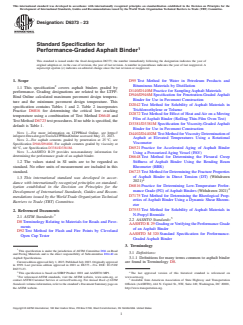
Overview
ASTM D6373-23, "Standard Specification for Performance-Graded Asphalt Binder," is a key international standard issued by ASTM International. This specification establishes the requirements for grading asphalt binders by their performance under varying climatic conditions. It focuses on the relationship between binder performance and pavement temperatures, using grades based on maximum and minimum pavement design temperatures determined through the LTPPBind Online system.
The standard applies to asphalt binders derived from crude petroleum, with or without performance-improving modifiers. ASTM D6373-23 aims to support the long-term durability and suitability of pavements by specifying grading, sampling, and testing methods for asphalt binders used in road construction and maintenance.
Key Topics
Performance Grading (PG): Asphalt binders are classified using Performance Grades tied to pavement temperature extremes, including both summer highs and winter lows.
Temperature Criteria: Binders are matched to pavement environments using the LTPPBind Online tool, which aggregates local weather data to specify appropriate binder grades for a given location.
Modifiers and Materials: The specification allows for the use of organic modifiers such as polymers or recycled materials, provided they are homogeneously blended to enhance asphalt performance.
Critical Low-Temperature Cracking: ASTM D6373-23 incorporates guidance for determining the critical low temperature at which pavement cracking may initiate, using a combination of test methods (referencing D6816, D6648, and D6723).
Homogeneity and Purity: Binders must be free from water and excessive impurities, with at least 99.0% solubility, ensuring consistent quality and field performance.
Sampling and Testing: Recognized ASTM test methods are designated for evaluating flash point, viscosity, solubility, aging, stiffness, and tension, supporting standardized assessment and quality control.
Applications
ASTM D6373-23 provides significant practical value in the following applications:
Road and Pavement Construction: The standard is fundamental for specifying and verifying performance-graded asphalt binders in new roadways, highways, and runways, aligning binder properties with regional climate requirements.
Pavement Rehabilitation: It guides selection of asphalt binders for overlays or reconstruction projects, ensuring compatibility with existing materials and optimizing long-term pavement performance.
Quality Assurance: By standardizing test methods and acceptance criteria, this specification supports manufacturers, suppliers, and project owners in ensuring compliance with industry best practices for asphalt binder supply and application.
Binder Selection: Agencies and contractors can select binders suited to anticipated temperature ranges, minimizing risks of rutting in hot weather and cracking in cold climates.
Use of Modified and Recycled Binders: The inclusion of modifiers-either virgin or recycled-promotes innovative and sustainable practices within the pavement industry, provided all performance criteria are met.
Related Standards
Several related standards and references enhance the utility of ASTM D6373-23:
- ASTM D946/D946M: Specification for Penetration-Graded Asphalt Binder for Use in Pavement Construction.
- ASTM D3381/D3381M: Specification for Viscosity-Graded Asphalt Binder for Use in Pavement Construction.
- ASTM D8: Terminology Relating to Materials for Roads and Pavements.
- ASTM D92: Test Method for Flash and Fire Points by Cleveland Open Cup Tester.
- ASTM D6648: Test Method for Flexural Creep Stiffness of Asphalt Binder (Bending Beam Rheometer).
- ASTM D6816: Practice for Determining Low-Temperature Performance Grade (PG) of Asphalt Binders.
- AASHTO M 320: Standard Specification for Performance-Graded Asphalt Binder.
These referenced standards offer additional guidance on material properties, terminology, and best practices, supporting the comprehensive selection and evaluation of asphalt binders for infrastructure projects.
Keywords: ASTM D6373-23, performance-graded asphalt binder, pavement temperature, binder specification, asphalt standards, PG binder, low-temperature cracking, road construction, LTPPBind, modifier.
Relations
- Effective Date
- 15-Dec-2023
- Effective Date
- 01-Dec-2023
- Effective Date
- 01-Oct-2023
- Effective Date
- 01-May-2020
- Effective Date
- 01-Aug-2019
- Effective Date
- 01-Jul-2019
- Effective Date
- 15-Dec-2018
- Effective Date
- 15-Aug-2018
- Effective Date
- 01-Jul-2018
- Effective Date
- 01-Jul-2018
- Effective Date
- 01-Feb-2018
- Effective Date
- 15-Jul-2017
- Effective Date
- 15-Jun-2017
- Effective Date
- 01-May-2017
- Effective Date
- 01-Mar-2017
Get Certified
Connect with accredited certification bodies for this standard

Zavod za gradbeništvo Slovenije (ZAG) - Inšpekcija
ZAG inspection body for construction products, structures, and materials.
Sponsored listings
Frequently Asked Questions
ASTM D6373-23 is a technical specification published by ASTM International. Its full title is "Standard Specification for Performance-Graded Asphalt Binder". This standard covers: ABSTRACT This specification covers asphalt binders graded by performance. Grading designations are related to the average seven-day maximum pavement design temperature, and minimum pavement design temperature. Asphalt binder shall be prepared by the refining of crude petroleum by suitable methods, with or without the addition of modifiers, which may be any organic material of suitable manufacture that is used in virgin or recycled condition, and that is dissolved, dispersed or reacted in asphalt cement to enhance its performance. This specification incorporates an aid for determining the critical low cracking temperature using a combination of test procedures. SCOPE 1.1 This specification2 covers asphalt binders graded by performance. Grading designations are related to the LTPPBind Online calculated maximum pavement design temperature and the minimum pavement design temperature. This specification contains Tables 1 and 2. Table 2 incorporates Practice D6816 for determining the critical low cracking temperature using a combination of Test Method D6648 and Test Method D6723 test procedures. If no table is specified, the default is Table 1. Note 1: For more information on LTPPBind Online, see https://infopave.fhwa.dot.gov/Tools/LTPPBindOnline accessed May 23, 2023. Note 2: For asphalt cements graded by penetration at 25 °C, see Specification D946/D946M. For asphalt cements graded by viscosity at 60 °C, see Specification D3381/D3381M. Note 3: AASHTO R 29 provides non-mandatory information for determining the performance grade of an asphalt binder. 1.2 The values stated in SI units are to be regarded as standard. No other units of measurement are included in this standard. 1.3 This international standard was developed in accordance with internationally recognized principles on standardization established in the Decision on Principles for the Development of International Standards, Guides and Recommendations issued by the World Trade Organization Technical Barriers to Trade (TBT) Committee.
ABSTRACT This specification covers asphalt binders graded by performance. Grading designations are related to the average seven-day maximum pavement design temperature, and minimum pavement design temperature. Asphalt binder shall be prepared by the refining of crude petroleum by suitable methods, with or without the addition of modifiers, which may be any organic material of suitable manufacture that is used in virgin or recycled condition, and that is dissolved, dispersed or reacted in asphalt cement to enhance its performance. This specification incorporates an aid for determining the critical low cracking temperature using a combination of test procedures. SCOPE 1.1 This specification2 covers asphalt binders graded by performance. Grading designations are related to the LTPPBind Online calculated maximum pavement design temperature and the minimum pavement design temperature. This specification contains Tables 1 and 2. Table 2 incorporates Practice D6816 for determining the critical low cracking temperature using a combination of Test Method D6648 and Test Method D6723 test procedures. If no table is specified, the default is Table 1. Note 1: For more information on LTPPBind Online, see https://infopave.fhwa.dot.gov/Tools/LTPPBindOnline accessed May 23, 2023. Note 2: For asphalt cements graded by penetration at 25 °C, see Specification D946/D946M. For asphalt cements graded by viscosity at 60 °C, see Specification D3381/D3381M. Note 3: AASHTO R 29 provides non-mandatory information for determining the performance grade of an asphalt binder. 1.2 The values stated in SI units are to be regarded as standard. No other units of measurement are included in this standard. 1.3 This international standard was developed in accordance with internationally recognized principles on standardization established in the Decision on Principles for the Development of International Standards, Guides and Recommendations issued by the World Trade Organization Technical Barriers to Trade (TBT) Committee.
ASTM D6373-23 is classified under the following ICS (International Classification for Standards) categories: 93.080.20 - Road construction materials. The ICS classification helps identify the subject area and facilitates finding related standards.
ASTM D6373-23 has the following relationships with other standards: It is inter standard links to ASTM D7175-23, ASTM D140/D140M-16(2023), ASTM D95-23, ASTM D946/D946M-20, ASTM D8-19, ASTM D6521-19, ASTM D8-18c, ASTM D8-18b, ASTM D6521-18, ASTM D8-18a, ASTM D8-18, ASTM D8-17c, ASTM D8-17b, ASTM D8-17a, ASTM D8-17. Understanding these relationships helps ensure you are using the most current and applicable version of the standard.
ASTM D6373-23 is available in PDF format for immediate download after purchase. The document can be added to your cart and obtained through the secure checkout process. Digital delivery ensures instant access to the complete standard document.
Standards Content (Sample)
This international standard was developed in accordance with internationally recognized principles on standardization established in the Decision on Principles for the
Development of International Standards, Guides and Recommendations issued by the World Trade Organization Technical Barriers to Trade (TBT) Committee.
Designation: D6373 − 23
Standard Specification for
Performance-Graded Asphalt Binder
This standard is issued under the fixed designation D6373; the number immediately following the designation indicates the year of
original adoption or, in the case of revision, the year of last revision. A number in parentheses indicates the year of last reapproval. A
superscript epsilon (´) indicates an editorial change since the last revision or reapproval.
1. Scope D95 Test Method for Water in Petroleum Products and
Bituminous Materials by Distillation
1.1 This specification covers asphalt binders graded by
D140/D140M Practice for Sampling Asphalt Materials
performance. Grading designations are related to the LTPP-
D946/D946M Specification for Penetration-Graded Asphalt
Bind Online calculated maximum pavement design tempera-
Binder for Use in Pavement Construction
ture and the minimum pavement design temperature. This
D2042 Test Method for Solubility of Asphalt Materials in
specification contains Tables 1 and 2. Table 2 incorporates
Trichloroethylene or Toluene
Practice D6816 for determining the critical low cracking
D2872 Test Method for Effect of Heat and Air on a Moving
temperature using a combination of Test Method D6648 and
Film of Asphalt Binder (Rolling Thin-Film Oven Test)
Test Method D6723 test procedures. If no table is specified, the
D3381/D3381M Specification for Viscosity-Graded Asphalt
default is Table 1.
Binder for Use in Pavement Construction
NOTE 1—For more information on LTPPBind Online, see https://
D4402/D4402M Test Method for Viscosity Determination of
infopave.fhwa.dot.gov/Tools/LTPPBindOnline accessed May 23, 2023.
Asphalt at Elevated Temperatures Using a Rotational
NOTE 2—For asphalt cements graded by penetration at 25 °C, see
Viscometer
Specification D946/D946M. For asphalt cements graded by viscosity at
D6521 Practice for Accelerated Aging of Asphalt Binder
60 °C, see Specification D3381/D3381M.
NOTE 3—AASHTO R 29 provides non-mandatory information for
Using a Pressurized Aging Vessel (PAV)
determining the performance grade of an asphalt binder.
D6648 Test Method for Determining the Flexural Creep
1.2 The values stated in SI units are to be regarded as Stiffness of Asphalt Binder Using the Bending Beam
standard. No other units of measurement are included in this Rheometer (BBR)
standard. D6723 Test Method for Determining the Fracture Properties
of Asphalt Binder in Direct Tension (DT) (Withdrawn
1.3 This international standard was developed in accor-
2021)
dance with internationally recognized principles on standard-
D6816 Practice for Determining Low-Temperature Perfor-
ization established in the Decision on Principles for the
mance Grade (PG) of Asphalt Binders (Withdrawn 2021)
Development of International Standards, Guides and Recom-
D7175 Test Method for Determining the Rheological Prop-
mendations issued by the World Trade Organization Technical
erties of Asphalt Binder Using a Dynamic Shear Rheom-
Barriers to Trade (TBT) Committee.
eter
D7553 Test Method for Solubility of Asphalt Materials in
2. Referenced Documents
N-Propyl Bromide
2.1 ASTM Standards:
2.2 AASHTO Standards:
D8 Terminology Relating to Materials for Roads and Pave-
AASHTO R 29 Grading or Verifying the Performance Grade
ments
of an Asphalt Binder
D92 Test Method for Flash and Fire Points by Cleveland
AASHTO M 320 Standard Specification for Performance-
Open Cup Tester
Graded Asphalt Binder
3. Terminology
This specification is under the jurisdiction of ASTM Committee D04 on Road
3.1 Definitions:
and Paving Materials and is the direct responsibility of Subcommittee D04.40 on
3.1.1 Definitions for many terms common to asphalt binder
Asphalt Specifications.
Current edition approved July 1, 2023. Published July 2023. Originally approved
are found in Terminology D8.
in 1999. Last previous edition approved in 2021 as D6373 – 21a. DOI: 10.1520/
D6373-23.
2 4
This specification is based on SHRP Product 1001 and AASHTO MP1. The last approved version of this historical standard is referenced on
For referenced ASTM standards, visit the ASTM website, www.astm.org, or www.astm.org.
contact ASTM Customer Service at service@astm.org. For Annual Book of ASTM Available from American Association of State Highway and Transportation
Standards volume information, refer to the standard’s Document Summary page on Officials (AASHTO), 444 N. Capitol St., NW, Suite 249, Washington, DC 20001,
the ASTM website. http://www.transportation.org.
Copyright © ASTM International, 100 Barr Harbor Drive, PO Box C700, West Conshohocken, PA 19428-2959. United States
D6373 − 23
suitability of the binder to meet the performance requirements of the
4. Ordering Information
projects on which they will be used.
4.1 When ordering under this specification, include in the
purchase order the performance grade (PG) of asphalt binder
6. Sampling
required and the table used (for example, PG 52-16, Table 1 or
6.1 The material shall be sampled in accordance with
PG 64-34, Table 2). If no table is specified, the default is Table
Practice D140/D140M.
1.
7. Test Methods
NOTE 4—Agencies may elect to specify PG grades not listed in the
tables, either outside the table limits or between listed grades, based on
7.1 The properties outlined in 5.3, 5.4, and 5.5 shall be
specific design or performance criteria. For these PG grades it is still
determined in accordance with Test Methods D92, D95,
appropriate to test the original and RTFO DSR at the specified PG high
D2042, D2872, and D4402/D4402M, Practice D6521, Test
temperature, and BBR at the specified PG low temperature +10 °C and
PAV DSR at (PG high + PG low)/2 + 4) °C, for example, for PG 64-22,
Methods D6648 and D6723, Practice D6816, and Test Method
(64 + (–22))/2 + 4 = 25.
D7553 or D7175.
5. Materials and Manufacture
8. Inspection and Certification
5.1 Asphalt binder shall be prepared by the refining of crude
8.1 Inspection and certification of the material shall be
petroleum, with or without the addition of modifiers.
agreed upon between the purchaser and the seller. Specific
5.2 Modifiers may be any materials of suitable manufacture
requirements shall be made part of the purchase contract. The
that are used in virgin or recycled condition, and that are
seller shall provide material handling and storage procedures
capable of being dissolved, dispersed, or reacted in asphalt
for each asphalt binder grade certified.
binder with the objective of improving its performance.
NOTE 7—A number of relevant research studies have suggested that
limits for the loss stiffness for the binder, G*·sinδ, in the ASTM and
NOTE 5—This specification is not intended to address the grading of
asphalt binders containing particulate or fibrous materials larger than 250 AASHTO PG Binder Specification is, by itself, not a sufficient indicator
of fatigue performance of an asphalt cement, or the asphalt concrete in
μm in size.
asphalt pavement structures, or both.
5.3 The asphalt binder shall be homogeneous, free from
water and deleterious materials, and shall not foam when
9. Rejection and Rehearing
heated to 175 °C.
9.1 If the results of any test do not conform to the require-
5.4 The asphalt binder shall be at least 99.0 % soluble, as
ments of this specification, retesting to determine conformity is
determined by Test Method D2042 or D7553. Any insoluble
performed as indicated in the purchase order or as otherwise
component shall be substantially free of fibers.
agreed upon between the purchaser and the seller.
5.5 The grades of asphalt binder shall conform to the
10. Keywords
requirements given in Table 1 or Table 2.
10.1 asphalt binder; asphalt cement; direct tension; flash
NOTE 6—Conformance with all of the parameters of this specification is
point; modifier; performance specifications; pressure aging;
not a guarantee that the asphalt concrete mix made from these products
will perform in the field. The end user of asphalt binders should asses
...
This document is not an ASTM standard and is intended only to provide the user of an ASTM standard an indication of what changes have been made to the previous version. Because
it may not be technically possible to adequately depict all changes accurately, ASTM recommends that users consult prior editions as appropriate. In all cases only the current version
of the standard as published by ASTM is to be considered the official document.
Designation: D6373 − 21a D6373 − 23
Standard Specification for
Performance-Graded Asphalt Binder
This standard is issued under the fixed designation D6373; the number immediately following the designation indicates the year of
original adoption or, in the case of revision, the year of last revision. A number in parentheses indicates the year of last reapproval. A
superscript epsilon (´) indicates an editorial change since the last revision or reapproval.
1. Scope
1.1 This specification covers asphalt binders graded by performance. Grading designations are related to the LTPPBind Online
calculated maximum pavement design temperature and the minimum pavement design temperature. This specification contains
Tables 1 and 2. Table 2 incorporates Practice D6816 for determining the critical low cracking temperature using a combination of
Test Method D6648 and Test Method D6723 test procedures. If no table is specified, the default is Table 1.
NOTE 1—For more information on LTPPBind online,Online, see https://infopave.fhwa.dot.gov/Tools/LTPPBindOnline accessed May 23, 2023June 10,
2020.
NOTE 2—For asphalt cements graded by penetration at 25 °C, see Specification D946/D946M. For asphalt cements graded by viscosity at 60 °C, see
Specification D3381/D3381M.
NOTE 3—AASHTO R 29 provides non-mandatory information for determining the performance grade of an asphalt binder.
1.2 The values stated in SI units are to be regarded as standard. No other units of measurement are included in this standard.
1.3 This international standard was developed in accordance with internationally recognized principles on standardization
established in the Decision on Principles for the Development of International Standards, Guides and Recommendations issued
by the World Trade Organization Technical Barriers to Trade (TBT) Committee.
2. Referenced Documents
2.1 ASTM Standards:
D8 Terminology Relating to Materials for Roads and Pavements
D92 Test Method for Flash and Fire Points by Cleveland Open Cup Tester
D95 Test Method for Water in Petroleum Products and Bituminous Materials by Distillation
D140/D140M Practice for Sampling Asphalt Materials
D946/D946M Specification for Penetration-Graded Asphalt Binder for Use in Pavement Construction
D2042 Test Method for Solubility of Asphalt Materials in Trichloroethylene or Toluene
D2872 Test Method for Effect of Heat and Air on a Moving Film of Asphalt Binder (Rolling Thin-Film Oven Test)
D3381/D3381M Specification for Viscosity-Graded Asphalt Binder for Use in Pavement Construction
D4402/D4402M Test Method for Viscosity Determination of Asphalt at Elevated Temperatures Using a Rotational Viscometer
D6521 Practice for Accelerated Aging of Asphalt Binder Using a Pressurized Aging Vessel (PAV)
This specification is under the jurisdiction of ASTM Committee D04 on Road and Paving Materials and is the direct responsibility of Subcommittee D04.40 on Asphalt
Specifications.
Current edition approved June 15, 2021July 1, 2023. Published July 2021July 2023. Originally approved in 1999. Last previous edition approved in 2021 as
D6373 – 21.D6373 – 21a. DOI: 10.1520/D6373-21A.10.1520/D6373-23.
This specification is based on SHRP Product 1001 and AASHTO MP1.
For referenced ASTM standards, visit the ASTM website, www.astm.org, or contact ASTM Customer Service at service@astm.org. For Annual Book of ASTM Standards
volume information, refer to the standard’s Document Summary page on the ASTM website.
Copyright © ASTM International, 100 Barr Harbor Drive, PO Box C700, West Conshohocken, PA 19428-2959. United States
D6373 − 23
D6648 Test Method for Determining the Flexural Creep Stiffness of Asphalt Binder Using the Bending Beam Rheometer (BBR)
D6723 Test Method for Determining the Fracture Properties of Asphalt Binder in Direct Tension (DT) (Withdrawn 2021)
D6816 Practice for Determining Low-Temperature Performance Grade (PG) of Asphalt Binders (Withdrawn 2021)
D7175 Test Method for Determining the Rheological Properties of Asphalt Binder Using a Dynamic Shear Rheometer
D7553 Test Method for Solubility of Asphalt Materials in N-Propyl Bromide
2.2 AASHTO Standards:
AASHTO R 29 Grading or Verifying the Performance Grade of an Asphalt Binder
AASHTO M 320 Standard Specification for Performance-Graded Asphalt Binder
3. Terminology
3.1 Definitions:
3.1.1 Definitions for many terms common to asphalt binder are found in Terminology D8.
4. Ordering Information
4.1 When ordering under this specification, include in the purchase order the performance grade (PG) of asphalt binder required
and the table used (for example, PG 52-16, Table 1 or PG 64-34, Table 2). If no table is specified, the default is Table 1.
NOTE 4—Agencies may elect to specify PG grades not listed in the tables, either outside the table limits or between listed grades, based on specific design
or performance criteria. For these PG grades it is still appropriate to test the original and RTFO DSR at the specified PG high temperature, and BBR at
the specified PG low temperature +10 °C and PAV DSR at (PG high + PG low)/2 + 4) °C, for example, for PG 64-22, (64 + (–22))/2 + 4 = 25.
NOTE 5—The different generations of the LTPPBind program use different algorithms and weather databases for determining the PG high tempeature for
a location. The choice of which LTPPBind version to use is up to the specifier.
5. Materials and Manufacture
5.1 Asphalt binder shall be prepared by the refining of crude petroleum, with or without the addition of modifiers.
5.2 Modifiers may be any materials of suitable manufacture that are used in virgin or recycled condition, and that are capable of
being dissolved, dispersed, or reacted in asphalt binder with the objective of improving its performance.
NOTE 5—This specification is not intended to address the grading of asphalt binders containing particulate or fibrous materials larger than 250 μm in size.
5.3 The asphalt binder shall be homogeneous, free from water and deleterious materials, and shall not foam when heated to
175 °C.
5.4 The asphalt binder shall be at least 99.0 % soluble, as determined by Test Method D2042 or D7553. Any insoluble component
shall be substantially free of fibers.
5.5 The grades of asphalt binder shall conform to the requirements given in Table 1 or Table 2.
NOTE 6—Conformance with all of the parameters of this specification is not a guarantee that the asphalt concrete mix made from these products will
perform in the field. The end user of asphalt binders should assess the suitability of the binder to meet the performance requirements of the projects on
which they will be used.
6. Sampling
6.1 The material shall be sampled in accordance with Practice D140/D140M.
The last approved version of this historical standard is referenced on www.astm.org.
Available from American Association of State Highway and Transportation Officials (AASHTO), 444 N. Capitol St., NW, Suite 249, Washington, DC 20001,
http://www.transportation.org.
D6373 − 23
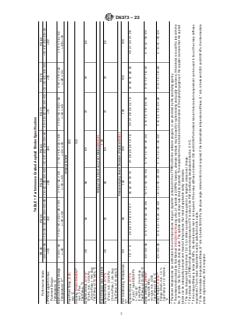
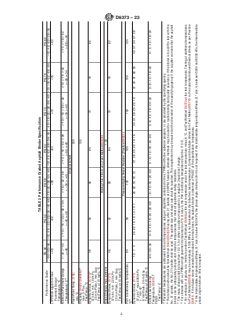
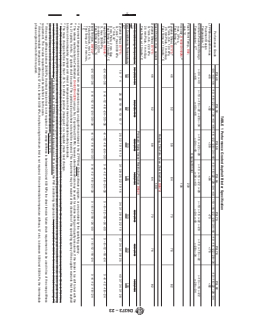
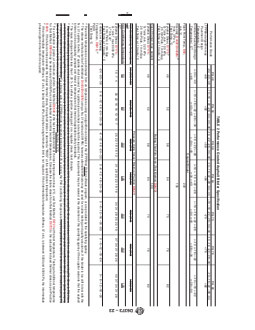
TABLE 1 Performance Graded Asphalt Binder Specification
PG 46 PG 52 PG 58 PG 64 PG 70 PG 76 PG 82
Performance Grade
–34 –40 –46 –10 –16 –22 –28 –34 –40 –46 –16 –22 –28 –34 –40 –10 –16 –22 –28 –34 –40 –10 –16 –22 –28 –34 –40 –10 –16 –22 –28 –34 –10 –16 –22 –28 –34
LTPPBind algorithm max <46 <52 <58 <64 <70 <76 <82
Pavement Design
Temperature, °C
Minimum Pavement Design >–34 >–40 >–10 >–16 >–22 >–28 >–34 >–16 >–22 >–28 >–10 >–16 >–22 >–28 >–10 >–16 >–22 >–28 >–10 >–16 >–22 >–10 >–16 >–22
A
Temperature,° C >–46 >–40 >–46 >–34 >–40 >–34 >–40 >–34 >–40 >–28 >–34 >–28 >–34
Original Binder
Flash Point Temp., D92; 230
min °C
B
Viscosity, D4402/D4402M: 135
max. 3 Pa·s,
Test Temp., °C
C
Dynamic Shear, D7175: 46 52 58 64 70 76 82
G*/sinδ, min. 1.00 kPa
25 mm Plate, 1 mm Gap
Test Temp. at 10 rad/s, °C
Rolling Thin Film Oven (Test Method D2872)
Mass Change, max. percent 1.00
Dynamic Shear, D7175: 46 52 58 64 70 76 82
G*/sinδ, min. 2.20 kPa
25 mm Plate, 1 mm Gap
Test Temp. at 10 rad/s,°C
Pressure Aging Vessel Residue (Practice D6521)
PAV Conditioning Temperature, 90 (100, 110) 90 (100, 110) 100 (110) 100 (110) 100 (110) 100 (110) 100 (110)
D
°C
PAV Conditioning Temperature, 90 90 100 100 100 100 100
D
°C
Dynamic Shear, D7175: 10 7 4 25 22 19 16 13 10 7 25 22 19 16 13 31 28 25 22 19 16 34 31 28 25 22 19 37 34 31 28 25 40 37 34 31 28
F
G*·sinδ, max 6000 kPa
F
δ, min 42°
8 mm Plate, 2 mm Gap
Test Temp. at 10 rad/s, °C
E
Creep Stiffness, D6648: –24 –30 –36 0 –6 –12 –18 –24 –30 –36 –6 –12 –18 –24 –30 0 –6 –12 –18 –24 –30 0 –6 –12 –18 –24 –30 0 –6 –12 –18 –24 0 –6 –12 –18 –24
S, max 300 MPa,
m-value; min. 0.300
Test Temp at 60 s, °C
E
Direct Tension, D6723: –24 –30 –36 0 –6 –12 –18 –24 –30 –36 –6 –12 –18
...