

ASTM F1957-99(2017)
(Test Method)Standard Test Method for Composite Foam Hardness-Durometer Hardness
General Information
- Abstract
SIGNIFICANCE AND USE
4.1 This test method is based on the penetration by a specific type of indentor when forced into the material under specified conditions. The indentation hardness is related inversely to the penetration and is dependent on the elastic modulus and viscoelastic behavior of the material. The geometry of the indentor and the applied force influence the measurements, such that no simple relationship exists between the measurements obtained with one type of durometer and those obtained with another type of durometer or other instruments used for measuring hardness. This test method is an empirical test intended primarily for control purposes. No simple relationship exists between indentation hardness determined by this test method and any fundamental property of the material tested. For specification purposes it is recommended that Test Method D785 be used for hard materials and Test Method D2240 be used for solid elatomers.
SCOPE
1.1 This test method describes a type of composite foam hardness measurement device known as durometer: Type CF. The procedure for determining indentation hardness of substances comprised of two or more elastomeric materials, one of which is a foam or foam like material. These are classified as composite foam structures. The composite foam product may have an armature made of a material suitable for adding structural integrity including but not limited to metal, plastic, or wood. This construction is typical for lapbar restraints, seating, and other restraint devices, as well as some show elements.
1.2 This test method is not equivalent to other indentation hardness methods and instrument types, specifically those described in Test Methods D1415 and D2240.
1.3 The values stated in SI units are to be regarded as standard. The values given in parentheses are for information only. Many of the stated dimensions in SI are direct conversions from the U.S. customary system to accommodate the instrumentation, practices, and procedures that existed prior to the Metric Conversion Act of 1975.
1.4 All materials, instruments, or equipment used for the determination of mass or dimension shall have traceability to the National Institute for Standards and Technology (NIST) or other internationally recognized organizations.
1.5 This test method is not a safety standard as it pertains to ride legislation. The use of this test method is optional based upon an agreement between customers and suppliers of foam products.
1.6 This standard does not purport to address all of the safety concerns, if any, associated with its use. It is the responsibility of the user of this standard to establish appropriate safety and health practices and determine the applicability of regulatory limitations prior to use.
- Status
- Published
- Publication Date
- 31-Jan-2017
- Technical Committee
- F24 - Amusement Rides and Devices
- Drafting Committee
- F24.10 - Test Methods and Component Parts
Overview
ASTM F1957-99(2017) – Standard Test Method for Composite Foam Hardness-Durometer Hardness – provides an empirical procedure to determine the indentation hardness of composite foam products using a specialized Type CF durometer. Composite foam structures typically feature two or more elastomeric materials, including foam or similar materials, sometimes reinforced with armatures such as metal, plastic, or wood. This method is widely used in applications such as lap bar restraints, seating, and other elements where structural integrity and comfort are essential.
The test focuses on measuring the penetration of a durometer indentor into the material under controlled conditions. The hardness value is inversely related to the depth of penetration and depends on the composite’s elastic and viscoelastic properties. This method is intended primarily for quality control and is not directly equivalent to other hardness test methods such as ASTM D2240 or D1415.
Key Topics
- Test Principle: Hardness is determined by the degree of indentation a specific indentor makes when a set force is applied. Results depend on material composition, indentor geometry, and applied force.
- Scope: Applies to composite foams comprised of at least one foam or foam-like component, possibly with a structural armature.
- Test Equipment: Uses a Type CF durometer with defined presser foot, indentor, and calibrated spring to ensure repeatability and accuracy.
- Specimen Preparation: Requires specimens to be at least 25.4 mm thick and sufficiently wide to avoid edge effects; surface flatness and parallelism are crucial.
- Calibration: All equipment used must be traceable to NIST or equivalent organizations, with strict procedures for instrument calibration and validation.
- Environmental Conditioning: Testing is performed at 23°C ±2°C, with relative humidity reported and controlled to ensure consistency when humidity affects material properties.
- Reporting: Results are reported as the mean or median of at least five determinations, along with environmental conditions, instrument details, and the testing procedure.
Applications
ASTM F1957-99(2017) is vital for industries where composite foam products are used and specified, including:
- Amusement ride safety components: Hardness control in lap bars, seat pads, and restraint elements to ensure both comfort and structural support.
- Seating: Used in public transport, stadiums, and commercial seating, where foam composites need regulated firmness and durability.
- Protective padding and show elements: Ensures consistent hardness in padding used for sports equipment, vehicle interiors, or entertainment props.
- Quality assurance between suppliers and customers: Provides a mutually agreed method for hardness verification during material acceptance, process control, or during development phases.
By establishing standardized procedures for measurement and reporting, this test method enables accurate comparison and quality assessment within and across different production lots.
Related Standards
- ASTM D2240 – Standard Test Method for Rubber Property-Durometer Hardness: Commonly used for solid elastomers, but not directly equivalent for composite foams.
- ASTM D785 – Test Method for Rockwell Hardness of Plastics and Electrical Insulating Materials: Recommended for harder plastics rather than foams.
- ASTM D1415 – Test Method for International Rubber Hardness: Another indentation method for solid rubber.
- ASTM D618 – Practice for Conditioning Plastics for Testing: Specifies suitable environmental conditioning prior to tests.
- ASTM D374 – Test Methods for Thickness of Solid Electrical Insulation: Relevant for specimen preparation and supporting accurate measurement.
- ASTM D4483 – Practice for Evaluating Precision for Test Method Standards: Offers guidance for interpreting precision and bias in hardness measurement.
For foam manufacturers, buyers, and industries requiring controlled foam hardness, ASTM F1957-99(2017) is an essential reference for standardized indentation hardness testing of composite foam products, providing a basis for quality control and specification compliance.
Relations
- Effective Date
- 01-Nov-2008
- Effective Date
- 01-Nov-2005
- Effective Date
- 01-Nov-2003
- Effective Date
- 10-Nov-2000
- Effective Date
- 10-Mar-1999
- Effective Date
- 10-Mar-1999
- Effective Date
- 10-May-1998
Get Certified
Connect with accredited certification bodies for this standard

DIN CERTCO
DIN Group product certification.

Smithers Quality Assessments
US management systems and product certification.
Sponsored listings
Frequently Asked Questions
ASTM F1957-99(2017) is a standard published by ASTM International. Its full title is "Standard Test Method for Composite Foam Hardness-Durometer Hardness". This standard covers: SIGNIFICANCE AND USE 4.1 This test method is based on the penetration by a specific type of indentor when forced into the material under specified conditions. The indentation hardness is related inversely to the penetration and is dependent on the elastic modulus and viscoelastic behavior of the material. The geometry of the indentor and the applied force influence the measurements, such that no simple relationship exists between the measurements obtained with one type of durometer and those obtained with another type of durometer or other instruments used for measuring hardness. This test method is an empirical test intended primarily for control purposes. No simple relationship exists between indentation hardness determined by this test method and any fundamental property of the material tested. For specification purposes it is recommended that Test Method D785 be used for hard materials and Test Method D2240 be used for solid elatomers. SCOPE 1.1 This test method describes a type of composite foam hardness measurement device known as durometer: Type CF. The procedure for determining indentation hardness of substances comprised of two or more elastomeric materials, one of which is a foam or foam like material. These are classified as composite foam structures. The composite foam product may have an armature made of a material suitable for adding structural integrity including but not limited to metal, plastic, or wood. This construction is typical for lapbar restraints, seating, and other restraint devices, as well as some show elements. 1.2 This test method is not equivalent to other indentation hardness methods and instrument types, specifically those described in Test Methods D1415 and D2240. 1.3 The values stated in SI units are to be regarded as standard. The values given in parentheses are for information only. Many of the stated dimensions in SI are direct conversions from the U.S. customary system to accommodate the instrumentation, practices, and procedures that existed prior to the Metric Conversion Act of 1975. 1.4 All materials, instruments, or equipment used for the determination of mass or dimension shall have traceability to the National Institute for Standards and Technology (NIST) or other internationally recognized organizations. 1.5 This test method is not a safety standard as it pertains to ride legislation. The use of this test method is optional based upon an agreement between customers and suppliers of foam products. 1.6 This standard does not purport to address all of the safety concerns, if any, associated with its use. It is the responsibility of the user of this standard to establish appropriate safety and health practices and determine the applicability of regulatory limitations prior to use.
SIGNIFICANCE AND USE 4.1 This test method is based on the penetration by a specific type of indentor when forced into the material under specified conditions. The indentation hardness is related inversely to the penetration and is dependent on the elastic modulus and viscoelastic behavior of the material. The geometry of the indentor and the applied force influence the measurements, such that no simple relationship exists between the measurements obtained with one type of durometer and those obtained with another type of durometer or other instruments used for measuring hardness. This test method is an empirical test intended primarily for control purposes. No simple relationship exists between indentation hardness determined by this test method and any fundamental property of the material tested. For specification purposes it is recommended that Test Method D785 be used for hard materials and Test Method D2240 be used for solid elatomers. SCOPE 1.1 This test method describes a type of composite foam hardness measurement device known as durometer: Type CF. The procedure for determining indentation hardness of substances comprised of two or more elastomeric materials, one of which is a foam or foam like material. These are classified as composite foam structures. The composite foam product may have an armature made of a material suitable for adding structural integrity including but not limited to metal, plastic, or wood. This construction is typical for lapbar restraints, seating, and other restraint devices, as well as some show elements. 1.2 This test method is not equivalent to other indentation hardness methods and instrument types, specifically those described in Test Methods D1415 and D2240. 1.3 The values stated in SI units are to be regarded as standard. The values given in parentheses are for information only. Many of the stated dimensions in SI are direct conversions from the U.S. customary system to accommodate the instrumentation, practices, and procedures that existed prior to the Metric Conversion Act of 1975. 1.4 All materials, instruments, or equipment used for the determination of mass or dimension shall have traceability to the National Institute for Standards and Technology (NIST) or other internationally recognized organizations. 1.5 This test method is not a safety standard as it pertains to ride legislation. The use of this test method is optional based upon an agreement between customers and suppliers of foam products. 1.6 This standard does not purport to address all of the safety concerns, if any, associated with its use. It is the responsibility of the user of this standard to establish appropriate safety and health practices and determine the applicability of regulatory limitations prior to use.
ASTM F1957-99(2017) is classified under the following ICS (International Classification for Standards) categories: 83.100 - Cellular materials. The ICS classification helps identify the subject area and facilitates finding related standards.
ASTM F1957-99(2017) has the following relationships with other standards: It is inter standard links to ASTM D618-08, ASTM D618-05, ASTM D785-03, ASTM D618-00, ASTM D374-99, ASTM D374-99(2004), ASTM D785-98e1. Understanding these relationships helps ensure you are using the most current and applicable version of the standard.
ASTM F1957-99(2017) is available in PDF format for immediate download after purchase. The document can be added to your cart and obtained through the secure checkout process. Digital delivery ensures instant access to the complete standard document.
Standards Content (Sample)
This international standard was developed in accordance with internationally recognized principles on standardization established in the Decision on Principles for the
Development of International Standards, Guides and Recommendations issued by the World Trade Organization Technical Barriers to Trade (TBT) Committee.
Designation: F1957 − 99 (Reapproved 2017)
Standard Test Method for
Composite Foam Hardness-Durometer Hardness
This standard is issued under the fixed designation F1957; the number immediately following the designation indicates the year of
original adoption or, in the case of revision, the year of last revision.Anumber in parentheses indicates the year of last reapproval.A
superscript epsilon (´) indicates an editorial change since the last revision or reapproval.
1. Scope 2. Referenced Documents
2.1 ASTM Standards:
1.1 This test method describes a type of composite foam
D374Test Methods for Thickness of Solid Electrical Insu-
hardness measurement device known as durometer: Type CF.
lation (Metric) D0374_D0374M
The procedure for determining indentation hardness of sub-
D618Practice for Conditioning Plastics for Testing
stancescomprisedoftwoormoreelastomericmaterials,oneof
D785Test Method for Rockwell Hardness of Plastics and
which is a foam or foam like material. These are classified as
Electrical Insulating Materials
composite foam structures. The composite foam product may
D1349Practice for Rubber—Standard Conditions for Test-
have an armature made of a material suitable for adding
ing
structural integrity including but not limited to metal, plastic,
D1415Test Method for Rubber Property—International
or wood. This construction is typical for lapbar restraints,
Hardness
seating, and other restraint devices, as well as some show
D2240TestMethodforRubberProperty—DurometerHard-
elements.
ness
1.2 This test method is not equivalent to other indentation
D4483Practice for Evaluating Precision for Test Method
hardness methods and instrument types, specifically those
StandardsintheRubberandCarbonBlackManufacturing
described in Test Methods D1415 and D2240.
Industries
1.3 The values stated in SI units are to be regarded as
3. Summary of Test Method
standard. The values given in parentheses are for information
3.1 This test method permits hardness measurements based
only. Many of the stated dimensions in SI are direct conver-
on either initial indentation or indentation after a specified
sions from the U.S. customary system to accommodate the
period of time, or both.
instrumentation, practices, and procedures that existed prior to
the Metric Conversion Act of 1975.
3.2 Those specimens, which have a durometer hardness
rangeotherthanspecified,shalluseanothersuitableprocedure
1.4 All materials, instruments, or equipment used for the
for determining durometer hardness.
determination of mass or dimension shall have traceability to
the National Institute for Standards and Technology (NIST) or
4. Significance and Use
other internationally recognized organizations.
4.1 This test method is based on the penetration by a
1.5 Thistestmethodisnotasafetystandardasitpertainsto
specific type of indentor when forced into the material under
ride legislation. The use of this test method is optional based
specified conditions. The indentation hardness is related in-
upon an agreement between customers and suppliers of foam
versely to the penetration and is dependent on the elastic
products.
modulus and viscoelastic behavior of the material. The geom-
etry of the indentor and the applied force influence the
1.6 This standard does not purport to address all of the
measurements, such that no simple relationship exists between
safety concerns, if any, associated with its use. It is the
the measurements obtained with one type of durometer and
responsibility of the user of this standard to establish appro-
those obtained with another type of durometer or other
priate safety and health practices and determine the applica-
instruments used for measuring hardness. This test method is
bility of regulatory limitations prior to use.
an empirical test intended primarily for control purposes. No
simple relationship exists between indentation hardness deter-
minedbythistestmethodandanyfundamentalpropertyofthe
This test method is under the jurisdiction of ASTM Committee F24 on
Amusement Rides and Devices and is the direct responsibility of F24.10 on Test
Methods. For referenced ASTM standards, visit the ASTM website, www.astm.org, or
Current edition approved Feb. 1, 2017. Published March 2017. Originally contact ASTM Customer Service at service@astm.org. For Annual Book of ASTM
approved in 1999. Last previous edition approved in 2011 as F1957–99 (2011). Standards volume information, refer to the standard’s Document Summary page on
DOI: 10.1520/F1957-99R17. the ASTM website.
Copyright © ASTM International, 100 Barr Harbor Drive, PO Box C700, West Conshohocken, PA 19428-2959. United States
F1957 − 99 (2017)
material tested. For specification purposes it is recommended
that Test Method D785 be used for hard materials and Test
Method D2240 be used for solid elatomers.
5. Apparatus
5.1 Hardnessmeasurementapparatus,ordurometer,consist-
ing of the following components:
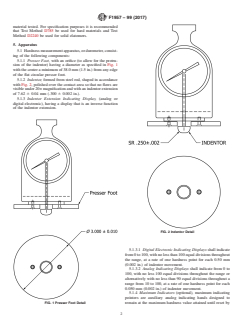
5.1.1 Presser Foot, with an orifice (to allow for the protru-
sion of the indentor) having a diameter as specified in Fig. 1
withthecenteraminimumof38.0mm(1.5in.)fromanyedge
of the flat circular presser foot.
5.1.2 Indentor, formed from steel rod, shaped in accordance
with Fig. 2, polished over the contact area so that no flaws are
visibleunder20×magnificationandwithanindentorextension
of 7.62 6 0.04 mm (.300 6 0.002 in.).
5.1.3 Indentor Extension Indicating Display, (analog or
digital electronic), having a display that is an inverse function
of the indentor extension.
FIG. 2 Indentor Detail
5.1.3.1 Digital Electronic Indicating Displays shall indicate
from0to100,withnolessthan100equaldivisionsthroughout
the range, at a rate of one hardness point for each 0.50 mm
(0.002 in.) of indentor movement.
5.1.3.2 Analog Indicating Displays shall indicate from 0 to
100, with no less 100 equal divisions throughout the range or
alternatively with no less than 90 equal divisions throughout a
range from 10 to 100, at a rate of one hardness point for each
0.050 mm (0.002 in.) of indentor movement.
5.1.4 Maximum Indicators (optional), maximum indicating
pointers are auxiliary analog indicating hands designed to
FIG. 1 Presser Foot Detail remain at the maximum hardness value attained until reset by
F1957 − 99 (2017)
the operator. Electronic maximum indicators are digital dis- suitablehardnessdeterminationmaybedifficulttoobtainonan
plays electronically indicating and maintaining the maximum uneven or rough point of contact with the indentor.
value hardness value achieved, until reset by the operator.
5.1.4.1 Analog maximum indicating pointers have been 7. Calibration
shown to have a nominal influence on the values attained;
7.1 Calibration Device—The durometer spring shall be
however, this influence is greater on durometers of lesser total
calibrated by supporting the durometer in a calibrating device
mainspring forces. The influence of a maximum indicating
in a vertical position and applying a measurable force to the
pointer shall be noted at the time of calibration in the
indentortip.Theforcemaybemeasuredbymeansofabalance
calibration report (see 10.1.4) and when reporting hardness
or by an electronic force cell. The calibrating device shall be
determinations (see 10.2.4).
capable of measuring applied force to within 50% of the
5.1.4.2 Digital electronic durometers may be equipped with
calibrationtolerancedescribedinTable1.Careshouldbetaken
electronic maximum indicators that shall not influence the
to ensure that the force is applied vertically to the indentor tip,
indicated reading or determinations attained by more than one
as lateral force will cause errors in calibration.
half of the calibration tolerance stated in Table 1.
7.2 Indentor Extension—Indentor extension and shape shall
5.1.5 Calibrated Spring, for applying force to the indentor
and capable of applying the forces as specified in Table 1. be in accordance with 5.1.2 and Fig. 2.
7.3 Indentor Extension Adjustment Procedure:
6. Test Specimen
7.3.1 Dimensional Gage Blocks:
6.1 The test specimen, herein referred to as “specimen” or
7.3.1.1 The presser foot must be attached to the durometer
“test specimen” interchangeably, shall be at least 25.4 mm
gage before adjustment.This allows a nominal indentor exten-
(1.00 in.) thick, herein, unless it is known that results equiva-
sion of 7.62 mm (0.300 in.).
lenttothe25.4mm(1.00in.)valuesareobtainedwithathinner
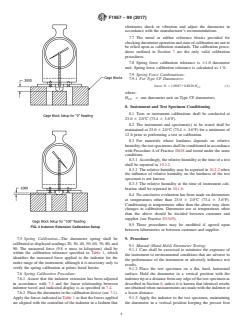
7.3.1.2 Placeprecisiongrounddimensionalblocks(GradeB
test specimen. On specimens with solid armatures, it is
or better) on the test specimen support table and beneath the
suggested that readings not be taken in areas close to the
durometerpresserfootandindentor.Arrangetheblockssothat
armature as this may affect the readings.
the durometer presser foot contacts the larger block and the
6.1.1 The lateral dimensions of the test specimen shall be
indentor tip is at the moment of contact with the smaller block
sufficient to permit measurements at least 12.0 mm (0.48 in.)
(Fig. 3).
from any edge unless it is known that identical results are
7.3.1.3 A combination of dimensional gage blocks may be
obtained when measurements are made at a lesser distance
usedtoachieveadifferenceof7.62+0.00,–0.0254mm(0.300
from an edge.
+0.00, –0.001 in.) between them:
6.1.2 The surfaces of the test specimen shall be flat and
7.3.2 Indentor Extension Adjustment:
parallel over a sufficient area to permit the presser foot to
7.3.2.1 Carefully lower the durometer presser foot until
contact the specimen over an area having a radius of at least
contact with the largest dimensional block, the indentor tip
30.0 mm (1.18 in.) from the indentor point if possible.
should be at the point of contact with the smaller block,
Variations are acceptable as agreed upon between laboratories
verifying full indentor extension.
or between customer and supplier. The test specimen shall be
supported suitably to provide for positioning and stability. A 7.3.2.2 Adjust the indentor extension to 7.620 6 0.04 mm
(0.300 6 0.002 in.), following the manufacturer’s recom-
mended procedure.
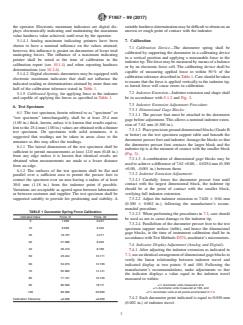
TABLE 1 Durometer Spring Force Calibration
7.3.2.3 When performing the procedures in 7.3, care should
Indicated Value Force, N Force, lbf
be used as not to cause damage to the indentor tip.
0 1.099 0.247
7.3.2.4 Parallelism of the durometer presser foot to the test
10 9.928 2.232
specimen support surface (table), and hence the dimensional
gage blocks, at the time of instrument calibration shall be in
20 18.757 4.217
accordancewithTestMethodsD374,machinist’smicrometers.
30 27.586 6.202
7.4 Indicator Display Adjustment (Analog and Digital):
40 36.415 8.186
7.4.1 After adjusting the indentor extension as indicated in
7.3,useanidenticalarrangementofdimensionalgageblocksto
50 45.244 10.171
verify the linear relationship between indentor travel and
60 54.073 12.156
indicated display at two points: 0 and 100. Following the
manufacturer’s recommendations, make adjustments so that
70 62.902 14.141
the indicator displays a value equal to the indentor travel
80 71.731 16.126
measured to within:
90 80.560 18.111 ± ⁄2 durometer units measured at 0;
± ⁄2 durometer units measured at 100, and
100 89.389 20.095 ±1 ⁄2 durometer units at all points enumerated in 7.5.
7.4.2 Each durometer point indicated is equal to 0.050 mm
Calibration Tolerance ±0.893 ±0.200
(0.002 in.) of indentor travel.
F1957 − 99 (2017)
eliminates shock or vibration and adjust the durometer in
accordance with the manufacturer’s recommendations.
7.7 The metal or rubber reference blocks provided for
checkingdurometeroperationandstateofcalibrationarenotto
be relied upon as calibration standards. The calibration proce-
dures outlined in Section 7 are the only valid calibration
procedures.
7.8 Spring force calibration tolerance is 61.0
...