

ASTM D8044-23
(Test Method)Standard Test Method for Evaluation of Asphalt Mixture Cracking Resistance Using the Semi-Circular Bend Test (SCB) at Intermediate Temperatures
General Information
- Abstract
SIGNIFICANCE AND USE
5.1 The critical strain energy release rate parameter, Jc, is used to compare the cracking resistance of asphalt mixtures prepared with different asphalt binder and aggregate types prepared to meet the volumetric requirements of differing traffic levels tested at intermediate temperatures.
5.2 The critical strain energy release rate parameter, Jc, is an engineering property and a performance indicator at intermediate temperature cracking.
Note 1: The quality of the results produced by this standard are dependent on the competence of the personnel performing the procedure and the capability, calibration, and maintenance of the equipment used. Agencies that meet the criteria of Specification D3666 are generally considered capable of competent and objective testing, sampling, inspection, etc. Users of this standard are cautioned that compliance with Specification D3666 alone does not completely ensure reliable results. Reliable results depend on many factors; following the suggestions of Specification D3666 or some similar acceptable guideline provides a means of evaluating and controlling some of those factors.
SCOPE
1.1 This test method covers the procedures for preparation, testing, and measurement of asphalt mixture cracking resistance at intermediate temperatures using semi-circular bend (SCB) geometry of laboratory-prepared or pavement core asphalt mixture samples tested monotonically. The SCB sample is a half-disk with a notch cut aligned vertically in parallel with the testing loading. The test method describes the determination of the critical strain energy release rate parameter, Jc, and other parameters determined from the load-displacement curve. These parameters can be used to rank the resistance of asphalt mixtures to cracking.
1.2 The text of this standard references notes and footnotes which provide explanatory material. These notes and footnotes (excluding those in tables and figures) shall not be considered as requirements of the standard.
1.3 The values stated in SI units are to be regarded as standard. No other units of measurement are included in this standard.
1.4 Since a complete Precision and Bias statement for this standard has not been developed, the test method is to be used for research and informational purposes only. Therefore, this standard should not be used for acceptance or rejection of a material for purchasing purposes.
1.5 This standard does not purport to address all of the safety concerns, if any, associated with its use. It is the responsibility of the user of this standard to establish appropriate safety, health, and environmental practices and determine the applicability of regulatory limitations prior to use.
1.6 This international standard was developed in accordance with internationally recognized principles on standardization established in the Decision on Principles for the Development of International Standards, Guides and Recommendations issued by the World Trade Organization Technical Barriers to Trade (TBT) Committee.
- Status
- Published
- Publication Date
- 14-May-2023
- Technical Committee
- D04 - Road and Paving Materials
- Drafting Committee
- D04.26 - Fundamental/Mechanistic Tests
Buy Documents
ASTM D8044-23 - Standard Test Method for Evaluation of Asphalt Mixture Cracking Resistance Using the Semi-Circular Bend Test (SCB) at Intermediate Temperatures
REDLINE ASTM D8044-23 - Standard Test Method for Evaluation of Asphalt Mixture Cracking Resistance Using the Semi-Circular Bend Test (SCB) at Intermediate Temperatures
Overview
ASTM D8044-23 specifies the Standard Test Method for Evaluation of Asphalt Mixture Cracking Resistance Using the Semi-Circular Bend Test (SCB) at Intermediate Temperatures. Developed by ASTM Committee D04 on Road and Paving Materials, this standard outlines procedures for preparing, testing, and analyzing asphalt mixture samples-either laboratory-prepared or cored from pavements-to assess resistance to cracking under intermediate temperature conditions using the SCB geometry.
This method is particularly valuable for comparing the cracking resistance of different asphalt mixtures and for understanding the performance implications of using various asphalt binders, aggregates, and mix designs. The critical strain energy release rate parameter, Jc, serves as the primary metric, offering a quantifiable means to rank and optimize asphalt mixtures for specific traffic and climatic conditions.
Key Topics
- Test Methodology: Describes how to prepare and test semi-circular asphalt specimens with precise notching and dimensions, subjected to monotonic loading until fracture at controlled intermediate temperatures.
- Critical Strain Energy Release Rate (Jc): The principal performance indicator, Jc measures the energy required for a crack to propagate and allows direct comparison between different asphalt mixtures.
- Sample Types: Addresses the use of both laboratory-compacted samples and field pavement cores, with detailed guidance on specimen size, air void content, and notching procedures.
- Data Acquisition and Analysis: Outlines requirements for equipment capabilities-such as loading devices, environmental chambers, and data systems-ensuring accurate measurement of load, displacement, and temperature throughout the test.
- Quality Control: Emphasizes the need for competent personnel, calibrated equipment, and adherence to relevant ASTM specifications (such as D3666) to ensure reliable results.
- Precision and Bias: Notes that the method is intended for research and informational purposes, advising against its use for material acceptance or rejection until repeatability and reproducibility are fully characterized.
Applications
This standard is highly practical for:
- Pavement Research and Mix Design: Enables engineers to compare the cracking resistance of various asphalt mix formulations under intermediate temperatures and optimize mixes for traffic and climate considerations.
- Performance Evaluation: Facilitates the selection of mixtures or binders that meet performance requirements, supporting efforts to extend pavement service life and reduce maintenance costs.
- Quality Assurance: Offers a standardized way to monitor and benchmark changes in asphalt mixture properties due to sources, aging, rehabilitated materials (such as RAP or RAS), or the use of rejuvenators.
- Academic and Laboratory Studies: Serves as a foundational method for the comparative study of asphalt mixture fracture mechanics.
Related Standards
Several ASTM and AASHTO standards complement the procedures and context of ASTM D8044-23:
- ASTM D3666: Minimum requirements for agencies testing and inspecting road and paving materials.
- ASTM D6925: Preparation and determination of relative density of asphalt mix specimens.
- ASTM D5361/D979: Practices for sampling compacted or uncompacted asphalt mixtures.
- ASTM D2041, D2726, D3203, D6857: Methods for determining specific gravity, density, and air voids in asphalt mixtures.
- ASTM D6373, AASHTO M320, AASHTO M332: Specifications for performance-graded asphalt binders.
- ASTM E4, E29, E178, E399, E2309: Practices for equipment calibration, significant digits, statistical analysis, and fracture toughness testing.
- AASHTO R30: Conditioning of hot mix asphalt for testing.
By adhering to ASTM D8044-23, practitioners can ensure a consistent, science-based approach to evaluating asphalt mixture cracking resistance, aiding in the development of longer-lasting and more resilient roadways.
Keywords: asphalt mixture cracking resistance, semi-circular bend test, intermediate temperature, performance testing, Jc parameter, pavement evaluation, ASTM standard, asphalt binder, fracture mechanics, road materials.
Relations
- Effective Date
- 01-Dec-2023
- Effective Date
- 01-Nov-2023
- Effective Date
- 01-Feb-2020
- Effective Date
- 01-Jun-2019
- Effective Date
- 15-Aug-2018
- Effective Date
- 01-Jun-2017
- Effective Date
- 01-Jun-2017
- Effective Date
- 01-Oct-2016
- Effective Date
- 01-Jun-2016
- Effective Date
- 01-Jan-2015
- Effective Date
- 01-Jan-2015
- Effective Date
- 01-Jun-2014
- Effective Date
- 07-Mar-2014
- Effective Date
- 01-Dec-2013
- Effective Date
- 01-Jul-2013
Buy Documents
ASTM D8044-23 - Standard Test Method for Evaluation of Asphalt Mixture Cracking Resistance Using the Semi-Circular Bend Test (SCB) at Intermediate Temperatures
REDLINE ASTM D8044-23 - Standard Test Method for Evaluation of Asphalt Mixture Cracking Resistance Using the Semi-Circular Bend Test (SCB) at Intermediate Temperatures
Get Certified
Connect with accredited certification bodies for this standard

Zavod za gradbeništvo Slovenije (ZAG) - Inšpekcija
ZAG inspection body for construction products, structures, and materials.
Sponsored listings
Frequently Asked Questions
ASTM D8044-23 is a standard published by ASTM International. Its full title is "Standard Test Method for Evaluation of Asphalt Mixture Cracking Resistance Using the Semi-Circular Bend Test (SCB) at Intermediate Temperatures". This standard covers: SIGNIFICANCE AND USE 5.1 The critical strain energy release rate parameter, Jc, is used to compare the cracking resistance of asphalt mixtures prepared with different asphalt binder and aggregate types prepared to meet the volumetric requirements of differing traffic levels tested at intermediate temperatures. 5.2 The critical strain energy release rate parameter, Jc, is an engineering property and a performance indicator at intermediate temperature cracking. Note 1: The quality of the results produced by this standard are dependent on the competence of the personnel performing the procedure and the capability, calibration, and maintenance of the equipment used. Agencies that meet the criteria of Specification D3666 are generally considered capable of competent and objective testing, sampling, inspection, etc. Users of this standard are cautioned that compliance with Specification D3666 alone does not completely ensure reliable results. Reliable results depend on many factors; following the suggestions of Specification D3666 or some similar acceptable guideline provides a means of evaluating and controlling some of those factors. SCOPE 1.1 This test method covers the procedures for preparation, testing, and measurement of asphalt mixture cracking resistance at intermediate temperatures using semi-circular bend (SCB) geometry of laboratory-prepared or pavement core asphalt mixture samples tested monotonically. The SCB sample is a half-disk with a notch cut aligned vertically in parallel with the testing loading. The test method describes the determination of the critical strain energy release rate parameter, Jc, and other parameters determined from the load-displacement curve. These parameters can be used to rank the resistance of asphalt mixtures to cracking. 1.2 The text of this standard references notes and footnotes which provide explanatory material. These notes and footnotes (excluding those in tables and figures) shall not be considered as requirements of the standard. 1.3 The values stated in SI units are to be regarded as standard. No other units of measurement are included in this standard. 1.4 Since a complete Precision and Bias statement for this standard has not been developed, the test method is to be used for research and informational purposes only. Therefore, this standard should not be used for acceptance or rejection of a material for purchasing purposes. 1.5 This standard does not purport to address all of the safety concerns, if any, associated with its use. It is the responsibility of the user of this standard to establish appropriate safety, health, and environmental practices and determine the applicability of regulatory limitations prior to use. 1.6 This international standard was developed in accordance with internationally recognized principles on standardization established in the Decision on Principles for the Development of International Standards, Guides and Recommendations issued by the World Trade Organization Technical Barriers to Trade (TBT) Committee.
SIGNIFICANCE AND USE 5.1 The critical strain energy release rate parameter, Jc, is used to compare the cracking resistance of asphalt mixtures prepared with different asphalt binder and aggregate types prepared to meet the volumetric requirements of differing traffic levels tested at intermediate temperatures. 5.2 The critical strain energy release rate parameter, Jc, is an engineering property and a performance indicator at intermediate temperature cracking. Note 1: The quality of the results produced by this standard are dependent on the competence of the personnel performing the procedure and the capability, calibration, and maintenance of the equipment used. Agencies that meet the criteria of Specification D3666 are generally considered capable of competent and objective testing, sampling, inspection, etc. Users of this standard are cautioned that compliance with Specification D3666 alone does not completely ensure reliable results. Reliable results depend on many factors; following the suggestions of Specification D3666 or some similar acceptable guideline provides a means of evaluating and controlling some of those factors. SCOPE 1.1 This test method covers the procedures for preparation, testing, and measurement of asphalt mixture cracking resistance at intermediate temperatures using semi-circular bend (SCB) geometry of laboratory-prepared or pavement core asphalt mixture samples tested monotonically. The SCB sample is a half-disk with a notch cut aligned vertically in parallel with the testing loading. The test method describes the determination of the critical strain energy release rate parameter, Jc, and other parameters determined from the load-displacement curve. These parameters can be used to rank the resistance of asphalt mixtures to cracking. 1.2 The text of this standard references notes and footnotes which provide explanatory material. These notes and footnotes (excluding those in tables and figures) shall not be considered as requirements of the standard. 1.3 The values stated in SI units are to be regarded as standard. No other units of measurement are included in this standard. 1.4 Since a complete Precision and Bias statement for this standard has not been developed, the test method is to be used for research and informational purposes only. Therefore, this standard should not be used for acceptance or rejection of a material for purchasing purposes. 1.5 This standard does not purport to address all of the safety concerns, if any, associated with its use. It is the responsibility of the user of this standard to establish appropriate safety, health, and environmental practices and determine the applicability of regulatory limitations prior to use. 1.6 This international standard was developed in accordance with internationally recognized principles on standardization established in the Decision on Principles for the Development of International Standards, Guides and Recommendations issued by the World Trade Organization Technical Barriers to Trade (TBT) Committee.
ASTM D8044-23 is classified under the following ICS (International Classification for Standards) categories: 93.080.20 - Road construction materials. The ICS classification helps identify the subject area and facilitates finding related standards.
ASTM D8044-23 has the following relationships with other standards: It is inter standard links to ASTM D6925-23, ASTM D6857/D6857M-23, ASTM E2309/E2309M-20, ASTM D2041/D2041M-19, ASTM D6857/D6857M-18, ASTM D2726/D2726M-17, ASTM D6857/D6857M-17, ASTM D3666-16, ASTM E178-16, ASTM D6373-15, ASTM D6925-15, ASTM E4-14, ASTM D5361/D5361M-14, ASTM D3666-13, ASTM D2726/D2726M-13. Understanding these relationships helps ensure you are using the most current and applicable version of the standard.
ASTM D8044-23 is available in PDF format for immediate download after purchase. The document can be added to your cart and obtained through the secure checkout process. Digital delivery ensures instant access to the complete standard document.
Standards Content (Sample)
This international standard was developed in accordance with internationally recognized principles on standardization established in the Decision on Principles for the
Development of International Standards, Guides and Recommendations issued by the World Trade Organization Technical Barriers to Trade (TBT) Committee.
Designation: D8044 − 23
Standard Test Method for
Evaluation of Asphalt Mixture Cracking Resistance Using
the Semi-Circular Bend Test (SCB) at Intermediate
Temperatures
This standard is issued under the fixed designation D8044; the number immediately following the designation indicates the year of
original adoption or, in the case of revision, the year of last revision. A number in parentheses indicates the year of last reapproval. A
superscript epsilon (´) indicates an editorial change since the last revision or reapproval.
1. Scope mendations issued by the World Trade Organization Technical
Barriers to Trade (TBT) Committee.
1.1 This test method covers the procedures for preparation,
testing, and measurement of asphalt mixture cracking resis-
2. Referenced Documents
tance at intermediate temperatures using semi-circular bend
2.1 ASTM Standards:
(SCB) geometry of laboratory-prepared or pavement core
D979/D979M Practice for Sampling Asphalt Mixtures
asphalt mixture samples tested monotonically. The SCB
D2041/D2041M Test Method for Theoretical Maximum
sample is a half-disk with a notch cut aligned vertically in
Specific Gravity and Density of Asphalt Mixtures
parallel with the testing loading. The test method describes the
D2726/D2726M Test Method for Bulk Specific Gravity and
determination of the critical strain energy release rate
Density of Non-Absorptive Compacted Asphalt Mixtures
parameter, J , and other parameters determined from the
c
D3203/D3203M Test Method for Percent Air Voids in Com-
load-displacement curve. These parameters can be used to rank
pacted Asphalt Mixtures
the resistance of asphalt mixtures to cracking.
D3666 Specification for Minimum Requirements for Agen-
1.2 The text of this standard references notes and footnotes
cies Testing and Inspecting Road and Paving Materials
which provide explanatory material. These notes and footnotes
D5361/D5361M Practice for Sampling Compacted Asphalt
(excluding those in tables and figures) shall not be considered
Mixtures for Laboratory Testing
as requirements of the standard.
D6373 Specification for Performance-Graded Asphalt
Binder
1.3 The values stated in SI units are to be regarded as
D6857/D6857M Test Method for Maximum Specific Grav-
standard. No other units of measurement are included in this
standard. ity and Density of Asphalt Mixtures Using Automatic
Vacuum Sealing Method
1.4 Since a complete Precision and Bias statement for this
D6925 Test Method for Preparation and Determination of
standard has not been developed, the test method is to be used
the Relative Density of Asphalt Mix Specimens by Means
for research and informational purposes only. Therefore, this
of the Superpave Gyratory Compactor
standard should not be used for acceptance or rejection of a
E4 Practices for Force Calibration and Verification of Test-
material for purchasing purposes.
ing Machines
1.5 This standard does not purport to address all of the
E29 Practice for Using Significant Digits in Test Data to
safety concerns, if any, associated with its use. It is the
Determine Conformance with Specifications
responsibility of the user of this standard to establish appro-
E178 Practice for Dealing With Outlying Observations
priate safety, health, and environmental practices and deter-
E399 Test Method for Linear-Elastic Plane-Strain Fracture
mine the applicability of regulatory limitations prior to use.
Toughness of Metallic Materials
1.6 This international standard was developed in accor-
E2309/E2309M Practices for Verification of Displacement
dance with internationally recognized principles on standard-
Measuring Systems and Devices Used in Material Testing
ization established in the Decision on Principles for the
Machines
Development of International Standards, Guides and Recom-
E3029 Practice for Determining Relative Spectral Correc-
tion Factors for Emission Signal of Fluorescence Spec-
trometers
This test method is under the jurisdiction of ASTM Committee D04 on Road
and Paving Materials and is the direct responsibility of Subcommittee D04.26 on
Fundamental/Mechanistic Tests. For referenced ASTM standards, visit the ASTM website, www.astm.org, or
Current edition approved May 15, 2023. Published May 2023. Originally contact ASTM Customer Service at service@astm.org. For Annual Book of ASTM
approved in 2016. Last previous edition approved in 2016 as D8044 – 16. DOI: Standards volume information, refer to the standard’s Document Summary page on
10.1520/D8044-23. the ASTM website.
Copyright © ASTM International, 100 Barr Harbor Drive, PO Box C700, West Conshohocken, PA 19428-2959. United States
D8044 − 23
2.2 AASHTO Standards: data acquisition system. The test system shall meet the mini-
R 30 Practice for Mixture Conditioning of Hot Mix Asphalt mum requirements specified in Table 1. (See Practices E2309/
(HMA) E2309M.)
M 320 Standard Specification for Performance-Graded As-
6.1.1 Axial Loading Device—The load apparatus shall be
phalt Binder
capable of maintaining a constant deformation rate of 0.5 6
M 332 Standard Specification for Performance-Graded Us-
0.02 mm/min.
ing Multiple Stress Creep Recovery (MSCR) Test
6.1.2 Environmental Chamber—A chamber capable of
maintaining 60.5 °C of the climatic intermediate temperature
3. Terminology
calculated in 8.4.
3.1 Definitions:
6.1.3 Control and Data Acquisition System—The system
3.1.1 J —critical strain energy release rate (kJ/m ), value
c
shall include a data acquisition system comprising analog to
used to evaluate mixture resistance to cracking.
digital conversion or digital input, or both, for storage and
3.1.2 U—strain energy to failure (kJ) is the area under the
analysis on a computer. The system shall be capable of
loading portion of the load versus deflection curves, up to the
measuring and recording three signals during the test including
maximum load measured for each notch depth.
load, displacement, and chamber temperature at a sampling
rate of 10 Hz. The minimum resolution of the measurements is
4. Summary of Test Method
provided in Table 1.
4.1 A semi-circular specimen is loaded monotonically until
6.2 Measurement Devices:
fracture failure occurs under a constant rate of deformation in
6.2.1 Load Measuring Device—The load measuring device
a three-point bending load configuration. The load and defor-
shall consist of an electronic load cell, designed for placement
mation are continuously recorded and are used to compute the
between the load platen and piston, with the minimum capacity
strain energy for a given notch depth. The test is repeated at
and sensitivity stated in Table 1. The load cell shall be
multiple notch depths to compute the critical strain energy
calibrated in accordance with Practices E4.
release rate parameter, J . High J values are desirable for
c c
6.2.2 Axial Deformations—Axial deformations shall be
fracture-resistant mixtures. A minimum J value ranging from
c
measured with linear variable differential transformers
0.50 to 0.60 kJ/m is typically recommended to ensure ad-
(LVDTs) or other devices capable of measuring displacement
equate fracture resistance of the mixture.
within the range and tolerance provided in Table 1. The LVDT
4.2 This test procedure considers the elasto-plastic/visco-
shall be calibrated in accordance with Practice E3029, Class B.
elastic relationship of asphalt mixtures and fracture mechanics
6.2.3 Temperature—Chamber temperature shall be mea-
(Mull et al., 2006; Anderson, 2005; and suggested by Wu et al.,
sured with Resistance Temperature Detectors (RTDs) or other
2005).
suitable devices accurate to within 60.5 °C.
5. Significance and Use
6.3 Gyratory Compactor—A gyratory compactor and asso-
5.1 The critical strain energy release rate parameter, J , is
ciated equipment for preparing laboratory specimens in accor-
c
used to compare the cracking resistance of asphalt mixtures
dance with Test Method D6925 shall be used.
prepared with different asphalt binder and aggregate types
6.4 Saw—The saw shall be capable of producing three
prepared to meet the volumetric requirements of differing
different notch sizes ranging from 0 to 50 mm. The width of the
traffic levels tested at intermediate temperatures.
saw blade shall be <3.5 mm.
5.2 The critical strain energy release rate parameter, J , is an
c
6.5 Test Fixture—The loading frame shall consist of a
engineering property and a performance indicator at interme-
loading rod and two sample support rods. The schematic of the
diate temperature cracking.
test apparatus is shown in Fig. 1. The diameters of the loading
NOTE 1—The quality of the results produced by this standard are
and supports rods shall be 25 mm and the anvil span shall be
dependent on the competence of the personnel performing the procedure
127 mm.
and the capability, calibration, and maintenance of the equipment used.
Agencies that meet the criteria of Specification D3666 are generally
6.6 Reaction Surface Treatment—Polytetrafluoroethylene
considered capable of competent and objective testing, sampling,
(PTFE) strips are used to reduce friction between the specimen
inspection, etc. Users of this standard are cautioned that compliance with
and the lower two support rollers.
Specification D3666 alone does not completely ensure reliable results.
Reliable results depend on many factors; following the suggestions of
Specification D3666 or some similar acceptable guideline provides a
means of evaluating and controlling some of those factors.
TABLE 1 Test System Minimum Requirements
6. Apparatus
Measurement Range Accuracy
6.1 Load Test System—A load test system consisting of an
Load Measurement 0 to 10 kN ±1 %
axial loading device, environmental chamber, and control and
and Control
Displacement Measurement 0 to 30 mm ±0.5 %
and Control
Available from American Association of State Highway and Transportation
Temperature Measurement 5 to 35 °C ±0.5 °C
Officials (AASHTO), 444 N. Capitol St., NW, Suite 249, Washington, DC 20001, and Control Range
http://www.transportation.org.
D8044 − 23
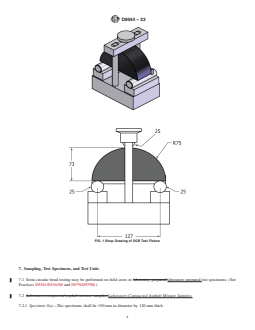
FIG. 1 Shop Drawing of SCB Test Fixture
7. Sampling, Test Specimens, and Test Units D6925 at the target air void content 6 1 %. The typical air void
target for the test specimens is 7.0 %.
7.1 Semi-circular bend testing may be performed on field
cores or laboratory-prepared test specimens. (See Practices
NOTE 2—The specimen air voids are calculated using Test Methods
D5361/D5361M and D979/D979M.)
D2041/D2041M, D2726/D2726M, D
...
This document is not an ASTM standard and is intended only to provide the user of an ASTM standard an indication of what changes have been made to the previous version. Because
it may not be technically possible to adequately depict all changes accurately, ASTM recommends that users consult prior editions as appropriate. In all cases only the current version
of the standard as published by ASTM is to be considered the official document.
Designation: D8044 − 16 D8044 − 23
Standard Test Method for
Evaluation of Asphalt Mixture Cracking Resistance
usingUsing the Semi-Circular Bend Test (SCB) at
Intermediate Temperatures
This standard is issued under the fixed designation D8044; the number immediately following the designation indicates the year of
original adoption or, in the case of revision, the year of last revision. A number in parentheses indicates the year of last reapproval. A
superscript epsilon (´) indicates an editorial change since the last revision or reapproval.
1. Scope
1.1 This test method covers the procedures for preparation, testing, and measurement of asphalt mixture cracking resistance at
Long Term Pavement Performance (LTPP) database intermediate temperatures using semi-circular bend (SCB) geometry
laboratory preparedof laboratory-prepared or pavement core asphalt mixmixture samples tested monotonically. The SCB sample
is a half-disk with a notch cut parallel to the loading and vertical axis. aligned vertically in parallel with the testing loading. The
test method describes the determination of the critical strain energy release rate, rate parameter, J , and other parameters
c
determined from the load-displacement curve. These parameters can be used to rank the resistance of asphalt mixtures to cracking.
1.2 The text of this standard references notes and footnotes which provide explanatory material. These notes and footnotes
(excluding those in tables and figures) shall not be considered as requirements of the standard.
1.3 The values stated in SI units are to be regarded as standard. No other units of measurement are included in this standard.
1.4 This standard does not purport to address all of the safety concerns, if any, associated with its use. It is the responsibility of
the user of this standard to establish appropriate safety and health practices and determine the applicability of regulatory limitations
prior to use.Since a complete Precision and Bias statement for this standard has not been developed, the test method is to be used
for research and informational purposes only. Therefore, this standard should not be used for acceptance or rejection of a material
for purchasing purposes.
1.5 This standard does not purport to address all of the safety concerns, if any, associated with its use. It is the responsibility
of the user of this standard to establish appropriate safety, health, and environmental practices and determine the applicability of
regulatory limitations prior to use.
1.6 This international standard was developed in accordance with internationally recognized principles on standardization
established in the Decision on Principles for the Development of International Standards, Guides and Recommendations issued
by the World Trade Organization Technical Barriers to Trade (TBT) Committee.
2. Referenced Documents
2.1 ASTM Standards:
This test method is under the jurisdiction of ASTM Committee D04 on Road and Paving Materials and is the direct responsibility of Subcommittee D04.26 on
Fundamental/Mechanistic Tests.
Current edition approved July 1, 2016May 15, 2023. Published August 2016May 2023. Originally approved in 2016. Last previous edition approved in 2016 as
D8044 – 16. DOI: 10.1520/D8044-16.10.1520/D8044-23.
For referenced ASTM standards, visit the ASTM website, www.astm.org, or contact ASTM Customer Service at service@astm.org. For Annual Book of ASTM Standards
volume information, refer to the standard’s Document Summary page on the ASTM website.
Copyright © ASTM International, 100 Barr Harbor Drive, PO Box C700, West Conshohocken, PA 19428-2959. United States
D8044 − 23
D979/D979M Practice for Sampling Asphalt Mixtures
D2041/D2041M Test Method for Theoretical Maximum Specific Gravity and Density of Asphalt Mixtures
D2726/D2726M Test Method for Bulk Specific Gravity and Density of Non-Absorptive Compacted Asphalt Mixtures
D3203/D3203M Test Method for Percent Air Voids in Compacted Asphalt Mixtures
D3666 Specification for Minimum Requirements for Agencies Testing and Inspecting Road and Paving Materials
D5361/D5361M Practice for Sampling Compacted Asphalt Mixtures for Laboratory Testing
D6373 Specification for Performance-Graded Asphalt Binder
D6857/D6857M Test Method for Maximum Specific Gravity and Density of Asphalt Mixtures Using Automatic Vacuum Sealing
Method
D6925 Test Method for Preparation and Determination of the Relative Density of Asphalt Mix Specimens by Means of the
Superpave Gyratory Compactor
E4 Practices for Force Calibration and Verification of Testing Machines
E29 Practice for Using Significant Digits in Test Data to Determine Conformance with Specifications
E178 Practice for Dealing With Outlying Observations
E399 Test Method for Linear-Elastic Plane-Strain Fracture Toughness of Metallic Materials
E2309/E2309M Practices for Verification of Displacement Measuring Systems and Devices Used in Material Testing Machines
E3029 Practice for Determining Relative Spectral Correction Factors for Emission Signal of Fluorescence Spectrometers
2.2 AASHTO Standards:
R30R 30 Practice for Mixture Conditioning of Hot Mix Asphalt (HMA)
M320M 320 Standard Specification for Performance-Graded Asphalt Binder
M332M 332 Standard Specification for Performance-Graded Using Multiple Stress Creep Recovery (MSCR) Test
3. Terminology
3.1 Definitions:
3.1.1 J —critical strain energy release rate (kJ/m ), value used to evaluate mixture resistance to cracking.
c
3.1.2 U—strain energy to failure (kJ) is the area under the loading portion of the load versus deflection curves, up to the maximum
load measured for each notch depth.
4. Summary of Test Method
4.1 A semi-circular specimen is loaded monotonically until fracture failure occurs under a constant rate of deformation in a
three-point bending load configuration. The load and deformation are continuously recorded and are used to compute the strain
energy for a given notch depth. The test is repeated at multiple notch depths to compute the critical strain energy release rate, rate
parameter, J . High J values are desirable for fracture-resistant mixtures. A minimum J value ranging from 0.50.50 to 0.60 kJ/m
c c c
is typically recommended to ensure adequate fracture resistance of the mixture.
4.2 This test procedure considers the elasto-plastic/visco-elastic relationship of asphalt mixtures and fracture mechanics (Mull, et
al., 2006, Anderson 2005(Mull et al., 2006; Anderson, 2005; and suggested by Wu et al., 2005).
5. Significance and Use
5.1 The critical strain energy release rate, rate parameter, J , is used to compare the cracking resistance of asphalt mixtures
c
prepared with different asphalt binder and aggregate types prepared to meet the volumetric requirements of differing traffic levels
tested at intermediate temperatures.
5.2 This The critical strain energy release rate parameter, J , is an engineering property isand a performance indicator ofat
c
intermediate temperature cracking.
NOTE 1—The quality of the results produced by this standard are dependent on the competence of the personnel performing the procedure and the
capability, calibration, and maintenance of the equipment used. Agencies that meet the criteria of Specification D3666 are generally considered capable
of competent and objective testing/sampling/inspection/etc. testing, sampling, inspection, etc. Users of this standard are cautioned that compliance with
Specification D3666 alone does not completely assureensure reliable results. Reliable results depend on many factors; following the suggestions of
Specification D3666 or some similar acceptable guideline provides a means of evaluating and controlling some of those factors.
Available from American Association of State Highway and Transportation Officials (AASHTO), 444 N. Capitol St., NW, Suite 249, Washington, DC 20001,
http://www.transportation.org.
D8044 − 23
6. Apparatus
6.1 Load Test System—A load test system consisting of an axial loading device, environmental chamber, and control and data
acquisition system. The test system shall meet the minimum requirements specified in Table 1. (See Practices E2309/E2309M.)
6.1.1 Axial Loading Device—The load apparatus shall be capable of maintaining a constant deformation rate of 0.5 6 0.02
mm/min.
6.1.2 Environmental Chamber—A chamber capable of maintaining 60.360.5 °C of the climatic intermediate temperature
calculated in 8.4.
6.1.3 Control and Data Acquisition System—The system shall include a data acquisition system comprising analog to digital
conversion or digital input, or both, for storage and analysis on a computer. The system shall be capable of measuring and recording
three signals during the test including load, displacement, and chamber temperature at a sampling rate of 10 Hz. The minimum
resolution of the measurements is provided in Table 1.
6.2 Measurement Devices:
6.2.1 Load Measuring Device—The load measuring device shall consist of an electronic load cell, designed for placement between
the load platen and piston, with the minimum capacity and sensitivity stated in Table 1. The load cell shall be calibrated in
accordance with Practices E4.
6.2.2 Axial Deformations—Axial deformations shall be measured with linear variable differential transformers (LVDT)(LVDTs)
or other devices capable of measuring displacement within the range and tolerance provided in Table 1. The LVDT shall be
calibrated in accordance with Practice E3029, Class B.
6.2.3 Temperature—Chamber temperature shall be measured with Resistance Temperature Detectors (RTD)(RTDs) or other
suitable devices accurate to within 6 0.3°C.60.5 °C.
6.3 Gyratory Compactor—A gyratory compactor and associated equipment for preparing laboratory specimens in accordance with
Test Method D6925 shall be used.
6.4 Saw—The saw shall be capable of producing three different notch sizes ranging from 0 to 50 mm. The width of the saw blade
shall be <3.5mm.<3.5 mm.
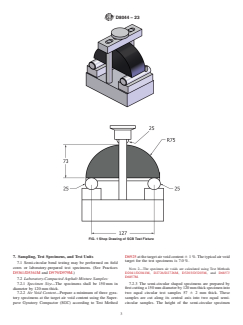
6.5 Test Fixture—The loading frame shall consist of a loading rod and two sample support rods. The schematic of the test
apparatus is shown in Fig. 1. The diameters of the loading and supports rods shall be 25 mm and the anvil span shall be 127 mm.
6.6 Reaction Surface Treatment—Polytetrafluoroethylene (PTFE) strips are used to reduce friction between the specimen and the
lower two support rollers.
TABLE 1 Test System Minimum Requirements
Measurement Range Accuracy
Load Measurement 0 to 10 kN ± 1 %
and Control
Load Measurement 0 to 10 kN ±1 %
and Control
Displacement Measurement 0 to 30 mm ± 0.5 %
and Control
Displacement Measurement 0 to 30 mm ±0.5 %
and Control
Temperature Measurement 5 to 35 °C ± 0.3 °C
and Control Range
Temperature Measurement 5 to 35 °C ±0.5 °C
and Control Range
D8044 − 23
FIG. 1 Shop Drawing of SCB Test Fixture
7. Sampling, Test Specimens, and Test Units
7.1 Semi-circular bend testing may be performed on field cores or laboratory prepared laboratory-prepared test specimens. (See
Practices D5361/D5361M and D979/D979M.)
7.2 Laboratory-compacted asphalt mixture samples:Laboratory-Compacted Asphalt Mixture Samples:
7.2.1 Specimen Size—The specimens shall be 150 mm in diameter by 120 mm thick.
D8044 − 23
7.2.2 Air Void Content—Prepare a minimum of three gyratory specimens at the target air void content using the Superpave
Gyratory Compacto
...