

ASTM E2177-20
(Test Method)Standard Test Method for Measuring the Coefficient of Retroreflected Luminance (RL) of Pavement Markings using the Bucket Method in a Condition of Wet Recovery
General Information
- Abstract
SIGNIFICANCE AND USE
4.1 The nighttime performance of pavement markings is determined by the coefficient of retroreflected luminance, RL, be it dry or wet, and depends on the materials used, age, and wear pattern. These conditions shall be observed and noted by the user.
4.2 Under the same conditions of headlight illumination and driver’s viewing, larger values of RL correspond to higher levels of visual performance at corresponding geometry.
4.3 The pavement marking’s measured performance in the condition of wet recovery is used to characterize the performance of the marking on the road when wet.
4.4 Newly installed pavement markings may have a natural surface tension or release agents that prevent wetting of the product by water. The water will tend to “bead up” on the marking. This “non wetting” condition is usually short lived. Pavement markings that have been on the road for one month prior to testing usually do not exhibit this non-wetting phenomenon. (Warning—This phenomenon produces an interference when assessing the wet characteristics of a pavement marking. Attempts to measure markings with this surface “non-wetting” or “beading” of the water may give higher values.)
4.5 The retroreflectivity, RL, of pavement (road) markings degrades with traffic wear and requires periodic measurement to ensure that sufficient line visibility is provided to drivers.
4.6 For a given viewing distance, measurements of RL made with a retroreflectometer having a geometry corresponding to that viewing distance are a good indicator of the visual ranking of the material measured.
4.7 As specified by Test Method E1710, the measurement geometry of the instrument is based on a viewing distance of 30 m, an eye height of 1.2 m and a headlight mounting height of 0.65 m (see Appendix X1).
4.8 It shall be the responsibility of the user to employ an instrument having the specified observation and entrance angles.
SCOPE
1.1 This test method covers the measurement of the wet retroreflective (RL) properties of horizontal pavement marking materials, such as traffic stripes and road surface symbols, using a portable retroreflectometer that can be placed on or before the road marking to measure the retroreflection at the prescribed geometry.
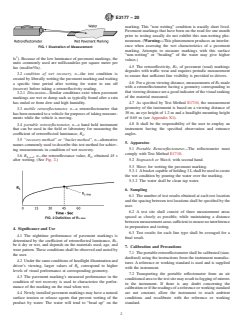
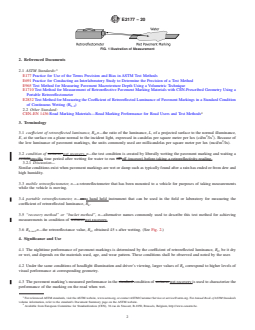
1.2 This method of measuring the wet retroreflective properties (RL) of pavement markings measures the wet retroreflectivity in a condition of wet recovery (see Fig. 1).
FIG. 1 Illustration of Measurement
1.2.1 This test condition typically exists (1) after a rainfall has ended and the pavement markings are still wet or (2) as the markings are wet from dew or humidity.
1.3 Retroreflective performance obtained with this test in condition of wet recovery does not necessarily relate to how markings perform in conditions of rain, that is, as markings are being rained upon. Test Method E2832 defines a method to measure the performance of pavement markings in conditions of simulated rain.
1.4 This test method specifies the use of portable reflectometers that can measure pavement markings in accordance with Test Method E1710.2 The entrance and observation angles required of the retroreflectometer in this test method are commonly referred to as “30 meter geometry.”2
1.5 The values stated in SI units are to be regarded as standard. No other units of measurement are included in this standard.
1.6 This standard does not purport to address all of the safety concerns, if any, associated with its use. It is the responsibility of the user of this standard to establish appropriate safety, health, and environmental practices and determine the applicability of regulatory limitations prior to use.
1.7 This international standard was developed in accordance with internationally recognized principles on standardization established in the Decision on Principles for the Development of International Standards, Guides and Recommendations issued by the World Trade Organization Technical...
- Status
- Published
- Publication Date
- 30-Sep-2020
- Technical Committee
- E12 - Color and Appearance
- Drafting Committee
- E12.10 - Retroreflection
Buy Documents
ASTM E2177-20 - Standard Test Method for Measuring the Coefficient of Retroreflected Luminance (R<inf >L</inf>) of Pavement Markings using the Bucket Method in a Condition of Wet Recovery
REDLINE ASTM E2177-20 - Standard Test Method for Measuring the Coefficient of Retroreflected Luminance (R<inf >L</inf>) of Pavement Markings using the Bucket Method in a Condition of Wet Recovery
Overview
ASTM E2177-20 is the standard test method for measuring the coefficient of retroreflected luminance (RL) of pavement markings using the "bucket method" under wet recovery conditions. Developed by ASTM International, this standard defines procedures for quantifying the wet retroreflective properties of horizontal pavement markings, such as traffic stripes and road surface symbols. The goal is to assess pavement marking visibility for drivers under nighttime and wet conditions, supporting roadway safety and maintenance.
Key Topics
- Coefficient of Retroreflected Luminance (RL): Measures the brightness of pavement markings when illuminated by vehicle headlights at night, which is critical for road safety.
- Wet Recovery Condition: This test simulates post-precipitation conditions-such as after rain or during dew or high humidity-when pavement markings are still wet but not actively being rained upon.
- Bucket Method: Water is poured over the test area, and retroreflectivity is measured after a prescribed waiting period, representing realistic wet road scenarios.
- Instrumentation: Requires a portable or mobile retroreflectometer compliant with ASTM E1710, using specified entrance and observation angles (commonly known as "30-meter geometry").
- Measurement Process:
- Wet condition is created by pouring 3 liters of clean water over the marking.
- Measurement is taken 45 seconds after wetting, simulating the natural draining process.
- Typically, three measurements are averaged at each test site for accuracy.
- Reporting: Results are documented in millicandelas per square meter per lux (mcd/m²/lx), with records of both dry and wet measurements, site conditions, instrument used, and weather.
Applications
The ASTM E2177-20 standard is critical for:
- Highway and Road Maintenance: Transportation agencies use this method to assess the durability and visibility of road markings after installation and throughout their service life, particularly in wet conditions.
- Pavement Marking Evaluation: Helps determine whether the marking materials (paint, thermoplastics, tapes, polyurea, etc.) meet required visibility standards under wet conditions.
- Contractual Compliance: Ensures that newly applied pavement markings provide the necessary visibility for road users and adhere to safety guidelines.
- Quality Assurance: Allows manufacturers and contractors to evaluate the wet retroreflective performance of their products over time.
- Research and Development: Supports the development of new materials and technologies aimed at improving nighttime visibility in wet conditions.
Related Standards
- ASTM E1710: Standard Test Method for Measurement of Retroreflective Pavement Marking Materials with CEN-Prescribed Geometry Using a Portable Retroreflectometer. Establishes the required geometry for measurement.
- ASTM E2832: Provides a method for measuring the coefficient of retroreflected luminance in a simulated rain condition, complementing ASTM E2177-20.
- CEN EN 1436: European standard specifying performance and test methods for road marking materials.
- ASTM E965: Relates to measuring pavement macrotexture depth, which can affect retroreflectivity.
Practical Value
Applying ASTM E2177-20 helps maintain high standards of road safety by ensuring pavement markings are visible to drivers under challenging nighttime and wet conditions. This is vital for accident prevention, efficient traffic management, and compliance with national and international regulations on road marking visibility. Periodic testing using this standard allows for proactive maintenance and timely replacement of degraded markings, directly contributing to safer road environments for all users.
Keywords: ASTM E2177-20, wet retroreflectivity, pavement marking visibility, coefficient of retroreflected luminance, bucket method, portable retroreflectometer, wet recovery, highway safety, traffic marking testing.
Relations
- Effective Date
- 01-Jan-2018
- Effective Date
- 01-Nov-2017
- Effective Date
- 01-May-2014
- Effective Date
- 01-May-2013
- Effective Date
- 01-May-2013
- Effective Date
- 01-Apr-2012
- Effective Date
- 01-Nov-2011
- Effective Date
- 01-Jun-2011
- Effective Date
- 01-Oct-2010
- Effective Date
- 01-Oct-2008
- Effective Date
- 01-Oct-2008
- Refers
ASTM E177-06b - Standard Practice for Use of the Terms Precision and Bias in ASTM Test Methods - Effective Date
- 15-Nov-2006
- Refers
ASTM E177-06a - Standard Practice for Use of the Terms Precision and Bias in ASTM Test Methods - Effective Date
- 01-Nov-2006
- Effective Date
- 01-Nov-2005
- Effective Date
- 01-Jan-2005
Buy Documents
ASTM E2177-20 - Standard Test Method for Measuring the Coefficient of Retroreflected Luminance (R<inf >L</inf>) of Pavement Markings using the Bucket Method in a Condition of Wet Recovery
REDLINE ASTM E2177-20 - Standard Test Method for Measuring the Coefficient of Retroreflected Luminance (R<inf >L</inf>) of Pavement Markings using the Bucket Method in a Condition of Wet Recovery
Get Certified
Connect with accredited certification bodies for this standard

Zavod za gradbeništvo Slovenije (ZAG) - Inšpekcija
ZAG inspection body for construction products, structures, and materials.
Sponsored listings
Frequently Asked Questions
ASTM E2177-20 is a standard published by ASTM International. Its full title is "Standard Test Method for Measuring the Coefficient of Retroreflected Luminance (R<inf >L</inf>) of Pavement Markings using the Bucket Method in a Condition of Wet Recovery". This standard covers: SIGNIFICANCE AND USE 4.1 The nighttime performance of pavement markings is determined by the coefficient of retroreflected luminance, RL, be it dry or wet, and depends on the materials used, age, and wear pattern. These conditions shall be observed and noted by the user. 4.2 Under the same conditions of headlight illumination and driver’s viewing, larger values of RL correspond to higher levels of visual performance at corresponding geometry. 4.3 The pavement marking’s measured performance in the condition of wet recovery is used to characterize the performance of the marking on the road when wet. 4.4 Newly installed pavement markings may have a natural surface tension or release agents that prevent wetting of the product by water. The water will tend to “bead up” on the marking. This “non wetting” condition is usually short lived. Pavement markings that have been on the road for one month prior to testing usually do not exhibit this non-wetting phenomenon. (Warning—This phenomenon produces an interference when assessing the wet characteristics of a pavement marking. Attempts to measure markings with this surface “non-wetting” or “beading” of the water may give higher values.) 4.5 The retroreflectivity, RL, of pavement (road) markings degrades with traffic wear and requires periodic measurement to ensure that sufficient line visibility is provided to drivers. 4.6 For a given viewing distance, measurements of RL made with a retroreflectometer having a geometry corresponding to that viewing distance are a good indicator of the visual ranking of the material measured. 4.7 As specified by Test Method E1710, the measurement geometry of the instrument is based on a viewing distance of 30 m, an eye height of 1.2 m and a headlight mounting height of 0.65 m (see Appendix X1). 4.8 It shall be the responsibility of the user to employ an instrument having the specified observation and entrance angles. SCOPE 1.1 This test method covers the measurement of the wet retroreflective (RL) properties of horizontal pavement marking materials, such as traffic stripes and road surface symbols, using a portable retroreflectometer that can be placed on or before the road marking to measure the retroreflection at the prescribed geometry. 1.2 This method of measuring the wet retroreflective properties (RL) of pavement markings measures the wet retroreflectivity in a condition of wet recovery (see Fig. 1). FIG. 1 Illustration of Measurement 1.2.1 This test condition typically exists (1) after a rainfall has ended and the pavement markings are still wet or (2) as the markings are wet from dew or humidity. 1.3 Retroreflective performance obtained with this test in condition of wet recovery does not necessarily relate to how markings perform in conditions of rain, that is, as markings are being rained upon. Test Method E2832 defines a method to measure the performance of pavement markings in conditions of simulated rain. 1.4 This test method specifies the use of portable reflectometers that can measure pavement markings in accordance with Test Method E1710.2 The entrance and observation angles required of the retroreflectometer in this test method are commonly referred to as “30 meter geometry.”2 1.5 The values stated in SI units are to be regarded as standard. No other units of measurement are included in this standard. 1.6 This standard does not purport to address all of the safety concerns, if any, associated with its use. It is the responsibility of the user of this standard to establish appropriate safety, health, and environmental practices and determine the applicability of regulatory limitations prior to use. 1.7 This international standard was developed in accordance with internationally recognized principles on standardization established in the Decision on Principles for the Development of International Standards, Guides and Recommendations issued by the World Trade Organization Technical...
SIGNIFICANCE AND USE 4.1 The nighttime performance of pavement markings is determined by the coefficient of retroreflected luminance, RL, be it dry or wet, and depends on the materials used, age, and wear pattern. These conditions shall be observed and noted by the user. 4.2 Under the same conditions of headlight illumination and driver’s viewing, larger values of RL correspond to higher levels of visual performance at corresponding geometry. 4.3 The pavement marking’s measured performance in the condition of wet recovery is used to characterize the performance of the marking on the road when wet. 4.4 Newly installed pavement markings may have a natural surface tension or release agents that prevent wetting of the product by water. The water will tend to “bead up” on the marking. This “non wetting” condition is usually short lived. Pavement markings that have been on the road for one month prior to testing usually do not exhibit this non-wetting phenomenon. (Warning—This phenomenon produces an interference when assessing the wet characteristics of a pavement marking. Attempts to measure markings with this surface “non-wetting” or “beading” of the water may give higher values.) 4.5 The retroreflectivity, RL, of pavement (road) markings degrades with traffic wear and requires periodic measurement to ensure that sufficient line visibility is provided to drivers. 4.6 For a given viewing distance, measurements of RL made with a retroreflectometer having a geometry corresponding to that viewing distance are a good indicator of the visual ranking of the material measured. 4.7 As specified by Test Method E1710, the measurement geometry of the instrument is based on a viewing distance of 30 m, an eye height of 1.2 m and a headlight mounting height of 0.65 m (see Appendix X1). 4.8 It shall be the responsibility of the user to employ an instrument having the specified observation and entrance angles. SCOPE 1.1 This test method covers the measurement of the wet retroreflective (RL) properties of horizontal pavement marking materials, such as traffic stripes and road surface symbols, using a portable retroreflectometer that can be placed on or before the road marking to measure the retroreflection at the prescribed geometry. 1.2 This method of measuring the wet retroreflective properties (RL) of pavement markings measures the wet retroreflectivity in a condition of wet recovery (see Fig. 1). FIG. 1 Illustration of Measurement 1.2.1 This test condition typically exists (1) after a rainfall has ended and the pavement markings are still wet or (2) as the markings are wet from dew or humidity. 1.3 Retroreflective performance obtained with this test in condition of wet recovery does not necessarily relate to how markings perform in conditions of rain, that is, as markings are being rained upon. Test Method E2832 defines a method to measure the performance of pavement markings in conditions of simulated rain. 1.4 This test method specifies the use of portable reflectometers that can measure pavement markings in accordance with Test Method E1710.2 The entrance and observation angles required of the retroreflectometer in this test method are commonly referred to as “30 meter geometry.”2 1.5 The values stated in SI units are to be regarded as standard. No other units of measurement are included in this standard. 1.6 This standard does not purport to address all of the safety concerns, if any, associated with its use. It is the responsibility of the user of this standard to establish appropriate safety, health, and environmental practices and determine the applicability of regulatory limitations prior to use. 1.7 This international standard was developed in accordance with internationally recognized principles on standardization established in the Decision on Principles for the Development of International Standards, Guides and Recommendations issued by the World Trade Organization Technical...
ASTM E2177-20 is classified under the following ICS (International Classification for Standards) categories: 93.080.20 - Road construction materials. The ICS classification helps identify the subject area and facilitates finding related standards.
ASTM E2177-20 has the following relationships with other standards: It is inter standard links to ASTM E1710-18, ASTM E2832-12(2017), ASTM E177-14, ASTM E691-13, ASTM E177-13, ASTM E2832-12, ASTM E691-11, ASTM E1710-11, ASTM E177-10, ASTM E691-08, ASTM E177-08, ASTM E177-06b, ASTM E177-06a, ASTM E691-05, ASTM E1710-05. Understanding these relationships helps ensure you are using the most current and applicable version of the standard.
ASTM E2177-20 is available in PDF format for immediate download after purchase. The document can be added to your cart and obtained through the secure checkout process. Digital delivery ensures instant access to the complete standard document.
Standards Content (Sample)
This international standard was developed in accordance with internationally recognized principles on standardization established in the Decision on Principles for the
Development of International Standards, Guides and Recommendations issued by the World Trade Organization Technical Barriers to Trade (TBT) Committee.
Designation:E2177 −20
Standard Test Method for
Measuring the Coefficient of Retroreflected Luminance (R )
L
of Pavement Markings using the Bucket Method in a
Condition of Wet Recovery
This standard is issued under the fixed designation E2177; the number immediately following the designation indicates the year of
original adoption or, in the case of revision, the year of last revision. A number in parentheses indicates the year of last reapproval. A
superscript epsilon (´) indicates an editorial change since the last revision or reapproval.
1. Scope 1.6 This standard does not purport to address all of the
safety concerns, if any, associated with its use. It is the
1.1 This test method covers the measurement of the wet
responsibility of the user of this standard to establish appro-
retroreflective (R ) properties of horizontal pavement marking
L
priate safety, health, and environmental practices and deter-
materials, such as traffic stripes and road surface symbols,
mine the applicability of regulatory limitations prior to use.
using a portable retroreflectometer that can be placed on or
1.7 This international standard was developed in accor-
before the road marking to measure the retroreflection at the
dance with internationally recognized principles on standard-
prescribed geometry.
ization established in the Decision on Principles for the
1.2 This method of measuring the wet retroreflective prop-
Development of International Standards, Guides and Recom-
erties (R ) of pavement markings measures the wet retroreflec- mendations issued by the World Trade Organization Technical
L
tivity in a condition of wet recovery (see Fig. 1).
Barriers to Trade (TBT) Committee.
1.2.1 This test condition typically exists (1) after a rainfall
2. Referenced Documents
has ended and the pavement markings are still wet or (2)asthe
markings are wet from dew or humidity. 2.1 ASTM Standards:
E177 Practice for Use of the Terms Precision and Bias in
1.3 Retroreflective performance obtained with this test in
ASTM Test Methods
condition of wet recovery does not necessarily relate to how
E691 Practice for Conducting an Interlaboratory Study to
markings perform in conditions of rain, that is, as markings are
Determine the Precision of a Test Method
being rained upon. Test Method E2832 defines a method to
E965 Test Method for Measuring Pavement Macrotexture
measure the performance of pavement markings in conditions
Depth Using a Volumetric Technique
of simulated rain.
E1710 Test Method for Measurement of Retroreflective
1.4 This test method specifies the use of portable reflecto- Pavement Marking Materials with CEN-Prescribed Ge-
meters that can measure pavement markings in accordance ometry Using a Portable Retroreflectometer
withTestMethodE1710. Theentranceandobservationangles E2832 Test Method for Measuring the Coefficient of Ret-
required of the retroreflectometer in this test method are roreflected Luminance of Pavement Markings in a Stan-
commonly referred to as “30 meter geometry.” dard Condition of Continuous Wetting (R )
L-2
2.2 Other Standard:
1.5 The values stated in SI units are to be regarded as
CEN–EN 1436 Road Marking Materials—Road Marking
standard. No other units of measurement are included in this
Performance for Road Users and Test Methods
standard.
3. Terminology
3.1 coeffıcient of retroreflected luminance, R ,n—the ratio
L
This test method is under the jurisdiction of ASTM Committee E12 on Color
of the luminance, L, of a projected surface to the normal
and Appearance and is the direct responsibility of Subcommittee E12.10 on
illuminance, E, at the surface on a plane normal to the incident
Retroreflection.
light, expressed in candelas per square meter per lux (cd/m /
Current edition approved Oct. 1, 2020. Published October 2020. Originally
approved in 2001. Last previous edition approved in 2019 as E2177 – 19. DOI:
10.1520/E2177-20.
2 3
Reference ASTM E1710 “Standard Test Method for Measurement of Retrore- For referenced ASTM standards, visit the ASTM website, www.astm.org, or
flective Pavement Markings with CEN-Prescribed Geometry Using a Portable contact ASTM Customer Service at service@astm.org. For Annual Book of ASTM
Retroreflectometer.” The standard measurement condition is intended to represent Standards volume information, refer to the standard’s Document Summary page on
the angles corresponding to a distance of 30 m for the driver of a passenger car with the ASTM website.
an eye height of 1.2 m and a headlight height of 0.65 m above the road. See Available from European Committee for Standardization (CEN), 36 rue de
Appendix X1. Stassart, B-1050, Brussels, Belgium, http://www.cenorm.be.
Copyright © ASTM International, 100 Barr Harbor Drive, PO Box C700, West Conshohocken, PA 19428-2959. United States
E2177−20
marking. This “non wetting” condition is usually short lived.
Pavement markings that have been on the road for one month
prior to testing usually do not exhibit this non-wetting phe-
nomenon. (Warning—This phenomenon produces an interfer-
ence when assessing the wet characteristics of a pavement
FIG. 1Illustration of Measurement
marking. Attempts to measure markings with this surface
“non-wetting” or “beading” of the water may give higher
lx ). Because of the low luminance of pavement markings, the
values.)
units commonly used are millicandelas per square meter per
2 4.5 The retroreflectivity, R , of pavement (road) markings
L
lux (mcd/m /lx).
degrades with traffic wear and requires periodic measurement
3.2 condition of wet recovery, n—the test condition is
to ensure that sufficient line visibility is provided to drivers.
created by liberally wetting the pavement marking and waiting
4.6 For a given viewing distance, measurements of R made
L
a specific time period after wetting for water to run off
with a retroreflectometer having a geometry corresponding to
(recover) before taking a retroreflectivity reading.
that viewing distance are a good indicator of the visual ranking
3.2.1 Discussion—Similar conditions exist when pavement
of the material measured.
markings are wet or damp such as typically found after a rain
has ended or from dew and high humidity. 4.7 As specified by Test Method E1710, the measurement
geometry of the instrument is based on a viewing distance of
3.3 mobile retroreflectometer, n—a retroreflectometer that
30 m, an eye height of 1.2 m and a headlight mounting height
has been mounted to a vehicle for purposes of taking measure-
of 0.65 m (see Appendix X1).
ments while the vehicle is moving.
4.8 It shall be the responsibility of the user to employ an
3.4 portable retroreflectometer, n—a hand held instrument
instrument having the specified observation and entrance
that can be used in the field or laboratory for measuring the
angles.
coefficient of retroreflected luminance, R .
L
3.5 “recovery method” or “bucket method”, n—alternative
5. Apparatus
names commonly used to describe this test method for achiev-
5.1 Portable Retroreflectometer—The reflectometer must
ing measurements in condition of wet recovery.
comply with Test Method E1710.
3.6 R ,n—the retroreflectance value, R , obtained 45 s
L-wet L
5.2 Stopwatch or Watch, with second hand.
after wetting. (See Fig. 2.)
5.3 Water, for wetting the pavement marking.
5.3.1 Abucketcapableofholding3Lshallbeusedtocreate
the wet condition by pouring the water over the marking.
5.3.2 The water shall be clean tap water.
6. Sampling
6.1 The number of test results obtained at each test location
and the spacing between test locations shall be specified by the
user.
6.2 A test site shall consist of three measurement areas
spaced as closely as possible, while maintaining a distance
FIG. 2Definition of R
L-Wet
betweenmeasurementareassufficienttoensurenointerference
in preparation and testing.
4. Significance and Use
6.3 Test results for each line type shall be averaged for a
4.1 The nighttime performance of pavement markings is
final result.
determined by the coefficient of retroreflected luminance, R ,
L
be it dry or wet, and depends on the materials used, age, and
7. Calibration and Precautions
wear pattern. These conditions shall be observed and noted by
7.1 The portable retroreflectometer shall be calibrated (stan-
the user.
dardized) using the instructions from the instrument manufac-
4.2 Underthesameconditionsofheadlightilluminationand
turer. A reference or working standard is used and is supplied
driver’s viewing, larger values of R correspond to higher
L
with the instrument.
levels of visual performance at corresponding geometry.
7.2 Transporting the portable reflectometer from an air
4.3 The pavement marking’s measured performance in the
conditionedareatothetestsitemayresultinfoggingofmirrors
condition of wet recovery is used to characterize the perfor-
in the instrument. If there is any doubt concerning the
mance of the marking on the road when wet.
calibrationorifthereadingsofareferenceorworkingstandard
4.4 Newly installed pavement markings may have a natural are not constant, allow the instrument to reach ambient
surface tension or release agents that prevent wetting of the conditions and recalibrate with the reference or working
product by water. The water will tend to “bead up” on the standard.
E2177−20
7.3 Verification must be made that there is no moisture on 8.4 Records—Record the dry and wet measurements in
the instrument’s lens when the instrument is being used for wet millicandelas per square meter per lux, (mcd/m /lx). Move to
readings. Sometimes the reflectometer’s lens will become
next measurement location which is separated sufficiently to
“fogged over” in high temperatures due to water evaporation.
provide meaningful data and repeat procedures in 8.2 and 8.3.
Whenroadsarehotonecanpre-cooltheroadwithwaterbefore
applying the test method to prevent the reflectometer from
9. Test Report
fogging.
9.1 Include
...
This document is not an ASTM standard and is intended only to provide the user of an ASTM standard an indication of what changes have been made to the previous version. Because
it may not be technically possible to adequately depict all changes accurately, ASTM recommends that users consult prior editions as appropriate. In all cases only the current version
of the standard as published by ASTM is to be considered the official document.
Designation: E2177 − 19 E2177 − 20
Standard Test Method for
Measuring the Coefficient of Retroreflected Luminance (R )
L
of Pavement Markings using the Bucket Method in a
Standard Condition of WetnessWet Recovery
This standard is issued under the fixed designation E2177; the number immediately following the designation indicates the year of
original adoption or, in the case of revision, the year of last revision. A number in parentheses indicates the year of last reapproval. A
superscript epsilon (´) indicates an editorial change since the last revision or reapproval.
1. Scope
1.1 This test method covers the measurement of the wet retroreflective (R ) properties of horizontal pavement marking materials,
L
such as traffic stripes and road surface symbols, using a portable or mobile retroreflectometer that can be placed on or before the
road marking to measure the retroreflection at the prescribed geometry.
1.2 This method of measuring the wet retroreflective properties (R ) of pavement markings measures the wet retroreflectivity in
L
a standard condition of wetness wet recovery (see Fig. 1).
1.2.1 Discussion—This test condition typically exists (1) after a rainfall has ended and the pavement markings are still wet or (2)
as the markings are wet from dew or humidity.
1.3 Retroreflective performance obtained with this test in conditionscondition of wetness wet recovery does not necessarily relate
to how markings perform in conditions of rain, that is, as markings are being rained upon. Test Method E2832 defines a method
to measure the performance of pavement markings in conditions of simulated rain.
1.4 This test method specifies the use of portable or mobile reflectometers that can measure pavement markings in accordance with
Test Method E1710. The entrance and observation angles required of the retroreflectometer in this test method are commonly
referred to as “30 meter geometry.”
1.5 The values stated in SI units are to be regarded as standard. No other units of measurement are included in this standard.
1.6 This standard does not purport to address all of the safety concerns, if any, associated with its use. It is the responsibility
of the user of this standard to establish appropriate safety, health, and environmental practices and determine the applicability of
regulatory limitations prior to use.
1.7 This international standard was developed in accordance with internationally recognized principles on standardization
established in the Decision on Principles for the Development of International Standards, Guides and Recommendations issued
by the World Trade Organization Technical Barriers to Trade (TBT) Committee.
This test method is under the jurisdiction of ASTM Committee E12 on Color and Appearance and is the direct responsibility of Subcommittee E12.10 on Retroreflection.
Current edition approved Jan. 1, 2019Oct. 1, 2020. Published February 2019October 2020. Originally approved in 2001. Last previous edition approved in 20182019 as
E2177 – 18.E2177 – 19. DOI: 10.1520/E2177-19.10.1520/E2177-20.
Reference ASTM E1710 “Standard Test Method for Measurement of Retroreflective Pavement Markings with CEN-Prescribed Geometry Using a Portable
Retroreflectometer.” The standard measurement condition is intended to represent the angles corresponding to a distance of 30 m for the driver of a passenger car with an
eye height of 1.2 m and a headlight height of 0.65 m above the road. See Appendix X1.
Copyright © ASTM International, 100 Barr Harbor Drive, PO Box C700, West Conshohocken, PA 19428-2959. United States
E2177 − 20
FIG. 1 Illustration of Measurement
2. Referenced Documents
2.1 ASTM Standards:
E177 Practice for Use of the Terms Precision and Bias in ASTM Test Methods
E691 Practice for Conducting an Interlaboratory Study to Determine the Precision of a Test Method
E965 Test Method for Measuring Pavement Macrotexture Depth Using a Volumetric Technique
E1710 Test Method for Measurement of Retroreflective Pavement Marking Materials with CEN-Prescribed Geometry Using a
Portable Retroreflectometer
E2832 Test Method for Measuring the Coefficient of Retroreflected Luminance of Pavement Markings in a Standard Condition
of Continuous Wetting (R )
L-2
2.2 Other Standard:
CEN–EN 1436 Road Marking Materials—Road Marking Performance for Road Users and Test Methods
3. Terminology
3.1 coeffıcient of retroreflected luminance, R ,n—the ratio of the luminance, L, of a projected surface to the normal illuminance,
L
2 1
E, at the surface on a plane normal to the incident light, expressed in candelas per square meter per lux (cd/m /lx ). Because of
the low luminance of pavement markings, the units commonly used are millicandelas per square meter per lux (mcd/m /lx).
3.2 condition of wetness, wet recovery, n—the test condition is created by liberally wetting the pavement marking and waiting a
certainspecific time period after wetting for water to run off.off (recover) before taking a retroreflectivity reading.
3.2.1 Discussion—
Similar conditions exist when pavement markings are wet or damp such as typically found after a rain has ended or from dew and
high humidity.
3.3 mobile retroreflectometer, n—a retroreflectometer that has been mounted to a vehicle for purposes of taking measurements
while the vehicle is moving.
3.4 portable retroreflectometer, n—an a hand held instrument that can be used in the field or laboratory for measuring the
coefficient of retroreflected luminance, R .
L
3.5 “recovery method” or “bucket method”, n—alternative names commonly used to describe this test method for achieving
measurements in condition of wetness.wet recovery.
3.6 R ,n—the retroreflectance value, R , obtained 45 s after wetting. (See Fig. 2.)
L-wet L
4. Significance and Use
4.1 The nighttime performance of pavement markings is determined by the coefficient of retroreflected luminance, R , be it dry
L
or wet, and depends on the materials used, age, and wear pattern. These conditions shall be observed and noted by the user.
4.2 Under the same conditions of headlight illumination and driver’s viewing, larger values of R correspond to higher levels of
L
visual performance at corresponding geometry.
4.3 The pavement marking’s measured performance in the standard condition of wetness wet recovery is used to characterize the
performance of the marking on the road when wet.
For referenced ASTM standards, visit the ASTM website, www.astm.org, or contact ASTM Customer Service at service@astm.org. For Annual Book of ASTM Standards
volume information, refer to the standard’s Document Summary page on the ASTM website.
Available from European Committee for Standardization (CEN), 36 rue de Stassart, B-1050, Brussels, Belgium, http://www.cenorm.be.
E2177 − 20
FIG. 2 Definition of R
L-Wet
4.4 Newly installed pavement markings may have a natural surface tension or release agents that prevent wetting of the product
by water. The water will tend to “bead up” on the marking. This “non wetting” condition is usually short lived. Pavement markings
that have been on the road for one month prior to testing usually do not exhibit this non-wetting phenomenon. (Warning—
WarningThis–This phenomenon produces an interference when assessing the wet characteristics of a pavement marking. Attempts
to measure markings with this surface “non-wetting” or “beading” of the water may give higher values.)
4.5 The retroreflectivity, R , of pavement (road) markings degrades with traffic wear and requires periodic measurement to ensure
L
that sufficient line visibility is provided to drivers.
4.6 For a given viewing distance, measurements of R made with a retroreflectometer having a geometry corresponding to that
L
viewing distance are a good indicator of the visual ranking of the material measured.
4.7 As specified by Test Method E1710, the measurement geometry of the instrument is based on a viewing distance of 30 m, an
eye height of 1.2 m and a headlight mounting height of 0.65 m (see Appendix X1).
4.8 It shall be the responsibility of the user to employ an instrument having the specified observation and entrance angles.
5. Apparatus
5.1 Portable or Mobile Retroreflectometer—The reflectometer must comply with Test Method E1710.
5.2 Stopwatch or Watch, with second hand.
5.3 Water, for wetting the pavement marking.
5.3.1 A bucket capable of holding 3 litersL shall be used to create the wet condition by pouring the water over the marking.
5.3.2 The water shall be clean tap water.
6. Sampling
6.1 The number of test results obtained at each test location and the spacing between test locations shall be specified by the user.
6.2 A test site shall consist of three measurement areas spaced as closely as possible, while maintaining a distance between
measurement areas sufficient to ensure no interference in preparation and testing.
6.3 Test results for each line type shall be averaged for a final result.
7. Calibration and Precautions
7.1 The portable or mobile retroreflectometer shall be calibrated (standardized) using the instructions from the instrument
manufacturer. A reference or working standard is used and is supplied with the instrument.
E2177 − 20
7.2 Transporting the portable reflectometer from an air conditioned area to the test site may result in fogging of mirrors in the
instrument. If there is any doubt concerning the calibration or if the readings of a reference or working standard are not constant,
allow the instrument to reach ambient conditions and recalibrate with the reference or working standard.
7.3 Verification must be made that there is no moisture on the instrument’s lens when the instrument is being used for wet readings.
Sometimes the reflectometer’s lens will become “fogged over” in high temperatures due to water evaporation. When roads are hot
one can pre-cool the road with water before applying the test method to prevent the reflectometer from fogging.
7.4 Calibration Recheck—If the subsequent readings on the reference standard deviate by more than 5 % from the initial one
...