

ASTM B789/B789M-16(2021)
(Practice)Standard Practice for Installing Corrugated Aluminum Structural Plate Pipe for Culverts and Sewers
General Information
- Abstract
SIGNIFICANCE AND USE
4.1 Corrugated aluminum structural plate pipe functions structurally as a flexible ring that is supported by and interacts with the compacted surrounding soil. The soil placed around the structure is thus an integral part of the structural system. It is therefore important to ensure that the soil structure is made up of the acceptable material and well-constructed. Field verification of soil structure acceptability using Test Methods D1556/D1556M, D2167, D6938, or D2937, as applicable, and comparing the results with Test Methods D698 or D1557, in accordance with the specifications for each project, is the most reliable basis for installation of an acceptable structure. The required density and method of measurement are not specified by this practice but must be established in the specifications for each project.
SCOPE
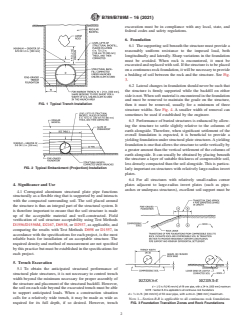
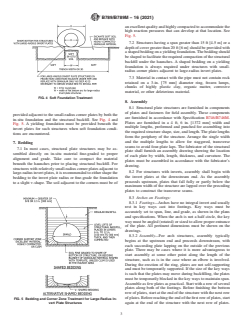
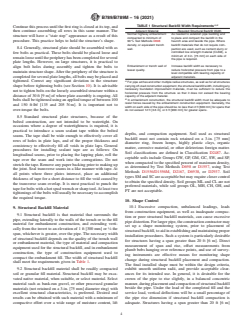
1.1 This practice covers procedures, soils, and soil placement for the proper installation of corrugated aluminum structural plate culverts and sewers in either trench or embankment installations. A typical trench installation is shown in Fig. 1, and a typical embankment (projection) installation is shown in Fig. 2. Structural plate structures as described herein are those structures factory fabricated in plate form and bolted together on site to provide the required shape, size, and length of structure. This practice applies to structures designed in accordance with Practice B790/B790M.
FIG. 1 Typical Trench Installation
FIG. 2 Typical Embankment (Projection) Installation
1.2 The values stated in either inch-pound units or SI units are to be regarded separately as standard. Within the text, the SI units are shown in brackets. The values stated in each system are not exact equivalents; therefore, each system shall be used independently of the other. Combining values from the two systems may result in nonconformance with the standard.
1.3 This standard does not purport to address all of the safety concerns, if any, associated with its use. It is the responsibility of the user of this standard to establish appropriate safety, health, and environmental practices and determine the applicability of regulatory limitations prior to use.
1.4 This international standard was developed in accordance with internationally recognized principles on standardization established in the Decision on Principles for the Development of International Standards, Guides and Recommendations issued by the World Trade Organization Technical Barriers to Trade (TBT) Committee.
- Status
- Published
- Publication Date
- 30-Apr-2021
- Technical Committee
- B07 - Light Metals and Alloys
Overview
ASTM B789/B789M-16(2021) establishes a standard practice for the installation of corrugated aluminum structural plate pipes for use in culverts and sewers. Developed by ASTM International, this standard provides recommended procedures for preparation, soil placement, assembly, and backfilling required to ensure the structural performance of installed aluminum structural plate pipes. The document covers both trench and embankment (projection) installations, addressing the critical interaction between the pipe and compacted surrounding soil, which together form an integral part of the structural system.
Ensuring proper installation, bedding, compaction, and verification are vital for achieving durability, load-support capabilities, and long service life for underground culvert and sewer installations.
Key Topics
Scope and Applicability
- Applies to field-assembled corrugated aluminum structural plate pipe, pipe-arches, and arches, designed in accordance with ASTM B790/B790M.
- Covers installation in both trench and embankment conditions.
Importance of Soil-Structure Interaction
- Emphasizes the role of properly compacted surrounding soil as a structural component.
- Requires field verification of soil density and quality using methods compatible with ASTM D1556/D1556M, D2167, D6938, or D2937.
Foundation and Bedding Preparation
- Focuses on achieving uniform foundation support, avoiding abrupt foundation changes, and providing bedding if rock is present.
- Recommends shaped bedding or v-shaped foundations for certain structure types and site conditions.
Structural Plate Assembly
- Details on bolted field assembly of plate sections.
- Discussion of appropriate tightening torque and procedures for maintaining correct shape during assembly.
Backfilling and Compaction
- Guidance on width, material quality, and compaction of structural backfill.
- Distinguishes between structural backfill and regular backfill, with emphasis on preventing structural distortion through uniform compaction.
- Recommends preferred soil types and highlights quality checks against standards such as ASTM D698 and D1557.
Safety and Compliance
- Highlights the need for adherence to local, state, and federal safety, health, and environmental regulations during installation.
Applications
This ASTM standard is used in a wide variety of civil and infrastructure projects where the performance and longevity of underground culverts and sewer systems are essential. Typical applications include:
- Highway and railway culverts
- Stormwater and sanitary sewer conduits
- Drainage structures below embankments or roads
- Underpasses and access tunnels
Designed for projects requiring factory-fabricated, bolted-together aluminum structures with flexibility and durability, this standard ensures that installation methods support both immediate and long-term structural requirements. It is applicable for both public and private sector construction, rehabilitation, or expansion of underground water management and transportation conduits.
Related Standards
Implementers of ASTM B789/B789M-16(2021) should be aware of closely related standards, which provide essential supporting requirements and test methods:
- ASTM B790/B790M - Practice for Structural Design of Corrugated Aluminum Pipe, Pipe-Arches, and Arches
- ASTM B746/B746M - Specification for Corrugated Aluminum Alloy Structural Plate for Field-Bolted Pipe, Pipe-Arches, and Arches
- ASTM D1556/D1556M - Test Method for Density and Unit Weight of Soil in Place by Sand-Cone Method
- ASTM D2167 - Test Method for Density and Unit Weight of Soil in Place by the Rubber Balloon Method
- ASTM D6938 - Test Methods for In-Place Density and Water Content of Soil and Soil-Aggregate by Nuclear Methods
- ASTM D698 - Test Methods for Laboratory Compaction Characteristics of Soil Using Standard Effort
- ASTM D1557 - Test Methods for Laboratory Compaction Characteristics of Soil Using Modified Effort
- ASTM D2487 - Practice for Classification of Soils for Engineering Purposes
Practical Value
Proper adherence to ASTM B789/B789M-16(2021) significantly reduces risks of premature failure, distortion, or reduced capacity of culvert and sewer systems. By following these standardized installation procedures and testing protocols, engineers, contractors, and project owners can ensure reliable, safe, and long-lasting underground infrastructure. The standard supports enhanced project quality, regulatory compliance, and overall service performance for corrugated aluminum structural plate pipe installations.
Relations
- Effective Date
- 01-May-2022
- Effective Date
- 15-Dec-2017
- Effective Date
- 15-Dec-2017
- Effective Date
- 01-Mar-2017
- Refers
ASTM D2937-17 - Standard Test Method for Density of Soil in Place by the Drive-Cylinder Method - Effective Date
- 01-Feb-2017
- Refers
ASTM D2937-17e1 - Standard Test Method for Density of Soil in Place by the Drive-Cylinder Method - Effective Date
- 01-Feb-2017
- Refers
ASTM D2937-17e2 - Standard Test Method for Density of Soil in Place by the Drive-Cylinder Method - Effective Date
- 01-Feb-2017
- Effective Date
- 01-Aug-2015
- Effective Date
- 01-Jul-2015
- Effective Date
- 01-Feb-2015
- Effective Date
- 01-Feb-2015
- Effective Date
- 01-May-2012
- Effective Date
- 01-May-2012
- Effective Date
- 01-May-2012
- Effective Date
- 01-May-2012
Get Certified
Connect with accredited certification bodies for this standard

DIBt (Deutsches Institut für Bautechnik)
German Institute for Building Technology.
DIN CERTCO
DIN Group product certification.

Aboma Certification B.V.
Specialized in construction, metal, and transport sectors.
Sponsored listings
Frequently Asked Questions
ASTM B789/B789M-16(2021) is a standard published by ASTM International. Its full title is "Standard Practice for Installing Corrugated Aluminum Structural Plate Pipe for Culverts and Sewers". This standard covers: SIGNIFICANCE AND USE 4.1 Corrugated aluminum structural plate pipe functions structurally as a flexible ring that is supported by and interacts with the compacted surrounding soil. The soil placed around the structure is thus an integral part of the structural system. It is therefore important to ensure that the soil structure is made up of the acceptable material and well-constructed. Field verification of soil structure acceptability using Test Methods D1556/D1556M, D2167, D6938, or D2937, as applicable, and comparing the results with Test Methods D698 or D1557, in accordance with the specifications for each project, is the most reliable basis for installation of an acceptable structure. The required density and method of measurement are not specified by this practice but must be established in the specifications for each project. SCOPE 1.1 This practice covers procedures, soils, and soil placement for the proper installation of corrugated aluminum structural plate culverts and sewers in either trench or embankment installations. A typical trench installation is shown in Fig. 1, and a typical embankment (projection) installation is shown in Fig. 2. Structural plate structures as described herein are those structures factory fabricated in plate form and bolted together on site to provide the required shape, size, and length of structure. This practice applies to structures designed in accordance with Practice B790/B790M. FIG. 1 Typical Trench Installation FIG. 2 Typical Embankment (Projection) Installation 1.2 The values stated in either inch-pound units or SI units are to be regarded separately as standard. Within the text, the SI units are shown in brackets. The values stated in each system are not exact equivalents; therefore, each system shall be used independently of the other. Combining values from the two systems may result in nonconformance with the standard. 1.3 This standard does not purport to address all of the safety concerns, if any, associated with its use. It is the responsibility of the user of this standard to establish appropriate safety, health, and environmental practices and determine the applicability of regulatory limitations prior to use. 1.4 This international standard was developed in accordance with internationally recognized principles on standardization established in the Decision on Principles for the Development of International Standards, Guides and Recommendations issued by the World Trade Organization Technical Barriers to Trade (TBT) Committee.
SIGNIFICANCE AND USE 4.1 Corrugated aluminum structural plate pipe functions structurally as a flexible ring that is supported by and interacts with the compacted surrounding soil. The soil placed around the structure is thus an integral part of the structural system. It is therefore important to ensure that the soil structure is made up of the acceptable material and well-constructed. Field verification of soil structure acceptability using Test Methods D1556/D1556M, D2167, D6938, or D2937, as applicable, and comparing the results with Test Methods D698 or D1557, in accordance with the specifications for each project, is the most reliable basis for installation of an acceptable structure. The required density and method of measurement are not specified by this practice but must be established in the specifications for each project. SCOPE 1.1 This practice covers procedures, soils, and soil placement for the proper installation of corrugated aluminum structural plate culverts and sewers in either trench or embankment installations. A typical trench installation is shown in Fig. 1, and a typical embankment (projection) installation is shown in Fig. 2. Structural plate structures as described herein are those structures factory fabricated in plate form and bolted together on site to provide the required shape, size, and length of structure. This practice applies to structures designed in accordance with Practice B790/B790M. FIG. 1 Typical Trench Installation FIG. 2 Typical Embankment (Projection) Installation 1.2 The values stated in either inch-pound units or SI units are to be regarded separately as standard. Within the text, the SI units are shown in brackets. The values stated in each system are not exact equivalents; therefore, each system shall be used independently of the other. Combining values from the two systems may result in nonconformance with the standard. 1.3 This standard does not purport to address all of the safety concerns, if any, associated with its use. It is the responsibility of the user of this standard to establish appropriate safety, health, and environmental practices and determine the applicability of regulatory limitations prior to use. 1.4 This international standard was developed in accordance with internationally recognized principles on standardization established in the Decision on Principles for the Development of International Standards, Guides and Recommendations issued by the World Trade Organization Technical Barriers to Trade (TBT) Committee.
ASTM B789/B789M-16(2021) is classified under the following ICS (International Classification for Standards) categories: 91.140.80 - Drainage systems. The ICS classification helps identify the subject area and facilitates finding related standards.
ASTM B789/B789M-16(2021) has the following relationships with other standards: It is inter standard links to ASTM B746/B746M-22e1, ASTM D2487-17e1, ASTM D2487-17, ASTM D6938-17, ASTM D2937-17, ASTM D2937-17e1, ASTM D2937-17e2, ASTM D6938-15, ASTM D2167-15, ASTM D1556/D1556M-15, ASTM D1556/D1556M-15e1, ASTM B746/B746M-02(2012), ASTM D698-12e1, ASTM D698-12, ASTM D1557-12. Understanding these relationships helps ensure you are using the most current and applicable version of the standard.
ASTM B789/B789M-16(2021) is available in PDF format for immediate download after purchase. The document can be added to your cart and obtained through the secure checkout process. Digital delivery ensures instant access to the complete standard document.
Standards Content (Sample)
This international standard was developed in accordance with internationally recognized principles on standardization established in the Decision on Principles for the
Development of International Standards, Guides and Recommendations issued by the World Trade Organization Technical Barriers to Trade (TBT) Committee.
Designation: B789/B789M − 16 (Reapproved 2021)
Standard Practice for
Installing Corrugated Aluminum Structural Plate Pipe for
Culverts and Sewers
This standard is issued under the fixed designation B789/B789M; the number immediately following the designation indicates the year
of original adoption or, in the case of revision, the year of last revision. A number in parentheses indicates the year of last reapproval.
A superscript epsilon (´) indicates an editorial change since the last revision or reapproval.
1. Scope Structural Plate for Field-Bolted Pipe, Pipe-Arches, and
Arches
1.1 This practice covers procedures, soils, and soil place-
B790/B790M Practice for Structural Design of Corrugated
ment for the proper installation of corrugated aluminum
Aluminum Pipe, Pipe-Arches, and Arches for Culverts,
structural plate culverts and sewers in either trench or embank-
Storm Sewers, and Other Buried Conduits
ment installations.Atypical trench installation is shown in Fig.
D698 Test Methods for Laboratory Compaction Character-
1, and a typical embankment (projection) installation is shown
istics of Soil Using Standard Effort (12,400 ft-lbf/ft (600
in Fig. 2. Structural plate structures as described herein are
kN-m/m ))
those structures factory fabricated in plate form and bolted
D1556/D1556M Test Method for Density and Unit Weight
together on site to provide the required shape, size, and length
of Soil in Place by Sand-Cone Method
of structure. This practice applies to structures designed in
D1557 Test Methods for Laboratory Compaction Character-
accordance with Practice B790/B790M.
istics of Soil Using Modified Effort (56,000 ft-lbf/ft
1.2 The values stated in either inch-pound units or SI units
(2,700 kN-m/m ))
are to be regarded separately as standard. Within the text, the
D2167 Test Method for Density and Unit Weight of Soil in
SI units are shown in brackets. The values stated in each
Place by the Rubber Balloon Method
system are not exact equivalents; therefore, each system shall
D2487 Practice for Classification of Soils for Engineering
be used independently of the other. Combining values from the
Purposes (Unified Soil Classification System)
two systems may result in nonconformance with the standard.
D2937 Test Method for Density of Soil in Place by the
1.3 This standard does not purport to address all of the
Drive-Cylinder Method
safety concerns, if any, associated with its use. It is the D6938 TestMethodsforIn-PlaceDensityandWaterContent
responsibility of the user of this standard to establish appro-
of Soil and Soil-Aggregate by Nuclear Methods (Shallow
priate safety, health, and environmental practices and deter-
Depth)
mine the applicability of regulatory limitations prior to use.
1.4 This international standard was developed in accor-
3. Terminology
dance with internationally recognized principles on standard-
3.1 Definitions of Terms Specific to This Standard:
ization established in the Decision on Principles for the
3.1.1 arch, n—segment of a circular shape spanning an open
Development of International Standards, Guides and Recom-
invert between the footings on which it rests.
mendations issued by the World Trade Organization Technical
3.1.2 bedding, n—earth or other material on which a pipe is
Barriers to Trade (TBT) Committee.
supported.
2. Referenced Documents
3.1.3 haunch, n—portion of the pipe cross section between
the maximum horizontal dimension and the top of the bedding.
2.1 ASTM Standards:
B746/B746M Specification for CorrugatedAluminumAlloy 3.1.4 invert, n—lowest point on the pipe cross section; also,
the bottom portion of a pipe.
3.1.5 pipe, n—conduit having a full circular shape; also, in
This practice is under the jurisdiction of ASTM Committee B07 on Light
a general context, all structure shapes covered by this specifi-
Metals and Alloys and is the direct responsibility of Subcommittee B07.08 on
Corrugated Aluminum Pipe and Corrugated Aluminum Structural Plate. cation.
Current edition approved May 1, 2021. Published June 2021. Originally
3.1.6 pipe-arch, n—pipe with an approximate semicircular
approved in 1988. Last previous edition approved in 2016 as B789/B789M – 16.
crown, small-radius corners, and large-radius invert.
DOI: 10.1520/B0789_B0789M-16R21.
For referenced ASTM standards, visit the ASTM website, www.astm.org, or
3.1.7 underpass, n—pipe with an approximate semicircular
contact ASTM Customer Service at service@astm.org. For Annual Book of ASTM
crown, large-radius sides, small-radius corners between sides
Standards volume information, refer to the standard’s Document Summary page on
the ASTM website. and invert, and large-radius invert.
Copyright © ASTM International, 100 Barr Harbor Drive, PO Box C700, West Conshohocken, PA 19428-2959. United States
B789/B789M − 16 (2021)
excavation must be in compliance with any local, state, and
federal codes and safety regulations.
6. Foundation
6.1 The supporting soil beneath the structure must provide a
reasonably uniform resistance to the imposed load, both
longitudinally and laterally. Sharp variations in the foundation
must be avoided. When rock is encountered, it must be
excavatedandreplacedwithsoil.Ifthestructureistobeplaced
onacontinuousrockfoundation,itwillbenecessarytoprovide
a bedding of soil between the rock and the structure. See Fig.
3.
6.2 Lateral changes in foundation should never be such that
the structure is firmly supported while the backfill on either
side is not.When soft material is encountered in the foundation
and must be removed to maintain the grade on the structure,
FIG. 1 Typical Trench Installation
then it must be removed, usually for a minimum of three
structure widths. See Fig. 4. A smaller width of removal can
sometimes be used if established by the engineer.
6.3 Performance of buried structures is enhanced by allow-
ing the structure to settle slightly relative to the columns of
earth alongside. Therefore, when significant settlement of the
overall foundation is expected, it is beneficial to provide a
yieldingfoundationunderstructuralplatestructures.Ayielding
foundationisonethatallowsthestructuretosettleverticallyby
a greater amount than the vertical settlement of the columns of
earth alongside. It can usually be obtained by placing beneath
the structure a layer of suitable thickness of compressible soil,
less densely compacted than the soil alongside. This is particu-
FIG. 2 Typical Embankment (Projection) Installation
larly important on structures with relatively large-radius invert
plates.
6.4 For all structures with relatively small-radius corner
plates adjacent to large-radius invert plates (such as pipe-
4. Significance and Use
arches or underpass structures), excellent soil support must be
4.1 Corrugated aluminum structural plate pipe functions
structurally as a flexible ring that is supported by and interacts
with the compacted surrounding soil. The soil placed around
the structure is thus an integral part of the structural system. It
is therefore important to ensure that the soil structure is made
up of the acceptable material and well-constructed. Field
verification of soil structure acceptability using Test Methods
D1556/D1556M, D2167, D6938,or D2937, as applicable, and
comparing the results with Test Methods D698 or D1557,in
accordance with the specifications for each project, is the most
reliable basis for installation of an acceptable structure. The
required density and method of measurement are not specified
by this practice but must be established in the specifications for
each project.
5. Trench Excavation
5.1 To obtain the anticipated structural performance of
structural plate structures, it is not necessary to control trench
width beyond the minimum necessary for proper assembly of
the structure and placement of the structural backfill. However,
the soil on each side beyond the excavated trench must be able
to support anticipated loads. When a construction situation 1
d = ⁄2 in./ft. [40 mm/m] of fill over pipe, with a 24-in. [600 mm] maximum.
calls for a relatively wide trench, it may be made as wide as
NOTE 1—Section B-B is applicable to all continuous rock foundations
required for its full depth, if so desired. However, trench FIG. 3 Foundation Transition Zones and Rock Foundations
B789/B789M − 16 (2021)
an excellent quality and highly compacted to accommodate the
high reaction pressures that can develop at that location. See
Fig. 5.
7.2 Structures having a span greater than 15 ft [4.5 m] or a
depth of cover greater than 20 ft [6 m] should be provided with
ashapedbeddingonayieldingfoundation.Thebeddingshould
be shaped to facilitate the required compaction of the structural
backfill under the haunches. A shaped bedding on a yielding
foundation is always required under structures with small-
radius corner plates adjacent to large-radius invert plates.
7.3 Material in contact with the pipe must not contain rock
retained on a 3-in. [75 mm] diameter ring, frozen lumps,
chunks of highly plastic clay, organic matter, corrosive
material, or other deleterious material.
FIG. 4 Soft Foundation Treatment
8. Assembly
8.1 Structural plate structures are furnished in components
of plates and fasteners for field assembly. These components
provided adjacent to the small-radius corner plates by both the
are furnished in accordance with Specification B746/B746M.
in-situ foundation and the structural backfill. See Fig. 4 and
Plates are furnished in a 4 ft, 6 in. [1372 mm] width and
Fig. 5. A yielding foundation must be provided beneath the
multiple lengths, preformed and punched for assembling into
invert plates for such structures when soft foundation condi-
the required structure shape, size, and length.The plate lengths
tions are encountered.
form the periphery of the structure. Arrange the single width
and the multiple lengths to allow for staggered, transverse
7. Bedding
seams to avoid four-plate laps. The fabricator of the structural
7.1 In most cases, structural plate structures may be as-
plate shall furnish an assembly drawing showing the location
sembled directly on in-situ material fine-graded to proper
of each plate by width, length, thickness, and curvature. The
alignment and grade. Take care to compact the material
plates must be assembled in accordance with the fabricator’s
beneath the haunches prior to placing structural backfill. For
drawing.
structures with relatively small-radius corner plates adjacent to
8.2 For structures with inverts, assembly shall begin with
large-radiusinvertplates,itisrecommendedtoeithershapethe
the invert plates at the downstream end. As the assembly
bedding to the invert plate radius or fine-grade the foundation
proceeds upstream, plates that fall fully or partly below the
to a slight v-shape. The soil adjacent to the corners must be of
maximum width of the structure are lapped over the preceding
plates to construct the transverse seams.
8.3 Arches on Footings:
8.3.1 Footings—Arches have no integral invert and usually
rest in key ways cast into footings. Key ways must be
accurately set to span, line, and grade, as shown in the plans
and specifications. When the arch is not a half circle, the key
way must be angled (rotated) or sized to allow proper entrance
of the plate. All pertinent dimensions must be shown on the
drawings.
8.3.2 Assembly—For arch structures, assembly typically
begins at the upstream end and proceeds downstream, with
each succeeding plate lapping on the outside of the previous
plate. There may be cases where it is more advantageous to
start assembly at some other point along the length of the
structure, such as is in the case where an elbow is involved.
During the erection of the ring, plates are not self-supporting
and must be temporarily supported. If the size of the key ways
is such that the plates may move during backfilling, the plates
must be temporarily blocked in the key ways to maintain span.
Assemble as few plates as practical. Start with a row of several
plates along both of the footings. Before finishing the bottom
row of plates, start at the end of the structure with the next row
ofplates.Beforereachingtheendofthefirstrowofplates,start
FIG. 5 Bedding and Corner Zone Treatment for Large-Radius In-
vert Plate Structures again at the end of the structure with the next row of plates.
B789/B789M − 16 (2021)
A,B
TABLE 1 Structural Backfill Width Requirements
Continue this process until the first ring is closed at its top, and
Adjacent Material Required Structural Backfill Width
then continue assembling all rows in this same manner. The
Normal highway embankment As needed to establish pipe bedding and
structure will have a “stair step” appearance as a result of this
compacted to minimum of to place and compact the backfill in the
procedure. This practice helps to hold the structure’s shape.
90 % Test Methods D698 haunch area and beside the pipe. Where
density, or equivalent trench backfill materials that do not require com-
8.4 Generally, structural plate should be assembled with as
wall. paction are used, such as cement slurry or
controlled low strength material (CLSM), a
few bolts as practical. These b
...