

ASTM B788/B788M-09(2020)
(Practice)Standard Practice for Installing Factory-Made Corrugated Aluminum Culverts and Storm Sewer Pipe
General Information
- Abstract
SIGNIFICANCE AND USE
4.1 Corrugated aluminum pipe functions structurally as a flexible ring which is supported by and interacts with the compacted surrounding soil. The soil constructed around the pipe is thus an integral part of the structural system. It is therefore important to ensure that the soil structure or backfill is made up of acceptable material and is well-constructed. Field verification of soil structure acceptability using Test Methods D1556/D1556M, D2167, D2937, or D6938 as applicable, and comparing the results with Test Method D698 in accordance with the specifications for each project, is the most reliable basis for installation of an acceptable structure. The required density and method of measurement are not specified by this practice, but they must be established in the specifications for each project.
SCOPE
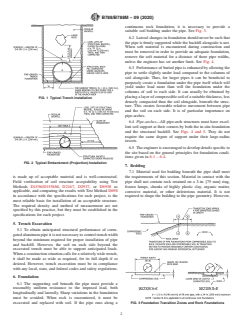
1.1 This practice describes procedures, soils, and soil placement for the proper installation of corrugated aluminum culverts and storm sewers in either trench or projection installations. A typical trench installation is shown in Fig. 1, and a typical embankment (projection) installation is shown in Fig. 2. The pipes described in this practice are manufactured in a factory and furnished to the job in lengths ordinarily from 10 to 30 ft [3 to 9 m], with 20 ft [6 m] being common, for field joining. This practice applies to structures designed in accordance with Practice B790/B790M.
FIG. 1 Typical Trench Installation
FIG. 2 Typical Embankment (Projection) Installation
1.2 The values stated in either SI units or inch-pound units are to be regarded separately as standard. The values stated in each system are not necessarily exact equivalents; therefore, to ensure conformance with the standard, each system shall be used independently of the other, and values from the two systems shall not be combined.
1.3 This standard does not purport to address all of the safety concerns, if any, associated with its use. It is the responsibility of the user of this standard to establish appropriate safety, health, and environmental practices and determine the applicability of regulatory limitations prior to use.
1.4 This international standard was developed in accordance with internationally recognized principles on standardization established in the Decision on Principles for the Development of International Standards, Guides and Recommendations issued by the World Trade Organization Technical Barriers to Trade (TBT) Committee.
- Status
- Published
- Publication Date
- 31-Aug-2020
- Technical Committee
- B07 - Light Metals and Alloys
Overview
ASTM B788/B788M-09(2020), Standard Practice for Installing Factory-Made Corrugated Aluminum Culverts and Storm Sewer Pipe, provides comprehensive guidelines for the proper installation of factory-made corrugated aluminum pipes used as culverts and storm sewers. Developed by ASTM International, this standard ensures the long-term structural integrity and function of buried conduits by detailing critical procedures, acceptable materials, and best practices for soil and backfill placement. Proper installation as described in this standard is essential for optimal performance, safety, and environmental sustainability of underground drainage infrastructure.
Key Topics
- Soil-Structure Interaction: Corrugated aluminum pipes act as flexible rings, relying on compacted, properly selected soil for support. Backfill material and installation are integral to the pipe’s structural system.
- Trench and Embankment Installations: The standard covers both trench and projection (embankment) installations, with typical layouts provided to guide field practice.
- Pipe Handling and Joining: Proper unloading, placement, and protection of pipe during installation are emphasized. Joining systems, including gaskets and coupling bands, must be specified and installed per manufacturer guidelines to ensure alignment, structural integrity, and prevent infiltration/exfiltration.
- Foundation and Bedding: The supporting soil must provide uniform resistance to loads. Special attention is needed in cases of rock or soft materials to ensure appropriate bedding beneath the pipe.
- Backfill Requirements: Structural backfill must meet certain material and compaction criteria. Materials such as bank-run gravels and processed granular fills are preferred, while unsuitable materials (e.g., highly plastic clays, organic matter, frozen lumps) must be avoided.
- Compaction and Field Verification: Compaction of the backfill is critical to avoid pipe distortion and ensure proper load distribution. Field density is often verified using ASTM test methods and must comply with project specifications.
- Safety and Quality Control: The standard emphasizes the importance of safety, adherence to regulatory limitations, and site-specific adaptation, underlining the engineer’s responsibility in implementation.
Applications
- Highway and Roadway Drainage: Provides the standard installation practice for storm sewer pipes and culverts beneath roads, highways, and embankments, supporting efficient surface water management.
- Municipal Infrastructure: Applied in urban sewer and stormwater projects to ensure reliable conveyance systems that meet design and durability criteria.
- Construction and Civil Engineering Projects: Used by engineers, contractors, and inspectors to establish uniform installation procedures, reduce failure risk, and comply with regulatory standards.
- Environmental Protection: By supporting leak-free joints and appropriate backfill, the standard helps limit infiltration/exfiltration, thus protecting surrounding soils and groundwater from contamination.
Related Standards
- ASTM B745/B745M - Specification for Corrugated Aluminum Pipe for Sewers and Drains
- ASTM B790/B790M - Practice for Structural Design of Corrugated Aluminum Pipe, Pipe-Arches, and Arches for Buried Conduits
- ASTM D698 - Test Methods for Laboratory Compaction Characteristics of Soil
- ASTM D1556/D1556M - Test Method for Density and Unit Weight of Soil in Place by the Sand-Cone Method
- ASTM D2167 - Test Method for Density and Unit Weight of Soil in Place by the Rubber Balloon Method
- ASTM D2937 - Test Method for Density of Soil in Place by the Drive-Cylinder Method
- ASTM D6938 - Test Methods for In-Place Density and Water Content of Soil by Nuclear Methods
- ASTM D2487 - Practice for Classification of Soils for Engineering Purposes
By adhering to ASTM B788/B788M-09(2020), professionals and organizations ensure the high-quality installation of corrugated aluminum culverts and storm sewer pipes, leading to durable, reliable, and compliant underground drainage systems.
Relations
- Effective Date
- 15-Dec-2017
- Effective Date
- 15-Dec-2017
- Effective Date
- 01-Mar-2017
- Refers
ASTM D2937-17 - Standard Test Method for Density of Soil in Place by the Drive-Cylinder Method - Effective Date
- 01-Feb-2017
- Refers
ASTM D2937-17e2 - Standard Test Method for Density of Soil in Place by the Drive-Cylinder Method - Effective Date
- 01-Feb-2017
- Refers
ASTM D2937-17e1 - Standard Test Method for Density of Soil in Place by the Drive-Cylinder Method - Effective Date
- 01-Feb-2017
- Effective Date
- 01-Aug-2015
- Effective Date
- 01-Jul-2015
- Effective Date
- 01-Feb-2015
- Effective Date
- 01-Feb-2015
- Refers
ASTM B745/B745M-12 - Standard Specification for Corrugated Aluminum Pipe for Sewers and Drains - Effective Date
- 01-Nov-2012
- Effective Date
- 01-May-2012
- Effective Date
- 01-May-2012
- Effective Date
- 01-Nov-2011
- Effective Date
- 01-May-2011
Get Certified
Connect with accredited certification bodies for this standard

DIBt (Deutsches Institut für Bautechnik)
German Institute for Building Technology.
DIN CERTCO
DIN Group product certification.

Aboma Certification B.V.
Specialized in construction, metal, and transport sectors.
Sponsored listings
Frequently Asked Questions
ASTM B788/B788M-09(2020) is a standard published by ASTM International. Its full title is "Standard Practice for Installing Factory-Made Corrugated Aluminum Culverts and Storm Sewer Pipe". This standard covers: SIGNIFICANCE AND USE 4.1 Corrugated aluminum pipe functions structurally as a flexible ring which is supported by and interacts with the compacted surrounding soil. The soil constructed around the pipe is thus an integral part of the structural system. It is therefore important to ensure that the soil structure or backfill is made up of acceptable material and is well-constructed. Field verification of soil structure acceptability using Test Methods D1556/D1556M, D2167, D2937, or D6938 as applicable, and comparing the results with Test Method D698 in accordance with the specifications for each project, is the most reliable basis for installation of an acceptable structure. The required density and method of measurement are not specified by this practice, but they must be established in the specifications for each project. SCOPE 1.1 This practice describes procedures, soils, and soil placement for the proper installation of corrugated aluminum culverts and storm sewers in either trench or projection installations. A typical trench installation is shown in Fig. 1, and a typical embankment (projection) installation is shown in Fig. 2. The pipes described in this practice are manufactured in a factory and furnished to the job in lengths ordinarily from 10 to 30 ft [3 to 9 m], with 20 ft [6 m] being common, for field joining. This practice applies to structures designed in accordance with Practice B790/B790M. FIG. 1 Typical Trench Installation FIG. 2 Typical Embankment (Projection) Installation 1.2 The values stated in either SI units or inch-pound units are to be regarded separately as standard. The values stated in each system are not necessarily exact equivalents; therefore, to ensure conformance with the standard, each system shall be used independently of the other, and values from the two systems shall not be combined. 1.3 This standard does not purport to address all of the safety concerns, if any, associated with its use. It is the responsibility of the user of this standard to establish appropriate safety, health, and environmental practices and determine the applicability of regulatory limitations prior to use. 1.4 This international standard was developed in accordance with internationally recognized principles on standardization established in the Decision on Principles for the Development of International Standards, Guides and Recommendations issued by the World Trade Organization Technical Barriers to Trade (TBT) Committee.
SIGNIFICANCE AND USE 4.1 Corrugated aluminum pipe functions structurally as a flexible ring which is supported by and interacts with the compacted surrounding soil. The soil constructed around the pipe is thus an integral part of the structural system. It is therefore important to ensure that the soil structure or backfill is made up of acceptable material and is well-constructed. Field verification of soil structure acceptability using Test Methods D1556/D1556M, D2167, D2937, or D6938 as applicable, and comparing the results with Test Method D698 in accordance with the specifications for each project, is the most reliable basis for installation of an acceptable structure. The required density and method of measurement are not specified by this practice, but they must be established in the specifications for each project. SCOPE 1.1 This practice describes procedures, soils, and soil placement for the proper installation of corrugated aluminum culverts and storm sewers in either trench or projection installations. A typical trench installation is shown in Fig. 1, and a typical embankment (projection) installation is shown in Fig. 2. The pipes described in this practice are manufactured in a factory and furnished to the job in lengths ordinarily from 10 to 30 ft [3 to 9 m], with 20 ft [6 m] being common, for field joining. This practice applies to structures designed in accordance with Practice B790/B790M. FIG. 1 Typical Trench Installation FIG. 2 Typical Embankment (Projection) Installation 1.2 The values stated in either SI units or inch-pound units are to be regarded separately as standard. The values stated in each system are not necessarily exact equivalents; therefore, to ensure conformance with the standard, each system shall be used independently of the other, and values from the two systems shall not be combined. 1.3 This standard does not purport to address all of the safety concerns, if any, associated with its use. It is the responsibility of the user of this standard to establish appropriate safety, health, and environmental practices and determine the applicability of regulatory limitations prior to use. 1.4 This international standard was developed in accordance with internationally recognized principles on standardization established in the Decision on Principles for the Development of International Standards, Guides and Recommendations issued by the World Trade Organization Technical Barriers to Trade (TBT) Committee.
ASTM B788/B788M-09(2020) is classified under the following ICS (International Classification for Standards) categories: 91.140.80 - Drainage systems. The ICS classification helps identify the subject area and facilitates finding related standards.
ASTM B788/B788M-09(2020) has the following relationships with other standards: It is inter standard links to ASTM D2487-17e1, ASTM D2487-17, ASTM D6938-17, ASTM D2937-17, ASTM D2937-17e2, ASTM D2937-17e1, ASTM D6938-15, ASTM D2167-15, ASTM D1556/D1556M-15e1, ASTM D1556/D1556M-15, ASTM B745/B745M-12, ASTM D698-12e1, ASTM D698-12, ASTM B790/B790M-11, ASTM D2487-11. Understanding these relationships helps ensure you are using the most current and applicable version of the standard.
ASTM B788/B788M-09(2020) is available in PDF format for immediate download after purchase. The document can be added to your cart and obtained through the secure checkout process. Digital delivery ensures instant access to the complete standard document.
Standards Content (Sample)
This international standard was developed in accordance with internationally recognized principles on standardization established in the Decision on Principles for the
Development of International Standards, Guides and Recommendations issued by the World Trade Organization Technical Barriers to Trade (TBT) Committee.
Designation: B788/B788M − 09 (Reapproved 2020)
Standard Practice for
Installing Factory-Made Corrugated Aluminum Culverts and
Storm Sewer Pipe
This standard is issued under the fixed designation B788/B788M; the number immediately following the designation indicates the year
of original adoption or, in the case of revision, the year of last revision. A number in parentheses indicates the year of last reapproval.
A superscript epsilon (´) indicates an editorial change since the last revision or reapproval.
This standard has been approved for use by agencies of the U.S. Department of Defense.
1. Scope B745/B745M Specification for Corrugated Aluminum Pipe
for Sewers and Drains
1.1 This practice describes procedures, soils, and soil place-
B790/B790M Practice for Structural Design of Corrugated
ment for the proper installation of corrugated aluminum
Aluminum Pipe, Pipe-Arches, and Arches for Culverts,
culverts and storm sewers in either trench or projection
Storm Sewers, and Other Buried Conduits
installations. A typical trench installation is shown in Fig. 1,
D698 Test Methods for Laboratory Compaction Character-
and a typical embankment (projection) installation is shown in
istics of Soil Using Standard Effort (12,400 ft-lbf/ft (600
Fig. 2. The pipes described in this practice are manufactured in
kN-m/m ))
a factory and furnished to the job in lengths ordinarily from 10
D1556/D1556M Test Method for Density and Unit Weight
to 30 ft [3 to 9 m], with 20 ft [6 m] being common, for field
of Soil in Place by Sand-Cone Method
joining. This practice applies to structures designed in accor-
D2167 Test Method for Density and Unit Weight of Soil in
dance with Practice B790/B790M.
Place by the Rubber Balloon Method
1.2 The values stated in either SI units or inch-pound units
D2487 Practice for Classification of Soils for Engineering
are to be regarded separately as standard. The values stated in
Purposes (Unified Soil Classification System)
each system are not necessarily exact equivalents; therefore, to
D2937 Test Method for Density of Soil in Place by the
ensure conformance with the standard, each system shall be
Drive-Cylinder Method
used independently of the other, and values from the two
D6938 TestMethodsforIn-PlaceDensityandWaterContent
systems shall not be combined.
of Soil and Soil-Aggregate by Nuclear Methods (Shallow
1.3 This standard does not purport to address all of the
Depth)
safety concerns, if any, associated with its use. It is the
responsibility of the user of this standard to establish appro- 3. Terminology
priate safety, health, and environmental practices and deter-
3.1 Definitions of Terms Specific to This Standard:
mine the applicability of regulatory limitations prior to use.
3.1.1 bedding, n—the earth or other material on which a
1.4 This international standard was developed in accor-
pipe is supported.
dance with internationally recognized principles on standard-
3.1.2 haunch, n—the portion of the pipe cross section
ization established in the Decision on Principles for the
between the maximum horizontal dimension and the top of the
Development of International Standards, Guides and Recom-
bedding.
mendations issued by the World Trade Organization Technical
3.1.3 invert, n—the lowest point on the pipe cross section;
Barriers to Trade (TBT) Committee.
also, the bottom portion of a pipe.
2. Referenced Documents
3.1.4 pipe, n—a conduit having full circular shape; also, in
2.1 ASTM Standards: a general context, all structure shapes covered by this practice.
3.1.5 pipe-arch, n—a pipe with an approximate semicircular
crown, small-radius corners, and large-radius invert.
This practice is under the jurisdiction of ASTM Committee B07 on Light
Metals and Alloys and is the direct responsibility of Subcommittee B07.08 on
Corrugated Aluminum Pipe and Corrugated Aluminum Structural Plate.
4. Significance and Use
Current edition approved Sept. 1, 2020. Published September 2020. Originally
4.1 Corrugated aluminum pipe functions structurally as a
approved in 1988. Last previous edition approved in 2014 as B788/
B788M – 09 (2014). DOI: 10.1520/B0788_B0788M-09R20.
flexible ring which is supported by and interacts with the
For referenced ASTM standards, visit the ASTM website, www.astm.org, or
compacted surrounding soil. The soil constructed around the
contact ASTM Customer Service at service@astm.org. For Annual Book of ASTM
pipe is thus an integral part of the structural system. It is
Standards volume information, refer to the standard’s Document Summary page on
the ASTM website. therefore important to ensure that the soil structure or backfill
Copyright © ASTM International, 100 Barr Harbor Drive, PO Box C700, West Conshohocken, PA 19428-2959. United States
B788/B788M − 09 (2020)
continuous rock foundation, it is necessary to provide a
suitable soil bedding under the pipe. See Fig. 3.
6.2 Lateral changes in foundation should never be such that
the pipe is firmly supported while the backfill alongside is not.
When soft material is encountered during construction and
must be removed in order to provide an adequate foundation,
remove the soft material for a distance of three pipe widths,
unless the engineer has set another limit. See Fig. 4.
6.3 Performance of buried pipe is enhanced by allowing the
pipe to settle slightly under load compared to the columns of
soil alongside. Thus, for larger pipes it can be beneficial to
purposely create a foundation under the pipe itself which will
yield under load more than will the foundation under the
columns of soil to each side. It can usually be obtained by
placing a layer of compressible soil of a suitable thickness, less
FIG. 1 Typical Trench Installation
densely compacted than the soil alongside, beneath the struc-
ture. This creates favorable relative movement between pipe
and the soil on each side. It is of particular importance on
pipe-arches.
6.4 Pipe-arches—All pipe-arch structures must have excel-
lent soil support at their corners by both the in-situ foundation
and the structural backfill. See Figs. 4 and 5. They do not
require the same degree of support under their large-radius
inverts.
6.5 Theengineerisencouragedtodevelopdetailsspecificto
the site based on the general principles for foundation condi-
tions given in 6.1 – 6.4.
FIG. 2 Typical Embankment (Projection) Installation
7. Bedding
7.1 Material used for bedding beneath the pipe shall meet
is made up of acceptable material and is well-constructed. the requirements of this section. Material in contact with the
Field verification of soil structure acceptability using Test
pipe shall not contain rock retained on a 3-in. [75 mm] ring,
Methods D1556/D1556M, D2167, D2937,or D6938 as
frozen lumps, chunks of highly plastic clay, organic matter,
applicable, and comparing the results with Test Method D698
corrosive material, or other deleterious material. It is not
in accordance with the specifications for each project, is the
required to shape the bedding to the pipe geometry. However,
most reliable basis for installation of an acceptable structure.
The required density and method of measurement are not
specified by this practice, but they must be established in the
specifications for each project.
5. Trench Excavation
5.1 To obtain anticipated structural performance of corru-
gated aluminum pipe it is not necessary to control trench width
beyond the minimum required for proper installation of pipe
and backfill. However, the soil on each side beyond the
excavated trench must be able to support anticipated loads.
Whenaconstructionsituationcallsforarelativelywidetrench,
it shall be made as wide as required, for its full depth if so
desired. However, trench excavation must be in compliance
with any local, state, and federal codes and safety regulations.
6. Foundation
6.1 The supporting soil beneath the pipe must provide a
reasonably uniform resistance to the imposed load, both
longitudinally and laterally. Sharp variations in the foundation
must be avoided. When rock is encountered, it must be
excavated and replaced with soil. If the pipe runs along a FIG. 3 Foundation Transition Zones and Rock Foundations
B788/B788M − 09 (2020)
continuous flow line, and (4) to limit the amount of infiltration
of backfill material into the pipe and to limit exfiltration of the
flow through the pipe.
8.2.2 Joint System Components—The joining system shall
be specified by the project engineer. The components shall
conform to the requirements of Specification B745/B745M.
The pipe fabricator shall provide the components specified for
the project or as designated by the fabricator in accordance
with Specification B745/B745M, Ordering Information. Con-
formance of the joining system components with the project
requirements shall be verified upon delivery to the project site.
8.2.3 Joining System Installation—The performance of the
pipe line and the joining system will be achieved only when all
components of the pipe system are properly installed. As an
integral portion of the pipe system, the joining system must be
assembled in accordance with the details in the project draw-
FIG. 4 Soft Foundation Treatment
ings or the recommendations provided by the pipe fabricator.
8.2.3.1 Gaskets—If gaskets are a required component of the
joining system, they shall be placed on the pipe ends, at the
requiredlocationonthepipe,priortoinstallationofthecoupler
orbands,orpriortostabbingabellandspigotjoint.Forjoining
systems incorporating o-rings(s), the o-ring shall be placed on
the spigot end of the pipe when the joint is a stab-type joining
system, or one shall be placed on each end of the pipes that
form a joining system that incorporates a coupling band. If the
joining system includes a flat gasket, the gasket shall be placed
over the end of the pipe previously placed and extended over
the end of the adjacent pipe after it is positioned. In lieu of a
single flat gasket, two smaller flat gaskets may be used with
one gasket on the end of the pipe forming the joint. For pipe
supplied with a factory installed band or coupler, no field
installed gasket will be required on the pipe end with the
factory installed device. When recommended by the
manufacturer, lubricant shall be applied to the designated
surfaces. Once installed, the gasket shall be protected against
damage until the joint is completely installed.
FIG. 5 Bedding and Corner Zone Treatment for Pipe-arch Struc-
8.2.3.2 Coupling Bands—Coupling bands shall be placed on
tures
the end of the last pipe installed. When installing two-part
bands, the first portion of the band shall be placed to cover the
bottom portion of the pipe. When the subsequent pipe is
for pipe-arches, it is recommended to either shape the bedding
placed, the installation of the joining system is completed to
to the relatively flat bottom arc or fine-grade the foundation to
ensure proper alignment of the pipeline. The width of the
a slight v-shape. This avoids the problem of trying to backfill
opening between pipe ends shall be as recommended by the
the difficult area beneath the invert of pipe-arches. See Fig. 5.
pipe fabricator. The band shall be tightened around the pipe
8. Pipe Installation
ends to the extent necessary to achieve proper performance of
the joining system. The band shall be placed over the pipe
8.1 All pipe shall be unloaded and handled with reasonable
being joined in a manner that matches any corrugations or
care.Pipeshallnotberolledordraggedovergravelorrockand
dimples in the band with the corrugations in the pipe. Follow
shall be prevented from striking rock or other hard objects
the pipe fabricator’s instructions and methods for tightening
during placement on bedding. Pipe with protective coatings
shall be handled with special care to avoid damage. Paved the bands.
inverts shall be placed and centered in the invert.
8.2.3.3 Sleeve Coupler and Bell and Spigot Joining
Systems—When a field installed sleeve coupler is utilized, it
8.2 Joining Systems:
shall be placed on the end of the pipe previously placed. With
8.2.1 Purpose of Joining systems—Joining systems for cor-
a bell and spigot system, the first pipe is to be oriented so the
rugated aluminum pipe serve several purpo
...