

ASTM E2207-15(2021)
(Practice)Standard Practice for Strain-Controlled Axial-Torsional Fatigue Testing with Thin-Walled Tubular Specimens
General Information
- Abstract
SIGNIFICANCE AND USE
4.1 Multiaxial forces often tend to introduce deformation and damage mechanisms that are unique and quite different from those induced under a simple uniaxial loading condition. Since most engineering components are subjected to cyclic multiaxial forces it is necessary to characterize the deformation and fatigue behaviors of materials in this mode. Such a characterization enables reliable prediction of the fatigue lives of many engineering components. Axial-torsional loading is one of several possible types of multiaxial force systems and is essentially a biaxial type of loading. Thin-walled tubular specimens subjected to axial-torsional loading can be used to explore behavior of materials in two of the four quadrants in principal stress or strain spaces. Axial-torsional loading is more convenient than in-plane biaxial loading because the stress state in the thin-walled tubular specimens is constant over the entire test section and is well-known. This practice is useful for generating fatigue life and cyclic deformation data on homogeneous materials under axial, torsional, and combined in- and out-of-phase axial-torsional loading conditions.
SCOPE
1.1 The standard deals with strain-controlled, axial, torsional, and combined in- and out-of-phase axial torsional fatigue testing with thin-walled, circular cross-section, tubular specimens at isothermal, ambient and elevated temperatures. This standard is limited to symmetric, completely-reversed strains (zero mean strains) and axial and torsional waveforms with the same frequency in combined axial-torsional fatigue testing. This standard is also limited to characterization of homogeneous materials with thin-walled tubular specimens and does not cover testing of either large-scale components or structural elements.
1.2 This standard does not purport to address all of the safety concerns, if any, associated with its use. It is the responsibility of the user of this standard to establish appropriate safety, health, and environmental practices and determine the applicability of regulatory limitations prior to use.
1.3 This international standard was developed in accordance with internationally recognized principles on standardization established in the Decision on Principles for the Development of International Standards, Guides and Recommendations issued by the World Trade Organization Technical Barriers to Trade (TBT) Committee.
- Status
- Published
- Publication Date
- 31-May-2021
- Technical Committee
- E08 - Fatigue and Fracture
- Drafting Committee
- E08.05 - Cyclic Deformation and Fatigue Crack Formation
Overview
ASTM E2207-15(2021) is an international standard developed by ASTM International that provides a comprehensive practice for conducting strain-controlled axial-torsional fatigue testing using thin-walled tubular specimens. This standard is essential for accurately characterizing the behavior of materials subjected to cyclic, multiaxial forces - conditions often encountered in real-world engineering applications. By employing thin-walled, circular cross-section specimens, the standard enables the generation of fatigue life and cyclic deformation data under axial, torsional, and combined or out-of-phase loading conditions, at both room and elevated temperatures.
Key Topics
- Multiaxial Fatigue Testing: The standard covers protocols for strain-controlled testing under axial, torsional, and combined in-phase or out-of-phase axial-torsional loading.
- Specimen Requirements: It specifies the use of homogeneous, thin-walled tubular test specimens, detailing preferred dimensions and surface finish to ensure accurate and repeatable results.
- Test Methodology:
- Consistent strain amplitude and frequency application.
- Use of symmetric, completely-reversed strains (zero mean strains).
- Monitoring of key parameters including axial strain, shear strain, torque, and temperature.
- Apparatus and Calibration:
- Requirements for testing machines, transducers, and extensometers to accurately capture axial and torsional loads.
- Emphasis on cross-talk between force and torque transducers not exceeding 1% of full-scale reading.
- Environmental Controls: Procedures for isothermal, ambient, and elevated temperature testing, including guidelines for temperature measurement and control.
- Data Reporting: Mandates comprehensive documentation of test conditions, specimen geometry, material properties, loading waveforms, phase angles, and fatigue data.
Applications
This standard is widely applied in industries where engineered components are subjected to complex loading environments, such as:
- Aerospace: Analysis of airframe and engine components where cyclic multiaxial stresses can lead to unique deformation and failure mechanisms.
- Automotive: Assessment of drive shafts, suspension elements, and other tubular parts that are exposed to combined axial and torsional loads.
- Materials Research: Characterization of metallic and alloy properties under realistic service conditions, aiding in the development and life prediction of advanced materials.
- Energy Sector: Evaluation of pipeline and tubular structural elements in power generation or oil and gas, where multiaxial fatigue is a critical concern.
Following ASTM E2207-15(2021) helps organizations:
- Accurately predict the fatigue life of materials and components under service-like multiaxial loading.
- Compare materials on a uniform basis due to the standardized test procedures.
- Satisfy regulatory and client requirements for component durability validation.
Related Standards
To ensure comprehensive testing and data reliability, ASTM E2207-15(2021) references and aligns with several related ASTM standards:
- ASTM E4: Practices for Force Verification of Testing Machines
- ASTM E83: Practice for Verification and Classification of Extensometer Systems
- ASTM E111: Test Method for Young’s Modulus, Tangent Modulus, and Chord Modulus
- ASTM E143: Test Method for Shear Modulus at Room Temperature
- ASTM E606/E606M: Test Method for Strain-Controlled Fatigue Testing
- ASTM E1012: Practice for Verification of Testing Frame and Specimen Alignment
Each of these standards supports accurate, traceable, and reproducible testing in conjunction with ASTM E2207.
Summary
ASTM E2207-15(2021) is a critical document for laboratories and engineers tasked with measuring and understanding the fatigue behavior of materials under complex axial-torsional loads. It ensures consistency, safety, and technical rigor in fatigue testing on thin-walled tubular specimens, making it invaluable for sectors where durability and multiaxial loading are of paramount concern.
Keywords: axial-torsional fatigue testing, thin-walled tubular specimens, strain-controlled fatigue, ASTM E2207, multiaxial fatigue, cyclic deformation, material fatigue life, combined loading, standardized test methods.
Relations
- Effective Date
- 15-Feb-2024
- Effective Date
- 01-Feb-2024
- Effective Date
- 01-Jan-2024
- Effective Date
- 01-Feb-2020
- Effective Date
- 01-Feb-2018
- Effective Date
- 01-Sep-2017
- Effective Date
- 15-Jul-2016
- Effective Date
- 01-Jun-2016
- Effective Date
- 01-Dec-2015
- Effective Date
- 01-Feb-2015
- Effective Date
- 01-Jun-2014
- Effective Date
- 01-Jun-2013
- Effective Date
- 01-Jun-2013
- Effective Date
- 15-Dec-2012
- Effective Date
- 15-Nov-2012
Get Certified
Connect with accredited certification bodies for this standard

IMP NDT d.o.o.
Non-destructive testing services. Radiography, ultrasonic, magnetic particle, penetrant, visual inspection.
Inštitut za kovinske materiale in tehnologije
Institute of Metals and Technology. Materials testing, metallurgical analysis, NDT.
Q Techna d.o.o.
NDT and quality assurance specialist. 30+ years experience. NDT personnel certification per ISO 9712, nuclear and thermal power plant inspections, QA/
Sponsored listings
Frequently Asked Questions
ASTM E2207-15(2021) is a standard published by ASTM International. Its full title is "Standard Practice for Strain-Controlled Axial-Torsional Fatigue Testing with Thin-Walled Tubular Specimens". This standard covers: SIGNIFICANCE AND USE 4.1 Multiaxial forces often tend to introduce deformation and damage mechanisms that are unique and quite different from those induced under a simple uniaxial loading condition. Since most engineering components are subjected to cyclic multiaxial forces it is necessary to characterize the deformation and fatigue behaviors of materials in this mode. Such a characterization enables reliable prediction of the fatigue lives of many engineering components. Axial-torsional loading is one of several possible types of multiaxial force systems and is essentially a biaxial type of loading. Thin-walled tubular specimens subjected to axial-torsional loading can be used to explore behavior of materials in two of the four quadrants in principal stress or strain spaces. Axial-torsional loading is more convenient than in-plane biaxial loading because the stress state in the thin-walled tubular specimens is constant over the entire test section and is well-known. This practice is useful for generating fatigue life and cyclic deformation data on homogeneous materials under axial, torsional, and combined in- and out-of-phase axial-torsional loading conditions. SCOPE 1.1 The standard deals with strain-controlled, axial, torsional, and combined in- and out-of-phase axial torsional fatigue testing with thin-walled, circular cross-section, tubular specimens at isothermal, ambient and elevated temperatures. This standard is limited to symmetric, completely-reversed strains (zero mean strains) and axial and torsional waveforms with the same frequency in combined axial-torsional fatigue testing. This standard is also limited to characterization of homogeneous materials with thin-walled tubular specimens and does not cover testing of either large-scale components or structural elements. 1.2 This standard does not purport to address all of the safety concerns, if any, associated with its use. It is the responsibility of the user of this standard to establish appropriate safety, health, and environmental practices and determine the applicability of regulatory limitations prior to use. 1.3 This international standard was developed in accordance with internationally recognized principles on standardization established in the Decision on Principles for the Development of International Standards, Guides and Recommendations issued by the World Trade Organization Technical Barriers to Trade (TBT) Committee.
SIGNIFICANCE AND USE 4.1 Multiaxial forces often tend to introduce deformation and damage mechanisms that are unique and quite different from those induced under a simple uniaxial loading condition. Since most engineering components are subjected to cyclic multiaxial forces it is necessary to characterize the deformation and fatigue behaviors of materials in this mode. Such a characterization enables reliable prediction of the fatigue lives of many engineering components. Axial-torsional loading is one of several possible types of multiaxial force systems and is essentially a biaxial type of loading. Thin-walled tubular specimens subjected to axial-torsional loading can be used to explore behavior of materials in two of the four quadrants in principal stress or strain spaces. Axial-torsional loading is more convenient than in-plane biaxial loading because the stress state in the thin-walled tubular specimens is constant over the entire test section and is well-known. This practice is useful for generating fatigue life and cyclic deformation data on homogeneous materials under axial, torsional, and combined in- and out-of-phase axial-torsional loading conditions. SCOPE 1.1 The standard deals with strain-controlled, axial, torsional, and combined in- and out-of-phase axial torsional fatigue testing with thin-walled, circular cross-section, tubular specimens at isothermal, ambient and elevated temperatures. This standard is limited to symmetric, completely-reversed strains (zero mean strains) and axial and torsional waveforms with the same frequency in combined axial-torsional fatigue testing. This standard is also limited to characterization of homogeneous materials with thin-walled tubular specimens and does not cover testing of either large-scale components or structural elements. 1.2 This standard does not purport to address all of the safety concerns, if any, associated with its use. It is the responsibility of the user of this standard to establish appropriate safety, health, and environmental practices and determine the applicability of regulatory limitations prior to use. 1.3 This international standard was developed in accordance with internationally recognized principles on standardization established in the Decision on Principles for the Development of International Standards, Guides and Recommendations issued by the World Trade Organization Technical Barriers to Trade (TBT) Committee.
ASTM E2207-15(2021) is classified under the following ICS (International Classification for Standards) categories: 19.060 - Mechanical testing. The ICS classification helps identify the subject area and facilitates finding related standards.
ASTM E2207-15(2021) has the following relationships with other standards: It is inter standard links to ASTM E1823-24a, ASTM E1823-24, ASTM E8/E8M-24, ASTM E1823-20, ASTM E209-18, ASTM E2624-17, ASTM E8/E8M-16, ASTM E1444/E1444M-16, ASTM E2624-15, ASTM E8/E8M-15, ASTM E4-14, ASTM E1417/E1417M-13, ASTM E8/E8M-13, ASTM E1823-12e, ASTM E112-12. Understanding these relationships helps ensure you are using the most current and applicable version of the standard.
ASTM E2207-15(2021) is available in PDF format for immediate download after purchase. The document can be added to your cart and obtained through the secure checkout process. Digital delivery ensures instant access to the complete standard document.
Standards Content (Sample)
This international standard was developed in accordance with internationally recognized principles on standardization established in the Decision on Principles for the
Development of International Standards, Guides and Recommendations issued by the World Trade Organization Technical Barriers to Trade (TBT) Committee.
Designation: E2207 − 15 (Reapproved 2021)
Standard Practice for
Strain-Controlled Axial-Torsional Fatigue Testing with Thin-
Walled Tubular Specimens
This standard is issued under the fixed designation E2207; the number immediately following the designation indicates the year of
original adoption or, in the case of revision, the year of last revision. A number in parentheses indicates the year of last reapproval. A
superscript epsilon (´) indicates an editorial change since the last revision or reapproval.
1. Scope rials at Room Temperature
E83 Practice for Verification and Classification of Exten-
1.1 The standard deals with strain-controlled, axial,
someter Systems
torsional, and combined in- and out-of-phase axial torsional
E111 Test Method for Young’s Modulus, Tangent Modulus,
fatigue testing with thin-walled, circular cross-section, tubular
and Chord Modulus
specimens at isothermal, ambient and elevated temperatures.
E112 Test Methods for Determining Average Grain Size
This standard is limited to symmetric, completely-reversed
E143 Test Method for Shear Modulus at Room Temperature
strains (zero mean strains) and axial and torsional waveforms
E209 PracticeforCompressionTestsofMetallicMaterialsat
with the same frequency in combined axial-torsional fatigue
Elevated Temperatures with Conventional or Rapid Heat-
testing. This standard is also limited to characterization of
ing Rates and Strain Rates
homogeneous materials with thin-walled tubular specimens
E467 Practice for Verification of Constant Amplitude Dy-
and does not cover testing of either large-scale components or
namic Forces in an Axial Fatigue Testing System
structural elements.
E606/E606M Test Method for Strain-Controlled Fatigue
1.2 This standard does not purport to address all of the
Testing
safety concerns, if any, associated with its use. It is the
E1012 Practice for Verification of Testing Frame and Speci-
responsibility of the user of this standard to establish appro-
men Alignment Under Tensile and Compressive Axial
priate safety, health, and environmental practices and deter-
Force Application
mine the applicability of regulatory limitations prior to use.
E1417/E1417M Practice for Liquid Penetrant Testing
1.3 This international standard was developed in accor-
E1444/E1444M Practice for Magnetic Particle Testing
dance with internationally recognized principles on standard-
E1823 TerminologyRelatingtoFatigueandFractureTesting
ization established in the Decision on Principles for the
E2624 Practice for Torque Calibration of Testing Machines
Development of International Standards, Guides and Recom-
mendations issued by the World Trade Organization Technical
3. Terminology
Barriers to Trade (TBT) Committee.
3.1 Definitions—The terms specific to this practice are
defined in this section.All other terms used in this practice are
2. Referenced Documents
in accordance with Terminologies E6 and E1823.
2.1 ASTM Standards:
3.2 Definitions of Terms Specific to This Standard:
E3 Guide for Preparation of Metallographic Specimens
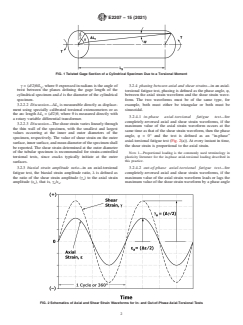
3.2.1 axial strain—refers to engineering axial strain, ε, and
E4 Practices for Force Verification of Testing Machines
is defined as change in length divided by the original length
E6 Terminology Relating to Methods of Mechanical Testing
(∆L /L ).
E8/E8M Test Methods for Tension Testing of Metallic Ma- g g
terials
3.2.2 shear strain—refers to engineering shear strain, γ,
E9 Test Methods of Compression Testing of Metallic Mate- resulting from the application of a torsional moment to a
cylindrical specimen. Such a torsional shear strain is simple
shear and is defined similar to axial strain with the exception
This practice is under the jurisdiction ofASTM Committee E08 on Fatigue and
that the shearing displacement, ∆L is perpendicular to rather
s
Fracture and is the direct responsibility of Subcommittee E08.05 on Cyclic
thanparalleltothegagelength, L ,thatis,γ=∆L/L (seeFig.
g s g
Deformation and Fatigue Crack Formation.
1).
Current edition approved June 1, 2021. Published June 2021. Originally
3.2.2.1 Discussion—γ= is related to the angles of twist, θ
approved in 2002. Last previous edition approved in 2015 as E2207–15. DOI:
10.1520/E2207-15R21.
and Ψ as follows:
For referenced ASTM standards, visit the ASTM website, www.astm.org, or
γ = tan Ψ, where Ψ is the angle of twist along the gage
contact ASTM Customer Service at service@astm.org. For Annual Book of ASTM
length of the cylindrical specimen. For small angles ex-
Standards volume information, refer to the standard’s Document Summary page on
the ASTM website. pressed in radians, tan Ψ approaches Ψ and γ approaches Ψ.
Copyright © ASTM International, 100 Barr Harbor Drive, PO Box C700, West Conshohocken, PA 19428-2959. United States
E2207 − 15 (2021)
FIG. 1 Twisted Gage Section of a Cylindrical Specimen Due to a Torsional Moment
γ=(d/2)θ/L , where θ expressed in radians is the angle of 3.2.4 phasing between axial and shear strains—in an axial-
g
twist between the planes defining the gage length of the torsional fatigue test, phasing is defined as the phase angle, φ,
cylindrical specimen and d is the diameter of the cylindrical between the axial strain waveform and the shear strain wave-
specimen.
form. The two waveforms must be of the same type, for
3.2.2.2 Discussion—∆L is measurable directly as displace-
example, both must either be triangular or both must be
s
ment using specially calibrated torsional extensometers or as
sinusoidal.
the arc length ∆L =(d/2)θ, where θ is measured directly with
s
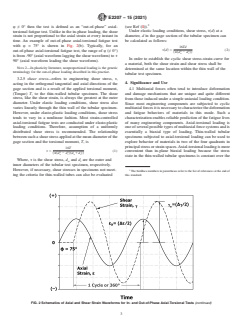
3.2.4.1 in-phase axial-torsional fatigue test—for
a rotary variable differential transformer.
completely-reversed axial and shear strain waveforms, if the
3.2.2.3 Discussion—The shear strain varies linearly through
maximum value of the axial strain waveform occurs at the
the thin wall of the specimen, with the smallest and largest
same time as that of the shear strain waveform, then the phase
values occurring at the inner and outer diameters of the
angle, φ = 0° and the test is defined as an “in-phase”
specimen, respectively. The value of shear strain on the outer
axial-torsional fatigue test (Fig. 2(a)).At every instant in time,
surface,innersurface,andmeandiameterofthespecimenshall
the shear strain is proportional to the axial strain.
be reported. The shear strain determined at the outer diameter
of the tubular specimen is recommended for strain-controlled
NOTE 1—Proportional loading is the commonly used terminology in
torsional tests, since cracks typically initiate at the outer
plasticity literature for the in-phase axial-torsional loading described in
this practice.
surfaces.
3.2.3 biaxial strain amplitude ratio—in an axial-torsional 3.2.4.2 out-of-phase axial-torsional fatigue test—for
completely-reversed axial and shear strain waveforms, if the
fatigue test, the biaxial strain amplitude ratio, λ is defined as
the ratio of the shear strain amplitude (γ ) to the axial strain maximum value of the axial strain waveform leads or lags the
a
maximum value of the shear strain waveform by a phase angle
amplitude (ε ), that is, γ /ε .
a a a
FIG. 2 Schematics of Axial and Shear Strain Waveforms for In- and Out-of-Phase Axial-Torsional Tests
E2207 − 15 (2021)
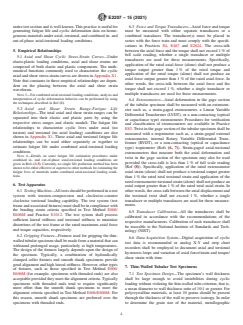
φ≠ 0° then the test is defined as an “out-of-phase” axial- (see Ref (1)).
torsional fatigue test. Unlike in the in-phase loading, the shear Under elastic loading conditions, shear stress, τ(d)ata
diameter, d in the gage section of the tubular specimen can
strain is not proportional to the axial strain at every instant in
time. An example of out-of-phase axial-torsional fatigue test be calculated as follows:
with φ = 75° is shown in Fig. 2(b). Typically, for an
16Td
τ~d! 5 (2)
4 4
out-of-phase axial-torsional fatigue test, the range of φ (≠ 0°)
~π~d 2 d !!
o i
is from -90° (axial waveform lagging the shear waveform) to +
In order to establish the cyclic shear stress-strain curve for
90° (axial waveform leading the shear waveform).
a material, both the shear strain and shear stress shall be
NOTE 2—In plasticity literature, nonproportional loading is the generic
determined at the same location within the thin wall of the
terminology for the out-of-phase loading described in this practice.
tubular test specimen.
3.2.5 shear stress—refers to engineering shear stress, τ,
4. Significance and Use
acting in the orthogonal tangential and axial directions of the
gage section and is a result of the applied torsional moment,
4.1 Multiaxial forces often tend to introduce deformation
(Torque) T, to the thin-walled tubular specimen. The shear
and damage mechanisms that are unique and quite different
stress, like the shear strain, is always the greatest at the outer
from those induced under a simple uniaxial loading condition.
diameter. Under elastic loading conditions, shear stress also
Since most engineering components are subjected to cyclic
varies linearly through the thin wall of the tubular specimen.
multiaxialforcesitisnecessarytocharacterizethedeformation
However, under elasto-plastic loading conditions, shear stress and fatigue behaviors of materials in this mode. Such a
tends to vary in a nonlinear fashion. Most strain-controlled
characterization enables reliable prediction of the fatigue lives
axial-torsional fatigue tests are conducted under elasto-plastic of many engineering components. Axial-torsional loading is
loading conditions. Therefore, assumption of a uniformly one of several possible types of multiaxial force systems and is
distributed shear stress is recommended. The relationship essentially a biaxial type of loading. Thin-walled tubular
specimens subjected to axial-torsional loading can be used to
between such a shear stress applied at the mean diameter of the
gage section and the torsional moment, T,is explore behavior of materials in two of the four quadrants in
principalstressorstrainspaces.Axial-torsionalloadingismore
16T
τ 5 (1)
convenient than in-plane biaxial loading because the stress
2 2
π d 2 d d 1d
~ ~ !~ !!
o i o i
state in the thin-walled tubular specimens is constant over the
Where, τ is the shear stress, d and d are the outer and
o i
inner diameters of the tubular test specimen, respectively.
However, if necessary, shear stresses in specimens not meet- 3
The boldface numbers in parentheses refer to the list of references at the end of
ing the criteria for thin-walled tubes can also be evaluated this standard.
FIG. 2 Schematics of Axial and Shear Strain Waveforms for In- and Out-of-Phase Axial-Torsional Tests (continued)
E2207 − 15 (2021)
entiretestsectionandiswell-known.Thispracticeisusefulfor 6.3 Force and Torque Transducers—Axial force and torque
generating fatigue life and cyclic deformation data on homo- must be measured with either separate transducers or a
geneous materials under axial, torsional, and combined in- and combined transducer. The transducer(s) must be placed in
out-of-phase axial-torsional loading conditions. series with the force train and must comply with the specifi-
cations in Practices E4, E467 and E2624. The cross-talk
5. Empirical Relationships between the axial force and the torque shall not exceed 1 % of
full scale reading, whether a single transducer or multiple
5.1 Axial and Shear Cyclic Stress-Strain Curves—Under
transducers are used for these measurements. Specifically,
elasto-plastic loading conditions, axial and shear strains are
application of the rated axial force (alone) shall not produce a
composed of both elastic and plastic components. The math-
torque output greater than 1 % of the rated torque and
ematical functions commonly used to characterize the cyclic
application of the rated torque (alone) shall not produce an
axial and shear stress-strain curves are shown in Appendix X1.
axial force output greater than 1 % of the rated axial force. In
Note that constants in these empirical relationships are depen-
other words, the cross-talk between the axial force and the
dent on the phasing between the axial and shear strain
torque shall not exceed 1 %, whether a single transducer or
waveforms.
multiple transducers are used for these measurements.
NOTE 3—For combined axial-torsional loading conditions, analysis and
interpretation of cyclic deformation behavior can be performed by using
6.4 Extensometers—Axial deformation in the gage section
the techniques described in Ref (2).
of the tubular specimen shall be measured with an extensom-
5.2 Axial and Shear Strain Range-Fatigue Life
eter such as, a strain-gaged extensometer, a Linear Variable
Relationships—The total axial and shear strain ranges can be
Differential Transformer (LVDT), or a non-contacting (optical
separated into their elastic and plastic parts by using the
or capacitance type) extensometer. Procedures for verification
respective stress ranges and elastic moduli. The fatigue life
and classification of extensometers are available in Practice
relationships to characterize cyclic lives under axial (no
E83. Twist in the gage section of the tubular specimen shall be
torsion) and torsional (no axial loading) conditions are also
measured with a troptometer such as, a strain-gaged external
shown in Appendix X1. These axial and torsional fatigue life
extensometer, internal Rotary Variable Differential Trans-
relationships can be used either separately or together to
former (RVDT), or a non-contacting (optical or capacitance
estimate fatigue life under combined axial-torsional loading
type) troptometer (Refs (6, 7)). Strain-gaged axial-torsional
conditions.
extensometers that measure both the axial deformation and
NOTE 4—Details on some fatigue life estimation procedures under
twist in the gage section of the specimen may also be used
combined in- and out-of-phase axial-torsional loading conditions are
provided the cross-talk is less than 1 % of full scale reading
given in Refs (3-5). Currently, no single life prediction method has been
(Ref (8)). Specifically, application of the rated extensometer
showntobeeithereffectiveorsuperiortoothermethodsforestimatingthe
fatigue lives of materials under combined axial-torsional loading condi-
axial strain (alone) shall not produce a torsional output greater
tions.
than 1 % the rated total torsional strain and application of the
rated extensometer torsional strain (alone) shall not produce an
6. Test Apparatus
axial output greater than 1 % of the rated total axial strain. In
6.1 Testing Machine—Alltestsshouldbeperformedinatest other words, the cross-talk between the axial displacement and
the torsional twist shall not exceed 1 %, whether a single
system with tension-compression and clockwise-counter
clockwise torsional loading capability. The test system (test transducer or multiple transducers are used for these measure-
ments.
frameandassociatedfixtures)mustshallbeincompliancewith
the bending strain criteria specified in Test Method E606/
6.5 Transducer Calibration—All the transducers shall be
E606M and Practice E1012. The test system shall possess
calibrated in accordance with the recommendations of the
sufficient lateral stiffness and torsional stiffness to minimize
respective manufacturers. Calibration of each transducer shall
distortions of the test frame at the rated maximum axial force
be traceable to the National Institute of Standards and Tech-
and torque capacities, respectively.
nology (NIST).
6.2 Gripping Fixtures—Fixtures used for gripping the thin-
6.6 Data Acquisition System—Digital acquisition of cyclic
walledtubularspecimenshallbemadefromamaterialthatcan
test data is recommended or analog X-Y and strip chart
withstand prolonged usage, particularly at high temperatures.
recorders shall be employed to document axial and torsional
The design of the fixtures largely depends upon the design of
hysteresis loops and variation of axial force/strain and torque/
the specimen. Typically, a combination of hydraulically
shear strain with time.
clamped collet fixtures and smooth shank specimens provide
good alignment and high lateral stiffness. However, other types
7. Thin-Walled Tubular Test Specimens
of fixtures, such as those specified in Test Method E606/
E606M (for example, specimens with threaded ends) are also 7.1 Test Specimen Design—The specimen’s wall thickness
acceptable provided they meet the alignment criteria.Typically shall be large enough to avoid instabilities during cyclic
specimens with threaded ends tend to require significantly loading without violating the thin-walled tube criterion, that is,
more effort than the smooth shank specimens to meet the a mean diameter to wall thickness ratio of 10:1 or greater. For
alignment criteria specified in Test Method E606/E606M. For polycrystalline materials, at least 10 grains should be present
this reason, smooth shank specimens are preferred over the through the thickness of the wall to preserve isotropy. In order
specimens with threaded ends. to determine the grain size of the material, metallographic
E2207 − 15 (2021)
samplesshouldbepreparedinaccordancewithPracticeE3and tubular specimens shall meet all the specifications documented
the average grain size should be measured according to Test in Appendix X3 of Test Method E606/E606M.
MethodE112.Ifrequiredforthetestspecimen’sdesign,tensile
8. Test Procedure
and compressive properties of the material can be determined
with Test Methods E8/E8M, E9, and E209. Suggested dimen-
8.1 Measurement of Test Specimen Dimensions—The outer
sions for the thin-walled tubular specimen are shown in Fig. 3.
and inner diameters of the thin-walled tubular test specimen
The test specimen design should minimize the bending stresses
shall be measured at least at three different locations (at each
within the transition region under uniaxial tension.
end and the center) within the gage section. To verify concen-
NOTE 5—For tubular test specimens with mean diameter to wall
tricity of the tubular specimen an additional set of three
thickness ratios of less than 10, the thin-walled tube assumption may not
measurements should be made perpendicular to the first set of
be appropriate.As a result, shear stress may vary significantly through the
measurements. Average values computed from these measure-
thick wall of the specimen. Shear stresses in such test specimens can be
ments shall be used to calculate the test specimen dimensions
evaluated with the method described in Ref (1).
NOTE 6—For nonpolycrystalline materials (for example, single-crystal for test control and post test data processing purposes.
(SC) and directionally-solidified (DS) materials) wall thickness of the
NOTE8—For elevated temperature tests, average valuescomputedfrom
tubular test specimen should be large enough to adequately capture the
the room temperature measurements may be corrected with the coefficient
representative microstructure of the material being tested.
of thermal expansion to calculate the specimen dimensions at the test
NOTE 7—In general, fatigue life under cyclic loading conditions
temperature. The calculated high temperature dimensions may also be
involvingtorsioncanbedependentontheratiooftheinnerdiametertothe
used to estimate the test control parameters and for post-test data
outer diameter, d/d of the tubular test specimen (Ref (9)). Therefore,
i o processing. Thermal coefficient of expansion can be measured for each
caution should be exercised in comparing fatigue lives obtained on the
test specimen before starting the fatigue test or alternatively, handbook
same material from specimens with substantially different d/
...