

ASTM E2624-17
(Practice)Standard Practice for Torque Calibration of Testing Machines
General Information
- Abstract
SIGNIFICANCE AND USE
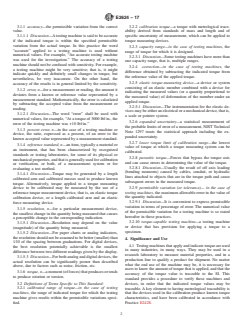
4.1 Testing machines that apply and indicate torque are used in many industries, in many ways. They may be used in a research laboratory to measure material properties, and in a production line to qualify a product for shipment. No matter what the end use of the machine may be, it is necessary for users to know the amount of torque that is applied, and that the accuracy of the torque value is traceable to the SI. This standard provides a procedure to verify these machines and devices, in order that the indicated torque values may be traceable. A key element to having metrological traceability is that the devices used in the calibration produce known torque characteristics, and have been calibrated in accordance with Practice E2428.
4.2 This standard may be used by those using, those manufacturing, and those providing calibration service for torque capable testing machines or devices and related instrumentation.
SCOPE
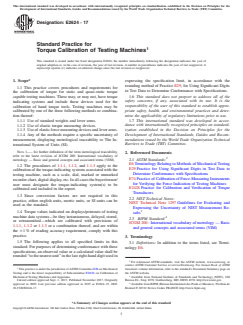
1.1 This practice covers procedures and requirements for the calibration of torque for static and quasi-static torque capable testing machines. These may, or may not, have torque indicating systems and include those devices used for the calibration of hand torque tools. Testing machines may be calibrated by one of the three following methods or combination thereof:
1.1.1 Use of standard weights and lever arms.
1.1.2 Use of elastic torque measuring devices.
1.1.3 Use of elastic force measuring devices and lever arms.
1.1.4 Any of the methods require a specific uncertainty of measurement, displaying metrological traceability to The International System of Units (SI).
Note 1: – for further definition of the term metrological traceability, refer to the latest revision of JCGM 200: International vocabulary of metrology — Basic and general concepts and associated terms (VIM).
1.2 The procedures of 1.1.1, 1.1.2, and 1.1.3 apply to the calibration of the torque-indicating systems associated with the testing machine, such as a scale, dial, marked or unmarked recorder chart, digital display, etc. In all cases the buyer/owner/user must designate the torque-indicating system(s) to be calibrated and included in the report.
1.3 Since conversion factors are not required in this practice, either english units, metric units, or SI units can be used as the standard.
1.4 Torque values indicated on displays/printouts of testing machine data systems—be they instantaneous, delayed, stored, or retransmitted—which are calibrated with provisions of 1.1.1, 1.1.2 or 1.1.3 or a combination thereof, and are within the ±1 % of reading accuracy requirement, comply with this practice.
1.5 The following applies to all specified limits in this standard: For purposes of determining conformance with these specifications, an observed value or a calculated value shall be rounded “to the nearest unit” in the last right-hand digit used in expressing the specification limit, in accordance with the rounding method of Practice E29, for Using Significant Digits in Test Data to Determine Conformance with Specifications.
1.6 This standard does not purport to address all of the safety concerns, if any, associated with its use. It is the responsibility of the user of this standard to establish appropriate safety, health, and environmental practices and determine the applicability of regulatory limitations prior to use.
1.7 This international standard was developed in accordance with internationally recognized principles on standardization established in the Decision on Principles for the Development of International Standards, Guides and Recommendations issued by the World Trade Organization Technical Barriers to Trade (TBT) Committee.
- Status
- Published
- Publication Date
- 31-Aug-2017
- Technical Committee
- E28 - Mechanical Testing
- Drafting Committee
- E28.01 - Calibration of Mechanical Testing Machines and Apparatus
Overview
ASTM E2624-17 is the standard practice developed by ASTM International for the calibration of torque in static and quasi-static torque-capable testing machines. This standard defines systematic procedures and requirements to ensure torque values indicated by testing machines are accurate and traceable to the International System of Units (SI). Calibration under this standard is vital for quality assurance in both research laboratories and production environments, where precise torque measurement helps determine material properties or qualify products for shipment.
Maintaining metrological traceability and ensuring the accuracy, repeatability, and proper documentation of torque measurements are at the core of this standard. ASTM E2624-17 is relevant to users, manufacturers, and calibration service providers working with torque testing equipment.
Key Topics
- Scope of Calibration: Applies specifically to static and quasi-static torque testing machines, including those used to calibrate hand torque tools and equipped with various torque-indicating systems (analog, digital, charts, etc.).
- Calibration Methods:
- Use of standard weights and lever arms
- Use of elastic torque measuring devices
- Use of elastic force measuring devices and lever arms
- Metrological Traceability: Ensures the devices used for calibration are themselves calibrated according to established practices, such as ASTM E2428, providing traceability to SI units.
- Accuracy and Uncertainty: Specifies that calibrated machines must demonstrate accuracy within ±1% of the indicated torque reading. Repeatability requirements are also outlined to ensure consistent performance.
- Range and Resolution: The standard provides guidance on the calibrated torque range, which cannot include values below 200 times the torque indicator’s resolution.
- Reporting and Documentation: Defines the essential information for calibration reports, including details of the testing machine and calibration devices, applied methods, measured errors, uncertainty, and environmental conditions.
- Frequency of Calibration: Recommends calibration intervals not exceeding 18 months, or more frequently in the case of machine repair, relocation, or suspected inaccuracy.
- Safety and Regulatory Compliance: Users are responsible for implementing appropriate safety and regulatory practices in addition to the standard’s requirements.
Applications
ASTM E2624-17 is widely used across industries where torque measurement is critical, including:
- Manufacturing and Production: Verifying the accuracy of machines used for quality monitoring or product acceptance criteria.
- Calibration Laboratories: Providing calibration services to bring client machines into compliance with global torque calibration standards.
- Research and Development: Ensuring reliable torque data for material testing and component development.
- Aerospace, Automotive, and Energy Sectors: Maintaining critical tolerances in assemblies and components by validating torque tools and testing machines to avoid safety or performance issues.
- Tool Calibration: Applying the standard to calibrate devices used in the calibration of hand torque tools, ensuring accuracy and traceability in tool certification.
Related Standards
The following standards are frequently referenced alongside ASTM E2624-17:
- ASTM E6: Terminology relating to methods of mechanical testing
- ASTM E29: Practice for using significant digits in test data to determine conformance with specifications
- ASTM E74: Practice for calibration of force-measuring instruments for verifying the force indication of testing machines
- ASTM E2428: Practice for calibration and verification of torque transducers
- NIST Technical Note 1297: Guidelines for evaluating and expressing the uncertainty of NIST measurement results
- JCGM 200: International vocabulary of metrology-Basic and general concepts and associated terms (VIM)
Conclusion
Compliance with ASTM E2624-17 ensures that torque testing machines are calibrated for reliable, traceable measurements, supporting quality assurance and safety across numerous industries. Adhering to this standard helps organizations meet stringent international requirements for torque calibration and reporting, enhancing confidence in measurement results and maintaining best practices in mechanical testing.
Relations
- Effective Date
- 01-Sep-2017
- Effective Date
- 01-Feb-2015
- Effective Date
- 15-Oct-2014
- Effective Date
- 01-May-2013
- Effective Date
- 01-Mar-2013
- Effective Date
- 01-Dec-2012
- Effective Date
- 15-May-2009
- Effective Date
- 15-May-2009
- Effective Date
- 01-Apr-2009
- Effective Date
- 01-Jan-2009
- Effective Date
- 01-Oct-2008
- Effective Date
- 01-Oct-2008
- Effective Date
- 15-Feb-2008
- Effective Date
- 01-Feb-2008
- Effective Date
- 01-Nov-2007
Get Certified
Connect with accredited certification bodies for this standard

IMP NDT d.o.o.
Non-destructive testing services. Radiography, ultrasonic, magnetic particle, penetrant, visual inspection.
Inštitut za kovinske materiale in tehnologije
Institute of Metals and Technology. Materials testing, metallurgical analysis, NDT.
Q Techna d.o.o.
NDT and quality assurance specialist. 30+ years experience. NDT personnel certification per ISO 9712, nuclear and thermal power plant inspections, QA/
Sponsored listings
Frequently Asked Questions
ASTM E2624-17 is a standard published by ASTM International. Its full title is "Standard Practice for Torque Calibration of Testing Machines". This standard covers: SIGNIFICANCE AND USE 4.1 Testing machines that apply and indicate torque are used in many industries, in many ways. They may be used in a research laboratory to measure material properties, and in a production line to qualify a product for shipment. No matter what the end use of the machine may be, it is necessary for users to know the amount of torque that is applied, and that the accuracy of the torque value is traceable to the SI. This standard provides a procedure to verify these machines and devices, in order that the indicated torque values may be traceable. A key element to having metrological traceability is that the devices used in the calibration produce known torque characteristics, and have been calibrated in accordance with Practice E2428. 4.2 This standard may be used by those using, those manufacturing, and those providing calibration service for torque capable testing machines or devices and related instrumentation. SCOPE 1.1 This practice covers procedures and requirements for the calibration of torque for static and quasi-static torque capable testing machines. These may, or may not, have torque indicating systems and include those devices used for the calibration of hand torque tools. Testing machines may be calibrated by one of the three following methods or combination thereof: 1.1.1 Use of standard weights and lever arms. 1.1.2 Use of elastic torque measuring devices. 1.1.3 Use of elastic force measuring devices and lever arms. 1.1.4 Any of the methods require a specific uncertainty of measurement, displaying metrological traceability to The International System of Units (SI). Note 1: – for further definition of the term metrological traceability, refer to the latest revision of JCGM 200: International vocabulary of metrology — Basic and general concepts and associated terms (VIM). 1.2 The procedures of 1.1.1, 1.1.2, and 1.1.3 apply to the calibration of the torque-indicating systems associated with the testing machine, such as a scale, dial, marked or unmarked recorder chart, digital display, etc. In all cases the buyer/owner/user must designate the torque-indicating system(s) to be calibrated and included in the report. 1.3 Since conversion factors are not required in this practice, either english units, metric units, or SI units can be used as the standard. 1.4 Torque values indicated on displays/printouts of testing machine data systems—be they instantaneous, delayed, stored, or retransmitted—which are calibrated with provisions of 1.1.1, 1.1.2 or 1.1.3 or a combination thereof, and are within the ±1 % of reading accuracy requirement, comply with this practice. 1.5 The following applies to all specified limits in this standard: For purposes of determining conformance with these specifications, an observed value or a calculated value shall be rounded “to the nearest unit” in the last right-hand digit used in expressing the specification limit, in accordance with the rounding method of Practice E29, for Using Significant Digits in Test Data to Determine Conformance with Specifications. 1.6 This standard does not purport to address all of the safety concerns, if any, associated with its use. It is the responsibility of the user of this standard to establish appropriate safety, health, and environmental practices and determine the applicability of regulatory limitations prior to use. 1.7 This international standard was developed in accordance with internationally recognized principles on standardization established in the Decision on Principles for the Development of International Standards, Guides and Recommendations issued by the World Trade Organization Technical Barriers to Trade (TBT) Committee.
SIGNIFICANCE AND USE 4.1 Testing machines that apply and indicate torque are used in many industries, in many ways. They may be used in a research laboratory to measure material properties, and in a production line to qualify a product for shipment. No matter what the end use of the machine may be, it is necessary for users to know the amount of torque that is applied, and that the accuracy of the torque value is traceable to the SI. This standard provides a procedure to verify these machines and devices, in order that the indicated torque values may be traceable. A key element to having metrological traceability is that the devices used in the calibration produce known torque characteristics, and have been calibrated in accordance with Practice E2428. 4.2 This standard may be used by those using, those manufacturing, and those providing calibration service for torque capable testing machines or devices and related instrumentation. SCOPE 1.1 This practice covers procedures and requirements for the calibration of torque for static and quasi-static torque capable testing machines. These may, or may not, have torque indicating systems and include those devices used for the calibration of hand torque tools. Testing machines may be calibrated by one of the three following methods or combination thereof: 1.1.1 Use of standard weights and lever arms. 1.1.2 Use of elastic torque measuring devices. 1.1.3 Use of elastic force measuring devices and lever arms. 1.1.4 Any of the methods require a specific uncertainty of measurement, displaying metrological traceability to The International System of Units (SI). Note 1: – for further definition of the term metrological traceability, refer to the latest revision of JCGM 200: International vocabulary of metrology — Basic and general concepts and associated terms (VIM). 1.2 The procedures of 1.1.1, 1.1.2, and 1.1.3 apply to the calibration of the torque-indicating systems associated with the testing machine, such as a scale, dial, marked or unmarked recorder chart, digital display, etc. In all cases the buyer/owner/user must designate the torque-indicating system(s) to be calibrated and included in the report. 1.3 Since conversion factors are not required in this practice, either english units, metric units, or SI units can be used as the standard. 1.4 Torque values indicated on displays/printouts of testing machine data systems—be they instantaneous, delayed, stored, or retransmitted—which are calibrated with provisions of 1.1.1, 1.1.2 or 1.1.3 or a combination thereof, and are within the ±1 % of reading accuracy requirement, comply with this practice. 1.5 The following applies to all specified limits in this standard: For purposes of determining conformance with these specifications, an observed value or a calculated value shall be rounded “to the nearest unit” in the last right-hand digit used in expressing the specification limit, in accordance with the rounding method of Practice E29, for Using Significant Digits in Test Data to Determine Conformance with Specifications. 1.6 This standard does not purport to address all of the safety concerns, if any, associated with its use. It is the responsibility of the user of this standard to establish appropriate safety, health, and environmental practices and determine the applicability of regulatory limitations prior to use. 1.7 This international standard was developed in accordance with internationally recognized principles on standardization established in the Decision on Principles for the Development of International Standards, Guides and Recommendations issued by the World Trade Organization Technical Barriers to Trade (TBT) Committee.
ASTM E2624-17 is classified under the following ICS (International Classification for Standards) categories: 19.060 - Mechanical testing. The ICS classification helps identify the subject area and facilitates finding related standards.
ASTM E2624-17 has the following relationships with other standards: It is inter standard links to ASTM E2624-15, ASTM E2428-15, ASTM E2428-14, ASTM E74-13a, ASTM E74-13, ASTM E74-12, ASTM E6-09be1, ASTM E6-09b, ASTM E6-09a, ASTM E6-09, ASTM E29-08, ASTM E6-08a, ASTM E2428-08, ASTM E6-08, ASTM E6-07b. Understanding these relationships helps ensure you are using the most current and applicable version of the standard.
ASTM E2624-17 is available in PDF format for immediate download after purchase. The document can be added to your cart and obtained through the secure checkout process. Digital delivery ensures instant access to the complete standard document.
Standards Content (Sample)
This international standard was developed in accordance with internationally recognized principles on standardization established in the Decision on Principles for the
Development of International Standards, Guides and Recommendations issued by the World Trade Organization Technical Barriers to Trade (TBT) Committee.
Designation: E2624 − 17
Standard Practice for
Torque Calibration of Testing Machines
This standard is issued under the fixed designation E2624; the number immediately following the designation indicates the year of
original adoption or, in the case of revision, the year of last revision.Anumber in parentheses indicates the year of last reapproval.A
superscript epsilon (´) indicates an editorial change since the last revision or reapproval.
1. Scope* expressing the specification limit, in accordance with the
rounding method of Practice E29, for Using Significant Digits
1.1 This practice covers procedures and requirements for
in Test Data to Determine Conformance with Specifications.
the calibration of torque for static and quasi-static torque
1.6 This standard does not purport to address all of the
capable testing machines. These may, or may not, have torque
safety concerns, if any, associated with its use. It is the
indicating systems and include those devices used for the
responsibility of the user of this standard to establish appro-
calibration of hand torque tools. Testing machines may be
priate safety, health, and environmental practices and deter-
calibrated by one of the three following methods or combina-
mine the applicability of regulatory limitations prior to use.
tion thereof:
1.7 This international standard was developed in accor-
1.1.1 Use of standard weights and lever arms.
dance with internationally recognized principles on standard-
1.1.2 Use of elastic torque measuring devices.
ization established in the Decision on Principles for the
1.1.3 Useofelasticforcemeasuringdevicesandleverarms.
Development of International Standards, Guides and Recom-
1.1.4 Any of the methods require a specific uncertainty of
mendations issued by the World Trade Organization Technical
measurement, displaying metrological traceability to The In-
Barriers to Trade (TBT) Committee.
ternational System of Units (SI).
NOTE 1—– for further definition of the term metrological traceability,
2. Referenced Documents
refer to the latest revision of JCGM 200: International vocabulary of
metrology — Basic and general concepts and associated terms (VIM). 2.1 ASTM Standards:
E6Terminology Relating to Methods of Mechanical Testing
1.2 The procedures of 1.1.1, 1.1.2, and 1.1.3 apply to the
E29Practice for Using Significant Digits in Test Data to
calibrationofthetorque-indicatingsystemsassociatedwiththe
Determine Conformance with Specifications
testing machine, such as a scale, dial, marked or unmarked
E74Practice of Calibration of Force-Measuring Instruments
recorderchart,digitaldisplay,etc.Inallcasesthebuyer/owner/
for Verifying the Force Indication of Testing Machines
user must designate the torque-indicating system(s) to be
E2428Practice for Calibration and Verification of Torque
calibrated and included in the report.
Transducers
1.3 Since conversion factors are not required in this
2.2 NIST Technical Notes:
practice, either english units, metric units, or SI units can be
NIST Technical Note 1297Guidelines for Evaluating and
used as the standard.
Expressing the Uncertainty of NIST Measurement Re-
1.4 Torque values indicated on displays/printouts of testing
sults
machine data systems—be they instantaneous, delayed, stored, 4
2.3 BIPM Standard:
or retransmitted—which are calibrated with provisions of
JCGM 200: International vocabulary of metrology — Basic
1.1.1, 1.1.2 or 1.1.3 or a combination thereof, and are within
and general concepts and associated terms (VIM)
the 61% of reading accuracy requirement, comply with this
practice.
3. Terminology
1.5 The following applies to all specified limits in this
3.1 Definitions: In addition to the terms listed, see Termi-
standard: For purposes of determining conformance with these
nology E6.
specifications, an observed value or a calculated value shall be
rounded“tothenearestunit”inthelastright-handdigitusedin
For referenced ASTM standards, visit the ASTM website, www.astm.org, or
contact ASTM Customer Service at service@astm.org. For Annual Book of ASTM
ThispracticeisunderthejurisdictionofASTMCommitteeE28onMechanical Standards volume information, refer to the standard’s Document Summary page on
Testing and is the direct responsibility of Subcommittee E28.01 on Calibration of the ASTM website.
Mechanical Testing Machines and Apparatus. Available from National Institute of Standards and Technology (NIST), 100
Current edition approved Sept. 1, 2017. Published November 2017. Originally Bureau Dr., Stop 1070, Gaithersburg, MD 20899-1070, http://www.nist.gov.
approved in 2009. Last previous edition approved in 2015 as E2624–15. DOI: Available from BIPM (Bureau International des Poids et Mesures)- Pavillon de
10.1520/E2624-17. Breteuil F-92312 Sèvres Cedex FRANCE http://www.bipm.org
*A Summary of Changes section appears at the end of this standard
Copyright © ASTM International, 100 Barr Harbor Drive, PO Box C700, West Conshohocken, PA 19428-2959. United States
E2624 − 17
3.1.1 accuracy—the permissible variation from the correct 3.2.2 calibration torque—a torque with metrological trace-
value. ability derived from standards of mass and length and of
3.1.1.1 Discussion—Atestingmachineissaidtobeaccurate specific uncertainty of measurement, which can be applied to
if the indicated torque is within the specified permissible torque measuring devices.
variation from the actual torque. In this practice the word
3.2.3 capacity range—in the case of testing machines, the
“accurate” applied to a testing machine is used without
range of torque for which it is designed.
numerical values. For example, “An accurate testing machine
3.2.3.1 Discussion—Some testing machines have more than
was used for the investigation.” The accuracy of a testing
one capacity range, that is, multiple ranges.
machine should not be confused with sensitivity. For example,
3.2.4 correction—in the case of testing machines, the
a testing machine might be very sensitive; that is, it might
difference obtained by subtracting the indicated torque from
indicate quickly and definitely small changes in torque, but
the reference value of the applied torque.
nevertheless, be very inaccurate. On the other hand, the
3.2.5 elastic torque-measuring device—a device or system
accuracy of the results is in general limited by the sensitivity.
consisting of an elastic member combined with a device for
3.1.2 error, n—for a measurement or reading, the amount it
indicating the measured values (or a quantity proportional to
deviates from a known or reference value represented by a
the measured value) of deformation of the member under an
measurement standard. Mathematically, the error is calculated
applied torque.
by subtracting the accepted value from the measurement or
3.2.5.1 Discussion—The instrumentation for the elastic de-
reading.
vicesmaybeeitheranelectricaloramechanicaldevice,thatis,
3.1.2.1 Discussion—The word “error” shall be used with
a scale or pointer system.
numericalvalues,forexample,“Atatorqueof3000lbf·in.,the
3.2.6 expanded uncertainty—a statistical measurement of
error of the testing machine was +10 lbf·in.”
the probable limits of error of a measurement, NISTTechnical
3.1.3 percent error, n—in the case of a testing machine or
Note 1297 treats the statistical approach including the ex-
device, the ratio, expressed as a percent, of an error to the
panded uncertainty.
known accepted value represented by a measurement standard.
3.2.7 lower torque limit of calibration range—the lowest
3.1.4 reference standard, n—an item, typically a material or
value of torque at which a torque measuring system can be
an instrument, that has been characterized by recognized
calibrated.
standards or testing laboratories, for some of its physical or
3.2.8 parasitic torque—Forces that bypass the torque axis
mechanicalproperties,andthatisgenerallyusedforcalibration
and can cause errors in determining the value of the torque.
or verification, or both, of a measurement system or for
3.2.8.1 Discussion—Usually the result of off axis loading
evaluating a test method.
(bending moments) caused by cables, conduit, or hydraulic
3.1.4.1 Discussion—Torque may be generated by a length
lines attached to objects that are in the torque path and cause
calibrated arm and calibrated masses used to produce known
subsequent errors in the measured torque.
torque. Alternatively, torque applied to a torque measuring
3.2.9 permissible variation (or tolerance)— in the case of
device to be calibrated may be measured by the use of a
testing machines, the maximum allowable error in the value of
reference torque measurement device, that is, an elastic torque
the quantity indicated.
calibration device, or a length calibrated arm and an elastic
3.2.9.1 Discussion—It is convenient to express permissible
force measuring device.
variation in terms of percentage of error. The numerical value
3.1.5 resolution, n—for a particular measurement device,
of the permissible variation for a testing machine is so stated
the smallest change in the quantity being measured that causes
hereafter in these practices.
a perceptible change in the corresponding indication.
3.2.10 torque-capable testing machine—a testing machine
3.1.5.1 Discussion—Resolution may depend on the value
or device that has provision for applying a torque to a
(magnitude) of the quantity being measured.
specimen.
3.1.5.2 Discussion—For paper charts or analog indicators,
theresolutionshouldnotbeassumedtobebetter(smaller)than
4. Significance and Use
1⁄10 of the spacing between graduations. For digital devices,
4.1 Testingmachinesthatapplyandindicatetorqueareused
the best resolution potentially achievable is the smallest
in many industries, in many ways. They may be used in a
difference between two different readings given by the display.
research laboratory to measure material properties, and in a
3.1.5.3 Discussion—Forbothanaloganddigitaldevices,the
production line to qualify a product for shipment. No matter
actual resolution can be significantly poorer than described
what the end use of the machine may be, it is necessary for
above, due to factors such as noise, friction, etc.
userstoknowtheamountoftorquethatisapplied,andthatthe
3.1.6 torque, n—amoment(offorces)thatproducesortends
accuracy of the torque value is traceable to the SI. This
to produce rotation or torsion.
standard provides a procedure to verify these machines and
3.2 Definitions of Terms Specific to This Standard: devices, in order that the indicated torque values may be
3.2.1 calibrated range of torque—in the case of testing traceable.Akey element to having metrological traceability is
machines, the range of indicated torque for which the testing that the devices used in the calibration produce known torque
machine gives results within the permissible variations speci- characteristics, and have been calibrated in accordance with
fied. Practice E2428.
E2624 − 17
rock density changed by 0.5 g/cc, an error of 0.003 % would result.
4.2 This standard may be used by those using, those
manufacturing, and those providing calibration service for
6.2 The force in customary units exerted by a weight in air
torque capable testing machines or devices and related instru-
is calculated as follows:
mentation.
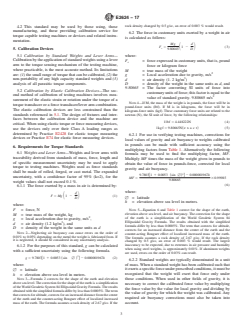
Mg d
F 5 1 2 (3)
S D
c
9.80665 D
5. Calibration Devices
5.1 Calibration by Standard Weights and Lever Arms— where:
Calibrationbytheapplicationofstandardweightsusingalever
F = force expressed in customary units, that is, pound
c
arm to the torque sensing mechanism of the testing machine,
force or kilogram force
where practicable, is the most accurate method. Its limitations
M = true mass of the weight
are: (1) the small range of torque that can be calibrated, (2) the
g = Local acceleration due to gravity, m/s
non-portability of any high capacity standard weights and (3) d = air density (1. 2 kg/m )
D = density of the weight in the same units as d, and
analysis of all parasitic torque components.
9.80665 = The factor converting SI units of force into
5.2 Calibration by Elastic Calibration Devices—The sec-
customaryunitsofforce;thisfactorisequaltothe
ond method of calibration of testing machines involves mea-
value of standard gravity. 9.80665 m/s
surement of the elastic strain or rotation under the torque of a
NOTE 4—If M, the mass of the weight is in pounds, the force will be in
torque transducer or a force transducer/lever arm combination.
pound-force units (lbf). If M is in kilograms, the force will be in
The elastic calibration devices are less constrained than the
kilogram-force units (kgf). These customary force units are related to the
standards referenced in 5.1. The design of fixtures and inter-
newton (N), the SI unit of force, by the following relationships:
faces between the calibration device and the machine are
1lbf 5 4.448222N (4)
critical. When using elastic torque or force measuring devices,
1kgf 5 9.80665N exact (5)
~ !
use the devices only over their Class A loading ranges as
determined by Practice E2428 for elastic torque measuring
6.2.1 For use in verifying testing machines, corrections for
devices or Practice E74 for elastic force measuring devices.
local values of gravity and air buoyancy to weights calibrated
in pounds can be made with sufficient accuracy using the
6. Requirements for Torque Standards
multiplying factors from Table 1. Alternatively the following
6.1 Weights and Lever Arms—Weights and lever arms with
formula may be used to find the multiplying factor, MF.
traceability derived from standards of mass, force, length and
Multiply MF times the mass of the weight given in pounds to
of specific measurement uncertainty may be used to apply
obtain the value of force in pounds-force, corrected for local
torque to testing machines. Weights used as force standards
gravity and air buoyancy.
shall be made of rolled, forged, or cast metal. The expanded
9.7803@1 1 0.0053 sin [ # 2 0.000001967h
~ !
uncertainty, with a confidence factor of 95% (k=2), for the
MF 5 30.99985
9.80665
weight values shall not exceed 0.1%.
(6)
6.1.1 The force exerted by a mass in air is determined by:
d where:
F 5 Mg 1 2 (1)
S D
D
[ = latitude
h = elevation above sea level in metres.
where:
NOTE 5—Equation 6 and Table 1 correct for the shape of the earth,
F = force, N
elevation above sea level, and air buoyancy. The correction for the shape
M = true mass of the weight, kg
of the earth is a simplification of the World Geodetic System 84
g = local acceleration due to gravity, m/s ,
Ellipsoidal Gravity Formula. The results obtained with the simplified
d = air density (1.2 kg/m ), and
formula differ by less than 0.0005%. The term that corrects for altitude,
D = density of the weight in the same units as d
corrects for an increased distance from the center of the earth and the
NOTE 2—Neglecting air buoyancy can cause errors on the order of
counter-acting Bouguer effect of localized increased mass of the earth.
0.01% to 0.05% depending on the metal the weight is fabricated from. If
The formula assumes a rock density of 2.67 g/cc. If the rock density
it is neglected, it should be considered in any uncertainty analysis.
changed by 0.5 g/cc, an error of 0.003 % would result. The largest
inaccuracy to be expected, due to extremes in air pressure and humidity
6.1.2 For the purposes of this standard, g can be calculated
when using steel weights, is approximately 0.01%. If aluminum weights
with a sufficient uncertainty using the following formula.
are used, errors on the order of 0.03% can result.
g 5 9.7803 1 1 0.0053 sin [ 2 0.000001967h (2)
@ ~ ! #
6.2.2 Standard weights are typically denominated in a unit
where: of mass.When a standard weight has been calibrated such that
itexertsaspecificforceunderprescribedconditions,itmustbe
[ = latitude
recognized that the weight will exert that force only under
h = elevation above sea level in meters.
NOTE 3—Formula 2 corrects for the shape of the earth and elevation those conditions. When used in other fields of gravity, it is
abovesealevel.Thecorrectionfortheshapeoftheearthisasimplification
necessary to correct the calibrated force value by multiplying
oftheWorldGeodeticSystem84EllipsoidalGravityFormula.Theresults
the force value by the value for local gravity and dividing by
obtainedwiththesimplifiedformuladifferbylessthan0.0005%.Theterm
the value of gravity for which the weight was calibrated. Any
thatcorrectsforaltitude,correctsforanincreaseddistancefromthecenter
required air buoyancy corrections must also be taken into
of the earth and the counter-acting Bouguer effect of localized increased
mass of the earth.The formula assumes a rock density of 2.67 g/cc. If the account.
E2624 − 17
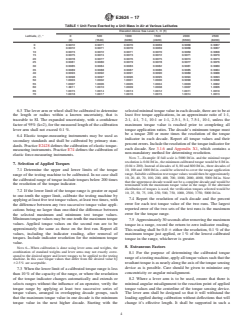
TABLE 1 Unit Force Exerted by a Unit Mass in Air at Various Latitudes
Elevation Above Sea Level, h, m (ft)
Latitiude,[,°
0 500 1000 1500 2000 2500
(0) (1640) (3280) (4920) (6560) (8200)
0 0.9972 0.9971 0.9970 0.9969 0.9968 0.9967
5 0.9972 0.9971 0.9970 0.9969 0.9968 0.9967
10 0.9973 0.9972 0.9971 0.9970 0.9969 0.9968
15 0.9975 0.9974 0.9973 0.9972 0.9971 0.9970
20 0.9978 0.9977 0.9976 0.9975 0.9974 0.9973
25 0.9981 0.9980 0.9979 0.9978 0.9977 0.9976
30 0.9985 0.9984 0.9983 0.9982 0.9981 0.9980
35 0.9989 0.9988 0.9987 0.9986 0.9985 0.9984
40 0.9993 0.9992 0.9991 0.9990 0.9989 0.9988
45 0.9998 0.9997 0.9996 0.9995 0.9994 0.9993
50 1.0003 1.0002 1.0001 1.0000 0.9999 0.9998
55 1.0007 1.0006 1.0005 1.0004 1.0003 1.0002
60 1.0011 1.0010 1.0009 1.0008 1.0007 1.0006
65 1.0015 1.0014 1.0013 1.0012 1.0011 1.0010
70 1.0018 1.0017 1.0016 1.0015 1.0014 1.0013
6.3 The lever arm or wheel shall be calibrated to determine selectedminimaltorquevalueineachdecade,therearetobeat
the length or radius within a known uncertainty, that is least five torque applications, in an approximate ratio of 1:1,
traceable to SI. The expanded uncertainty, with a confidence 2:1, 4:1, 7:1, 10:1 or 1:1, 2.5:1, 5:1, 7.5:1, 10:1, unless the
factor of 95% (k=2), for the measured length of the calibration maximum torque value is reached prior to completing all
lever arm shall not exceed 0.1%. torque application ratios. The decade’s minimum torque must
be a torque 200 or more times the resolution of the torque
6.4 Elastic torque-measuring instruments may be used as
indicator in each decade. Report all torque values and their
secondary standards and shall be calibrated by primary stan-
percenterrors.Includetheresolutionofthetorqueindicatorfor
dards. Practice E2428 defines the calibration of elastic torque-
each decade. See 3.1.6 and Appendix X1, which contains a
measuring instruments. Practice E74 defines the calibration of
non-mandatory method for determining resolution.
elastic force-measuring instruments.
NOTE 7—Example: If full scale is 5000 lbf·in. and the minimal torque
resolutionis0.04lbf·in.,theminimumcalibratedtorquewouldbe8lbf·in.
7. Selection of Applied Torques
(0.04 × 200). Instead of decades of 8, 80 and 800 lbf·in., three decades of
10, 100 and 1000 lbf·in. could be selected to cover the torque application
7.1 Determine the upper and lower limits of the torque
range.Suitablecalibrationtesttorquevalueswouldthenbeapproximately
range of the testing machine to be calibrated. In no case shall
10, 20, 40, 70, 100, 200, 400, 700, 1000, 2000, 4000, 5000 lbf·in. Note
the calibrated range of torque include torques below 200 times
that the uppermost decade would not be a complete decade and would be
the resolution of the torque indicator.
terminated with the maximum torque value in the range. If the alternate
distribution of torques is used, the verification torques selected would be
7.2 If the lower limit of the torque range is greater or equal
10, 25, 50, 75, 100, 250, 500, 750, 1000, 2500, 3750, 5000 lbf·in.
to one-tenth the upper limit, calibrate the testing machine by
7.4 Report the resolution of each decade and the percent
applyingatleastfivetesttorquevalues,atleasttwotimes,with
error for each test torque value of the two runs. The largest
the difference between any two successive torque value appli-
reported error of the two sets of the test runs is the maximum
cations being no larger than one-third the difference between
error for the torque range.
the selected maximum and minimum test torque values.
Minimumtorquevaluesmaybeone-tenththemaximumtorque
7.5 Approximately30secondsafterremovingthemaximum
values. Applied torque values on the second run are to be
torque in a range, record the return to zero indicator reading.
approximately the same as those on the first run. Report all
This reading shall be 0.0 6 either the resolution, 0.1% of the
values, including the indicator reading, after removal of
maximum torque just applied, or 1% of the lowest calibrated
torques. Include indicator resolution for the minimum torque
torque in the range, whichever is greater.
value.
8. Extraneous Factors
NOTE 6—When calibration is done using lever arms and weights, the
combination of standard weights and lever arms may not exactly corre-
8.1 For the purpose of determining the calibrated torque
spond to the desired upper and lower torques to be applied to the testing
rangeofatestingmachine,applyalltorquevaluessuchthatthe
machine. In this case torque values that differ from the desired value by
resultanttorqueisasnearlyalongtheaxisofthetorquesensing
62.5% are acceptable.
device as is possible. Care should be given to minimize any
7.3 When the lower limit of a calibrated torque range is less
concentricity or angular misalignment.
than 10% of the capacity of the range, or where the resolution
of the torque indicator changes automatically and extends or 8.2 Where a lever arm is to be used, ensure that there is
selects ranges without the influence of an operator, verify the minimal angular misalignment to the reaction point of applied
torque range by applying at least two successive series of torque values and the centerline of the torque sensing device.
torque values, arranged in overlapping decade groups, such The lever arm shall be designed so that it will withstand the
that the maximum torque value in one decade is the minimum loading applied during calibration without deflections that will
torque value in the next higher decade. Starting with the change it’s effective length. It shall be supported in such a
E2624 − 17
manner to minimize bending around the centerline of the 9.5 Testing machines that are used to apply torque in both
torque sensing device. T
...
This document is not an ASTM standard and is intended only to provide the user of an ASTM standard an indication of what changes have been made to the previous version. Because
it may not be technically possible to adequately depict all changes accurately, ASTM recommends that users consult prior editions as appropriate. In all cases only the current version
of the standard as published by ASTM is to be considered the official document.
Designation: E2624 − 15 E2624 − 17
Standard Practice for
Torque Calibration of Testing Machines
This standard is issued under the fixed designation E2624; the number immediately following the designation indicates the year of
original adoption or, in the case of revision, the year of last revision. A number in parentheses indicates the year of last reapproval. A
superscript epsilon (´) indicates an editorial change since the last revision or reapproval.
1. Scope Scope*
1.1 This practice covers procedures and requirements for the calibration of torque for static and quasi-static torque capable
testing machines. These may, or may not, have torque indicating systems and include those devices used for the calibration of hand
torque tools. Testing machines may be calibrated by one of the three following methods or combination thereof:
1.1.1 Use of standard weights and lever arms.
1.1.2 Use of elastic torque measuring devices.
1.1.3 Use of elastic force measuring devices and lever arms.
1.1.4 Any of the methods require a specific uncertainty of measurement, displaying metrological traceability to The
International System of Units (SI).
NOTE 1—– for further definition of the term metrological traceability, refer to the latest revision of JCGM 200: International vocabulary of metrology
— Basic and general concepts and associated terms (VIM).
1.2 The procedures of 1.1.1, 1.1.2, and 1.1.3 apply to the calibration of the torque-indicating systems associated with the testing
machine, such as a scale, dial, marked or unmarked recorder chart, digital display, etc. In all cases the buyer/owner/user must
designate the torque-indicating system(s) to be calibrated and included in the report.
1.3 Since conversion factors are not required in this practice, either english units, metric units, or SI units can be used as the
standard.
1.4 Torque values indicated on displays/printouts of testing machine data systems—be they instantaneous, delayed, stored, or
retransmitted—which are calibrated with provisions of 1.1.1, 1.1.2 or 1.1.3 or a combination thereof, and are within the 61 % of
reading accuracy requirement, comply with this practice.
1.5 The following applies to all specified limits in this standard: For purposes of determining conformance with these
specifications, an observed value or a calculated value shall be rounded “to the nearest unit” in the last right-hand digit used in
expressing the specification limit, in accordance with the rounding method of Practice E29, for Using Significant Digits in Test
Data to Determine Conformance with Specifications.
1.6 This standard does not purport to address all of the safety concerns, if any, associated with its use. It is the responsibility
of the user of this standard to establish appropriate safety safety, health, and healthenvironmental practices and determine the
applicability of regulatory limitations prior to use.
1.7 This international standard was developed in accordance with internationally recognized principles on standardization
established in the Decision on Principles for the Development of International Standards, Guides and Recommendations issued
by the World Trade Organization Technical Barriers to Trade (TBT) Committee.
2. Referenced Documents
2.1 ASTM Standards:
E6 Terminology Relating to Methods of Mechanical Testing
E29 Practice for Using Significant Digits in Test Data to Determine Conformance with Specifications
E74 Practice of Calibration of Force-Measuring Instruments for Verifying the Force Indication of Testing Machines
E2428 Practice for Calibration and Verification of Torque Transducers
This practice is under the jurisdiction of ASTM Committee E28 on Mechanical Testing and is the direct responsibility of Subcommittee E28.01 on Calibration of
Mechanical Testing Machines and Apparatus.
Current edition approved Dec. 1, 2015Sept. 1, 2017. Published January 2016November 2017. Originally approved in 2009. Last previous edition approved in 20092015
as E2624– 09. –15. DOI: 10.1520/E2624-15.10.1520/E2624-17.
For referenced ASTM standards, visit the ASTM website, www.astm.org, or contact ASTM Customer Service at service@astm.org. For Annual Book of ASTM Standards
volume information, refer to the standard’s Document Summary page on the ASTM website.
*A Summary of Changes section appears at the end of this standard
Copyright © ASTM International, 100 Barr Harbor Drive, PO Box C700, West Conshohocken, PA 19428-2959. United States
E2624 − 17
2.2 NIST Technical Notes:
NIST Technical Note 1297 Guidelines for Evaluating and Expressing the Uncertainty of NIST Measurement Results
2.3 BIPM Standard:
JCGM 200 : International vocabulary of metrology — Basic and general concepts and associated terms (VIM)
3. Terminology
3.1 Definitions: In addition to the terms listed, see Terminology E6.
3.1.1 accuracy—the permissible variation from the correct value.
3.1.1.1 Discussion—
A testing machine is said to be accurate if the indicated torque is within the specified permissible variation from the actual torque.
In this practice the word “accurate” applied to a testing machine is used without numerical values. For example, “An accurate
testing machine was used for the investigation.” The accuracy of a testing machine should not be confused with sensitivity. For
example, a testing machine might be very sensitive; that is, it might indicate quickly and definitely small changes in torque, but
nevertheless, be very inaccurate. On the other hand, the accuracy of the results is in general limited by the sensitivity.
3.1.2 error, n—for a measurement or reading, the amount it deviates from a known or reference value represented by a
measurement standard. Mathematically, the error is calculated by subtracting the accepted value from the measurement or reading.
3.1.2.1 Discussion—
The word “error” shall be used with numerical values, for example, “At a torque of 3000 lbf·in., the error of the testing machine
was +10 lbf·in.”
3.1.3 percent error, n—in the case of a testing machine or device, the ratio, expressed as a percent, of an error to the known
accepted value represented by a measurement standard.
3.1.4 reference standard, n—an item, typically a material or an instrument, that has been characterized by recognized standards
or testing laboratories, for some of its physical or mechanical properties, and that is generally used for calibration or verification,
or both, of a measurement system or for evaluating a test method.
3.1.4.1 Discussion—
Torque may be generated by a length calibrated arm and calibrated masses used to produce known torque. Alternatively, torque
applied to a torque measuring device to be calibrated may be measured by the use of a reference torque measurement device, that
is, an elastic torque calibration device, or a length calibrated arm and an elastic force measuring device.
3.1.5 resolution, n—for a particular measurement device, the smallest change in the quantity being measured that causes a
perceptible change in the corresponding indication.
3.1.5.1 Discussion—
Resolution may depend on the value (magnitude) of the quantity being measured.
3.1.5.2 Discussion—
For paper charts or analog indicators, the resolution should not be assumed to be better (smaller) than 1⁄10 of the spacing between
graduations. For digital devices, the best resolution potentially achievable is the smallest difference between two different readings
given by the display.
3.1.5.3 Discussion—
For both analog and digital devices, the actual resolution can be significantly poorer than described above, due to factors such as
noise, friction, etc.
3.1.6 torque, n—a moment (of forces) that produces or tends to produce rotation or torsion.
Available from National Institute of Standards and Technology (NIST), 100 Bureau Dr., Stop 1070, Gaithersburg, MD 20899-1070, http://www.nist.gov.
Available from BIPM (Bureau International des Poids et Mesures)- Pavillon de Breteuil F-92312 Sèvres Cedex FRANCE http://www.bipm.org
E2624 − 17
3.2 Definitions of Terms Specific to This Standard:
3.2.1 calibrated range of torque—in the case of testing machines, the range of indicated torque for which the testing machine
gives results within the permissible variations specified.
3.2.2 calibration torque—a torque with metrological traceability derived from standards of mass and length and of specific
uncertainty of measurement, which can be applied to torque measuring devices.
3.2.3 capacity range—in the case of testing machines, the range of torque for which it is designed.
3.2.3.1 Discussion—
Some testing machines have more than one capacity range, that is, multiple ranges.
3.2.4 correction—in the case of testing machines, the difference obtained by subtracting the indicated torque from the reference
value of the applied torque.
3.2.5 elastic torque-measuring device—a device or system consisting of an elastic member combined with a device for
indicating the measured values (or a quantity proportional to the measured value) of deformation of the member under an applied
torque.
3.2.5.1 Discussion—
The instrumentation for the elastic devices may be either an electrical or a mechanical device, that is, a scale or pointer system.
3.2.6 expanded uncertainty—a statistical measurement of the probable limits of error of a measurement, NIST Technical Note
1297 treats the statistical approach including the expanded uncertainty.
3.2.7 lower torque limit of calibration range—the lowest value of torque at which a torque measuring system can be calibrated.
3.2.8 parasitic torque—Forces that bypass the torque axis and can cause errors in determining the value of the torque.
3.2.8.1 Discussion—
Usually the result of off axis loading (bending moments) caused by cables, conduit, or hydraulic lines attached to objects that are
in the torque path and cause subsequent errors in the measured torque.
3.2.9 permissible variation (or tolerance)— in the case of testing machines, the maximum allowable error in the value of the
quantity indicated.
3.2.9.1 Discussion—
It is convenient to express permissible variation in terms of percentage of error. The numerical value of the permissible variation
for a testing machine is so stated hereafter in these practices.
3.2.10 torque-capable testing machine—a testing machine or device that has provision for applying a torque to a specimen.
4. Significance and Use
4.1 Testing machines that apply and indicate torque are used in many industries, in many ways. They may be used in a research
laboratory to measure material properties, and in a production line to qualify a product for shipment. No matter what the end use
of the machine may be, it is necessary for users to know the amount of torque that is applied, and that the accuracy of the torque
value is traceable to the SI. This standard provides a procedure to verify these machines and devices, in order that the indicated
torque values may be traceable. A key element to having metrological traceability is that the devices used in the calibration produce
known torque characteristics, and have been calibrated in accordance with Practice E2428.
4.2 This standard may be used by those using, those manufacturing, and those providing calibration service for torque capable
testing machines or devices and related instrumentation.
5. Calibration Devices
5.1 Calibration by Standard Weights and Lever Arms—Calibration by the application of standard weights using a lever arm to
the torque sensing mechanism of the testing machine, where practicable, is the most accurate method. Its limitations are: (1) the
small range of torque that can be calibrated, (2) the non-portability of any high capacity standard weights and (3) analysis of all
parasitic torque components.
5.2 Calibration by Elastic Calibration Devices—The second method of calibration of testing machines involves measurement
of the elastic strain or rotation under the torque of a torque transducer or a force transducer/lever arm combination. The elastic
E2624 − 17
calibration devices are less constrained than the standards referenced in 5.1. The design of fixtures and interfaces between the
calibration device and the machine are critical. When using elastic torque or force measuring devices, use the devices only over
their Class A loading ranges as determined by Practice E2428 for elastic torque measuring devices or Practice E74 for elastic force
measuring devices.
6. Requirements for Torque Standards
6.1 Weights and Lever Arms—Weights and lever arms with traceability derived from standards of mass, force, length and of
specific measurement uncertainty may be used to apply torque to testing machines. Weights used as force standards shall be made
of rolled, forged, or cast metal. The expanded uncertainty, with a confidence factor of 95% (k=2), for the weight values shall not
exceed 0.1 %.
6.1.1 The force exerted by a mass in air is determined by:
d
F 5 Mg 1 2 (1)
S D
D
where:
F = force, N
M = true mass of the weight, kg
g = local acceleration due to gravity, m/s ,
d = air density (1.2 kg/m ), and
D = density of the weight in the same units as d
NOTE 2—Neglecting air buoyancy can cause errors on the order of 0.01% to 0.05% depending on the metal the weight is fabricated from. If it is
neglected, it should be considered in any uncertainty analysis.
6.1.2 For the purposes of this standard, g can be calculated with a sufficient uncertainty using the following formula.
g 5 9.7803@1 1 0.0053 ~sin [ ! # 2 0.000001967h (2)
where:
[ = latitude
h = elevation above sea level in meters.
NOTE 3—Formula 2 corrects for the shape of the earth and elevation above sea level. The correction for the shape of the earth is a simplification of
the World Geodetic System 84 Ellipsoidal Gravity Formula. The results obtained with the simplified formula differ by less than 0.0005%. The term that
corrects for altitude, corrects for an increased distance from the center of the earth and the counter-acting Bouguer effect of localized increased mass of
the earth. The formula assumes a rock density of 2.67 g/cc. If the rock density changed by 0.5 g/cc, an error of 0.003 % would result.
6.2 The force in customary units exerted by a weight in air is calculated as follows:
Mg d
F 5 1 2 (3)
S D
c
9.80665 D
where:
F = force expressed in customary units, that is, pound force or kilogram force
c
M = true mass of the weight
g = Local acceleration due to gravity, m/s
d = air density (1. 2 kg/m )
D = density of the weight in the same units as d, and
9.80665 = The factor converting SI units of force into customary units of force; this factor is equal to the value of standard
gravity. 9.80665 m/s
NOTE 4—If M, the mass of the weight is in pounds, the force will be in pound-force units (lbf). If M is in kilograms, the force will be in kilogram-force
units (kgf). These customary force units are related to the newton (N), the SI unit of force, by the following relationships:
1lbf5 4.448222N (4)
1kgf5 9.80665N e x a c t (5)
~ !
6.2.1 For use in verifying testing machines, corrections for local values of gravity and air buoyancy to weights calibrated in
pounds can be made with sufficient accuracy using the multiplying factors from Table 1. Alternatively the following formula may
be used to find the multiplying factor, MF. Multiply MF times the mass of the weight given in pounds to obtain the value of force
in pounds-force, corrected for local gravity and air buoyancy.
9.7803 1 1 0.0053 sin [ 2 0.000001967h
@ ~ ! #
MF 5 30.99985 (6)
9.80665
where:
[ = latitude
h = elevation above sea level in metres.
E2624 − 17
TABLE 1 Unit Force Exerted by a Unit Mass in Air at Various Latitudes
Elevation Above Sea Level, ft (m)
Latitude, °
–30 to 150 150 to 460 460 to 760 760 to 1070 1070 to 1470 1470 to 1670
(–100 to 500) (500 to 1500) (1500 to 2500) (2500 to 3500) (3500 to 4500) (4500 to 5500)
20 0.9978 0.9977 0.9977 0.9976 0.9975 0.9975
25 0.9981 0.9980 0.9980 0.9979 0.9979 0.9978
30 0.9985 0.9984 0.9984 0.9983 0.9982 0.9982
35 0.9989 0.9988 0.9988 0.9987 0.9986 0.9986
40 0.9993 0.9993 0.9992 0.9992 0.9991 0.9990
45 0.9998 0.9997 0.9997 0.9996 0.9996 0.9995
50 1.0002 1.0002 1.0001 1.0001 1.0000 0.9999
55 1.0007 1.0006 1.0006 1.0005 1.0005 1.0004
TABLE 1 Unit Force Exerted by a Unit Mass in Air at Various Latitudes
Elevation Above Sea Level, h, m (ft)
Latitiude, [, °
0 500 1000 1500 2000 2500
(0) (1640) (3280) (4920) (6560) (8200)
0 0.9972 0.9971 0.9970 0.9969 0.9968 0.9967
5 0.9972 0.9971 0.9970 0.9969 0.9968 0.9967
10 0.9973 0.9972 0.9971 0.9970 0.9969 0.9968
15 0.9975 0.9974 0.9973 0.9972 0.9971 0.9970
20 0.9978 0.9977 0.9976 0.9975 0.9974 0.9973
25 0.9981 0.9980 0.9979 0.9978 0.9977 0.9976
30 0.9985 0.9984 0.9983 0.9982 0.9981 0.9980
35 0.9989 0.9988 0.9987 0.9986 0.9985 0.9984
40 0.9993 0.9992 0.9991 0.9990 0.9989 0.9988
45 0.9998 0.9997 0.9996 0.9995 0.9994 0.9993
50 1.0003 1.0002 1.0001 1.0000 0.9999 0.9998
55 1.0007 1.0006 1.0005 1.0004 1.0003 1.0002
60 1.0011 1.0010 1.0009 1.0008 1.0007 1.0006
65 1.0015 1.0014 1.0013 1.0012 1.0011 1.0010
70 1.0018 1.0017 1.0016 1.0015 1.0014 1.0013
NOTE 5—Equation 6 and Table 1 correct for the shape of the earth, elevation above sea level, and air buoyancy. The correction for the shape of the
earth is a simplification of the World Geodetic System 84 Ellipsoidal Gravity Formula. The results obtained with the simplified formula differ by less
than 0.0005%. The term that corrects for altitude, corrects for an increased distance from the center of the earth and the counter-acting Bouguer effect
of localized increased mass of the earth. The formula assumes a rock density of 2.67 g/cc. If the rock density changed by 0.5 g/cc, an error of 0.003 %
would result. The largest inaccuracy to be expected, due to extremes in air pressure and humidity when using steel weights, is approximately 0.01%. If
aluminum weights are used, errors on the order of 0.03% can result.
6.2.2 Standard weights are typically denominated in a unit of mass. When a standard weight has been calibrated such that it
exerts a specific force under prescribed conditions, it must be recognized that the weight will exert that force only under those
conditions. When used in other fields of gravity, it is necessary to correct the calibrated force value by multiplying the force value
by the value for local gravity and dividing by the value of gravity for which the weight was calibrated. Any required air buoyancy
corrections must also be taken into account.
6.3 The lever arm or wheel shall be calibrated to determine the length or radius within a known uncertainty, that is traceable
to SI. The expanded uncertainty, with a confidence factor of 95% (k=2), for the measured length of the calibration lever arm shall
not exceed 0.1 %.
6.4 Elastic torque-measuring instruments may be used as secondary standards and shall be calibrated by primary standards.
Practice E2428 defines the calibration of elastic torque-measuring instruments. Practice E74 defines the calibration of elastic
force-measuring instruments.
7. Selection of Applied Torques
7.1 Determine the upper and lower limits of the torque range of the testing machine to be calibrated. In no case shall the
calibrated range of torque include torques below 200 times the resolution of the torque indicator.
7.2 If the lower limit of the torque range is greater or equal to one-tenth the upper limit, calibrate the testing machine by
applying at least five test torque values, at least two times, with the difference between any two successive torque value applications
being no larger than one-third the difference between the selected maximum and minimum test torque values. Minimum torque
values may be one-tenth the maximum torque values. Applied torque values on the second run are to be approximately the same
as those on the first run. Report all values, including the indicator reading, after removal of torques. Include indicator resolution
for the minimum torque value.
NOTE 6—When calibration is done using lever arms and weights, the combination of standard weights and lever arms may not exactly correspond to
the desired upper and lower torques to be applied to the testing machine. In this case torque values that differ from the desired value by 62.5 % are
acceptable.
E2624 − 17
7.3 When the lower limit of a calibrated torque range is less than 10 % of the capacity of the range, or where the resolution of
the torque indicator changes automatically and extends or selects ranges without the influence of an operator, verify the torque
range by applying at least two successive series of torque values, arranged in overlapping decade groups, such that the maximum
torque value in one decade is the minimum torque value in the next higher decade. Starting with the selected minimal torque value
in each decade, there are to be at least five torque applications, in an approximate ratio of 1:1, 2:1, 4:1, 7:1, 10:1 or 1:1, 2.5:1, 5:1,
7.5:1, 10:1, unless the maximum torque value is reached prior to completing all torque application ratios. The decade’s minimum
torque must be a torque 200 or more times the resolution of the torque indicator in each decade. Report all torque values and their
percent errors. Include the resolution of the torque indicator for each decade. See 3.1.6 and Appendix X1, which contains a
non-mandatory method for determining resolution.
NOTE 7—Example: If full scale is 5000 lbf·in. and the minimal torque resolution is 0.04 lbf·in., the minimum calibrated torque would be 8 lbf·in. (0.04
× 200). Instead of decades of 8, 80 and 800 lbf·in., three decades of 10, 100 and 1000 lbf·in. could be selected to cover the torque application range.
Suitable calibration test torque values would then be approximately 10, 20, 40, 70, 100, 200, 400, 700, 1000, 2000, 4000, 5000 lbf·in. Note that the
uppermost decade would not be a complete decade and would be terminated with the maximum torque value in the range. If the alternate distribution
of torques is used, the verification torques selected would be 10, 25, 50, 75, 100, 250, 500, 750, 1000, 2500, 3750, 5000 lbf·in.
7.4 Report the resolution of each decade and the percent error for each test torque value of the two runs. The largest reported
error of the two sets of the test runs is the maximum error for the torque range.
7.5 Approximately 30 seconds after removing the maximum torque in a range, record the return to zero indicator reading. This
reading shall be 0.0 6 either the resolution, 0.1 % of the maximum torque just applied, or 1 % of the lowest calibrated torque in
the range, whichever is greater.
8. Extraneous Factors
8.1 For the purpose of determining the calibrated torque range of a testing machine, apply all torque values such that the
resultant torque is as nearly along the axis of the torque sensing device as is possible. Care should be given to minimize any
concentricity or angular misalignment.
8.2 Where a lever arm is to be used, ensure that there is minimal angular misalignment to the reaction point of applied to
...