

ASTM E1949-21
(Test Method)Standard Test Method for Ambient Temperature Fatigue Life of Metallic Bonded Resistance Strain Gages
General Information
- Abstract
SIGNIFICANCE AND USE
4.1 Strain gages are the most widely used devices for measuring strains and for evaluating stresses in structures. In many applications there are often cyclic loads that can cause strain gage failure. Performance characteristics of strain gages are affected by both the materials from which they are made and their geometric design.
4.2 The determination of most strain gage performance characteristics requires mechanical testing that is destructive. Since strain gages tested for fatigue life cannot be used again, it is necessary to treat data statistically. In general, longer and wider strain gages with lower resistances will have greater fatigue life. Optional additions to strain gages (integral lead wires are an example) will often reduce fatigue life.
4.3 To be used, strain gages must be bonded to a structure. Good results, particularly in a fatigue environment, depend heavily on the materials used to clean the bonding surface, to bond the strain gage, and to provide a protective coating. Skill of the installer is another major factor in success. Finally, instrumentation systems shall be carefully selected and calibrated to ensure that they do not unduly degrade the performance of the strain gages.
4.4 Fatigue failure of a strain gage often does not involve visible cracking or fracture of the strain gage, but merely sufficient zero shift to compromise the accuracy of the strain gage output for static strain components.
SCOPE
1.1 This test method covers a uniform procedure for the determination of strain gage fatigue life at ambient temperature. A suggested testing equipment design is included.
1.2 This test method does not apply to force transducers or extensometers that use metallic bonded resistance strain gages as sensing elements.
1.3 Strain gages are part of a complex system that includes structure, adhesive, strain gage, lead wires, instrumentation, and (often) environmental protection. As a result, many things affect the performance of strain gages, including user technique. A further complication is that strain gages, once installed, normally cannot be reinstalled in another location. Therefore, it is not possible to calibrate individual strain gages; performance characteristics are normally presented on a statistical basis.
1.4 This test method encompasses only fully reversed stain cycles.
1.5 This standard does not purport to address all of the safety concerns, if any, associated with its use. It is the responsibility of the user of this standard to establish appropriate safety, health, and environmental practices and determine the applicability of regulatory limitations prior to use.
1.6 This international standard was developed in accordance with internationally recognized principles on standardization established in the Decision on Principles for the Development of International Standards, Guides and Recommendations issued by the World Trade Organization Technical Barriers to Trade (TBT) Committee.
- Status
- Published
- Publication Date
- 31-Jan-2021
- Technical Committee
- E28 - Mechanical Testing
- Drafting Committee
- E28.01 - Calibration of Mechanical Testing Machines and Apparatus
Buy Documents
ASTM E1949-21 - Standard Test Method for Ambient Temperature Fatigue Life of Metallic Bonded Resistance Strain Gages
REDLINE ASTM E1949-21 - Standard Test Method for Ambient Temperature Fatigue Life of Metallic Bonded Resistance Strain Gages
Overview
ASTM E1949-21, Standard Test Method for Ambient Temperature Fatigue Life of Metallic Bonded Resistance Strain Gages, provides a comprehensive test method to determine the fatigue life of metallic bonded resistance strain gages subjected to fully reversed strain cycles at ambient temperatures. Strain gages are essential for measuring strain and stress in structures; their performance under cyclic load conditions is critical in many engineering applications. This standard method sets out uniform procedures to ensure reliable and meaningful results, taking into account the inherent destructiveness of fatigue testing and the many factors that influence gage lifespan.
Key Topics
- Strain Gage Fatigue Life: Defines fatigue life as the number of fully reversed strain cycles a gage can withstand before performance is considered degraded, often identified by a significant zero shift.
- Sample Preparation: Emphasizes strict adherence to manufacturer instructions for gage bonding and recommends Guide ASTM E1237 for best practices in installation, cleaning, and protection.
- Test Procedure:
- Testing is performed at ambient temperature (typically 23°C and 50% relative humidity).
- Employs cantilever test beams, often made from unidirectional glass-reinforced epoxy composites for linear strain distribution and optimal fatigue resistance.
- Utilizes both static and dynamic data collection to determine gage performance at key cycle intervals.
- Data Handling: Since testing is destructive and strain gages cannot be reused, results are statistically analyzed with a sufficient number of samples at each strain level.
- Failure Criteria: Fatigue failure is commonly defined by a zero shift (typically 100 μm/m), though higher thresholds may be used for specific gage types.
- Installation and Measurement Quality: Highlights the importance of installer skill, optimal bonding materials, environmental protection, and precise calibration of instrumentation.
Applications
ASTM E1949-21 is widely used in:
- Aerospace and Automotive: To qualify strain gages for use in components subjected to repeated loading and ensure long-term reliability in safety-critical applications.
- Civil and Structural Engineering: For stress analysis and monitoring in bridges, buildings, and infrastructure, especially in locations exposed to cyclic loads.
- Material and Component Testing: As part of qualification processes in laboratories verifying strain gage durability for research or manufacturing quality assurance.
- Instrumentation System Validation: To select and verify the best combination of gage, adhesive, lead wires, and signal conditioning equipment for accurate strain measurements under fatigue.
Related Standards
- ASTM E6: Terminology Relating to Methods of Mechanical Testing, providing essential definitions used throughout E1949-21.
- ASTM E1237: Guide for Installing Bonded Resistance Strain Gages, referenced for best practices on installation and validation.
- ISO and International Guidelines: Aligns with internationally recognized principles for standardization as established by the WTO TBT Committee.
Practical Value
Using ASTM E1949-21 ensures a standardized approach for evaluating the fatigue life of metallic bonded resistance strain gages under ambient conditions. Key benefits include:
- Improved Measurement Reliability: By following this standard, laboratories and manufacturers can confidently assess gage durability and avoid premature failure.
- Enhanced Safety and Performance: Applications in high-stress and cyclic environments rely on verified gage performance to prevent structural or component failure.
- Consistent Data for Statistical Analysis: The method’s structure supports meaningful data collection for quality control and research purposes.
- Guidance on Installation and Use: Carefully addresses not just the testing, but also the preparatory steps crucial for real-world performance, including environmental protection and proper calibration of equipment.
ASTM E1949-21 is integral to the quality assurance process wherever reliable strain measurement under cyclic loading is required.
Relations
- Effective Date
- 15-Aug-2020
- Effective Date
- 15-Apr-2014
- Effective Date
- 15-May-2009
- Effective Date
- 15-May-2009
- Effective Date
- 01-Apr-2009
- Effective Date
- 01-Apr-2009
- Effective Date
- 01-Jan-2009
- Effective Date
- 01-Oct-2008
- Effective Date
- 01-Feb-2008
- Effective Date
- 01-Nov-2007
- Effective Date
- 01-Jun-2007
- Effective Date
- 01-Mar-2007
- Effective Date
- 01-Apr-2006
- Effective Date
- 10-Jun-2003
- Effective Date
- 10-Jun-2003
Buy Documents
ASTM E1949-21 - Standard Test Method for Ambient Temperature Fatigue Life of Metallic Bonded Resistance Strain Gages
REDLINE ASTM E1949-21 - Standard Test Method for Ambient Temperature Fatigue Life of Metallic Bonded Resistance Strain Gages
Get Certified
Connect with accredited certification bodies for this standard

IMP NDT d.o.o.
Non-destructive testing services. Radiography, ultrasonic, magnetic particle, penetrant, visual inspection.
Inštitut za kovinske materiale in tehnologije
Institute of Metals and Technology. Materials testing, metallurgical analysis, NDT.
Q Techna d.o.o.
NDT and quality assurance specialist. 30+ years experience. NDT personnel certification per ISO 9712, nuclear and thermal power plant inspections, QA/
Sponsored listings
Frequently Asked Questions
ASTM E1949-21 is a standard published by ASTM International. Its full title is "Standard Test Method for Ambient Temperature Fatigue Life of Metallic Bonded Resistance Strain Gages". This standard covers: SIGNIFICANCE AND USE 4.1 Strain gages are the most widely used devices for measuring strains and for evaluating stresses in structures. In many applications there are often cyclic loads that can cause strain gage failure. Performance characteristics of strain gages are affected by both the materials from which they are made and their geometric design. 4.2 The determination of most strain gage performance characteristics requires mechanical testing that is destructive. Since strain gages tested for fatigue life cannot be used again, it is necessary to treat data statistically. In general, longer and wider strain gages with lower resistances will have greater fatigue life. Optional additions to strain gages (integral lead wires are an example) will often reduce fatigue life. 4.3 To be used, strain gages must be bonded to a structure. Good results, particularly in a fatigue environment, depend heavily on the materials used to clean the bonding surface, to bond the strain gage, and to provide a protective coating. Skill of the installer is another major factor in success. Finally, instrumentation systems shall be carefully selected and calibrated to ensure that they do not unduly degrade the performance of the strain gages. 4.4 Fatigue failure of a strain gage often does not involve visible cracking or fracture of the strain gage, but merely sufficient zero shift to compromise the accuracy of the strain gage output for static strain components. SCOPE 1.1 This test method covers a uniform procedure for the determination of strain gage fatigue life at ambient temperature. A suggested testing equipment design is included. 1.2 This test method does not apply to force transducers or extensometers that use metallic bonded resistance strain gages as sensing elements. 1.3 Strain gages are part of a complex system that includes structure, adhesive, strain gage, lead wires, instrumentation, and (often) environmental protection. As a result, many things affect the performance of strain gages, including user technique. A further complication is that strain gages, once installed, normally cannot be reinstalled in another location. Therefore, it is not possible to calibrate individual strain gages; performance characteristics are normally presented on a statistical basis. 1.4 This test method encompasses only fully reversed stain cycles. 1.5 This standard does not purport to address all of the safety concerns, if any, associated with its use. It is the responsibility of the user of this standard to establish appropriate safety, health, and environmental practices and determine the applicability of regulatory limitations prior to use. 1.6 This international standard was developed in accordance with internationally recognized principles on standardization established in the Decision on Principles for the Development of International Standards, Guides and Recommendations issued by the World Trade Organization Technical Barriers to Trade (TBT) Committee.
SIGNIFICANCE AND USE 4.1 Strain gages are the most widely used devices for measuring strains and for evaluating stresses in structures. In many applications there are often cyclic loads that can cause strain gage failure. Performance characteristics of strain gages are affected by both the materials from which they are made and their geometric design. 4.2 The determination of most strain gage performance characteristics requires mechanical testing that is destructive. Since strain gages tested for fatigue life cannot be used again, it is necessary to treat data statistically. In general, longer and wider strain gages with lower resistances will have greater fatigue life. Optional additions to strain gages (integral lead wires are an example) will often reduce fatigue life. 4.3 To be used, strain gages must be bonded to a structure. Good results, particularly in a fatigue environment, depend heavily on the materials used to clean the bonding surface, to bond the strain gage, and to provide a protective coating. Skill of the installer is another major factor in success. Finally, instrumentation systems shall be carefully selected and calibrated to ensure that they do not unduly degrade the performance of the strain gages. 4.4 Fatigue failure of a strain gage often does not involve visible cracking or fracture of the strain gage, but merely sufficient zero shift to compromise the accuracy of the strain gage output for static strain components. SCOPE 1.1 This test method covers a uniform procedure for the determination of strain gage fatigue life at ambient temperature. A suggested testing equipment design is included. 1.2 This test method does not apply to force transducers or extensometers that use metallic bonded resistance strain gages as sensing elements. 1.3 Strain gages are part of a complex system that includes structure, adhesive, strain gage, lead wires, instrumentation, and (often) environmental protection. As a result, many things affect the performance of strain gages, including user technique. A further complication is that strain gages, once installed, normally cannot be reinstalled in another location. Therefore, it is not possible to calibrate individual strain gages; performance characteristics are normally presented on a statistical basis. 1.4 This test method encompasses only fully reversed stain cycles. 1.5 This standard does not purport to address all of the safety concerns, if any, associated with its use. It is the responsibility of the user of this standard to establish appropriate safety, health, and environmental practices and determine the applicability of regulatory limitations prior to use. 1.6 This international standard was developed in accordance with internationally recognized principles on standardization established in the Decision on Principles for the Development of International Standards, Guides and Recommendations issued by the World Trade Organization Technical Barriers to Trade (TBT) Committee.
ASTM E1949-21 is classified under the following ICS (International Classification for Standards) categories: 19.060 - Mechanical testing. The ICS classification helps identify the subject area and facilitates finding related standards.
ASTM E1949-21 has the following relationships with other standards: It is inter standard links to ASTM E1237-20, ASTM E1237-93(2014), ASTM E6-09be1, ASTM E6-09b, ASTM E6-09a, ASTM E1237-93(2009), ASTM E6-09, ASTM E6-08a, ASTM E6-08, ASTM E6-07b, ASTM E6-07a, ASTM E6-07, ASTM E6-06, ASTM E6-03e1, ASTM E6-03. Understanding these relationships helps ensure you are using the most current and applicable version of the standard.
ASTM E1949-21 is available in PDF format for immediate download after purchase. The document can be added to your cart and obtained through the secure checkout process. Digital delivery ensures instant access to the complete standard document.
Standards Content (Sample)
This international standard was developed in accordance with internationally recognized principles on standardization established in the Decision on Principles for the
Development of International Standards, Guides and Recommendations issued by the World Trade Organization Technical Barriers to Trade (TBT) Committee.
Designation: E1949 − 21
Standard Test Method for
Ambient Temperature Fatigue Life of Metallic Bonded
Resistance Strain Gages
This standard is issued under the fixed designation E1949; the number immediately following the designation indicates the year of
original adoption or, in the case of revision, the year of last revision.Anumber in parentheses indicates the year of last reapproval.A
superscript epsilon (´) indicates an editorial change since the last revision or reapproval.
1. Scope* 2. Referenced Documents
2.1 ASTM Standards:
1.1 This test method covers a uniform procedure for the
E6Terminology Relating to Methods of Mechanical Testing
determination of strain gage fatigue life at ambient tempera-
E1237Guide for Installing Bonded Resistance Strain Gages
ture. A suggested testing equipment design is included.
1.2 This test method does not apply to force transducers or 3. Terminology
extensometers that use metallic bonded resistance strain gages
3.1 Definitions of terms common to mechanical testing:
as sensing elements.
3.1.1 The terms accuracy, extensometer, gage factor, lead
wire,metallicbondedresistancestraingage,andresolutionare
1.3 Strain gages are part of a complex system that includes
used as defined in Terminology E6.
structure, adhesive, strain gage, lead wires, instrumentation,
3.2 Definitions of Terms Specific to This Standard:
and (often) environmental protection.As a result, many things
3.2.1 strain gage, n—the term “strain gage” is equivalent to
affect the performance of strain gages, including user tech-
the longer, but more accurate, “metallic bonded resistance
nique. A further complication is that strain gages, once
strain gage.”
installed, normally cannot be reinstalled in another location.
Therefore,itisnotpossibletocalibrateindividualstraingages;
3.2.2 strain gage fatigue life, n—the number of fully re-
performance characteristics are normally presented on a statis-
versed strain cycles corresponding to the onset of degraded
tical basis. gage performance, whether due to excessive zero shift or other
detectable failure mode (see 9.6).
1.4 This test method encompasses only fully reversed stain
cycles.
4. Significance and Use
1.5 This standard does not purport to address all of the
4.1 Strain gages are the most widely used devices for
safety concerns, if any, associated with its use. It is the
measuring strains and for evaluating stresses in structures. In
responsibility of the user of this standard to establish appro-
many applications there are often cyclic loads that can cause
priate safety, health, and environmental practices and deter-
strain gage failure. Performance characteristics of strain gages
mine the applicability of regulatory limitations prior to use.
are affected by both the materials from which they are made
and their geometric design.
1.6 This international standard was developed in accor-
dance with internationally recognized principles on standard-
4.2 The determination of most strain gage performance
ization established in the Decision on Principles for the
characteristics requires mechanical testing that is destructive.
Development of International Standards, Guides and Recom-
Since strain gages tested for fatigue life cannot be used again,
mendations issued by the World Trade Organization Technical
it is necessary to treat data statistically. In general, longer and
Barriers to Trade (TBT) Committee.
wider strain gages with lower resistances will have greater
fatigue life. Optional additions to strain gages (integral lead
wires are an example) will often reduce fatigue life.
4.3 To be used, strain gages must be bonded to a structure.
Good results, particularly in a fatigue environment, depend
heavily on the materials used to clean the bonding surface, to
This test method is under the jurisdiction of ASTM Committee E28 on
Mechanical Testing and is the direct responsibility of Subcommittee E28.01 on
Calibration of Mechanical Testing Machines and Apparatus. For referenced ASTM standards, visit the ASTM website, www.astm.org, or
Current edition approved Feb. 1, 2021. Published March 2021. Originally contact ASTM Customer Service at service@astm.org. For Annual Book of ASTM
ɛ1
approved in 1998. Last previous edition approved in 2014 as E1949–03(2014) . Standards volume information, refer to the standard’s Document Summary page on
DOI: 10.1520/E1949-21. the ASTM website.
*A Summary of Changes section appears at the end of this standard
Copyright © ASTM International, 100 Barr Harbor Drive, PO Box C700, West Conshohocken, PA 19428-2959. United States
E1949 − 21
bond the strain gage, and to provide a protective coating. Skill
of the installer is another major factor in success. Finally,
instrumentation systems shall be carefully selected and cali-
brated to ensure that they do not unduly degrade the perfor-
mance of the strain gages.
4.4 Fatigue failure of a strain gage often does not involve
visible cracking or fracture of the strain gage, but merely
sufficient zero shift to compromise the accuracy of the strain
FIG. 1 Cantilever Test Beam
gage output for static strain components.
5. Interferences
NOTE 1—One material that meets this requirement is CYPLY 1002 ,
5.1 In order to ensure that strain gage test data are within a
which is a unidirectional glass-reinforced epoxy composite material, with
definedaccuracy,thestraingagesmustbeproperlybondedand
all fibers aligned with the long axis of the cantilever test beam. Surface
protected with acceptable materials. Aids in the strain gage
spalling of metallic cantilever test beams and crazing of plastic cantilever
installation and validation can be found in Guide E1237. Good
test beams are examples of beam failures that will produce faulty,
misleadingly low, strain gage fatigue life.
performance in cyclic applications requires the best installa-
tions possible.
7.2.1.2 Epoxy composite cantilever test beams shall be cut
such that the glass fibers are aligned with the long dimension
6. Hazards
of the cantilever test beam.
6.1 Warning—In the specimen surface cleaning, strain
NOTE 2—The strain level near the cantilever test beam clamp is very
gage bonding, and protection steps of strain gage installations,
high.Normalstructuralmaterialswillnotsurvivesuchhighlevelsandcan
hazardous chemicals are often employed. Users of these test
fail in ways that imply strain gage failure when such is not the case.)
methods are responsible for contacting manufactures of such
7.2.1.3 A cantilever test beam should be used for one test
chemicals for applicable Material Safety Data Sheets, and
only.
adhering to the required precautions.
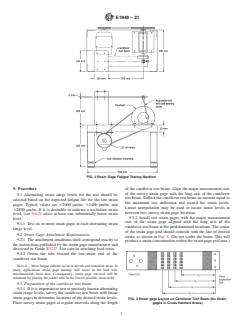
7.2.2 Afatiguetestingmachinesimilartotheoneillustrated
inFig.2shouldbeused.Foracantilevertestbeamwithoverall
7. Apparatus
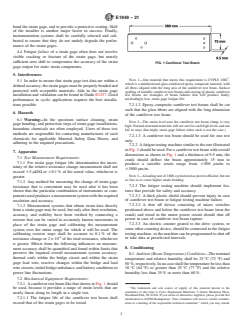
dimensions as shown in Fig. 1 and a thickness of 9.5 mm, the
7.1 Test Measurement Requirements:
crank should deflect the beam approximately 15 mm to
7.1.1 For strain gage fatigue life determination the uncer-
produce a suitable strain range from 6500 µm/m to
tainty of the relative resistance change measurement shall not
63500µm⁄m.
exceed 65µΩ/Ω or 60.1% of the actual value, whichever is
NOTE3—Aloadingrateof1800cycles/minhasprovenefficient,butnot
greater.
so fast as to cause higher mode bending.
7.1.2 Any method for measuring the change of strain gage
7.2.3 The fatigue testing machine should implement fea-
resistance that is convenient may be used after it has been
tures that provide for safety and accuracy.
shown that the particular combination of instruments or com-
7.2.3.1 A thick plastic shield should prevent injury in case
ponentsusedproducesameasurementsystemwiththerequired
of cantilever test beam or fatigue testing machine failure.
resolution and accuracy.
7.2.3.2 A shut off device consisting of micro switches
7.1.3 Measurement systems that obtain strain data directly
positioned above and below the cantilever test beam (near the
from a strain gage may be used, but only after their resolution,
crank) and wired in the motor power circuit should shut off
accuracy, and stability have been verified by connecting a
power in case of cantilever test beam rupture.
resistor that can be varied in accurately known increments in
7.2.3.3 An electric counter geared to the drive system, or
place of the strain gage and calibrating the measurement
someothercountingdevice,shouldbeconnectedtothefatigue
system over the entire range for which it will be used. The
testingmachine,sothemachinecanbeprogrammedtoshutoff
calibrating resistor steps shall be accurate to 0.1% of the
-6
or take data at preselected intervals.
resistance change or 2×10 of the total resistance, whichever
is greater. Effects from the following influences on measure-
8. Conditioning
ment accuracy shall be quantified and found within limits that
preserve the required overall measurement system accuracy:
8.1 Ambient (Room Temperature) Conditions—Thenominal
thermal emfs within the bridge circuit and within the strain
temperature and relative humidity shall be 23°C (73°F) and
gage lead wire, reactive changes within the bridge and lead
50%,respectively.Innocaseshallthetemperaturebelessthan
wirecircuits,initialbridgeunbalance,andbatteryconditionsor
18°C (64°F) or greater than 25°C (77°F) and the relative
power line fluctuations.
humidity less than 35% or more than 60%.
7.2 Mechanical Equipment Requirements:
7.2.1 AcantilevertestbeamlikethatshowninFig.1should
The trademark and sole source of supply of this material known to the
be used, because it provides a range of strain levels that are
committee at this time is Cytec Engineered Materials, 5 Garret Mountain Plaza,
nearly linear along its length in a single test.
Woodland Park, NJ 07424. If you aware of alternative suppliers, please provide this
7.2.1.1 The fatigue life of the cantilever test beam shall
information to ASTM Headquarters. Your comments will receive careful consider-
exceed that of the strain gages to be tested. ation at a meeting o
...
This document is not an ASTM standard and is intended only to provide the user of an ASTM standard an indication of what changes have been made to the previous version. Because
it may not be technically possible to adequately depict all changes accurately, ASTM recommends that users consult prior editions as appropriate. In all cases only the current version
of the standard as published by ASTM is to be considered the official document.
´1
Designation: E1949 − 03 (Reapproved 2014) E1949 − 21
Standard Test Method for
Ambient Temperature Fatigue Life of Metallic Bonded
Resistance Strain Gages
This standard is issued under the fixed designation E1949; the number immediately following the designation indicates the year of
original adoption or, in the case of revision, the year of last revision. A number in parentheses indicates the year of last reapproval. A
superscript epsilon (´) indicates an editorial change since the last revision or reapproval.
ε NOTE—Section 7.2.1 and Footnote 3 were editorially corrected in August 2014.
1. Scope Scope*
1.1 This test method covers a uniform procedure for the determination of strain gage fatigue life at ambient temperature. A
suggested testing equipment design is included.
1.2 This test method does not apply to force transducers or extensometers that use metallic bonded resistance strain gages as
sensing elements.
1.3 Strain gages are part of a complex system that includes structure, adhesive, strain gage, lead wires, instrumentation, and (often)
environmental protection. As a result, many things affect the performance of strain gages, including user technique. A further
complication is that strain gages, once installed, normally cannot be reinstalled in another location. Therefore, it is not possible
to calibrate individual strain gages; performance characteristics are normally presented on a statistical basis.
1.4 This test method encompasses only fully reversed stain cycles.
1.5 This standard does not purport to address all of the safety concerns, if any, associated with its use. It is the responsibility
of the user of this standard to establish appropriate safety safety, health, and healthenvironmental practices and determine the
applicability of regulatory limitations prior to its use.
1.6 This international standard was developed in accordance with internationally recognized principles on standardization
established in the Decision on Principles for the Development of International Standards, Guides and Recommendations issued
by the World Trade Organization Technical Barriers to Trade (TBT) Committee.
2. Referenced Documents
2.1 ASTM Standards:
E6 Terminology Relating to Methods of Mechanical Testing
E1237 Guide for Installing Bonded Resistance Strain Gages
3. Terminology
3.1 Definitions of terms common to mechanical testing:
This test method is under the jurisdiction of ASTM Committee E28 on Mechanical Testing and is the direct responsibility of Subcommittee E28.01 on Calibration of
Mechanical Testing Machines and Apparatus.
Current edition approved April 1, 2009Feb. 1, 2021. Published August 2014March 2021. Originally approved in 1998. Last previous edition approved in 20092014 as
ɛ1
E1949 – 03(2009).(2014) . DOI: 10.1520/E1949-03R14E01.10.1520/E1949-21.
For referenced ASTM standards, visit the ASTM website, www.astm.org, or contact ASTM Customer Service at service@astm.org. For Annual Book of ASTM Standards
volume information, refer to the standard’s Document Summary page on the ASTM website.
*A Summary of Changes section appears at the end of this standard
Copyright © ASTM International, 100 Barr Harbor Drive, PO Box C700, West Conshohocken, PA 19428-2959. United States
E1949 − 21
3.1.1 The terms accuracy, extensometer, gage factor, lead wire, metallic bonded resistance strain gage, and resolution are used
as defined in Terminology E6.
3.2 Definitions of Terms Specific to This Standard:
3.2.1 strain gage, n—the term “strain gage” is equivalent to the longer, but more accurate, “metallic bonded resistance strain
gage.”
3.2.2 strain gage fatigue life, n—the number of fully reversed strain cycles corresponding to the onset of degraded gage
performance, whether due to excessive zero shift or other detectable failure mode (see 9.6).
4. Significance and Use
4.1 Strain gages are the most widely used devices for measuring strains and for evaluating stresses in structures. In many
applications there are often cyclic loads whichthat can cause strain gage failure. Performance parameterscharacteristics of strain
gages are affected by both the materials from which they are made and their geometric design.
4.2 The determination of most strain gage parameters performance characteristics requires mechanical testing that is destructive.
Since strain gages tested for fatigue life cannot be used again, it is necessary to treat data statistically. In general, longer and wider
strain gages with lower resistances will have greater fatigue life. Optional additions to strain gages (integral leads lead wires are
an example) will often reduce fatigue life.
4.3 To be used, strain gages must be bonded to a structure. Good results, particularly in a fatigue environment, depend heavily
on the materials used to clean the bonding surface, to bond the strain gage, and to provide a protective coating. Skill of the installer
is another major factor in success. Finally, instrumentation systems mustshall be carefully selected and calibrated to ensure that
they do not unduly degrade the performance of the strain gages.
4.4 This test method encompasses only fully reversed strain cycles.
4.4 Fatigue failure of a strain gage may often does not involve visible cracking or fracture of the strain gage, but merely sufficient
zero shift to compromise the accuracy of the strain gage output for static strain components.
5. Interferences
5.1 In order to ensure that strain gage test data are within a defined accuracy, the strain gages must be properly bonded and
protected with acceptable materials. Aids in the strain gage installation and verification thereof validation can be found in Guide
E1237. It is important to note that good Good performance in cyclic applications requires the best installations possible.
6. Hazards
6.1 Warning—In the specimen surface cleaning, strain gage bonding, and protection steps of strain gage installations, hazardous
chemicals are often employed. Users of these test methods are responsible for contacting manufactures of such chemicals for
applicable Material Safety Data Sheets, and adhering to adhere to the required precautions.
7. Apparatus
7.1 Test Measurement Requirements:
7.1.1 For strain gage fatigue life determination the uncertainty of the relative resistance change measurement shall not exceed 65
μΩ/ΩμΩ/Ω or 60.1 % of the actual value, whichever is greater.
7.1.2 Several methods are available Any method for measuring the change of gage resistance with sufficient resolution and
accuracy. In general, any method strain gage resistance that is convenient may be used after it has been shown that the particular
combination of instruments or components used produces a measurement system with the required resolution and accuracy.
7.1.3 Many types of instruments are available for obtaining Measurement systems that obtain strain data directly from a resistance
E1949 − 21
strain gage. These instruments use various types of excitation and read-out systems. Such indicators may be used strain gage may
be used, but only after their resolution, accuracy, and stability have been verified by connecting a resistor that can be varied in
accurately known increments in place of the strain gage and calibrating the strain indicatormeasurement system over the entire
-6
range for which it will be used. The calibrating resistor steps shall be accurate to 0.1 % of the resistance change or 22 × 10 ppm
of the total resistance, whichever is greater. Effects from the following influences on measurement accuracy mustshall be quantified
and found within limits that preserve the required overall measurement system accuracy: thermal emfs within the bridge circuit
and within the strain gage leadwire, lead wire, reactive changes within the bridge and lead wire circuits, initial bridge unbalance,
and battery conditions or power line fluctuations.
7.2 Mechanical Equipment Requirements:
7.2.1 A suggested cantilever test beam is like that shown in Fig. 1. The beam must have a fatigue life exceeding that of the strain
gages to be tested. One material which meets this requirement is CYPLY 1002 should be used, because it provides , which is a
unidirectional glass-reinforced epoxy composite material, with all fibers aligned with the long axis of the beam. Surface spalling
of metallic test beams and crazing of plastic specimens are examples of beam failures that will produce faulty, misleadingly low,
strain gage fatigue life.a range of strain levels that are nearly linear along its length in a single test.
7.2.1.1 The fatigue life of the cantilever test beam shall exceed that of the strain gages to be tested.
NOTE 1—One material that meets this requirement is CYPLY 1002 , which is a unidirectional glass-reinforced epoxy composite material, with all fibers
aligned with the long axis of the cantilever test beam. Surface spalling of metallic cantilever test beams and crazing of plastic cantilever test beams are
examples of beam failures that will produce faulty, misleadingly low, strain gage fatigue life.
7.2.1.2 Beam specimens must Epoxy composite cantilever test beams shall be cut such that the glass fibers are aligned with the
long dimension of the specimen. A cantilever specimen is recommended for this testing because it provides a range of strain levels
in a single test. (A consequence is that the specimen’s strain level near the clamp is very high. Normal structural materials will
not survive such high levels and may fail in ways that imply strain gage failure when such is not the case.) A test beam should
be used for one test only.cantilever test beam.
NOTE 2—The strain level near the cantilever test beam clamp is very high. Normal structural materials will not survive such high levels and can fail in
ways that imply strain gage failure when such is not the case.)
7.2.1.3 A cantilever test beam should be used for one test only.
7.2.2 A fatigue testing machine similar to the one illustrated in Fig. 2 should be used. For a cantilever test beam with overall
dimensions as shown in Fig. 1 and a thickness of 9.5 mm, the crank should deflect the beam approximately 15 mm to produce a
suitable strain range from 6500 μm/m to 63500 μm ⁄m.
NOTE 3—A loading rate of 1800 cycles/min has proven efficient, but not so fast as to cause higher mode bending.
7.2.3 A suggested The fatigue testing machine is illustrated in Fig. 2. For a specimen with overall dimensions as shown in Fig.
1 and a thickness of 9.5 mm (0.375 in.), the crank should deflect the beam approximately 15 mm (0.6 in.) to produce a suitable
strain range from 6500 μm/m to 63500 μm/m. A loading rate of 1800 cycles/min has proven efficient, but not so fast as to cause
FIG. 1 Cantilever Test Beam
The trademark and sole source of supply of this material known to the committee at this time is Cytec Engineered Materials, 5 Garret Mountain Plaza, Woodland Park,
NJ 07424. If you aware of alternative suppliers, please provide this information to ASTM Headquarters. Your comments will receive careful consideration at a meeting of
the responsible technical committee, which you may attend.
E1949 − 21
FIG. 2 Strain Gage Fatigue RigTesting Machine
higher mode bending. While not absolutely essential, there are several should implement features that provide for a safer and more
accurate machine, as follows:safety and accuracy.
7.2.3.1 A thick plastic shield toshould prevent injury in case of specimen or cantilever test beam or fatigue testing machine failure.
7.2.3.2 A shut off device consisting of micro switches positioned above and below the specimen cantilever test beam (near the
crank) and wired in the motor power circuit toshould shut off power in case of specimen rupture; andcantilever test beam rupture.
7.2.3.3 An electric counter geared to the drive system, or some other counting device appropriately device, should be connected
to the fatigue testing machine, so the machine can be programmed to shut off or take data at preselected intervals.
8. Conditioning
8.1 Ambient (Room Temperature) Conditions—The nominal temperature and relative humidity shall be 23°C (73°F)23 °C (73 °F)
and 50 %, respectively. In no case shall the temperature be less than 18°C (64°F)18 °C (64 °F) or greater than 25°C (77°F)25 °C
(77 °F) and the relative humidity less than 35 % or more than 60 %.
9. Procedure
9.1 Strain Alternating strain range levels for the test should be selected based on the expected fatigue life for the test strain gages.
Typical values might be are 62000 μm/m, 62400 μm/m, and 62800 μm/m. (It may be necessary to select at least one substantially
lower strain level if If it is desirable to indicate a no-failure strain level; seelevel, (see 9.6.2) Normally six or more strain gages
are tested at each select at least one substantially lower strain level.
9.1.1 Test six or more strain gages at each alternating strain range level.
E1949 − 21
9.2 Strain Gage Attachment Requirements:
9.2.1 The attachment conditions shall correspond exactly to the instructions published by the strain gage manufacturer and
discussed in Guide E1237. Most fatigue failures occur in the tab and transition areas. Use care in attaching leadwires.lead wires.
9.2.2 In many applications strain gage damage will occur in the lead attachment/tab areas first. Consequently sensor survival will
be enhanced by placing the solder tabs in the lowest possible strain field. When conducting fatigue tests, orient the tabs Orient the
tabs toward the low-strain end of the cantilever test beam.
NOTE 4— Most fatigue failures occur in the tab and transition areas. In many applications strain gage damage will occur in the lead wire attachment/tab
areas first. Consequently, strain gage surviva
...