

ASTM C1211-18(2023)
(Test Method)Standard Test Method for Flexural Strength of Advanced Ceramics at Elevated Temperatures
General Information
- Abstract
SIGNIFICANCE AND USE
4.1 This test method may be used for material development, quality control, characterization, and design data generation purposes. This test method is intended to be used with ceramics whose flexural strength is ∼50 MPa (∼7 ksi) or greater.
4.2 The flexure stress is computed based on simple beam theory, with assumptions that the material is isotropic and homogeneous, the moduli of elasticity in tension and compression are identical, and the material is linearly elastic. The average grain size should be no greater than 1/50 of the beam thickness. The homogeneity and isotropy assumptions in the test method rule out the use of it for continuous fiber-reinforced composites for which Test Method C1341 is more appropriate.
4.3 The flexural strength of a group of test specimens is influenced by several parameters associated with the test procedure. Such factors include the testing rate, test environment, specimen size, specimen preparation, and test fixtures. Specimen and fixture sizes were chosen to provide a balance between the practical configurations and resulting errors as discussed in Test Method C1161, and Refs (1-3).4 Specific fixture and specimen configurations were designated in order to permit the ready comparison of data without the need for Weibull size scaling.
4.4 The flexural strength of a ceramic material is dependent on both its inherent resistance to fracture and the size and severity of flaws. Variations in these cause a natural scatter in test results for a sample of test specimens. Fractographic analysis of fracture surfaces, although beyond the scope of this test method, is highly recommended for all purposes, especially if the data will be used for design as discussed in Ref (4) and Practices C1322 and C1239.
4.5 This method determines the flexural strength at elevated temperature and ambient environmental conditions at a nominal, moderately fast testing rate. The flexural strength under these conditions may or may not necessarily be the...
SCOPE
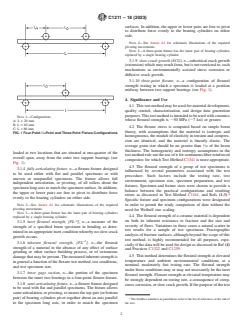
1.1 This test method covers determination of the flexural strength of advanced ceramics at elevated temperatures.2 Four-point-1/4-point and three-point loadings with prescribed spans are the standard as shown in Fig. 1. Rectangular specimens of prescribed cross-section are used with specified features in prescribed specimen-fixture combinations. Test specimens may be 3 by 4 by 45 to 50 mm in size that are tested on 40-mm outer span four-point or three-point fixtures. Alternatively, test specimens and fixture spans half or twice these sizes may be used. The test method permits testing of machined or as-fired test specimens. Several options for machining preparation are included: application matched machining, customary procedures, or a specified standard procedure. This test method describes the apparatus, specimen requirements, test procedure, calculations, and reporting requirements. The test method is applicable to monolithic or particulate- or whisker-reinforced ceramics. It may also be used for glasses. It is not applicable to continuous fiber-reinforced ceramic composites.
1.2 The values stated in SI units are to be regarded as the standard. The values given in parentheses are for information only.
1.3 This standard does not purport to address all of the safety concerns, if any, associated with its use. It is the responsibility of the user of this standard to establish appropriate safety, health, and environmental practices and determine the applicability of regulatory limitations prior to use.
1.4 This international standard was developed in accordance with internationally recognized principles on standardization established in the Decision on Principles for the Development of International Standards, Guides and Recommendations issued by the World Trade Organization Technical Barriers to Trade (TBT) Committee.
- Status
- Published
- Publication Date
- 31-Dec-2022
- Technical Committee
- C28 - Advanced Ceramics
- Drafting Committee
- C28.01 - Mechanical Properties and Performance
Overview
ASTM C1211-18(2023) establishes standardized procedures for determining the flexural strength of advanced ceramics at elevated temperatures. Developed by ASTM International, this standard supports reliable testing for ceramics with a flexural strength of approximately 50 MPa (7 ksi) or greater. The test method is widely used for material development, quality control, material characterization, and the generation of design data, ensuring consistency and comparability across industries working with high-performance ceramics.
This method utilizes both four-point and three-point loading configurations to assess the flexural properties of monolithic, particulate-, or whisker-reinforced ceramics, and it is also applicable to glasses. However, it does not cover continuous fiber-reinforced ceramic composites, for which other standards such as ASTM C1341 are more appropriate.
Key Topics
- Flexural Strength Measurement: The standard details how to measure the ultimate strength of advanced ceramics in bending, using prescribed fixture spans and specimen geometries.
- Test Configurations: It specifies four-point (1/4-point) and three-point test setups with clearly defined support and loading spans, using rectangular specimens.
- Fixture and Specimen Requirements: The document outlines material, size tolerances, fixture articulation, and temperature control necessary for consistent results.
- Environmental Controls: Testing is performed at both ambient and elevated temperatures, with strict requirements for temperature stability and minimal gradients across the specimen.
- Assumptions and Limitations: The method assumes the ceramic tested is isotropic and homogeneous, with no substantial variations in moduli between tension and compression. It is not applicable to continuous fiber-reinforced composites.
- Influence of Testing Parameters: Results are affected by factors such as test rate, specimen preparation, environment, and size, which are carefully controlled to permit ready comparison of data and minimize errors.
- Reporting and Analysis: Clear instructions are provided on result calculation, data reporting, and the importance of fractographic analysis for specimens, especially when data is used for design purposes.
Applications
The ASTM C1211-18(2023) test method is essential in sectors that design, manufacture, or rely on advanced ceramics for demanding applications, where mechanical performance at high temperatures must be assured. Typical applications include:
- Material Development and Selection: Useful for comparing ceramic materials and optimizing their composition or processing.
- Quality Control: Provides a measurable, repeatable standard for verifying production consistency and suitability for end use.
- Engineering Design Data: Generates flexural strength values that feed into simulations and calculations for component design, especially where ceramics are exposed to significant stress or elevated temperatures.
- Failure Analysis and Research: Highly recommended for characterizing fracture origins and understanding the influence of flaws and slow crack growth, aiding in material improvement and failure prevention.
Industries benefiting from this standard include aerospace, automotive, electronics, defense, and any field utilizing ceramics or glass-ceramic components for structural, electrical, or thermal performance.
Related Standards
For comprehensive testing, reporting, and analysis of ceramics, several related ASTM standards are referenced:
- ASTM C1161 - Test Method for Flexural Strength of Advanced Ceramics at Ambient Temperature
- ASTM C1239 - Practice for Reporting Uniaxial Strength Data and Estimating Weibull Distribution Parameters for Advanced Ceramics
- ASTM C1322 - Practice for Fractography and Characterization of Fracture Origins in Advanced Ceramics
- ASTM C1341 - Test Method for Flexural Properties of Continuous Fiber-Reinforced Advanced Ceramic Composites
- ASTM C1368 and C1465 - Methods for Determining Slow Crack Growth Parameters
- ASTM E4 - Practices for Force Calibration and Verification of Testing Machines
- ASTM E220 and E230 - Methods and Specifications for Thermocouple Calibration
By adhering to ASTM C1211-18(2023) and related standards, organizations can ensure robust, reliable assessment of ceramic materials’ flexural strength at elevated temperatures-supporting innovation, safety, and quality in advanced ceramics applications.
Relations
- Effective Date
- 01-Jul-2019
- Effective Date
- 01-Jul-2019
- Effective Date
- 01-Jul-2018
- Effective Date
- 01-Jan-2018
- Effective Date
- 01-Feb-2017
- Effective Date
- 01-Jul-2015
- Effective Date
- 01-Jun-2014
- Effective Date
- 01-Nov-2013
- Effective Date
- 01-Aug-2013
- Effective Date
- 01-Aug-2013
- Effective Date
- 01-Aug-2013
- Effective Date
- 01-Aug-2013
- Effective Date
- 15-Feb-2013
- Effective Date
- 01-Dec-2010
- Effective Date
- 15-Jul-2010
Frequently Asked Questions
ASTM C1211-18(2023) is a standard published by ASTM International. Its full title is "Standard Test Method for Flexural Strength of Advanced Ceramics at Elevated Temperatures". This standard covers: SIGNIFICANCE AND USE 4.1 This test method may be used for material development, quality control, characterization, and design data generation purposes. This test method is intended to be used with ceramics whose flexural strength is ∼50 MPa (∼7 ksi) or greater. 4.2 The flexure stress is computed based on simple beam theory, with assumptions that the material is isotropic and homogeneous, the moduli of elasticity in tension and compression are identical, and the material is linearly elastic. The average grain size should be no greater than 1/50 of the beam thickness. The homogeneity and isotropy assumptions in the test method rule out the use of it for continuous fiber-reinforced composites for which Test Method C1341 is more appropriate. 4.3 The flexural strength of a group of test specimens is influenced by several parameters associated with the test procedure. Such factors include the testing rate, test environment, specimen size, specimen preparation, and test fixtures. Specimen and fixture sizes were chosen to provide a balance between the practical configurations and resulting errors as discussed in Test Method C1161, and Refs (1-3).4 Specific fixture and specimen configurations were designated in order to permit the ready comparison of data without the need for Weibull size scaling. 4.4 The flexural strength of a ceramic material is dependent on both its inherent resistance to fracture and the size and severity of flaws. Variations in these cause a natural scatter in test results for a sample of test specimens. Fractographic analysis of fracture surfaces, although beyond the scope of this test method, is highly recommended for all purposes, especially if the data will be used for design as discussed in Ref (4) and Practices C1322 and C1239. 4.5 This method determines the flexural strength at elevated temperature and ambient environmental conditions at a nominal, moderately fast testing rate. The flexural strength under these conditions may or may not necessarily be the... SCOPE 1.1 This test method covers determination of the flexural strength of advanced ceramics at elevated temperatures.2 Four-point-1/4-point and three-point loadings with prescribed spans are the standard as shown in Fig. 1. Rectangular specimens of prescribed cross-section are used with specified features in prescribed specimen-fixture combinations. Test specimens may be 3 by 4 by 45 to 50 mm in size that are tested on 40-mm outer span four-point or three-point fixtures. Alternatively, test specimens and fixture spans half or twice these sizes may be used. The test method permits testing of machined or as-fired test specimens. Several options for machining preparation are included: application matched machining, customary procedures, or a specified standard procedure. This test method describes the apparatus, specimen requirements, test procedure, calculations, and reporting requirements. The test method is applicable to monolithic or particulate- or whisker-reinforced ceramics. It may also be used for glasses. It is not applicable to continuous fiber-reinforced ceramic composites. 1.2 The values stated in SI units are to be regarded as the standard. The values given in parentheses are for information only. 1.3 This standard does not purport to address all of the safety concerns, if any, associated with its use. It is the responsibility of the user of this standard to establish appropriate safety, health, and environmental practices and determine the applicability of regulatory limitations prior to use. 1.4 This international standard was developed in accordance with internationally recognized principles on standardization established in the Decision on Principles for the Development of International Standards, Guides and Recommendations issued by the World Trade Organization Technical Barriers to Trade (TBT) Committee.
SIGNIFICANCE AND USE 4.1 This test method may be used for material development, quality control, characterization, and design data generation purposes. This test method is intended to be used with ceramics whose flexural strength is ∼50 MPa (∼7 ksi) or greater. 4.2 The flexure stress is computed based on simple beam theory, with assumptions that the material is isotropic and homogeneous, the moduli of elasticity in tension and compression are identical, and the material is linearly elastic. The average grain size should be no greater than 1/50 of the beam thickness. The homogeneity and isotropy assumptions in the test method rule out the use of it for continuous fiber-reinforced composites for which Test Method C1341 is more appropriate. 4.3 The flexural strength of a group of test specimens is influenced by several parameters associated with the test procedure. Such factors include the testing rate, test environment, specimen size, specimen preparation, and test fixtures. Specimen and fixture sizes were chosen to provide a balance between the practical configurations and resulting errors as discussed in Test Method C1161, and Refs (1-3).4 Specific fixture and specimen configurations were designated in order to permit the ready comparison of data without the need for Weibull size scaling. 4.4 The flexural strength of a ceramic material is dependent on both its inherent resistance to fracture and the size and severity of flaws. Variations in these cause a natural scatter in test results for a sample of test specimens. Fractographic analysis of fracture surfaces, although beyond the scope of this test method, is highly recommended for all purposes, especially if the data will be used for design as discussed in Ref (4) and Practices C1322 and C1239. 4.5 This method determines the flexural strength at elevated temperature and ambient environmental conditions at a nominal, moderately fast testing rate. The flexural strength under these conditions may or may not necessarily be the... SCOPE 1.1 This test method covers determination of the flexural strength of advanced ceramics at elevated temperatures.2 Four-point-1/4-point and three-point loadings with prescribed spans are the standard as shown in Fig. 1. Rectangular specimens of prescribed cross-section are used with specified features in prescribed specimen-fixture combinations. Test specimens may be 3 by 4 by 45 to 50 mm in size that are tested on 40-mm outer span four-point or three-point fixtures. Alternatively, test specimens and fixture spans half or twice these sizes may be used. The test method permits testing of machined or as-fired test specimens. Several options for machining preparation are included: application matched machining, customary procedures, or a specified standard procedure. This test method describes the apparatus, specimen requirements, test procedure, calculations, and reporting requirements. The test method is applicable to monolithic or particulate- or whisker-reinforced ceramics. It may also be used for glasses. It is not applicable to continuous fiber-reinforced ceramic composites. 1.2 The values stated in SI units are to be regarded as the standard. The values given in parentheses are for information only. 1.3 This standard does not purport to address all of the safety concerns, if any, associated with its use. It is the responsibility of the user of this standard to establish appropriate safety, health, and environmental practices and determine the applicability of regulatory limitations prior to use. 1.4 This international standard was developed in accordance with internationally recognized principles on standardization established in the Decision on Principles for the Development of International Standards, Guides and Recommendations issued by the World Trade Organization Technical Barriers to Trade (TBT) Committee.
ASTM C1211-18(2023) is classified under the following ICS (International Classification for Standards) categories: 81.060.30 - Advanced ceramics; 81.060.99 - Other standards related to ceramics. The ICS classification helps identify the subject area and facilitates finding related standards.
ASTM C1211-18(2023) has the following relationships with other standards: It is inter standard links to ASTM C1465-08(2019), ASTM C1322-15(2019), ASTM C1239-13(2018), ASTM C1368-18, ASTM C1368-10(2017), ASTM C1322-15, ASTM E4-14, ASTM E220-13, ASTM C1161-13, ASTM C1239-13, ASTM C1465-08(2013), ASTM C1465-08(2013)e1, ASTM C1341-13, ASTM C1368-10, ASTM C1322-05b(2010). Understanding these relationships helps ensure you are using the most current and applicable version of the standard.
ASTM C1211-18(2023) is available in PDF format for immediate download after purchase. The document can be added to your cart and obtained through the secure checkout process. Digital delivery ensures instant access to the complete standard document.
Standards Content (Sample)
This international standard was developed in accordance with internationally recognized principles on standardization established in the Decision on Principles for the
Development of International Standards, Guides and Recommendations issued by the World Trade Organization Technical Barriers to Trade (TBT) Committee.
Designation: C1211 − 18 (Reapproved 2023)
Standard Test Method for
Flexural Strength of Advanced Ceramics at Elevated
Temperatures
This standard is issued under the fixed designation C1211; the number immediately following the designation indicates the year of
original adoption or, in the case of revision, the year of last revision. A number in parentheses indicates the year of last reapproval. A
superscript epsilon (´) indicates an editorial change since the last revision or reapproval.
1. Scope 2. Referenced Documents
1.1 This test method covers determination of the flexural 2.1 ASTM Standards:
strength of advanced ceramics at elevated temperatures. C1161 Test Method for Flexural Strength of Advanced
Four-point- ⁄4-point and three-point loadings with prescribed Ceramics at Ambient Temperature
spans are the standard as shown in Fig. 1. Rectangular C1239 Practice for Reporting Uniaxial Strength Data and
specimens of prescribed cross-section are used with specified Estimating Weibull Distribution Parameters for Advanced
features in prescribed specimen-fixture combinations. Test Ceramics
specimens may be 3 by 4 by 45 to 50 mm in size that are tested C1322 Practice for Fractography and Characterization of
on 40-mm outer span four-point or three-point fixtures. Fracture Origins in Advanced Ceramics
Alternatively, test specimens and fixture spans half or twice C1341 Test Method for Flexural Properties of Continuous
these sizes may be used. The test method permits testing of Fiber-Reinforced Advanced Ceramic Composites
machined or as-fired test specimens. Several options for C1368 Test Method for Determination of Slow Crack
machining preparation are included: application matched Growth Parameters of Advanced Ceramics by Constant
machining, customary procedures, or a specified standard Stress Rate Strength Testing at Ambient Temperature
procedure. This test method describes the apparatus, specimen C1465 Test Method for Determination of Slow Crack
requirements, test procedure, calculations, and reporting re- Growth Parameters of Advanced Ceramics by Constant
quirements. The test method is applicable to monolithic or Stress-Rate Flexural Testing at Elevated Temperatures
particulate- or whisker-reinforced ceramics. It may also be E4 Practices for Force Calibration and Verification of Test-
used for glasses. It is not applicable to continuous fiber- ing Machines
reinforced ceramic composites. E220 Test Method for Calibration of Thermocouples By
Comparison Techniques
1.2 The values stated in SI units are to be regarded as the
E230 Specification for Temperature-Electromotive Force
standard. The values given in parentheses are for information
(emf) Tables for Standardized Thermocouples
only.
1.3 This standard does not purport to address all of the
3. Terminology
safety concerns, if any, associated with its use. It is the
3.1 Definitions:
responsibility of the user of this standard to establish appro-
3.1.1 complete gage section, n—the portion of the specimen
priate safety, health, and environmental practices and deter-
between the two outer bearings in four-point flexure and
mine the applicability of regulatory limitations prior to use.
three-point flexure fixtures.
1.4 This international standard was developed in accor-
dance with internationally recognized principles on standard- NOTE 1—In this standard, the complete four-point flexure gage section
is twice the size of the inner gage section. Weibull statistical analyses, in
ization established in the Decision on Principles for the
this instance, only include portions of the specimen volume or surface
Development of International Standards, Guides and Recom-
which experience tensile stresses.
mendations issued by the World Trade Organization Technical
–2
3.1.2 flexural strength, [FL ], n—a measure of the ultimate
Barriers to Trade (TBT) Committee.
strength of a specified beam in bending.
3.1.3 four-point- ⁄4-point flexure, n—a configuration of flex-
This test method is under the jurisdiction of ASTM Committee C28 on
ural strength testing in which a specimen is symmetrically
Advanced Ceramics and is the direct responsibility of Subcommittee C28.01 on
Mechanical Properties and Performance.
Current edition approved Jan. 1, 2023. Published February 2023. Originally
approved in 1992. Last previous edition approved in 2018 as C1211 – 18. DOI: For referenced ASTM standards, visit the ASTM website, www.astm.org, or
10.1520/C1211-18R23. contact ASTM Customer Service at service@astm.org. For Annual Book of ASTM
Elevated temperatures typically denote, but are not restricted to, 200 to Standards volume information, refer to the standard’s Document Summary page on
1600 °C. the ASTM website.
*A Summary of Changes section appears at the end of this standard
Copyright © ASTM International, 100 Barr Harbor Drive, PO Box C700, West Conshohocken, PA 19428-2959. United States
C1211 − 18 (2023)
surfaces. In addition, the upper or lower pairs are free to pivot
to distribute force evenly to the bearing cylinders on either
side.
NOTE 4—See Annex A1 for schematic illustrations of the required
pivoting movements.
NOTE 5—A three-point fixture has the inner pair of bearing cylinders
replaced by a single bearing cylinder.
3.1.9 slow crack growth (SCG), n—subcritical crack growth
(extension) which may result from, but is not restricted to, such
mechanisms as environmentally assisted stress corrosion or
diffusive crack growth.
3.1.10 three-point flexure, n—a configuration of flexural
strength testing in which a specimen is loaded at a position
midway between two support bearings (see Fig. 1).
4. Significance and Use
4.1 This test method may be used for material development,
quality control, characterization, and design data generation
purposes. This test method is intended to be used with ceramics
NOTE 1—Configuration:
whose flexural strength is ;50 MPa (;7 ksi) or greater.
A: L = 20 mm
B: L = 40 mm
4.2 The flexure stress is computed based on simple beam
C: L = 80 mm
theory, with assumptions that the material is isotropic and
FIG. 1 Four-Point- ⁄4-Point and Three-Point Fixture Configurations
homogeneous, the moduli of elasticity in tension and compres-
sion are identical, and the material is linearly elastic. The
average grain size should be no greater than ⁄50 of the beam
thickness. The homogeneity and isotropy assumptions in the
loaded at two locations that are situated at one-quarter of the
test method rule out the use of it for continuous fiber-reinforced
overall span, away from the outer two support bearings (see
composites for which Test Method C1341 is more appropriate.
Fig. 1).
4.3 The flexural strength of a group of test specimens is
3.1.4 fully articulating fixture, n—a flexure fixture designed
influenced by several parameters associated with the test
to be used either with flat and parallel specimens or with
procedure. Such factors include the testing rate, test
uneven or nonparallel specimens. The fixture allows full
environment, specimen size, specimen preparation, and test
independent articulation, or pivoting, of all rollers about the
fixtures. Specimen and fixture sizes were chosen to provide a
specimen long axis to match the specimen surface. In addition,
balance between the practical configurations and resulting
the upper or lower pairs are free to pivot to distribute force
errors as discussed in Test Method C1161, and Refs (1-3).
evenly to the bearing cylinders on either side.
Specific fixture and specimen configurations were designated
NOTE 2—See Annex A1 for schematic illustrations of the required
in order to permit the ready comparison of data without the
pivoting movements.
need for Weibull size scaling.
NOTE 3—A three-point fixture has the inner pair of bearing cylinders
4.4 The flexural strength of a ceramic material is dependent
replaced by a single bearing cylinder.
–2
on both its inherent resistance to fracture and the size and
3.1.5 inert flexural strength, [FL ], n—a measure of the
severity of flaws. Variations in these cause a natural scatter in
strength of a specified beam specimen in bending as deter-
test results for a sample of test specimens. Fractographic
mined in an appropriate inert condition whereby no slow crack
analysis of fracture surfaces, although beyond the scope of this
growth occurs.
test method, is highly recommended for all purposes, espe-
–2
3.1.6 inherent flexural strength, [FL ], n—the flexural
cially if the data will be used for design as discussed in Ref (4)
strength of a material in the absence of any effect of surface
and Practices C1322 and C1239.
grinding or other surface finishing process, or of extraneous
4.5 This method determines the flexural strength at elevated
damage that may be present. The measured inherent strength is
temperature and ambient environmental conditions at a
in general a function of the flexure test method, test conditions,
nominal, moderately fast testing rate. The flexural strength
and test specimen size.
under these conditions may or may not necessarily be the inert
3.1.7 inner gage section, n—the portion of the specimen
flexural strength. Flexure strength at elevated temperature may
between the inner two bearings in a four-point flexure fixture.
be strongly dependent on testing rate, a consequence of creep,
3.1.8 semi-articulating fixture, n—a flexure fixture designed
stress corrosion, or slow crack growth. If the purpose of the test
to be used with flat and parallel specimens. The fixture allows
some articulation, or pivoting, to ensure the top pair (or bottom
pair) of bearing cylinders pivot together about an axis parallel
The boldface numbers in parentheses refer to the list of references at the end of
to the specimen long axis, in order to match the specimen the text.
C1211 − 18 (2023)
TABLE 1 Fixture Spans
is to measure the inert flexural strength, then extra precautions
are required and faster testing rates may be necessary. Support Span Loading Span,
Configuration
(L), mm mm
NOTE 6—Many ceramics are susceptible to either environmentally
A 20 10
assisted slow crack growth or thermally activated slow crack growth.
B 40 20
Oxide ceramics, glasses, glass ceramics, and ceramics containing bound-
C 80 40
ary phase glass are particularly susceptible to slow crack growth.
Time-dependent effects that are caused by environmental factors (for
example, water as humidity in air) may be minimized through the use of
inert testing atmosphere such as dry nitrogen gas or vacuum. Alternatively,
testing rates faster than specified in this standard may be used if the goal or may not produce the inert flexural strength whereby negli-
is to measure the inert strength. Thermally activated slow crack growth
gible slow crack growth occurs. See Test Methods C1368 and
may occur at elevated temperature even in inert atmospheres. Testing rates
C1465 and Ref (5) for more information about possible rate
faster than specified in this standard should be used if the goal is to
dependencies of flexural strength and methodologies for quan-
measure the inert flexural strength. On the other hand, many ceramics such
tifying the rate sensitivity
as boron carbide, silicon carbide, aluminum nitride, and many silicon
nitrides have no sensitivity to slow crack growth at room or moderately
elevated temperatures and for such materials, the flexural strength
6. Apparatus
measured under laboratory ambient conditions at the nominal testing rate
6.1 Loading—Specimens may be force in any suitable
is the inert flexural strength.
testing machine provided that uniform rates of direct loading
4.6 The three-point test configuration exposes only a very
can be maintained. The force measuring system shall be free of
small portion of the specimen to the maximum stress.
initial lag at the loading rates used and shall be equipped with
Therefore, three-point flexural strengths are likely to be much
a means for retaining readout of the maximum force as well as
greater than four-point flexural strengths. Three-point flexure
a force-time or force-deflection record. The accuracy of the
has some advantages. It uses simpler test fixtures, it is easier to
testing machine shall be in accordance with Practices E4.
adapt to high temperature, and it is sometimes helpful in
Weibull statistical studies. However, four-point flexure is 6.2 Four-Point Flexure Four-Point- ⁄4-Point Fixtures (Fig.
1), having support spans as given in Table 1.
preferred and recommended for most characterization pur-
poses.
6.3 Three-Point Flexure Three-Point Fixtures (Fig. 1), hav-
ing a support span as given in Table 1.
4.7 The three-point test configuration exposes only a very
small portion of the specimen to the maximum stress.
6.4 Bearings, Three- and four-point flexure.
Therefore, three-point flexural strengths are likely to be much
6.4.1 Cylindrical bearings shall be used for support of the
greater than four-point flexural strengths. Three-point flexure
test specimen and for load application. The cylinders may be
has some advantages. It uses simpler test fixtures, it is easier to
made of a ceramic with an elastic modulus between 200 and
adapt to high temperature, and it is sometimes helpful in
400 GPa (30 to 60 × 10 psi) and a flexural strength no less
Weibull statistical studies. However, four-point flexure is
than 275 MPa (≈40 ksi). The loading cylinders must remain
preferred and recommended for most characterization pur-
elastic (and have no plastic deformation) over the load and
poses.
temperature ranges used, and they must not react chemically
with or contaminate the test specimen. The test fixture shall
5. Interferences
also be made of a ceramic that is resistant to permanent
5.1 Time-dependent phenomena, such as stress corrosion
deformation.
and slow crack growth, can interfere with determination of the
6.4.2 The bearing cylinder diameter shall be approximately
flexural strength at room and elevated temperatures. Creep
1.5 times the beam depth of the test specimen size used (see
phenomena also become significant at elevated temperatures.
Table 2).
Creep deformation can cause stress relaxation in a flexure
6.4.3 The bearing cylinders shall be positioned carefully
specimen during a strength test, thereby causing the elastic
such that the spans are accurate to within 60.10 mm. The load
formulation that is used to compute the strength to be in error.
application bearing for the three-point configurations shall be
5.2 Surface preparation of the test specimens can introduce
positioned midway between the support bearings within
machining damage such as microcracks that may have a
60.10 mm. The load application (inner) bearings for the
pronounced effect on flexural strength. Machining damage
four-point configurations shall be centered with respect to the
imposed during specimen preparation can be either a random
support (outer) bearings within 60.10 mm.
interfering factor or an inherent part of the strength character-
6.4.4 The bearing cylinders shall be free to rotate in order to
istic to be measured. With proper care and good machining
relieve frictional constraints (with the exception of the middle
practice, it is possible to obtain fractures from the material’s
load bearing in three-point flexure, which need not rotate). This
natural flaws. Surface preparation can also lead to residual
can be accomplished as shown in Figs. 2 and 3. Annex A1
stresses. Universal or standardized test methods of surface
illustrates the action required of the bearing cylinders. Note
preparation do not exist. It should be understood that final
machining steps may or may not negate machining damage
introduced during the early coarse or intermediate machining. The accuracy requirement is different from that specified in Test Method C1161
and is a concession to difficulties incurred in conducting elevated temperature
5.3 Slow crack growth can lead to a rate dependency of
testing. The accuracy required by Practices E4 is 1 %; Test Method C1161 calls for
flexural strength. The testing rate specified in this standard may 0.5 %.
C1211 − 18 (2023)
TABLE 2 Nominal Bearing Diameters
two inner bearings shall be parallel to each other to within
Configuration Diameter, mm 0.015 mm over their length. The two outer bearings shall be
A 2.0 to 2.5
parallel to each other to within 0.015 mm over their length. The
B 4.5
inner bearings shall be supported independently of the outer
C 9.0
bearings. All four bearings shall rest uniformly and evenly
across the specimen surfaces. The fixture shall be designed to
apply equal load to all four bearings.
6.6 Fully Articulating Four-Point Fixture—Specimens that
are as-fired, heat treated, or oxidized often have slight twists or
unevenness. Specimens that do not meet the parallelism
requirements of 7.1 shall be tested in a fully articulating fixture
as illustrated in Fig. 3 and in Fig. A1.1(b). Well-machined
specimens may also be tested in fully articulating fixtures. All
four bearings shall be free to roll. One bearing need not
articulate. The other three bearings shall articulate to match the
specimen’s surface. All four bearings shall rest uniformly and
evenly across the specimen surfaces. The fixture shall apply
equal load to all four bearings.
6.7 Semi-Articulated Three-Point Fixture—Specimens pre-
pared in accordance with the parallelism requirements of 7.1
may be tested in a semi-articulating fixture as illustrated in Fig.
A1.2(a). The middle bearing shall be fixed and not free to roll.
The two outer bearings shall be parallel to each other to within
0.015 mm over their length. The two outer bearings shall
articulate together to match the specimen surface, or the middle
bearing shall articulate to match the specimen surface. All three
bearings shall rest uniformly and evenly across the specimen
surface. The fixture shall be designed to apply equal load to the
NOTE 1—Configuration:
two outer bearings.
A: L = 20 mm
B: L = 40 mm
6.8 Fully Articulated Three-Point Flexure—Specimens that
C: L = 80 mm
do not meet the parallelism requirements of 7.1 shall be tested
NOTE 2—Load is applied through a rounded and well-centered tip that
in a fully articulating fixture as illustrated in Fig. A1.2(b) or
permits the loading member to tilt as necessary to ensure uniform loading.
Fig. A1.2(c). Well-machined specimens may also be tested in
FIG. 2 Schematics of Semi-Articulated Four-Point Fixtures Suit-
fully articulating fixtures. The two support (outer) bearings
able for Flat and Parallel Specimens
shall be free to roll outwards. The middle bearing shall not roll.
Any two of the bearings shall be capable of articulating to
that the outer support bearings roll outward and the inner
match the specimen surface. All three bearings shall rest
loading bearings roll inward.
uniformly and evenly across the specimen surface. The fixture
shall be designed to apply equal load to the two outer bearings.
6.5 Semi-Articulating Four-Point Fixture—Specimens pre-
pared in accordance with the parallelism requirements of 7.1
6.9 System Compliance—The compliance of the load train
may be tested in a semi-articulating fixture as illustrated in Fig.
shall be characterized for the loading range used and the testing
2 and in Fig. A1.1(a). All four bearings shall be free to roll. The
temperature. The load train and fixtures shall be sufficiently
rigid so that at least 80 % of the crosshead motion is transmit-
ted to the actual test specimens. The load train and fixtures
In general, fixed-pin fixtures have frictional constraints that can cause a
shall not permanently deform during testing. It is not necessary
systematic error on the order of 5 % to 15 % in flexure strength (see Refs (1, 2, 4-7)).
Since this error is systematic (constant for all specimens in a sample), it will lead to
to check the system compliance for every test sequence,
a bias in estimates of the mean strength and will shift a Weibull curve a fixed amount
provided that it has been characterized previously for the
of stress. The scatter, however, will remain constant.
identical setup.
Rolling-pin fixtures are required by this test method. It is recognized that they
may not be feasible in some instances, in which case fixed-pin fixtures may be used,
but this must be stated explicitly in the report, and justification must be given as
noted in 10.1.16.
Some fixtures have loading cylinders that fit into square slots with a slight Compliance can be measured by inserting an oversized block onto the flexure
clearance. Of course, the clearance must be such that the possible spans are within fixture, loading it to the maximum expected break force at the test temperature, and
the prescribed limits of this test method. Unfortunately, for any given test, it is recording a load-deflection graph. The block must be a ceramic material that will
usually not possible to ascertain whether a roller rests against an inner or outer remain elastic under these conditions. The compliance check shall be made with the
shoulder, and thus it is possible that some rollers may be free to roll and others not. entire force train in place, especially the load bearing rollers. It is recommended that
This can lead to the superimposition of a random error on the results. Such fixtures the block be at least five times thicker than the normal test specimen and one to two
should therefore be used with caution. times thicker than the normal specimen width.
C1211 − 18 (2023)
NOTE 1—Configuration:
A: L = 20 mm
B: L = 40 mm
C: L = 80 mm
NOTE 2—One of the four load bearings (for example, Roller No. 1) should not articulate about the x axis. The other three will provide the necessary
degrees of freedom. The radius R in the bottom fixture should be sufficiently large such that contact stresses on the roller are minimized.
FIG. 3 Schematics of Fully Articulating Four-Point Fixtures Suitable for Twisted or Uneven Specimens
6.10 Fixture Material, essentially inert for the testing con- 62 °C. The temperature readout device shall have a resolution
ditions used. The fixture shall be oxidation resistant if the of 1 °C or lower. The furnace system shall be such that thermal
testing is performed in air. gradients are minimal in the flexure specimen, so that no more
than a 5 °C differential exists from end to end in the specimen.
6.11 Heating Apparatus—A furnace capable of meeting the
6.11.2 The specimen temperature shall be monitored by a
following requirements:
thermocouple with its tip located no more than 1 mm from the
6.11.1 The furnace shall be capable of establishing and
midpoint of the flexure specimen. Either a fully sheathed or
maintaining a constant temperature during each testing period.
exposed bead junction may be used. If a sheathed tip is used,
The variation in temperature during the test shall be within
it must be verified that there is negligible error associated with
9,10
the covering.
Various grades of silicon carbide are available that will be suitable for fixtures
and load trains. Hot-pressed or sintered silicon carbides with low additive content
are elastic to temperatures in excess of 1500 °C. Siliconized silicon carbides and
high-purity aluminas are less expensive and are available in a variety of shapes, but Exposed thermocouple beads have greater sensitivity, but they may be exposed
they exhibit creep deformations at temperatures above 1200 °C. Recrystallized to vapors that can react with the thermocouple materials. (For example, silica vapors
silicon carbides are elastic to temperatures up to 2000 °C but are relatively weak due will react with platinum.) Beware of the use of heavy-gage thermocouple wire,
to their porosity. Graphites are extremely refractory but are restricted to usage in thermal gradients along the thermocouple length, or excessively heavy-walled
inert atmospheres. They may suffice for load rams or portions of fixtures, but they insulators, all of which can lead to erroneous temperature readings.
should be avoided for use where there are concentrated loads, such as loading The thermocouple tip may contact the flexure specimen, but only if there is
bearings, since graphite is too soft. Avoid materials that will oxidize significantly at certainty that the thermocouple tip or sheathing material will not interact chemically
test temperatures (if testing in air) or that will react chemically with or contaminate with the specimen. Thermocouples may be prone to breakage if they are in contact
test specimens. with the specimen.
C1211 − 18 (2023)
TABLE 3 Specimen Sizes
0.015 mm for A and B specimens and 0.03 mm for C
Width (b), Depth (d), Length (L ), specimens. The two end faces need not be precision machined.
T
Configuration
mm mm mm, min
7.2 Specimen Preparation—Depending on the intended ap-
A 2.0 1.5 25
plication of the flexural strength data, use one of the following
B 4.0 3.0 45
C 8.0 6.0 90
four specimen preparation procedures:
7.2.1 As-Fabricated—The flexure specimen shall simulate
the surface condition of an application in which no machining
is used, for example, as-cast, sintered, or injection-molded
6.11.3 A separate thermocouple may be used to control the
parts. No additional machining specifications are relevant. An
furnace chamber if necessary, but the specimen temperature
edge chamfer is not necessary in this instance. As-fired
shall be the reported temperature of the test.
specimens are especially prone to twist or warpage and may
6.11.4 The thermocouple(s) shall be calibrated in accor-
not meet the parallelism requirements. A fully articulating
dance with Test Method E220 and Specification E230.
fixture (see 6.6 and Fig. 3) shall be used in this instance.
6.11.5 The temperature shall be accurate to within 65 °C.
7.2.2 Application-Matched Machining—The specimen shall
The accuracy shall include the error inherent to the thermo-
13,14
be given the same surface preparation as that given to a
couple as well as any errors in the measuring instruments.
component. Unless the process is proprietary, the report shall
6.11.6 The appropriate thermocouple extension wire should
be specific concerning the stages of material removal, wheel
be used to connect a thermocouple to the furnace controller and
grits, wheel bonding, and the amount of material removed per
temperature readout device, which must have either a cold
pass.
junction or a room temperature compensation circuit. Special
7.2.3 Customary Procedure—This procedure shall be used
attention should be directed toward connecting the extension
wire with the correct polarity. in instances in which a customary machining procedure has
been developed that is completely satisfactory for a class of
6.11.7 The furnace may have an air, inert, or vacuum
environment, as required. If an inert or vacuum chamber is materials (that is, it induces no unwanted surface damage or
residual stresses). It shall be fully specified in the report.
used, and it is necessary to direct load through a bellows,
fittings, or seal, it shall be verified that load losses or errors do 7.2.4 Standard Procedure—In the instances in which 7.2.1 –
7.2.3 are not appropriate, the “Standard Procedure” option in
not exceed 1 % of the expected failure loads.
7.2.4 of Test Method C1161 shall apply. All machining shall be
6.12 System Equilibrium—The time for the system to reach
parallel to the specimen long axis as shown in Fig. 5. No
thermal equilibrium at test temperature shall be determined for
Blanchard or rotary grinding shall be used.
the test temperature to be used. This shall be performed for
7.2.4.1 The four long edges of each B-sized test specimen
both hot-furnace loading, in accordance with 8.4, or cold-
shall be chamfered uniformly at 45°, a distance of 0.12 6
furnace loading, in accordance with 8.3. This determination
0.03 mm, as shown in Fig. 4. They can alternatively be
can be accomplished during the compliance check specified in
rounded with a radius of 0.15 6 0.05 mm. Edge finishing shall
6.9.
be comparable to that applied to the test specimen surfaces. In
6.13 Micrometer—A micrometer with a resolution of
particular, the direction of machining shall be parallel to the
0.002 mm (or 0.0001 in.) or smaller should be used to measure
test specimen long axis. If chamfers are larger than the
the test specimen dimensions. The micrometer shall have flat
tolerance allows, corrections shall be made to the stress
anvil faces. The micrometer shall not have a ball tip or sharp tip
calculation in accordance with Annex A2 of Test Method
since these might damage the test specimen if the specimen
C1161. Smaller chamfer or rounded edge sizes are recom-
dimensions are measured prior to fracture. Alternative dimen-
mended for A-test bars. Larger chambers or rounded edges may
sion measuring instruments may be used provided that they
be used with C-test specimens. Consult Annex A2 of Test
have a resolution of 0.002 mm (or 0.0001 in.) or finer and do
Method C1161 for guidance and whether corrections for
no harm to the specimen.
flexural strength are necessary. No chipping is allowed. Up to
50× magnification may be used to verify this. Alternatively, if
7. Specimens
a test specimen can be prepared with an edge that is free of
7.1 Specimen Size—Dimensions are given in Table 3 and
machining damage, then a chamfer is not required.
shown in Fig. 4. Cross-sectional dimensional tolerances are
7.2.5 Handling Precautions—Exercise care in the storing
60.13 mm for B and C specimens and 60.05 for A specimens.
and handling of specimens to avoid the introduction of random
The parallelism tole
...