

ASTM D1050-05(2022)
(Specification)Standard Specification for Rubber Insulating Line Hose
General Information
- Abstract
ABSTRACT
This specification covers acceptance testing of rubber insulating line hose for use as a portable protective device for protection of workers from accidental contact with live electrical conductors. Two types of line hose are provided and are designated as Type I, non-resistant to ozone, and Type II and Type III, resistant to ozone. Five classes of line hose, differing in electrical characteristics, are provided and are designated as Class 0, Class 1, Class 2, Class 3, and Class 4. Four styles of line hose, differing in design characteristics, are provided and are designated as Style A, Style B, Style C, and Style D. The line hose shall be constructed in four styles: straight style, connector-end style, extended-lip style, and connectorend extended-lip style. The line hose shall be formed with an interlocking lip of sufficient length to prevent the device from being dislodged accidentally from the conductor it covers. The interlocking lip shall be closely adjacent to the inside surface contour of the outer wall. The depth of adapter end of connector-end style line hose shall be not less than a certain value, and its inside diameter shall be such that it will snugly grip the end of the line hose of the same size which it joins. Each line hose shall conform to the physical requirements such as determined tensile strength, elongation, tension set, tear resistance and moisture absorption.
SCOPE
1.1 This specification covers acceptance testing of rubber insulating line hose for use as a portable protective device for protection of workers from accidental contact with live electrical conductors.
1.2 Two types of line hose are provided and are designated as Type I, non-resistant to ozone, and Type II and Type III, resistant to ozone.
1.3 Five classes of line hose, differing in electrical characteristics, are provided and are designated as Class 0, Class 1, Class 2, Class 3, and Class 4.
1.4 Four styles of line hose, differing in design characteristics, are provided and are designated as Style A, Style B, Style C, and Style D.
1.5 The following precautionary caveat pertains only to the test method portion, Sections 16, 17, 18, 19, of this specification: This standard does not purport to address all of the safety concerns, if any, associated with its use. It is the responsibility of the user of this standard to establish appropriate safety, health, and environmental practices and determine the applicability of regulatory limitations prior to use. For specific precautionary statements, see 18.1.1.
1.6 This international standard was developed in accordance with internationally recognized principles on standardization established in the Decision on Principles for the Development of International Standards, Guides and Recommendations issued by the World Trade Organization Technical Barriers to Trade (TBT) Committee.
- Status
- Published
- Publication Date
- 31-Jan-2022
- Technical Committee
- F18 - Electrical Protective Equipment for Workers
- Drafting Committee
- F18.25 - Insulating Cover-Up Equipment
Overview
ASTM D1050-05(2022) is an internationally recognized standard specification published by ASTM International. It addresses the acceptance testing and performance criteria for rubber insulating line hose, a critical safety device designed to protect workers from accidental contact with live electrical conductors. This standard outlines requirements for different types, classes, and styles of rubber insulating line hose, ensuring their reliability and effectiveness as portable electrical protection on energized equipment.
Key Topics
Types of Line Hose:
- Type I: Non-resistant to ozone
- Type II & III: Ozone-resistant, suitable for environments where ozone exposure is a concern
Electrical Classes:
- Classified as Class 0, 1, 2, 3, and 4 - each providing different electrical insulating capabilities based on maximum voltage use
Design Styles:
- Style A: Straight style
- Style B: Connector-end
- Style C: Extended-lip
- Style D: Connector-end with extended lip
These styles address a variety of field applications and connection requirements.
Physical and Chemical Requirements:
- The standard defines minimum physical performance characteristics, including tensile strength, elongation, tear resistance, and moisture absorption.
- Specific manufacturing and marking guidelines are set to ensure product traceability and proper usage.
Testing and Evaluation Methods:
- Includes rigorous acceptance testing for proof-test voltage, flashover resistance, ozone resistance, and dimensional conformity.
- Sampling and inspection procedures ensure ongoing compliance with specification criteria.
Applications
Rubber insulating line hose covered by ASTM D1050-05(2022) is widely used in the electrical utility sector, construction, maintenance, and various industrial environments. Typical use cases include:
Electrical Lineman Protection:
- Enables safe working conditions during repair, maintenance, or installation on live conductors and energized lines.
- Provides a critical barrier to accidental electrical contact, minimizing the risk of electric shock.
Temporary Electrical Insulation:
- Line hose is employed during temporary work on power distribution systems, substations, and overhead lines where portable insulation is required.
Field Adaptability:
- The four available styles (straight, connector-end, extended-lip, connector-end with extended lip) enable use in a broad range of installations, accommodating complex geometries and different conductor types.
Worker Safety Compliance:
- Meets occupational safety regulations and industry best practices for electrical insulating protective equipment.
The specification also highlights proper storage, handling, and inspection of insulating line hose to maintain performance, emphasizing the need for careful visual checks and test procedures before field use.
Related Standards
ASTM D1050-05(2022) references and aligns with several other standards to provide a comprehensive framework for safety and quality, including:
- ASTM D297: Chemical analysis of rubber products
- ASTM D412: Tensile properties of rubber and thermoplastic elastomers
- ASTM D570: Water absorption of plastics
- ASTM D573: Deterioration of rubber in air oven
- ASTM D624: Tear strength of vulcanized rubber and thermoplastic elastomers
- ASTM D2865: Calibration of standards for electrical insulating materials
- ASTM F819: Terminology relating to electrical protective equipment
- ANSI C2: National Electrical Safety Code
- ANSI C84.1: Electric power systems and equipment-voltage ratings
These related documents reinforce the importance of consistency, reliability, and interoperability in electrical safety equipment.
By adhering to ASTM D1050-05(2022), organizations safeguard workers’ health and ensure compliance with rigorous international safety standards for rubber insulating line hose. This specification is essential for manufacturers, safety managers, and anyone involved in electrical protective equipment selection, inspection, and use.
Relations
- Effective Date
- 01-Apr-2010
- Effective Date
- 15-May-2008
- Effective Date
- 15-Nov-2006
- Effective Date
- 01-Nov-2005
- Effective Date
- 01-Jan-2005
- Effective Date
- 01-Dec-2004
- Effective Date
- 01-Nov-2004
- Effective Date
- 10-Mar-2001
- Effective Date
- 10-Mar-2001
- Effective Date
- 10-May-2000
- Effective Date
- 10-Jul-1998
Get Certified
Connect with accredited certification bodies for this standard

Institut za varilstvo d.o.o. (Welding Institute)
Slovenia's leading welding institute since 1952. ISO 3834, EN 1090, pressure equipment certification, NDT personnel, welder qualification. Only IIW Au
Sponsored listings
Frequently Asked Questions
ASTM D1050-05(2022) is a technical specification published by ASTM International. Its full title is "Standard Specification for Rubber Insulating Line Hose". This standard covers: ABSTRACT This specification covers acceptance testing of rubber insulating line hose for use as a portable protective device for protection of workers from accidental contact with live electrical conductors. Two types of line hose are provided and are designated as Type I, non-resistant to ozone, and Type II and Type III, resistant to ozone. Five classes of line hose, differing in electrical characteristics, are provided and are designated as Class 0, Class 1, Class 2, Class 3, and Class 4. Four styles of line hose, differing in design characteristics, are provided and are designated as Style A, Style B, Style C, and Style D. The line hose shall be constructed in four styles: straight style, connector-end style, extended-lip style, and connectorend extended-lip style. The line hose shall be formed with an interlocking lip of sufficient length to prevent the device from being dislodged accidentally from the conductor it covers. The interlocking lip shall be closely adjacent to the inside surface contour of the outer wall. The depth of adapter end of connector-end style line hose shall be not less than a certain value, and its inside diameter shall be such that it will snugly grip the end of the line hose of the same size which it joins. Each line hose shall conform to the physical requirements such as determined tensile strength, elongation, tension set, tear resistance and moisture absorption. SCOPE 1.1 This specification covers acceptance testing of rubber insulating line hose for use as a portable protective device for protection of workers from accidental contact with live electrical conductors. 1.2 Two types of line hose are provided and are designated as Type I, non-resistant to ozone, and Type II and Type III, resistant to ozone. 1.3 Five classes of line hose, differing in electrical characteristics, are provided and are designated as Class 0, Class 1, Class 2, Class 3, and Class 4. 1.4 Four styles of line hose, differing in design characteristics, are provided and are designated as Style A, Style B, Style C, and Style D. 1.5 The following precautionary caveat pertains only to the test method portion, Sections 16, 17, 18, 19, of this specification: This standard does not purport to address all of the safety concerns, if any, associated with its use. It is the responsibility of the user of this standard to establish appropriate safety, health, and environmental practices and determine the applicability of regulatory limitations prior to use. For specific precautionary statements, see 18.1.1. 1.6 This international standard was developed in accordance with internationally recognized principles on standardization established in the Decision on Principles for the Development of International Standards, Guides and Recommendations issued by the World Trade Organization Technical Barriers to Trade (TBT) Committee.
ABSTRACT This specification covers acceptance testing of rubber insulating line hose for use as a portable protective device for protection of workers from accidental contact with live electrical conductors. Two types of line hose are provided and are designated as Type I, non-resistant to ozone, and Type II and Type III, resistant to ozone. Five classes of line hose, differing in electrical characteristics, are provided and are designated as Class 0, Class 1, Class 2, Class 3, and Class 4. Four styles of line hose, differing in design characteristics, are provided and are designated as Style A, Style B, Style C, and Style D. The line hose shall be constructed in four styles: straight style, connector-end style, extended-lip style, and connectorend extended-lip style. The line hose shall be formed with an interlocking lip of sufficient length to prevent the device from being dislodged accidentally from the conductor it covers. The interlocking lip shall be closely adjacent to the inside surface contour of the outer wall. The depth of adapter end of connector-end style line hose shall be not less than a certain value, and its inside diameter shall be such that it will snugly grip the end of the line hose of the same size which it joins. Each line hose shall conform to the physical requirements such as determined tensile strength, elongation, tension set, tear resistance and moisture absorption. SCOPE 1.1 This specification covers acceptance testing of rubber insulating line hose for use as a portable protective device for protection of workers from accidental contact with live electrical conductors. 1.2 Two types of line hose are provided and are designated as Type I, non-resistant to ozone, and Type II and Type III, resistant to ozone. 1.3 Five classes of line hose, differing in electrical characteristics, are provided and are designated as Class 0, Class 1, Class 2, Class 3, and Class 4. 1.4 Four styles of line hose, differing in design characteristics, are provided and are designated as Style A, Style B, Style C, and Style D. 1.5 The following precautionary caveat pertains only to the test method portion, Sections 16, 17, 18, 19, of this specification: This standard does not purport to address all of the safety concerns, if any, associated with its use. It is the responsibility of the user of this standard to establish appropriate safety, health, and environmental practices and determine the applicability of regulatory limitations prior to use. For specific precautionary statements, see 18.1.1. 1.6 This international standard was developed in accordance with internationally recognized principles on standardization established in the Decision on Principles for the Development of International Standards, Guides and Recommendations issued by the World Trade Organization Technical Barriers to Trade (TBT) Committee.
ASTM D1050-05(2022) is classified under the following ICS (International Classification for Standards) categories: 23.040.70 - Hoses and hose assemblies. The ICS classification helps identify the subject area and facilitates finding related standards.
ASTM D1050-05(2022) has the following relationships with other standards: It is inter standard links to ASTM F819-10, ASTM F819-08, ASTM F819-06, ASTM D570-98(2005), ASTM F819-05, ASTM F819-04a, ASTM F819-04, ASTM D2865-95, ASTM D2865-01, ASTM F819-00e1, ASTM D570-98. Understanding these relationships helps ensure you are using the most current and applicable version of the standard.
ASTM D1050-05(2022) is available in PDF format for immediate download after purchase. The document can be added to your cart and obtained through the secure checkout process. Digital delivery ensures instant access to the complete standard document.
Standards Content (Sample)
This international standard was developed in accordance with internationally recognized principles on standardization established in the Decision on Principles for the
Development of International Standards, Guides and Recommendations issued by the World Trade Organization Technical Barriers to Trade (TBT) Committee.
Designation: D1050 −05 (Reapproved 2022)
Standard Specification for
Rubber Insulating Line Hose
This standard is issued under the fixed designation D1050; the number immediately following the designation indicates the year of
original adoption or, in the case of revision, the year of last revision.Anumber in parentheses indicates the year of last reapproval.A
superscript epsilon (´) indicates an editorial change since the last revision or reapproval.
This standard has been approved for use by agencies of the U.S. Department of Defense.
1. Scope D297Test Methods for Rubber Products—ChemicalAnaly-
sis
1.1 This specification covers acceptance testing of rubber
D412TestMethodsforVulcanizedRubberandThermoplas-
insulating line hose for use as a portable protective device for
tic Elastomers—Tension
protection of workers from accidental contact with live elec-
D570Test Method for Water Absorption of Plastics
trical conductors.
D573Test Method for Rubber—Deterioration in an Air
1.2 Two types of line hose are provided and are designated
Oven
as Type I, non-resistant to ozone, and Type II and Type III,
D624Test Method for Tear Strength of Conventional Vul-
resistant to ozone.
canized Rubber and Thermoplastic Elastomers
D2865Practice for Calibration of Standards and Equipment
1.3 Five classes of line hose, differing in electrical
characteristics, are provided and are designated as Class 0, for Electrical Insulating Materials Testing
F819Terminology Relating to Electrical Protective Equip-
Class 1, Class 2, Class 3, and Class 4.
ment for Workers
1.4 Four styles of line hose, differing in design
2.2 Federal Specification:
characteristics, are provided and are designated as Style A,
Style B, Style C, and Style D. PPP-B-636 Box, Shipping, Filterboard
1.5 The following precautionary caveat pertains only to the 2.3 ANSI Standards:
test method portion, Sections 16, 17, 18, 19, of this specifica-
C2National Electrical Safety Code, Section 44
tion: This standard does not purport to address all of the safety C39.5Safety Requirements for Electrical and Electronic
concerns, if any, associated with its use. It is the responsibility Measuring and Controlling Instrumentation
of the user of this standard to establish appropriate safety, C84.1 Electric Power Systems and Equipment-Voltage
health, and environmental practices and determine the appli- Ratings
cability of regulatory limitations prior to use. For specific
precautionary statements, see 18.1.1.
3. Terminology
1.6 This international standard was developed in accor-
3.1 Definitions of Terms Specific to This Standard:
dance with internationally recognized principles on standard-
3.1.1 breakdown—the electrical discharge or arc occurring
ization established in the Decision on Principles for the
betweentheelectrodesandthroughtheequipmentbeingtested.
Development of International Standards, Guides and Recom-
3.1.2 flashover—the electrical discharge or arc occurring
mendations issued by the World Trade Organization Technical
between electrodes and over or around, but not through, the
Barriers to Trade (TBT) Committee.
equipment being tested.
2. Referenced Documents
3.1.3 electrical testing facility—a location with qualified
2.1 ASTM Standards:
personnel,testingequipment,andproceduresfortheinspection
and electrical testing of electrical insulating protective equip-
ment.
This specification is under the jurisdiction of ASTM Committee F18 on
Electrical Protective Equipment for Workers and is the direct responsibility of
3.1.4 electrode clearance—the shortest path from the ener-
Subcommittee F18.25 on Insulating Cover-Up Equipment. This standard replaces
gized electrode to the ground electrode.
ANSI Standard J6.1, which is no longer available
Current edition approved Feb. 1, 2022. Published March 2022. Originally
approved in 1949 as D1050–49T. Last previous edition approved in 2017 as
D1050–05(2017). DOI: 10.1520/D1050-05R22.
2 3
For referenced ASTM standards, visit the ASTM website, www.astm.org, or Available from Standardization Documents, Order Desk, Bldg. 4, Section D,
contact ASTM Customer Service at service@astm.org. For Annual Book of ASTM 700 Robbins Ave., Philadelphia, PA 19111-5094, ATTN: NPODS.
Standards volume information, refer to the standard’s Document Summary page on Available from American National Standards Institute, 11 West 42nd Street,
the ASTM website. 13th Floor, New York, NY 10036.
Copyright © ASTM International, 100 Barr Harbor Drive, PO Box C700, West Conshohocken, PA 19428-2959. United States
D1050 − 05 (2022)
TABLE 1 Proof-Test/Use Voltage Relationship
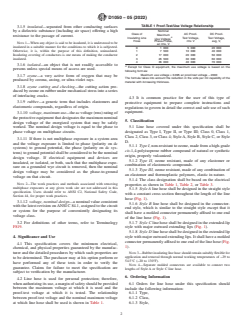
3.1.5 insulated—separated from other conducting surfaces
by a dielectric substance (including air space) offering a high Nominal
Class of AC Proof- DC Proof-
Maximum
resistance to the passage of current.
A
Insulating Line Test Voltage, Test Voltage,
Use Voltage
Hose Phase-Phase, rms V avg, V,
NOTE 1—When any object is said to be insulated, it is understood to be
ac rms, V
insulated in a suitable manner for the conditions to which it is subjected.
0 1 000 5 000 20 000
Otherwise, it is, within the purpose of this definition, uninsulated.
1 7 500 10 000 40 000
Insulating covering of conductors is one means of making the conductor 2 17 000 20 000 50 000
3 26 500 30 000 60 000
insulated.
4 36 000 40 000 70 000
3.1.6 isolated—an object that is not readily accessible to
A
Except for Class O equipment, the maximum use voltage is based on the
persons unless special means of access are used.
following formula:
Maximum use voltage = 0.095 ac proof-test voltage − 2000
3.1.7 ozone—a very active form of oxygen that may be
The formula takes into account the reduction in the volts per mil capability of the
produced by corona, arcing, or ultra-violet rays.
material with increasing thickness.
3.1.8 ozone cutting and checking—the cutting action pro-
ducedbyozoneonrubberundermechanicalstressintoaseries
of interlacing cracks.
4.3 It is common practice for the user of this type of
3.1.9 rubber—a generic term that includes elastomers and
protective equipment to prepare complete instructions and
elastomeric compounds, regardless of origin.
regulations to govern in detail the correct and safe use of such
equipment.
3.1.10 voltage,maximumuse—theacvoltage(rms)ratingof
theprotectiveequipmentthatdesignatesthemaximumnominal
5. Classification
design voltage of the energized system that may be safely
5.1 Line hose covered under this specification shall be
worked. The nominal design voltage is equal to the phase to
phase voltage on multiphase circuits. designated as Type I, Type II, or Type III; Class 0, Class 1,
Class 2, Class 3, or Class 4; StyleA, Style B, Style C, or Style
3.1.11 If there is not multiphase exposure in a system area
D.
and the voltage exposure is limited to phase (polarity on dc
5.1.1 Type I,non-resistanttoozone,madefromahigh-grade
systems) to ground potential, the phase (polarity on dc sys-
cis-1,4-polyisoprene rubber compound of natural or synthetic
tems)togroundpotentialshallbeconsideredtobethenominal
origin, properly vulcanized.
design voltage. If electrical equipment and devices are
5.1.2 Type II, ozone resistant, made of any elastomer or
insulated, or isolated, or both, such that the multiphase expo-
combination of elastomeric compounds.
sure on a grounded wye circuit is removed, then the nominal
5.1.3 Type III, ozone resistant, made of any combination of
design voltage may be considered as the phase-to-ground
an elastomer and thermoplastic polymers, elastic in nature.
voltage on that circuit.
5.1.4 The class designation shall be based on the electrical
NOTE 2—The work practices and methods associated with removing
properties as shown in Table 1, Table 2,or Table 3.
multiphase exposures at any given work site are not addressed in this
5.1.5 Style Aline hose shall be designed in the straight style
specification. Users should refer to ANSI C2, National Safety Code,
with a constant cross section throughout the length of the line
Section 44, for proper work practices.
hose (Fig. 1).
3.1.12 voltage, nominal design—a nominal value consistent
5.1.6 Style B line hose shall be designed in the connector-
with the latest revision onANSI C84.1, assigned to the circuit
end style, which is similar to the straight style except that it
or system for the purpose of conveniently designating its
shall have a molded connector permanently affixed to one end
voltage class.
of the line hose (Fig. 1).
3.2 For definitions of other terms, refer to Terminology
5.1.7 Style C line hose shall be designed in the extended-lip
F819. style with major outward extending lips (Fig. 1).
5.1.8 Style D line hose shall be designed in the extended lip
4. Significance and Use stylewithmajoroutwardextendinglips.Itshallhaveamolded
connector permanently affixed to one end of the line hose (Fig.
4.1 This specification covers the minimum electrical,
1).
chemical, and physical properties guaranteed by the manufac-
turer and the detailed procedures by which such properties are NOTE3—Rubberinsulatinglinehoseshouldremainsuitablyflexiblefor
application and removal through normal working temperatures of −29 to
to be determined. The purchaser may at his option perform or
54.5°C (−20 to 130°F).
have performed any of these tests in order to verify the
NOTE 4—Separate molded connectors are available to connect two
guarantee. Claims for failure to meet the specification are
lengths of Style A or Style C line hose.
subject to verification by the manufacturer.
6. Ordering Information
4.2 Line hose is used for personal protection; therefore,
whenauthorizingitsuse,amarginofsafetyshouldbeprovided 6.1 Orders for line hose under this specification should
between the maximum voltage at which it is used and the include the following information:
proof-test voltage at which it is tested. The relationship 6.1.1 Type,
between proof-test voltage and the nominal maximum voltage 6.1.2 Class,
at which line hose shall be used is shown in Table 1. 6.1.3 Style,
D1050 − 05 (2022)
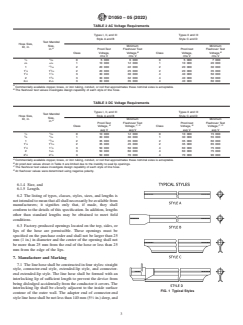
TABLE 2 AC Voltage Requirements
Types I, II, and III Types II and III
Style A and B Style C and D
Test Mandrel
Hose Size,
Size, Minimum Minimum
ID, in.
A
in.
Proof-Test Flashover Test Proof-test Flashover Test
B B
Class Voltage, Voltage, Class Voltage, Voltage,
rms V rms V rms V rms V
1 3
⁄4 ⁄16 0 5 000 6 000 0 5 000 7 000
5 9
⁄8 ⁄16 1 10 000 12 000 1 10 000 20 000
1 ⁄16 2 20 000 22 000 2 20 000 30 000
1 3
1 ⁄4 1 ⁄16 2 20 000 25 000 2 20 000 35 000
1 1
1 ⁄2 1 ⁄4 3 30 000 30 000 4 40 000 50 000
21 ⁄4 3 30 000 32 000 4 40 000 50 000
1 1
2 ⁄2 2 ⁄4 3 30 000 35 000 4 40 000 60 000
A
Commercially available copper, brass, or iron tubing, conduit, or rod that approximates these nominal sizes is acceptable.
B
The flashover test values investigate design capability of each style of line hose.
TABLE 3 DC Voltage Requirements
Types I, II, and III Types II and III
Test Mandrel
Style A and B Style C and D
Hose Size,
Size,
ID, in. Minimum Minimum
A
in.
Proof-Test Flashover Test Proof-test Flashover Test
B C, D B C, D
Class Voltage, Voltage, Class Voltage, Voltage,
avg V avg V avg V avg V
1 3
⁄4 ⁄16 0 10 000 12 000 0 10 000 15 000
5 9
⁄8 ⁄16 1 30 000 30 000 1 30 000 55 000
1 ⁄16 2 35 000 35 000 2 35 000 60 000
1 3
1 ⁄4 1 ⁄16 2 35 000 45 000 2 35 000 65 000
1 1
1 ⁄2 1 ⁄4 3 50 000 50 000 4 60 000 75 000
21 ⁄4 3 50 000 60 000 4 60 000 75 000
1 1
2 ⁄2 2 ⁄4 3 50 000 70 000 4 70 000 90 000
A
Commercially available copper, brass, or iron tubing, conduit, or rod that approximates these nominal sizes is acceptable.
B
dc proof-test values shown in Table 3 are limited due to the inability to seal lip openings.
C
The flashover test values investigate design capability of each style of line hose.
D
dc flashover values were determined using negative polarity.
6.1.4 Size, and
6.1.5 Length.
6.2 The listing of types, classes, styles, sizes, and lengths is
notintendedtomeanthatallshallnecessarilybeavailablefrom
manufacturers; it signifies only that, if made, they shall
conform to the details of this specification. In addition, lengths
other than standard lengths may be obtained to meet field
conditions.
6.3 Factory-produced openings located on the top, sides, or
lips of the hose are permissible. These openings must be
specified on the purchase order and shall not be larger than 25
mm (1 in.) in diameter and the center of the opening shall not
be more than 25 mm from the end of the hose or less than 25
mm from the edge of the lips.
7. Manufacture and Marking
7.1 Thelinehoseshallbeconstructedinfourstyles:straight
style, connector-end style, extended-lip style, and connector-
end extended-lip style. The line hose shall be formed with an
interlocking lip of sufficient length to prevent the device from
being dislodged accidentally from the conductor it covers.The
interlocking lip shall be closely adjacent to the inside surface
FIG. 1 Typical Styles
contour of the outer wall. The adapter end of connector-end
stylelinehoseshallbenotlessthan140mm(5 ⁄2in.)deep,and
D1050 − 05 (2022)
its inside diameter shall be such that it will snugly grip the end (60.5in.).Inaddition,lengthsotherthanstandardlengthsmay
of the line hose of the same size which it joins. be obtained to meet field conditions.
7.2 Each line hose shall be marked clearly and permanently 10.3 Thickness—The wall thickness shall not be less than
with the name of manufacturer or supplier, type, class, and 3.2mm(0.12in.)forClass0,5.1mm(0.20in.)forClass1,5.6
ASTMD1050.Linehosemaybemarkedbyeithermoldingthe mm(0.22in.)forClass2,6.4mm(0.25in.)forClass3,and6.4
information directly into the hose or by use of a label; either mm (0.25 in.) for Class 4.
method is equally acceptable. The method shall be at the
11. Workmanship, Finish, and Appearance
discretionofthemanufacturer.Ifalabelisused,thecolorshall
be that specified for each voltage class: Class 0—red, Class
11.1 The line hose shall be free from harmful physical
1—white, Class 2—yellow, Class 3—green, and Class
irregularities, which can be detected by thorough test or
4—orange.
inspection.
11.1.1 Non-Harmful Irregularities —Surface irregularities
8. Chemical and Physical Properties
may be present on all rubber goods due to imperfections on
8.1 Each line hose shall conform to the physical require-
forms, molds, or extruding dies, and inherent difficulties in the
mentsinTable4and,forTypeIlinehose,thedeterminationof
manufacturing process. These irregularities may appear as
rubber polymer in accordance with 19.1.1.
indentations, protuberances, or imbedded foreign material that
are acceptable provided that:
9. Electrical Requirements
11.1.1.1 Theindentationorprotuberancetendstoblendinto
a smooth slope upon stretching of the material,
9.1 Each line hose shall withstand the 60-Hz ac proof-test
voltage (rms value) specified in Table 2 or the dc proof test 11.1.1.2 Foreign material remains in place when the hose is
bent and stretches equally with the material surrounding it.
voltage (average value) specified in Table 3. The proof test
shall be performed in accordance with Section 18 and shall be
12. Guarantee
run continuously for 3 min.
12.1 The manufacturer or supplier shall replace without
9.2 Sample lengths of line hose, as specified in 14.3.2 and
charge to the purchaser, unused line hose which at any time
14.3.3, shall pass the minimum flashover test values ofTable 2
within a period of nine months, from date of receipt of
or 3 when tested in accordance with 18.2.
shipmentbythepurchaserorhisdesignee,failstopassthetests
9.3 Sample lengths of Type II and Type III line hose, as
inthisspecification.Acceptancetestsmadebythepurchaseror
specified in 14.3.4, shall show no visible effects from ozone
his designee shall be performed within two months of receipt
when tested in accordance with 18.3. Any visible signs of
by the purchaser or his designee unless otherwise specified.
ozone deterioration, such as checking, cracking, breaks,
Tests shall be performed as shown in Section 16.
pitting, etc., shall be considered as evidence of failure to meet
the requirements of Type II and Type III line hose. NOTE 5—Proper storage means that the line hose are stored without
distortion, and not stored directly above or in proximity to steam pipes,
radiators, or other sources of artificial heat, or exposed to direct sunlight
10. Dimensions and Permissible Variations
or other sources of ozone
...