

ASTM F1846-98(2020)
(Practice)Standard Practice for Symbols and Markings for Use With Land Search Maps
General Information
- Abstract
SIGNIFICANCE AND USE
4.1 The base map and overlays are used in managing a search by graphically tracking progress, resource allocation, and results. Standard symbols and markings allow a person to visually scan the map to obtain the status of the search without the need for a briefing or reading search documents.
4.2 Overlays are used for symbols which are likely to change during the search, that will cover other symbols or base map features, to prevent marking the base map, and to avoid too many markings at one time.
4.3 The symbols and colors have been chosen to be compatible with the symbols defined in Incident Command System Field Operations Guide ICS-420. This compatibility is either exact (for example, incident command post) or functional (for example, search area boundaries).
SCOPE
1.1 This practice covers the symbols and markings to be used with land search maps to show resources, search coverage, status, and results.
1.2 Operational usage of these symbols and markings, the resources they represent, and maps are not included in this practice.
1.3 This standard does not purport to address all of the safety concerns, if any, associated with its use. It is the responsibility of the user of this standard to establish appropriate safety, health, and environmental practices and determine the applicability of regulatory limitations prior to use.
1.4 This international standard was developed in accordance with internationally recognized principles on standardization established in the Decision on Principles for the Development of International Standards, Guides and Recommendations issued by the World Trade Organization Technical Barriers to Trade (TBT) Committee.
- Status
- Published
- Publication Date
- 31-Mar-2020
- Technical Committee
- F32 - Search and Rescue
- Drafting Committee
- F32.02 - Management and Operations


Overview
ASTM F1846-98(2020), titled Standard Practice for Symbols and Markings for Use With Land Search Maps, establishes guidelines for the use of standardized symbols and markings on maps utilized in land search operations. Published by ASTM International, this standard aims to facilitate effective search management by enabling clear visual communication of resource deployment, search coverage, status updates, and operational results. By adopting common map symbols and overlay techniques, participants in search and rescue (SAR) operations can track progress and allocate resources efficiently, reducing errors caused by misinterpretation of map notations.
Key Topics
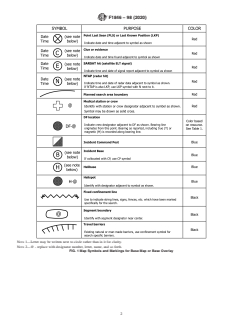
- Standardized Map Symbols: Provides a visual language for denoting resources such as search crews, dog teams, helicopters, and patrols. Each resource is assigned a specific color, promoting immediate recognition.
- Use of Map Overlays: Introduces transparent overlays to display symbols that are subject to change during a search, preventing permanent or cluttered markings on the base map.
- Graphical Status at a Glance: Standard practices allow quick visual scanning to determine search progress, area coverage, and resource allocation, reducing the need for written reports or briefings.
- Compatibility with ICS-420: Ensures that map symbols and colors remain consistent and compatible with the Incident Command System Field Operations Guide ICS-420, supporting interoperability between agencies and jurisdictions.
- Clarity and Flexibility: Guidelines specify legibility, placement, and adaptability of symbols and associated annotations to suit varying map scales and operational needs.
Applications
ASTM F1846-98(2020) is widely applicable in the following scenarios:
- Search and Rescue Coordination: Ensures standardized map communication during land searches for missing persons, disaster response, or wilderness rescue operations.
- Incident Command Centers: Facilitates resource tracking and dynamic scenario management at command posts by using overlays for real-time updates.
- Interagency Collaboration: Promotes seamless information sharing and operational synergy across multiple teams and organizations by adopting a consistent symbol set.
- Training and Preparedness: Serves as a reference for training SAR personnel and for developing scenario-based exercises involving mapping and resource tracking.
- Documentation and Reporting: Assists in maintaining accurate search records and producing after-action reports by using clear, standardized symbols.
Related Standards
When implementing ASTM F1846-98(2020), the following standards and guides may also be relevant:
- ICS-420 Field Operations Guide: Provides closely related incident management symbols, enhancing compatibility and communication during multi-agency responses.
- General Cartographic Standards: Guides from national and international standards organizations on map production and overlay techniques.
- ASTM Standards for Search and Rescue: Such as ASTM F32 series, offering additional best practices for SAR management and operations.
Practical Value
The adoption of ASTM F1846-98(2020) for symbols and markings in land search maps leads to:
- Enhanced Situational Awareness: Ensures all team members and stakeholders have a shared understanding of the search plan and current status.
- Reduction of Miscommunication: Minimizes confusion or errors due to inconsistent or unclear map notations.
- Operational Efficiency: Streamlines map updates, reduces the workload during shift changes, and ensures critical information is always up-to-date and readily accessible.
By following this standard, SAR teams and incident managers can ensure greater accuracy, efficiency, and safety in land search operations through the consistent use of symbols and effective use of mapping overlays.
Relations
- Replaces
ASTM F1846-98(2014) - Standard Practice for Symbols and Markings for Use With Land Search Maps - Effective Date
- 01-Apr-2020
- Effective Date
- 01-Apr-2020
- Effective Date
- 01-Apr-2020
- Referred By
ASTM F3026-14(2019) - Standard Guide for Helicopter Inland Search and Rescue (SAR) Crew Chief - Effective Date
- 01-Apr-2020
- Referred By
ASTM F2958-14(2019) - Standard Guide for Helicopter Inland Search and Rescue (SAR) Technician - Effective Date
- 01-Apr-2020
Get Certified
Connect with accredited certification bodies for this standard

CIS Institut d.o.o.
Personal Protective Equipment (PPE) certification body. Notified Body NB-2890 for EU Regulation 2016/425 PPE.

Kiwa BDA Testing
Building and construction product certification.
Kmetijski inštitut Slovenije
Agricultural Institute of Slovenia. Soil testing, plant health, agricultural product analysis.
Sponsored listings
Frequently Asked Questions
ASTM F1846-98(2020) is a standard published by ASTM International. Its full title is "Standard Practice for Symbols and Markings for Use With Land Search Maps". This standard covers: SIGNIFICANCE AND USE 4.1 The base map and overlays are used in managing a search by graphically tracking progress, resource allocation, and results. Standard symbols and markings allow a person to visually scan the map to obtain the status of the search without the need for a briefing or reading search documents. 4.2 Overlays are used for symbols which are likely to change during the search, that will cover other symbols or base map features, to prevent marking the base map, and to avoid too many markings at one time. 4.3 The symbols and colors have been chosen to be compatible with the symbols defined in Incident Command System Field Operations Guide ICS-420. This compatibility is either exact (for example, incident command post) or functional (for example, search area boundaries). SCOPE 1.1 This practice covers the symbols and markings to be used with land search maps to show resources, search coverage, status, and results. 1.2 Operational usage of these symbols and markings, the resources they represent, and maps are not included in this practice. 1.3 This standard does not purport to address all of the safety concerns, if any, associated with its use. It is the responsibility of the user of this standard to establish appropriate safety, health, and environmental practices and determine the applicability of regulatory limitations prior to use. 1.4 This international standard was developed in accordance with internationally recognized principles on standardization established in the Decision on Principles for the Development of International Standards, Guides and Recommendations issued by the World Trade Organization Technical Barriers to Trade (TBT) Committee.
SIGNIFICANCE AND USE 4.1 The base map and overlays are used in managing a search by graphically tracking progress, resource allocation, and results. Standard symbols and markings allow a person to visually scan the map to obtain the status of the search without the need for a briefing or reading search documents. 4.2 Overlays are used for symbols which are likely to change during the search, that will cover other symbols or base map features, to prevent marking the base map, and to avoid too many markings at one time. 4.3 The symbols and colors have been chosen to be compatible with the symbols defined in Incident Command System Field Operations Guide ICS-420. This compatibility is either exact (for example, incident command post) or functional (for example, search area boundaries). SCOPE 1.1 This practice covers the symbols and markings to be used with land search maps to show resources, search coverage, status, and results. 1.2 Operational usage of these symbols and markings, the resources they represent, and maps are not included in this practice. 1.3 This standard does not purport to address all of the safety concerns, if any, associated with its use. It is the responsibility of the user of this standard to establish appropriate safety, health, and environmental practices and determine the applicability of regulatory limitations prior to use. 1.4 This international standard was developed in accordance with internationally recognized principles on standardization established in the Decision on Principles for the Development of International Standards, Guides and Recommendations issued by the World Trade Organization Technical Barriers to Trade (TBT) Committee.
ASTM F1846-98(2020) is classified under the following ICS (International Classification for Standards) categories: 13.200 - Accident and disaster control. The ICS classification helps identify the subject area and facilitates finding related standards.
ASTM F1846-98(2020) has the following relationships with other standards: It is inter standard links to ASTM F1846-98(2014), ASTM F1422-08(2020), ASTM F2099-01(2020), ASTM F3026-14(2019), ASTM F2958-14(2019). Understanding these relationships helps ensure you are using the most current and applicable version of the standard.
ASTM F1846-98(2020) is available in PDF format for immediate download after purchase. The document can be added to your cart and obtained through the secure checkout process. Digital delivery ensures instant access to the complete standard document.
Standards Content (Sample)
This international standard was developed in accordance with internationally recognized principles on standardization established in the Decision on Principles for the
Development of International Standards, Guides and Recommendations issued by the World Trade Organization Technical Barriers to Trade (TBT) Committee.
Designation: F1846 − 98 (Reapproved 2020)
Standard Practice for
Symbols and Markings for Use With Land Search Maps
This standard is issued under the fixed designation F1846; the number immediately following the designation indicates the year of
original adoption or, in the case of revision, the year of last revision. A number in parentheses indicates the year of last reapproval. A
superscript epsilon (´) indicates an editorial change since the last revision or reapproval.
1. Scope 3.3 map overlay, n—a transparent sheet placed over the base
map on which markings and symbols are made. Overlays are
1.1 This practice covers the symbols and markings to be
used for symbols subject to change, to prevent marking the
used with land search maps to show resources, search
base map, or to avoid cluttering the base map.
coverage, status, and results.
1.2 Operational usage of these symbols and markings, the 4. Significance and Use
resources they represent, and maps are not included in this
4.1 The base map and overlays are used in managing a
practice.
search by graphically tracking progress, resource allocation,
1.3 This standard does not purport to address all of the
and results. Standard symbols and markings allow a person to
safety concerns, if any, associated with its use. It is the
visually scan the map to obtain the status of the search without
responsibility of the user of this standard to establish appro-
the need for a briefing or reading search documents.
priate safety, health, and environmental practices and deter-
4.2 Overlays are used for symbols which are likely to
mine the applicability of regulatory limitations prior to use.
change during the search, that will cover other symbols or base
1.4 This international standard was developed in accor-
map features, to prevent marking the base map, and to avoid
dance with internationally recognized principles on standard-
too many markings at one time.
ization established in the Decision on Principles for the
4.3 The symbols and colors have been chosen to be com-
Development of International Standards, Guides and Recom-
patible with the symbols defined in Incident Command System
mendations issued by the World Trade Organization Technical
Field Operations Guide ICS-420. This compatibility is either
Barriers to Trade (TBT) Committee.
exact (for example, incident command post) or functional (for
2. Referenced Documents
example, search area boundaries).
2.1 Incident Command System Publications: Field Opera-
5. Procedure
tions Guide ICS-420
5.1 Symbols and markings for use on the base map or base
3. Terminology
overlay shall be made in accordance with Fig. 1 and Table 1.
3.1 Definitions of Terms Specific to This Standard:
5.2 Symbols and markings for use on overlays shall be
3.1.1 base map, n—the master map or chart of the search
made in accordance with Fig. 2 and Table 1.
area, normally maintained at the incident base or command
5.3 Where words or letters are associated with a symbol,
post.
they shall be legible and as close to the symbol as possible.
3.2 base overlay, n—the map overlay on which are placed
Size and placement may vary depending on map scale, the
the symbols and markings shown in Fig. 1 when it is desired to
need for adjacent map features to remain visible and the
not mark on the base map.
writing instrument being used.
5.4 Locating mark
...