

ASTM D7741/D7741M-23
(Test Method)Standard Test Method for Measurement of Apparent Viscosity of Asphalt-Rubber or Other Asphalt Binders by Using a Rotational Handheld Viscometer
General Information
- Abstract
SIGNIFICANCE AND USE
3.1 This test is primarily used for field production control of asphalt-rubber (A-R) and other high-viscosity binders; however, the test can also be used in a laboratory setting.
3.2 A handheld rotational viscometer is used to measure the apparent viscosity of a completed blend of A-R or high-viscosity binder. A rotor (spindle), turning at constant speed, is inserted in the liquid binder to be measured. The resistance to movement of the spindle (torque) caused by the viscosity of the surrounding liquid is measured using a special mechanism to obtain direct readings in Pa·s or cP.
Note 1: Spindle is generally made of stainless steel, although another metal such as brass could be used.
3.3 The measured apparent viscosity is used to control the production of the A-R or other high-viscosity binder, to assess the uniformity of the binder produced, or for other related purposes.
3.4 As the spindle turns in the A-R or other high-viscosity binder, it has a tendency to “drill” into the sample (that is, for A-R, the spindle spins the rubber particles out of the measurement area). Consequently, the apparent viscosity drops to reflect only the liquid phase of the high-viscosity binder. Therefore, the peak viscosity measurement value is recorded to reflect the viscosity of the blended material.
SCOPE
1.1 The use of high-viscosity asphalt binders like asphalt-rubber is becoming more common in the United States and worldwide. Specifications such as Specification D6114/D6114M note the need for field control of the apparent viscosity and require the use of a field production rotational viscometer. The testing of asphalt-rubber binder for use in asphalt-rubber hot mix and for asphalt-rubber membrane is necessary to ensure consistent mix properties that will ensure good performance of these materials. Logistics of field applications limits the use of conventional laboratory controls and testing equipment. This test, using a handheld rotational viscometer, can be conducted in either the field or laboratory to determine the apparent viscosity of asphalt-rubber and other high-viscosity binders for field production control and to assess the uniformity of the binder produced, or for other related purposes.
1.2 Asphalt-rubber binder consists of a blend of paving grade asphalt cement and crumb rubber as described in Specification D6114/D6114M. Other high-viscosity asphalt binders may consist of asphalts modified with polymer or fiber, or both. Testing is performed following the specified reaction time, if any, within the production process. Control of the raw materials is separate from the test.
1.3 The values stated in SI units or inch-pound units are to be regarded separately as standard. The values stated in each system may not be exact equivalents; each system shall be used independently of the other. Combining values from the two systems may result in noncompliance with the standard.
1.4 The text of this standard references notes and footnotes which provide explanatory material. These notes and footnotes (excluding those in tables and figures) shall not be considered as requirements of the standard.
1.5 This standard does not purport to address all of the safety concerns, if any, associated with its use. It is the responsibility of the user of this standard to establish appropriate safety, health, and environmental practices and determine the applicability of regulatory limitations prior to use.
1.6 This international standard was developed in accordance with internationally recognized principles on standardization established in the Decision on Principles for the Development of International Standards, Guides and Recommendations issued by the World Trade Organization Technical Barriers to Trade (TBT) Committee.
- Status
- Published
- Publication Date
- 30-Nov-2023
- Technical Committee
- D04 - Road and Paving Materials
- Drafting Committee
- D04.44 - Rheological Tests
Buy Documents
ASTM D7741/D7741M-23 - Standard Test Method for Measurement of Apparent Viscosity of Asphalt-Rubber or Other Asphalt Binders by Using a Rotational Handheld Viscometer
REDLINE ASTM D7741/D7741M-23 - Standard Test Method for Measurement of Apparent Viscosity of Asphalt-Rubber or Other Asphalt Binders by Using a Rotational Handheld Viscometer
Overview
ASTM D7741/D7741M-23, titled Standard Test Method for Measurement of Apparent Viscosity of Asphalt-Rubber or Other Asphalt Binders by Using a Rotational Handheld Viscometer, is a key standard for evaluating the viscosity of high-viscosity binders such as asphalt-rubber (A-R) during production. This method is widely utilized for both field and laboratory settings, offering crucial data for controlling the quality and consistency of A-R binders and other modified asphalts.
Apparent viscosity is a key characteristic in ensuring the performance and workability of asphalt-rubber and other high-viscosity binders, particularly during hot mix and membrane applications. Accurate viscosity measurement contributes to the durability and performance of pavement materials and ensures compliance with industry specifications.
Key Topics
Purpose of the Test:
The primary use of this method is to provide field production control for asphalt-rubber and other high-viscosity asphalt binders. It helps assess the uniformity and quality of binder blends immediately after production, supporting reliable material performance.Apparatus and Procedure Highlights:
- Uses a rotational handheld viscometer with a spindle (typically stainless steel or brass) to determine resistance to movement in the binder.
- Apparent viscosity is directly read in Pa·s or cP.
- Requires proper sampling technique and field calibration of equipment using reference oils.
- Three measurements are taken and averaged for each sample, with temperature closely controlled and recorded.
Peak Viscosity Recording:
Due to the possibility of “drilling” and separation of crumb rubber particles during the test, the highest initial viscosity (peak value) is taken to reflect the blend's true viscosity.Precision and Repeatability:
- Single-operator test results are considered non-equivalent if their values differ by more than 12% of the mean.
- Multi-laboratory results are considered non-equivalent if differing by more than 22% of the mean.
Applications
The test method described in ASTM D7741/D7741M-23 is valuable for a range of practical industry applications, including:
Quality Assurance in Field Production:
- Used for real-time monitoring during binder production to ensure specification compliance.
- Detects variations in binder uniformity, supporting immediate process adjustments.
Compatibility with Modified Binders:
- Applicable not only to asphalt-rubber, but also to asphalt binders modified with polymers or fibers.
- Ensures consistency across various high-viscosity binder formulations.
Construction and Maintenance:
- Assists in selecting appropriate binder blends for hot mix asphalt and membrane installations.
- Contributes to longer-lasting, high-performance pavement surfaces.
Laboratory Assessments:
- Can supplement routine laboratory evaluation when conventional equipment is impractical or unavailable.
- Useful for research, development, and product verification in binder manufacturing.
Related Standards
For comprehensive control and specification of asphalt-rubber and other high-viscosity binders, consider referencing the following standards:
- ASTM D6114/D6114M - Specification for Asphalt-Rubber Binder
- Other ASTM viscosity and rheological test methods for asphalt binders
- Internationally recognized standards developed in accordance with WTO TBT principles
Keywords
Asphalt-rubber, high-viscosity binders, apparent viscosity, handheld rotational viscometer, field production control, asphalt binder uniformity, ASTM standards
Relations
- Effective Date
- 01-Dec-2023
- Effective Date
- 01-Dec-2023
- Effective Date
- 01-Jul-2019
- Effective Date
- 01-Dec-2023
Buy Documents
ASTM D7741/D7741M-23 - Standard Test Method for Measurement of Apparent Viscosity of Asphalt-Rubber or Other Asphalt Binders by Using a Rotational Handheld Viscometer
REDLINE ASTM D7741/D7741M-23 - Standard Test Method for Measurement of Apparent Viscosity of Asphalt-Rubber or Other Asphalt Binders by Using a Rotational Handheld Viscometer
Get Certified
Connect with accredited certification bodies for this standard

Zavod za gradbeništvo Slovenije (ZAG) - Inšpekcija
ZAG inspection body for construction products, structures, and materials.
Sponsored listings
Frequently Asked Questions
ASTM D7741/D7741M-23 is a standard published by ASTM International. Its full title is "Standard Test Method for Measurement of Apparent Viscosity of Asphalt-Rubber or Other Asphalt Binders by Using a Rotational Handheld Viscometer". This standard covers: SIGNIFICANCE AND USE 3.1 This test is primarily used for field production control of asphalt-rubber (A-R) and other high-viscosity binders; however, the test can also be used in a laboratory setting. 3.2 A handheld rotational viscometer is used to measure the apparent viscosity of a completed blend of A-R or high-viscosity binder. A rotor (spindle), turning at constant speed, is inserted in the liquid binder to be measured. The resistance to movement of the spindle (torque) caused by the viscosity of the surrounding liquid is measured using a special mechanism to obtain direct readings in Pa·s or cP. Note 1: Spindle is generally made of stainless steel, although another metal such as brass could be used. 3.3 The measured apparent viscosity is used to control the production of the A-R or other high-viscosity binder, to assess the uniformity of the binder produced, or for other related purposes. 3.4 As the spindle turns in the A-R or other high-viscosity binder, it has a tendency to “drill” into the sample (that is, for A-R, the spindle spins the rubber particles out of the measurement area). Consequently, the apparent viscosity drops to reflect only the liquid phase of the high-viscosity binder. Therefore, the peak viscosity measurement value is recorded to reflect the viscosity of the blended material. SCOPE 1.1 The use of high-viscosity asphalt binders like asphalt-rubber is becoming more common in the United States and worldwide. Specifications such as Specification D6114/D6114M note the need for field control of the apparent viscosity and require the use of a field production rotational viscometer. The testing of asphalt-rubber binder for use in asphalt-rubber hot mix and for asphalt-rubber membrane is necessary to ensure consistent mix properties that will ensure good performance of these materials. Logistics of field applications limits the use of conventional laboratory controls and testing equipment. This test, using a handheld rotational viscometer, can be conducted in either the field or laboratory to determine the apparent viscosity of asphalt-rubber and other high-viscosity binders for field production control and to assess the uniformity of the binder produced, or for other related purposes. 1.2 Asphalt-rubber binder consists of a blend of paving grade asphalt cement and crumb rubber as described in Specification D6114/D6114M. Other high-viscosity asphalt binders may consist of asphalts modified with polymer or fiber, or both. Testing is performed following the specified reaction time, if any, within the production process. Control of the raw materials is separate from the test. 1.3 The values stated in SI units or inch-pound units are to be regarded separately as standard. The values stated in each system may not be exact equivalents; each system shall be used independently of the other. Combining values from the two systems may result in noncompliance with the standard. 1.4 The text of this standard references notes and footnotes which provide explanatory material. These notes and footnotes (excluding those in tables and figures) shall not be considered as requirements of the standard. 1.5 This standard does not purport to address all of the safety concerns, if any, associated with its use. It is the responsibility of the user of this standard to establish appropriate safety, health, and environmental practices and determine the applicability of regulatory limitations prior to use. 1.6 This international standard was developed in accordance with internationally recognized principles on standardization established in the Decision on Principles for the Development of International Standards, Guides and Recommendations issued by the World Trade Organization Technical Barriers to Trade (TBT) Committee.
SIGNIFICANCE AND USE 3.1 This test is primarily used for field production control of asphalt-rubber (A-R) and other high-viscosity binders; however, the test can also be used in a laboratory setting. 3.2 A handheld rotational viscometer is used to measure the apparent viscosity of a completed blend of A-R or high-viscosity binder. A rotor (spindle), turning at constant speed, is inserted in the liquid binder to be measured. The resistance to movement of the spindle (torque) caused by the viscosity of the surrounding liquid is measured using a special mechanism to obtain direct readings in Pa·s or cP. Note 1: Spindle is generally made of stainless steel, although another metal such as brass could be used. 3.3 The measured apparent viscosity is used to control the production of the A-R or other high-viscosity binder, to assess the uniformity of the binder produced, or for other related purposes. 3.4 As the spindle turns in the A-R or other high-viscosity binder, it has a tendency to “drill” into the sample (that is, for A-R, the spindle spins the rubber particles out of the measurement area). Consequently, the apparent viscosity drops to reflect only the liquid phase of the high-viscosity binder. Therefore, the peak viscosity measurement value is recorded to reflect the viscosity of the blended material. SCOPE 1.1 The use of high-viscosity asphalt binders like asphalt-rubber is becoming more common in the United States and worldwide. Specifications such as Specification D6114/D6114M note the need for field control of the apparent viscosity and require the use of a field production rotational viscometer. The testing of asphalt-rubber binder for use in asphalt-rubber hot mix and for asphalt-rubber membrane is necessary to ensure consistent mix properties that will ensure good performance of these materials. Logistics of field applications limits the use of conventional laboratory controls and testing equipment. This test, using a handheld rotational viscometer, can be conducted in either the field or laboratory to determine the apparent viscosity of asphalt-rubber and other high-viscosity binders for field production control and to assess the uniformity of the binder produced, or for other related purposes. 1.2 Asphalt-rubber binder consists of a blend of paving grade asphalt cement and crumb rubber as described in Specification D6114/D6114M. Other high-viscosity asphalt binders may consist of asphalts modified with polymer or fiber, or both. Testing is performed following the specified reaction time, if any, within the production process. Control of the raw materials is separate from the test. 1.3 The values stated in SI units or inch-pound units are to be regarded separately as standard. The values stated in each system may not be exact equivalents; each system shall be used independently of the other. Combining values from the two systems may result in noncompliance with the standard. 1.4 The text of this standard references notes and footnotes which provide explanatory material. These notes and footnotes (excluding those in tables and figures) shall not be considered as requirements of the standard. 1.5 This standard does not purport to address all of the safety concerns, if any, associated with its use. It is the responsibility of the user of this standard to establish appropriate safety, health, and environmental practices and determine the applicability of regulatory limitations prior to use. 1.6 This international standard was developed in accordance with internationally recognized principles on standardization established in the Decision on Principles for the Development of International Standards, Guides and Recommendations issued by the World Trade Organization Technical Barriers to Trade (TBT) Committee.
ASTM D7741/D7741M-23 is classified under the following ICS (International Classification for Standards) categories: 93.080.20 - Road construction materials. The ICS classification helps identify the subject area and facilitates finding related standards.
ASTM D7741/D7741M-23 has the following relationships with other standards: It is inter standard links to ASTM D7741/D7741M-18, ASTM D6114/D6114M-19(2023), ASTM D6114/D6114M-19, ASTM D8418-21. Understanding these relationships helps ensure you are using the most current and applicable version of the standard.
ASTM D7741/D7741M-23 is available in PDF format for immediate download after purchase. The document can be added to your cart and obtained through the secure checkout process. Digital delivery ensures instant access to the complete standard document.
Standards Content (Sample)
This international standard was developed in accordance with internationally recognized principles on standardization established in the Decision on Principles for the
Development of International Standards, Guides and Recommendations issued by the World Trade Organization Technical Barriers to Trade (TBT) Committee.
Designation: D7741/D7741M − 23
Standard Test Method for
Measurement of Apparent Viscosity of Asphalt-Rubber or
Other Asphalt Binders by Using a Rotational Handheld
Viscometer
This standard is issued under the fixed designation D7741/D7741M; the number immediately following the designation indicates the
year of original adoption or, in the case of revision, the year of last revision. A number in parentheses indicates the year of last
reapproval. A superscript epsilon (´) indicates an editorial change since the last revision or reapproval.
1. Scope 1.5 This standard does not purport to address all of the
safety concerns, if any, associated with its use. It is the
1.1 The use of high-viscosity asphalt binders like asphalt-
responsibility of the user of this standard to establish appro-
rubber is becoming more common in the United States and
priate safety, health, and environmental practices and deter-
worldwide. Specifications such as Specification D6114/
mine the applicability of regulatory limitations prior to use.
D6114M note the need for field control of the apparent
1.6 This international standard was developed in accor-
viscosity and require the use of a field production rotational
dance with internationally recognized principles on standard-
viscometer. The testing of asphalt-rubber binder for use in
ization established in the Decision on Principles for the
asphalt-rubber hot mix and for asphalt-rubber membrane is
Development of International Standards, Guides and Recom-
necessary to ensure consistent mix properties that will ensure
mendations issued by the World Trade Organization Technical
good performance of these materials. Logistics of field appli-
Barriers to Trade (TBT) Committee.
cations limits the use of conventional laboratory controls and
testing equipment. This test, using a handheld rotational
2. Referenced Documents
viscometer, can be conducted in either the field or laboratory to
2.1 ASTM Standards:
determine the apparent viscosity of asphalt-rubber and other
D6114/D6114M Specification for Asphalt-Rubber Binder
high-viscosity binders for field production control and to assess
the uniformity of the binder produced, or for other related
3. Significance and Use
purposes.
3.1 This test is primarily used for field production control of
1.2 Asphalt-rubber binder consists of a blend of paving
asphalt-rubber (A-R) and other high-viscosity binders;
grade asphalt cement and crumb rubber as described in
however, the test can also be used in a laboratory setting.
Specification D6114/D6114M. Other high-viscosity asphalt
binders may consist of asphalts modified with polymer or fiber, 3.2 A handheld rotational viscometer is used to measure the
apparent viscosity of a completed blend of A-R or high-
or both. Testing is performed following the specified reaction
time, if any, within the production process. Control of the raw viscosity binder. A rotor (spindle), turning at constant speed, is
inserted in the liquid binder to be measured. The resistance to
materials is separate from the test.
movement of the spindle (torque) caused by the viscosity of the
1.3 The values stated in SI units or inch-pound units are to
surrounding liquid is measured using a special mechanism to
be regarded separately as standard. The values stated in each
obtain direct readings in Pa·s or cP.
system may not be exact equivalents; each system shall be used
independently of the other. Combining values from the two NOTE 1—Spindle is generally made of stainless steel, although another
metal such as brass could be used.
systems may result in noncompliance with the standard.
3.3 The measured apparent viscosity is used to control the
1.4 The text of this standard references notes and footnotes
production of the A-R or other high-viscosity binder, to assess
which provide explanatory material. These notes and footnotes
the uniformity of the binder produced, or for other related
(excluding those in tables and figures) shall not be considered
purposes.
as requirements of the standard.
3.4 As the spindle turns in the A-R or other high-viscosity
binder, it has a tendency to “drill” into the sample (that is, for
This test method is under the jurisdiction of ASTM Committee D04 on Road
and Paving Materials and is the direct responsibility of Subcommittee D04.44 on
Rheological Tests. For referenced ASTM standards, visit the ASTM website, www.astm.org, or
Current edition approved Dec. 1, 2023. Published December 2023. Originally contact ASTM Customer Service at service@astm.org. For Annual Book of ASTM
approved in 2011. Last previous edition approved in 2018 as D7741/D7741M – 18. Standards volume information, refer to the standard’s Document Summary page on
DOI: 10.1520/D7741_D7741M-23. the ASTM website.
Copyright © ASTM International, 100 Barr Harbor Drive, PO Box C700, West Conshohocken, PA 19428-2959. United States
D7741/D7741M − 23
A-R, the spindle spins the rubber particles out of the measure- 4.5 Viscosity Standard Oils—Calibrated in absolute viscos-
ment area). Consequently, the apparent viscosity drops to ity in Pa·s [centipoises, cP] and in the range of 1.0 to 5.0 Pa·s
reflect only the liquid phase of the high-viscosity binder. [1000 to 5000 cP].
Therefore, the peak viscosity measurement value is recorded to
4.6 Controllable Heat Source, such as a hot plate, gas stove,
reflect the viscosity of the blended material.
or burner, etc., to maintain the test temperature of the A-R or
high-viscosity binder sample during viscosity measurement.
4. Apparatus
4.7 Viscometer Holder—Clean metal can or some type of
4.1 Viscometer—Handheld, rotational-type viscometer (see
frame where the viscometer can be stored between tests.
Fig. 1). The viscometer shall be equipped with a level bubble
to ensure proper orientation of the viscometer in the sample to
5. Calibration Verification
be tested. Spindle (rotor) speed is typically 62.5 rpm; however,
it may vary with different manufacturers. 5.1 Calibration of the rotational viscometer shall be verified
prior to use at each site per manufacturer’s instructions, using
NOTE 2—The viscosity scale readings for the various rotor types
the reference viscosity standard oils.
overlap in part. For example, the following viscosity ranges can be
measured with both of the following rotors:
6. Sampling
3 dPa·s to 13 dPa·s: No. 3 or No. 1 rotor
100 dPa·s to 150 dPa·s: No. 2 or No. 1 rotor
6.1 The sample shall consist of at least 3 L [0.75 gal] of the
4.2 Spindle (Rotor)—Diameter: 24 6 1.1 mm [1.0 6
completed mixture of A-R or other high-viscosity binder.
0.05 in.]; Height: 53 6 0.1 mm [2 6 0.005 in.] or equivalent
Obtain the sample from an appropriate sample valve located to
(see Fig. 2).
intercept the normal flow of material during production.
4.3 Thermometer—A digital thermometer of suitable range, Perform s
...
This document is not an ASTM standard and is intended only to provide the user of an ASTM standard an indication of what changes have been made to the previous version. Because
it may not be technically possible to adequately depict all changes accurately, ASTM recommends that users consult prior editions as appropriate. In all cases only the current version
of the standard as published by ASTM is to be considered the official document.
Designation: D7741/D7741M − 18 D7741/D7741M − 23
Standard Test Method for
Measurement of Apparent Viscosity of Asphalt-Rubber or
Other Asphalt Binders by Using a Rotational Handheld
Viscometer
This standard is issued under the fixed designation D7741/D7741M; the number immediately following the designation indicates the
year of original adoption or, in the case of revision, the year of last revision. A number in parentheses indicates the year of last
reapproval. A superscript epsilon (´) indicates an editorial change since the last revision or reapproval.
1. Scope
1.1 The use of high-viscosity asphalt binders like asphalt-rubber is becoming more common in the United States and worldwide.
Specifications such as Specification D6114D6114/D6114M note the need for field control of the apparent viscosity and require the
use of a field production rotational viscometer. The testing of asphalt-rubber binder for use in asphalt-rubber hot mix and for
asphalt-rubber membrane is necessary to ensure consistent mix properties that will ensure good performance of these materials.
Logistics of field applications limits the use of conventional laboratory controls and testing equipment. This test, using a handheld
rotational viscometer, can be conducted in either the field or laboratory to determine the apparent viscosity of asphalt-rubber and
other high-viscosity binders for field production control and to assess the uniformity of the binder produced, or for other related
purposes.
1.2 Asphalt-rubber binder consists of a blend of paving grade asphalt cement and crumb rubber as described in Specification
D6114D6114/D6114M. Other high-viscosity asphalt binders may consist of asphalts modified with polymer or fiber, or both.
Testing is performed following the specified reaction time, if any, within the production process. Control of the raw materials is
separate from the test.
1.3 The values stated in SI units or inch-pound units are to be regarded separately as standard. The values stated in each system
may not be exact equivalents; each system shall be used independently of the other. Combining values from the two systems may
result in noncompliance with the standard.
1.4 The text of this standard references notes and footnotes which provide explanatory material. These notes and footnotes
(excluding those in tables and figures) shall not be considered as requirements of the standard.
1.5 This standard does not purport to address all of the safety concerns, if any, associated with its use. It is the responsibility
of the user of this standard to establish appropriate safety, health, and environmental practices and determine the applicability of
regulatory limitations prior to use.
1.6 This international standard was developed in accordance with internationally recognized principles on standardization
established in the Decision on Principles for the Development of International Standards, Guides and Recommendations issued
by the World Trade Organization Technical Barriers to Trade (TBT) Committee.
This test method is under the jurisdiction of ASTM Committee D04 on Road and Paving Materials and is the direct responsibility of Subcommittee D04.44 on Rheological
Tests.
Current edition approved June 1, 2018Dec. 1, 2023. Published June 2018December 2023. Originally approved in 2011. Last previous edition approved in 20172018 as
D7741/D7741M – 11 (2017).D7741/D7741M – 18. DOI: 10.1520/D7741_D7741M-18.10.1520/D7741_D7741M-23.
Copyright © ASTM International, 100 Barr Harbor Drive, PO Box C700, West Conshohocken, PA 19428-2959. United States
D7741/D7741M − 23
2. Referenced Documents
2.1 ASTM Standards:
D6114D6114/D6114M Specification for Asphalt-Rubber Binder
3. Significance and Use
3.1 This test is primarily used for field production control of asphalt-rubber (A-R) and other high-viscosity binders; however, the
test can also be used in a laboratory setting.
3.2 A handheld rotational viscometer is used to measure the apparent viscosity of a completed blend of A-R or high-viscosity
binder. A rotor (spindle), turning at constant speed, is inserted in the liquid binder to be measured. The resistance to movement
of the spindle (torque) caused by the viscosity of the surrounding liquid is measured using a special mechanism to obtain direct
readings in Pa·s or cP.
NOTE 1—Spindle is generally made of stainless steel, although another metal such as brass could be used.
3.3 The measured apparent viscosity is used to control the production of the A-R or other high-viscosity binder, to assess the
uniformity of the binder produced, or for other related purposes.
3.4 As the spindle turns in the A-R or other high-viscosity binder, it has a tendency to “drill” into the sample (that is, for A-R,
the spindle spins the rubber particles out of the measurement area). Consequently, the apparent viscosity drops to reflect only the
liquid phase of the high-viscosity binder. Therefore, the peak viscosity measurement value is recorded to reflect the viscosity of
the blended material.
4. Apparatus
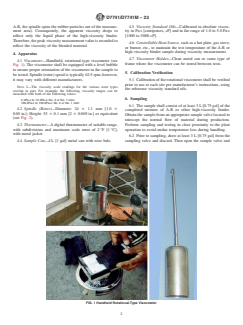
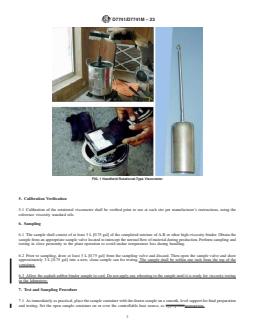
4.1 Viscometer—Handheld, rotational-type viscometer (see Fig. 1). The viscometer shall be equipped with a level bubble to ensure
proper orientation of the viscometer in the sample to be tested. Spindle (rotor) speed is typically 62.5 rpm; however, it may vary
with different manufacturers.
NOTE 2—The viscosity scale readings for the various rotor types overlap in part. For example, the following viscosity ranges can be measured with both
of the following rotors:
3 dPa·s to 13 dPa·s: No. 3 or No. 1 rotor
100 dPa·s to 150 dPa·s: No. 2 or No. 1 rotor
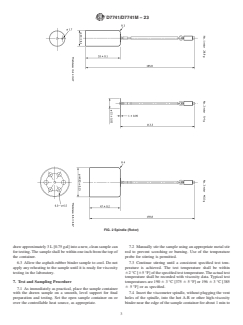
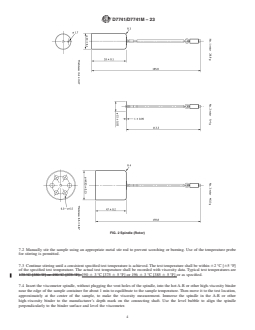
4.2 Spindle (Rotor)—Diameter: 24 6 1.1 mm [1.0 6 0.05 in.]; Height: 53 6 0.1 mm [2 6 0.005 in.] or equivalent (see Fig. 2).
4.3 Thermometer—A digital thermometer of suitable range, with subdivisions and maximum scale error of 2 °F [1 °C], with metal
jacket.
4.4 Sample Can—4-L [1-gal] 4 L [1 gal] metal can with wire bale.
4.5 Viscosity Standard Oils—Calibrated in absolute viscosity in Pa·s [centipoises, cP] and in the range of 1.0 to 5.0 Pa·s [1000 to
5000 cP].
4.6 Controllable Heat Source, such as a hot plate, gas stove, or burner, etc., to maintain the test temperature of the A-R or
high-viscosity binder sample during viscosity measurement.
4.7 Viscometer Holder—Clean metal can or some type of frame where the viscometer can be stored between tests.
For referenced ASTM standards, visit the ASTM website, www.astm.org, or contact ASTM Customer Service at service@astm.org. For Annual Book of ASTM Standards
volume information, refer to the standard’s Document Summary page on the ASTM website.
D7741/D7741M − 23
FIG. 1 Handheld Rotational-Type Viscometer
5. Calibration Verification
5.1 Calibration of the rotational viscometer shall be verified prior to use at each site per manufacturer’s instructions, u
...