


ASTM E1463-92(2012)
(Guide)Standard Guide for Conducting Static and Flow-Through Acute Toxicity Tests With Mysids From the West Coast of the United States (Withdrawn 2021)
Standard Guide for Conducting Static and Flow-Through Acute Toxicity Tests With Mysids From the West Coast of the United States (Withdrawn 2021)
SIGNIFICANCE AND USE
5.1 Mysids are an important component of both the pelagic and epibenthic community. They are preyed upon by many species of fish, birds, and larger invertebrate species, and they are predators of smaller crustaceans and larval stages of invertebrates. In some cases, they feed upon algae. Mysids are sensitive to both organic and inorganic toxicants (1).3 The ecological importance of mysids, their wide geographical distribution, ability to be cultured in the laboratory, and sensitivity to contaminants make them appropriate acute toxicity test organisms.
5.2 An acute toxicity test is conducted to obtain information concerning the immediate effects of a short-term exposure to a test material on a test organism under specified experimental conditions. An acute toxicity test provides data on the short-term effects that are useful for comparisons to other species but does not provide information on delayed effects.
5.3 Results of acute toxicity tests can be used to predict acute effects likely to occur on aquatic organisms in field conditions except that mysids might avoid exposure when possible.
5.4 Results of acute toxicity tests might be used to compare the acute sensitivities of different species and the acute toxicities of different test materials, and to study the effects of various environmental factors on results of such tests.
5.5 Results of acute toxicity tests might be an important consideration when assessing the hazards of materials to aquatic organisms (see Guide E1023) or when deriving water quality criteria for aquatic organisms (2).
5.6 Results of acute toxicity tests might be useful for studying biological availability of, and structure activity relationships between test materials.
5.7 Results of acute toxicity tests will depend, in part, on the temperature, quality of the food, condition of test organisms, test procedures, and other factors.
SCOPE
1.1 This guide describes procedures for obtaining data concerning the adverse effects of a test material (not food) added to marine and estuarine waters on certain species of marine and estuarine mysids during 96 h of continuous exposure. Juvenile mysids used in these tests are taken from cultures shortly after release from the brood and exposed to varying concentrations of a toxicant in static or flow-through conditions. These procedures will be useful for conducting toxicity tests with other species of mysids, although modifications might be necessary.
1.2 Modifications of these procedures might be justified by special needs or circumstances. Although using appropriate procedures is more important than following prescribed procedures, results of tests conducted using unusual procedures are not likely to be comparable to results of many other tests. Comparisons of results obtained using modified and unmodified versions of these procedures might provide useful information concerning new concepts and procedures for conducting acute tests with other species of mysids.
1.3 The procedures given in this guide are applicable to most chemicals, either individually or in formulations, commercial products, and known or unknown mixtures. With appropriate modifications these procedures can be used to conduct acute tests on factors such as temperature, salinity, and dissolved oxygen. These procedures can also be used to assess the toxicity of potentially toxic discharges such as municipal wastes, oil drilling fluids, produced water from oil well production, and other types of industrial wastes.
1.4 Results of acute toxicity tests with toxicants experimentally added to salt and estuarine waters should usually be reported in terms of a LC50 (median lethal concentration).
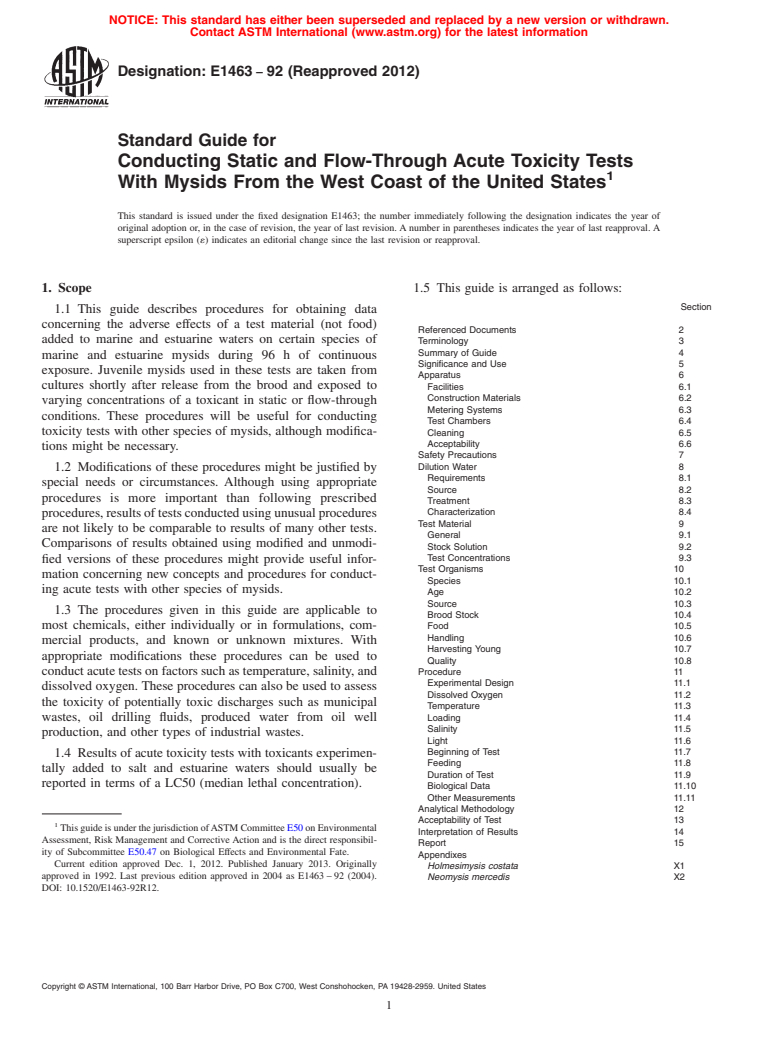
1.5 This guide is arranged as follows:
Section
Referenced Documents
2
Terminology
3
Summary of Guide
4
Significance and Use
5
Apparatus
6
Facilities
6.1
Construction Materials ...
General Information
Standards Content (Sample)
NOTICE: This standard has either been superseded and replaced by a new version or withdrawn.
Contact ASTM International (www.astm.org) for the latest information
Designation: E1463 − 92 (Reapproved 2012)
Standard Guide for
Conducting Static and Flow-Through Acute Toxicity Tests
With Mysids From the West Coast of the United States
This standard is issued under the fixed designation E1463; the number immediately following the designation indicates the year of
original adoption or, in the case of revision, the year of last revision. A number in parentheses indicates the year of last reapproval. A
superscript epsilon (´) indicates an editorial change since the last revision or reapproval.
1. Scope 1.5 This guide is arranged as follows:
Section
1.1 This guide describes procedures for obtaining data
concerning the adverse effects of a test material (not food)
Referenced Documents 2
added to marine and estuarine waters on certain species of
Terminology 3
Summary of Guide 4
marine and estuarine mysids during 96 h of continuous
Significance and Use 5
exposure. Juvenile mysids used in these tests are taken from
Apparatus 6
cultures shortly after release from the brood and exposed to Facilities 6.1
Construction Materials 6.2
varying concentrations of a toxicant in static or flow-through
Metering Systems 6.3
conditions. These procedures will be useful for conducting
Test Chambers 6.4
toxicity tests with other species of mysids, although modifica-
Cleaning 6.5
Acceptability 6.6
tions might be necessary.
Safety Precautions 7
Dilution Water 8
1.2 Modifications of these procedures might be justified by
Requirements 8.1
special needs or circumstances. Although using appropriate
Source 8.2
procedures is more important than following prescribed
Treatment 8.3
Characterization 8.4
procedures,resultsoftestsconductedusingunusualprocedures
Test Material 9
are not likely to be comparable to results of many other tests.
General 9.1
Comparisons of results obtained using modified and unmodi-
Stock Solution 9.2
Test Concentrations 9.3
fied versions of these procedures might provide useful infor-
Test Organisms 10
mation concerning new concepts and procedures for conduct-
Species 10.1
ing acute tests with other species of mysids.
Age 10.2
Source 10.3
1.3 The procedures given in this guide are applicable to
Brood Stock 10.4
most chemicals, either individually or in formulations, com- Food 10.5
Handling 10.6
mercial products, and known or unknown mixtures. With
Harvesting Young 10.7
appropriate modifications these procedures can be used to
Quality 10.8
conductacutetestsonfactorssuchastemperature,salinity,and Procedure 11
Experimental Design 11.1
dissolved oxygen. These procedures can also be used to assess
Dissolved Oxygen 11.2
the toxicity of potentially toxic discharges such as municipal
Temperature 11.3
wastes, oil drilling fluids, produced water from oil well Loading 11.4
Salinity 11.5
production, and other types of industrial wastes.
Light 11.6
Beginning of Test 11.7
1.4 Results of acute toxicity tests with toxicants experimen-
Feeding 11.8
tally added to salt and estuarine waters should usually be
Duration of Test 11.9
reported in terms of a LC50 (median lethal concentration).
Biological Data 11.10
Other Measurements 11.11
Analytical Methodology 12
Acceptability of Test 13
ThisguideisunderthejurisdictionofASTMCommitteeE50onEnvironmental
Interpretation of Results 14
Assessment, Risk Management and CorrectiveAction and is the direct responsibil-
Report 15
ity of Subcommittee E50.47 on Biological Effects and Environmental Fate.
Appendixes
Current edition approved Dec. 1, 2012. Published January 2013. Originally
Holmesimysis costata X1
approved in 1992. Last previous edition approved in 2004 as E1463 – 92 (2004).
Neomysis mercedis X2
DOI: 10.1520/E1463-92R12.
Copyright © ASTM International, 100 Barr Harbor Drive, PO Box C700, West Conshohocken, PA 19428-2959. United States
E1463 − 92 (2012)
1.6 The values stated in SI units are to be regarded as the solution that results in the death of 50 % of the test organisms
standard. within the test period (see Definition E943).
1.7 This standard does not purport to address all of the
3.2.2 For definitions of other terms used in this guide, refer
safety concerns, if any, associated with its use. It is the
to Guide E729, Terminology E943, Guides E1191 and E1192,
responsibility of the user of this standard to establish appro-
and Practice E1203. For an explanation of units and symbols,
priate safety and health practices and determine the applica-
refer to IEEE/ASTM SI 10.
bility of regulatory limitations prior to use. Specific precau-
tionary statements are given in Section 7.
4. Summary of Guide
4.1 Thetoxicityofasubstanceinmarineorestuarinewaters
2. Referenced Documents
can be determined through a 96-h acute static test or a
2.1 ASTM Standards:
flow-through test. Static tests may be conducted in glass 2-L
E729 Guide for Conducting Acute Toxicity Tests on Test
finger bowls or 350-mL finger bowls. Either size finger bowl
Materials with Fishes, Macroinvertebrates, and Amphib-
provides a large surface-to-volume ratio and ample horizontal
ians
space to minimize cannibalism. The dishes should be covered
E943 Terminology Relating to Biological Effects and Envi-
and aerated. Whichever static technique is used, specific data
ronmental Fate
on the concentration of test material are obtained and analyzed
E1023 Guide for Assessing the Hazard of a Material to
to determine the effect(s) of the toxicant on survival. In the
Aquatic Organisms and Their Uses
flow-through acute technique, the test solution flows through
E1191 Guide for Conducting Life-Cycle Toxicity Tests with
the test chamber on a once-through basis throughout the test.
Saltwater Mysids
The flow-through test is considered to be more representative
E1192 Guide for ConductingAcute Toxicity Tests onAque-
of actual field conditions, but not all laboratories have the
ous Ambient Samples and Effluents with Fishes,
capabilities of conducting this type of test.
Macroinvertebrates, and Amphibians
E1203 Practice for Using Brine Shrimp Nauplii as Food for
5. Significance and Use
Test Animals in Aquatic Toxicology (Withdrawn 2013)
5.1 Mysids are an important component of both the pelagic
IEEE/ASTM SI 10 American National Standard for Use of
and epibenthic community. They are preyed upon by many
theInternationalSystemofUnits(SI):TheModernMetric
species of fish, birds, and larger invertebrate species, and they
System
are predators of smaller crustaceans and larval stages of
3. Terminology
invertebrates. In some cases, they feed upon algae. Mysids are
sensitive to both organic and inorganic toxicants (1). The
3.1 Theterms“must,”“should,”“may,”“can,”and“might”
ecological importance of mysids, their wide geographical
have very specific meanings in this guide. “Must” is used to
distribution, ability to be cultured in the laboratory, and
expressthestrongestpossiblerecommendation,justshortofan
sensitivity to contaminants make them appropriate acute tox-
absolute requirement, that is, to state that this test ought to be
icity test organisms.
designed to satisfy the specific condition, unless the purpose of
the test requires a different design. “Must” is only used in
5.2 An acute toxicity test is conducted to obtain information
connection with factors that directly relate to the acceptability
concerning the immediate effects of a short-term exposure to a
of the test (see Section 13).
test material on a test organism under specified experimental
3.1.1 “Should” is used to state that the specific condition is
conditions. An acute toxicity test provides data on the short-
recommended and ought to be met if possible. Although
termeffectsthatareusefulforcomparisonstootherspeciesbut
violationofone“should”israrelyaseriousmatter,violationof
does not provide information on delayed effects.
several will often render the results questionable. Terms such
5.3 Results of acute toxicity tests can be used to predict
as “is desirable.” “is often desirable,” and “might be desirable”
acute effects likely to occur on aquatic organisms in field
are used in connection with less important factors.
conditions except that mysids might avoid exposure when
3.1.2 “May” is used to mean “is (are) allowed to,” “can” is
possible.
used to mean “is (are) able to,” and “might” is used to mean
“could possibly.” Thus the classic distinction between “may” 5.4 Results of acute toxicity tests might be used to compare
and “can” is preserved, and “might” is never used as a the acute sensitivities of different species and the acute
synonym for either “may” or “can.” toxicities of different test materials, and to study the effects of
various environmental factors on results of such tests.
3.2 Definitions:
3.2.1 LC50—the statistically or graphically derived best
5.5 Results of acute toxicity tests might be an important
estimate of the concentration of a toxicant added to an aqueous consideration when assessing the hazards of materials to
aquatic organisms (see Guide E1023) or when deriving water
quality criteria for aquatic organisms (2).
For referenced ASTM standards, visit the ASTM website, www.astm.org, or
contact ASTM Customer Service at service@astm.org. For Annual Book of ASTM
Standards volume information, refer to the standard’s Document Summary page on
the ASTM website.
3 4
The last approved version of this historical standard is referenced on The boldface numbers given in parentheses refer to a list of references at the
www.astm.org. end of this guide.
E1463 − 92 (2012)
5.6 Results of acute toxicity tests might be useful for test material and the necessary flow rates of test solutions. The
studying biological availability of, and structure activity rela- system should permit the mixing of test material with dilution
tionships between test materials. water immediately before entrance to the test chambers and
permit the supply of the selected concentration(s) of test
5.7 Resultsofacutetoxicitytestswilldepend,inpart,onthe
material (see 9.1.3 and 11.7.5) in a reproducible fashion.
temperature, quality of the food, condition of test organisms,
Various metering systems, using different combinations of
test procedures, and other factors.
syringes, “dipping birds,” siphons, pumps, saturators,
6. Apparatus
solenoids, valves, and so forth, have been used successfully to
control the concentrations of test material in, and the flow rates
6.1 Facilities—Aquaria or tanks containing either clean
of, test solutions (6). Proportional diluters (7) use an intermit-
(uncontaminated) natural sea water or reconstituted sea water
tent flow design and various devices for metering the test
(see 8.2) should be used for holding mysids after field
material (8). Continuous-flow metering systems are also
collection and prior to a test. Both static-recirculating and
available,asaresystemsthatpreparethedifferenttestsolutions
flow-through holding systems have been used successfully (1).
independently of each other (6).
Cultures of Holmesimysis costata have not been reported for
6.3.2 The metering system should be calibrated before and
media of reconstituted sea water. The holding tanks and any
after the test by determining the flow rate through each test
area used for manipulating live mysids should be located in a
chamber and by measuring either the concentration of test
room or space separated from that in which toxicity tests are to
material in each test chamber or the volume of solution used in
be conducted. The sea water should be monitored periodically
each portion of the metering system. The general operation of
to ensure a constant salinity. The holding tanks, water supply,
the metering system should be visually checked daily in the
or the room in which they are kept should be equipped with
morning and afternoon throughout the test. The metering
temperaturecontrol.Aerationshouldbeprovidedtoensurethat
system should be adjusted during the test if necessary.
the concentration of dissolved oxygen is greater than 60 % of
saturation as well as adequate water circulation in the tanks.A 6.3.3 The flow rate through each test chamber should be at
timingdeviceshouldbeusedtoprovidea16-hlightandan8-h least five-volume additions per 24 h. It is usually desirable to
dark photoperiod. A15 to 30-min transition period (3) when construct the metering system so that it can provide at least
lights go on might be desirable to reduce the possibility of ten-volume additions per 24 h in case the loading is high (see
organisms being stressed by large, sudden increases in light 11.4) or there is rapid loss of test material due to microbial
intensity. A transition period when the lights go off might also degradation, hydrolysis, oxidation, photolysis, reductions,
be desirable. sorption, or volatilization. At any particular time during the
test, the flow rates through any two test chambers should not
6.2 Construction Materials—Equipment and facilities that
differ by more than 10 %.
contact stock solutions, test solutions, or any water into which
test organisms will be placed should not contain substances
6.4 Test Chambers:
that can be leached or dissolved by aqueous solutions in
6.4.1 Inatoxicitytestwithaquaticorganisms,testchambers
amounts that adversely affect test organisms. In addition,
are defined as the smallest physical units between which there
equipment and facilities that contact stock or test solutions
are no water connections. Screens and cups may be used to
should be chosen to minimize sorption of test materials from
create two or more compartments within each chamber but
water. Glass, Type 316 stainless steel, nylon, and fluorocarbon
such compartments are not replicate experimental units.
plastics should be used whenever possible to minimize
Therefore, the test solution can be in contact with the test
dissolution, leaching, and sorption, except that stainless steel
organisms in the compartments within a test chamber, but, by
shouldnotbeusedintestsonmetalsinsaltwater.Concreteand
definition, cannot flow from one chamber to another. Because
rigid plastics may be used for holding tanks and in the
the solution can flow from one compartment to another in the
water-supply system, but they should be soaked, preferably in
same test chamber, the temperature, concentration of test
flowing dilution water, for a week or more before use (4). Cast
material, or types of pathogens and extraneous contaminants
iron pipe should not be used with salt water and probably
are likely to be more similar between compartments in the
shouldnotbeusedinafreshwater-supplyfiltersystembecause
same test chamber than between compartments in different test
colloidal iron will be added to the dilution water and strainers
chambers in the same treatment. Chambers should be covered
will be needed to remove rust particles. A specially designed
to keep out extraneous contaminants and to reduce evaporation
s
...
Questions, Comments and Discussion
Ask us and Technical Secretary will try to provide an answer. You can facilitate discussion about the standard in here.