

ASTM D8309-21
(Guide)Standard Guide for Stability Testing of Cannabis-Based Products
General Information
- Abstract
SIGNIFICANCE AND USE
4.1 Stability testing provides evidence on how the quality and safety of cannabis-based product varies with time under the influence of a variety of environmental factors such as temperature, humidity, and light. The stability testing will also establish a re-test period for the cannabis product or a shelf-life for the cannabis product under recommended storage conditions. Recommended test conditions are based on ICH Q1A.
4.2 The choice of test conditions defined in this guideline is based on an analysis of the effects of climatic conditions in the three regions of the European Commission (EC), Japan and the United States. The mean kinetic temperature in any part of the world can be derived from climatic data, and the world can be divided into four climatic zones, I-IV.
4.3 Requirements of regulatory bodies or governmental departments supersede the recommendations in this guide.
SCOPE
1.1 This guide is applicable to commercial processors and manufacturers engaged in the processing, testing, packaging, labeling, and storage of cannabis products intended for human consumption, including those derived from hemp. Hemp seed and products derived from hemp seed are excluded from the scope of this guide This guide describes the minimum requirements for conducting stability testing of new cannabis products with the purpose of determining appropriate storage conditions and shelf-life.
1.2 This guide applies to all cannabis-derived products commercially manufactured and distributed for consumer use, regardless of the type of cannabis plant from which they were derived.
1.3 Units—The values stated in SI units are to be regarded as standard. No other units of measurement are included in this standard.
1.4 This standard does not purport to address all of the safety concerns, if any, associated with its use. It is the responsibility of the user of this standard to establish appropriate safety, health, and environmental practices and determine the applicability of regulatory limitations prior to use.
1.5 This international standard was developed in accordance with internationally recognized principles on standardization established in the Decision on Principles for the Development of International Standards, Guides and Recommendations issued by the World Trade Organization Technical Barriers to Trade (TBT) Committee.
- Status
- Published
- Publication Date
- 31-May-2021
- Technical Committee
- D37 - Cannabis
- Drafting Committee
- D37.03 - Laboratory
Overview
ASTM D8309-21: Standard Guide for Stability Testing of Cannabis-Based Products provides a comprehensive framework for evaluating the stability of cannabis-based products intended for human consumption. Developed by ASTM International, this guide outlines minimum requirements for stability studies, helping processors and manufacturers determine suitable storage conditions, shelf-life, and expiration dates for cannabis-derived products. The guide emphasizes quality and safety through systematic testing under various environmental conditions and aligns with internationally recognized principles and the recommendations of regulatory agencies.
Key Topics
- Stability Testing Objectives: The guide details how to assess changes in cannabis product quality and safety over time due to environmental factors like temperature, humidity, and light. It supports establishing reliable shelf-life and retest periods.
- Environmental Testing Conditions: Stability studies should consider international climatic zones (I-IV), reflecting global storage and distribution conditions. Protocols for long-term, accelerated, and photostability testing are included.
- Test Methods and Validation: Analytical methods used for stability assessment must be validated for accuracy and relevance. Typical tests include chemical (cannabinoid and terpene profiles), microbiological, and physical stability evaluations.
- Sampling and Study Design: At least three production batches and each product variant (e.g., concentration, container size) should be tested. Studies involve frequent testing intervals over time to establish consistent stability profiles.
- Requirements for Documentation: Comprehensive documentation, including storage conditions, test results, and data analysis using statistical approaches, is required to demonstrate product stability and compliance.
Applications
For Manufacturers and Processors
- Establishing Product Shelf-Life: By following ASTM D8309-21, manufacturers can scientifically determine the shelf-life and expiration dates for cannabis-based products, reducing risk and supporting regulatory compliance.
- Quality Assurance: Implementing these guidelines ensures product quality is maintained from manufacture to the end of shelf-life, addressing consumer safety and reducing liability.
- Product Development: Stability data generated as per D8309-21 supports formulation improvements and packaging decisions, helping optimize product performance and marketability.
For Testing Laboratories
- Regulatory Compliance: Laboratories can use this guide to ensure their stability testing protocols meet industry and international expectations, simplifying submissions to regulatory bodies.
- Comprehensive Test Planning: The standard offers a road map for designing robust stability studies, including criteria for batch selection, sampling, and choosing test intervals for reliable results.
For Regulators and Consumers
- Transparency and Safety: By referencing ASTM D8309-21, regulatory agencies can enforce standards that protect consumers and harmonize expectations across markets.
- Consistent Product Experience: Standardized testing helps prevent quality degradation, ensuring a consistent consumer experience regardless of distribution region or storage conditions.
Related Standards
Professionals implementing ASTM D8309-21 for cannabis stability testing may also refer to these related standards and guidelines:
- ASTM D8270: Terminology Relating to Cannabis
- ASTM D8282: Practice for Laboratory Test Method Validation and Method Development
- ICH Q1A: Stability Testing of New Drug Substances and Products
- ICH Q1B: Photostability Testing of New Drug Substances and Products
- ICH Q1D: Bracketing and Matrixing Designs for Stability Testing
- ICH Q6A/Q6B: Specification Guidelines for Pharmaceuticals and Biological Products
- WHO Stability Testing Guidelines: For pharmaceutical ingredients and finished products
Keywords: cannabis stability testing, shelf-life, cannabis product expiration, cannabis-based product quality, ASTM cannabis standards, stability study, storage conditions, accelerated testing, photostability, regulatory compliance
Relations
- Refers
ASTM D8282-19 - Standard Practice for Laboratory Test Method Validation and Method Development - Effective Date
- 01-Sep-2019
Get Certified
Connect with accredited certification bodies for this standard

BSI Group
BSI (British Standards Institution) is the business standards company that helps organizations make excellence a habit.

TÜV Rheinland
TÜV Rheinland is a leading international provider of technical services.

TÜV SÜD
TÜV SÜD is a trusted partner of choice for safety, security and sustainability solutions.
Sponsored listings
Frequently Asked Questions
ASTM D8309-21 is a guide published by ASTM International. Its full title is "Standard Guide for Stability Testing of Cannabis-Based Products". This standard covers: SIGNIFICANCE AND USE 4.1 Stability testing provides evidence on how the quality and safety of cannabis-based product varies with time under the influence of a variety of environmental factors such as temperature, humidity, and light. The stability testing will also establish a re-test period for the cannabis product or a shelf-life for the cannabis product under recommended storage conditions. Recommended test conditions are based on ICH Q1A. 4.2 The choice of test conditions defined in this guideline is based on an analysis of the effects of climatic conditions in the three regions of the European Commission (EC), Japan and the United States. The mean kinetic temperature in any part of the world can be derived from climatic data, and the world can be divided into four climatic zones, I-IV. 4.3 Requirements of regulatory bodies or governmental departments supersede the recommendations in this guide. SCOPE 1.1 This guide is applicable to commercial processors and manufacturers engaged in the processing, testing, packaging, labeling, and storage of cannabis products intended for human consumption, including those derived from hemp. Hemp seed and products derived from hemp seed are excluded from the scope of this guide This guide describes the minimum requirements for conducting stability testing of new cannabis products with the purpose of determining appropriate storage conditions and shelf-life. 1.2 This guide applies to all cannabis-derived products commercially manufactured and distributed for consumer use, regardless of the type of cannabis plant from which they were derived. 1.3 Units—The values stated in SI units are to be regarded as standard. No other units of measurement are included in this standard. 1.4 This standard does not purport to address all of the safety concerns, if any, associated with its use. It is the responsibility of the user of this standard to establish appropriate safety, health, and environmental practices and determine the applicability of regulatory limitations prior to use. 1.5 This international standard was developed in accordance with internationally recognized principles on standardization established in the Decision on Principles for the Development of International Standards, Guides and Recommendations issued by the World Trade Organization Technical Barriers to Trade (TBT) Committee.
SIGNIFICANCE AND USE 4.1 Stability testing provides evidence on how the quality and safety of cannabis-based product varies with time under the influence of a variety of environmental factors such as temperature, humidity, and light. The stability testing will also establish a re-test period for the cannabis product or a shelf-life for the cannabis product under recommended storage conditions. Recommended test conditions are based on ICH Q1A. 4.2 The choice of test conditions defined in this guideline is based on an analysis of the effects of climatic conditions in the three regions of the European Commission (EC), Japan and the United States. The mean kinetic temperature in any part of the world can be derived from climatic data, and the world can be divided into four climatic zones, I-IV. 4.3 Requirements of regulatory bodies or governmental departments supersede the recommendations in this guide. SCOPE 1.1 This guide is applicable to commercial processors and manufacturers engaged in the processing, testing, packaging, labeling, and storage of cannabis products intended for human consumption, including those derived from hemp. Hemp seed and products derived from hemp seed are excluded from the scope of this guide This guide describes the minimum requirements for conducting stability testing of new cannabis products with the purpose of determining appropriate storage conditions and shelf-life. 1.2 This guide applies to all cannabis-derived products commercially manufactured and distributed for consumer use, regardless of the type of cannabis plant from which they were derived. 1.3 Units—The values stated in SI units are to be regarded as standard. No other units of measurement are included in this standard. 1.4 This standard does not purport to address all of the safety concerns, if any, associated with its use. It is the responsibility of the user of this standard to establish appropriate safety, health, and environmental practices and determine the applicability of regulatory limitations prior to use. 1.5 This international standard was developed in accordance with internationally recognized principles on standardization established in the Decision on Principles for the Development of International Standards, Guides and Recommendations issued by the World Trade Organization Technical Barriers to Trade (TBT) Committee.
ASTM D8309-21 is classified under the following ICS (International Classification for Standards) categories: 11.120.10 - Medicaments; 65.020.20 - Plant growing. The ICS classification helps identify the subject area and facilitates finding related standards.
ASTM D8309-21 has the following relationships with other standards: It is inter standard links to ASTM D8282-19. Understanding these relationships helps ensure you are using the most current and applicable version of the standard.
ASTM D8309-21 is available in PDF format for immediate download after purchase. The document can be added to your cart and obtained through the secure checkout process. Digital delivery ensures instant access to the complete standard document.
Standards Content (Sample)
This international standard was developed in accordance with internationally recognized principles on standardization established in the Decision on Principles for the
Development of International Standards, Guides and Recommendations issued by the World Trade Organization Technical Barriers to Trade (TBT) Committee.
Designation: D8309 − 21
Standard Guide for
Stability Testing of Cannabis-Based Products
This standard is issued under the fixed designation D8309; the number immediately following the designation indicates the year of
original adoption or, in the case of revision, the year of last revision. A number in parentheses indicates the year of last reapproval. A
superscript epsilon (´) indicates an editorial change since the last revision or reapproval.
1. Scope 2.2 ICH Documents:
Q1A(R2) Harmonised Tripartite Guideline – Stability Test-
1.1 This guide is applicable to commercial processors and
ing of New Drug Substances and Products
manufacturers engaged in the processing, testing, packaging,
Q1B Harmonised Tripartite Guideline – Stability Testing:
labeling, and storage of cannabis products intended for human
Photostability Testing of New Drug Substances and Prod-
consumption, including those derived from hemp. Hemp seed
ucts
and products derived from hemp seed are excluded from the
scope of this guide This guide describes the minimum require-
3. Terminology
mentsforconductingstabilitytestingofnewcannabisproducts
with the purpose of determining appropriate storage conditions 3.1 Definitions:
and shelf-life.
3.1.1 For definitions of terms, see Terminology D8270.
3.2 Definitions of Terms Specific to This Standard:
1.2 This guide applies to all cannabis-derived products
3.2.1 accelerated testing, n—studies designed to increase
commercially manufactured and distributed for consumer use,
the rate of chemical degradation or physical change of a
regardless of the type of cannabis plant from which they were
product by using exaggerated storage conditions as part of the
derived.
formal stability studies.
1.3 Units—The values stated in SI units are to be regarded
3.2.1.1 Discussion—Data from these studies, in addition to
as standard. No other units of measurement are included in this
long term stability studies, can be used to assess longer term
standard.
chemical effects at non-accelerated conditions and to evaluate
1.4 This standard does not purport to address all of the
the effect of short-term excursions outside the label storage
safety concerns, if any, associated with its use. It is the
conditions (for example, during shipping). Results from accel-
responsibility of the user of this standard to establish appro-
erated testing studies are not always predictive of physical
priate safety, health, and environmental practices and deter-
changes.
mine the applicability of regulatory limitations prior to use.
3.2.2 cannabis product, n—products derived from the can-
1.5 This international standard was developed in accor-
nabis plant (flowers or resins) that are intended for human
dance with internationally recognized principles on standard-
consumption and are packaged and labeled in their final form
ization established in the Decision on Principles for the
for marketing.
Development of International Standards, Guides and Recom-
mendations issued by the World Trade Organization Technical 3.2.3 climatic zones, n—the four zones in the world that are
distinguished by their characteristic prevalent annual climatic
Barriers to Trade (TBT) Committee.
conditions.
2. Referenced Documents
3.2.3.1 Discussion—Zone 1 is temperate, Zone II is
2.1 ASTM Standards:
subtropical, Zone III is hot dry, and Zone IV is hot humid/
D8270 Terminology Relating to Cannabis
tropical. This is based on the concept described by Grimm,
D8282 Practice for Laboratory Test Method Validation and
1985 and 1986.
Method Development
3.2.4 D65/ID65, n—anilluminantstandardusedtorepresent
daylight as defined by the International Commission on Illu-
mination.
This guide is under the jurisdiction ofASTM Committee D37 on Cannabis and
is the direct responsibility of Subcommittee D37.03 on Laboratory.
Current edition approved June 1, 2021. Published July 2021. DOI: 10.1520/
D8309-21. Available from International Council for Harmonisation of Technical Require-
For referenced ASTM standards, visit the ASTM website, www.astm.org, or ments for Pharmaceuticals for Human Use (ICH), ICH Secretariat, Route de
contact ASTM Customer Service at service@astm.org. For Annual Book of ASTM Pré-Bois, 20, P.O Box 1894, 1215 Geneva, Switzerland, https://www.ich.org.
Standards volume information, refer to the standard’s Document Summary page on Grimm, W., Drugs Made in Germany, Vol 28, pp. 196–202, 1985, and Vol 29,
the ASTM website. pp. 39–47, 1986.
Copyright © ASTM International, 100 Barr Harbor Drive, PO Box C700, West Conshohocken, PA 19428-2959. United States
D8309 − 21
3.2.4.1 Discussion—ID65 is the indoor equivalent of the 4. Significance and Use
D65 standard.
4.1 Stability testing provides evidence on how the quality
3.2.5 expiration date, n—the date placed on the packaging
and safety of cannabis-based product varies with time under
or label, or both, that displays the time period during which the
the influence of a variety of environmental factors such as
product is known to remain stable, which means it retains its
temperature, humidity, and light. The stability testing will also
strength, quality, and purity when it is stored according to its
establishare-testperiodforthecannabisproductorashelf-life
labeled storage conditions.
for the cannabis product under recommended storage condi-
tions. Recommended test conditions are based on ICH Q1A.
3.2.6 extrapolation, n—the practice of using a known data
set to estimate information about future data.
4.2 The choice of test conditions defined in this guideline is
based on an analysis of the effects of climatic conditions in the
3.2.7 long-term testing, n—stability studies under the rec-
three regions of the European Commission (EC), Japan and the
ommended storage condition for the re-test period or shelf-life
United States. The mean kinetic temperature in any part of the
proposed (or approved) for labeling.
world can be derived from climatic data, and the world can be
3.2.8 mass balance, n—the process of adding together the
divided into four climatic zones, I-IV.
assay value and levels of degradation products to see how
4.3 Requirements of regulatory bodies or governmental
closely these add up to 100 % of the initial value, with due
departments supersede the recommendations in this guide.
consideration of the margin of analytical error.
3.2.9 shelf-life, n—(also referred to as expiration dating
5. Stability of Cannabis-Based Products
period)—the time period during which a cannabis product is
5.1 Information on the stability of the analyte(s) in cannabis
known to remain within the final product specifications,
products is an integral part of the systematic approach to
provided that it is stored under the conditions defined on the
stability evaluation.
container packaging or label, or both.
5.2 Stress Testing:
3.2.10 storage condition tolerances, n—the acceptable
5.2.1 Stress testing of the cannabis-based products can help
variations in temperature and relative humidity of storage
identify the likely degradation products of analytes contained
facilities for formal stability studies.
in the cannabis products, which can in turn help establish the
3.2.10.1 Discussion—The equipment should be capable of degradation pathways and the intrinsic stability of the analytes
and validate the stability indicating power of the analytical
controlling the storage condition within the ranges defined in
this guideline. The actual temperature and humidity must be proceduresused.Thenatureofthestresstestingwilldependon
monitored,documented,andcontrolledthroughoutthestability the individual analyte(s) and the type of cannabis product
study. Short term temperature/humidity excursions that occur involved.
due to opening doors of the storage chamber are accepted as 5.2.2 Photostability testing should be an integral part of
unavoidable. The effect of excursions due to equipment failure stresstesting.Thestandardconditionsforphotostabilitytesting
should be addressed and reported if judged to affect stability are described in ICH Q1B.
results. Excursions that exceed the defined tolerances for more 5.2.3 Examining degradation products under stress condi-
than 24 hours should be described in the study report and their tions is useful in establishing degradation pathways and
effect assessed. developing and validating suitable analytical procedures.
However, it may not be necessary to examine specifically for
3.2.11 stress testing, n—studies undertaken to elucidate the
certain degradation products if it has been demonstrated that
intrinsic stability of the cannabis products.
they are not formed under accelerated or long-term storage
3.2.11.1 Discussion—Such testing is part of the develop-
conditions.
ment strategy and is normally carried out under more severe
5.3 Evaluation:
conditions than those used for accelerated testing.
5.3.1 The purpose of the stability study is to establish a
3.2.12 supporting data, n—data, other than those from
stability timeline, based on the recommendation to test a
formal stability studies, that support the analytical procedures,
minimum of three batches of the cannabis product, and to
the proposed re-test period or shelf-life, and the label storage
evaluate the stability information (including, as appropriate,
statements.
results of the physical, chemical, biological, and microbiologi-
cal tests). A statistical approach should be used to determine
3.2.12.1 Discussion—Such data include (1) stability data on
the sample size for each batch.
early small-scale batches of materials, investigational formu-
lations not proposed for marketing, related formulations, and
6. Stability Study Design
product presented in containers and closures other than those
6.1 The design of the formal stability studies for the
proposed for marketing; (2) information regarding test results
on containers; and (3) other scientific rationales. cannabis product should be based on knowledge of the
behavior, properties of the cannabis product analytes, and from
stability studies on those chemicals and on experience gained
from formulation studies. The likely changes on storage and
InternationalCommissiononIllumination(CIE)andInternationalOrganization
the rationale for the selection of attributes to be tested in the
for Standardization (IS) joint standard, Colorimetry – Part 2: CIE Standard
Illuminants for Colorimetry, CIE S 014-2/E:2006/ISO 11664-2:2007(E). formal stability studies should be stated.
D8309 − 21
6.2 Photostability Testing: other materials that may not be homogeneous after exposure
6.2.1 Photostability testing should be conducted on at least (for example, creams, ointments, suspensions, etc.).The analy-
one initial production batch of the cannabis product if appro- sis of the exposed sample should be performed concomitantly
priate. with that of any protected samples used as dark controls if
6.2.2 Light sources that meet the D65/ID65 standard for these are used in the test.
outdoor daylight and indoor indirect daylight may be used for
6.2.6 The analytical procedures used should be validated
photostability testing. Appropriate control of temperature
prior to testing of stability samples and in accordance with
should be maintained to minimize the effect of localized
Practice D8282.
temperature changes or include a dark control in the same
6.2.7 Depending on the extent of change, special labeling or
environment unless otherwise justified. The manufacturer may
packaging may be needed to mitigate exposure to light. When
rely on the spectral distribution specification of the light source
evaluating the results of photostability studies to determine
manufacturer.
whether change due to exposure to light is acceptable, it is
6.2.3 Care should be taken to ensure that the physical
important to consider the results obtained from other formal
characteristics of the samples under test are taken into account
stability studies in order to assure that the product will be
and efforts, such as cooling and/or placing the samples in
within proposed specifications during the shelf-life.
sealed containers, should be made to ensure that the effects,
6.3 Selection of Batches:
such as sublimation, evaporation, or melting, that result in
6.3.1 Stability studies should be performed on at least three
changes to physical state are minimized.
initial production batches of the cannabis product. The initial
6.2.4 At the end of the exposure period, the samples should
production batches should be of the same formulation and
be examined for any changes in physical properties (for
packaged in the same container closure system as proposed for
example, organoleptic, appearance, clarity or color of solution,
marketing. The manufacturing process used for initial produc-
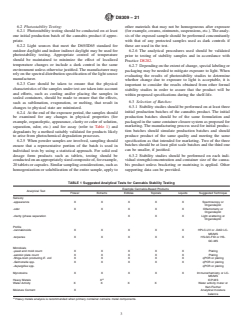
separation, odor, etc.) and for assay (refer to Table 1) and
tion batches should simulate production batches and should
degradants by a method suitably validated for products likely
produce product of the same quality and meeting the same
to arise from photochemical degradation processes.
specification as that intended for marketing. Two of the three
6.2.5 When powder samples are involved, sampling should
batches should be at least pilot scale batches and the third one
ensure that a representative portion of the batch is used
...