

ASTM D8056-18
(Guide)Standard Guide for Elemental Analysis of Crude Oil
General Information
- Abstract
SIGNIFICANCE AND USE
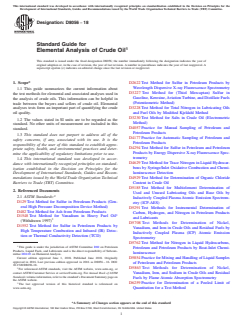
3.1 This guide summarizes the test methods used in the elemental analysis of crude oils. Additional information on the significance and use of the test methods quoted in this guide can be found under discussion of individual test methods in Sections 8 through 15.
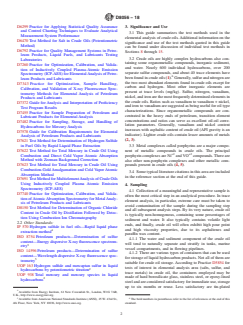
3.2 Crude oils are highly complex hydrocarbons also containing some organometallic compounds, inorganic sediment, and water. Nearly 600 individual hydrocarbons, over 200 separate sulfur compounds, and about 40 trace elements have been found in crude oils (1).6 Generally, sulfur and nitrogen are the two most abundant elements found in crude oils except for carbon and hydrogen. Most other inorganic elements are present at trace levels (mg/kg). Sulfur, nitrogen, vanadium, nickel, and iron are the most frequently determined elements in the crude oils. Ratios such as vanadium to vanadium + nickel, and iron to vanadium are suggested as being useful for oil type characterizations. Since organometallic compounds are concentrated in the heavy ends of petroleum, transition element concentrations and ratios can serve as excellent oil-oil correlation parameters. Generally, vanadium and nickel content increases with asphaltic content of crude oil (API gravity is an indicator). Lighter crude oils contain lesser amounts of metals (2, 3).
3.3 Metal complexes called porphyrins are a major component of metallic compounds in crude oils. The principal porphyrin complexes are Ni+2 and VO+2 compounds. There are also other non-porphyrin complexes and other metallic compounds present in crude oils (4, 5).
3.4 Some typical literature citations in this area are included in the reference section at the end of this guide.
SCOPE
1.1 This guide summarizes the current information about the test methods for elemental and associated analyses used in the analysis of crude oils. This information can be helpful in trade between the buyers and sellers of crude oil. Elemental analyses tests form an important part of quantifying the crude oil quality.
1.2 The values stated in SI units are to be regarded as the standard. No other units of measurement are included in this standard.
1.3 This standard does not purport to address all of the safety concerns, if any, associated with its use. It is the responsibility of the user of this standard to establish appropriate safety, health, and environmental practices and determine the applicability of regulatory limitations prior to use.
1.4 This international standard was developed in accordance with internationally recognized principles on standardization established in the Decision on Principles for the Development of International Standards, Guides and Recommendations issued by the World Trade Organization Technical Barriers to Trade (TBT) Committee.
- Status
- Published
- Publication Date
- 31-May-2018
- Technical Committee
- D02 - Petroleum Products, Liquid Fuels, and Lubricants
- Drafting Committee
- D02.03 - Elemental Analysis
Overview
ASTM D8056-18: Standard Guide for Elemental Analysis of Crude Oil provides a comprehensive overview of test methods used to determine the elemental composition of crude oils. Issued by ASTM International, this guide is vital for laboratories, refiners, and stakeholders in the petroleum industry to ensure accurate assessment of crude oil quality. The elemental analysis of crude oil is essential for quality control, regulatory compliance, and optimizing refining processes. This standard summarizes current analytical techniques, proper sample handling, and the significance and application of elemental data in the petroleum sector.
Key Topics
Test Methods for Elemental Analysis: The guide summarizes standardized methods for analyzing elements such as sulfur, nitrogen, vanadium, nickel, iron, mercury, and chlorides. It references multiple ASTM test methods, including combustion, X-ray fluorescence (XRF), atomic absorption spectrometry (AAS), and inductively coupled plasma atomic emission spectrometry (ICP-AES).
Crude Oil Composition: Crude oil contains a complex mixture of hydrocarbons, organometallic compounds, inorganic sediments, and water. Besides carbon and hydrogen, sulfur and nitrogen are the most prevalent elements. Trace metals like vanadium, nickel, and iron are analyzed for both operational and environmental reasons.
Sample Collection and Preparation: Proper sample collection and preparation are critical to avoiding contamination and ensuring that results accurately represent the crude oil bulk. ASTM practices for manual and automatic sampling, optimal container types, and homogenization techniques are highlighted.
Calibration and Quality Assurance: The importance of calibration, use of appropriate standards, and application of quality control measures are emphasized to maintain the accuracy, reliability, and comparability of analytical results.
Significant Analytical Parameters: Key parameters include:
- Sulfur (various forms and total content)
- Nitrogen
- Metals (vanadium, nickel, iron, sodium)
- Mercury
- Ash and Salts
- Organic Chlorides
Applications
The standards and methods outlined in ASTM D8056-18 for elemental analysis of crude oil serve a range of practical applications:
Crude Oil Trading: Elemental data supports fair trade between buyers and sellers by quantifying crude oil quality and helping to meet contractual specifications.
Refining and Processing: Knowing the elemental content allows refiners to adjust processes for efficiency, manage corrosion risks, and comply with environmental regulations.
Regulatory Compliance: Accurate elemental analysis helps the industry meet limits for hazardous contaminants (e.g., mercury, organic chloride, sulfur) imposed by local and international authorities.
Catalyst Protection: Monitoring nitrogen and metals informs decisions to prevent catalyst poisoning in downstream processing units.
Asset Integrity and Maintenance: Salt, sulfur, and metal content are linked to corrosion and fouling issues in pipelines and refineries, informing risk assessments and maintenance planning.
Related Standards
For full implementation and cross-referencing, ASTM D8056-18 cites a broad range of related standards and international equivalents, including:
ASTM Standards:
- D129, D482, D1548, D1552, D2622, D3227, D3228, D3230, D4294, D4629, D4929, D5291, D5708, D5762, D5863, D6470, D7578, D7691, D7740, D8150, among others.
International Standards:
- ISO 8754 (Petroleum products – Determination of sulfur content – XRF)
- ISO 14596 (Petroleum products – Sulfur content – Wavelength dispersive XRF)
- IP 570 (Hydrogen sulfide in fuel oils)
- UOP 163 and 938 (Methods for sulfur and mercury)
Sampling and Handling Practices:
- ASTM D4057, D4177, D5854, D7455, and D7482 cover sample collection, mixing, and handling to support proper analytical workflows for representative results.
By following ASTM D8056-18 and its referenced methods, laboratories and industry professionals can achieve accurate and reliable elemental data on crude oil, strengthening quality assurance, contract fulfillment, and operational safety across the oil value chain.
Relations
- Effective Date
- 01-Jun-2018
- Effective Date
- 01-Mar-2024
- Effective Date
- 01-Dec-2023
- Effective Date
- 01-Nov-2023
- Effective Date
- 01-Oct-2023
- Effective Date
- 01-Jul-2020
- Effective Date
- 01-May-2020
- Effective Date
- 01-May-2020
- Effective Date
- 01-May-2019
- Effective Date
- 01-May-2019
- Effective Date
- 01-May-2019
- Effective Date
- 01-Jun-2018
- Effective Date
- 01-Apr-2018
- Effective Date
- 01-Apr-2018
- Effective Date
- 15-Dec-2017
Get Certified
Connect with accredited certification bodies for this standard

Element Materials Technology
Materials testing and product certification.

ABS Group Brazil
ABS Group certification services in Brazil.

ABS Quality Evaluations Inc.
American Bureau of Shipping quality certification.
Sponsored listings
Frequently Asked Questions
ASTM D8056-18 is a guide published by ASTM International. Its full title is "Standard Guide for Elemental Analysis of Crude Oil". This standard covers: SIGNIFICANCE AND USE 3.1 This guide summarizes the test methods used in the elemental analysis of crude oils. Additional information on the significance and use of the test methods quoted in this guide can be found under discussion of individual test methods in Sections 8 through 15. 3.2 Crude oils are highly complex hydrocarbons also containing some organometallic compounds, inorganic sediment, and water. Nearly 600 individual hydrocarbons, over 200 separate sulfur compounds, and about 40 trace elements have been found in crude oils (1).6 Generally, sulfur and nitrogen are the two most abundant elements found in crude oils except for carbon and hydrogen. Most other inorganic elements are present at trace levels (mg/kg). Sulfur, nitrogen, vanadium, nickel, and iron are the most frequently determined elements in the crude oils. Ratios such as vanadium to vanadium + nickel, and iron to vanadium are suggested as being useful for oil type characterizations. Since organometallic compounds are concentrated in the heavy ends of petroleum, transition element concentrations and ratios can serve as excellent oil-oil correlation parameters. Generally, vanadium and nickel content increases with asphaltic content of crude oil (API gravity is an indicator). Lighter crude oils contain lesser amounts of metals (2, 3). 3.3 Metal complexes called porphyrins are a major component of metallic compounds in crude oils. The principal porphyrin complexes are Ni+2 and VO+2 compounds. There are also other non-porphyrin complexes and other metallic compounds present in crude oils (4, 5). 3.4 Some typical literature citations in this area are included in the reference section at the end of this guide. SCOPE 1.1 This guide summarizes the current information about the test methods for elemental and associated analyses used in the analysis of crude oils. This information can be helpful in trade between the buyers and sellers of crude oil. Elemental analyses tests form an important part of quantifying the crude oil quality. 1.2 The values stated in SI units are to be regarded as the standard. No other units of measurement are included in this standard. 1.3 This standard does not purport to address all of the safety concerns, if any, associated with its use. It is the responsibility of the user of this standard to establish appropriate safety, health, and environmental practices and determine the applicability of regulatory limitations prior to use. 1.4 This international standard was developed in accordance with internationally recognized principles on standardization established in the Decision on Principles for the Development of International Standards, Guides and Recommendations issued by the World Trade Organization Technical Barriers to Trade (TBT) Committee.
SIGNIFICANCE AND USE 3.1 This guide summarizes the test methods used in the elemental analysis of crude oils. Additional information on the significance and use of the test methods quoted in this guide can be found under discussion of individual test methods in Sections 8 through 15. 3.2 Crude oils are highly complex hydrocarbons also containing some organometallic compounds, inorganic sediment, and water. Nearly 600 individual hydrocarbons, over 200 separate sulfur compounds, and about 40 trace elements have been found in crude oils (1).6 Generally, sulfur and nitrogen are the two most abundant elements found in crude oils except for carbon and hydrogen. Most other inorganic elements are present at trace levels (mg/kg). Sulfur, nitrogen, vanadium, nickel, and iron are the most frequently determined elements in the crude oils. Ratios such as vanadium to vanadium + nickel, and iron to vanadium are suggested as being useful for oil type characterizations. Since organometallic compounds are concentrated in the heavy ends of petroleum, transition element concentrations and ratios can serve as excellent oil-oil correlation parameters. Generally, vanadium and nickel content increases with asphaltic content of crude oil (API gravity is an indicator). Lighter crude oils contain lesser amounts of metals (2, 3). 3.3 Metal complexes called porphyrins are a major component of metallic compounds in crude oils. The principal porphyrin complexes are Ni+2 and VO+2 compounds. There are also other non-porphyrin complexes and other metallic compounds present in crude oils (4, 5). 3.4 Some typical literature citations in this area are included in the reference section at the end of this guide. SCOPE 1.1 This guide summarizes the current information about the test methods for elemental and associated analyses used in the analysis of crude oils. This information can be helpful in trade between the buyers and sellers of crude oil. Elemental analyses tests form an important part of quantifying the crude oil quality. 1.2 The values stated in SI units are to be regarded as the standard. No other units of measurement are included in this standard. 1.3 This standard does not purport to address all of the safety concerns, if any, associated with its use. It is the responsibility of the user of this standard to establish appropriate safety, health, and environmental practices and determine the applicability of regulatory limitations prior to use. 1.4 This international standard was developed in accordance with internationally recognized principles on standardization established in the Decision on Principles for the Development of International Standards, Guides and Recommendations issued by the World Trade Organization Technical Barriers to Trade (TBT) Committee.
ASTM D8056-18 is classified under the following ICS (International Classification for Standards) categories: 75.040 - Crude petroleum. The ICS classification helps identify the subject area and facilitates finding related standards.
ASTM D8056-18 has the following relationships with other standards: It is inter standard links to ASTM D8056-16, ASTM D3227-24, ASTM D6299-23a, ASTM D6792-23c, ASTM D6792-23b, ASTM D7740-20, ASTM D7578-20, ASTM D6470-99(2020), ASTM D3228-08(2019), ASTM D7455-19, ASTM D7260-19, ASTM D7578-18, ASTM D5185-18, ASTM D5762-18, ASTM D6299-17b. Understanding these relationships helps ensure you are using the most current and applicable version of the standard.
ASTM D8056-18 is available in PDF format for immediate download after purchase. The document can be added to your cart and obtained through the secure checkout process. Digital delivery ensures instant access to the complete standard document.
Standards Content (Sample)
This international standard was developed in accordance with internationally recognized principles on standardization established in the Decision on Principles for the
Development of International Standards, Guides and Recommendations issued by the World Trade Organization Technical Barriers to Trade (TBT) Committee.
Designation: D8056 − 18
Standard Guide for
Elemental Analysis of Crude Oil
This standard is issued under the fixed designation D8056; the number immediately following the designation indicates the year of
original adoption or, in the case of revision, the year of last revision. A number in parentheses indicates the year of last reapproval. A
superscript epsilon (´) indicates an editorial change since the last revision or reapproval.
1. Scope* D2622 Test Method for Sulfur in Petroleum Products by
Wavelength Dispersive X-ray Fluorescence Spectrometry
1.1 This guide summarizes the current information about
D3227 Test Method for (Thiol Mercaptan) Sulfur in
the test methods for elemental and associated analyses used in
Gasoline, Kerosine,Aviation Turbine, and Distillate Fuels
the analysis of crude oils. This information can be helpful in
(Potentiometric Method)
trade between the buyers and sellers of crude oil. Elemental
D3228 Test Method for Total Nitrogen in Lubricating Oils
analyses tests form an important part of quantifying the crude
oil quality. and Fuel Oils by Modified Kjeldahl Method
D3230 Test Method for Salts in Crude Oil (Electrometric
1.2 The values stated in SI units are to be regarded as the
Method)
standard. No other units of measurement are included in this
D4057 Practice for Manual Sampling of Petroleum and
standard.
Petroleum Products
1.3 This standard does not purport to address all of the
D4177 Practice for Automatic Sampling of Petroleum and
safety concerns, if any, associated with its use. It is the
Petroleum Products
responsibility of the user of this standard to establish appro-
D4294 Test Method for Sulfur in Petroleum and Petroleum
priate safety, health, and environmental practices and deter-
Products by Energy Dispersive X-ray Fluorescence Spec-
mine the applicability of regulatory limitations prior to use.
trometry
1.4 This international standard was developed in accor-
D4629 Test Method for Trace Nitrogen in Liquid Hydrocar-
dance with internationally recognized principles on standard-
bons by Syringe/Inlet Oxidative Combustion and Chemi-
ization established in the Decision on Principles for the
luminescence Detection
Development of International Standards, Guides and Recom-
mendations issued by the World Trade Organization Technical
D4929 Test Method for Determination of Organic Chloride
Barriers to Trade (TBT) Committee.
Content in Crude Oil
D5185 Test Method for Multielement Determination of
2. Referenced Documents
Used and Unused Lubricating Oils and Base Oils by
2.1 ASTM Standards:
Inductively Coupled Plasma Atomic Emission Spectrom-
D129 Test Method for Sulfur in Petroleum Products (Gen-
etry (ICP-AES)
eral High Pressure Decomposition Device Method)
D5291 Test Methods for Instrumental Determination of
D482 Test Method for Ash from Petroleum Products
Carbon, Hydrogen, and Nitrogen in Petroleum Products
D1548 Test Method for Vanadium in Heavy Fuel Oil
and Lubricants
(Withdrawn 1997)
D5708 Test Methods for Determination of Nickel,
D1552 Test Method for Sulfur in Petroleum Products by
Vanadium, and Iron in Crude Oils and Residual Fuels by
High Temperature Combustion and Infrared (IR) Detec-
Inductively Coupled Plasma (ICP) Atomic Emission
tion or Thermal Conductivity Detection (TCD)
Spectrometry
D5762 Test Method for Nitrogen in Liquid Hydrocarbons,
This guide is under the jurisdiction of ASTM Committee D02 on Petroleum
Petroleum and Petroleum Products by Boat-Inlet Chemi-
Products, Liquid Fuels, and Lubricants and is the direct responsibility of Subcom-
luminescence
mittee D02.03 on Elemental Analysis.
Current edition approved June 1, 2018. Published June 2018. Originally D5854 Practice for Mixing and Handling of Liquid Samples
approved in 2016. Last previous edition approved in 2016 as D8056 – 16. DOI:
of Petroleum and Petroleum Products
10.1520/D8056-18.
2 D5863 Test Methods for Determination of Nickel,
For referenced ASTM standards, visit the ASTM website, www.astm.org, or
contact ASTM Customer Service at service@astm.org. For Annual Book of ASTM Vanadium, Iron, and Sodium in Crude Oils and Residual
Standards volume information, refer to the standard’s Document Summary page on
Fuels by Flame Atomic Absorption Spectrometry
the ASTM website.
3 D6259 Practice for Determination of a Pooled Limit of
The last approved version of this historical standard is referenced on
www.astm.org. Quantitation for a Test Method
*A Summary of Changes section appears at the end of this standard
Copyright © ASTM International, 100 Barr Harbor Drive, PO Box C700, West Conshohocken, PA 19428-2959. United States
D8056 − 18
D6299 Practice for Applying Statistical Quality Assurance 3. Significance and Use
and Control Charting Techniques to Evaluate Analytical
3.1 This guide summarizes the test methods used in the
Measurement System Performance
elemental analysis of crude oils.Additional information on the
D6470 Test Method for Salt in Crude Oils (Potentiometric
significance and use of the test methods quoted in this guide
Method)
can be found under discussion of individual test methods in
D6792 Practice for Quality Management Systems in Petro-
Sections 8 through 15.
leum Products, Liquid Fuels, and Lubricants Testing
3.2 Crude oils are highly complex hydrocarbons also con-
Laboratories
taining some organometallic compounds, inorganic sediment,
D7260 Practice for Optimization, Calibration, and Valida-
and water. Nearly 600 individual hydrocarbons, over 200
tion of Inductively Coupled Plasma-Atomic Emission
separate sulfur compounds, and about 40 trace elements have
Spectrometry (ICP-AES) for ElementalAnalysis of Petro-
beenfoundincrudeoils (1). Generally,sulfurandnitrogenare
leum Products and Lubricants
the two most abundant elements found in crude oils except for
D7343 Practice for Optimization, Sample Handling,
carbon and hydrogen. Most other inorganic elements are
Calibration, and Validation of X-ray Fluorescence Spec-
present at trace levels (mg/kg). Sulfur, nitrogen, vanadium,
trometry Methods for Elemental Analysis of Petroleum
nickel,andironarethemostfrequentlydeterminedelementsin
Products and Lubricants
the crude oils. Ratios such as vanadium to vanadium + nickel,
D7372 Guide for Analysis and Interpretation of Proficiency
and iron to vanadium are suggested as being useful for oil type
Test Program Results
characterizations. Since organometallic compounds are con-
D7455 Practice for Sample Preparation of Petroleum and
centrated in the heavy ends of petroleum, transition element
Lubricant Products for Elemental Analysis
concentrations and ratios can serve as excellent oil-oil corre-
D7482 Practice for Sampling, Storage, and Handling of
lation parameters. Generally, vanadium and nickel content
Hydrocarbons for Mercury Analysis
increases with asphaltic content of crude oil (API gravity is an
D7578 Guide for Calibration Requirements for Elemental
indicator). Lighter crude oils contain lesser amounts of metals
Analysis of Petroleum Products and Lubricants
(2, 3).
D7621 Test Method for Determination of Hydrogen Sulfide
in Fuel Oils by Rapid Liquid Phase Extraction
3.3 Metal complexes called porphyrins are a major compo-
D7622 Test Method for Total Mercury in Crude Oil Using nent of metallic compounds in crude oils. The principal
+2 +2
Combustion and Direct Cold Vapor Atomic Absorption
porphyrincomplexesareNi andVO compounds.Thereare
Method with Zeeman Background Correction also other non-porphyrin complexes and other metallic com-
D7623 Test Method for Total Mercury in Crude Oil Using
pounds present in crude oils (4, 5).
Combustion-GoldAmalgamation and Cold VaporAtomic
3.4 Some typical literature citations in this area are included
Absorption Method
in the reference section at the end of this guide.
D7691 TestMethodforMultielementAnalysisofCrudeOils
Using Inductively Coupled Plasma Atomic Emission
4. Sampling
Spectrometry (ICP-AES)
4.1 Collection of a meaningful and representative sample is
D7740 Practice for Optimization, Calibration, and Valida-
often the most critical step in an analytical procedure. In trace
tion ofAtomicAbsorption Spectrometry for MetalAnaly-
element analysis, in particular, extreme care must be taken to
sis of Petroleum Products and Lubricants
avoid contamination of the sample during the sampling step
D8150 Test Method for Determination of Organic Chloride
and all subsequent analysis steps. By its very nature, crude oil
Content in Crude Oil by Distillation Followed by Detec-
is typically non-homogenous, containing some percentages of
tion Using Combustion Ion Chromatography
sediment and water. It also typically contains volatile light
2.2 Other Standards:
ends, and finally, crude oil will often exhibit high pour point
IP 570 Hydrogen sulfide in fuel oils—Rapid liquid phase
and high viscosity properties, due to its asphaltenes and
extraction method
paraffin wax content.
ISO 8754 Petroleum products—Determination of sulfur
4.1.1 The water and sediment component of the crude oil
content—Energy dispersive X-ray fluorescence spectrom-
will tend to naturally separate and stratify in tanks, marine
etry
vessel compartments, and in flowing pipelines.
ISO 14596 Petroleum products—Determination of sulfur
4.1.2 There are various types of containers that can be used
content—Wavelength dispersive X-ray fluorescence spec-
for storage of liquid hydrocarbon products. Not all of them are
trometry
suitable for crude oil storage.According to Practice D5854 for
UOP 163 Hydrogen sulfide and mercaptan sulfur in liquid
tests of interest in elemental analysis area (salts, sulfur, and
hydrocarbons by potentiometric titration
trace metals) in crude oil, the containers employed may be
UOP 938 Total mercury and mercury species in liquid
made of hard borosilicate glass, stainless steel, or epoxy-lined
hydrocarbons
steelandareconsideredsatisfactoryforimmediateuse,storage
up to six months or reuse. Less satisfactory are tin-plated
Available from Energy Institute, 61 New Cavendish St., London, W1G 7AR,
U.K., http://www.energyinst.org.
5 6
Available fromAmerican National Standards Institute (ANSI), 25 W. 43rd St., The bold numbers in parentheses refer to the list of references at the end of this
4th Floor, New York, NY 10036, http://www.ansi.org. standard.
D8056 − 18
soldered steel, polytetrafluoroethylene propylene (PTFE), and Method D1548, and AAS method for nickel, vanadium, iron,
high-density linear polyethylene containers. See Table 1. and sodium: Test Method D5863 A.
4.2 Three principal protocols are available for sampling of a 5.5 For volatile elements such as nitrogen or sulfur, com-
representative aliquot from a bulk sample: Practice D4057 for bustion trains using adsorbants have been used in Test Method
manual sampling, Practice D4177 for automatic sampling, and D1552 for sulfur, and Test Methods D4629 and D5762 for
Practice D5854 for mixing and handling of liquid samples. nitrogen.
4.3 Crude oil to be sampled may be in static storage in a 5.6 Organic chloride in crude oil is determined by Test
tank, a marine vessel, or a pipeline. Stabilized crude oils Methods D4929 after elaborate pre-treatment of samples to
typically contain multiple phases, particulates, and volatiles. separate organic chloride fraction from crude oil.
Decisions whether to separate the phases and analyze them
5.7 Determination of mercury in crude oil poses special
separately, or homogenize the whole sample need to be made
problems both in sample collection and in measurement.These
prior to analysis.
are discussed elsewhere in detail in Practice D7482, Test
4.4 If the sample does not readily flow at room temperature, Method D7622, and Test Method D7623.
heat it to a sufficiently high and safe temperature to ensure
6. Calibration
adequate fluidity. Great care needs to be taken in heating the
viscous sample prior to analysis. Changes in chemical
6.1 Depending upon the analysis being done, different
composition, loss of volatile elements, and so forth are causes
calibration practices may have to be followed. A review of
for concern.
calibration practices used in elemental analysis is given in
Guide D7578.
5. Sample Preparation
5.1 Often different test methods for specific determination 7. Analysis of Crude Oils
of elements require different sample preparation steps. Guide
7.1 A number of elemental analysis techniques have been
D7455 reviews alternative techniques for sample preparation
used in the analysis of crude oils. These include instrumental
for elemental analysis. The means of sample preparation vary
techniques such as atomic absorption spectrometry (AAS),
from no sample preparation to simple sample dilution to
inductively coupled plasma-atomic emission spectrometry
extensive detailed procedures such as sample decomposition
(ICP-AES), inductively coupled plasma- mass spectrometry
depending on the measurement technique to be used for the
(ICP-MS), isotope dilution mass spectrometry (IDMS), neu-
final determination.
tron activation analysis (NAA), energy-dispersive X-ray fluo-
5.2 Among the test methods used for the elemental analysis rescence (ED-XRF), and wavelength-dispersive X-ray fluores-
of crude oil, test methods such as XRF – Test Methods D2622 cence (WD-XRF). The highlights of these techniques and the
orD4294forsulfurneednospecialpreparation.However,they examplesoftheirutilizationtoelementalanalysisofpetroleum
may need dilution with a solvent if the sulfur levels are above products and lubricants, and particularly to crude oils have
thescopeofthetestmethods.Othernon-XRFtestmethodsthat been discussed in detail elsewhere (2, 6, 7).
do not need special sample treatment include Test Method
7.2 Parameters that are usually determined for elemental
D3230 for salt by titration, and Test Methods D5291 for
analysis are listed in Table 2 along with their scope and the
carbon-hydrogen-nitrogen by combustion.
applicability of the test methods to crude oil assay. Several of
5.3 Somemethodsrequiresampledilutionsuchasinatomic the tests methods are not specifically designated for crude oil
absorption spectrometry (AAS) Test Method D5863 B for analysis but conventionally they are widely used for such
nickel, vanadium, iron, and sodium; inductively coupled analyses in the industry.
plasma-atomic emission spectrometry (ICP-AES) Test Method 7.2.1 Some of the ASTM tests listed in Table 2 have their
D5708 for nickel, vanadium, and iron; and ICP-AES Test international counterparts listed in Table 3 (8).
Method D7691 for multi-element analysis of crude oils.
7.3 When performing several tests on a crude oil sample, it
is very important to ensure that the sequence of testing is
5.4 Decompositionagentsareemployedtobringthedesired
parameter in aqueous solution for final measurement. Ex- evaluated to minimize altering the properties of the remaining
amples of these are Kjeldahl method for nitrogen:Test Method sample to be tested or retained. For crude oil samples, the
D3228, acid decomposition of crude oil for vanadium: Test vapor pressure, H S, or any other test in which retention of
A
TABLE 1 Recommended Sample Containers for Crude Oil Storage
Container Material For Immediate Use For Storage for 6 months For Reuse
Hard Borosilicate Glass Preferred Preferred Suitable
Stainless Steel Suitable Suitable Suitable
Epoxy-lined Steel Suitable Suitable Suitable
Tin-plated Soldered Steel Not recommended Not recommended Not recommended
Polytetrafluoroethylene Propylene (PTFE) Preferred Not recommended Suitable
High-density Linear Polyethylene (HDPE) Preferred Not recommended Not recommended
A
Excerpted from Practice D5854.
D8056 − 18
TABLE 2 Scope and Applicability of Test Methods Used for Analysis in Crude Oils
NOTE 1—ICP-AES: Inductively Coupled Plasma Atomic Emission Spectrometry
CVAAS: Cold Vapor Atomic Absorption Spectrometry
ASTM
Analysis Measurement Technique Scope
Standard
A
D129 Sulfur Combustion – Gravimetry 0.09 % to 5.5 % by mass
A
D482 Ash Combustion 0.001 % to 0.180 % by mass
A
D1552 Sulfur Combustion – IR Detection >0.06 % by mass
D2622 Sulfur Wavelength Dispersive X-ray Fluorescence 3 mg/kg to 4.6 % by mass
A
D3227 Mercaptan Sulfur Potentiometric Titration 0.0003 % to 0.01 % by mass
A
D3228 Nitrogen Digestion – Titration 0.015 % to 2.0 % by mass
D3230 Salts Conductivity 0 mg ⁄kg to 500 mg/kg
D4294 Sulfur Energy Dispersive X-Ray Fluorescence 17 mg/kg to 4.6 % by mass
A
D4629 Nitrogen Oxidative Combustion and Chemiluminescence 0.3 mg/kg to 100 mg/kg
Detection
D4929 Organic Chloride Sodium Biphenyl Reduction and Potentiometry; or >1 mg/kg
Combustion and Microcoulometry
A
D5291 Carbon – Hydrogen-Nitrogen Combustion and Instrumental Detection <0.1 % to 2 % by mass Nitrogen
D5708 Nickel, Vanadium, Iron Acid Decomposition or Solvent Dilution + ICP- V: 50 mg/kg to 100 mg/kg;
AES Measurement Ni: 10 mg/kg to 100 mg/kg; and
Fe: 1 mg/kg to 10 mg/kg
A
D5762 Nitrogen Boat Inlet Combustion and Chemiluminescence 40 mg/kg to 10 000 mg/kg
Detection
D5863 Nickel, Vanadium, Iron, Sodium Acid Decomposition or Solvent Dilution + AAS V: 50 mg/kg to 500 mg/kg;
Measurement Ni: 10 mg/kg to 100 mg/kg;
Fe: 3 mg/kg to 10 mg/kg; and
Na: 1 mg/kg to 20 mg/kg
D6470 Salts Solvent Extraction and Potentiometric Measure- 0.0005 % to 0.15 % mass ⁄mass
ment
D7621 Hydrogen Sulfide Dilution with base oil, extraction of H S with air, 0 mg/kg to 150 mg/kg
and detection with H S specific electrochemical
detector.
D7622 Mercury Combustion + CVAAS 5 ng/mL to 350 ng/mL
D7623 Mercury Combustion Gold Amalgamation + CVAAS 5 ng/mL to 400 ng/mL
D7691 Iron, Sulfur, Nickel, Vanadium Solvent Dilution + ICP-AES Measurement Fe: 1 mg/kg to 40 mg/kg;
Ni: 1 mg/kg to 100 mg/kg;
S: 400 mg/kg to 50 000 mg/kg; and
V: 1 mg/kg to 1000 mg/kg
D4929 Organic Chloride Sodium Biphenyl Reduction and Potentiometry; or
Combustion and Microcoulometry; or Distillation
and XRF; or Distillation and Combustion-Ion
Chromatography
D8150 Organic Chloride Distillation and Combustion-Ion Chromatography Above 1 µg/g
A
Method scope does not include crude oils.
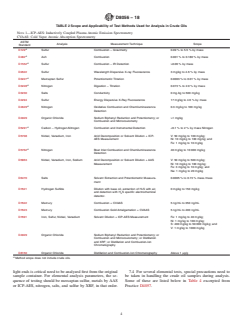
light ends is critical need to be analyzed first from the original 7.4 For several elemental tests, special precautions need to
sample container. For elemental analysis parameters, the se- be taken in handling the crude oil samples during analysis.
quence of testing should be mercaptan sulfur, metals by AAS Some of these are listed below in Table 4 excerpted from
or ICP-AES, nitrogen, salts, and sulfur by XRF, in that order. Practice D4057.
D8056 − 18
A
TABLE 3 International Equivalent Test Methods for Crude Oil Analysis
Analysis ASTM Institute of Petroleum/ International German Institute for Japanese Industrial
Energy Institute (IP) Standards Standardization (DIN) Standards (JIS)
Organization (ISO)
Sulfur by Bomb Method D129 61 51-577
Ash D482 4 6245 K 2272
Sulfur by WD-XRF D2622 14596 51-400T6 K 2541
Mercaptans D3227 342 3012 K 2276
Sulfur by ED-XRF D4294 336 8754
Nitrogen-Chemiluminescence D4629 379
Metals by AAS D5863 441
Hydrogen Sulfide D7621 570
A
From reference (8).
TABLE 4 Sample Handling for Elemental Analysis Tests for Crude Oils
Sample
Analysis Precautions to be Taken
Volume, mL
Mercaptan Sulfur (UOP 163); D3227 200 Minimize sample exposure to air.
Metals (D5863 B) 25 Prior to weighing stir the sample and then shake in its container. Employ adequate mixing and
sampling procedures for crude and heavy oils. Use paint mixer for mixing of crude oils. If the
sample does not readily flow at room temperature, heat the sample to a sufficiently high and
safe temperature to ensure adequate fluidity.
Nitrogen (D4629; D5762) 3 Test samples as soon as possible after taking from bulk supplies to prevent loss of nitrogen or
contamination due to exposure or contact with the sample container. If the test sample is not
used immediately, then thoroughly mix it in its container prior to taking a test specimen. Some
test samples require heating in order to thoroughly homogenize.
Salts (D3230) 10 The presence of water and sediment will influence the conductivity of the sample. The utmost
care shall be taken in obtaining homogenized representative samples. Samples of very viscous
materials may be warmed until they are reasonably fluid before they are sampled. However, no
sample shall be heated more than is necessary to lower the viscosity to a manageable level.
Salts (D6470) 50 Homogenize the sample within 15 min of drawing the test sample. Mix the sample at room tem-
perature (15 °C to 20 °C), or less in the laboratory sample container. Heat waxy samples, solid
at room temperature, to 3 °C above their pour point in order to facilitate sample withdrawal. See
Annex A1 of D6470 for mixer requirements and containers to be used.
Sulfur (D2622; D4294) 25 Be sure the sample is homogenous, and that there is no sediment or water present in the
sample aliquot taken.
Organic Chloride (D4929) 500 Use organic chloride free environment.
8. Ash 9. Mercaptans
8.1 Significance—Ash present in the crude oil results from
9.1 Significance—Hydrogen sulfide and mercaptans are
the presence of non-combustible extraneous solids such as
highly toxic and corrosive compounds that occur naturally in
sediment, pipeline scales, rust and salt contamination from sea
some crude oils. Thiols or mercaptans are considerably more
water. If the crude oil is used as a fuel, it is important to know
prevalent in crude oil than H S.They are the least stable sulfur
its ash content because this could be related directly to
compounds and many decompose on heating to form H S (3).
particulate emission.
9.2 Analysis—These compounds can be determined by non-
8.2 Analysis—Ash in petroleum products is determined
aqueous potentiometric titration with silver nitrate (Test
using the Test Method D482. In this test, the sample contained
Method D3227 and UOP 163). Although both methods are
in a suitable vessel is ignited and allowed to burn until only the
similar, the ASTM method did not include crude oils in its
ash and carbon remain.The carbonaceous residue is reduced to
scope. IP method 570 and its equivalent Test Method D7621
an ash by heating in a muffle furnace at 775 °C, cooled, and
can determine amount of hydrogen sulfide in crude oils.
weighed.
9.2.1 Test Method D3227 is applicable to various fuels
containingfrom0.0003 %to0.01 %bymassmercaptansulfur.
8.3 Test Precision—Although crude oils were not specifi-
cally analyzed by this test method to estimate precision, in Organic sulfur compounds such as sulfides, disulfides, and
thiophene do not interfere. Elemental sulfur in amounts less
general, for petroleum products, the following precision is
expected. than 0.0005 % by mass does not interfere. Hydrogen sulfide
will interfere if not removed as described in the test method. In
Ash, percent by mass Repeatability Reproducibility
0.001 to 0.079 0.003 0.005
this test method, the hydrogen sulfide-free sample is dissolved
0.080 to 0.180 0.007 0.024
in an alcoholic sodium acetate titration solvent and titrated
D8056 − 18
potentiometrically with silver nitrate solution, using as an should be used for guidance for sampling, storage, and
indicator the potential between a glass reference electrode and handling of hydrocarbons for mercury analysis.
a silver/silver-sulfide indicating electrode. Under these
10.2 Analysis—Giventheultra-tracelevelsofmercurypres-
conditions, the mercaptan sulfur is precipitated as silver
ent in crude oil, there are only limited analytical techniques
mercaptideandtheendpointofthetitrationisshownbyalarge
available for such analysis. Basically the methods available are
change in cell potential.
a variation on the basic cold vapor atomic absorption spec-
9.2.2 Test Method D7621 and its equivalent test method IP
trometry technique.
570 are automatic methods suitable for laboratory testing or
10.2.1 Test Method D7622—The crude oil sample placed in
field use, and provides results in about 15 min. They can
a sample boat is inserted in the first chamber of an atomizer
quantify hydrogen sulfide at a range from 0 mg⁄kg to
where the sample is heated at 300 °C to 500 °C. The mercury
150 mg⁄kg hydrogen sulfide in the liquid phase in a wide
compounds are evaporated and partially dissociated forming
varietyofcrudeoilswithanAPIrangingfrom11.8to57.3,and
elemental mercury vapor. Mercury and all decomposition
sulfur levels from 0.1 % to 6.7 %. In this test method, a sample
products are carried to a second atomizer chamber heated to
is introduced into a heated test vessel containing a diluent base
about 700 °C to 750 °C. Mercury compounds are totally
oil. Air is bubbled through the oil to extract the H S gas. The
dissociated, and the organic matrix of the sample is burnt out.
airwiththeextractedH Sispassedviaavaporphaseprocessor
Continuouslyflowingaircarriesmercuryandothercombustion
to an H S specific electrochemical detector enabling the H S
2 2
products through absorbance analytical cell heated up to
content of the air to be quantitated.
750 °C positioned in the light path of double-wave cold vapor
9.2.2.1 The alternative procedure for crude oil is given in
Zeeman atomic absorption spectrometer. The mercury reso-
Appendix X1 of Test Method D7621. The vapor phase proces-
nance line at 253.65 nm is split to several components, one of
sor (ProcedureA) is required for this analysis as vapor present
those falling within the mercury absorbance line profile and
in the crude oil can damage the detector and chemical
anotheronelyingoutside.Differencebetweentheintensitiesof
interferences can be present.
these two lines is proportional to the number of mercury atoms
9.3 Test Precision—Following precision was obtained from in the analytical cell.
interlaboratory studies. 10.2.2 Test Method D7623 and UOP 938—A crude oil
9.3.1 Precision of Test Method D3227 has been found to be sample is heated to dryness in an oxygen atmosphere in the
as follows. This study did not include crude oils in the matrix. instrument, and then thermally (at about 700 °C) and then
chemically decomposed. The decomposition products are car-
Repeatability 0.00007 + 0.027 X
Reproducibility 0.0031 + 0.042 X
riedbyflowingtreatedairtothecatalyticsectionofthefurnace
(at about 850 °C), where oxidation is completed. The decom-
Where X is the average mercaptan sulfur, percent by mass.
position products are carried to a gold amalgamator that
9.3.2 Only repeatability estimate of Test Method D7621 is
selectively traps mercury. After the system is flushed with
available.Inonestudyasinglelaboratoryanalyzed21samples
oxygentoremoveanyremainingdecompositionproductsother
of crude oil ranging in their H S levels from 0 mg⁄kg to
than mercury, the amalgamator is rapidly heated to about
150 mg⁄kg and found a repeatability of 12 mg⁄kg. A similar
600 °C, releasing mercury vapor. Flowing oxygen carries the
analysis of 12 lowest H S level samples ranging in the
mercury vapor through absorbance cells positioned in the light
concentration from 0 mg⁄kg to 50 mg⁄kg found a repeatability
path of single wavelength cold vapor atomic absorption spec-
of 5 mg⁄kg.
trophotometer. Absorbance peak height or peak area, as a
function of mercury concentration, is measured at 253.65 nm.
10. Mercury
10.2.2.1 An Appendix to UOP 938 Test Method also con-
10.1 Significance—Mercury has been designated by Envi-
tains a procedure that can be used to differentiate between
ronmental Protection Agency (EPA) and many state agencies
elemental mercury, organic non-ionic mercury, and ionic (in-
as a hazardous material that can cause central nervous system,
organic and organic) mercury species.
kidney, and liver damage. Mercury or its vapors may be
10.3 Test Precision—Based on an interlaboratory study
hazardous to health and corrosive to material. Mercury can
(RR:D02-1692) following precision was obtained. Reproduc-
occur in crude oil as volatile, dissolved, and particulate
ibility limit is not yet available.
(suspended) species—all of which differ considerably in their
chemical structure and chemical behavior. Elemental mercury Test Method Scope Repeatability Reproducibility
0.6
D7622 5ng⁄mLto 0.7147 X NA
has been found in condensed in cooled regions in refinery
350 ng/mL
distillation towers and in cryogenic heat exchangers that
D7623 5 ng/mL to 0.4396 NA
0.5864
liquefy petroleum gases. Mercury can be present in various 400 ng/mL X
distillation fractions across a broad boiling range (1, 3).
Where X is the average mercury concentration in ng/mL.
10.1.1 Mercury is present at low ppm to ppb levels in crude
11. Nitrogen
oils. Giles et al have reported mercury in the range from
0.02 ng⁄g to 10 ng⁄g (1, 3). Others also have reported mercury
11.1 Significance—Nitrogen is an important element for
in the less than a ppb level in crude oil (9, 10). Mercury
determining in crude oil. Numerous nitrogenous compounds
speciation is predominantly Hg(0) present as a mixture of
dissolved Hg(0) atoms, adsorbed Hg(0) on particulates and
Supporting data have been filed at ASTM International Headquarters and may
suspended droplets of metallic mercury (11). Practice D7482 be obtained by contacting ASTM Customer Service at service@astm.org.
D8056 − 18
are present in crude oils. Many problems are caused by their instrument type available. Basically, in each type of
presence in refining and product quality.As a group even their instrument, a sample is combusted at an elevated temperature
trace quantities present in feedstocks can contaminate refinery in an atmosphere temporarily enriched in purified oxygen to
catalysts. Nitrogen compounds can also contribute to refined convert the constituents to carbon dioxide, hydrogen halides,
product instability, are responsible for formation and precipi- watervapor,elementalnitrogenandnitrogenoxides,andsulfur
tation of gum, and contribute to environmental pollution when oxides. Different absorbers are used in each instrument to
fuels are burned by emission of nitrogen oxides (NO ) (3). remove undesirable products and separate the desired constitu-
x
ents. Eventually, after the gaseous separation, the nitrogen
11.2 Analysis—There are four principle test methods for the
species is measured using thermal conductivity cell or an IR
determination of nitrogen in crude oils: Test Methods D3228,
detector.
D4629, D5291, and D5762. None of them are specifically
11.2.4 Boat-inlet Combustion and Chemiluminescence De-
meant for analysis of crude oils. However, they are commonly
tection Method—Test Method D5762 can be used for deter-
used when necessary for crude oils.
mining nitrogen in liquid hydrocarbons, including petroleum
11.2.1 Kjeldahl Method—Test Method D3228 is not often
process streams and lubricating oils in the nitrogen concentra-
used in analysis of crude oils, and uses sample digestion in a
tion range from 40 µg⁄g to 10 000 µg⁄g. In this test method, a
mixture of concentrated sulfuric acid, potassium sulfate, mer-
hydrocarbon sample is placed in a sample boat at room
curic oxide, and copper sulfate to convert nitrogen species into
temperature. The sample boat is advanced into a high-
inorganic nitrate compounds.After digestion, sodium sulfide is
temperature combustion tube where the nitrogen is oxidized to
added to precipitate the mercury as mercuric sulfide, and the
nitric oxide (NO) in an oxygen atmosphere. The NO contacts
mixture is made alkaline with NaOH. Nitrogen, now in the
ozone and is converted to excited nitrogen dioxide (NO ). The
form of ammonia, is distilled into a boric acid solution. The 2
light emitted as the excited NO decays is detected by a
ammonia is titrated with standard sulfuric acid using methyl 2
photomultiplier tube, and the resulting signal is a measure of
purple as an indicator. Kjeldahl method may not be applicable
the nitrogen contained in the sample.
to certain materials containing N-O or N-N linkage.
11.2.2 Syringe/inlet Oxidative Combustion and Chemilumi-
11.3 Test Precision—Based on various interlaboratory stud-
nescence Detection Method—Test Method D4629 can analyze
ies following precisions were found for the above test methods
totalnitrogenfoundinliquidhydrocarbonsboilingintherange
for nitrogen (Table 5).
of approximately 50 °C to 400 °C, with viscosities between
approximately 0.2 cSt and 10 cSt at room temperature. This
12. Organic Chloride
method is applicable to naphthas, distillates, and oils contain-
12.1 Significance—Organic chlorides do not occur naturally
ing 0.3 mg⁄kg to 100 mg/kg of total nitrogen. In this test
in crude oil. If present they result from contamination in some
method, a sample of liquid hydrocarbon is introduced either by
manner, such as disposal of chlorinated solvent in many
syringe or boat inlet system, into a stream of inert gas such as
dewaxingpipelinesorotherequipmentoperations.Uncontami-
helium or argon. The sample is vaporized and carried to a high
nated crude oil will not contain any detectable organic
temperature zone where oxygen is introduced and the organi-
chloride, and most refineries can handle very small amounts
callyboundnitrogenisconvertedtonitricoxide(NO).TheNO
withoutdeleteriouseffects.Mosttradecontractsspecifythatno
contacts ozone, and is converted to excited nitrogen dioxide
organic chloride be present in the crude oil. Several pipeline
(NO ).The light emitted as the excited NO decays is detected
2 2
organizations have set specification limits at <1 mg/kg organic
by a photomultiplier tube and the resulting signal is a measure
chlorides in the whole crude oil, and <5 mg/kg in the light
of the nitrogen contained in the sample.
naphtha, on the basis of the naphtha fraction being 20 % of the
11.2.3 Instrumental Determination of Carbon-Hydrogen-
original sample (3).
Nitrogen—Test Methods D5291 consists of four separate
procedures for simultaneous determination of carbon, 12.1.1 Organic chloride species are potentially damaging to
hydrogen, and nitrogen in petroleum products including crude refinery process. Hydrochloric acid can be produced in hy-
oil and lubricants. Each procedure is dedicated to a separate drotreating or reforming reactors, and the acid accumulates in
TABLE 5 Precision of Test Methods for Determination of Nitrogen in Crude Oils
NOTE 1—Where X is the average of the two test results.
NA: Not available
A
Test Method Matrix Repeatability Reproducibility ASTM Research Report
D3228 Lubricating Oils 0.01 % by mass 0.02 % by mass NA
0.5 0.5
Fuel Oils 0.066 x m 0.190 x m NA
0.5149 0.5149
D4629 Liquid Hydrocarbons 0.1825 X 0.8094 X RR:D02-1199 and RR:D02-1527
D5291 Petroleum Products 0.1670 0.4456 RR:D02-1289 and RR:D02-1679
0.006897(X + 3) 0.02967 (X + 3)
D5762 Liquid Hydrocarbons 0.087 X 0.266 X RR:D02-1370 and RR:D02-1507
A
Supporting data have been filed at ASTM International Headquarters and may be obtained by contacting ASTM Customer Service at service@astm.org.
D8056 − 18
the condensing regions of the refinery. Unexpected concentra- detrimental effects on catalysts used in these units. The salt
tions of organic chlorides can be effectively neutralized and content of crude oils can be highly variable, and results
damage can result (3). principally from the production practices used in the field and
to a lesser extent from its handling by tankers abroad, which
12.2 Analysis—In Test Methods D4929, crude oil distilla-
transport crude oil to the terminals.The bulk of the salt present
tion is performed to obtain the naphtha cut at 204 °C. The
will be dissolved in co-existing free water and can be removed
naphthacutiswashedwithcaustic,repeatedlywhennecessary,
in desalters. But small amounts of salt may be dissolved in the
until all hydrogen sulfide is removed. The naphtha cut, free of
crude oil itself (3).
hydrogen sulfide, is then washed with water, repeatedly, when
13.1.1 Salt in crude oil may be deleterious in several ways.
necessary, to remove inorganic halides (chlorides). This is
Even in small concentrations, salts will accumulate in stills,
followed by four alternative test methods for the determination
heaters, and exchangers, leading to fouling that leads to
of organic chloride in the washed naphtha fraction as follows.
extensive cleanup. During flash vaporization of crude oils,
12.2.1 ProcedureA—Thewashednaphthafractionistreated
certain metallic salts can be hydrolyzed to hydrochloric acid
with sodium biphenyl reagent in toluene. The free radical
according to the following equations:
nature of this reagent promotes very rapid conversion of the
organic halogen to inorganic halide. The excess reagent is 2NaCl1H O→2HCl1Na O (1)
2 2
decomposed, the mixture acidified, and the phases separated.
MgCl 1H O→2HCl1MgO (2)
2 2
The aqueous phase is evaporated to a small volume, acetone is
13.1.2 The hydrochloric acid evolved is extremely
added and the solution is titrated potentiometrically.
corrosive, necessitating the injection of a basic compound such
12.2.2 Procedure B—The washed naphtha fraction is com-
as ammonia into the overhead lines to minimize damage (3).
busted in a flowing tube at about 800 °C in a flow of oxygen
plus an inert gas. The chlorine is converted to chloride and
13.2 Analysis—Therearetwotestmethodsavailableforthis
oxychlorides which then flow into a titration cell where they
analysis:D3230SaltsinCrudeOil(ElectrometricMethod)and
are titrated with silver nitrate solution coulometrically.
D6470SaltsinCrudeOil(PotentiometricMethod).Samplesof
12.2.3 Procedure C—Thewashednaphthafractionisplaced
crudeoilcontainwaterandsedimentandareinhomogenousby
in the X-ray beam, and the peak intensity of the chlorine K
nature. Homogenization of crude oil is an important step in
alpha line is measured by monochromatic wavelength disper-
either of these two test procedures. Samples of very viscous
sive X-ray fluorescence, monochromatic energy dispersive
crude oils may have to be warmed until they are reasonably
X-ray fluorescence, or energy dispersive X-ray fluorescence
fluid before they are sampled. However, no samples shall be
spectrometry. The resulting net count rate is then compared to
heated more than necessary to lower the viscosity to a
a previously prepared calibration curve or equation to obtain
manageable level.
the concentration.
13.2.1 Test Method D3230—This test method measures
12.2.4 Test Method D8150—The washed naphtha fraction is
conductivity in the crude oil due to the presence of common
placed into a sample boat and combusted under controlled
chlorides, such as sodium, calcium, and magnesium. Other
conditions in oxygen-rich pyrohydrolytic environment. The
conductivity materials may also be present in the crude oil. A
gaseous by-products are cleaned in adsorption columns and a
homogenizedtestspecimenofcrudeoilisdissolvedinamixed
portion is injected into an ion chromatograph and the chloride
alcohol solvent and placed in a test cell consisting of a beaker
content is measured with conductivity detection.
and a set of electrodes. A voltage is impressed on the
12.3 Test Precision—Following precisions of the four pro- electrodes, and the resulting current flow is measured. The
cedures in Test Methods D4929 and D8150 were obtained
chloride (salt) content is obtained by reference to a calibration
based on interlaboratory studies (Table 6). curve of current versus chloride concentration of known
mixtures.
13. Salts
13.2.2 Test Method D6470—After homogenizing crude oil
13.1 Significance—Aknowledge of the salt content of crude with a mixer, a weighed aliquot is dissolved in xylene at 65 °C
oil is important in deciding whether or not the crude oil needs and extracted with specified volumes of alcohol, acetone, and
desalting. The efficiency of the desalter process can also be water in an electrically heated extraction apparatus. A portion
evaluated. Excessive chloride left in the crude oil frequently of the aqueous extract is analyzed for total halides by poten-
results in high corrosion rates in refining units, and also has tiometric titration.
TABLE 6 Precision for Organic Chloride Determination in Crude Oil Procedures
NOTE 1—Where X is µg/g chloride.
A
Test Method Repeatability Reproducibility ASTM Research Report
0.644 0.644
D4929A 0.32(X+0.33) 0.7(X+0.33) RR:D02-1293
0.467 0.467
D4929B 1.01(X–0.17) 1.32 (X – 0.17) RR:D02-1293
0.44 0.44
D4929 C – MWD-XRF 0.643 X 1.235 X RR:D02-1875
0.44 0.44
D4929 C – MED-XRF 0.591 X 1.500 X RR:D02-1875
0.48 0.48
D4929 C – ED-XRF 0.9341 (X + 0.4) 2.000 (X + 0.4) RR:D02-1875
0.6746 0.6746
D8150 0.2918 (X) 0.7599 (X) RR:D02-1868
A
Supporting data have been filed at ASTM International Headquarters and may be obtained by contacting ASTM Customer Service at service@astm.org.
D8056 − 18
13.2.3 Results byTest Method D3230 are expressed in units ofcrudeoilscanvaryfromlessthan0.1 %bymasstoover5 %
of mg/kg. Alternatively, they can also be reported in units of by mass. Chapter 23 in Ref (2), Chapter 7 in Ref (6), and
g/m or as lb/1000 bbl (a common industry reporting practice), Chapter 5 in Ref (7) have covered various aspects of occur-
if so required. Results by Test Method D6470 are reported as rence and analysis of sulfur in petroleum products, fuels, and
mass %. The result units can be converted by formula given
lubricants.
below:
14.1.1 Sulfur compounds are some of the most egregious
non-hydrocarbon materials present in crude oils. They contrib-
Salt, mg/kg 5 ~1000 X! ⁄d or (3)
ute to corrosion of refinery equipment, poisoning of catalysts,
Salt, mg/kg 5 2.853 Y⁄d (4)
cause corrosiveness in refined products, and contribute to
where:
environmental pollution through emission of sulfur oxides
X = measured salt concentration in g/m , from combustion of fuel products (1, 3).
Y = measured salt concentration in PTB, and
14.2 Analysis—As to be expected, a large number of test
D = specimen density at 15 °C in kg/m .
methods for sulfur determination in petroleum products and
13.3 Test Method Precision—Based on interlaboratory stud-
lubricants have been issued by ASTM (7, 8). Many of the
ies following precisions have been obtained for the above two
earlier test methods such as D129 or D1552 have been
test methods (Table 7).
superseded by modern instrumental test methods such as
13.3.1 Test Method Bias—Since salt content of crude oil is
D2622,or D4294 based on X-ray fluorescence technology.
defined only in terms of these tests, and since there are no
Protocol for using XRF analyzers has been described in Guide
standard reference materials available for such analysis, no
D7343.
statement regarding bias of these test methods can be made.
14.2.1 Test Method D129—This is a much older test method
13.3.2 In one study (RR:D02-1470) the samples were near
involving combustion of a sample in an oxidation bomb with
desalted crudes, spiked with known quantities of salt (as sea
subsequent gravimetric determination of sulfur as barium
water and formation water), bias might be defined as percent
sulfate.ThisisnotasaccurateamethodasTestMethodD1552,
recovery of added halides. Over the range from 5 g⁄m to 500
partially because of interference from the sediment inherently
g/m (1.5 PTB to 150 PTB) salt added, the recovery proved to
present in crude oil.
be approximately constant and averaged 93 % for D3230 test
14.2.2 Test Method D1552—This test method uses combus-
method. In a similar study (RR:D02-1458), over the range
tion of the sample in oxygen to convert the sulfur to sulfur
0.0005 % to 0.0400 % by mass salt added, the recovery proved
dioxide, which is collected and subsequently detected by
to be constant and averaged 97 % for D6470 test method. Over
non-dispersive infrared (IR) spectroscopy.
the range 0.0400 to 0.1500, the recovery proved to be a
function of concentration and gradually decreased from 97 % 14.2.3 Test Method D2622—Thistestmethodiswidelyused
in the industry for analysis of a wide variety of petroleum and
at 0.04 % by mass to 88 % at the 0.15 % by mass level.
lubricantproductsincludingcrudeoils.Afundamentalassump-
14. Sulfur
tionofthistestmethodisthatthestandardandsamplematrices
are well matched, or that the matrix differences are accounted
14.1 Significance—Perhaps the largest amount of data col-
for. Matrix mismatch can be caused by C/H ratio differences
lected in the analysis of crude oils is for sulfur. This is
between samples and standards or by the presence of other
appropriate given the importance of sulfur chemistry and its
interfering heteroatoms or species. Howeve
...
This document is not an ASTM standard and is intended only to provide the user of an ASTM standard an indication of what changes have been made to the previous version. Because
it may not be technically possible to adequately depict all changes accurately, ASTM recommends that users consult prior editions as appropriate. In all cases only the current version
of the standard as published by ASTM is to be considered the official document.
Designation: D8056 − 16 D8056 − 18
Standard Guide for
Elemental Analysis of Crude Oil
This standard is issued under the fixed designation D8056; the number immediately following the designation indicates the year of
original adoption or, in the case of revision, the year of last revision. A number in parentheses indicates the year of last reapproval. A
superscript epsilon (´) indicates an editorial change since the last revision or reapproval.
1. Scope Scope*
1.1 This guide summarizes the current information about the test methods for elemental and associated analyses used in the
analysis of crude oils. This information can be helpful in trade between the buyers and sellers of crude oil. Elemental analyses tests
form an important part of quantifying the crude oil quality.
1.2 The values stated in SI units are to be regarded as the standard. No other units of measurement are included in this standard.
1.3 This standard does not purport to address all of the safety concerns, if any, associated with its use. It is the responsibility
of the user of this standard to establish appropriate safety safety, health, and healthenvironmental practices and determine the
applicability of regulatory limitations prior to use.
1.4 This international standard was developed in accordance with internationally recognized principles on standardization
established in the Decision on Principles for the Development of International Standards, Guides and Recommendations issued
by the World Trade Organization Technical Barriers to Trade (TBT) Committee.
2. Referenced Documents
2.1 ASTM Standards:
D129 Test Method for Sulfur in Petroleum Products (General High Pressure Decomposition Device Method)
D482 Test Method for Ash from Petroleum Products
1 3
D1548 Test Method for Vanadium in Heavy Fuel Oil (Withdrawn 1997)
D1552 Test Method for Sulfur in Petroleum Products by High Temperature Combustion and Infrared (IR) Detection or Thermal
Conductivity Detection (TCD)
D2622 Test Method for Sulfur in Petroleum Products by Wavelength Dispersive X-ray Fluorescence Spectrometry
D3227 Test Method for (Thiol Mercaptan) Sulfur in Gasoline, Kerosine, Aviation Turbine, and Distillate Fuels (Potentiometric
Method)
D3228 Test Method for Total Nitrogen in Lubricating Oils and Fuel Oils by Modified Kjeldahl Method
D3230 Test Method for Salts in Crude Oil (Electrometric Method)
D4057 Practice for Manual Sampling of Petroleum and Petroleum Products
D4177 Practice for Automatic Sampling of Petroleum and Petroleum Products
D4294 Test Method for Sulfur in Petroleum and Petroleum Products by Energy Dispersive X-ray Fluorescence Spectrometry
D4629 Test Method for Trace Nitrogen in Liquid Hydrocarbons by Syringe/Inlet Oxidative Combustion and Chemiluminescence
Detection
D4929 Test Method for Determination of Organic Chloride Content in Crude Oil
D5185 Test Method for Multielement Determination of Used and Unused Lubricating Oils and Base Oils by Inductively
Coupled Plasma Atomic Emission Spectrometry (ICP-AES)
D5291 Test Methods for Instrumental Determination of Carbon, Hydrogen, and Nitrogen in Petroleum Products and Lubricants
D5708 Test Methods for Determination of Nickel, Vanadium, and Iron in Crude Oils and Residual Fuels by Inductively Coupled
Plasma (ICP) Atomic Emission Spectrometry
D5762 Test Method for Nitrogen in Liquid Hydrocarbons, Petroleum and Petroleum Products by Boat-Inlet Chemiluminescence
D5854 Practice for Mixing and Handling of Liquid Samples of Petroleum and Petroleum Products
This guide is under the jurisdiction of ASTM Committee D02 on Petroleum Products, Liquid Fuels, and Lubricants and is the direct responsibility of Subcommittee
D02.03 on Elemental Analysis.
Current edition approved July 1, 2016June 1, 2018. Published July 2016June 2018. Originally approved in 2016. Last previous edition approved in 2016 as D8056 – 16.
DOI: 10.1520/D8056-16.10.1520/D8056-18.
For referenced ASTM standards, visit the ASTM website, www.astm.org, or contact ASTM Customer Service at service@astm.org. For Annual Book of ASTM Standards
volume information, refer to the standard’s Document Summary page on the ASTM website.
The last approved version of this historical standard is referenced on www.astm.org.
*A Summary of Changes section appears at the end of this standard
Copyright © ASTM International, 100 Barr Harbor Drive, PO Box C700, West Conshohocken, PA 19428-2959. United States
D8056 − 18
D5863 Test Methods for Determination of Nickel, Vanadium, Iron, and Sodium in Crude Oils and Residual Fuels by Flame
Atomic Absorption Spectrometry
D6259 Practice for Determination of a Pooled Limit of Quantitation for a Test Method
D6299 Practice for Applying Statistical Quality Assurance and Control Charting Techniques to Evaluate Analytical Measure-
ment System Performance
D6470 Test Method for Salt in Crude Oils (Potentiometric Method)
D6792 Practice for Quality Management Systems in Petroleum Products, Liquid Fuels, and Lubricants Testing Laboratories
D7260 Practice for Optimization, Calibration, and Validation of Inductively Coupled Plasma-Atomic Emission Spectrometry
(ICP-AES) for Elemental Analysis of Petroleum Products and Lubricants
D7343 Practice for Optimization, Sample Handling, Calibration, and Validation of X-ray Fluorescence Spectrometry Methods
for Elemental Analysis of Petroleum Products and Lubricants
D7372 Guide for Analysis and Interpretation of Proficiency Test Program Results
D7455 Practice for Sample Preparation of Petroleum and Lubricant Products for Elemental Analysis
D7482 Practice for Sampling, Storage, and Handling of Hydrocarbons for Mercury Analysis
D7578 Guide for Calibration Requirements for Elemental Analysis of Petroleum Products and Lubricants
D7621 Test Method for Determination of Hydrogen Sulfide in Fuel Oils by Rapid Liquid Phase Extraction
D7622 Test Method for Total Mercury in Crude Oil Using Combustion and Direct Cold Vapor Atomic Absorption Method with
Zeeman Background Correction
D7623 Test Method for Total Mercury in Crude Oil Using Combustion-Gold Amalgamation and Cold Vapor Atomic Absorption
Method
D7691 Test Method for Multielement Analysis of Crude Oils Using Inductively Coupled Plasma Atomic Emission Spectrometry
(ICP-AES)
D7740 Practice for Optimization, Calibration, and Validation of Atomic Absorption Spectrometry for Metal Analysis of
Petroleum Products and Lubricants
D8150 Test Method for Determination of Organic Chloride Content in Crude Oil by Distillation Followed by Detection Using
Combustion Ion Chromatography
2.2 Other Standards:
IP 570 Hydrogen Sulfide in Fuel Oils—Rapid Liquid Phase Extraction Methodsulfide in fuel oils—Rapid liquid phase extraction
method
ISO 8754 Petroleum Products, Determination of Sulfur Content, Energy Dispersive X-ray Fluorescence Spectrometryproducts—
Determination of sulfur content—Energy dispersive X-ray fluorescence spectrometry
ISO 14596 Petroleum Products, Determination of Sulfur Content, Wavelength Dispersive X-ray Fluorescence
Spectrometryproducts—Determination of sulfur content—Wavelength dispersive X-ray fluorescence spectrometry
UOP 163 Hydrogen Sulfidesulfide and Mercaptan Sulfur in Liquid Hydrocarbons by Potentiometric Titrationmercaptan sulfur
in liquid hydrocarbons by potentiometric titration
UOP 938 Total Mercurymercury and Mercury Species in Liquid Hydrocarbonsmercury species in liquid hydrocarbons
3. Significance and Use
3.1 This guide summarizes the test methods used in the elemental analysis of crude oils. Additional information on the
significance and use of the test methods quoted in this guide can be found under discussion of individual test methods in Sections
8 through 15.
3.2 Crude oils are highly complex hydrocarbons also containing some organometallic compounds, inorganic sediment, and
water. Nearly 600 individual hydrocarbons, over 200 separate sulfur compounds, and about 40 trace elements have been found in
crude oils (1). Generally, sulfur and nitrogen are the two most abundant elements found in crude oils except for carbon and
hydrogen. Most other inorganic elements are present at trace levels (mg/kg). Sulfur, nitrogen, vanadium, nickel, and iron are the
most frequently determined elements in the crude oils. Ratios such as vanadium to vanadium + nickel, and iron to vanadium are
suggested as being useful for oil type characterizations. Since organometallic compounds are concentrated in the heavy ends of
petroleum, transition element concentrations and ratios can serve as excellent oil-oil correlation parameters. Generally, vanadium
and nickel content increases with asphaltic content of crude oil (API gravity is an indicator). Lighter crude oils contain lesser
amounts of metals (2, 3).
3.3 Metal complexes called porphyrins are a major component of metallic compounds in crude oils. The principal porphyrin
+2 +2
complexes are Ni and VO compounds. There are also other non-porphyrin complexes and other metallic compounds present
in crude oils (4, 5).
Available from Energy Institute, 61 New Cavendish St., London, W1G 7AR, U.K., http://www.energyinst.org.
Available from American National Standards Institute (ANSI), 25 W. 43rd St., 4th Floor, New York, NY 10036, http://www.ansi.org.
The bold numbers in parentheses refer to the list of references at the end of this standard.
D8056 − 18
3.4 Some typical literature citations in this area are included in the reference section at the end of this guide.
4. Sampling
4.1 Collection of a meaningful and representative sample is often the most critical step in an analytical procedure. In trace
element analysis, in particular, extreme care must be taken to avoid contamination of the sample during the sampling step and all
subsequent analysis steps. By its very nature, crude oil is typically non-homogenous, containing some percentages of sediment and
water. It also typically contains volatile light ends, and finally, crude oil will often exhibit high pour point and high viscosity
properties, due to its asphaltenes and paraffin wax content.
4.1.1 The water and sediment component of the crude oil will tend to naturally separate and stratify in tanks, marine vessel
compartments, and in flowing pipelines.
4.1.2 There are various types of containers that can be used for storage of liquid hydrocarbon products. Not all of them are
suitable for crude oil storage. According to Practice D5854 for tests of interest in elemental analysis area (salts, sulfur, and trace
metals) in crude oil, the containers employed may be made of hard borosilicate glass, stainless steel, or epoxy-lined steel and are
considered satisfactory for immediate use, storage up to six months or reuse. Less satisfactory are tin-plated soldered steel,
polytetrafluoroethylene propylene (PTFE), and high-density linear polyethylene containers. See Table 1.
4.2 Three principal protocols are available for sampling of a representative aliquot from a bulk sample: Practice D4057 for
manual sampling, Practice D4177 for automatic sampling, and Practice D5854 for mixing and handling of liquid samples.
4.3 Crude oil to be sampled may be in static storage in a tank, a marine vessel, or a pipeline. Stabilized crude oils typically
contain multiple phases, particulates, and volatiles. Decisions whether to separate the phases and analyze them separately, or
homogenize the whole sample need to be made prior to analysis.
4.4 If the sample does not readily flow at room temperature, heat it to a sufficiently high and safe temperature to ensure adequate
fluidity. Great care needs to be taken in heating the viscous sample prior to analysis. Changes in chemical composition, loss of
volatile elements, and so forth are causes for concern.
5. Sample Preparation
5.1 Often different test methods for specific determination of elements require different sample preparation steps. Guide D7455
reviews alternative techniques for sample preparation for elemental analysis. The means of sample preparation vary from no
sample preparation to simple sample dilution to extensive detailed procedures such as sample decomposition depending on the
measurement technique to be used for the final determination.
5.2 Among the test methods used for the elemental analysis of crude oil, test methods such as XRF – Test Methods D2622 or
D4294 for sulfur need no special preparation. However, they may need dilution with a solvent if the sulfur levels are above the
scope of the test methods. Other non-XRF test methods that do not need special sample treatment include Test Method D3230 for
salt by titration, and Test Methods D5291 for carbon-hydrogen-nitrogen by combustion.
5.3 Some methods require sample dilution such as in atomic absorption spectrometry (AAS) Test Method D5863 B for nickel,
vanadium, iron, and sodium; inductively coupled plasma-atomic emission spectrometry (ICP-AES) Test Method D5708 for nickel,
vanadium, and iron; and ICP-AES Test Method D7691 for multi-element analysis of crude oils.
5.4 Decomposition agents are employed to bring the desired parameter in aqueous solution for final measurement. Examples
of these are Kjeldahl method for nitrogen: Test Method D3228, acid decomposition of crude oil for vanadium: Test Method D1548,
and AAS method for nickel, vanadium, iron, and sodium: Test Method D5863 A.
5.5 For volatile elements such as nitrogen or sulfur, combustion trains using adsorbants have been used in Test Method D1552
for sulfur, and Test Methods D4629 and D5762 for nitrogen.
5.6 Organic chloride in crude oil is determined by Test Methods D4929 after elaborate pre-treatment of samples to separate
organic chloride fraction from crude oil.
5.7 Determination of mercury in crude oil poses special problems both in sample collection and in measurement. These are
discussed elsewhere in detail in Practice D7482, Test Method D7622, and Test Method D7623.
A
TABLE 1 Recommended Sample Containers for Crude Oil Storage
Container Material For Immediate Use For Storage for 6 months For Reuse
Hard Borosilicate Glass Preferred Preferred Suitable
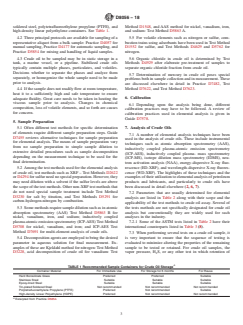
Stainless Steel Suitable Suitable Suitable
Epoxy-lined Steel Suitable Suitable Suitable
Tin-plated Soldered Steel Not recommended Not recommended Not recommended
Polytetrafluoroethylene Propylene (PTFE) Preferred Not recommended Suitable
High-density Linear Polyethylene (HDPE) Preferred Not recommended Not recommended
A
Excerpted from Practice D5854.
D8056 − 18
6. Calibration
6.1 Depending upon the analysis being done, different calibration practices may have to be followed. A review of calibration
practices used in elemental analysis is given in Guide D7578.
7. Analysis of Crude Oils
7.1 A number of elemental analysis techniques have been used in the analysis of crude oils. These include instrumental
techniques such as atomic absorption spectrometry (AAS), inductively coupled plasma-atomic emission spectrometry (ICP-AES),
inductively coupled plasma- mass spectrometry (ICP-MS), isotope dilution mass spectrometry (IDMS), neutron activation analysis
(NAA), energy-dispersive X-ray fluorescence (ED-XRF), and wavelength-dispersive X-ray fluorescence (WD-XRF). The
highlights of these techniques and the examples of their utilization to elemental analysis of petroleum products and lubricants, and
particularly to crude oils have been discussed in detail elsewhere (2, 6, 7).
7.2 Parameters that are usually determined for elemental analysis are listed in Table 2 along with their scope and the
applicability of the test methods to crude oil assay. Several of the tests methods are not specifically designated for crude oil analysis
but conventionally they are widely used for such analyses in the industry.
7.2.1 Some of the ASTM tests listed in Table 2 have their international counterparts listed in Table 3 (8).
7.3 When performing several tests on a crude oil sample, it is very important to ensure that the sequence of testing is evaluated
to minimize altering the properties of the remaining sample to be tested or retained. For crude oil samples, the vapor pressure, H S,
or any other test in which retention of light ends is critical need to be analyzed first from the original sample container. For
elemental analysis parameters, the sequence of testing should be mercaptan sulfur, metals by AAS or ICP-AES, nitrogen, salts, and
sulfur by XRF, in that order.
7.4 For several elemental tests, special precautions need to be taken in handling the crude oil samples during analysis. Some
of these are listed below in Table 4 excerpted from Practice D4057.
8. Ash
8.1 Significance—Ash present in the crude oil results from the presence of non-combustible extraneous solids such as sediment,
pipeline scales, rust and salt contamination from sea water. If the crude oil is used as a fuel, it is important to know its ash content
because this could be related directly to particulate emission.
8.2 Analysis—Ash in petroleum products is determined using the Test Method D482. In this test, the sample contained in a
suitable vessel is ignited and allowed to burn until only the ash and carbon remain. The carbonaceous residue is reduced to an ash
by heating in a muffle furnace at 775 °C, cooled, and weighed.
8.3 Test Precision—Although crude oils were not specifically analyzed by this test method to estimate precision, in general, for
petroleum products, the following precision is expected.
Ash, percent by mass Repeatability Reproducibility
0.001 to 0.079 0.003 0.005
0.080 to 0.180 0.007 0.024
9. Mercaptans
9.1 Significance—Hydrogen sulfide and mercaptans are highly toxic and corrosive compounds that occur naturally in some
crude oils. Thiols or mercaptans are considerably more prevalent in crude oil than H S. They are the least stable sulfur compounds
and many decompose on heating to form H S (3).
9.2 Analysis—These compounds can be determined by non-aqueous potentiometric titration with silver nitrate (Test Method
D3227 and UOP 163). Although both methods are similar, the ASTM method did not include crude oils in its scope. IP method
570 and its equivalent Test Method D7621 can determine amount of hydrogen sulfide in crude oils.
9.2.1 Test Method D3227 is applicable to various fuels containing from 0.0003 % to 0.01 % by mass mercaptan sulfur. Organic
sulfur compounds such as sulfides, disulfides, and thiophene do not interfere. Elemental sulfur in amounts less than 0.0005 % by
mass does not interfere. Hydrogen sulfide will interfere if not removed as described in the test method. In this test method, the
hydrogen sulfide-free sample is dissolved in an alcoholic sodium acetate titration solvent and titrated potentiometrically with silver
nitrate solution, using as an indicator the potential between a glass reference electrode and a silver/silver-sulfide indicating
electrode. Under these conditions, the mercaptan sulfur is precipitated as silver mercaptide and the end point of the titration is
shown by a large change in cell potential.
9.2.2 Test Method D7621 and its equivalent test method IP 570 are automatic methods suitable for laboratory testing or field
use, and provides results in about 15 min. They can quantify hydrogen sulfide at a range from 0 mg ⁄kg to 150 mg ⁄kg hydrogen
sulfide in the liquid phase in a wide variety of crude oils with an API ranging from 11.8 to 57.3, and sulfur levels from 0.1 % to
6.7 %. In this test method, a sample is introduced into a heated test vessel containing a diluent base oil. Air is bubbled through
the oil to extract the H S gas. The air with the extracted H S is passed via a vapor phase processor to an H S specific
2 2 2
electrochemical detector enabling the H S content of the air to be quantitated.
D8056 − 18
TABLE 2 Scope and Applicability of Test Methods Used for Analysis in Crude Oils
NOTE 1—ICP-AES: Inductively Coupled Plasma Atomic Emission Spectrometry
CVAAS: Cold Vapor Atomic Absorption Spectrometry
ASTM
Analysis Measurement Technique Scope
Standard
A
D129 Sulfur Combustion – Gravimetry 0.09 % to 5.5 % by mass
A
D482 Ash Combustion 0.001 % to 0.180 % by mass
A
D1552 Sulfur Combustion – IR Detection >0.06 % by mass
D2622 Sulfur Wavelength Dispersive X-ray Fluorescence 3 mg/kg to 4.6 % by mass
A
D3227 Mercaptan Sulfur Potentiometric Titration 0.0003 % to 0.01 % by mass
A
D3228 Nitrogen Digestion – Titration 0.015 % to 2.0 % by mass
D3230 Salts Conductivity 0 mg ⁄kg to 500 mg/kg
D4294 Sulfur Energy Dispersive X-Ray Fluorescence 17 mg/kg to 4.6 % by mass
A
D4629 Nitrogen Oxidative Combustion and Chemiluminescence 0.3 mg/kg to 100 mg/kg
Detection
D4929 Organic Chloride Sodium Biphenyl Reduction and Potentiometry; or >1 mg/kg
Combustion and Microcoulometry
A
D5291 Carbon – Hydrogen-Nitrogen Combustion and Instrumental Detection <0.1 % to 2 % by mass Nitrogen
D5708 Nickel, Vanadium, Iron Acid Decomposition or Solvent Dilution + ICP- V: 50 mg/kg to 100 mg/kg;
AES Measurement Ni: 10 mg/kg to 100 mg/kg; and
Fe: 1 mg/kg to 10 mg/kg
A
D5762 Nitrogen Boat Inlet Combustion and Chemiluminescence 40 mg/kg to 10 000 mg/kg
Detection
D5863 Nickel, Vanadium, Iron, Sodium Acid Decomposition or Solvent Dilution + AAS V: 50 mg/kg to 500 mg/kg;
Measurement Ni: 10 mg/kg to 100 mg/kg;
Fe: 3 mg/kg to 10 mg/kg; and
Na: 1 mg/kg to 20 mg/kg
D6470 Salts Solvent Extraction and Potentiometric Measure- 0.0005 % to 0.15 % mass ⁄mass
ment
D7621 Hydrogen Sulfide Dilution with base oil, extraction of H S with air, 0 mg/kg to 150 mg/kg
and detection with H S specific electrochemical
detector.
D7622 Mercury Combustion + CVAAS 5 ng/mL to 350 ng/mL
D7623 Mercury Combustion Gold Amalgamation + CVAAS 5 ng/mL to 400 ng/mL
D7691 Iron, Sulfur, Nickel, Vanadium Solvent Dilution + ICP-AES Measurement Fe: 1 mg/kg to 40 mg/kg;
Ni: 1 mg/kg to 100 mg/kg;
S: 400 mg/kg to 50 000 mg/kg; and
V: 1 mg/kg to 1000 mg/kg
D4929 Organic Chloride Sodium Biphenyl Reduction and Potentiometry; or
Combustion and Microcoulometry; or Distillation
and XRF; or Distillation and Combustion-Ion
Chromatography
D8150 Organic Chloride Distillation and Combustion-Ion Chromatography Above 1 μg/g
A
Method scope does not include crude oils.
9.2.2.1 The alternative procedure for crude oil is given in Appendix X1 of Test Method D7621. The vapor phase processor
(Procedure A) is required for this analysis as vapor present in the crude oil can damage the detector and chemical interferences
can be present.
9.3 Test Precision—Following precision was obtained from interlaboratory studies.
9.3.1 Precision of Test Method D3227 has been found to be as follows. This study did not include crude oils in the matrix.
D8056 − 18
A
TABLE 3 International Equivalent Test Methods for Crude Oil Analysis
Analysis ASTM Institute of Petroleum/ International German Institute for Japanese Industrial
Energy Institute (IP) Standards Standardization (DIN) Standards (JIS)
Organization (ISO)
Sulfur by Bomb Method D129 61 51-577
Ash D482 4 6245 K 2272
Sulfur by WD-XRF D2622 14596 51-400T6 K 2541
Mercaptans D3227 342 3012 K 2276
Sulfur by ED-XRF D4294 336 8754
Nitrogen-Chemiluminescence D4629 379
Metals by AAS D5863 441
Hydrogen Sulfide D7621 570
A
From reference (8).
TABLE 4 Sample Handling for Elemental Analysis Tests for Crude Oils
Sample
Analysis Precautions to be Taken
Volume, mL
Mercaptan Sulfur (UOP 163); D3227 200 Minimize sample exposure to air.
Metals (D5863 B) 25 Prior to weighing stir the sample and then shake in its container. Employ adequate mixing and
sampling procedures for crude and heavy oils. Use paint mixer for mixing of crude oils. If the
sample does not readily flow at room temperature, heat the sample to a sufficiently high and
safe temperature to ensure adequate fluidity.
Nitrogen (D4629; D5762) 3 Test samples as soon as possible after taking from bulk supplies to prevent loss of nitrogen or
contamination due to exposure or contact with the sample container. If the test sample is not
used immediately, then thoroughly mix it in its container prior to taking a test specimen. Some
test samples require heating in order to thoroughly homogenize.
Salts (D3230) 10 The presence of water and sediment will influence the conductivity of the sample. The utmost
care shall be taken in obtaining homogenized representative samples. Samples of very viscous
materials may be warmed until they are reasonably fluid before they are sampled. However, no
sample shall be heated more than is necessary to lower the viscosity to a manageable level.
Salts (D6470) 50 Homogenize the sample within 15 min of drawing the test sample. Mix the sample at room tem-
perature (15 °C to 20 °C), or less in the laboratory sample container. Heat waxy samples, solid
at room temperature, to 3 °C above their pour point in order to facilitate sample withdrawal. See
Annex A1 of D6470 for mixer requirements and containers to be used.
Sulfur (D2622; D4294) 25 Be sure the sample is homogenous, and that there is no sediment or water present in the
sample aliquot taken.
Organic Chloride (D4929) 500 Use organic chloride free environment.
Repeatability 0.00007 + 0.027 X
Reproducibility 0.0031 + 0.042 X
Where X is the average mercaptan sulfur, percent by mass.
9.3.2 Only repeatability estimate of Test Method D7621 is available. In one study a single laboratory analyzed 21 samples of
crude oil ranging in their H S levels from 0 mg ⁄kg to 150 mg ⁄kg and found a repeatability of 12 mg ⁄kg. A similar analysis of 12
lowest H S level samples ranging in the concentration from 0 mg ⁄kg to 50 mg ⁄kg found a repeatability of 5 mg ⁄kg.
10. Mercury
10.1 Significance—Mercury has been designated by Environmental Protection Agency (EPA) and many state agencies as a
hazardous material that can cause central nervous system, kidney, and liver damage. Mercury or its vapors may be hazardous to
health and corrosive to material. Mercury can occur in crude oil as volatile, dissolved, and particulate (suspended) species—all of
which differ considerably in their chemical structure and chemical behavior. Elemental mercury has been found in condensed in
cooled regions in refinery distillation towers and in cryogenic heat exchangers that liquefy petroleum gases. Mercury can be present
in various distillation fractions across a broad boiling range (1, 3).
10.1.1 Mercury is present at low ppm to ppb levels in crude oils. Giles et al have reported mercury in the range from 0.02 ng ⁄g
to 10 ng ⁄g (1, 3). Others also have reported mercury in the less than a ppb level in crude oil (9, 10). Mercury speciation is
predominantly Hg(0) present as a mixture of dissolved Hg(0) atoms, adsorbed Hg(0) on particulates and suspended droplets of
metallic mercury (11). Practice D7482 should be used for guidance for sampling, storage, and handling of hydrocarbons for
mercury analysis.
10.2 Analysis—Given the ultra-trace levels of mercury present in crude oil, there are only limited analytical techniques available
for such analysis. Basically the methods available are a variation on the basic cold vapor atomic absorption spectrometry technique.
D8056 − 18
10.2.1 Test Method D7622—The crude oil sample placed in a sample boat is inserted in the first chamber of an atomizer where
the sample is heated at 300 °C to 500 °C. The mercury compounds are evaporated and partially dissociated forming elemental
mercury vapor. Mercury and all decomposition products are carried to a second atomizer chamber heated to about 700 °C to
750 °C. Mercury compounds are totally dissociated, and the organic matrix of the sample is burnt out. Continuously flowing air
carries mercury and other combustion products through absorbance analytical cell heated up to 750 °C positioned in the light path
of double-wave cold vapor Zeeman atomic absorption spectrometer. The mercury resonance line at 253.65 nm is split to several
components, one of those falling within the mercury absorbance line profile and another one lying outside. Difference between the
intensities of these two lines is proportional to the number of mercury atoms in the analytical cell.
10.2.2 Test Method D7623 and UOP 938—A crude oil sample is heated to dryness in an oxygen atmosphere in the instrument,
and then thermally (at about 700 °C) and then chemically decomposed. The decomposition products are carried by flowing treated
air to the catalytic section of the furnace (at about 850 °C), where oxidation is completed. The decomposition products are carried
to a gold amalgamator that selectively traps mercury. After the system is flushed with oxygen to remove any remaining
decomposition products other than mercury, the amalgamator is rapidly heated to about 600 °C, releasing mercury vapor. Flowing
oxygen carries the mercury vapor through absorbance cells positioned in the light path of single wavelength cold vapor atomic
absorption spectrophotometer. Absorbance peak height or peak area, as a function of mercury concentration, is measured at
253.65 nm.
10.2.2.1 An Appendix to UOP 938 Test Method also contains a procedure that can be used to differentiate between elemental
mercury, organic non-ionic mercury, and ionic (inorganic and organic) mercury species.
10.3 Test Precision—Based on an interlaboratory study (RR:D02-1692) following precision was obtained. Reproducibility
limit is not yet available.
Test Method Scope Repeatability Reproducibility
0.6
D7622 5 ng ⁄mL to 0.7147 X NA
350 ng/mL
D7623 5 ng/mL to 0.4396 NA
0.5864
400 ng/mL X
Where X is the average mercury concentration in ng/mL.
11. Nitrogen
11.1 Significance—Nitrogen is an important element for determining in crude oil. Numerous nitrogenous compounds are present
in crude oils. Many problems are caused by their presence in refining and product quality. As a group even their trace quantities
present in feedstocks can contaminate refinery catalysts. Nitrogen compounds can also contribute to refined product instability, are
responsible for formation and precipitation of gum, and contribute to environmental pollution when fuels are burned by emission
of nitrogen oxides (NO ) (3).
x
11.2 Analysis—There are four principle test methods for the determination of nitrogen in crude oils: Test Methods D3228,
D4629, D5291, and D5762. None of them are specifically meant for analysis of crude oils. However, they are commonly used when
necessary for crude oils.
11.2.1 Kjeldahl Method—Test Method D3228 is not often used in analysis of crude oils, and uses sample digestion in a mixture
of concentrated sulfuric acid, potassium sulfate, mercuric oxide, and copper sulfate to convert nitrogen species into inorganic
nitrate compounds. After digestion, sodium sulfide is added to precipitate the mercury as mercuric sulfide, and the mixture is made
alkaline with NaOH. Nitrogen, now in the form of ammonia, is distilled into a boric acid solution. The ammonia is titrated with
standard sulfuric acid using methyl purple as an indicator. Kjeldahl method may not be applicable to certain materials containing
N-O or N-N linkage.
11.2.2 Syringe/inlet Oxidative Combustion and Chemiluminescence Detection Method—Test Method D4629 can analyze total
nitrogen found in liquid hydrocarbons boiling in the range of approximately 5050 °C to 400°C,400 °C, with viscosities between
approximately 0.20.2 cSt and 10 cSt 10 cSt at room temperature. This method is applicable to naphthas, distillates, and oils
containing 0.3 mg ⁄kg to 100 mg/kg of total nitrogen. In this test method, a sample of liquid hydrocarbon is introduced either by
syringe or boat inlet system, into a stream of inert gas such as helium or argon. The sample is vaporized and carried to a high
temperature zone where oxygen is introduced and the organically bound nitrogen is converted to nitric oxide (NO). The NO
contacts ozone, and is converted to excited nitrogen dioxide (NO ). The light emitted as the excited NO decays is detected by
2 2
a photomultiplier tube and the resulting signal is a measure of the nitrogen contained in the sample.
11.2.3 Instrumental Determination of Carbon-Hydrogen-Nitrogen—Test Methods D5291 consists of four separate procedures
for simultaneous determination of carbon, hydrogen, and nitrogen in petroleum products including crude oil and lubricants. Each
procedure is dedicated to a separate instrument type available. Basically, in each type of instrument, a sample is combusted at an
elevated temperature in an atmosphere temporarily enriched in purified oxygen to convert the constituents to carbon dioxide,
hydrogen halides, water vapor, elemental nitrogen and nitrogen oxides, and sulfur oxides. Different absorbers are used in each
Supporting data have been filed at ASTM International Headquarters and may be obtained by contacting ASTM Customer Service at service@astm.org.
D8056 − 18
instrument to remove undesirable products and separate the desired constituents. Eventually, after the gaseous separation, the
nitrogen species is measured using thermal conductivity cell or an IR detector.
11.2.4 Boat-inlet Combustion and Chemiluminescence Detection Method—Test Method D5762 can be used for determining
nitrogen in liquid hydrocarbons, including petroleum process streams and lubricating oils in the nitrogen concentration range from
40 μg ⁄g to 10 000 μg ⁄g. In this test method, a hydrocarbon sample is placed in a sample boat at room temperature. The sample boat
is advanced into a high-temperature combustion tube where the nitrogen is oxidized to nitric oxide (NO) in an oxygen atmosphere.
The NO contacts ozone and is converted to excited nitrogen dioxide (NO ). The light emitted as the excited NO decays is detected
2 2
by a photomultiplier tube, and the resulting signal is a measure of the nitrogen contained in the sample.
11.3 Test Precision—Based on various interlaboratory studies following precisions were found for the above test methods for
nitrogen (Table 5).
12. Organic Chloride
12.1 Significance—Organic chlorides do not occur naturally in crude oil. If present they result from contamination in some
manner, such as disposal of chlorinated solvent in many dewaxing pipelines or other equipment operations. Uncontaminated crude
oil will not contain any detectable organic chloride, and most refineries can handle very small amounts without deleterious effects.
Most trade contracts specify that no organic chloride be present in the crude oil. Several pipeline organizations have set
specification limits at <1 mg/kg organic chlorides in the whole crude oil, and <5 mg/kg in the light naphtha, on the basis of the
naphtha fraction being 20 % of the original sample (3).
12.1.1 Organic chloride species are potentially damaging to refinery process. Hydrochloric acid can be produced in
hydrotreating or reforming reactors, and the acid accumulates in the condensing regions of the refinery. Unexpected concentrations
of organic chlorides can be effectively neutralized and damage can result (3).
12.2 Analysis—In Test Methods D4929, crude oil distillation is performed to obtain the naphtha cut at 204 °C. The naphtha cut
is washed with caustic, repeatedly when necessary, until all hydrogen sulfide is removed. The naphtha cut, free of hydrogen sulfide,
is then washed with water, repeatedly, when necessary, to remove inorganic halides (chlorides). This is followed by twofour
alternative test methods for the determination of organic chloride in the washed naphtha fraction as follows.
12.2.1 Procedure A—The washed naphtha fraction is treated with sodium biphenyl reagent in toluene. The free radical nature
of this reagent promotes very rapid conversion of the organic halogen to inorganic halide. The excess reagent is decomposed, the
mixture acidified, and the phases separated. The aqueous phase is evaporated to a small volume, acetone is added and the solution
is titrated potentiometrically.
12.2.2 Procedure B—The washed naphtha fraction is combusted in a flowing tube at about 800 °C in a flow of oxygen plus an
inert gas. The chlorine is converted to chloride and oxychlorides which then flow into a titration cell where they are titrated with
silver nitrate solution coulometrically.
12.2.3 Procedure C—The washed naphtha fraction is placed in the X-ray beam, and the peak intensity of the chlorine K alpha
line is measured by monochromatic wavelength dispersive X-ray fluorescence, monochromatic energy dispersive X-ray
fluorescence, or energy dispersive X-ray fluorescence spectrometry. The resulting net count rate is then compared to a previously
prepared calibration curve or equation to obtain the concentration.
12.2.4 Test Method D8150—The washed naphtha fraction is placed into a sample boat and combusted under controlled
conditions in oxygen-rich pyrohydrolytic environment. The gaseous by-products are cleaned in adsorption columns and a portion
is injected into an ion chromatograph and the chloride content is measured with conductivity detection.
12.3 Test Precision—Following precisionprecisions of the twofour procedures in Test Methods D4929 wasand D8150 were
obtained based on an interlaboratory studystudies (RR:D02-1293Table 6).
Test Method A B
0.644 0.467
Repeatability 0.32 (X + 0.33) 1.01 (X – 0.17)
0.644 0.467
Reproducibility 0.7 (X + 0.33) 1.32 (X – 0.17)
TABLE 5 Precision of Test Methods for Determination of Nitrogen in Crude Oils
NOTE 1—Where X is the average of the two test results.
NA: Not available
A
Test Method Matrix Repeatability Reproducibility ASTM Research Report
D3228 Lubricating Oils 0.01 % by mass 0.02 % by mass NA
0.5 0.5
Fuel Oils 0.066 x m 0.190 x m NA
0.5149 0.5149
D4629 Liquid Hydrocarbons 0.1825 X 0.8094 X RR:D02-1199 and RR:D02-1527
D5291 Petroleum Products 0.1670 0.4456 RR:D02-1289 and RR:D02-1679
0.006897(X + 3) 0.02967 (X + 3)
D5762 Liquid Hydrocarbons 0.087 X 0.266 X RR:D02-1370 and RR:D02-1507
A
Supporting data have been filed at ASTM International Headquarters and may be obtained by contacting ASTM Customer Service at service@astm.org.
D8056 − 18
TABLE 6 Precision for Organic Chloride Determination in Crude Oil Procedures
NOTE 1—Where X is μg/g chloride.
A
Test Method Repeatability Reproducibility ASTM Research Report
0.644 0.644
D4929 A 0.32 (X + 0.33) 0.7 (X + 0.33) RR:D02-1293
0.467 0.467
D4929 B 1.01 (X – 0.17) 1.32 (X – 0.17) RR:D02-1293
0.44 0.44
D4929 C – MWD-XRF 0.643 X 1.235 X RR:D02-1875
0.44 0.44
D4929 C – MED-XRF 0.591 X 1.500 X RR:D02-1875
0.48 0.48
D4929 C – ED-XRF 0.9341 (X + 0.4) 2.000 (X + 0.4) RR:D02-1875
0.6746 0.6746
D8150 0.2918 (X) 0.7599 (X) RR:D02-1868
A
Supporting data have been filed at ASTM International Headquarters and may be obtained by contacting ASTM Customer Service at service@astm.org.
13. Salts
13.1 Significance—A knowledge of the salt content of crude oil is important in deciding whether or not the crude oil needs
desalting. The efficiency of the desalter process can also be evaluated. Excessive chloride left in the crude oil frequently results
in high corrosion rates in refining units, and also has detrimental effects on catalysts used in these units. The salt content of crude
oils can be highly variable, and results principally from the production practices used in the field and to a lesser extent from its
handling by tankers abroad, which transport crude oil to the terminals. The bulk of the salt present will be dissolved in co-existing
free water and can be removed in desalters. But small amounts of salt may be dissolved in the crude oil itself (3).
13.1.1 Salt in crude oil may be deleterious in several ways. Even in small concentrations, salts will accumulate in stills, heaters,
and exchangers, leading to fouling that leads to extensive cleanup. During flash vaporization of crude oils, certain metallic salts
can be hydrolyzed to hydrochloric acid according to the following equations:
2NaCl1H O→2HCl1Na O (1)
2 2
MgCl 1H O→2HCl1MgO (2)
2 2
13.1.2 The hydrochloric acid evolved is extremely corrosive, necessitating the injection of a basic compound such as ammonia
into the overhead lines to minimize damage (3).
13.2 Analysis—There are two test methods available for this analysis: D3230 Salts in Crude Oil (Electrometric Method) and
D6470 Salts in Crude Oil (Potentiometric Method). Samples of crude oil contain water and sediment and are inhomogenous by
nature. Homogenization of crude oil is an important step in either of these two test procedures. Samples of very viscous crude oils
may have to be warmed until they are reasonably fluid before they are sampled. However, no samples shall be heated more than
necessary to lower the viscosity to a manageable level.
13.2.1 Test Method D3230—This test method measures conductivity in the crude oil due to the presence of common chlorides,
such as sodium, calcium, and magnesium. Other conductivity materials may also be present in the crude oil. A homogenized test
specimen of crude oil is dissolved in a mixed alcohol solvent and placed in a test cell consisting of a beaker and a set of electrodes.
A voltage is impressed on the electrodes, and the resulting current flow is measured. The chloride (salt) content is obtained by
reference to a calibration curve of current versus chloride concentration of known mixtures.
13.2.2 Test Method D6470—After homogenizing crude oil with a mixer, a weighed aliquot is dissolved in xylene at 65°C65 °C
and extracted with specified volumes of alcohol, acetone, and water in an electrically heated extraction apparatus. A portion of the
aqueous extract is analyzed for total halides by potentiometric titration.
13.2.3 Results by Test Method D3230 are expressed in units of mg/kg. Alternatively, they can also be reported in units of g/m
or as lb/1000 bbl (a common industry reporting practice), if so required. Results by Test Method D6470 are reported as mass %.
The result units can be converted by formula given below:
Salt, mg/kg 5 1000 X ⁄d or (3)
~ !
Salt, mg/kg 5 2.853 Y⁄d (4)
where:
X = measured salt concentration in g/m ,
Y = measured salt concentration in PTB, and
D = specimen density at 15 °C in kg/m .
13.3 Test Method Precision—Based on interlaboratory studies following precisions have been obtained for the above two test
methods (Table 67).
13.3.1 Test Method Bias—Since salt content of crude oil is defined only in terms of these tests, and since there are no standard
reference materials available for such analysis, no statement regarding bias of these test methods can be made.
13.3.2 In one study (RR:D02-1470) the samples were near desalted crudes, spiked with known quantities of salt (as sea water
3 3
and formation water), bias might be defined as percent recovery of added halides. Over the range from 5 g ⁄m to 500 g/m
(1.5 PTB to 150 PTB) salt added, the recovery proved to be approximately constant and averaged 93 % for D3230 test method.
In a similar study (RR:D02-1458), over the range 0.0005 % to 0.0400 % by mass salt added, the recovery proved to be constant
D8056 − 18
TABLE 67 Precision of Test Methods for Salt Content of
Crude Oils
NOTE 1—Where:
X = the average of two test results in mg/kg (for D3230) and in mass
% (for D6470)
Y = the average of two test results in lb/1000 bbl (PTB)
Parameter D3230 D6470
Scope 0 mg ⁄kg to 500 mg/kg or 0.0005 % to 0.15 %
0 lb ⁄1000 bbl to 150 lb/1000 bbl m ⁄m
0.75 0.612
Repeatability 0.3401 X mg/kg or 0.0243 X % by
0.75
0.2531 Y lb/1000 bbl mass
0.75 0.612
Reproducibility 2.7803 X mg/kg or 0.0477 X % by
0.75
2.069 Y lb/1000 bbl mass
ASTM Re- RR:D02-1470 RR:D02-1458
search Re-
A
port
A
Supporting data have been filed at ASTM International Headquarters and may be
obtained by contacting ASTM Customer Service at service@astm.org.
and averaged 97 % for D6470 test method. Over the range 0.0400 to 0.1500, the recovery proved to be a function of concentration
and gradually decreased from 97 % at 0.04 % by mass to 88 % at the 0.15 % by mass level.
14. Sulfur
14.1 Significance—Perhaps the largest amount of data collected in the analysis of crude oils is for sulfur. This is appropriate
given the importance of sulfur chemistry and its effect on utilizing crude oil in the industry. The sulfur content of crude oils can
vary from less than 0.1 % by mass to over 5 % by mass. Chapter 23 in Ref (2), Chapter 7 in Ref (6), and Chapter 5 in Ref (7)
have covered various aspects of occur
...