

ASTM D8003-22
(Test Method)Standard Test Method for Determination of Light Hydrocarbons and Cut Point Intervals in Live Crude Oils and Condensates by Gas Chromatography
General Information
- Abstract
SIGNIFICANCE AND USE
5.1 This test method determines methane (nC1) to hexane (nC6), cut point carbon fraction intervals to nC24 and recovery (nC24+) of live crude oils and condensates without depressurizing, thereby avoiding the loss of highly volatile components and maintaining sample integrity. This test method provides a highly resolved light end profile which can aid in determining and improving appropriate safety measures and product custody transport procedures. Decisions in regards to marketing, scheduling, and processing of crude oils may rely on light end compositional results.
5.2 Equation of state calculations can be applied to variables provided by this method to allow for additional sample characterization.
SCOPE
1.1 This test method covers the determination of light hydrocarbons and cut point intervals by gas chromatography in live crude oils and condensates with VPCR4 (see Note 1) up to 500 kPa at 37.8 °C.
Note 1: As described in Test Method D6377.
1.2 Methane (C1) to hexane (nC6) and benzene are speciated and quantitated. Samples containing mass fractions of up to 0.5 % methane, 2.0 % ethane, 10 % propane, or 15 % isobutane may be analyzed. A mass fraction with a lower limit of 0.001 % exists for these compounds.
1.3 This test method may be used for the determination of cut point carbon fraction intervals (see 3.2.1) of live crude oils and condensates from initial boiling point (IBP) to 391 °C (nC24). The nC24 plus fraction is reported.
1.4 Dead oils or condensates sampled in accordance with 12.1 may also be analyzed.
1.5 The values stated in SI units are to be regarded as standard. No other units of measurement are included in this standard.
1.5.1 Exception—Where there is no direct SI equivalent such as tubing size.
1.6 This standard does not purport to address all of the safety concerns, if any, associated with its use. It is the responsibility of the user of this standard to establish appropriate safety, health, and environmental practices and determine the applicability of regulatory limitations prior to use.
1.7 This international standard was developed in accordance with internationally recognized principles on standardization established in the Decision on Principles for the Development of International Standards, Guides and Recommendations issued by the World Trade Organization Technical Barriers to Trade (TBT) Committee.
- Status
- Published
- Publication Date
- 31-Oct-2022
- Technical Committee
- D02 - Petroleum Products, Liquid Fuels, and Lubricants
- Drafting Committee
- D02.04.0L - Gas Chromatography Methods
Buy Documents
ASTM D8003-22 - Standard Test Method for Determination of Light Hydrocarbons and Cut Point Intervals in Live Crude Oils and Condensates by Gas Chromatography
REDLINE ASTM D8003-22 - Standard Test Method for Determination of Light Hydrocarbons and Cut Point Intervals in Live Crude Oils and Condensates by Gas Chromatography
Overview
ASTM D8003-22 is the Standard Test Method for Determination of Light Hydrocarbons and Cut Point Intervals in Live Crude Oils and Condensates by Gas Chromatography. Developed by ASTM International, this standard specifies procedures for analyzing light hydrocarbons-from methane (nC1) to hexane (nC6)-and establishing carbon fraction cut point intervals up to nC24 in live crude oils and condensates. The method is designed to maintain sample integrity by preventing depressurization, ensuring accurate quantification of volatile components. The results provide a comprehensive light hydrocarbon profile, essential for petroleum industry operations.
This document plays a crucial role in the characterization of crude oils and condensates, supporting safe handling, transportation, custody transfer, and various process decisions in the oil and gas sector.
Key Topics
- Scope of Analysis: The standard covers live crude oils and condensates with a vapor pressure (VPCR4) up to 500 kPa at 37.8°C, as well as dead oils or condensates sampled appropriately.
- Analyte Range: Speciates and quantifies methane (C1) to hexane (nC6), benzene, and higher hydrocarbons up to nC24. The method also reports the nC24+ residue fraction.
- Cut Point Carbon Fraction Intervals: Cut point intervals are defined by percent mass between selected n-paraffin peaks. This approach avoids reliance on boiling point intervals, providing robust compositional data.
- Sample Integrity: The method emphasizes the collection and analysis of samples without depressurizing, crucial for maintaining accurate representation of light ends.
- Analytical Technique: Utilizes gas chromatography with a heated pressurized liquid injection system (HPLIS), split/splitless inlet, capillary column, and flame ionization detector (FID).
- Quality Assurance: Incorporates performance verification, calibration using standard mixtures, and statistical quality control to ensure reliable analytical results.
- Applicable Units: All values are reported in SI units, aligning with international standards.
Applications
ASTM D8003-22 provides direct practical value for:
- Operational Safety: Detailed light end profiles improve safety measures during storage, transfer, and transport of crude oil and condensates.
- Product Custody Transfer: Accurate hydrocarbon composition supports fair and consistent custody transfer transactions in the petroleum supply chain.
- Marketing and Scheduling: Compositional data guide marketing strategies, enable efficient scheduling and planning in refining and processing streams.
- Process Optimization: Enables application of equation-of-state calculations for further sample characterization, supporting process design and optimization in refineries and petrochemical plants.
- Regulatory Compliance: Offers traceable and internationally recognized methodology, facilitating compliance with both industry and government regulations.
- Research and Development: Serves as a reference for developing new analytical protocols and for comparative studies in petroleum testing laboratories.
Related Standards
ASTM D8003-22 references and complements several critical standards, including:
- ASTM D6377: Vapor Pressure of Crude Oil-provides methodologies for vapor pressure measurement compatible with D8003-22 sample requirements.
- ASTM D1265: Sampling Liquefied Petroleum Gases-outlines manual sampling methods for pressurized hydrocarbons.
- ASTM D3700: Obtaining LPG Samples Using a Floating Piston Cylinder-focuses on maintaining sample integrity during collection.
- ASTM D4307: Preparation of Liquid Blends for Analytical Standards-guides calibration standard preparation.
- ASTM D5002: Density and API Gravity of Crude Oils-relevant for sample density determination.
- ASTM D6792: Quality Management in Petroleum Laboratories-supports statistical quality control in analytical measurement.
- ASTM D6299: Statistical QA and Performance Charting-ensures ongoing analytical reliability.
By following ASTM D8003-22, laboratories and industry professionals ensure robust, reproducible, and defendable analysis of live crude oil and condensate compositions, supporting key decision-making in oil and gas operations.
Relations
- Refers
ASTM D4175-23a - Standard Terminology Relating to Petroleum Products, Liquid Fuels, and Lubricants - Effective Date
- 15-Dec-2023
- Effective Date
- 01-Dec-2023
- Effective Date
- 01-Dec-2023
- Effective Date
- 01-Nov-2023
- Effective Date
- 01-Oct-2023
- Refers
ASTM D4175-23e1 - Standard Terminology Relating to Petroleum Products, Liquid Fuels, and Lubricants - Effective Date
- 01-Jul-2023
- Effective Date
- 15-Dec-2017
- Effective Date
- 15-Nov-2017
- Effective Date
- 01-Jan-2017
- Effective Date
- 15-Dec-2015
- Effective Date
- 01-Oct-2015
- Effective Date
- 01-Oct-2015
- Effective Date
- 01-Oct-2014
- Effective Date
- 01-Oct-2013
- Effective Date
- 01-Oct-2013
Buy Documents
ASTM D8003-22 - Standard Test Method for Determination of Light Hydrocarbons and Cut Point Intervals in Live Crude Oils and Condensates by Gas Chromatography
REDLINE ASTM D8003-22 - Standard Test Method for Determination of Light Hydrocarbons and Cut Point Intervals in Live Crude Oils and Condensates by Gas Chromatography
Get Certified
Connect with accredited certification bodies for this standard

Element Materials Technology
Materials testing and product certification.

ABS Group Brazil
ABS Group certification services in Brazil.

ABS Quality Evaluations Inc.
American Bureau of Shipping quality certification.
Sponsored listings
Frequently Asked Questions
ASTM D8003-22 is a standard published by ASTM International. Its full title is "Standard Test Method for Determination of Light Hydrocarbons and Cut Point Intervals in Live Crude Oils and Condensates by Gas Chromatography". This standard covers: SIGNIFICANCE AND USE 5.1 This test method determines methane (nC1) to hexane (nC6), cut point carbon fraction intervals to nC24 and recovery (nC24+) of live crude oils and condensates without depressurizing, thereby avoiding the loss of highly volatile components and maintaining sample integrity. This test method provides a highly resolved light end profile which can aid in determining and improving appropriate safety measures and product custody transport procedures. Decisions in regards to marketing, scheduling, and processing of crude oils may rely on light end compositional results. 5.2 Equation of state calculations can be applied to variables provided by this method to allow for additional sample characterization. SCOPE 1.1 This test method covers the determination of light hydrocarbons and cut point intervals by gas chromatography in live crude oils and condensates with VPCR4 (see Note 1) up to 500 kPa at 37.8 °C. Note 1: As described in Test Method D6377. 1.2 Methane (C1) to hexane (nC6) and benzene are speciated and quantitated. Samples containing mass fractions of up to 0.5 % methane, 2.0 % ethane, 10 % propane, or 15 % isobutane may be analyzed. A mass fraction with a lower limit of 0.001 % exists for these compounds. 1.3 This test method may be used for the determination of cut point carbon fraction intervals (see 3.2.1) of live crude oils and condensates from initial boiling point (IBP) to 391 °C (nC24). The nC24 plus fraction is reported. 1.4 Dead oils or condensates sampled in accordance with 12.1 may also be analyzed. 1.5 The values stated in SI units are to be regarded as standard. No other units of measurement are included in this standard. 1.5.1 Exception—Where there is no direct SI equivalent such as tubing size. 1.6 This standard does not purport to address all of the safety concerns, if any, associated with its use. It is the responsibility of the user of this standard to establish appropriate safety, health, and environmental practices and determine the applicability of regulatory limitations prior to use. 1.7 This international standard was developed in accordance with internationally recognized principles on standardization established in the Decision on Principles for the Development of International Standards, Guides and Recommendations issued by the World Trade Organization Technical Barriers to Trade (TBT) Committee.
SIGNIFICANCE AND USE 5.1 This test method determines methane (nC1) to hexane (nC6), cut point carbon fraction intervals to nC24 and recovery (nC24+) of live crude oils and condensates without depressurizing, thereby avoiding the loss of highly volatile components and maintaining sample integrity. This test method provides a highly resolved light end profile which can aid in determining and improving appropriate safety measures and product custody transport procedures. Decisions in regards to marketing, scheduling, and processing of crude oils may rely on light end compositional results. 5.2 Equation of state calculations can be applied to variables provided by this method to allow for additional sample characterization. SCOPE 1.1 This test method covers the determination of light hydrocarbons and cut point intervals by gas chromatography in live crude oils and condensates with VPCR4 (see Note 1) up to 500 kPa at 37.8 °C. Note 1: As described in Test Method D6377. 1.2 Methane (C1) to hexane (nC6) and benzene are speciated and quantitated. Samples containing mass fractions of up to 0.5 % methane, 2.0 % ethane, 10 % propane, or 15 % isobutane may be analyzed. A mass fraction with a lower limit of 0.001 % exists for these compounds. 1.3 This test method may be used for the determination of cut point carbon fraction intervals (see 3.2.1) of live crude oils and condensates from initial boiling point (IBP) to 391 °C (nC24). The nC24 plus fraction is reported. 1.4 Dead oils or condensates sampled in accordance with 12.1 may also be analyzed. 1.5 The values stated in SI units are to be regarded as standard. No other units of measurement are included in this standard. 1.5.1 Exception—Where there is no direct SI equivalent such as tubing size. 1.6 This standard does not purport to address all of the safety concerns, if any, associated with its use. It is the responsibility of the user of this standard to establish appropriate safety, health, and environmental practices and determine the applicability of regulatory limitations prior to use. 1.7 This international standard was developed in accordance with internationally recognized principles on standardization established in the Decision on Principles for the Development of International Standards, Guides and Recommendations issued by the World Trade Organization Technical Barriers to Trade (TBT) Committee.
ASTM D8003-22 is classified under the following ICS (International Classification for Standards) categories: 75.040 - Crude petroleum. The ICS classification helps identify the subject area and facilitates finding related standards.
ASTM D8003-22 has the following relationships with other standards: It is inter standard links to ASTM D4175-23a, ASTM D1265-23a, ASTM D6299-23a, ASTM D6792-23c, ASTM D6792-23b, ASTM D4175-23e1, ASTM D6299-17b, ASTM D6299-17a, ASTM D6299-17, ASTM D5002-15, ASTM D4307-99(2015), ASTM D6377-15, ASTM D6377-14, ASTM D6299-13e1, ASTM D5002-13. Understanding these relationships helps ensure you are using the most current and applicable version of the standard.
ASTM D8003-22 is available in PDF format for immediate download after purchase. The document can be added to your cart and obtained through the secure checkout process. Digital delivery ensures instant access to the complete standard document.
Standards Content (Sample)
This international standard was developed in accordance with internationally recognized principles on standardization established in the Decision on Principles for the
Development of International Standards, Guides and Recommendations issued by the World Trade Organization Technical Barriers to Trade (TBT) Committee.
Designation: D8003 − 22
Standard Test Method for
Determination of Light Hydrocarbons and Cut Point
Intervals in Live Crude Oils and Condensates by Gas
Chromatography
This standard is issued under the fixed designation D8003; the number immediately following the designation indicates the year of
original adoption or, in the case of revision, the year of last revision. A number in parentheses indicates the year of last reapproval. A
superscript epsilon (´) indicates an editorial change since the last revision or reapproval.
1. Scope* 2. Referenced Documents
1.1 This test method covers the determination of light 2.1 ASTM Standards:
hydrocarbonsandcutpointintervalsbygaschromatographyin D1265 Practice for Sampling Liquefied Petroleum (LP)
live crude oils and condensates withVPCR (see Note 1)upto Gases, Manual Method
500 kPa at 37.8 °C. D3700 Practice for Obtaining LPG Samples Using a Float-
ing Piston Cylinder
NOTE 1—As described in Test Method D6377.
D4175 Terminology Relating to Petroleum Products, Liquid
1.2 Methane(C )tohexane(nC )andbenzenearespeciated
1 6
Fuels, and Lubricants
and quantitated. Samples containing mass fractions of up to
D4307 Practice for Preparation of Liquid Blends for Use as
0.5 % methane, 2.0 % ethane, 10 % propane, or 15 % isobu-
Analytical Standards
tane may be analyzed. A mass fraction with a lower limit of
D5002 Test Method for Density, Relative Density, and API
0.001 % exists for these compounds.
Gravity of Crude Oils by Digital Density Analyzer
1.3 This test method may be used for the determination of D6299 Practice for Applying Statistical Quality Assurance
and Control Charting Techniques to Evaluate Analytical
cut point carbon fraction intervals (see 3.2.1) of live crude oils
and condensates from initial boiling point (IBP) to 391 °C Measurement System Performance
D6377 Test Method for Determination of Vapor Pressure of
(nC ). The nC plus fraction is reported.
24 24
Crude Oil: VPCR (Expansion Method)
x
1.4 Dead oils or condensates sampled in accordance with
D6792 Practice for Quality Management Systems in Petro-
12.1 may also be analyzed.
leum Products, Liquid Fuels, and Lubricants Testing
1.5 The values stated in SI units are to be regarded as
Laboratories
standard. No other units of measurement are included in this
E1510 Practice for Installing Fused Silica Open Tubular
standard.
Capillary Columns in Gas Chromatographs
1.5.1 Exception—Where there is no direct SI equivalent
2.2 Other Regulations:
such as tubing size.
CAN/CGSB-3.0 No. 14.3-99 Standard Test Method for the
1.6 This standard does not purport to address all of the
Identification of Hydrocarbon Components inAutomotive
safety concerns, if any, associated with its use. It is the
Gasoline using Gas Chromatography
responsibility of the user of this standard to establish appro-
priate safety, health, and environmental practices and deter- 3. Terminology
mine the applicability of regulatory limitations prior to use.
3.1 Definitions:
1.7 This international standard was developed in accor-
3.1.1 For definitions of terms used in this test method, refer
dance with internationally recognized principles on standard-
to Terminology D4175.
ization established in the Decision on Principles for the
3.2 Definitions of Terms Specific to This Standard:
Development of International Standards, Guides and Recom-
3.2.1 cut point carbon fraction interval, n—thepercentmass
mendations issued by the World Trade Organization Technical
obtained between two selected n-paraffins of the interval. The
Barriers to Trade (TBT) Committee.
1 2
This test method is under the jurisdiction of ASTM Committee D02 on For referenced ASTM standards, visit the ASTM website, www.astm.org, or
Petroleum Products, Liquid Fuels, and Lubricants and is the direct responsibility of contact ASTM Customer Service at service@astm.org. For Annual Book of ASTM
Subcommittee D02.04.0L on Gas Chromatography Methods. Standards volume information, refer to the standard’s Document Summary page on
Current edition approved Nov. 1, 2022. Published November 2022. Originally the ASTM website.
approved in 2015. Last previous edition approved in 2021 as D8003 – 15a (2021). Available from Standards Council of Canada (SCC), 600–55 Metcalfe St.,
DOI: 10.1520/D8003-22. Ottowa, ON K1P 6L5, http://www.scc.ca.
*A Summary of Changes section appears at the end of this standard
Copyright © ASTM International, 100 Barr Harbor Drive, PO Box C700, West Conshohocken, PA 19428-2959. United States
D8003 − 22
cut point carbon fraction interval as used in this test method is 5. Significance and Use
defined as the percent mass obtained between the end of one
5.1 This test method determines methane (nC ) to hexane
n-paraffin peak to the end of the next n-paraffin peak, thus a
(nC ), cut point carbon fraction intervals to nC and recovery
6 24
temperature interval is not used to determine the cut points but
(nC +) of live crude oils and condensates without
rather the end points sequential of a n-paraffin peak pair.
depressurizing, thereby avoiding the loss of highly volatile
3.2.2 D1265 cylinder, n—a container used for storage and componentsandmaintainingsampleintegrity.Thistestmethod
transportation of a sample obtained at pressures above atmo- provides a highly resolved light end profile which can aid in
spheric pressure as described in Practice D1265. determining and improving appropriate safety measures and
product custody transport procedures. Decisions in regards to
3.2.3 dead crude oil, n—a term usually employed for crude
marketing, scheduling, and processing of crude oils may rely
oils that, when exposed to normal atmospheric pressure at
on light end compositional results.
room temperature, will not result in actual boiling of the
sample. 5.2 Equationofstatecalculationscanbeappliedtovariables
provided by this method to allow for additional sample
3.2.3.1 Discussion—These crudes will have vapor pressures
characterization.
below atmospheric pressure at room temperature.
3.2.4 floating piston cylinder, n—a high pressure sample
6. Apparatus
container, with a free floating internal piston that effectively
6.1 Gas Chromatograph—The recommended conditions of
divides the container into two separate compartments, as
the gas chromatograph are listed in Table 1.The gas chromato-
described in Practice D3700.
graph shall be equipped with an electronic pressure control
3.2.5 live crude oil, n—crudeoilwithsufficientlyhighvapor
(EPC) or manual split/splitless inlet system. A 4-way 24 VDC
pressure that it would boil if exposed to normal atmospheric
solenoid valve controlled from the gas chromatograph key-
pressure at room temperature.
board for actuator air pressure control to accommodate the
3.2.5.1 Discussion—Sampling and handling of live crude
HPLIS is also required. Important features of instrument
oils requires a pressurized sample system and pressurized
components are listed in 6.2 to 6.4.
sample containers to ensure sample integrity and prevent loss
6.2 Data System—A data system capable of measuring the
of volatile components.
retention time and areas of eluting peaks accurately and
3.2.6 residue, n—the percent mass of the sample that either
repeatedly as well as possess a data rate to achieve 10 points to
does not elute from the column or elutes after the end of the
20 points per peak.
nC peak.
6.3 Flame Ionization Detector (FID)—A FID system shall
3.2.7 vapor pressure of crude oil (VPCR ), n—the pressure
x be connected to the column to avoid any cold spots and have
exerted in an evacuated chamber at a vapor-liquid ratio of X:1
the ability to operate at a temperature equivalent to the
by conditioned or unconditioned crude oil, which may contain
maximum column temperature used. The detector shall have
gas, air, or water, or a combination thereof, where X may vary
sufficient sensitivity to detect n-heptane at a mass fraction of
from 4 to 0.02.
0.01 % with a signal-to-noise greater than 5.
4. Summary of Test Method
TABLE 1 Gas Chromatograph Parameters
Initial Oven Temperature 35 °C
4.1 This is a gas chromatographic method using a Heated
4 Initial Oven Time 2 min
Pressurized Liquid Injection System (HPLIS) (trademarked) ,
Oven Temperature Program 20 °C/min
split/splitless inlet, capillary column, and flame ionization
Final Oven Temperature 310 °C
Final Hold Time 10 min
detector. A calibration mixture which fully elutes from the
capillary column, consisting of a full range of hydrocarbons
HPLIS Collar Heater Temperature 200 °C
including methane, ethane, and normal paraffins up to C is
Inlet Temperature 400 °C
used to ensure system performance (Section 7). This calibra-
tion mixture serves as an external response standard to deter-
Column 15m×0.28mm×3µm PDMS
mine sample recovery. Samples are introduced to the GC
Column Flow (Hydrogen) 2 mL/min
Carrier Control Constant Flow
systembyloadingtheHPLISvalveunderpressurefollowedby
the pneumatic piston action of the HPLIS injection system
Detector FID
introducing the sample into the gas chromatographic injection
Detector Temperature 425 °C
Detector Gases:
port.
Hydrogen 40 mL/min
Air 450 mL/min
Make-Up (N ) 25 mL/min
HPLIS (trademarked) has been found to be a suitable injector. The sole source
Volume Injected 0.5 µL
of supply of the HPLIS known to the committee at this time is Transcendent
Split Ratio 30:1
Enterprises Inc., #33: 17715 - 96 Ave Edmonton, Alberta, Canada, T5T 6W9,
Data Acquisition Rate 10 Hz
www.transcendent.ca. If you are aware of alternative suppliers, please provide this
HPLIS Valve Timing On 0 min
information to ASTM International Headquarters. Your comments will receive
HPLIS Valve Timing Off 0.3 min
careful consideration at a meeting of the responsible technical committee, which Total Acquisition Time 25.75 min
you may attend.
D8003 − 22
6.4 Heated Pressure Liquid Injection System (HPLIS)—A each component selected, its concentration does not vary by
HPLIS system that is compatible with a split/splitless inlet and more than 3 % relative error.
capable of linearly introducing C to C components should
1 24
percent relative error5
be used. The unit should possess an internal dead volume of
concentration determined 2 concentration known
~ ! (2)
≤80 µL in sample transfer zone and a 0.5 uL stem volume to 100 3
concentration known
contain the pressurized liquid sample. The sample pressure
7.4 The sensitivity of the system shall be determined by
rating for the unit should be ≥8300 kPa (1200 psig) at 30 °C
analyzing a 10 mg⁄kg pentane standard (Practice D4307). The
using helium as the test media. Other injection systems may be
signal to noise ratio shall be greater than 5.
employed provided the performance criteria in Section 7 are
met.
8. Reagents and Materials
8.1 Gas Chromatograph Gases—The purity of the volume
7. Column and Performance Criteria
fraction for all gases used in this system should be≥99.995 %.
7.1 A 100 % polydimethylsiloxane (PDMS) phase column
8.1.1 Carrier Gas—Hydrogen. Follow proper safety proce-
of a 15 m length with an inside diameter of 0.28 mm and 3 µm
dures. (Warning—Extremely flammable under high pressure;
film thickness is recommended. The column shall possess
use of a safety hydrogen sensor in GC oven containing the
stability at 380 °C. Metal columns have been successfully used
column is highly recommended.)
for this test method. The column should be installed according
8.1.2 Detector Gases—Air, hydrogen, and make-up gas
to Practice E1510. To prevent column overloading, the skew-
(helium or nitrogen) are used for Flame Ionization Detector
ness is measured for nC . The value shall not be less than 1 or
operation (Warning—Compressed gas under high pressure.
more than 4. Skewness is determined drawing a straight line
Hydrogen is extremely flammable under high pressure.)
downtheapex,aswellasoneacrossthelengthofthenC peak
8.1.3 Injection System Wash—Methylene chloride, with a
at 5 % height.The width of the right section of the peak at 5 %
purity of 99 %, used to remove any residual components from
height (B) is divided by that of the left section (A) (see Fig. 1).
HPLIS sample injection. (Warning—Toxic material. May be
7.2 Baseline resolution for C ,C ,C , isobutane and butane
1 2 3 combustible at high temperatures.) Toluene, with a purity of
shall be achieved (R ≥ 1.0). The resolution is calculated as
99 %, or other suitable solvents may be used as an alternative
follows:
to methylene chloride but caution shall be taken to eliminate
residual sample and solvent in the HPLIS sample lines.
R 5 2 3 t 2 2 t 1 ⁄1.699 w 1 1 w 2 (1)
~ ! ~ !
8.1.4 Calibration Standard—The calibration standard may
where:
serve three purposes. A retention time calibration for
t2 = retention time of peak 1,
n-paraffins covering the range of C to nC , the determination
1 24
t1 = retention time of peak 2,
of the detector response to enable the sample recovery calcu-
w1 = peak width at half height for peak 1, and
lation and a linearity check sample. A hydrocarbon mixture
w2 = peak width at half height for peak 2.
such as a gasoline mid-distillate (diesel or jet fuel) containing
7.3 Splitter Linearity Verification—Using the calibration a known amount of C,C,C,nC , and n-paraffins in the
1 2 3 5
standard (see 8.1.4), inject this sample according to the range of nC through nC is required.All n-paraffins present
17 24
parameters listed in Table 1. Identify and quantify the normal up to nC shall be identifiable. The calibration standard shall
paraffins C to C . Compare the calculated mass percent completely elute from the column by peak end of nC under
1 24 24
concentrations to the known standard concentrations after the conditions of the method. A commercially prepared cali-
calculating the corrected area normalization using the response bration standard or one prepared as described in theAppendix
factors from Table 2 procedures in Section 13. Verify that for of this method has been found to be successful.
FIG. 1 Calculation of Peak Skewness
D8003 − 22
A
TABLE 2 Component Properties and Theoretical Response Factors
Generalized Molecular Generalized Density of
Generalized Boiling
Molecular Weight of Density of Compound Weight of Cut Point Cut Point Fraction Theoretical Mass
Component Point of Cut Point
Compound (g/mol) @20°C(g/mL) Fraction Interval Interval @ 20 °C Response Factor
Fraction Interval °C
(g/mol) (g/mL)
C 16.04 0.26 1.00
C 30.08 0.34 0.937
C 44.10 0.505 0.916
iC 58.12 0.557 0.906
n-C 58.12 0.5788 0.906
iC 72.15 0.6201 0.899
n-C 72.15 0.6262 0.899
n-C 86.18 0.6603 63.9 84 0.685 0.895
Benzene 78.12 0.8765 0.812
n-C 100.21 0.6837 91.9 96 0.722 0.892
n-C 114.22 0.7025 116.7 107 0.745 0.890
n-C 128.26 0.7176 142.2 121 0.764 0.888
n-C 142.28 0.73 165.8 134 0.778 0.887
n-C 156.32 0.7402 187.2 147 0.789 0.886
n-C 170.34 0.7487 208.3 161 0.800 0.885
n-C 184.37 0.7564 227.2 175 0.811 0.884
n-C 198.39 0.7628 246.4 190 0.822 0.883
n-C 212.41 0.7685 266 206 0.832 0.883
n-C 226.45 0.7733 283 222 0.839 0.882
n-C 240.48 0.778 300 237 0.847 0.882
n-C 254.51 0.782 313 251 0.852 0.881
n-C 268.53 0.7855 325 263 0.857 0.881
n-C 282.56 0.7886 338 275 0.862 0.881
n-C 296.59 0.7919 351 291 0.867 0.880
n-C 310.61 0.7944 363 305 0.872 0.880
n-C 324.67 0.7969 375 318 0.877 0.880
n-C 338.67 0.7991 386 331 0.881 0.880
Residue 540 500 0.925 0.88
A
Density and molecular weight values for C to benzene obtained from CRC Handbook of Chemistry and Physics, 61st ed, CRC Press, Boca Raton, FL, 1981.
Theoretical Mass response factors up to nC obtained from Test Method: CAN/CGSB-3.0 No. 14.3-99.
Generalizedcomponentpropertiesofboilingpoint,molecularweightanddensityareaveragesandbestestimatesobtainedfromKatz,D.L.,Firoozabadi,A.,“Predicting
Phase Behavior of Condensate/Crude-Oil Systems Using Methane Interaction Coefficients, Society of Petroleum Engineers,” (SPE 6721), 1978.
Residue properties are estimates only and will vary for sample type.
9. Preparation of Apparatus 10.1.2 Gas chromatograph maintenance includes column
replacement, injection port or detector cleaning.
9.1 Install the HPLIS system according to supplier proce-
10.1.3 Calibration shall include verification of total area
dures. The unit should have one of the sample chamber tubes
reproducibility. The calibration standard (8.1.4) shall be run at
connected to an isolation (needle) valve to allow control and
a minimum interval of every five samples. All sample runs
termination of sample flow during the ‘inject’ cycle. Attach
shall be bracketed by a preceding and following calibration
⁄16 in. SS tubing to the remaining sample chamber tube. This
will be attached to the sample cylinder. Install the appropriate standard run. The total area of the calibration runs shall not
vary more than 63 % absolute from run to run. If it does not
column and check for leaks. Set the gas chromatograph to the
conditions stated in Table 1. meetthisrequirementensureallhardwareisoperatingproperly
andallinstrumentsettingsareasstatedaboveorrecommended
9.2 Baseline—Obtain a suitable blank baseline prior to any
by the manufacturer.
analysis or after any system change (Fig. A1.2). A blank run
10.1.4 Apply statistical quality control techniques (Practice
requires actuation of the HPLIS without a sample in
...
This document is not an ASTM standard and is intended only to provide the user of an ASTM standard an indication of what changes have been made to the previous version. Because
it may not be technically possible to adequately depict all changes accurately, ASTM recommends that users consult prior editions as appropriate. In all cases only the current version
of the standard as published by ASTM is to be considered the official document.
Designation: D8003 − 15a (Reapproved 2021) D8003 − 22
Standard Test Method for
Determination of Light Hydrocarbons and Cut Point
Intervals in Live Crude Oils and Condensates by Gas
Chromatography
This standard is issued under the fixed designation D8003; the number immediately following the designation indicates the year of
original adoption or, in the case of revision, the year of last revision. A number in parentheses indicates the year of last reapproval. A
superscript epsilon (´) indicates an editorial change since the last revision or reapproval.
1. Scope Scope*
1.1 This test method covers the determination of light hydrocarbons and cut point intervals by gas chromatography in live crude
oils and condensates with VPCR (see Note 1) up to 500 kPa at 37.8 °C.
NOTE 1—As described in Test Method D6377.
1.2 Methane (C ) to hexane (nC ) and benzene are speciated and quantitated. Samples containing mass fractions of up to 0.5 %
1 6
methane, 2.0 % ethane, 10 % propane, or 15 % isobutane may be analyzed. A mass fraction with a lower limit of 0.001 % exists
for these compounds.
1.3 This test method may be used for the determination of cut point carbon fraction intervals (see 3.1.13.2.1) of live crude oils
and condensates from initial boiling point (IBP) to 391 °C (nC ). The nC plus fraction is reported.
24 24
1.4 Dead oils or condensates sampled in accordance with 12.1 may also be analyzed.
1.5 The values stated in SI units are to be regarded as standard. No other units of measurement are included in this standard.
1.5.1 Exception—Where there is no direct SI equivalent such as tubing size.
1.6 This standard does not purport to address all of the safety concerns, if any, associated with its use. It is the responsibility
of the user of this standard to establish appropriate safety, health, and environmental practices and determine the applicability of
regulatory limitations prior to use.
1.7 This international standard was developed in accordance with internationally recognized principles on standardization
established in the Decision on Principles for the Development of International Standards, Guides and Recommendations issued
by the World Trade Organization Technical Barriers to Trade (TBT) Committee.
2. Referenced Documents
2.1 ASTM Standards:
This test method is under the jurisdiction of ASTM Committee D02 on Petroleum Products, Liquid Fuels, and Lubricants and is the direct responsibility of Subcommittee
D02.04.0L on Gas Chromatography Methods.
Current edition approved Jan. 1, 2021Nov. 1, 2022. Published February 2021November 2022. Originally approved in 2015. Last previous edition approved in 20152021
as D8003 – 15a.D8003 – 15a (2021). DOI: 10.1520/D8003-15AR21.10.1520/D8003-22.
For referenced ASTM standards, visit the ASTM website, www.astm.org, or contact ASTM Customer Service at service@astm.org. For Annual Book of ASTM Standards
volume information, refer to the standard’s Document Summary page on the ASTM website.
*A Summary of Changes section appears at the end of this standard
Copyright © ASTM International, 100 Barr Harbor Drive, PO Box C700, West Conshohocken, PA 19428-2959. United States
D8003 − 22
D1265 Practice for Sampling Liquefied Petroleum (LP) Gases, Manual Method
D3700 Practice for Obtaining LPG Samples Using a Floating Piston Cylinder
D4175 Terminology Relating to Petroleum Products, Liquid Fuels, and Lubricants
D4307 Practice for Preparation of Liquid Blends for Use as Analytical Standards
D5002 Test Method for Density, Relative Density, and API Gravity of Crude Oils by Digital Density Analyzer
D6299 Practice for Applying Statistical Quality Assurance and Control Charting Techniques to Evaluate Analytical Measure-
ment System Performance
D6377 Test Method for Determination of Vapor Pressure of Crude Oil: VPCR (Expansion Method)
x
D6792 Practice for Quality Management Systems in Petroleum Products, Liquid Fuels, and Lubricants Testing Laboratories
E1510 Practice for Installing Fused Silica Open Tubular Capillary Columns in Gas Chromatographs
2.2 Other Regulations:
CAN/CGSB-3.0 No. 14.3-99 Standard Test Method for the Identification of Hydrocarbon Components in Automotive Gasoline
using Gas Chromatography
3. Terminology
3.1 Definitions:
3.1.1 For definitions of terms used in this test method, refer to Terminology D4175.
3.2 Definitions:Definitions of Terms Specific to This Standard:
3.2.1 cut point carbon fraction interval, n—the percent mass obtained between two selected n-paraffins of the interval. The cut
point carbon fraction interval as used in this test method is defined as the percent mass obtained between the end of one n-paraffin
peak to the end of the next n-paraffin peak, thus a temperature interval is not used to determine the cut points but rather the end
points sequential of a n-paraffin peak pair.
3.2.2 D1265 cylinder, n—a container used for storage and transportation of a sample obtained at pressures above atmospheric
pressure as described in Practice D1265.
3.2.3 dead crude oil, n—a term usually employed for crude oils that, when exposed to normal atmospheric pressure at room
temperature, will not result in actual boiling of the sample.
3.2.3.1 Discussion—
These crudes will have vapor pressures below atmospheric pressure at room temperature.
3.2.4 floating piston cylinder, n—a high pressure sample container, with a free floating internal piston that effectively divides the
container into two separate compartments, as described in Practice D3700.
3.2.5 live crude oil, n—crude oil with sufficiently high vapor pressure that it would boil if exposed to normal atmospheric pressure
at room temperature.
3.2.5.1 Discussion—
Sampling and handling of live crude oils requires a pressurized sample system and pressurized sample containers to ensure sample
integrity and prevent loss of volatile components.
3.2.6 residue, n—the percent mass of the sample that either does not elute from the column or elutes after the end of the nC peak.
3.2.7 vapor pressure of crude oil (VPCR ), n—the pressure exerted in an evacuated chamber at a vapor-liquid ratio of X:1 by
x
conditioned or unconditioned crude oil, which may contain gas, air, or water, or a combination thereof, where X may vary from
4 to 0.02.
4. Summary of Test Method
4.1 This is a gas chromatographic method using a Heated Pressurized Liquid Injection System (HPLIS) (trademarked) ,
split/splitless inlet, capillary column, and flame ionization detector. A calibration mixture which fully elutes from the capillary
Available from Standards Council of Canada (SCC), 600–55 Metcalfe St., Ottowa, ON K1P 6L5, http://www.scc.ca.
HPLIS (trademarked) has been found to be a suitable injector. The sole source of supply of the HPLIS known to the committee at this time is Transcendent Enterprises
Inc., #33: 17715 - 96 Ave Edmonton, Alberta, Canada, T5T 6W9, www.transcendent.ca. If you are aware of alternative suppliers, please provide this information to ASTM
International Headquarters. Your comments will receive careful consideration at a meeting of the responsible technical committee, which you may attend.
D8003 − 22
column, consisting of a full range of hydrocarbons including methane, ethane, and normal paraffins up to C is used to ensure
system performance (Section 7). This calibration mixture serves as an external response standard to determine sample recovery.
Samples are introduced to the GC system by loading the HPLIS valve under pressure followed by the pneumatic piston action of
the HPLIS injection system introducing the sample into the gas chromatographic injection port.
5. Significance and Use
5.1 This test method determines methane (nC ) to hexane (nC ), cut point carbon fraction intervals to nC and recovery (nC +)
1 6 24 24
of live crude oils and condensates without depressurizing, thereby avoiding the loss of highly volatile components and maintaining
sample integrity. This test method provides a highly resolved light end profile which can aid in determining and improving
appropriate safety measures and product custody transport procedures. Decisions in regards to marketing, scheduling, and
processing of crude oils may rely on light end compositional results.
5.2 Equation of state calculations can be applied to variables provided by this method to allow for additional sample
characterization.
6. Apparatus
6.1 Gas Chromatograph—The recommended conditions of the gas chromatograph are listed in Table 1. The gas chromatograph
shall be equipped with an electronic pressure control (EPC) or manual split/splitless inlet system. A 4-way 24 VDC solenoid valve
controlled from the gas chromatograph keyboard for actuator air pressure control to accommodate the HPLIS is also required.
Important features of instrument components are listed in section 6.2 to 6.4.
6.2 Data System—A data system capable of measuring the retention time and areas of eluting peaks accurately and repeatedly as
well as possess a data rate to achieve 10 points to 20 points per peak.
6.3 Flame Ionization Detector (FID)—A FID system shall be connected to the column to avoid any cold spots and have the ability
to operate at a temperature equivalent to the maximum column temperature used. The detector shall have sufficient sensitivity to
detect n-heptane at a mass fraction of 0.01 % with a signal-to-noise greater than 5.
6.4 Heated Pressure Liquid Injection System (HPLIS)—A HPLIS system that is compatible with a split/splitless inlet and capable
of linearly introducing C to C components should be used. The unit should possess an internal dead volume of ≤80 μL in sample
1 24
TABLE 1 Gas Chromatograph Parameters
Initial Oven Temperature 35 °C
Initial Oven Time 2 min
Oven Temperature Program 20 °C/min
Final Oven Temperature 310 °C
Final Hold Time 10 min
HPLIS Collar Heater Temperature 200 °C
Inlet Temperature 400 °C
Column 15 m × 0.28 mm × 3 μm PDMS
Column Flow (Hydrogen) 2 mL/min
Carrier Control Constant Flow
Detector FID
Detector Temperature 425 °C
Detector Gases:
Hydrogen 40 mL/min
Air 450 mL/min
Make-Up (N ) 25 mL/min
Volume Injected 0.5 μL
Split Ratio 30:1
Data Acquisition Rate 10 Hz
HPLIS Valve Timing On 0 min
HPLIS Valve Timing Off 0.3 min
Total Acquisition Time 25.75 min
D8003 − 22
transfer zone and a 0.5 uL stem volume to contain the pressurized liquid sample. The sample pressure rating for the unit should
be ≥8300 kPa (1200 psig) at 30 °C using helium as the test media. Other injection systems may be employed provided the
performance criteria in Section 7 are met.
7. Column and Performance Criteria
7.1 A 100 % polydimethylsiloxane (PDMS) phase column of a 15 m length with an inside diameter of 0.28 mm and 3 μm film
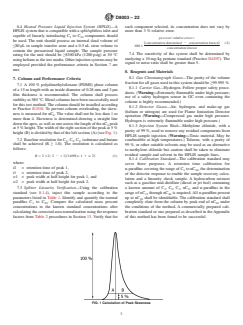
thickness is recommended. The column shall possess stability at 380 °C. Metal columns have been successfully used for this test
method. The column should be installed according to Practice E1510. To prevent column overloading, the skewness is measured
for nC . The value shall not be less than 1 or more than 4. Skewness is determined drawing a straight line down the apex, as well
as one across the length of the nC peak at 5 % height. The width of the right section of the peak at 5 % height (B) is divided by
that of the left section (A) (see Fig. 1).
7.2 Baseline resolution for C , C , C , isobutane and butane shall be achieved (R ≥ 1.0). The resolution is calculated as follows:
1 2 3
R 5 23~t 2 2 t 1!⁄1.699~w 1 1 w 2! (1)
where:
t2 = retention time of peak 1,
t1 = retention time of peak 2,
w1 = peak width at half height for peak 1, and
w2 = peak width at half height for peak 2.
7.3 Splitter Linearity Verification—Using the calibration standard (see 8.1.4), inject this sample according to the parameters listed
in Table 1. Identify and quantify the normal paraffins C to C . Compare the calculated mass %percent concentrations to the
1 24
known standard concentrations after calculating the corrected area normalization using the response factors from Table 2
procedures in Section 13. Verify that for each component selected, its concentration does not vary by more than 3 % relative error.
percent relative error5
concentration determined 2 concentration known
~ ! (2)
100 3
concentration known
7.4 The sensitivity of the system shall be determined by analyzing a 10 mg ⁄kg pentane standard (Practice D4307). The signal to
noise ratio shall be greater than 5.
8. Reagents and Materials
8.1 Gas Chromatograph Gases—The purity of the volume fraction for all gases used in this system should be ≥99.995 %.
8.1.1 Carrier Gas—Hydrogen. Follow proper safety procedures. (Warning—Extremely flammable under high pressure; use of a
safety hydrogen sensor in GC oven containing the column is highly recommended.)
FIG. 1 Calculation of Peak Skewness
D8003 − 22
A
TABLE 2 Component Properties and Theoretical Response Factors
Generalized Molecular Generalized Density of
Generalized Boiling
Molecular Weight of Density of Compound Weight of Cut Point Cut Point Fraction Theoretical Mass
Component Point of Cut Point
Compound (g/mol) @ 20 °C (g/mL) Fraction Interval Interval @ 20 °C Response Factor
Fraction Interval °C
(g/mol) (g/mL)
C 16.04 0.26 1.00
C 30.08 0.34 0.937
C 44.10 0.505 0.916
iC 58.12 0.557 0.906
n-C 58.12 0.5788 0.906
iC 72.15 0.6201 0.899
n-C 72.15 0.6262 0.899
n-C 86.18 0.6603 63.9 84 0.685 0.895
Benzene 78.12 0.8765 0.812
n-C 100.21 0.6837 91.9 96 0.722 0.892
n-C 114.22 0.7025 116.7 107 0.745 0.890
n-C 128.26 0.7176 142.2 121 0.764 0.888
n-C 142.28 0.73 165.8 134 0.778 0.887
n-C 156.32 0.7402 187.2 147 0.789 0.886
n-C 170.34 0.7487 208.3 161 0.800 0.885
n-C 184.37 0.7564 227.2 175 0.811 0.884
n-C 198.39 0.7628 246.4 190 0.822 0.883
n-C 212.41 0.7685 266 206 0.832 0.883
n-C 226.45 0.7733 283 222 0.839 0.882
n-C 240.48 0.778 300 237 0.847 0.882
n-C 254.51 0.782 313 251 0.852 0.881
n-C 268.53 0.7855 325 263 0.857 0.881
n-C 282.56 0.7886 338 275 0.862 0.881
n-C 296.59 0.7919 351 291 0.867 0.880
n-C 310.61 0.7944 363 305 0.872 0.880
n-C 324.67 0.7969 375 318 0.877 0.880
n-C 338.67 0.7991 386 331 0.881 0.880
Residue 540 500 0.925 0.88
A
Density and molecular weight values for C to benzene obtained from CRC Handbook of Chemistry and Physics, 61st ed, CRC Press, Boca Raton, FL, 1981.
Theoretical Mass response factors up to nC obtained from Test Method: CAN/CGSB-3.0 No. 14.3-99.
Generalized component properties of boiling point, molecular weight and density are averages and best estimates obtained from Katz, D. L., Firoozabadi, A., “Predicting
Phase Behavior of Condensate/Crude-Oil Systems Using Methane Interaction Coefficients, Society of Petroleum Engineers,” (SPE 6721), 1978.
Residue properties are estimates only and will vary for sample type.
8.1.2 Detector Gases—Air, hydrogen, and make-up gas (helium or nitrogen) are used for Flame Ionization Detector operation
(Warning—Compressed gas under high pressure. Hydrogen is extremely flammable under high pressure.)
8.1.3 Injection System Wash—Methylene chloride, with a purity of 99 %, used to remove any residual components from HPLIS
sample injection. (Warning—Toxic material. May be combustible at high temperatures.) Toluene, with a purity of 99 %, or other
suitable solvents may be used as an alternative to methylene chloride but caution shall be taken to eliminate residual sample and
solvent in the HPLIS sample lines.
8.1.4 Calibration Standard—The calibration standard may serve three purposes. A retention time calibration for n-paraffins
covering the range of C to nC , the determination of the detector response to enable the sample recovery calculation and a
1 24
linearity check sample. A hydrocarbon mixture such as a gasoline mid-distillate (diesel or jet fuel) containing a known amount of
C , C , C , nC , and n-paraffins in the range of nC through nC is required. All n-paraffins present up to nC shall be
1 2 3 5 17 24 24
identifiable. The calibration standard shall completely elute from the column by peak end of nC under the conditions of the
method. A commercially prepared calibration standard or one prepared as described in the Appendix of this method has been found
to be successful.
9. Preparation of Apparatus
9.1 Install the HPLIS system according to supplier procedures. The unit should have one of the sample chamber tubes connected
to an isolation (needle) valve to allow control and termination of sample flow during the ‘inject’ cycle. Attach ⁄16 in. SS tubing
to the remaining sample chamber tube. This will be attached to the sample cylinder. Install the appropriate column and check for
leaks. Set the gas chromatograph to the conditions stated in Table 1.
9.2 Baseline—Obtain a suitable blank baseline prior to any analysis or after any system change (Fig. A1.2). A blank run requires
actuation of the HPLIS without a sample injection. It may take several blanks to show a stable plateau at the highest temperature
of the oven with no indication of residual elution or of carryover. It should also not contain any ‘ghost’ peaks. Overlay the baseline
D8003 − 22
signal with the sample signal as shown in Fig. A1.2. Use only those sample signals that asymptotically approach the baseline
signals. Reject any sample run where the baseline signal at the end of the run exceeds in value the sample run.
10. Calibration
10.1 Calibration and performance criteria (Section 7) shall be performed whenever HPLIS valve or gas chrom
...