

ASTM D3838-23
(Test Method)Standard Test Method for pH of Activated Carbon
General Information
- Abstract
SIGNIFICANCE AND USE
4.1 When a fluid containing an adsorbate is passed through a bed of activated carbon, chemical reactions may take place between the activated carbon, its other noncarbonaceous constituents, and the adsorbate-containing fluid. The pH of the carbon may be a significant parameter of such a reaction and therefore may be an important characteristic of the carbon.
SCOPE
1.1 This test method covers determination of the pH of a water extract of activated carbon.
1.2 The values stated in SI units are to be regarded as standard. No other units of measurement are included in this standard.
1.3 This standard does not purport to address all of the safety concerns, if any, associated with its use. It is the responsibility of the user of this standard to establish appropriate safety, health, and environmental practices and determine the applicability of regulatory limitations prior to use. For specific hazard statements, see Section 6.
1.4 This international standard was developed in accordance with internationally recognized principles on standardization established in the Decision on Principles for the Development of International Standards, Guides and Recommendations issued by the World Trade Organization Technical Barriers to Trade (TBT) Committee.
- Status
- Published
- Publication Date
- 30-Nov-2023
- Technical Committee
- D28 - Activated Carbon
- Drafting Committee
- D28.02 - Liquid Phase Evaluation



Overview
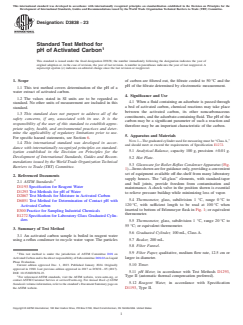
ASTM D3838-23: Standard Test Method for pH of Activated Carbon is an international standard developed by ASTM International. This document provides a reliable and consistent method for determining the pH of a water extract of activated carbon. Understanding the pH of activated carbon is essential, as it can significantly impact the chemical reactions that occur when the material interacts with fluid streams during adsorption processes. The test delivers vital quality control data for both manufacturers and users of activated carbon across various industries, helping ensure product performance and regulatory compliance.
Key Topics
- pH Determination: The standard describes how to measure the pH of an aqueous extract of activated carbon using electrometric methods, focusing on precise laboratory techniques and accurate reporting.
- Chemical Interaction: Highlights the importance of pH as a parameter that influences how activated carbon interacts chemically with fluids and adsorbates.
- Laboratory Apparatus: Outlines the use of specialized equipment, such as a boiler-reflux condenser, analytical balances, glassware, and pH meters, in accordance with referenced ASTM guidelines.
- Sampling and Safety: Emphasizes correct sampling methods, the responsibility for safety practices, and technical calibration procedures to ensure reliable and reproducible results.
- Reporting Requirements: Details stringent reporting criteria, including data on the source, type, and batch of carbon, as well as test conditions and personnel involved.
Applications
The ASTM D3838-23 test method is used extensively in sectors that rely on activated carbon for purification, filtration, and treatment processes. Typical practical applications include:
- Water Treatment and Filtration: Assessing activated carbon used in municipal and industrial water purification systems, where pH levels can impact adsorption capacity and contaminant removal efficiency.
- Air and Gas Purification: Evaluating the suitability of carbon materials in air filtration and gas treatment facilities, ensuring that the pH property aligns with process requirements.
- Food and Beverage Industry: Supporting quality control for activated carbon used in decolorization and purification in food and beverage manufacturing.
- Pharmaceutical Production: Helping ensure the pH characteristics of activated carbon meet specifications for pharmaceutical applications, where chemical stability and purity are critical.
- Environmental Compliance: Providing standardized testing for regulatory submissions and documentation, especially when pH is a critical parameter for environmental safety and product approval.
By following ASTM D3838-23, laboratories and manufacturers can guarantee that their activated carbon products exhibit consistent and expected pH properties, fostering confidence in end-use applications.
Related Standards
ASTM D3838-23 is part of a family of ASTM standards that support activated carbon analysis and laboratory practices:
- ASTM D1193 - Specification for Reagent Water: Ensures the purity of water used in laboratory testing.
- ASTM D1293 - Test Methods for pH of Water: Provides procedures for pH meter calibration and measurement.
- ASTM D2867 - Test Methods for Moisture in Activated Carbon: Offers methods to determine the moisture content of carbon samples.
- ASTM D6851 - Test Method for Determination of Contact pH with Activated Carbon: Complementary procedures focusing on direct contact pH measurement.
- ASTM E300 - Practice for Sampling Industrial Chemicals: Supplies guidance for representative sampling.
- ASTM E1272 - Specification for Laboratory Glass Graduated Cylinders: Specifies requirements for measuring instruments used during testing.
Adhering to ASTM D3838-23, alongside related standards, ensures thorough quality control, accurate reporting, and international acceptance of test results for activated carbon pH measurement.
Relations
- Effective Date
- 01-Dec-2023
- Effective Date
- 01-Dec-2023
- Referred By
ASTM D6851-20 - Standard Test Method for Determination of Contact pH with Activated Carbon - Effective Date
- 01-Dec-2023
- Effective Date
- 01-Dec-2023
Get Certified
Connect with accredited certification bodies for this standard

Element Materials Technology
Materials testing and product certification.

ABS Group Brazil
ABS Group certification services in Brazil.

ABS Quality Evaluations Inc.
American Bureau of Shipping quality certification.
Sponsored listings
Frequently Asked Questions
ASTM D3838-23 is a standard published by ASTM International. Its full title is "Standard Test Method for pH of Activated Carbon". This standard covers: SIGNIFICANCE AND USE 4.1 When a fluid containing an adsorbate is passed through a bed of activated carbon, chemical reactions may take place between the activated carbon, its other noncarbonaceous constituents, and the adsorbate-containing fluid. The pH of the carbon may be a significant parameter of such a reaction and therefore may be an important characteristic of the carbon. SCOPE 1.1 This test method covers determination of the pH of a water extract of activated carbon. 1.2 The values stated in SI units are to be regarded as standard. No other units of measurement are included in this standard. 1.3 This standard does not purport to address all of the safety concerns, if any, associated with its use. It is the responsibility of the user of this standard to establish appropriate safety, health, and environmental practices and determine the applicability of regulatory limitations prior to use. For specific hazard statements, see Section 6. 1.4 This international standard was developed in accordance with internationally recognized principles on standardization established in the Decision on Principles for the Development of International Standards, Guides and Recommendations issued by the World Trade Organization Technical Barriers to Trade (TBT) Committee.
SIGNIFICANCE AND USE 4.1 When a fluid containing an adsorbate is passed through a bed of activated carbon, chemical reactions may take place between the activated carbon, its other noncarbonaceous constituents, and the adsorbate-containing fluid. The pH of the carbon may be a significant parameter of such a reaction and therefore may be an important characteristic of the carbon. SCOPE 1.1 This test method covers determination of the pH of a water extract of activated carbon. 1.2 The values stated in SI units are to be regarded as standard. No other units of measurement are included in this standard. 1.3 This standard does not purport to address all of the safety concerns, if any, associated with its use. It is the responsibility of the user of this standard to establish appropriate safety, health, and environmental practices and determine the applicability of regulatory limitations prior to use. For specific hazard statements, see Section 6. 1.4 This international standard was developed in accordance with internationally recognized principles on standardization established in the Decision on Principles for the Development of International Standards, Guides and Recommendations issued by the World Trade Organization Technical Barriers to Trade (TBT) Committee.
ASTM D3838-23 is classified under the following ICS (International Classification for Standards) categories: 75.160.10 - Solid fuels. The ICS classification helps identify the subject area and facilitates finding related standards.
ASTM D3838-23 has the following relationships with other standards: It is inter standard links to ASTM D3838-05(2017), ASTM D5029-98(2020), ASTM D6851-20, ASTM D4069-95(2020). Understanding these relationships helps ensure you are using the most current and applicable version of the standard.
ASTM D3838-23 is available in PDF format for immediate download after purchase. The document can be added to your cart and obtained through the secure checkout process. Digital delivery ensures instant access to the complete standard document.
Standards Content (Sample)
This international standard was developed in accordance with internationally recognized principles on standardization established in the Decision on Principles for the
Development of International Standards, Guides and Recommendations issued by the World Trade Organization Technical Barriers to Trade (TBT) Committee.
Designation: D3838 − 23
Standard Test Method for
pH of Activated Carbon
This standard is issued under the fixed designation D3838; the number immediately following the designation indicates the year of
original adoption or, in the case of revision, the year of last revision. A number in parentheses indicates the year of last reapproval. A
superscript epsilon (´) indicates an editorial change since the last revision or reapproval.
1. Scope of carbon are filtered out, the filtrate cooled to 50 °C and the
pH of the filtrate determined by electrometic measurement.
1.1 This test method covers determination of the pH of a
water extract of activated carbon.
4. Significance and Use
1.2 The values stated in SI units are to be regarded as
4.1 When a fluid containing an adsorbate is passed through
standard. No other units of measurement are included in this
a bed of activated carbon, chemical reactions may take place
standard.
between the activated carbon, its other noncarbonaceous
1.3 This standard does not purport to address all of the
constituents, and the adsorbate-containing fluid. The pH of the
safety concerns, if any, associated with its use. It is the
carbon may be a significant parameter of such a reaction and
responsibility of the user of this standard to establish appro-
therefore may be an important characteristic of the carbon.
priate safety, health, and environmental practices and deter-
mine the applicability of regulatory limitations prior to use.
5. Apparatus and Materials
For specific hazard statements, see Section 6.
NOTE 1—The graduated cylinder used for measuring must be “Class A,”
1.4 This international standard was developed in accor-
and should meet or exceed the requirements of Specification E1272.
dance with internationally recognized principles on standard-
5.1 Analytical Balance, capacity 100 g, precision 60.01 g.
ization established in the Decision on Principles for the
Development of International Standards, Guides and Recom-
5.2 Hot Plate.
mendations issued by the World Trade Organization Technical
5.3 Glassware for Boiler-Reflux Condenser Apparatus (Fig.
Barriers to Trade (TBT) Committee.
1)—Items shown are for guidance only, providing a convenient
set of equipment available off-the-shelf from many laboratory
2. Referenced Documents
supply houses. The “all-glass” elements, with standard-taper
2.1 ASTM Standards:
and ball joints, provide freedom from contamination and
D1193 Specification for Reagent Water
maintenance. A check valve in the position shown is essential
D1293 Test Methods for pH of Water
to relieve pressure buildup while minimizing loss of vapor.
D2867 Test Methods for Moisture in Activated Carbon
5.4 Thermometer, glass, subdivision 1 °C, range 0 °C to
D6851 Test Method for Determination of Contact pH with
120 °C, with sufficient length to be read at 100 °C when
Activated Carbon
inserted to bottom of Erlenmeyer flask in Fig. 1; or equivalent
E300 Practice for Sampling Industrial Chemicals
thermometer.
E1272 Specification for Laboratory Glass Graduated Cylin-
ders
5.5 Thermometer, glass, subdivision 1 °C, range 20 °C to
55 °C; or equivalent thermometer.
3. Summary of Test Method
5.6 Graduated Cylinder, 100 mL, Class A.
3.1 An activated carbon sample is boiled in reagent water
5.7 Beaker, 200 mL.
using a reflux condenser to recycle water vapor. The particles
5.8 Filter Funnel.
1 5.9 Filter Paper, qualitative, medium flow rate, 12.5 cm or
This test method is under the jurisdiction of ASTM Committee D28 on
Activated Carbon and is the direct responsibility of Subcommittee D28.02 on Liquid larger in diameter.
Phase Evaluation.
5.10 Timer.
Current edition approved Dec. 1, 2023. Published January 2024. Originally
approved in 1980. Last previous edition approved in 2017 as D3838 – 05 (2017).
5.11 pH Meter, in accordance with Test Methods D1293,
DOI: 10.1520/D3838-23.
Type II (automatic thermal compensation preferred).
For referenced ASTM standards, visit the ASTM website, www.astm.org, or
contact ASTM Customer Service at service@astm.org. For Annual Book of ASTM
5.12 Reagent Water, in accordance with Specification
Standards volume information, refer to the standard’s Document Summary page on
the ASTM website. D1193, Type II.
Copyright © ASTM International, 100 Barr Harbor Drive, PO Box C700, West Conshohocken, PA 19428-2959. United States
D3838 − 23
9.4 Bring water in flask to a boil, using thermometer reading
to assure that no false boiling
...
This document is not an ASTM standard and is intended only to provide the user of an ASTM standard an indication of what changes have been made to the previous version. Because
it may not be technically possible to adequately depict all changes accurately, ASTM recommends that users consult prior editions as appropriate. In all cases only the current version
of the standard as published by ASTM is to be considered the official document.
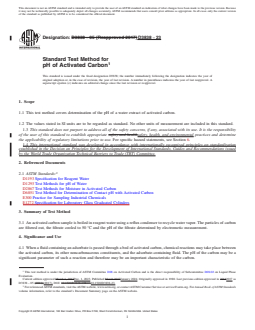
Designation: D3838 − 05 (Reapproved 2017) D3838 − 23
Standard Test Method for
pH of Activated Carbon
This standard is issued under the fixed designation D3838; the number immediately following the designation indicates the year of
original adoption or, in the case of revision, the year of last revision. A number in parentheses indicates the year of last reapproval. A
superscript epsilon (´) indicates an editorial change since the last revision or reapproval.
1. Scope
1.1 This test method covers determination of the pH of a water extract of activated carbon.
1.2 The values stated in SI units are to be regarded as standard. No other units of measurement are included in this standard.
1.3 This standard does not purport to address all of the safety concerns, if any, associated with its use. It is the responsibility
of the user of this standard to establish appropriate safety and healthsafety, health, and environmental practices and determine
the applicability of regulatory limitations prior to use. For specific hazard statements, see Section 6.
1.4 This international standard was developed in accordance with internationally recognized principles on standardization
established in the Decision on Principles for the Development of International Standards, Guides and Recommendations issued
by the World Trade Organization Technical Barriers to Trade (TBT) Committee.
2. Referenced Documents
2.1 ASTM Standards:
D1193 Specification for Reagent Water
D1293 Test Methods for pH of Water
D2867 Test Methods for Moisture in Activated Carbon
D6851 Test Method for Determination of Contact pH with Activated Carbon
E300 Practice for Sampling Industrial Chemicals
E1272 Specification for Laboratory Glass Graduated Cylinders
3. Summary of Test Method
3.1 An activated carbon sample is boiled in reagent water using a reflux condenser to recycle water vapor. The particles of carbon
are filtered out, the filtrate cooled to 50 °C and the pH of the filtrate determined by electrometic measurement.
4. Significance and Use
4.1 When a fluid containing an adsorbate is passed through a bed of activated carbon, chemical reactions may take place between
the activated carbon, its other noncarbonaceous constituents, and the adsorbate-containing fluid. The pH of the carbon may be a
significant parameter of such a reaction and therefore may be an important characteristic of the carbon.
This test method is under the jurisdiction of ASTM Committee D28 on Activated Carbon and is the direct responsibility of Subcommittee D28.02 on Liquid Phase
Evaluation.
Current edition approved March 1, 2017Dec. 1, 2023. Published March 2017January 2024. Originally approved in 1980. Last previous edition approved in 20112017 as
D3838 – 05 (2011).(2017). DOI: 10.1520/D3838-05R17.10.1520/D3838-23.
For referenced ASTM standards, visit the ASTM website, www.astm.org, or contact ASTM Customer Service at service@astm.org. For Annual Book of ASTM Standards
volume information, refer to the standard’s Document Summary page on the ASTM website.
Copyright © ASTM International, 100 Barr Harbor Drive, PO Box C700, West Conshohocken, PA 19428-2959. United States
D3838 − 23
5. Apparatus and Materials
NOTE 1—The graduated cylinder used for measuring must be “Class A,” and should meet or exceed the requirements of Specification E1272.
5.1 Analytical Balance, capacity 100 g, precision 6 0.01 60.01 g.
5.2 Hot Plate.
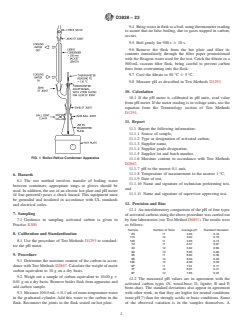
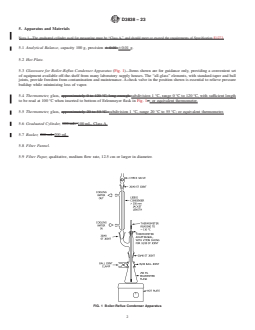
5.3 Glassware for Boiler-Reflux Condenser Apparatus (Fig. 1)—Items shown are for guidance only, providing a convenient set
of equipment available off-the-shelf from many laboratory supply houses. The “all-glass” elements, with standard-taper and ball
joints, provide freedom from contamination and maintenance. A check valve in the position shown is essential to relieve pressure
buildup while minimizing loss of vapor.
5.4 Thermometer, glass, approximately 0 to 120 °C, long enough subdivision 1 °C, range 0 °C to 120 °C, with sufficient length
to be read at 100 °C when inserted to bottom of Erlenmeyer flask in Fig. 1. ; or equivalent thermometer.
5.5 Thermometer, glass, approximately 20 to 55 °C. subdivision 1 °C, range 20 °C to 55 °C; or equivalent thermometer.
5.6 Graduated Cylinder, 100-mL. 100 mL, Class A.
5.7 Beaker, 200-mL.200 mL.
5.8 Filter Funnel.
5.9 Filter Paper, qualitative, medium flow rate, 12.5 cm or larger in diameter.
FIG. 1 Boiler-Reflux Condenser Apparatus
D3838 − 23
5.10 Timer.
5.11 pH Meter, in accordance with Test Methods D1293, Type II (automatic thermal compensation preferred).
5.12 Reagent Water, in
...